Cost-Benefit of 5-Ton Overhead Cranes in Packaging Plants
Content Quick Link
Most Important Takeaway:
Investing in a 5-ton overhead crane can dramatically improve packaging plant operations by reducing labor costs, minimizing product damage, and increasing material handling efficiency—yielding a clear ROI within a short period.
Key Takeaways:
- A 5-ton overhead crane reduces manual handling and speeds up product movement.
- Single girder cranes are cost-effective for light-duty packaging operations, while double girder cranes are ideal for high-volume or heavy-duty workflows.
- Proper crane selection enhances plant efficiency, reduces product damage, and supports safety compliance.
- Calculating ROI involves comparing investment costs (purchase, installation, maintenance) against labor savings, reduced product loss, and improved throughput.
Why 5-Ton Overhead Cranes Are Critical for Packaging Plants
In packaging plants, material handling efficiency directly impacts productivity, product safety, and labor costs. A 5-ton overhead crane allows operators to move heavy pallets, cartons, or bulk products with precision and minimal effort. For facilities handling high-volume packaging lines, fragile goods, or frequent lifting cycles, investing in the right crane can transform operations.
Choosing Between Single Girder and Double Girder Cranes
When selecting a 5-ton overhead crane for a packaging plant, it's essential to consider the facility layout, the type of products handled, and the frequency of lifts. Single girder and double girder cranes each have their ideal applications, and understanding these differences helps packaging plant managers make informed decisions. Let's take a closer look at single girder cranes.
Single Girder Overhead Cranes
When selecting a 5-ton overhead crane for a packaging plant, it's essential to consider the facility layout, the type of products handled, and the frequency of lifts. Single girder and double girder cranes each have their ideal applications, and understanding these differences helps packaging plant managers make informed decisions. Let's take a closer look at single girder cranes.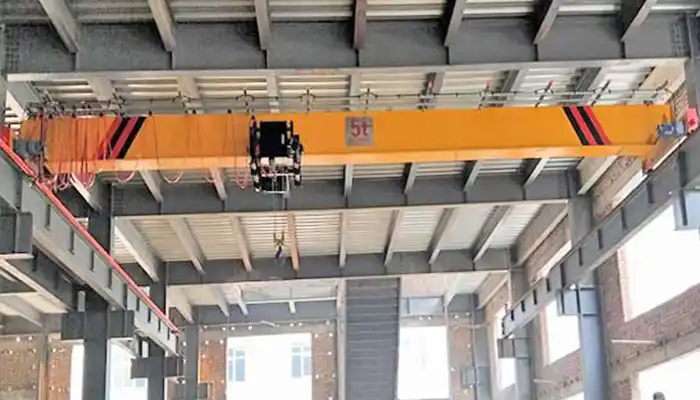
5 ton overhead crane single girder
Single Girder Overhead Crane Overview in Packaging Plants
Single girder cranes are often chosen for small to medium packaging plants where loads are moderate and lifting is frequent but not excessively heavy. They are practical for moving pallets, cartons, and light bulk products across workstations or conveyor lines. These cranes improve workflow efficiency without requiring major structural modifications to the facility.
Best For
Small to medium-sized packaging plants where product loads are light to moderate. They work well in areas with frequent lifting but relatively low weight, such as palletizing stations or packaging lines.
Typical Crane Designs and Configurations
Single girder cranes are usually designed to maximize space efficiency while keeping installation simple. Common designs include:
- Standard single girder bridge with a hoist running on the bottom flange of the beam.
- Underslung (underhung) designs for facilities with low ceiling heights.
- Compact layouts for narrow aisles or smaller workstations, which reduce interference with other operations.
Typical Functions and Applications
In packaging plants, single girder cranes serve multiple purposes. They are not just lifting machines—they are an integral part of the material handling process, helping move products safely and efficiently:
- Lifting and transferring cartons, boxes, and pallets between conveyors or stations.
- Loading and unloading products from trucks or storage racks.
- Positioning semi-finished products or equipment for maintenance or line adjustments.
- Handling lightweight bulk packaging materials within the workshop.
Typical Loads Handled and Load Features
Understanding the type of loads is critical to ensure the crane matches your operational needs. Single girder cranes are designed for moderate weights and generally stable loads:
- Weight range: typically 1 to 5 tons per lift.
- Load types: palletized goods, carton stacks, crates, and lightweight machinery components.
- Load characteristics: mostly uniform and stable, occasionally irregular but not excessively heavy or unbalanced.
- Lift frequency: moderate to high, depending on the production schedule.
Typical Workshop or Facility
These cranes are commonly found in compact packaging facilities where headroom may be limited but workflow efficiency is a priority:
- Small to medium packaging plants with spans up to 20 meters.
- Facilities with low ceilings or restricted floor space.
- Areas requiring frequent moderate lifting without disrupting other operations.
- Workspaces needing cost-effective solutions that integrate easily with conveyor lines and packaging machinery.
Advantages
When used appropriately, single girder cranes provide an efficient and cost-conscious solution for packaging plants:
- Lower initial cost compared to double girder cranes, making them budget-friendly.
- Easier installation and simpler maintenance due to lighter design.
- Compact design saves headroom, leaving space for other equipment and operations.
Limitations
Single girder cranes are not ideal for every packaging facility, particularly those with high-volume or heavy lifting demands:
- Reduced lifespan under heavy or continuous use.
- Lower lifting speed and shorter spans compared to double girder models, limiting efficiency in larger facilities.
Double Girder Overhead Cranes
Double girder overhead cranes are built for packaging plants where lifting demands are high and operations run continuously. These cranes are stronger and more stable than single girder designs, making them ideal for facilities that move heavy pallets, bulk materials, or large equipment across long spans. They are commonly found in high-volume production lines where reliability and efficiency are crucial.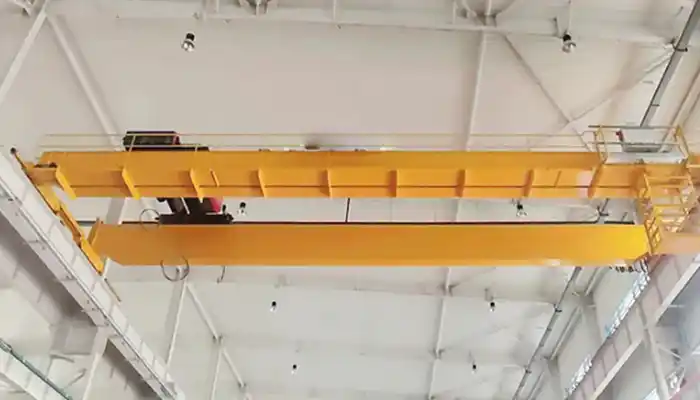
5 ton overhead crane double girder design
Best For
For packaging plants handling frequent or heavy lifting, double girder cranes are usually the better choice. They are designed to handle repeated lifts of large pallets or bulk products without slowing down operations. If your plant has long work areas or multiple production lines, these cranes ensure smooth and consistent material handling.
- High-Volume Packaging Operations: Suitable for facilities with heavy, continuous lifting. Perfect for moving large pallets, crates, or bulk items regularly without compromising safety.
Advantages
Double girder cranes offer several benefits that make them well-suited for busy packaging operations:
- Supports Longer Spans and Higher Lifting Capacity: The two-girder design distributes weight effectively, enabling cranes to cover wide areas and lift heavier loads with ease.
- More Stable and Durable: Can operate continuously in demanding environments without excessive wear, reducing downtime.
- Handles Heavier Pallets and Bulk Materials Efficiently: Ideal for shipping zones, storage racks, or bulk material handling.
Considerations
While double girder cranes are powerful, there are a few practical considerations for packaging plants:
- Higher Purchase and Installation Cost: Requires a larger initial investment, installation may take more time, and stronger structural support is needed.
- Slightly More Complex Maintenance: Regular inspections are essential; some maintenance tasks may require trained technicians or specialized tools.
Double Girder Cranes Overview in Packaging Plants
In high-volume packaging operations, double girder cranes are installed over long work areas, palletizing lines, or shipping bays. They are designed for frequent and heavy lifts, ensuring consistent workflow without interruptions. These cranes are especially valuable in plants handling bulk cartons, large pallets, or semi-finished goods.
Typical Crane Designs and Configurations
Double girder cranes come in several practical configurations to fit packaging plant needs:
- Bridge-Type Double Girder with Top-Running Hoist: Provides maximum stability and load control.
- Heavy-Duty Configuration for Long Spans: Designed to cover areas exceeding 20 meters, ideal for large facilities.
- Reinforced Rails and Trolleys: Ensures durability under frequent or heavy use.
Typical Functions and Applications
Double girder cranes play multiple roles in material handling, moving products efficiently while reducing manual labor:
- Moving Large Pallets and Bulk Materials: Supports heavy items across the production floor efficiently.
- Loading and Unloading Trucks or Storage Areas: Speeds up material transfer and reduces handling time.
- Positioning Heavy Machinery or Equipment: Helps rearrange production lines or handle maintenance tasks.
- Supporting Multiple Production Zones: Can serve several areas without needing multiple cranes.
Typical Loads Handled and Load Features
Double girder cranes are built for heavier loads and larger packaging items:
- Weight Range: Typically 3 to 5 tons per lift, sometimes more depending on design.
- Load Types: Large pallets, bulk cartons, crates, semi-finished products, and heavy packaging machinery.
- Load Characteristics: Mostly stable but can be irregular in shape; heavier or stacked loads.
- Lift Frequency: High, with multiple lifts per hour in continuous production lines.
Typical Workshop or Facility
Double girder cranes are ideal for medium-to-large packaging plants where space, durability, and workflow efficiency are important:
- Medium to Large Packaging Plants: Especially those with long spans and multiple production lines.
- Facilities Handling Bulk Materials or High-Volume Products: For shipping, storage, and high-throughput operations.
- Areas Where Durability and Heavy Lifting Are Needed: Ensures continuous operation without downtime or frequent maintenance.
Related Keywords and Phrases
- double girder overhead crane for packaging plant
- heavy-duty crane for packaging lines
- 5 ton double girder crane packaging facility
- packaging plant material handling equipment
Cost Components of 5-Ton Overhead Cranes in Packaging Plants
Investing in a 5-ton overhead crane is more than just buying equipment. To understand the true cost, packaging plant managers should consider all components—from purchase and installation to ongoing maintenance and operations. Each cost element affects your total investment and the eventual ROI.
Purchase Costs
The initial purchase is the most obvious expense, but choosing between single girder and double girder designs can have a big impact on your budget.
Single girder cranes are typically more affordable and fit smaller to medium packaging plants. Double girder cranes cost more upfront but are ideal for high-volume operations, offering higher lifting capacity, longer spans, and increased durability. When deciding, it's important to weigh the upfront savings against long-term operational needs.
Key Point: Single girder = lower upfront cost; Double girder = higher capacity and durability.
Installation Costs
Installation involves more than just placing the crane on the runway. Proper setup ensures safety, minimizes production disruption, and guarantees smooth operation.
Consider the following:
- Crane Runway & Structural Setup: Depending on your facility, you may need reinforced beams or supports to handle the crane load safely.
- Electrical Setup: The crane requires proper wiring and power supply connection to operate efficiently.
- Workflow Considerations: Experienced installers plan the setup to minimize downtime and avoid disrupting active packaging lines.
Tip: Installation costs vary based on plant layout and crane type—double girder cranes usually require more work and time.
Maintenance & Inspection Costs
Regular maintenance is essential to keep the crane running safely and efficiently. A neglected crane can lead to downtime, product damage, and higher repair costs.
- Scheduled Inspections: Check hoists, trolleys, motors, and safety devices according to the crane's usage intensity.
- Routine Maintenance: Includes lubrication, minor repairs, and component replacements as needed.
Best Practice: High-frequency operations require more frequent inspections to ensure reliability.
Operational Costs
Beyond purchase and maintenance, cranes have ongoing operational costs that should be included in your budgeting.
- Energy Consumption: Electricity for hoists and travel motors.
- Operator Training: Ensures safe and efficient crane operation.
- Minor Repairs: Small fixes over time prevent larger, costlier problems.
Bottom Line: Operational costs are usually manageable but should be included in ROI calculations.
Benefits for Packaging Plant Operations
A 5-ton overhead crane is not installed just to lift heavier loads. In a packaging plant, its real value shows up in daily operations—less manual work, fewer damaged products, and smoother material flow across packaging lines. These benefits are measurable and directly tied to operating costs and output stability.
Labor Savings
Packaging plants rely heavily on repetitive material movement. Without overhead cranes, much of this work is done manually or with forklifts, which consumes time and labor. A 5-ton overhead crane changes how materials move inside the plant.
By reducing manual lifting and repositioning, operators can focus on packaging tasks instead of handling loads. Loading and unloading pallets becomes quicker and more controlled, especially in tight spaces where forklifts are less efficient. Over time, plants often notice fewer labor hours per shift allocated to internal material handling.
Practical impacts include:
- Reduced manual lifting of pallets, cartons, and bulk packaging materials
- Faster loading and unloading at packaging lines and storage areas
- Less dependence on forklifts, trolleys, and manual transport
This directly lowers labor costs and reduces fatigue-related safety risks.
Reduced Product Damage
Product damage is a hidden cost in many packaging plants. Boxes get crushed, cartons fall, and goods are sometimes mishandled during manual or forklift-based transport. Overhead cranes offer controlled, vertical lifting that reduces these risks.
With proper lifting tools and stable movement, products are handled more gently. This matters most for pre-packaged goods, stacked cartons, and high-value or fragile products where small damage can lead to rejection or rework.
Key benefits in daily operations:
- Lower risk of dropping or crushing packaged goods
- Better protection for delicate or high-value products
- More consistent product quality reaching storage or shipping
Reducing product loss improves margins and supports quality control standards.
Improved Efficiency and Workflow
In packaging plants, bottlenecks often happen between processes rather than at the machines themselves. A well-positioned 5-ton overhead crane helps materials flow smoothly between packaging lines, palletizing areas, and storage zones.
During peak production periods, cranes prevent congestion by moving loads quickly and predictably. They also offer flexibility. When product sizes, packaging formats, or line layouts change, the crane adapts without major disruption.
Operational improvements typically include:
- Smoother flow across packaging lines
- Fewer delays during high-output or peak production shifts
- Flexible handling of different product types and packaging configurations
This improves overall packaging line efficiency and helps maintain steady output.
Calculating ROI for Packaging Plants
Return on investment is one of the first questions packaging plant managers ask before approving a crane purchase. A 5-ton overhead crane is not a short-term expense; it is an operational investment. The key is to look beyond the purchase price and focus on how the crane changes daily costs, output, and losses over time.
Rather than using complex formulas, most packaging plants calculate ROI by breaking it into a few practical steps.
Step 1: Estimate Labor Cost Savings
Start by reviewing how materials are currently moved inside the plant. In many packaging facilities, pallets and cartons are still handled manually or with forklifts. This requires multiple operators and consumes a significant amount of time per shift.
A 5-ton overhead crane reduces the number of workers involved in each lift and shortens handling time. Faster movement between packaging lines, palletizing areas, and storage zones translates directly into labor savings.
What to calculate:
- Labor hours saved per shift
- Reduced need for manual handling crews
- Annual labor cost reduction based on current wages
Even small time savings per lift add up quickly over months of operation.
Step 2: Quantify Reduced Product Damage and Loss
Product damage is often underestimated because it is spread across many small incidents. Crushed boxes, dropped cartons, and damaged packaged goods all contribute to loss.
Overhead cranes provide stable, vertical lifting and precise positioning. This reduces sudden impacts and uncontrolled movement, especially for stacked or fragile packages.
What to calculate:
- Annual cost of damaged or rejected products
- Reduction in damage after switching to crane-based handling
- Savings from improved quality consistency
Many packaging plants recover a noticeable portion of crane costs simply by cutting product loss.
Step 3: Factor in Throughput and Workflow Improvements
A crane does more than move loads; it keeps production flowing. By removing handling delays, packaging lines operate more smoothly. During peak production periods, cranes help avoid congestion and missed output targets.
Improved throughput does not always mean increasing line speed. In many cases, it means fewer interruptions and better coordination between processes.
What to consider:
- Reduced downtime between production stages
- Improved loading and unloading speed
- Better use of existing packaging equipment
These gains support consistent output without expanding labor or floor space.
Step 4: Compare Savings Against Total Investment
Once savings are identified, compare them to the full cost of the crane. This includes more than just the purchase price.
Total investment should include:
- Crane purchase cost (single or double girder)
- Installation and electrical setup
- Maintenance and inspection expenses
The goal is not to recover costs immediately, but to understand how quickly the crane pays for itself through operational savings.
Practical ROI Example
In a medium-sized packaging plant, installing a 5-ton single girder overhead crane often leads to measurable improvements. Many plants report a 20–30% reduction in manual handling labor, along with fewer damaged goods during internal transport.
If product damage is reduced by around $10,000 per year, and labor savings continue month after month, the total investment is commonly recovered within 2 to 3 years. From that point on, the crane continues to deliver savings throughout its service life.
Practical Recommendations for Packaging Plant Buyers
Choosing a 5-ton overhead crane is not only about current needs. Packaging plants operate in changing environments where product types, output volume, and layouts evolve over time. The following recommendations focus on practical decision-making that helps buyers avoid under- or over-investing.
Match Crane Type to Actual Operating Conditions
The first step is being honest about how the crane will be used on a daily basis. Overestimating capacity increases cost, while underestimating usage leads to early wear and lost efficiency.
Single Girder Cranes
Single girder overhead cranes are best suited for packaging plants with light-duty loads and low to moderate lifting frequency. If the crane is mainly used to move cartons, pallets, or packaging materials a few times per hour, a single girder design offers adequate performance at a lower cost.
Double Girder Cranes
Double girder cranes are better for high-volume operations where lifting is frequent and loads are close to the rated capacity. They are also recommended for plants with long spans, wide workshops, or bulk packaging areas where stability and durability matter more than initial price.
Prioritize Safety Standards and Compliance
Safety should never be treated as an optional feature. Packaging plants often operate with high staff density, and unsafe equipment increases operational risk.
Before purchasing, confirm that the crane complies with CE, ISO, and relevant local standards. Proper safety certification protects workers, ensures compliance during inspections, and reduces liability for the plant owner.
Evaluate Supplier Support, Not Just Equipment Price
A crane is a long-term asset. The quality of after-sales support affects uptime more than many buyers expect.
Look for suppliers who can provide:
- Clear maintenance guidelines
- Readily available spare parts
- Technical support for inspections, troubleshooting, and repairs
Reliable support reduces downtime and prevents small issues from becoming production-stopping failures.
Plan for Future Expansion and Workflow Changes
Packaging plants often grow or change product formats over time. A crane that barely meets today's needs may limit flexibility tomorrow.
When reviewing specifications, consider:
- Potential increases in load size or weight
- Additional packaging lines or storage areas
- Changes in layout requiring longer travel distances
Selecting a crane with reasonable reserve capacity helps protect the investment and avoids early replacement.
Conclusion: Making a Practical Investment Decision for Packaging Plants
A 5-ton overhead crane is not something a packaging plant buys on impulse. It affects how materials move every day, how many people are needed on the floor, and how much product loss quietly adds up over time. When evaluated properly, it becomes a tool for control and consistency rather than just a lifting device.
Focus on Real Operating Needs, Not Just Rated Capacity
The first practical lesson is simple: not all packaging plants operate the same way. Some move pallets a few times per hour. Others lift continuously across multiple lines and long spans.
Choosing between a single girder and a double girder crane should be based on actual usage, not assumptions.
- Single girder cranes make sense for light-duty, low-frequency operations with moderate spans
- Double girder cranes are better suited for high-volume plants, heavier pallet loads, and wider workshops
- Overspecifying increases cost without benefit, while underspecifying leads to wear and disruption
When crane design matches real workload, performance is steady and predictable.
Look at Total Cost, Not Just the Purchase Price
The purchase price often gets the most attention, but it is only part of the picture. What matters more is how the crane performs over years of daily use.
Practical buyers evaluate:
- Purchase and installation costs
- Maintenance and inspection requirements
- Energy use and operator training
- Downtime risk if the crane is unavailable
A crane that costs less upfront but struggles under load can end up costing more over time.
ROI Comes from Daily Savings, Not Theoretical Calculations
In packaging plants, return on investment usually shows up quietly. Fewer operators needed for lifting. Less product damaged during internal transport. Fewer delays between packaging, palletizing, and storage.
Most plants see ROI through:
- Reduced manual handling labor
- Lower product damage and rework
- More stable workflow during peak production
- Better use of existing floor space and equipment
These savings accumulate month by month and are easier to justify than complex financial models.
Plan for Growth, Not Just Today's Layout
Packaging lines change. Product sizes vary. Output increases. A crane installed today should still work well two or three years from now.
When making the final decision, buyers should consider:
- Potential increases in load size or weight
- Additional packaging lines or storage zones
- Changes in layout that affect span or travel distance
A small margin of flexibility protects the investment and avoids early replacement.
Final Buyer Takeaway
For packaging plants, a 5-ton overhead crane is a practical, long-term investment when chosen with clear operational logic. Matching crane type to workload, understanding full ownership cost, and focusing on real daily savings allow managers to make decisions that hold up under scrutiny.
FAQs: 5-Ton Overhead Cranes for Packaging Plants
This section addresses the most common, practical questions raised by packaging plant managers, engineers, and procurement teams when evaluating a 5-ton overhead crane. The answers focus on real operating conditions, not theory.
Which type of 5-ton crane is suitable for my packaging plant?
The right crane depends on how your plant actually runs day to day.
In most packaging plants, a 5-ton single girder overhead crane is sufficient. It works well for handling palletized goods, packaging machinery components, molds, and finished products. Single girder cranes are lighter, cost less, and place lower loads on the building structure, which makes them suitable for standard warehouses and workshops.
A 5-ton double girder overhead crane becomes a better choice when the plant has longer spans, higher lifting heights, or frequent daily lifting cycles. If your crane runs across multiple production lines or lifts close to full capacity throughout the day, the added stability and duty rating of a double girder design can be justified.
Quick guidance:
- Single girder: light-duty, moderate usage, tighter budgets
- Double girder: high frequency, wider workshops, future expansion plans
How can a 5-ton overhead crane help reduce labor costs and product damage?
Manual handling and forklifts often create hidden costs in packaging plants. These include damaged cartons, crushed pallets, rework, and operator fatigue.
An overhead crane provides controlled vertical lifting and precise positioning. Loads are lifted straight up, moved smoothly, and lowered exactly where needed. That consistency reduces drops, collisions, and stacking errors.
From a labor perspective:
- One trained crane operator can replace multiple manual handling tasks
- Less dependency on forklifts in congested areas
- Faster movement between packaging, storage, and dispatch zones
Over time, plants usually see fewer damaged goods, fewer workplace injuries, and more predictable handling workflows.
What is the expected ROI from installing a 5-ton overhead crane?
Return on investment varies by plant size and operating intensity, but the pattern is usually similar.
Most packaging plants recover their crane investment within 12 to 36 months. The ROI mainly comes from:
- Reduced labor requirements
- Lower product damage and scrap rates
- Shorter handling time per batch
- Improved production flow and uptime
Plants running multiple shifts or handling heavier pallet loads tend to reach payback faster. Even low-frequency users benefit in the long term through safer operations and better layout efficiency.
How do installation and operating costs affect the total investment?
The crane purchase price is only one part of the total cost.
Installation costs depend heavily on your building:
- Existing runway beams reduce cost and installation time
- New runway columns or structural reinforcement increase upfront expense
- Electrical setup and power supply readiness also matter
Operating costs are generally stable and predictable:
- Electricity consumption for a 5-ton crane is modest
- Scheduled inspections help prevent breakdowns
- Routine maintenance mainly involves wire ropes, brakes, and limit switches
Planning these costs early helps avoid surprises and allows a more accurate comparison between suppliers.
Summary Advice for Packaging Plant Buyers
If you are evaluating a 5-ton overhead crane for a packaging plant, reviewing these questions against your actual workflow, load types, and building conditions will lead to a safer and more cost-effective decision.

Article by Bella ,who has been in the hoist and crane field since 2016. Bella provides overhead crane & gantry crane consultation services for clients who need a customized overhead travelling crane solution.Contact her to get free consultation.
Free consultation to Confirm Parameters & Specifications and Get
Latest Crane Price & Crane Rate.
- Types of overhead cranes : _______?
- Optional: Overhead travelling crane, goliath gantry crane,Slewing jib crane, Single girder or double girder crane,small portable crane or kbk crane, etc.
- Capacity of overhead crane: _______?
- Optional: 0.25ton, 0.5 ton, 1 ton, 2 ton, 3ton, 5 ton, 10 ton,15ton, 20ton, 25 ton, 30ton,35ton, up to 550ton, etc.
- Crane span & lifting height : _______?
- Crane travelling length : _____?
- Control of overhead crane:_______?
- Optional: pendant/ remote/cabin control
- Voltage supply of overhead crane:_____?
- Eg,: 380V50/60HZ,3Phase or others,etc.
- Application/usage of crane:_______?
- Eg,: Steel mill, ,injection mold, cement,stone, concrete,granite, general manufacturing, etc.
Just leave a message via the contact form and our hoist and crane engineer will contact you with in 24working hours.
Get In Touch