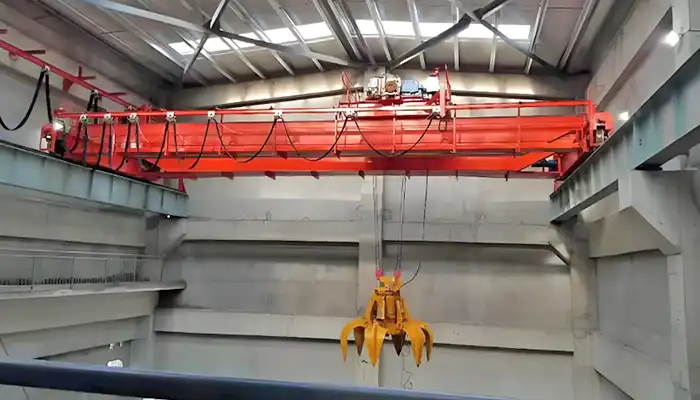
How Crane Type Affects Scrap Grab Bucket Selection
menu_open
Content Quick Link
How Crane Type Influences Your Choice of Scrap Handling Grab Bucket
Introduction
Understanding How Gantry, Overhead, and Jib Cranes Affect Grab Design and Selection
When it comes to handling scrap materials, there’s more to it than just picking a strong crane or a tough grab. The crane type you’re working with—whether it’s a gantry crane out in the yard, an overhead crane in your workshop, or a jib crane by a sorting line—can completely change which grab bucket will work best for you.
A grab bucket isn’t a one-size-fits-all tool. It has to match not just the material, but the motion and limits of the crane it’s hanging from. If it doesn’t? You might end up with a grab that doesn’t open properly, a motor that wears out too quickly, or even worse—downtime from mechanical failure. And no one wants that in a busy scrap yard.
Why This Matters for Scrap Handlers
Choosing the wrong grab for your crane setup leads to more than just poor performance. It can impact your day-to-day work and even your bottom line. Here’s what’s at risk:
- Wasted energy – A heavy grab on a light crane will force the system to work harder than needed.
- Inefficient material handling – If the grab can’t rotate or reach properly, you’ll spend more time trying to get it in position.
- Faster wear and tear – Incompatible systems cause parts to fail faster—cables, motors, seals, and even the grab teeth.
- Safety issues – A mismatched grab might swing too far, open at the wrong time, or jam when full of scrap.
So, before you look at grab size or type, take a good look at the crane it’s going on. That’s where the real selection process begins.
Overview of Common Overhead Crane Types Used in Scrap Handling
Before picking a grab bucket, it's worth understanding how different crane types are commonly used in scrap handling. Not all cranes are built for the same kind of work—and that has a direct impact on what kind of grab bucket makes sense. Let's take a closer look at the three main types you'll usually come across: gantry cranes, overhead (bridge) cranes, and jib cranes.
Gantry Cranes – For Heavy-Duty Outdoor Scrap Handling
Gantry cranes are the go-to choice for outdoor scrap yards, port terminals, and large open areas where space and movement aren't restricted by walls or roofs. These cranes move on rails set at ground level or slightly elevated, allowing them to cover large distances with ease.
They're strong, flexible, and built to handle the big stuff—think long beams, tangled rebar, or heavy steel scrap.
Key characteristics of gantry cranes:
- Installation area: Outdoor yards, port scrap terminals, and open industrial spaces
- Movement range: Very wide, with long-span rails and often tall lifting height
- Typical loads: Heavy and bulky scrap, oversized steel items, bundles of shredded material
- Grab compatibility: Best suited for hydraulic or electro-hydraulic orange peel grabs with multiple petals
- Power access: Easier to support external power packs or cable reels for grab control systems
If you're moving tons of scrap daily in a wide-open yard, this is your workhorse.
Overhead (Bridge) Cranes – Precision Inside Covered Facilities
Overhead cranes, often referred to as bridge cranes, are common in recycling plants, scrap processing workshops, and steel mills. They run on runway beams installed on both sides of the building, giving precise control in the X and Y directions—ideal for placing scrap exactly where it's needed.
But while they offer pinpoint accuracy, they're limited to the building's span and lifting height.
Key characteristics of grab bucket overhead cranes:
- Installation area: Indoor scrap sorting or melting facilities, production lines
- Movement range: Fixed within the span and runway of the workshop
- Typical loads: Medium to heavy scrap loads, processed scrap, or furnace feeding
- Grab compatibility: Electric or motor-driven orange peel grabs preferred for easy integration with trolley system
- Power access: Usually powered through conductor bars or festoon systems—stable and continuous
These cranes are all about controlled handling. You don't need brute force here—you need finesse.
Jib Cranes – Compact Solutions for Localized Scrap Tasks
Jib cranes may be small, but they're incredibly useful for localized operations. These cranes are fixed in place, either floor-mounted or wall-mounted, and can rotate to cover a small work area. You'll find them next to cutting stations, near bins, or on sorting lines where scrap needs to be loaded or moved in a tight radius.
Their compact size, however, limits both capacity and movement range.
Key characteristics of jib cranes:
- Installation area: Workstations, edge of processing zones, confined spaces
- Movement range: Limited rotation—commonly 180° or 270°, up to 360° if freestanding
- Typical loads: Light to medium scrap loads, individual pieces, or small batches
- Grab compatibility: Lightweight electric or manual grab buckets for simple grab-and-drop operations
- Power access: Often wired through slip rings or pendant-controlled systems
They're not made for volume—but they're perfect for convenience.
Key Factors Influenced by Crane Type
Not every grab bucket can go on every crane. In fact, the type of crane you're using has a direct impact on three critical things: how the grab is lifted and powered, how much space it has to move, and whether you can even install the right support equipment. Let's break it down.
Lifting Method Compatibility – What Your Crane Can Actually Handle
Each crane has its own limits when it comes to weight, hoisting method, and what kind of equipment it can comfortably work with. Matching the grab to the lifting style is one of the first things to get right.
Gantry Cranes:
- Handle heavier loads, including bundled scrap or large structural pieces.
- Typically use hydraulic or electro-hydraulic grabs with multiple tines.
- Can support heavier grab weights because of strong structure and high hoisting capacity.
Overhead Cranes:
- Often used in tighter indoor spaces with lower headroom.
- Prefer electric motor-driven grabs with compact profiles for precision handling.
- Work better with grabs that integrate directly with the trolley or hoist system.
Jib Cranes:
- Usually deal with light-duty lifting.
- Work best with lightweight, compact grab buckets that won't overload the arm or affect rotation.
- Commonly use manual or small electric grabs for simple, repetitive tasks.
If your crane can't lift the grab safely, nothing else matters.
Motion Range and Working Area – How Much Room the Grab Has to Work
This factor affects how your grab will move in the field—and whether it can cover the full working area effectively. If your grab is too bulky for the crane's reach, it becomes a bottleneck.
Gantry Cranes:
- Travel long distances on rails; ideal for large yard coverage.
- Can accommodate large multi-petal orange peel grabs that swing and open wide.
- Movement in all directions is usually not a limitation.
Overhead Cranes:
- Move in a straight grid (X-Y), without rotation.
- Require grabs with precise opening and closing control, especially if used above melting furnaces or sorting conveyors.
- May use remote-control or push-button operations for tight coordination.
Jib Cranes:
- Rotation is usually 180° to 360°, with a short radial reach.
- Need quick, responsive grabs that can open/close cleanly within a small working radius.
- The more compact and lightweight the grab, the better it performs within these limits.
If your grab can't move the way your crane does, you'll waste more time adjusting than actually grabbing scrap.
Power Supply and Installation Feasibility – Getting the Grab to Work
Once you've chosen the right grab size and shape, you need to make sure you can power and install it correctly. This often depends heavily on the type of crane.
Gantry Cranes:
- Typically outdoors with room to install external power packs or cable reels.
- Easily support electro-hydraulic grabs that require more power and cabling.
- Installation flexibility is high—cranes can be customized with external platforms or power lines.
Overhead Cranes:
- Usually powered through conductor bars, festoon cables, or drag chains.
- Well-suited to electric or hydraulic grabs connected to the crane trolley or hoist.
- Need careful cable routing to avoid interference with other equipment.
Jib Cranes:
- Power access is often limited—especially if mounted in tight corners or on walls.
- May require battery-powered grabs or compact electric units that can plug into local power.
- Installation has to consider rotation clearance and cable flexibility.
No matter how good the grab is, it's no use if you can't hook it up or power it properly.
Matching Grab Bucket Types to Crane Applications
Now that you've got a sense of how crane types affect lifting, motion, and power access, let's tie it all together. This section shows how to match the right grab bucket to the right crane—based on the real-world job it's meant to do.
Different working environments call for different grab styles. Below are the most common pairings you'll see—and the reasons they work.
Gantry Cranes + Hydraulic or Electro-Hydraulic Orange Peel Grabs
| Crane Type | Suitable Grab Bucket | Typical Application | Key Considerations |
|---|---|---|---|
| Gantry | Hydraulic or Electro-hydraulic Orange Peel Grab | Outdoor scrap yards, ports | Rugged design, high lifting power |
| Overhead | Electric Motor-Driven Orange Peel Grab | Indoor plants, melting shops | Compact design, electric integration |
| Jib | Lightweight Manual or Electric Grab | Localized scrap bins, workshops | Weight limitation, tight rotation radius |
When you're working in outdoor scrap yards, ports, or bulk storage areas, the combination of a gantry crane and a rugged orange peel grab is hard to beat. These cranes have the power and space to carry heavy grab buckets, and they're often set up to handle external hydraulic or power units.
Typical Applications:
- Scrap yards handling heavy or irregular metal scrap
- Port unloading zones
- Long-distance yard transfers
Key Considerations:
- Gantry structure can handle high grab weight and strong swing forces
- External power packs for hydraulic grab operation are easy to install
- Great for handling dense, tangled, or oversized materials
This setup is all about muscle—perfect for volume and size.
Overhead (Bridge) Cranes + Electric Motor-Driven Orange Peel Grabs
Overhead cranes work best when combined with compact, electrically powered grabs. These are designed to integrate directly with the trolley system and perform in confined spaces like recycling plants or steel mill bays.
Typical Applications:
- Feeding scrap into furnaces or shears
- Scrap handling along conveyor lines
- Sorting and reprocessing stations in workshops
Key Considerations:
- Grab should be low-profile to match ceiling clearance
- Electric integration avoids extra hoses and minimizes maintenance
- Must coordinate smoothly with trolley controls and hoist system
In short, this combo is about precision and efficiency in tight spaces.
Jib Cranes + Lightweight Manual or Small Electric Grabs
Jib cranes are more focused on local handling—like lifting from bins, feeding small machines, or supporting workstations. The grabs used here need to be simple, quick to respond, and not too heavy.
Typical Applications:
- Pulling scrap from bins or baskets
- Feeding sorting tables or small cutting areas
- Supporting manual operations in tight work areas
Key Considerations:
- Grab must be light enough to avoid overloading the jib arm
- Rotation radius is limited, so grab motion must be clean and direct
- Simple electric or manual grabs are ideal—battery-powered options also work well
This setup is perfect when you need flexibility and low-cost support in smaller operations.
Special Considerations
Even after you've matched the grab type to the crane, a few more details can make or break your scrap handling setup. These aren't just fine-tuning—they affect performance, downtime, and daily workflow. Let's take a closer look at three practical areas buyers often overlook: scrap material type, frequency of use, and maintenance accessibility.
Scrap Material Type – Not All Scrap Is Created Equal
The type of scrap you're handling plays a big role in determining the right jaw shape, opening mechanism, and grab durability. A grab bucket that works perfectly for shredded steel may struggle with tangled beams or loose industrial waste.
Key differences based on scrap type:
Heavy steel scrap (e.g., rebar bundles, engine blocks, large castings):
- Requires multi-petal orange peel grabs with high clamping force.
- Jaws should be reinforced to resist wear and damage from sharp edges.
- Hydraulic or electro-hydraulic systems are preferred for powerful grip.
Loose, light scrap (e.g., metal shavings, light aluminum, sheet offcuts):
- Can be handled with fewer tines or broader jaw openings.
- May use manual or smaller electric grabs where tight closure isn't critical.
- In some cases, clamshell grabs or lightweight four-tine versions work better.
Always match the jaw design to the shape, density, and behavior of the scrap during lifting. Otherwise, material will slip or overload the grab.
Frequency of Use – How Often You Operate the Grab
A grab bucket that runs once an hour doesn't need the same features as one that moves nonstop all day. The more frequent the cycle, the more your system benefits from automation and operator convenience.
High-frequency applications (e.g., loading lines, furnace feeding, conveyor sorting):
- Favor electric or electro-hydraulic grabs with remote control options.
- Look for wear-resistant components and self-lubricating pins.
- Auto-close and auto-release functions reduce cycle time and operator fatigue.
Low-frequency tasks (e.g., occasional bin emptying or manual collection):
- Manual or pendant-operated grabs may be sufficient.
- Durability matters less; ease of setup and affordability become more important.
High-use systems should be designed to minimize downtime. It's better to spend a bit more upfront than to face constant breakdowns later.
Maintenance and Access – Can You Reach It When It Breaks?
Maintenance isn't always about what you can fix—it's about how easily you can get to the grab when something goes wrong. Depending on your crane type, this can be easy—or a real headache.
Gantry cranes:
- Usually in open spaces with easy overhead access for technicians or mobile lifts.
- Grab systems can be lowered to the ground for servicing.
- Suits larger, more complex grabs with external power units.
Overhead cranes:
- Maintenance is trickier if the grab is suspended over work areas or machines.
- Best to use modular grab buckets with plug-and-play electrical connections.
- Quick-disconnect features help reduce crane downtime during repairs.
Jib cranes:
- Often installed near walls or tight corners—access is limited.
- Grab should be lightweight and easy to remove without full crane disassembly.
- Battery-powered or plug-in designs simplify both usage and service.
If you can't reach your grab easily, even a simple repair turns into lost time. Plan for accessibility before installation.
Conclusion
Choosing the Right Grab Starts with Choosing the Right Crane
By now, it should be clear: the type of crane you're using isn't just a structural detail—it directly shapes your options when it comes to grab buckets. From the crane's lifting capacity to its movement range, and from how it delivers power to where it's installed, every detail plays a part.
If you try to pick a grab bucket without thinking about your crane, you're basically guessing. That can lead to poor material handling, increased wear, or even safety hazards—none of which you want in a scrap yard or industrial plant.
Before You Choose, Double-Check These Key Points:
- Lifting Capacity: Can the crane handle the weight of the grab plus the scrap load?
- Work Radius and Movement: Will the grab be able to reach and rotate freely under your crane type?
- Power Supply and Integration: Do you have the right power access for electric, hydraulic, or manual grabs?
- Scrap Material Type: Are you handling large, tangled metal or small, loose waste? The jaws must match.
Final Tip: Don’t Go It Alone
If you're unsure—even just a little—talk to a crane and grab bucket supplier who understands how both systems work together. A quick consultation can help avoid expensive mismatches and ensure that your equipment performs reliably day in and day out.
After all, the right grab on the right crane doesn’t just get the job done—it keeps things running smoothly.

Article by Bella ,who has been in the hoist and crane field since 2016. Bella provides overhead crane & gantry crane consultation services for clients who need a customized overhead travelling crane solution.Contact her to get free consultation.