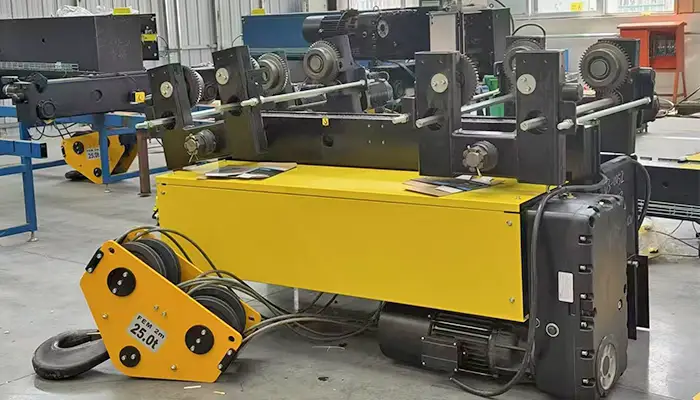
25 Ton Electric Hoist for Sale Poland for Gantry Crane Case
Content Quick Link
When purchasing an European style 25 ton electric hoist for sale or a complete 25 ton gantry crane system, many buyers focus on lifting capacity first. However, the actual project requirements often involve much more than tonnage alone. Power supply compatibility, lifting height, control systems, safety protection, and integration with the gantry crane structure all play an important role in long-term performance.
This case study is based on a industrial export project for a customer in Poland. The project involved the supply of a 25 ton wire rope electric hoist designed for installation on a European style 25 ton single girder gantry crane used for heavy material handling operations. The complete crane specification was: The customer required a lifting solution capable of handling large steel structures, fabricated components, and heavy machine assemblies while meeting common European industrial operating requirements. Unlike many standard lifting applications, this project also required detailed factory testing before shipment. Particular attention was given to the two-speed hoisting system, rotary limit switch operation, braking performance, and overall integration between the 25 ton gantry hoist and the gantry crane structure. For buyers evaluating a 25 ton electric hoist for sale Poland, 25 ton wire rope hoist, or a complete 25 ton gantry crane solution, this project provides a practical example of how equipment selection, safety testing, and crane integration are handled before delivery. What is included in a typical 25 ton electric hoist for sale Poland project? A typical project includes a 25 ton wire rope electric hoist, trolley system, electrical control panel, limit switch system, remote control, factory testing, technical drawings, and integration with a 25 ton gantry crane. How is a 25 ton wire rope electric hoist integrated into a 25 ton gantry crane? The hoist is mounted on a trolley that travels along the gantry girder, allowing lifting, lowering, and horizontal movement across the crane span while working together with the gantry traveling system. Common requirements include 25 ton lifting capacity, 7 m lifting height, 400V/50Hz/3 Phase power supply, European-standard electrical components, two-speed lifting, remote control, and safety protection systems. They verify that the hoist stops safely at preset positions, switches correctly between lifting speeds, and operates reliably before installation at the customer's site. What should buyers verify before purchasing a 25 ton gantry hoist for steel fabrication or machinery handling applications? Buyers should confirm the lifting capacity, lifting height, power supply, duty classification, control method, safety devices, limit switch configuration, factory testing reports, and compatibility with the gantry crane structure. This project was supplied to a steel fabrication workshop in Poland, where large steel structures, fabricated components, and machinery assemblies are handled daily. The customer needed a reliable 25 ton electric hoist and 25 ton gantry crane system capable of lifting heavy loads safely while maintaining efficient material flow throughout the production process.
In this type of workshop, lifting operations are not limited to moving materials from one location to another. The crane is also used during fabrication, welding, assembly, storage, and loading operations. As production volumes increase, stable lifting performance and precise load positioning become increasingly important. The 25 ton wire rope electric hoist was selected to handle a wide range of heavy industrial loads, including: The lifting requirements varied depending on the production stage and product type. Because some components approached the upper lifting limit, the customer preferred a 25 ton gantry crane rather than smaller lifting equipment. This provided additional capacity margin for future production requirements and improved operational safety. Several lifting solutions were evaluated during the project planning stage. A 25 ton gantry crane with a 25 ton wire rope hoist was ultimately chosen because it offered: For the customer, the goal was not simply to lift 25 tons. The crane needed to handle a variety of load sizes safely, support daily production activities, and provide reliable operation for many years. Industries such as steel fabrication, structural steel manufacturing, machinery production, heavy equipment assembly, metal processing, and industrial manufacturing commonly use 25 ton electric hoists. Large steel structures, machine bases, welded assemblies, heavy industrial equipment, fabricated modules, and other loads approaching or exceeding 10–15 tons typically require a 25 ton wire rope hoist. A 25 ton gantry crane is a suitable choice when handling heavy loads, moving large components across a wide work area, requiring full-span coverage, or planning for future increases in lifting requirements. It is often selected when smaller cranes or hoists cannot provide sufficient capacity, safety margin, or operational flexibility. Selecting a 25 ton electric hoist involves more than matching the lifting capacity to the load weight. Buyers also need to consider lifting height, operating conditions, control requirements, safety systems, and how the hoist will perform during daily production.
For this Poland project, the hoist was installed on a 25 ton single girder gantry crane (25T-11.5M-H7M). The customer required reliable operation, smooth load handling, and safe performance under continuous workshop use. A 25 ton load places significant demands on the hoisting system. Every component, including the motor, brake, gearbox, wire rope, drum, and hook block, must work together to lift and hold the load safely. Key considerations included: The crane was designed with a 7-meter lifting height, which required efficient use of the available space. The challenge was to: This is one reason why a compact European-style wire rope electric hoist was selected. The customer required the hoist to comply with common European industrial operating practices before shipment. Important requirements included: Unlike a standalone hoist, a 25 ton gantry crane system operates in three directions: Because all three movements can occur during material handling, the risk of collision, load swing, and positioning errors increases. The hoist therefore needed: The customer requested a dual-speed hoisting system to improve both productivity and positioning accuracy. The two-speed design allows: This feature is especially useful when handling heavy steel components or positioning machinery during assembly work. The project engineering team focused on several critical areas: Buyers should evaluate lifting capacity, lifting height, duty classification, braking performance, limit switch protection, control system design, power supply compatibility, and integration with the crane structure. Dual-speed hoists combine fast lifting for productivity with slow-speed operation for accurate positioning, helping reduce load swing, impact forces, and positioning errors. Key factors include brake reliability, wire rope quality, gearbox performance, limit switch accuracy, electrical control systems, hoist design, and proper integration with the gantry crane. After reviewing the customer's lifting requirements, working environment, and crane specifications, a European-style 25 ton wire rope electric hoist was selected for the project. The goal was to provide reliable lifting performance, precise load control, and long service life while meeting the operational requirements of the 25 ton single girder gantry crane.
Since the crane would be used for handling steel structures, machinery components, and heavy fabricated assemblies, the hoist needed to deliver both lifting power and positioning accuracy. The customer also required smooth operation, compact design, and stable performance under continuous use. Several factors influenced the final hoist configuration: This combination made the solution well suited for the Poland steel fabrication workshop, where lifting precision and equipment reliability are equally important. The main hoist specifications included: The performance of a 25 ton wire rope electric hoist depends heavily on the quality and configuration of its major components. The dual-speed motor provides two operating modes: The drum assembly is responsible for winding and unwinding the wire rope smoothly. A multi-sheave hook block was selected to handle the 25 ton working load safely. The rotary limit switch protects the hoist from over-travel during lifting operations. The brake system is designed to hold the load securely whenever power is removed. The electrical system was designed for compatibility with European industrial standards. For this Poland project, the selected 25 ton electric hoist for sale offered several practical advantages: Buyers should evaluate lifting capacity, lifting height, duty classification, two-speed control, braking performance, limit switch protection, electrical system quality, and compatibility with the crane structure. The most important components include the hoisting motor, wire rope drum, hook block, gearbox, brake system, rotary limit switch, electrical controls, and wire rope assembly. A European-style electric hoist typically offers a more compact structure, improved headroom utilization, smoother operation, advanced control systems, lower energy consumption, and enhanced safety features compared with traditional hoist designs. A 25 ton electric hoist performs best when it is properly integrated with the entire gantry crane system. The hoist, trolley, girder, end carriages, electrical controls, and gantry travel mechanism must work together as one lifting system. If any part is not properly matched, it can affect lifting performance, positioning accuracy, and long-term reliability.
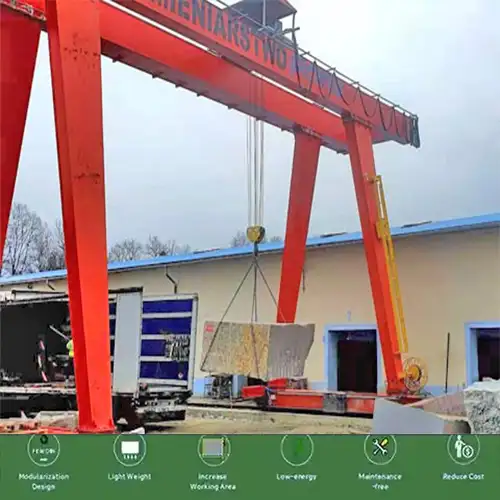
For this Poland project, the customer selected a European-style single girder gantry crane designed for handling heavy steel structures and machinery components. The crane was engineered to provide smooth lifting, stable travel, and safe load handling throughout the workshop. The main crane configuration included: The 25 ton wire rope electric hoist is mounted on a trolley that travels along the main girder. During operation, the crane performs movement in three directions: These movements allow operators to lift, transport, position, and place heavy loads anywhere within the crane's working area. To achieve smooth operation, the hoist and crane systems must be properly matched in terms of: The 11.5 m span plays an important role in crane performance. As loads move across the girder, the crane structure must distribute weight evenly while maintaining stability. Proper load distribution helps: For a 25 ton gantry crane, this becomes particularly important when handling large steel fabrications, machine bases, and heavy assemblies near the crane's maximum capacity. A well-integrated gantry crane system delivers more than lifting capacity. It also improves safety, efficiency, and equipment life. Key benefits include: Before purchasing a 25 ton gantry hoist system, buyers should verify that the hoist and crane are designed as a complete system rather than as separate components. Important items to confirm include: The hoist is mounted on a trolley that travels along the gantry girder. Together with gantry travel movement, the system allows loads to be lifted, moved horizontally, and positioned throughout the crane's working area. Buyers should verify lifting capacity, span, lifting height, duty classification, power supply, travel speeds, structural design, safety systems, and compatibility between the hoist and gantry crane. Crane span affects load distribution, girder strength, trolley performance, structural deflection, and overall crane stability. The hoist must be selected to match the span and structural design of the gantry crane. Before shipment to Poland, the 25 ton electric hoist for sale was fully tested under Factory Acceptance Testing (FAT) conditions. This step is not just a formality. For European industrial projects, it is a practical way to confirm that the hoist performs safely and consistently before it arrives on site.
In industrial workshop conditions, once the crane is installed, adjustments become more difficult and costly. That is why FAT is carried out in advance—to reduce installation risks and avoid unexpected commissioning issues at the customer's facility. For this 25 ton gantry hoist system, FAT was especially important due to the heavy-duty application and European operational expectations. It helps to: In practice, many European buyers expect video proof and test reports before approving final shipment. When a 25 ton wire rope electric hoist is installed on a gantry crane in a steel workshop, any adjustment at site can interrupt production. FAT helps reduce these risks by: The following tests were completed before delivery: Each test was carried out step by step to confirm that the hoist operates safely and consistently under working conditions similar to industrial use. During FAT review, buyers typically focus on practical operation rather than theoretical specifications. Key points include: FAT videos provide visual proof that the 25 ton electric hoist operates correctly, helping buyers confirm safety, function, and quality before the equipment leaves the factory. Key tests include hoisting performance, dual-speed operation, limit switch calibration, braking system performance, emergency stop function, electrical stability, and trolley travel testing. Buyers can verify quality through FAT reports, test videos, electrical diagrams, load testing records, and confirmation of correct operation under simulated working conditions. In a 25 ton electric hoist for sale Poland project, the two-speed limit switch system is one of the most important safety functions. It directly controls how the hoist behaves when the hook approaches the upper limit position during lifting.
Because the system handles heavy loads in a 25 ton gantry crane, even small errors in limit switch adjustment can lead to serious mechanical stress or unsafe operation. That is why this function is carefully tested during Factory Acceptance Testing (FAT). During normal lifting, the hoist operates in high-speed mode to improve efficiency. As the hook approaches the upper limit position, the limit switch system is activated. In this stage: This prevents the hook from approaching the mechanical limit too quickly. Once the high-speed reduction is triggered, the hoist switches into slow-speed mode. In this stage: This is especially important when handling steel beams, machine bases, and large fabricated components, where accurate positioning is required. The rotary limit switch is not just a safety device. It is a protection system for the entire 25 ton wire rope hoist structure. When properly adjusted, it helps: In industrial practice, correct calibration is often the difference between stable long-term operation and frequent maintenance issues. During factory testing for the Poland project, the following points were carefully verified: Each step was observed under controlled test conditions to ensure consistent behavior. Correct setup and testing help avoid common operational issues such as: These problems are not theoretical. In industrial workshop operation, they often appear when limit switch calibration is incorrect or not properly tested before shipment. It detects the hook position during lifting and automatically reduces speed from high-speed to slow-speed before reaching the upper limit, then triggers final stopping protection. Buyers should observe smooth speed reduction, stable braking, accurate stopping position, and absence of vibration or impact during limit activation. Incorrect adjustment can cause over-hoisting, wire rope strain, drum damage, and repeated mechanical shocks, which significantly reduce the service life of the hoist system.Project Overview: 25 Ton Electric Hoist for Sale Poland – Industrial Gantry Crane Case Study
Main Specifficaitons of 25 ton electric Hoists and Gantry Cranes
Main Specifficaitons of 25 ton electric Hoists and Gantry Cranes
Key Questions This Section Answers
End User Industry and Lifting Requirements for a 25 Ton Gantry Crane
Typical Materials Handled
Typical Load Requirements
Why a 25 Ton Gantry Crane Was Selected
Key Questions This Section Answers
What industries commonly use 25 ton electric hoists?
What loads require a 25 ton wire rope hoist?
When should buyers choose a 25 ton gantry crane system?
Technical Challenges in Selecting a 25 Ton Electric Hoist
Heavy Load Handling Requirements
Limited Lifting Height and Compact Design Requirements
European Safety and Operational Requirements
Three-Direction Movement Creates Additional Risks
Dual-Speed Lifting Control Requirements
Main Engineering Challenges
Key Questions This Section Answers
What technical issues should buyers consider before purchasing a 25 ton electric hoist?
Why are dual-speed hoists commonly used in heavy-duty gantry cranes?
What affects safety and performance in 25 ton lifting systems?
25 Ton Wire Rope Electric Hoist Solution Design
Why This Design Was Selected
25 Ton Electric Hoist Specifications
Key Components of the 25 Ton Wire Rope Hoist
Dual-Speed Hoisting Motor
Wire Rope Drum Assembly
Multi-Sheave Heavy-Duty Hook Block
Rotary Limit Switch System
Electromagnetic Fail-Safe Brake
European-Standard Electrical Control Cabinet
Advantages of the Selected Hoist Design
Key Questions This Section Answers
What features should buyers look for in a 25 ton electric hoist for sale?
What components are critical in a 25 ton wire rope hoist?
How does a European-style electric hoist differ from standard designs?
25 Ton Gantry Crane Configuration and System Integration
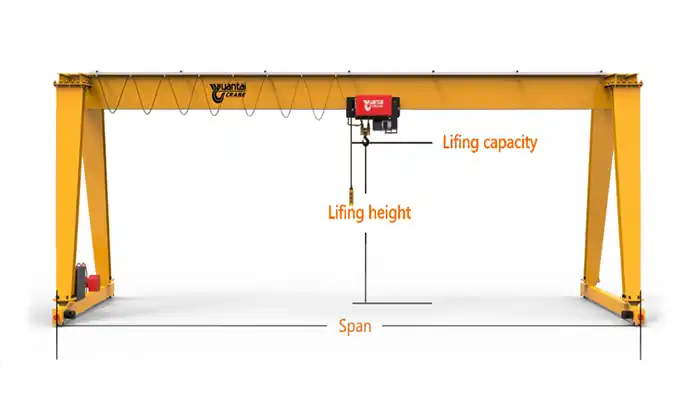
Gantry Crane Specifications
How the System Works Together
Importance of Load Distribution on an 11.5 m Span
Why System Integration Matters
What Buyers Should Check Before Ordering
Key Questions This Section Answers
How does a 25 ton electric hoist work with a gantry crane?
What should buyers verify before ordering a 25 ton gantry hoist system?
Why is crane span important in hoist selection?
Factory Acceptance Testing (FAT) of the 25 Ton Electric Hoist
Importance of FAT for European Projects
How FAT Reduces Site Risk
FAT Test Scope for the 25 Ton Electric Hoist
What Buyers Should Pay Attention To in FAT
Key Questions This Section Answers
Why should buyers request FAT videos before shipment?
What tests should be performed on a 25 ton wire rope electric hoist?
How can buyers verify hoist quality before delivery?
Two-Speed Limit Switch Testing on a 25 Ton Wire Rope Hoist
How the High-Speed Limit Function Works
How the Slow-Speed Positioning Function Works
Why Proper Limit Switch Adjustment Matters
Testing Focus During FAT
Common Problems Prevented by Proper Limit Switch Testing
Key Questions This Section Answers
How does a two-speed electric hoist limit switch work?
What should buyers watch for in FAT testing videos?
How can improper limit adjustment affect hoist life?
Engineering Value Delivered to the Poland Customer
Delivered operational value
This project provided a fully tested 25 ton electric hoist for sale Poland, integrated into a complete gantry crane system with validated safety performance.
Customer benefits
- Pre-tested 25 ton hoist ready for installation
- Reduced commissioning time at site in Poland
- Lower installation and adjustment risk
- Improved lifting safety under EU working conditions
- Stable two-speed operation under heavy load
- Longer wire rope and drum service life
- Reduced long-term maintenance workload
Practical outcome
In industrial workshop use, the system performs as a stable heavy-duty lifting solution for steel fabrication. The key value is not only capacity, but predictable behavior under continuous industrial operation.
Key buyer questions answered (short answers)
What is the value of FAT testing?
FAT testing confirms the hoist performs correctly before shipment, reducing installation problems and ensuring safety functions like two-speed control and limit switches work properly.
How does engineering reduce operating cost?
Proper engineering improves efficiency and reduces wear by ensuring smooth lifting, stable braking, correct load handling, and fewer breakdowns during daily operation.
What long-term benefits can buyers expect?
Buyers can expect safer operation, lower maintenance needs, longer equipment life, and more stable performance in continuous industrial use.
Buyer Checklist Before Purchasing a 25 Ton Electric Hoist for Sale
Before ordering a 25 ton electric hoist for sale, the first step is always to confirm the industrial working conditions in the workshop. In practical projects, many issues come from missing basic parameters, not from equipment design itself. These parameters determine whether a 25 ton wire rope electric hoist will operate smoothly or face adjustment issues during installation.
Technical checklist
Key technical parameters that must be confirmed before quotation:
- Confirm 25 ton lifting capacity requirement (real maximum load, not average load)
- Confirm required lifting height (e.g., 7m in this project case)
- Verify 400V / 50Hz / 3-phase power supply compatibility
- Confirm crane span and runway structure dimensions
- Define duty class based on daily operating cycle
- Review workshop layout and actual load travel path
These points directly determine whether the system can be installed smoothly or requires redesign during site installation.
Supplier and engineering verification checklist
In industrial procurement of 25 ton gantry crane and hoist systems, supplier capability is as important as technical selection.
Supplier verification items include:
- Request full FAT testing video before shipment
- Review electrical drawings (control logic, wiring, protection system)
- Review mechanical drawings (drum, hook block, structure layout)
- Confirm limit switch test records for two-speed operation
- Check spare parts availability for long-term maintenance
- Confirm after-sales support and commissioning assistance
This is especially critical for European projects such as electric hoist for sale Poland, where compliance documentation and verified testing are expected before delivery.
Practical buyer insight
In real industrial procurement, the difference between a smooth project and a problematic one often comes from small details rather than major design issues.
For example, unclear runway dimensions or missing duty classification can lead to redesign work at the installation stage.
A properly defined 25 ton electric hoist project should arrive as a system that is ready for installation, not one that requires on-site correction.
Key Questions This Section Answers
What should buyers prepare before requesting a quotation for a 25 ton hoist?
Buyers should clearly define load capacity (25 ton), lifting height, crane span, power supply (400V/50Hz/3P), duty class, and workshop layout with actual load movement requirements.
How can different suppliers of 25 ton electric hoists be compared fairly?
Comparison should be based on technical scope rather than price alone, including hoist configuration, FAT testing capability, engineering drawings, safety design, and after-sales service support.
What critical details are often missed during procurement planning?
Commonly missed points include duty classification, peak load conditions, runway compatibility, installation constraints, and verification of limit switch testing and documentation before shipment.
Conclusion: Lessons from a Real 25 Ton Electric Hoist for Sale Poland Project
In this Poland project, the hoist selection was not decided by tonnage alone. In industrial workshop conditions, the way the equipment performs under continuous steel handling work is more important than the rated capacity on paper.
Why selecting a 25 ton electric hoist is about more than lifting capacity
In industrial applications, selection is determined by operational behavior rather than nominal tonnage.
- Continuous 25 ton lifting requirement in steel fabrication
- Stable operation under daily production cycles
- Safe handling of large structural steel components
- Reduced risk during peak load operations
Importance of matching the hoist to the 25 ton gantry crane and workshop workflow
A 25 ton hoist must function as part of an integrated gantry crane system. Misalignment between equipment and workflow typically leads to operational inefficiencies during production.
- Match hoist to 25 ton gantry crane (11.5m span system)
- Ensure lifting height (7m) fits industrial workshop geometry
- Align with material flow in fabrication process
- Reduce unnecessary repositioning during lifting work
How FAT testing improves confidence before shipment
Factory Acceptance Testing (FAT) verifies system performance before delivery, especially for European industrial projects such as Poland.
Key validation points include:
- Confirm two-speed lifting function
- Verify limit switch switching behavior
- Test braking stability under load
- Check electrical system reliability (400V / 50Hz / 3P)
Why dual-speed control and limit switch protection matter for long-term reliability
Dual-speed control and limit switch systems directly affect operational safety, mechanical wear, and service life.
- High speed improves working efficiency
- Low speed ensures accurate positioning near upper limit
- Limit switch prevents over-hoisting damage
- Stable switching reduces mechanical shock
Practical advice for buyers evaluating a 25 ton wire rope electric hoist or gantry crane system
Purchasing decisions should be based on system-level evaluation rather than isolated specifications or price comparisons.
- Check full system integration (hoist + gantry + workflow)
- Request FAT testing records and videos
- Confirm industrial workshop operating conditions
- Evaluate maintenance and spare parts planning
Key takeaway
For buyers comparing different 25 ton electric hoists for sale, the lowest price is rarely the best decision factor.
Long-term value comes from proper system design, verified testing, safe operation, and stable performance throughout the equipment lifecycle.

Article by Bella ,who has been in the hoist and crane field since 2016. Bella provides overhead crane & gantry crane consultation services for clients who need a customized overhead travelling crane solution.Contact her to get free consultation.
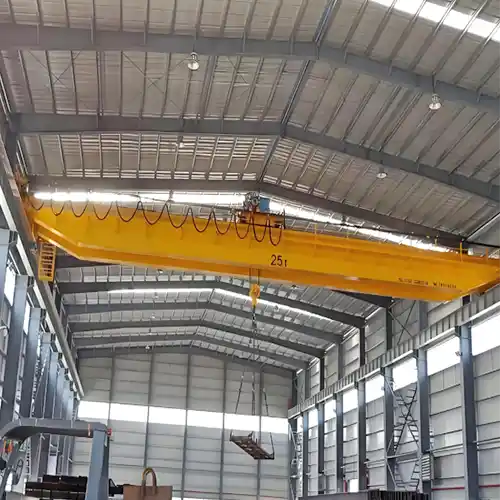
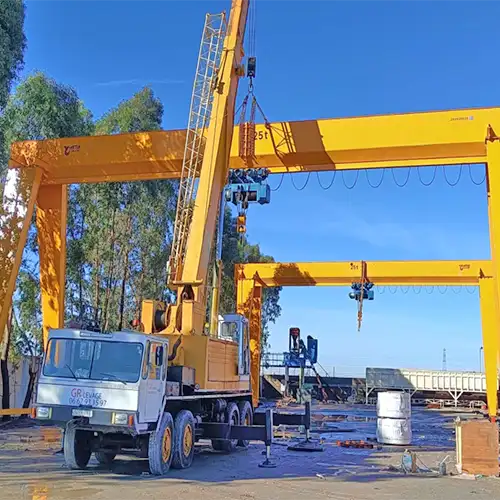
Yuantai Cranes
Overhead Crane Manufacturer with CE, ISO, SGS, CNEX Certificates.
- Main Specifications - Capacity: 0.5–550 tons | Span: up to 40m | Speed: 0.8–12 m/min | Duty: A3–A7 | Power: 380–690V, 50/60Hz | Control: pendant/remote/cabin
- Full engineering: FEA/PLC/VFD + in-house build + global delivery + on-site support, for workshops, factories, EPC contractors, industrial projects, etc.
- Support: design, manufacturing, testing, service – end-to-end, customized lifting solutions worldwide.
How to Get an Accurate Crane Price for Your Application?
Tips: Copy the spec list, fill in your details, and paste it into the form on the right/ down-below for a quick price.
- Crane type:_____ . (e.g., overhead crane, gantry crane, jib crane)
- Max weight to lift:_____ tons. (e.g., 2t, 5t, 10t, 20t, 50t)
- Lifting height:_____ m. (How high does the hook need to reach?
- Workshop width (span):_____ m . (Distance between the two crane rails)
- Travel distance:_____ m . (How long does the crane need to move along the runway?)
- Control type:_____. (Pendant / remote / cabin Control)
- Power supply:_____. (Local voltage & frequency – e.g., 380V, 50Hz, 3-phase)
- What will it be used for?_____ (e.g., steel fabrication, concrete products, mold handling, general manufacturing, etc.)
- Any special requirements?_____ (e.g., extreme temperature, dusty or explosive environment, special paint color, etc.)
Just leave a message via the contact form and our hoist and crane engineer will contact you with in 24working hours.
Get Your Custom Quote–Quick & Easy
Fill in what you know. Skip what you don't – we'll help.Any question will be reply with 24 working hours