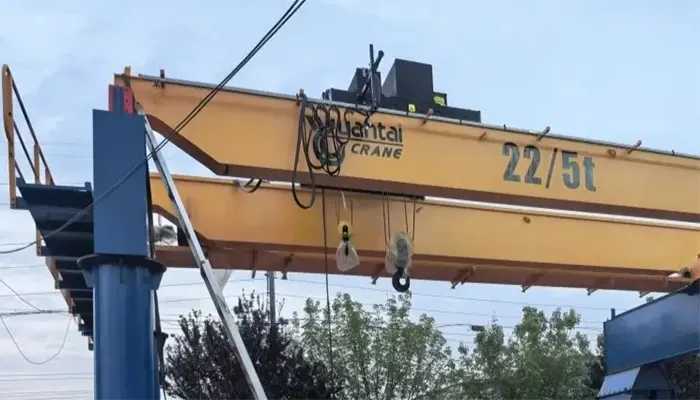
What Overhead Crane Products Can You Source from China? OEM Guide
Content Quick Link
What Overhead Crane Products Can You Source from a Chinese OEM Crane Manufacturer?
When sourcing crane products from China, you don't necessarily need to buy a complete overhead crane or gantry crane. Depending on your business model, you may only need electric hoists, end carriages, crane wheels, motors, brakes, or other replacement parts. You can also source complete mechanical assemblies or crane kits and handle the steel fabrication and final assembly locally.
This gives overseas buyers quite a bit of flexibility. A crane manufacturer can outsource the production of key components, a spare-parts wholesaler can purchase standard crane parts in bulk, and a distributor can add electric hoists or complete crane systems to its product range without setting up its own manufacturing facility.
So, what exactly can you source from a Chinese crane components manufacturer? Let's look at the main product categories, how they are supplied, and which options make sense for different types of buyers.
Four Levels of Crane Products You Can Source from China
Before looking at individual products, it helps to understand the different levels of outsourcing available. You can purchase anything from a single replacement component to a complete crane system, depending on how much manufacturing work you want to handle locally.
| Sourcing Level | Typical Products | Suitable Buyers | What You Handle Locally |
|---|---|---|---|
| Individual components | Crane wheels, motors, brakes, gearboxes, hooks, electrical parts | Component importers, spare-parts wholesalers, maintenance companies | Component selection, installation, replacement and maintenance |
| Functional assemblies | End carriages, hoists, trolleys, travelling mechanisms | Crane manufacturers, distributors, service companies | Integration with the main crane structure and other systems |
| Complete crane kits | Single girder, double girder and gantry crane kits | Local crane manufacturers and crane distributors | Depending on the supply scope, steel fabrication, assembly, installation and commissioning |
| Complete crane systems | Overhead cranes, gantry cranes and customized lifting systems | Industrial buyers, EPC contractors, distributors and project contractors | Site preparation, runway or foundation work, installation and local compliance where required |
For example, if you already manufacture crane girders in your own workshop, importing end carriages, hoists and electrical systems may be enough. On the other hand, if you are a distributor without manufacturing facilities, purchasing a complete overhead crane may be a more practical choice.
Individual Crane Components: What Parts Can You Buy from China?
Individual crane components are commonly sourced by crane parts importers, spare-parts wholesalers and maintenance contractors. Some buyers need regular supplies of standard components, while others purchase specific parts to replace damaged or outdated equipment. Chinese OEM crane components manufacturers can supply a wide range of mechanical, electrical and structural parts. Here are the main categories.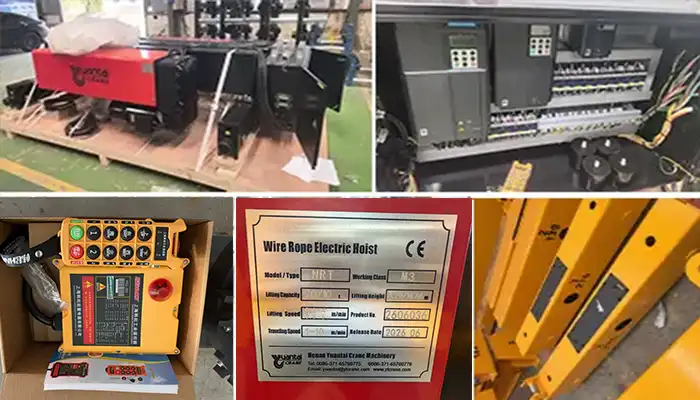
Crane Wheels and Wheel Assemblies
Crane wheels are used in bridge travelling mechanisms, trolley travelling systems and gantry crane running gear. They must match the rail profile, wheel load, travelling speed and operating conditions of the crane. Common material grades include 42CrMo, 65Mn and ZG35CrMnSi, with surface hardness typically ranging from 300 to 380 HB depending on the application and duty class.
Common products include:
- Forged steel crane wheels (e.g., 42CrMo forged wheels for heavy-duty overhead crane runway applications)
- Machined crane wheels with precise tread and flange profiles
- Driven and idler wheels for bridge and trolley travel
- Overhead crane end carriage wheels
- Gantry crane travelling wheels
- Complete wheel blocks and wheel assemblies
These products are relevant to crane manufacturers building their own travelling mechanisms, as well as maintenance companies replacing worn wheels on existing cranes.
If you are ordering replacement crane wheels, don't rely on the wheel diameter alone. The supplier will also need the rail profile (e.g., QU70, QU80, QU100, QU120), tread width, flange dimensions, material requirements and, where possible, an existing drawing or sample.
Crane Motors and Gearboxes
Motors and gearboxes are used throughout an overhead crane or gantry crane system. Depending on the application, you may need separate motors and reducers or a complete geared motor assembly.
Common products include:
- Hoisting motors (e.g., YZR series wound rotor motors for heavy-duty hoisting)
- Crane long-travel motors (e.g., YZ series three-phase asynchronous motors)
- Cross-travel motors
- Geared motors for compact drive solutions
- Helical gearboxes for smooth and efficient power transmission
- Bevel and helical-bevel gearboxes for right-angle drive configurations
- Travel drive assemblies
When buying crane motors from China, check the power rating, speed, voltage, frequency, number of phases, insulation class (e.g., Class F or H), protection rating (e.g., IP54, IP55, IP65), and duty classification (e.g., S3-40% or S4). For replacement orders, the existing motor nameplate and mounting dimensions are particularly useful.
For example, a 380V, 50Hz motor is not automatically suitable for a 400V, 60Hz installation. The motor and gearbox configuration should be checked against the actual crane operating conditions, including ambient temperature, altitude and humidity.
Crane Brakes and Couplings
Crane brakes control stopping and holding during lifting and travelling operations. They are important parts of the hoisting and travelling systems, particularly where frequent starts, stops and precise load positioning are required.
Available products may include:
- Electromagnetic brakes (e.g., DZS series for compact installations)
- Electro-hydraulic drum brakes (e.g., YWZ series for reliable stopping)
- Electro-hydraulic thruster brakes (e.g., YT1 series)
- Disc brakes for high-torque applications
- Motor brakes for integrated motor-brake solutions
- Flexible shaft couplings with high torsional flexibility
- Gear couplings for high-torque transmission
When selecting a replacement brake, check braking torque, shaft or mounting dimensions, operating voltage, release mechanism and compatibility with the motor or gearbox. Simply choosing a brake with a similar appearance can lead to installation and performance problems.
Electrical Components and Crane Control Systems
Electrical components are another major sourcing category for crane manufacturers and maintenance companies. You can purchase individual electrical parts or order a complete control panel assembled according to your requirements.
Typical products include:
- Crane control panels and electrical cabinets (IP54 or IP65 rated for dusty or humid environments)
- Contactors, relays and circuit breakers (e.g., Schneider, Siemens, or equivalent brands)
- Frequency inverters (VFDs) for stepless speed control and energy savings
- Limit switches and overload protection devices
- Pendant push-button controls (e.g., 6-way or 8-way pushbutton stations)
- Industrial radio remote controls (e.g., Tele Radio, HBC, or compatible systems)
- Festoon cable systems for reliable power supply to moving trolleys
- Conductor rails and current collectors (e.g., copper or aluminum conductor rails for long runways)
- Cable reels and power supply equipment
For overseas orders, voltage, frequency, phase, control voltage (e.g., 24V, 48V, 110V, or 220V), component brands and applicable electrical standards (e.g., IEC, CE) should be agreed before production. If you are replacing an existing control panel, a wiring diagram and clear photos of the original cabinet will help the supplier understand the configuration.
Other Crane Spare Parts
There are also many smaller components that crane parts wholesalers and maintenance contractors need to keep in stock.
| Product | Typical Application | Key Technical Data to Specify |
|---|---|---|
| Wire rope | Hoisting mechanisms and lifting systems | Diameter (e.g., 8mm–32mm), construction (e.g., 6x36WS+FC), tensile grade (e.g., 1770 N/mm², 1960 N/mm²), lay direction |
| Wire rope drums | Electric hoists and open winches | Drum diameter, rope capacity, groove pitch, material |
| Crane hooks and hook blocks | General material handling and lifting | Capacity (e.g., 1t–100t), hook type (single or double), material grade (e.g., forged 35CrMo) |
| Bearings and shafts | Wheel assemblies, gearboxes and drive mechanisms | Bearing type (e.g., spherical roller, tapered roller), shaft diameter and material |
| Buffers | Bridge, trolley and gantry crane travel protection | Energy absorption capacity, stroke, material (e.g., polyurethane, rubber, hydraulic) |
| Cable festoon systems | Power supply for moving trolleys and cranes | Cable trolley size, track length, cable diameter range |
| Conductor rails and collectors | Power supply for overhead and gantry cranes | Rail cross-section (e.g., 50A, 80A, 120A), collector type (e.g., carbon brush), voltage rating |
| Limit switches | Hoisting and travelling position control | Type (e.g., lever, spindle, or proximity), IP rating, operating voltage |
For spare-parts distributors, it may make sense to start with commonly replaced components such as wheels, brakes, motors, limit switches and electrical parts. More specialized components can be purchased against specific customer orders rather than held in stock.
Functional Crane Assemblies: Products Ready for Integration
Some overseas buyers don't want to source every nut, bolt and mechanical component separately. They would rather purchase a complete assembly that can be installed directly into their own crane structure. This is where functional crane assemblies become useful. Instead of manufacturing every part in-house, local crane manufacturers can outsource major mechanical units to a Chinese OEM crane manufacturer and concentrate on steel fabrication, integration and project delivery.
Overhead Crane End Carriages (End Trucks)
An overhead crane end carriage, also called an end truck, supports the bridge girder and allows the crane to travel along the runway rails. It normally consists of a fabricated frame, wheel assemblies and, depending on the design, travelling drive units.
Available configurations include:
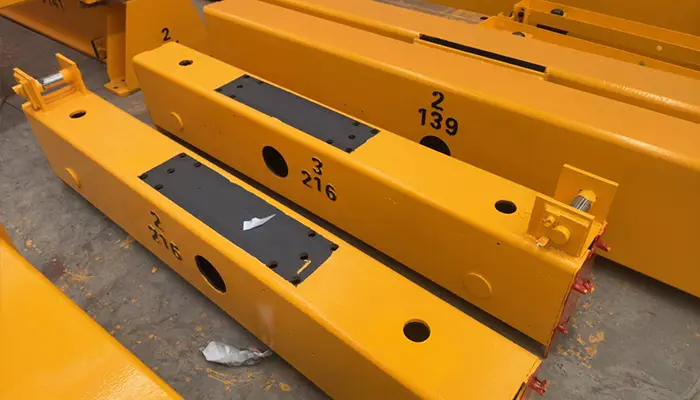
- Single girder overhead crane end carriages (e.g., for 1t–20t single girder cranes)
- Double girder overhead crane end carriages (e.g., for 5t–100t double girder cranes)
- Driven and non-driven end trucks
- End carriages with integrated motor and gearbox assemblies
- Customized end carriages for different wheelbases (e.g., 2.5m, 3.5m, 4.5m) and rail arrangements
For a local crane manufacturer, purchasing an overhead crane end carriage from an OEM supplier can reduce machining, fabrication and assembly work in its own workshop.
Before placing an order, provide the following information:
- Crane capacity and crane type (e.g., single girder, double girder, gantry)
- Crane span and end carriage wheelbase
- Wheel diameter and rail profile (e.g., QU70, QU80, QU100)
- Wheel load and travelling speed (e.g., 20 m/min, 30 m/min)
- Motor and gearbox requirements (e.g., power, voltage, frequency, speed)
- Connection dimensions between the end carriage and bridge girder
One point worth checking: the end carriage must match the actual bridge girder connection and runway arrangement. A standard-looking end truck is not necessarily interchangeable with another manufacturer's design.
Electric Wire Rope Hoists
Electric wire rope hoists are widely used in industrial overhead cranes, gantry cranes and standalone lifting applications. They are available in different capacities, lifting heights and mounting arrangements.
Common types include: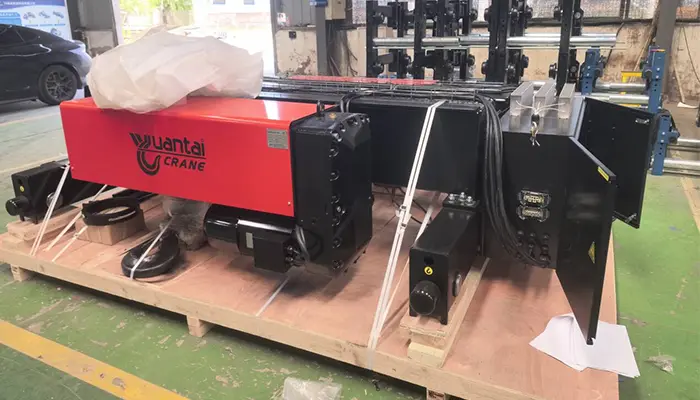
- Standard electric wire rope hoists (e.g., CD1, MD1 series for general material handling)
- Low-headroom wire rope hoists for limited building height
- European-style electric wire rope hoists (e.g., FEM/ISO-compliant for high-duty cycles)
- Fixed electric wire rope hoists for stationary lifting points
- Trolley-mounted electric wire rope hoists for cross-travel movement
- Single-speed, dual-speed and VFD-controlled hoists for precise load positioning
They are commonly used in machinery manufacturing, steel fabrication workshops, warehouses, precast concrete plants, maintenance facilities and general industrial production lines.
For buyers planning to import electric wire rope hoists from China, capacity is only the starting point. Lifting height (e.g., 6m, 9m, 12m, 18m), lifting speed (e.g., 8/0.8 m/min), working class (e.g., M3, M4, M5, M6), rope reeving (e.g., 2/1, 4/1), trolley type (e.g., plain, geared, motorized), headroom and power supply all affect the final configuration.
Electric Chain Hoists
Electric chain hoists are another common product for crane distributors and industrial equipment suppliers. Compared with wire rope hoists, they are often used for lighter lifting applications, workstation cranes and production-line handling.
Typical configurations include:
- Fixed electric chain hoists (e.g., 0.5t–5t capacity)
- Electric chain hoists with plain trolleys
- Electric chain hoists with geared trolleys
- Motorized trolley chain hoists
- Low-headroom chain hoists
- Single-speed and dual-speed models
Typical applications include assembly workshops, automotive component plants, equipment maintenance stations, warehouses and small manufacturing facilities.
If you are sourcing chain hoists for distribution, pay attention to rated capacity, lifting height, chain size (e.g., 7.1mm x 21mm, 9mm x 27mm), lifting speed, duty classification (e.g., M4, M5), power supply and available spare parts. These details matter when you need to support customers after the sale.
Crane Trolleys
A crane trolley carries the hoisting unit and travels across the bridge girder or another supporting structure. It provides the cross-travel movement needed to position a load across the working area.
Common trolley products include:
- Electric wire rope hoist trolleys
- Electric chain hoist trolleys
- Plain and geared trolleys
- Motorized hoist trolleys
- Customized trolley assemblies
When purchasing a crane trolley, check the supporting beam or rail profile, flange width (e.g., 50mm–300mm), wheel arrangement, rated load, trolley speed and installation dimensions. For an existing crane, the trolley must also be compatible with the available clearance and structural arrangement.
Crane Travelling Mechanisms
Crane travelling mechanisms are responsible for moving the crane bridge or trolley. They can be supplied as individual drive components or as complete drive assemblies.
There are two main types:
| Mechanism | Function | Typical Components |
|---|---|---|
| Long-travel mechanism | Moves the overhead crane bridge or gantry crane along its runway or ground rails. | Travel motors, gearboxes, drive wheels, driven shafts, brakes and couplings. |
| Cross-travel mechanism | Moves the hoist or trolley across the bridge girder. | Trolley motors, gearboxes, trolley wheels, brakes and transmission components. |
Crane manufacturers can purchase these mechanisms as matched assemblies rather than selecting each motor, gearbox and wheel separately. This can save assembly time and reduce compatibility issues, provided the supplier has the correct crane drawings and operating data.
Complete Crane Kits: A Practical Choice for Local Crane Manufacturers
If you already have a workshop, fabrication equipment and an engineering team, importing a complete overhead bridge crane kit from China may be a good option. You can outsource the main mechanical and electrical systems while keeping the structural fabrication and final assembly under your own control. This arrangement is particularly useful for local crane manufacturing companies that want to expand their product range without investing in the production of every mechanical component.
Single Girder Overhead Crane Kits
A single girder overhead crane kit typically includes the main functional components required to build a complete crane, such as:
- Electric wire rope hoist or hoist trolley (e.g., CD1, MD1, or European-style hoist)
- End carriages and wheel assemblies
- Long-travel drive mechanisms
- Electrical control panel (e.g., IP54 or IP65 rated)
- Conductor rail or festoon power supply system
- Pendant control or radio remote control
- Limit switches and other safety devices
The local manufacturer generally fabricates the main bridge girder and completes the structural assembly. The exact division of work depends on the agreed supply scope.
Double Girder Overhead Crane Kits
Double girder overhead crane kits are commonly used for heavier lifting capacities, higher lifting heights and more demanding industrial applications.
The supply package may include:
- Hoisting trolley or open winch (e.g., for 20t–100t capacity)
- Double girder crane end carriages
- Long-travel mechanisms
- Electrical control cabinets
- Power supply equipment
- Safety and control components
- Connection parts and installation drawings
For cranes above 20 ton, a double girder arrangement is commonly used, although the final design depends on span, lifting height, duty classification, headroom and the actual load-handling requirements.
For example, a crane manufacturer may fabricate the two bridge girders locally and purchase the hoisting trolley, end carriages and electrical system as an integrated package from China.
Gantry Crane Kits
Gantry crane kits are another option for overseas manufacturers serving outdoor industrial sites, construction yards, precast concrete plants and steel storage facilities.
A typical supply package may include:
- Electric wire rope hoist or hoisting trolley
- Gantry crane travelling mechanisms
- Wheel assemblies
- Motors and gearboxes
- Electrical control systems
- Power supply equipment
- Selected structural connection components
Depending on the project, the local manufacturer may fabricate the main girder, gantry legs and other steel structures. The imported components are then integrated during crane assembly.
What Does the Local Crane Manufacturer Need to Handle?
Importing a crane kit does not mean every part of the manufacturing process is outsourced. The local manufacturer's responsibilities depend on the contract and technical scope.
| Work Item | Typical Responsibility |
|---|---|
| Main girder and structural fabrication | Local manufacturer, unless included in the imported supply |
| End carriage and drive assembly | OEM supplier or local manufacturer |
| Hoist and trolley | OEM supplier |
| Electrical control system | OEM supplier or local electrical integrator |
| Crane assembly | Local manufacturer or installation contractor |
| Site installation and commissioning | Local contractor or agreed project team |
| Local inspection and statutory approval | As required by the destination market |
Before requesting a quotation, make sure both sides agree on what is included. A crane kit can mean different things to different suppliers. One supplier may provide only the hoist and end carriages, while another may include the complete mechanical and electrical package with drawings and technical support.
Complete Overhead and Gantry Cranes: When Should You Buy the Finished System?
Not every overseas buyer wants to manufacture cranes locally. If you are an industrial end user, EPC contractor or equipment distributor without a fabrication workshop, purchasing a complete overhead crane or gantry crane may be the simpler route. Chinese crane manufacturers can supply complete lifting systems for a wide range of industrial applications.
Overhead Cranes
Overhead cranes are widely used in factories and industrial buildings where materials need to be lifted and moved along a fixed runway.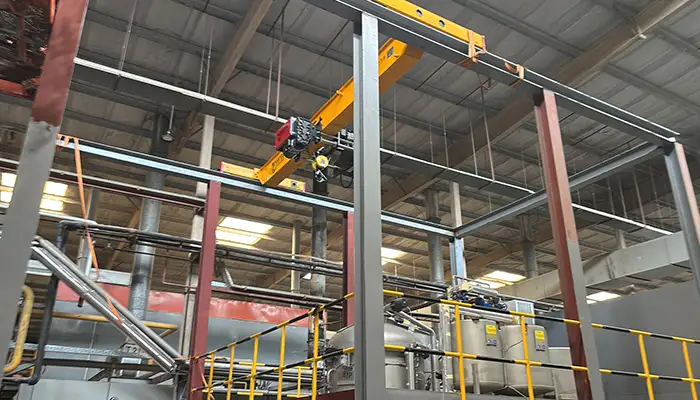
Common products include:
- Single girder overhead cranes: General material handling in workshops, warehouses and light manufacturing facilities (e.g., 1t–20t capacity).
- Double girder overhead cranes: Higher-capacity lifting in steel plants, machinery factories, heavy fabrication workshops and industrial production facilities (e.g., 5t–100t capacity).
- European-style overhead cranes: Compact configurations for applications requiring optimized headroom, weight and operating performance (e.g., FEM/ISO-compliant).
- Underhung overhead cranes: Suitable for buildings where the crane runs on the lower flanges of supporting runway structures.
- Low-headroom overhead cranes: Useful where building height or available lifting clearance is limited.
- Explosion-proof overhead cranes: Designed for specified hazardous areas, subject to the required explosion-protection classification (e.g., Ex d IIB T4, Ex d IIC T4).
- Grab bucket overhead cranes: Used for handling bulk materials such as coal, sand, grain, scrap and waste.
Gantry Cranes
Gantry cranes are commonly used where a conventional overhead crane runway is unavailable or where materials need to be handled in outdoor areas.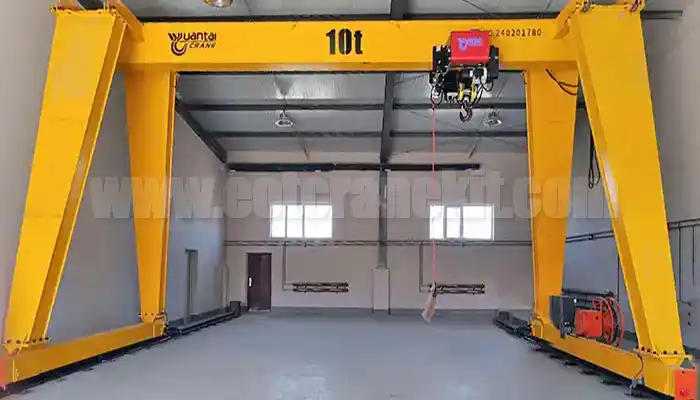
Available configurations include:
- Single girder gantry cranes: General material handling in yards, workshops and construction areas.
- Double girder gantry cranes: Heavy-duty lifting in steel yards, precast concrete plants and industrial storage facilities.
- Semi-gantry cranes: Used where one side runs on an elevated runway and the other travels on ground rails.
- Rubber tyred gantry cranes (RTG): Used in container yards and other applications requiring mobile gantry equipment.
- Container gantry cranes: Specialized systems for container handling at ports and terminals.
What Is Included in a Complete Crane Supply?
When purchasing a complete crane from China, check the supply scope carefully. A finished crane does not automatically include every item needed to make the entire site operational.
| Supply Item | Typical Scope |
|---|---|
| Main steel structure | Bridge girders, gantry legs, end carriages and structural connections |
| Hoisting system | Electric hoist, hoisting trolley or open winch |
| Travelling system | Long-travel and cross-travel mechanisms |
| Electrical system | Control panels, motors, wiring and control devices |
| Power supply | Conductor rails, festoon systems or cable reels, as specified |
| Safety devices | Limit switches, overload protection, buffers and other specified devices |
| Documentation | Technical drawings, manuals, inspection and testing records |
| Installation support | Installation supervision and commissioning, if included in the contract |
Runway beams, runway rails, foundations, building modifications, site installation and local certification may be separate items. Always confirm these points before comparing quotations from different crane manufacturers.
Which Crane Products Should You Source for Your Business?
The right products depend on what your company does. A crane manufacturer needs a different supply package from a spare-parts wholesaler, and a maintenance contractor usually has very specific requirements.
Here is a practical guide to help you decide which products to source from China.
| Buyer Type | Products Worth Sourcing | Main Business Purpose |
|---|---|---|
| Crane manufacturers | End carriages, hoists, trolleys, travelling mechanisms, crane wheels and complete crane kits | Outsource mechanical and electrical manufacturing while keeping local steel fabrication and assembly. |
| Crane component importers | Motors, gearboxes, brakes, wheels, hoists and electrical components | Supply local crane manufacturers and equipment integrators. |
| Spare-parts wholesalers | Wheels, motors, brakes, hooks, limit switches, contactors and wire ropes | Build a product range for regular replacement and maintenance demand. |
| Crane distributors | Electric hoists, chain hoists, crane kits, overhead cranes and gantry cranes | Expand product offerings and serve different customer segments. |
| Maintenance companies | Replacement motors, brakes, wheels, gearboxes, hoists and control parts | Repair existing equipment, replace worn components and upgrade crane systems. |
| EPC contractors | Complete overhead cranes, gantry cranes and specialized lifting equipment | Procure lifting equipment for industrial construction and engineering projects. |
There is no need to limit yourself to just one sourcing model. For example, a crane distributor may import standard electric hoists and spare parts for regular sales while purchasing customized double girder crane kits for larger industrial projects.
If you are a local crane manufacturer, it may be worth starting with end carriages, hoists and travelling mechanisms. These are major assemblies that require mechanical design, machining and component coordination. Outsourcing them can free up workshop capacity for bridge girder fabrication and project-specific work.
OEM Manufacturing and Customization: What Can Be Made to Your Requirements?
OEM crane manufacturing does not always mean developing a completely new product. In many cases, buyers can start with an existing product model and customize the technical configuration, branding or packaging to suit their market. The available customization depends on the manufacturer's production capabilities and the product involved.
Standard Products for Regular Distribution
If you are a crane parts importer or wholesaler, standard products may be the easiest way to start.
- Existing product models and technical configurations
- Standard lifting capacities (e.g., 1t, 2t, 3t, 5t, 10t) and lifting heights
- Common motor and gearbox specifications
- Standard mounting dimensions
- Regular product packaging and documentation
Standard products are generally easier to quote, manufacture and replenish. They also make it easier to maintain consistent stock for your local customers.
OEM Branding and Private-Label Manufacturing
Some overseas distributors prefer to sell crane components under their own brand. Depending on the agreement, OEM arrangements may include:
- Customized nameplates and product labels
- Customer logos and branding
- Private-label packaging
- Customized product manuals and documentation
- Agreed product configurations and specifications
If you plan to build your own crane equipment brand, discuss the branding requirements before production. This includes nameplate information, product identification, packaging and technical documentation.
Customized Crane Components and Assemblies
For crane manufacturers and industrial buyers, technical customization is often more important than branding.
Common requirements include:
- Customized end carriage dimensions and wheelbases
- Special hoist lifting heights and speeds
- Different motor voltage and frequency configurations (e.g., 400V/60Hz, 440V/60Hz, 230V/50Hz)
- Customized trolley arrangements and installation dimensions
- Different working classes and duty ratings (e.g., M3–M8)
- VFD-controlled lifting and travelling systems for smooth acceleration and precise positioning
- High-temperature and outdoor configurations (e.g., –20°C to +50°C operating range)
- Explosion-proof electrical and mechanical equipment for specified hazardous areas
For example, a buyer in the Middle East may need crane motors and electrical components suitable for 400V, 60Hz, three-phase power, while a customer in Europe may have different voltage, conformity and documentation requirements.
The more detailed your technical requirements are, the easier it is for the OEM manufacturer to select the right product and prepare an accurate quotation.
What Should You Check Before Buying Crane Products from China?
Price is important, especially when you are importing crane components in bulk. But a low quotation is of little use if the product does not fit your existing crane or cannot handle the required operating conditions. Before placing an order with a crane components manufacturer in China, check the following points.
Technical Specifications and Compatibility
The information required depends on the product, but the following details are commonly needed.
| Product Category | Important Information to Provide |
|---|---|
| Crane wheels | Wheel diameter, tread width, flange dimensions, rail profile, material and wheel load. |
| Motors and gearboxes | Power, speed, voltage, frequency, phase, mounting dimensions, duty and protection rating. |
| Brakes | Braking torque, voltage, mounting dimensions, brake type and application. |
| End carriages | Crane capacity, span, wheelbase, wheel diameter, rail profile, motor configuration and connection dimensions. |
| Electric hoists | Capacity, lifting height, lifting speed, working class, reeving, trolley type, headroom and power supply. |
| Crane trolleys | Rated load, beam or rail profile, flange width, wheel arrangement, speed and installation dimensions. |
| Electrical systems | Voltage, frequency, phase, control voltage, motor power, control method and applicable electrical requirements. |
| Crane kits | Capacity, span, lifting height, duty classification, operating conditions, structural drawings and supply scope. |
If you are buying replacement parts, send the original model number, nameplate photo, dimension drawing or physical sample whenever possible. This is usually much more reliable than identifying a component by appearance alone.
Working Class and Duty Classification
Two cranes with the same rated capacity may need very different components because they do not necessarily perform the same amount of work.
For example, a 10-ton crane used occasionally in a maintenance workshop has different operating requirements from a 10-ton crane handling steel coils throughout several production shifts.
When sourcing hoists, motors, brakes and complete crane mechanisms, check the working class and duty classification. Relevant classification systems include:
- ISO 4301 crane classification (e.g., M3, M4, M5, M6, M7, M8)
- FEM classification (e.g., 1Am, 2m, 3m, 4m)
- Applicable GB/T crane standards
The correct selection should consider load spectrum, operating frequency, average lifting height, working hours and the number of operating cycles. Do not select a component based on rated lifting capacity alone.
Standards, Certifications and Destination-Market Requirements
Different markets have different requirements for crane components and complete lifting equipment. Depending on the product and destination, buyers may need to consider:
- CE conformity and applicable European legislation (e.g., Machinery Directive 2006/42/EC)
- ISO quality management requirements (e.g., ISO 9001:2015)
- GB/T Chinese national standards
- FEM and ISO technical classifications
- EAC requirements for applicable Eurasian markets
- Explosion-protection requirements for hazardous areas (e.g., ATEX, IECEx)
- Electrical protection ratings (e.g., IP54, IP55, IP65) and local installation standards
Be specific about the documents you need. A manufacturer's general ISO certificate does not automatically mean every supplied crane component is CE compliant or suitable for a particular hazardous area.
For explosion-proof equipment, confirm the required protection concept, gas or dust group, temperature class, equipment protection level and applicable certification before ordering.
Manufacturing Quality and Supplier Capability
When comparing Chinese crane parts suppliers, ask how the products are manufactured and inspected. A supplier's product catalogue tells you what it offers, but it does not tell you everything about its actual production capability.
Useful questions include:
- Are the main components manufactured in-house or outsourced?
- Can the supplier provide material specifications and technical drawings?
- What machining and dimensional inspection procedures are used?
- Are motors, gearboxes and brakes sourced from established manufacturers?
- Can the supplier provide load test reports where applicable?
- Are spare parts available for future maintenance?
- Can the supplier support repeat OEM orders with consistent specifications?
Price, Lead Time and Shipping Arrangements
For overseas buyers, the commercial side of the order matters just as much as the technical details.
Before confirming an order, clarify:
- Minimum order quantity (MOQ)
- Sample or trial-order availability
- Production lead time (e.g., 30–60 days for standard crane kits)
- OEM branding and packaging costs
- Warranty terms (e.g., 12–24 months from delivery)
- Export packaging and shipping dimensions
- Spare-parts availability
- Payment terms and delivery terms (e.g., FOB, CIF)
For complete crane kits and larger assemblies, pay particular attention to packing dimensions, total shipment weight and container loading arrangements. These factors can affect the landed cost considerably.
How to Choose the Right Chinese OEM Crane Manufacturer
There are many companies in China offering crane parts, hoists and complete lifting equipment. But not every supplier has the same manufacturing scope. Some specialize in electric hoists, some focus on mechanical components, and others can supply coordinated crane kits or complete overhead and gantry cranes.
Before choosing a supplier, consider these points:
- Product range: Can the manufacturer supply the components or assemblies you actually need?
- Manufacturing capability: Does it have its own production facilities for the main products, or does it mainly trade products from other factories?
- Engineering support: Can its technical team review drawings, check compatibility and recommend suitable configurations?
- OEM experience: Can it support private labeling, customized specifications and repeat production?
- Quality control: Are material checks, machining inspections, assembly inspections and testing procedures in place?
- Export experience: Can it handle overseas packaging, documentation and destination-market requirements?
- After-sales support: Can it supply replacement parts and technical assistance after delivery?
If you are a crane manufacturer, engineering support and component compatibility should be high on your list. If you are a spare-parts wholesaler, product consistency, pricing and long-term availability may matter more.
In either case, look beyond the number of products shown on a supplier's website. What matters is whether the manufacturer can deliver the products to the required specifications and support your business over the long term.
Frequently Asked Questions About Sourcing Crane Products from China
Answers to common questions about sourcing crane products from China, covering available components, end carriage purchase, electric hoists and trolleys, complete crane kits, local assembly, private-label manufacturing, quotation requirements, and component vs. kit selection.
What crane components can be sourced from China?
You can source a wide range of crane components from China, including end carriages, crane wheels, electric wire rope hoists, electric chain hoists, trolleys, motors, gearboxes, brakes, hooks, wire ropes, control panels, conductor rails and other spare parts. Some manufacturers also supply complete mechanical assemblies and crane kits.
Can I buy overhead crane end carriages separately?
Yes. Overhead crane end carriages can be purchased separately from an OEM manufacturer. Depending on the supplier, they may be available as fabricated frames, wheel assemblies or complete units with motors, gearboxes and brakes. Provide your wheelbase, rail profile, wheel dimensions and bridge girder connection details to check compatibility.
Can I buy electric hoists and crane trolleys from China?
Yes. Chinese manufacturers supply electric wire rope hoists, electric chain hoists, fixed hoists, trolley-mounted hoists and different trolley configurations. Before ordering, confirm capacity, lifting height, speed, working class, power supply and installation dimensions.
Can a Chinese manufacturer supply a complete overhead crane kit?
Yes. A complete overhead crane kit may include the hoisting unit, end carriages, travelling mechanisms, electrical controls and power supply equipment. Local crane manufacturers can fabricate the main bridge girder and complete the assembly, depending on the agreed supply scope.
Can I import crane components and assemble the crane locally?
Yes. This is a common sourcing arrangement for local crane manufacturers. You can import the main mechanical and electrical components from China and manufacture the bridge girder, gantry structure or other steelwork locally. The imported components must be selected and coordinated according to the crane design.
Can Chinese OEM manufacturers produce crane components under my brand?
Many OEM manufacturers can provide private-label services, including customized nameplates, logos, packaging and product documentation. The available options depend on the product and order quantity. Confirm the branding requirements before production starts.
What information do I need to request a crane component quotation?
It depends on the product. For replacement components, provide the original model, nameplate information, dimensions, drawings or photos. For complete assemblies, include rated capacity, working class, operating speed, installation dimensions, power supply and application details. The more complete the information, the more accurately the manufacturer can select and quote the product.
Is it better to buy individual crane components or a complete crane kit?
If you already have engineering and assembly capabilities, buying individual components or functional assemblies gives you more control over local manufacturing. If you want to reduce component sourcing and coordination work, a complete crane kit may be more convenient. The right choice depends on your production facilities, technical team, project requirements and local market.
Source Crane Components, Crane Kits and Complete Cranes from Yuantai Crane
Whether you are a crane manufacturer looking for OEM end carriages and hoisting systems, a distributor sourcing electric hoists, or a spare-parts wholesaler building a crane component supply range, the first step is to define exactly what you need.
Yuantai Crane supplies overhead crane and gantry crane products, hoisting equipment, mechanical assemblies and related crane components for different industrial applications. Depending on the project, buyers can discuss individual component orders, customized assemblies, crane kits or complete crane systems.
To help our engineering team review your requirements, please provide:
- Product required: End carriage, hoist, trolley, motor, brake, crane kit or complete crane.
- Technical specifications: Capacity, dimensions, speed, duty class and other relevant parameters.
- Application: Steel workshop, machinery factory, warehouse, precast concrete plant, maintenance facility or another industrial environment.
- Power supply: Voltage, frequency and phase.
- Drawings or photos: Existing product drawings, nameplates or installation dimensions, if available.
- Order quantity: Estimated quantity or annual purchasing demand.
If you are looking for a crane components manufacturer in China or planning to develop a long-term OEM supply relationship, send us your product list or technical drawings. Our engineering team can review the requirements and discuss a suitable supply arrangement.
Yuantai Crane – China Crane Manufacturer
OEM Crane Components | Electric Hoists | Crane Kits | Overhead Cranes | Gantry Cranes
Related Articles
Reference articles for overseas crane companies evaluating Chinese OEM manufacturing, covering cooperation models, kit vs. local manufacturing decisions, brand building, sourceable products, supplier selection, technical requirements, quality control, and order pricing.
Focus: Explain OEM manufacturing, how overseas companies cooperate with Chinese crane factories, what can be manufactured, and how the cooperation works.
Why it matters: Buyers need to understand whether they can use a Chinese factory as a manufacturing partner without building their own production facilities or giving up their local market and brand.
Target buyers: Local crane manufacturers, crane engineering companies, established crane distributors, and companies planning to launch their own crane product range.
Focus: Compare three business models: local manufacturing, importing complete cranes, and importing crane kits or major components for local assembly.
Why it matters: This is a practical investment decision. Buyers want to know which parts they should manufacture themselves and which parts are more suitable to source from China.
Focus: Private-label manufacturing, customer branding, nameplates, drawings, product specifications, packaging, warranty, and division of responsibilities.
Why it matters: Buyers may have their own customers and sales channels but lack the manufacturing capacity to produce every crane or component themselves. They need to know whether they can sell products under their own brand.
Focus: Explain the products buyers can source: end carriages, hoists, trolleys, travel mechanisms, wheels, motors, brakes, electrical systems, crane kits, and complete overhead and gantry cranes.
Why it matters: Many buyers know they want to source from China but are unsure how much of the crane manufacturing process they can outsource. This article helps them identify the products relevant to their business.
Focus: Factory capability, engineering team, manufacturing processes, welding and machining, assembly, testing, export experience, and supplier verification.
Why it matters: Overseas buyers face difficulty distinguishing a real manufacturer from a trading company or a supplier that outsources most of the work. They need evidence of manufacturing and engineering capability.
Focus: What buyers need to provide before production: GA drawings, capacity, span, lifting height, duty class, wheel loads, connection dimensions, motors, electrical requirements, operating environment, and applicable standards.
Why it matters: Incomplete specifications cause quotation delays, design changes, component mismatches, and problems during local assembly. This article helps buyers prepare a useful technical inquiry.
Focus: Incoming material inspection, welding, machining, component verification, assembly, functional testing, load testing where applicable, FAT, inspection reports, and third-party inspection.
Why it matters: The buyer may not be present during manufacturing. They need to know what evidence to request and how to check that the delivered products match the approved drawings and specifications.
Focus: How OEM prices are calculated, customization costs, minimum order quantities, sample orders, production lead times, export packaging, freight, Incoterms, payment terms, and warranty.
Why it matters: Buyers need to calculate the total purchasing cost, not just the factory quotation. They also need to understand whether their order volume and delivery requirements are practical.

Article by Bella ,who has been in the hoist and crane field since 2016. Bella provides overhead crane & gantry crane consultation services for clients who need a customized overhead travelling crane solution.Contact her to get free consultation.
Yuantai Cranes
Overhead Crane Manufacturer with CE, ISO, SGS, CNEX Certificates.
- Main Specifications - Capacity: 0.5–550 tons | Span: up to 40m | Speed: 0.8–12 m/min | Duty: A3–A7 | Power: 380–690V, 50/60Hz | Control: pendant/remote/cabin
- Full engineering: FEA/PLC/VFD + in-house build + global delivery + on-site support, for workshops, factories, EPC contractors, industrial projects, etc.
- Support: design, manufacturing, testing, service – end-to-end, customized lifting solutions worldwide.
How to Get an Accurate Crane Price for Your Application?
Tips: Copy the spec list, fill in your details, and paste it into the form on the right/ down-below for a quick price.
- Crane type:_____ . (e.g., overhead crane, gantry crane, jib crane)
- Max weight to lift:_____ tons. (e.g., 2t, 5t, 10t, 20t, 50t)
- Lifting height:_____ m. (How high does the hook need to reach?
- Workshop width (span):_____ m . (Distance between the two crane rails)
- Travel distance:_____ m . (How long does the crane need to move along the runway?)
- Control type:_____. (Pendant / remote / cabin Control)
- Power supply:_____. (Local voltage & frequency – e.g., 380V, 50Hz, 3-phase)
- What will it be used for?_____ (e.g., steel fabrication, concrete products, mold handling, general manufacturing, etc.)
- Any special requirements?_____ (e.g., extreme temperature, dusty or explosive environment, special paint color, etc.)
Just leave a message via the contact form and our hoist and crane engineer will contact you with in 24working hours.
Get Your Custom Quote–Quick & Easy
Fill in what you know. Skip what you don't – we'll help.Any question will be reply with 24 working hours