How to Build Your Own Crane Brand with a Chinese OEM
Content Quick Link
How to Build Your Own Crane Brand with a Chinese Overhead Crane Manufacturer
You don't necessarily need your own crane factory or plant to build an overhead crane brand. If you already sell industrial equipment, lifting equipment, or machinery, working with a Chinese overhead crane manufacturer or overhead crane supplier can be a practical way to expand your product range without investing in a complete manufacturing facility or crane plant.
Think about a local overhead crane distributor who already has customers in steel fabrication, automotive manufacturing, warehouses, or construction. The distributor understands the local market, has sales channels, and can provide customer service. What they may not have is the engineering team, production equipment, crane factory infrastructure, and manufacturing capacity needed to produce overhead cranes, gantry cranes, or electric hoists.
This is where OEM overhead crane manufacturing comes in. A Chinese overhead crane manufacturer produces the overhead cranes, gantry cranes, or crane components according to agreed technical requirements, while the distributor sells them under its own brand. Depending on the cooperation model, the buyer can also customize overhead crane specifications, company logos, nameplates, packaging, and technical documents.
For companies looking to become regional overhead crane brands, this arrangement offers a way to enter the crane market without building a crane factory or plant from scratch. But there are some important details to settle before placing the first overhead crane order, particularly regarding product specifications, drawing ownership, quality control, warranty, and after-sales responsibilities.
Let's look at how the overhead crane OEM arrangement works and what you should discuss with a Chinese overhead crane supplier or gantry crane manufacturer.
Can You Build Your Own Overhead Crane Brand Without Owning a Factory or Plant?
Yes. Many industrial equipment brands rely on external overhead crane manufacturers to produce some or all of their products. The brand owner concentrates on sales, marketing, customer relationships, and local service, while the overhead crane manufacturing partner handles production and engineering according to the agreed arrangement. The same business model can work for overhead cranes, gantry cranes, electric hoists, and other lifting equipment sourced from an overhead crane supplier.
OEM, ODM, and Authorized Distribution: What's the Difference?
Before approaching an overhead crane manufacturer, it helps to understand three common cooperation models.
| Business Model | How It Works | Branding |
|---|---|---|
| OEM Overhead Crane Manufacturing | The overhead crane manufacturer produces cranes or components according to the buyer's agreed specifications, drawings, or technical requirements. | Overhead cranes and gantry cranes can carry the buyer's brand. |
| ODM Manufacturing | The overhead crane manufacturer provides an existing product design or technical platform, which can be adapted for the buyer's market. | Products can be marketed under the buyer's brand, subject to the agreement. |
| Authorized Distribution | The buyer purchases and resells the overhead crane manufacturer's existing products. | Usually carries the manufacturer's brand. |
For an overhead crane distributor who wants to establish an independent brand, OEM or ODM cooperation with an overhead crane manufacturer is usually more relevant than ordinary product distribution.
What Does Your Company Need to Handle?
Working with an overhead crane OEM manufacturer doesn't mean you can simply place an order and leave everything else to the crane factory. Your company still needs to manage several parts of the business:
- Developing your own overhead crane brand and finding customers.
- Understanding local demand for overhead cranes, gantry cranes, and electric hoists.
- Communicating customer requirements to the overhead crane manufacturer.
- Handling quotations, sales contracts, and importation.
- Arranging local installation, commissioning, and maintenance where required.
- Providing customer support and coordinating warranty claims.
You don't have to manufacture every overhead crane yourself, but you do need enough technical knowledge to understand what you are selling. Overhead crane buyers expect more than a price list. They want to know whether the proposed overhead crane or gantry crane will fit their building, handle their loads, and work under their operating conditions.
What Overhead Crane and Gantry Crane Products Can You Sell Under Your Own Brand?
One advantage of working with a Chinese overhead crane manufacturer is the opportunity to build an overhead crane and gantry crane product range without developing every product from the beginning. You might start with standard overhead cranes and electric hoists, then add gantry cranes, special-purpose cranes, or customized lifting equipment as your customer base grows.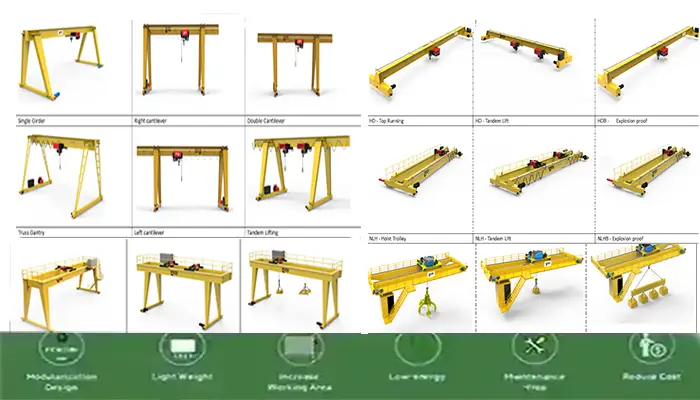
- Single girder overhead cranes: Commonly used in workshops, warehouses, equipment assembly facilities, and general manufacturing plants.
- Double girder overhead cranes: Suitable for heavier lifting duties, steel fabrication, machinery manufacturing, and industrial production lines.
- European-style overhead cranes: Available with compact structural designs, optimized headroom, and modern drive configurations.
- Low-headroom overhead cranes: Useful in buildings where roof clearance and available lifting height are limited.
- Under-running overhead cranes: Used where the overhead crane runs on a suspended runway system.
- Single girder gantry cranes for workshops and outdoor handling areas.
- Double girder gantry cranes for heavier industrial loads.
- Semi-gantry cranes for buildings with one supported runway side.
- Rubber-tired gantry cranes for applications requiring mobile lifting equipment.
Electric Hoists and Overhead Crane Components
If you already sell lifting equipment, adding hoists and overhead crane components may be a straightforward way to expand your product catalogue.
- Electric wire rope hoists.
- Electric chain hoists.
- Hoist trolleys and end carriages.
- Overhead crane motors, gearboxes, and brakes.
- Electrical control panels and radio remote controls.
- Overhead crane kits and spare parts.
Special-Purpose and Industrial Process Cranes
Once you have established a customer base, you may also want to offer overhead cranes and gantry cranes for more specialized applications.
| Crane Type | Typical Industrial Application |
|---|---|
| Grab overhead crane | Scrap yards, waste handling plants, bulk material storage, and cement factories. |
| Electromagnetic overhead crane | Steel mills, metal processing plants, and steel plate or scrap handling. |
| Explosion-proof overhead crane | Petrochemical facilities, chemical plants, and other classified hazardous areas. |
| Foundry crane | Foundries and metal production facilities handling hot metal and ladles. |
| Ladle crane | Steelmaking plants and metallurgical production lines. |
| Process crane | Automotive manufacturing, paper mills, power plants, and other production processes. |
You don't need to offer all these overhead crane types immediately. A better starting point is to look at what your existing customers are asking for. For example, an overhead crane distributor serving steel fabrication workshops may have more opportunities with double girder overhead cranes, electromagnetic cranes, and electric hoists than with container-handling equipment.
Which Parts of an Overhead Crane Can Be Customized for Your Brand?
This is usually one of the first things an overhead crane distributor wants to discuss with a private-label overhead crane manufacturer. Can the overhead crane carry your logo? Can you use your own overhead crane model numbers? Can the nameplate show your company name? What about the packaging and technical documents? In many cases, these arrangements can be discussed with your overhead crane supplier before production. The important thing is to define exactly what needs to be customized and confirm the details with the overhead crane manufacturer.
Company Logo and Brand Identity
Your company logo can be applied to different parts of the overhead crane or gantry crane, depending on the product design and branding agreement.
- Overhead crane bridge girder and end carriages.
- Electric hoist or trolley housing.
- Electrical control cabinet.
- Product identification labels.
- Instruction manuals and technical documents.
You can also specify your preferred paint colors, logo size, placement, and label design. If you plan to sell several overhead crane models, it is worth establishing a consistent visual style from the beginning.
For example, your single girder overhead cranes, double girder overhead cranes, gantry cranes, and electric hoists should look like products from the same brand, even if they are manufactured in different production batches at the overhead crane factory.
Overhead Crane Nameplates and Identification Plates
The nameplate is more than a place to display your logo. It identifies the overhead crane equipment and provides important technical information for operators, maintenance personnel, inspectors, and end users.
A private-label overhead crane nameplate may include the following information:
| Information | Typical Details |
|---|---|
| Brand name | Buyer's company or authorized overhead crane product brand. |
| Product type | Single girder overhead crane, double girder overhead crane, gantry crane, or electric hoist. |
| Model number | Agreed overhead crane product model or identification code. |
| Rated capacity | For example, 5 ton, 10 ton, or 20 ton. |
| Span and lifting height | Applicable overhead crane dimensions and rated lifting height. |
| Working class | Applicable ISO, FEM, or other agreed classification. |
| Electrical information | Voltage, frequency, phase, and relevant electrical ratings. |
| Serial number | Unique overhead crane equipment identification for production records and after-sales service. |
| Manufacturer information | Legal overhead crane manufacturer details and other information required by applicable regulations. |
One point needs attention: putting your own brand on an overhead crane nameplate does not automatically allow you to remove the original overhead crane manufacturer's legally required identification. Depending on the destination market and applicable machinery regulations, manufacturer details, traceability information, conformity markings, and other information may need to remain visible.
Agree on the overhead crane nameplate layout and legal identification requirements before production, rather than trying to change them after the overhead cranes have been manufactured at the plant.
Overhead Crane Specifications and Technical Configuration
Branding is only one part of private-label overhead crane manufacturing. For a serious overhead crane distributor, the technical configuration matters just as much.
You may want to establish your own standard overhead crane specifications for different markets. For example, an overhead crane distributor in Southeast Asia may need 415V, 50Hz, 3-phase electrical configurations, while another market may commonly require 400V or 480V systems.
Typical overhead crane customization options include:
- Lifting capacity, overhead crane span, and lifting height.
- Hoisting speed and overhead crane travelling speed.
- Working duty classification, such as ISO A3–A8 or FEM 1Am–5M, as applicable.
- Single girder or double girder overhead crane structural arrangement.
- Motor, gearbox, and brake brands.
- VFD control, pendant control, and radio remote control.
- Electrical voltage, frequency, and phase.
- Safety devices, limit switches, and anti-collision systems.
- Protection requirements for dust, moisture, temperature, or hazardous environments.
Take a steel fabrication workshop as an example. Its overhead crane may need to handle steel plates, fabricated beams, and heavy components throughout several shifts. A warehouse overhead crane handling occasional palletized loads has a different duty requirement. Even if both overhead cranes have the same rated capacity, their specifications should not necessarily be identical.
Technical note on duty classification: Under ISO 4301-1 and FEM 1.001, overhead crane duty class is determined by the load spectrum and total operating hours over the crane's design life. A3/M3 (light duty) is suitable for maintenance shops and occasional use, while A5/M5 (medium duty) is the most common industrial specification for machine shops and fabrication plants. A6/M6 and A7/M7 are required for steel mills, foundries, and continuous heavy handling. Specifying an overhead crane one or two classes below actual usage will accelerate fatigue on hoist motors, gearboxes, and wire ropes, often leading to premature failure within 18–24 months. Your overhead crane manufacturer should confirm the duty class against the customer's actual cycles per hour, average load ratio, and daily operating hours—not simply reuse a standard overhead crane model with a new logo.
For reference, a typical 10-ton single girder overhead crane with a span of 10–31.5 m and lifting height of 6–18 m is commonly offered in A3–A5 duty, with hoisting speeds around 1.6–7 m/min and overhead crane travel speeds of 20–30 m/min. A 15-ton double girder overhead crane intended for heavier service may be specified in A4–A7, with hoisting speeds of approximately 8.3/0.83 m/min (dual speed) and crane travel speeds up to 32 m/min. These parameters should be treated as illustrative starting points and confirmed against the actual application by your overhead crane supplier.
Packaging and Shipping Identification
Packaging is another part of your overhead crane brand presentation, especially if you import overhead crane kits, hoists, or components and distribute them to customers in your own market.
Depending on the order, you can discuss with your overhead crane manufacturer:
- Custom packaging labels and company logos.
- Brand identification on wooden cases and crates.
- Custom shipping marks and package numbers.
- Product labels for separately packed overhead crane components.
- Branded spare parts packaging.
- Customized packing lists and product identification documents.
For complete overhead cranes and gantry cranes, the equipment is often shipped in separate sections and packages rather than as one assembled machine. Good package identification makes receiving, inventory management, and installation much easier for your local team.
Who Owns the Overhead Crane Drawings, Designs, and Technical Specifications?
This is an important subject that should be discussed before you begin developing your own overhead crane product range with any overhead crane manufacturer. Suppose you work with a Chinese overhead crane manufacturer to develop a 10-ton double girder overhead crane under your brand. The overhead crane manufacturer prepares the general arrangement drawing, structural calculations, electrical diagrams, and manufacturing drawings. Can you take those overhead crane drawings to another factory or plant and ask it to manufacture the same crane? Not necessarily. The answer depends on the original design ownership, intellectual property rights, and the terms of your OEM overhead crane agreement.
Standard Manufacturer Drawings vs. Customer-Specific Drawings
Not all overhead crane technical drawings have the same ownership status.
| Drawing Type | Description | What to Agree On |
|---|---|---|
| Standard overhead crane product drawings | Existing designs and drawings developed by the overhead crane manufacturer. | Permitted use for quotations, sales, and manufacturing. |
| Customer-specific GA drawings | Drawings prepared for a particular overhead crane project based on the buyer's requirements. | Rights to use and share the project drawings. |
| Custom engineering drawings | New designs or engineering modifications developed for a specific overhead crane product range. | Ownership, licensing, and permitted manufacturing use. |
| Electrical diagrams | Control circuit diagrams and electrical system documentation. | Access, modification, and maintenance rights. |
| Manufacturing drawings | Detailed fabrication and assembly drawings used for overhead crane production. | Confidentiality and restrictions on third-party use. |
Can You Use Your Own Overhead Crane Model Numbers and Technical Datasheets?
Yes, this is something worth arranging when building a private-label overhead crane brand.
Instead of using the overhead crane manufacturer's internal product codes, you can establish your own product naming system. For example, you might have separate model series for single girder overhead cranes, double girder overhead cranes, gantry cranes, and electric wire rope hoists.
You can also prepare branded overhead crane technical datasheets and product catalogues that include:
- Your overhead crane product model and brand name.
- Standard capacity and span ranges.
- Available lifting heights and working classes.
- Standard motor and electrical configurations.
- Optional features and customization choices.
- Technical drawings and installation information, where authorized.
For repeat overhead crane orders, maintaining a controlled specification system is particularly useful. It reduces the risk of receiving different configurations under the same overhead crane model number.
What About Drawing Ownership and Intellectual Property?
Putting your company logo on an overhead crane does not mean you automatically own its engineering design. An overhead crane manufacturer may already have invested years in developing its standard overhead crane structures, hoisting mechanisms, and control systems.
If you want exclusive rights to a newly developed overhead crane product or project-specific design, this needs to be discussed separately with your overhead crane supplier.
Before signing an OEM overhead crane manufacturing agreement, clarify:
- Who owns the overhead crane manufacturer's existing designs and standard drawings.
- Who owns newly developed overhead crane drawings paid for by the buyer.
- Whether the buyer can use drawings for marketing and technical proposals.
- Whether the buyer can share drawings with local installation contractors.
- Whether the overhead crane manufacturer can supply the same design to other customers.
- How confidential technical information will be protected.
For most overhead crane distributors, the practical priority is having reliable access to the drawings and technical documents needed for sales, installation, maintenance, and repeat orders. Full ownership of every overhead crane manufacturing drawing may not be necessary.
How to Develop Your Own Overhead Crane Product Range and Specifications
If you want to sell overhead cranes under your own brand for the long term, it is better to develop a consistent overhead crane product range rather than quote every order as a completely different product. A clear product structure makes your overhead crane catalogue easier to understand and helps your sales team prepare quotations more efficiently.
Start with a Manageable Overhead Crane Product Range
For a new overhead crane brand, you might begin with a few commonly requested products.
| Product Series | Illustrative Capacity Range | Typical Customers |
|---|---|---|
| Single girder overhead crane | 1–20 ton | Workshops, warehouses, and general manufacturing plants. |
| Double girder overhead crane | 10–100 ton | Heavy manufacturing, steel fabrication, and industrial production facilities. |
| Gantry crane | 3–50 ton | Outdoor workshops, precast yards, and material storage areas. |
| Electric wire rope hoist | 0.5–50 ton | Overhead crane manufacturers, workshops, and industrial equipment distributors. |
| Electric chain hoist | 0.25–10 ton | Assembly lines, maintenance workshops, and light industrial handling. |
These are suggested commercial overhead crane product ranges, not universal design limits. Actual capacity ranges and configurations depend on the overhead crane manufacturer's production capabilities and the applicable technical requirements.
You can expand the overhead crane range later as your sales network develops. For example, an overhead crane distributor with regular customers in steel mills may gradually add electromagnetic cranes, grab cranes, and other process lifting equipment.
Establish Standard Overhead Crane Technical Configurations
For each overhead crane product series, prepare a basic technical specification sheet. This gives your sales team a consistent starting point when discussing overhead crane projects with customers.
For overhead cranes, the basic information should include:
- Rated lifting capacity.
- Overhead crane span and runway arrangement.
- Lifting height and available headroom.
- Working duty classification.
- Hoisting, cross-travel, and long-travel speeds.
- Motor and gearbox configuration.
- Electrical voltage, frequency, and phase.
- Control method and safety devices.
- Operating environment and applicable standards.
For example, a 10-ton overhead crane for a steel fabrication workshop may require a different duty classification, lifting speed, and control arrangement from a 10-ton overhead crane used for occasional warehouse loading.
Don't define an overhead crane product by lifting capacity alone. Your customers need an overhead crane that matches their actual working conditions.
Separate Standard Features from Optional Features
A useful way to manage your overhead crane product range is to define which features are included in the standard configuration and which are available as options.
| Standard Configuration | Optional Customization |
|---|---|
| Standard motor and gearbox arrangement. | Specified motor or gearbox brands. |
| Pendant control. | Radio remote control or cabin operation. |
| Standard paint finish. | Custom brand colors and paint systems. |
| Standard electrical configuration. | Market-specific voltage and frequency. |
| Standard working duty. | Higher duty classification where technically required. |
| Basic safety devices. | Additional anti-collision, overload protection, and other safety systems. |
This arrangement makes your overhead crane product catalogue easier to manage while leaving room for customized projects.
How Should Warranty and After-Sales Responsibilities Be Divided?
For an overhead crane distributor, warranty and after-sales service can be more challenging than the initial purchase. Your customer may contact your company when an overhead crane hoist stops working, a motor overheats, or a gantry crane develops an electrical fault. If the overhead crane was manufactured in China, you need a clear process for getting technical support and replacement parts from the overhead crane supplier.
What Should the Overhead Crane Manufacturer Be Responsible For?
Depending on the agreement, the overhead crane manufacturing partner may be responsible for:
- Manufacturing overhead cranes according to approved technical specifications.
- Conducting factory inspections and agreed testing.
- Providing technical drawings, manuals, and product documentation.
- Investigating manufacturing defects covered by the warranty.
- Providing replacement parts for approved warranty claims.
- Offering remote technical assistance to the overhead crane distributor.
What Should the Local Overhead Crane Brand or Distributor Handle?
The overhead crane distributor is usually closer to the end customer, so it often takes the lead in local service and communication.
- Receiving customer complaints and service requests.
- Collecting fault information, photos, and videos.
- Arranging local inspection and troubleshooting.
- Coordinating installation and commissioning where contracted.
- Maintaining suitable overhead crane spare parts inventory.
- Communicating warranty decisions and service arrangements to the customer.
How Does a Typical OEM Overhead Crane Warranty Claim Work?
Consider a situation where a customer reports a fault with an electric wire rope hoist supplied under your overhead crane brand.
- Customer reports the problem: The end user contacts your local service team.
- Information is collected: Your team records the hoist model, serial number, operating conditions, fault description, and supporting photos or videos.
- The overhead crane manufacturer reviews the issue: The manufacturer checks the technical information and provides an initial assessment.
- The cause is investigated: Both parties determine whether the issue relates to manufacturing, installation, operation, maintenance, or external conditions.
- A solution is agreed: The responsible party arranges technical support, replacement parts, or another agreed remedy.
This process works much better when both sides have access to the original overhead crane specifications, serial number records, and maintenance information.
What Should Be Included in the Overhead Crane Warranty Agreement?
| Warranty Item | What Needs to Be Defined |
|---|---|
| Warranty period | Start date, duration, and applicable operating conditions. |
| Covered components | Hoists, motors, gearboxes, brakes, electrical parts, and overhead crane structural components. |
| Warranty exclusions | Misuse, unauthorized modification, improper installation, and inadequate maintenance, as agreed. |
| Replacement parts | Availability, supply procedure, and shipping costs. |
| Labor costs | Responsibility for local inspection, removal, installation, and repair labor. |
| Technical support | Communication channels and expected response arrangements. |
| Warranty claims | Required evidence, review procedure, and claim approval process. |
One thing worth remembering: the overhead crane warranty you promise your end customer and the warranty you receive from your overhead crane manufacturer are two separate contractual arrangements. Make sure they are compatible. Otherwise, your company could end up paying for service costs that your manufacturing partner has not agreed to cover.
How to Divide Responsibilities Between Your Brand and the Overhead Crane Manufacturer
A successful OEM overhead crane relationship requires more than agreeing on a product price. Both companies need to know who is responsible for each stage, from engineering and production to delivery and local customer service.
The following table provides a practical starting point for an overhead crane OEM cooperation agreement.
Business Activity | Overhead Crane Manufacturer | Brand Owner / Distributor |
Product development | Provides engineering and manufacturing input. | Defines market demand and overhead crane product requirements. |
Technical specifications | Reviews feasibility and confirms the overhead crane design. | Provides customer requirements and approves the proposal. |
Engineering drawings | Prepares agreed overhead crane drawings and documentation. | Reviews and approves customer-facing project documents. |
Manufacturing | Handles overhead crane production and quality control. | Monitors progress as agreed. |
Branding | Applies approved logos, nameplates, and labels. | Provides brand assets and confirms artwork. |
Factory inspection | Conducts agreed inspections and testing at the crane plant. | Reviews records or arranges third-party inspection. |
Export packaging | Prepares packaging and export documents as agreed. | Confirms shipping and packaging requirements. |
Importation | Provides agreed export documentation. | Handles import clearance, duties, and local taxes. |
Installation | Provides technical support if included in the contract. | Arranges local overhead crane installation or appoints a contractor. |
Commissioning | Provides technical guidance or on-site support if agreed. | Coordinates local commissioning and customer handover. |
After-sales service | Provides technical assistance and agreed spare parts support. | Handles local customer communication and service coordination. |
Warranty | Handles manufacturing-related obligations under the OEM agreement. | Coordinates customer claims and fulfills its own contractual obligations. |
This is a general responsibility framework, not a fixed rule. For example, an experienced overhead crane distributor may have its own installation engineers, while a new equipment importer may depend more heavily on the Chinese overhead crane manufacturer for commissioning support.
Decide this before signing the order. It is much easier to agree on responsibilities at the beginning than to argue about them after a customer reports a problem with an overhead crane or gantry crane.
What Should Be Included in a Chinese OEM Overhead Crane Manufacturing Agreement?
A written OEM overhead crane agreement protects both sides and provides a reference when questions arise during production or after delivery. You don't need to make the first agreement unnecessarily complicated, but several areas should be covered.
Company and Branding Information
- Legal company names and registration information.
- Authorized overhead crane brand name and logo.
- Logo placement and nameplate design.
- Packaging and overhead crane product identification requirements.
- Trademark authorization and permitted brand usage.
Product and Technical Requirements
- Overhead crane product types, model numbers, and rated capacities.
- Approved technical specifications and drawings.
- Applicable design and manufacturing standards.
- Electrical configurations and component requirements.
- Quality inspection and acceptance criteria.
- Required manuals, certificates, and technical documents.
Commercial Terms
- Overhead crane product pricing and quotation validity.
- Minimum order quantity, if applicable.
- Payment terms and currency.
- Production lead time.
- Delivery terms and shipping arrangements.
- Spare parts pricing and supply arrangements.
- Pricing arrangements for repeat overhead crane orders.
Brand Protection and Intellectual Property
- Ownership and authorized use of trademarks.
- Ownership of standard and customized overhead crane drawings.
- Confidentiality of customer and technical information.
- Restrictions on unauthorized use of the buyer's brand.
- Territory or exclusivity arrangements, where applicable.
Quality, Warranty, and Liability
- Overhead crane manufacturing quality requirements.
- Inspection and factory acceptance procedures.
- Warranty coverage and exclusions.
- Defect handling and replacement parts.
- Technical support and after-sales arrangements.
- Allocation of liability and dispute resolution.
Managing Product Changes
For a long-term private-label overhead crane manufacturing relationship, it is also worth agreeing on how product changes will be managed. If the overhead crane manufacturer changes a motor, gearbox, brake, or electrical component, should it notify you first? For a branded overhead crane product range, the answer should normally be yes, particularly when the change affects approved specifications, safety, or maintenance.
How Much Does It Cost to Build Your Own Overhead Crane Brand?
There is no single fixed investment required to start an overhead crane brand. The amount depends on your overhead crane product range, order volume, branding requirements, market, and the level of local service you intend to provide.
The main difference between OEM overhead crane manufacturing and setting up your own crane factory or plant is where the manufacturing investment sits. With OEM cooperation, you purchase overhead cranes from an established overhead crane manufacturer rather than investing in all the production facilities yourself.
However, you still need a budget for overhead crane product purchases, brand development, working capital, and customer support.
Cost Category | What It Covers |
Product development | Engineering modifications, customized overhead crane drawings, and initial product development. |
OEM manufacturing | Purchase cost of overhead cranes, gantry cranes, hoists, or components. |
Branding | Logo application, nameplates, labels, packaging, and product documentation. |
Certification and compliance | Applicable testing, conformity assessment, inspection, and market-specific compliance. |
Importation and logistics | International freight, insurance, customs clearance, duties, and local taxes. |
Local operations | Warehousing, sales staff, overhead crane installation, commissioning, and service support. |
Marketing | Website development, overhead crane catalogues, exhibitions, advertising, and sales materials. |
Spare parts inventory | Common replacement components and initial after-sales stock. |
Indicative FOB China pricing (2026): To help with early-stage budgeting, publicly listed wholesale price bands from Chinese overhead crane suppliers suggest single-girder 5-ton overhead cranes in the range of USD 4,500–8,500, double-girder 20-ton overhead cranes at approximately USD 18,000–32,000, and double-girder 50-ton overhead cranes at USD 45,000–78,000. A 10-ton gantry crane with a 16 m span may fall in the USD 12,000–22,000 range, while a 1-ton electric chain hoist is commonly quoted between USD 380 and 680. These figures are indicative only and vary with specification, span, lifting height, duty class, and certification requirements. Chinese-manufactured overhead cranes are typically priced 30–50% below equivalent European brands at the same FEM duty class. Overhead crane distributors should treat these as reference bands for initial feasibility, not as firm quotations from any specific overhead crane manufacturer.
OEM Overhead Crane Manufacturing vs. Building Your Own Crane Factory or Plant
Investment Area | Building Your Own Crane Factory or Plant | Working with an Overhead Crane OEM |
Production facilities | Requires investment in factory buildings and equipment. | Uses the overhead crane manufacturer's existing facilities. |
Engineering team | Requires in-house engineering personnel. | Can use the overhead crane manufacturer's engineering resources under the agreement. |
Production workers | Requires recruitment and workforce management. | Production workforce is managed by the overhead crane manufacturer. |
Quality control | Requires an internal quality management system. | Relies on the manufacturer's quality system, agreed inspections, and acceptance procedures. |
Product branding | Managed internally. | Can be customized through private-label overhead crane arrangements. |
Business focus | Manufacturing, engineering, sales, and service. | Sales, brand development, technical coordination, and local service. |
For a company that already has a customer base but lacks manufacturing capacity, OEM cooperation with an overhead crane manufacturer can be a more practical starting point. You can test demand, develop an overhead crane product range, and build your brand before considering whether factory or plant investment makes commercial sense.
How to Choose the Right Chinese Overhead Crane Manufacturer or Supplier
Not every crane factory or plant is suitable for private-label overhead crane manufacturing. A supplier may be able to produce a standard overhead crane, but that doesn't automatically mean it can support your brand over several years. When comparing Chinese overhead crane manufacturers and overhead crane suppliers, look beyond the initial quotation.
Check Actual Overhead Crane Manufacturing Capability
- Does the company manufacture overhead cranes and gantry cranes in its own facilities or plant?
- Can it produce both standard and customized overhead crane systems?
- Does it manufacture electric hoists and relevant overhead crane components?
- Can it handle the capacities and working duties you plan to sell?
- Does it have experience with your target industrial applications?
Evaluate Overhead Crane Engineering Support
A good OEM overhead crane partner should be able to discuss more than product prices. Its engineering team should understand overhead crane selection, structural design, lifting mechanisms, electrical systems, and operating conditions.
Ask whether the overhead crane manufacturer can prepare general arrangement drawings, review customer specifications, modify standard configurations, and provide technical documentation in a format your local team can use.
Review Quality Control and Documentation
Ask how the overhead crane factory controls material quality, welding, machining, assembly, electrical installation, and final testing.
You should also confirm which inspection reports, load test records, certificates, and technical documents can be supplied with each overhead crane order. If your market requires third-party inspection or specific conformity documentation, discuss this with your overhead crane supplier before production.
Check OEM Cooperation Experience
For private-label overhead crane manufacturing, ask practical questions:
- Can the overhead crane manufacturer apply your company logo and custom nameplates?
- Can it follow your overhead crane product model numbers and branding guidelines?
- Can it supply customized overhead crane catalogues and technical documents?
- Can it maintain consistent overhead crane specifications across repeat orders?
- Can it protect your brand and customer information?
- Can it provide spare parts and technical support over the overhead crane's service life?
Discuss a Trial Order
It is also useful to discuss a trial order. A smaller initial overhead crane order can help you evaluate product quality, communication, packaging, documentation, and delivery performance before committing to a larger OEM arrangement with an overhead crane manufacturer.
How to Start Your First OEM Overhead Crane Order
If you are ready to develop your own overhead crane brand, you don't need to prepare a complicated business plan before contacting an overhead crane manufacturer. Start with a clear idea of what you want to sell and the customers you want to serve.
Step 1: Define Your Target Market
Identify the industries and customers you plan to serve. Are you targeting steel fabrication workshops, warehouses, automotive plants, precast concrete factories, ports, or general manufacturing facilities?
Your target market will influence the overhead crane types, capacities, working duties, and electrical configurations you need.
Step 2: Select Your Initial Overhead Crane Product Range
Choose a few overhead crane products that match your existing sales channels. For example, you might begin with single girder overhead cranes, double girder overhead cranes, gantry cranes, and electric wire rope hoists before expanding into special-purpose cranes.
Step 3: Prepare Your Branding Requirements
Provide the overhead crane manufacturer with your company logo, preferred colors, brand name, model numbering system, nameplate layout, and packaging requirements.
Step 4: Submit Your Overhead Crane Technical Requirements
Prepare the basic technical information for each overhead crane product, including lifting capacity, span, lifting height, working class, voltage, frequency, control method, and operating environment.
For customized overhead crane projects, also provide building drawings, runway information, load details, and any special operating requirements available.
Step 5: Review Drawings and Overhead Crane Product Configurations
Before production, check the approved overhead crane drawings, technical specifications, component brands, electrical configuration, and branding details. Make sure the overhead crane manufacturer is working from the latest approved documents.
Step 6: Confirm the OEM Overhead Crane Agreement
Agree on pricing, payment, lead time, inspection, packaging, warranty, drawing rights, and after-sales responsibilities with your overhead crane supplier. Put the important points in writing.
Step 7: Complete Manufacturing and Inspection
Follow the overhead crane production schedule and arrange the agreed factory inspection and testing. Check that the nameplates, logos, documents, and packing identification match your approved requirements.
Step 8: Develop Your Local Overhead Crane Market
Once your first overhead cranes are ready, prepare your overhead crane product catalogue, website, technical sales materials, spare parts plan, and customer service arrangements. Your brand needs to offer more than a different logo. Reliable technical support and consistent overhead crane product quality are what help customers trust it over time.
Frequently Asked Questions About Private-Label Overhead Crane Manufacturing
Answers to common questions about private-label overhead crane manufacturing, covering brand ownership, logo application, model numbers, local market customization, drawing ownership, multi-product branding, MOQ, warranty claims, exclusivity, and spare parts supply.
Can I sell overhead cranes under my own brand without owning a factory or plant?
Yes. You can cooperate with an overhead crane manufacturer that produces overhead crane equipment according to agreed specifications and branding requirements. Your company can focus on sales, customer relationships, importation, and local service while the overhead crane manufacturer handles production at its plant.
Can a Chinese overhead crane manufacturer put my company logo on an overhead crane?
Yes, subject to the overhead crane manufacturer's capabilities and agreement. Your logo can typically be applied to the overhead crane structure, hoist, electrical cabinet, product labels, and packaging. Legally required manufacturer and equipment identification must also be maintained.
Can I use my own overhead crane model numbers and nameplates?
Yes. You can establish your own overhead crane model numbering system and customized nameplate layout. Agree on the technical information, traceability details, and required manufacturer identification with your overhead crane supplier before production.
Can I customize overhead crane specifications for my local market?
Yes. Common overhead crane customization options include capacity, span, lifting height, working duty, motor brands, control systems, electrical voltage, frequency, and safety devices. The final overhead crane configuration must be reviewed and approved by the overhead crane manufacturer.
Who owns the overhead crane drawings in an OEM manufacturing agreement?
It depends on the agreement. Existing standard overhead crane drawings usually remain the manufacturer's intellectual property unless otherwise agreed. Ownership or usage rights for customer-funded custom engineering should be defined separately in writing.
Can I sell overhead cranes, gantry cranes, and electric hoists under the same brand?
Yes. Many lifting equipment distributors develop an overhead crane product range that includes overhead cranes, gantry cranes, electric wire rope hoists, electric chain hoists, and overhead crane components. Working with one overhead crane manufacturer for several product categories can also simplify technical coordination and spare parts purchasing.
Is there a minimum order quantity for private-label overhead crane manufacturing?
There is no universal MOQ. It depends on the overhead crane product, customization level, and manufacturer. Custom nameplates or logo application may be possible for individual overhead crane orders, while special product development or customized packaging may require additional costs or minimum quantities.
Who handles warranty claims for private-label overhead cranes?
The local overhead crane distributor usually communicates with the end customer and collects fault information, while the overhead crane manufacturer investigates manufacturing-related issues and provides agreed technical support or replacement parts. The exact responsibilities should be defined in the warranty agreement.
Can I become an exclusive overhead crane distributor in my country?
Potentially, but exclusivity is a separate commercial arrangement. It may depend on sales targets, annual order volume, market development commitments, product coverage, and territory restrictions. Both parties should agree on the conditions in writing.
Can a Chinese overhead crane manufacturer supply spare parts for my overhead crane brand?
Yes, this can be arranged as part of the OEM cooperation with your overhead crane supplier. Discuss spare parts identification, component specifications, pricing, availability, and long-term supply arrangements. Maintaining accurate overhead crane product model and serial number records will make future parts orders easier.
Build Your Own Overhead Crane Brand with Yuantai Crane
If you already have customers and sales channels in the lifting equipment market, developing your own overhead crane brand can be a practical next step. You don't necessarily need to invest in a complete overhead crane manufacturing facility or plant to expand your product range.
Yuantai Crane has been involved in overhead crane manufacturing since 1984, supplying overhead cranes, gantry cranes, electric hoists, and customized lifting equipment for different industrial applications.
As an experienced overhead crane manufacturer and overhead crane supplier, we support distributors, dealers, importers, and regional crane brands with OEM manufacturing arrangements covering:
- Single girder and double girder overhead cranes.
- Gantry cranes and customized industrial lifting systems.
- Electric wire rope hoists and electric chain hoists.
- Overhead crane components and spare parts.
- Customized overhead crane technical specifications and engineering drawings.
- Customer logos, nameplates, product identification, and packaging.
- Factory inspection, technical documentation, and export support.
Whether you are launching a new overhead crane brand or adding overhead cranes and gantry cranes to an existing lifting equipment business, the first step is to define the overhead crane products you want to sell and the requirements of your target market.
Looking for a Chinese Overhead Crane Manufacturer or Overhead Crane Supplier for Your Brand?
Tell us about your company, target market, planned overhead crane product range, and branding requirements. If you already have overhead crane technical specifications or reference drawings, you can send them for an initial review.
Our engineering team can discuss suitable overhead crane and gantry crane configurations, manufacturing arrangements, customization options, and the technical support required for your business.
Contact Yuantai Crane to discuss your private-label overhead crane manufacturing requirements.
Related Articles
Reference articles for overseas crane companies evaluating Chinese OEM manufacturing, covering cooperation models, kit vs. local manufacturing decisions, brand building, sourceable products, supplier selection, technical requirements, quality control, and order pricing.
Focus: Explain OEM manufacturing, how overseas companies cooperate with Chinese crane factories, what can be manufactured, and how the cooperation works.
Why it matters: Buyers need to understand whether they can use a Chinese factory as a manufacturing partner without building their own production facilities or giving up their local market and brand.
Target buyers: Local crane manufacturers, crane engineering companies, established crane distributors, and companies planning to launch their own crane product range.
Focus: Compare three business models: local manufacturing, importing complete cranes, and importing crane kits or major components for local assembly.
Why it matters: This is a practical investment decision. Buyers want to know which parts they should manufacture themselves and which parts are more suitable to source from China.
Focus: Private-label manufacturing, customer branding, nameplates, drawings, product specifications, packaging, warranty, and division of responsibilities.
Why it matters: Buyers may have their own customers and sales channels but lack the manufacturing capacity to produce every crane or component themselves. They need to know whether they can sell products under their own brand.
Focus: Explain the products buyers can source: end carriages, hoists, trolleys, travel mechanisms, wheels, motors, brakes, electrical systems, crane kits, and complete overhead and gantry cranes.
Why it matters: Many buyers know they want to source from China but are unsure how much of the crane manufacturing process they can outsource. This article helps them identify the products relevant to their business.
Focus: Factory capability, engineering team, manufacturing processes, welding and machining, assembly, testing, export experience, and supplier verification.
Why it matters: Overseas buyers face difficulty distinguishing a real manufacturer from a trading company or a supplier that outsources most of the work. They need evidence of manufacturing and engineering capability.
Focus: What buyers need to provide before production: GA drawings, capacity, span, lifting height, duty class, wheel loads, connection dimensions, motors, electrical requirements, operating environment, and applicable standards.
Why it matters: Incomplete specifications cause quotation delays, design changes, component mismatches, and problems during local assembly. This article helps buyers prepare a useful technical inquiry.
Focus: Incoming material inspection, welding, machining, component verification, assembly, functional testing, load testing where applicable, FAT, inspection reports, and third-party inspection.
Why it matters: The buyer may not be present during manufacturing. They need to know what evidence to request and how to check that the delivered products match the approved drawings and specifications.
Focus: How OEM prices are calculated, customization costs, minimum order quantities, sample orders, production lead times, export packaging, freight, Incoterms, payment terms, and warranty.
Why it matters: Buyers need to calculate the total purchasing cost, not just the factory quotation. They also need to understand whether their order volume and delivery requirements are practical.

Article by Bella ,who has been in the hoist and crane field since 2016. Bella provides overhead crane & gantry crane consultation services for clients who need a customized overhead travelling crane solution.Contact her to get free consultation.
Yuantai Cranes
Overhead Crane Manufacturer with CE, ISO, SGS, CNEX Certificates.
- Main Specifications - Capacity: 0.5–550 tons | Span: up to 40m | Speed: 0.8–12 m/min | Duty: A3–A7 | Power: 380–690V, 50/60Hz | Control: pendant/remote/cabin
- Full engineering: FEA/PLC/VFD + in-house build + global delivery + on-site support, for workshops, factories, EPC contractors, industrial projects, etc.
- Support: design, manufacturing, testing, service – end-to-end, customized lifting solutions worldwide.
How to Get an Accurate Crane Price for Your Application?
Tips: Copy the spec list, fill in your details, and paste it into the form on the right/ down-below for a quick price.
- Crane type:_____ . (e.g., overhead crane, gantry crane, jib crane)
- Max weight to lift:_____ tons. (e.g., 2t, 5t, 10t, 20t, 50t)
- Lifting height:_____ m. (How high does the hook need to reach?
- Workshop width (span):_____ m . (Distance between the two crane rails)
- Travel distance:_____ m . (How long does the crane need to move along the runway?)
- Control type:_____. (Pendant / remote / cabin Control)
- Power supply:_____. (Local voltage & frequency – e.g., 380V, 50Hz, 3-phase)
- What will it be used for?_____ (e.g., steel fabrication, concrete products, mold handling, general manufacturing, etc.)
- Any special requirements?_____ (e.g., extreme temperature, dusty or explosive environment, special paint color, etc.)
Just leave a message via the contact form and our hoist and crane engineer will contact you with in 24working hours.
Get Your Custom Quote–Quick & Easy
Fill in what you know. Skip what you don't – we'll help.Any question will be reply with 24 working hours