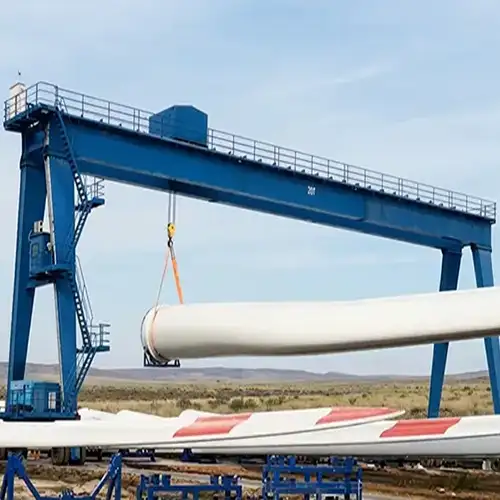
RTG Crane 20T×2 Tandem Lifting Wind Blades Oman Case
Oman wind project using 20T×2 RTG gantry cranes for tandem wind blade lifting. Practical case study for crane buyers and wind energy projects.
| Crane Type | Double Girder Rubber Tyred Gantry Crane with A Frame Design |
| Crane Capacity | 20 ton per RTG crane × 2 units; the two cranes operate together for synchronized tandem lifting. Combined rated capacity: 40 ton for the two-crane system, subject to the actual load distribution and engineered tandem-lifting procedure. |
| Span Length | Project-specific A-frame gantry working width and travel range; the rubber-tyred design allows the cranes to reposition between turbine locations without fixed rails. |
| Lifting Height | Project-specific; customized according to wind turbine blade dimensions, transport position, installation height, turbine foundation layout and required hook travel. |
| Coverage Area Type | Wind farms, turbine installation areas, component unloading zones, temporary assembly areas, construction sites, remote desert work areas and other large outdoor renewable-energy project sites in Oman. |
| Application | Typical Tasks: Wind Blade Unloading / Tandem Lifting / Horizontal Transfer / Positioning / Assembly / Installation / Site Relocation · Typical Loads: Wind Turbine Blades · Tower Sections · Nacelle Components · Wind Turbine Components · Long and Oversized |
| Certifications | CE / ISO / SGS / Other third-party inspection |
| Customization | Configuration: Rubber-Tyred Gantry / Double Girder / A-Frame / Tandem Lifting · Capacity: 20 ton per crane / 40 ton combined rated capacity for the two-crane system · Travel: Rubber Tyres / Multi-Directional Steering· Control: Synchronized Tandem Control |
Crane Manufacturer: Yuantai Cranes – 30+ Years Professional Crane Manufacturer from China
Category: Oman
Tags: oman,rtgcrane,20ton
Your Trusted Rubber Tyred Gantry Cranes Manufacturer & Supplier
RTG Gantry Crane 20 Ton × 2 Tandem Lifting of Wind Blades in Oman
Project Overview
This project is located in Oman, at a wind energy construction site that is part of a larger renewable energy development area. The site is typical of many industrial projects in Oman—wide open land, long distances between working points, and exposure to natural desert conditions.
Project Location and Industrial Environment (Oman)
Oman's wind energy sites are usually located in open desert or semi-desert regions. These areas are chosen for wind resources, but they also bring clear working challenges for lifting equipment.
Typical site conditions include:
- Large open working zones with long distances between turbine foundations
- Desert terrain with sand, loose soil, or partially compacted ground
- Strong sunlight and high daytime temperatures
- Occasional wind that affects long lifting components like blades
- Limited permanent infrastructure during early construction stages
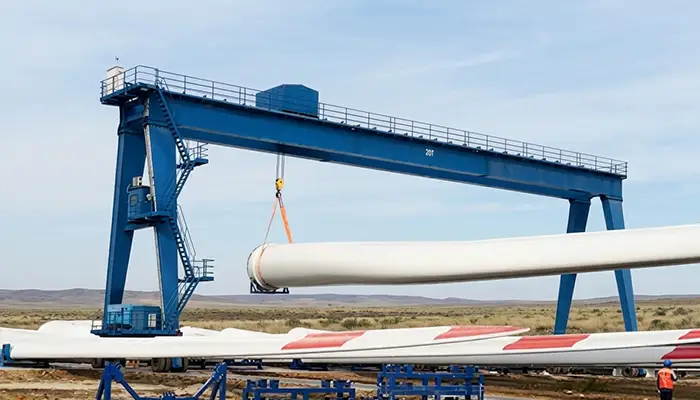
Because of these conditions, equipment used on site must be mobile, stable, and easy to reposition.
Equipment Used on Site
The project uses:
- 2 sets of 20 ton RTG gantry cranes with A frame designs
- Rubber-tyred travel system (no rail dependency)
- Outdoor operation design for wind farm construction
Each crane has a 20-ton lifting capacity and is designed to work independently or together in synchronized lifting.
Why This Setup Fits Oman Wind Energy Projects
In many Oman industrial sites, especially wind farms, flexibility is more important than fixed installation systems. Rail-mounted cranes are often not suitable because site layouts change as construction progresses.
The 20 ton rubber tyred gantry crane system was selected because:
- It can move directly on desert ground without rails
- It adapts to changing turbine installation layouts
- It reduces site preparation work in remote areas
- It supports relocation between multiple turbine positions
This is particularly useful in Oman, where wind farm sites are often spread across large geographic areas.
Tandem Lifting for Wind Blade Handling
Wind turbine blades used in Oman projects are long and sensitive to bending. In open desert conditions, wind influence can also affect stability during lifting.
To manage this, two 20 ton RTG gantry cranes are used together.
Working method:
- Each crane supports one lifting point of the blade
- Load is shared evenly between both cranes
- Movement is controlled slowly and in coordination
- The blade remains balanced during lifting and transport
This approach helps reduce stress on the blade structure and improves control during installation.
Field Operation in Oman Conditions
On site, the workflow is practical and direct:
- Cranes move across open desert ground to turbine locations
- Positioning is adjusted based on terrain and installation layout
- Tandem lifting is carried out step by step, not rushed
- Operators focus on balance, distance, and ground stability
The equipment is not used in a controlled factory environment. It is working in real outdoor conditions where dust, heat, and open wind are part of daily operation.
Summary
This Oman wind energy project shows how 20 ton RTG gantry cranes can be used effectively in large-scale outdoor industrial environments.
Key points from the project:
- Open desert geography requires mobile lifting equipment
- Wind farm layouts need flexible crane movement
- Long wind blades require tandem lifting for stability
- Rubber-tyred gantry design avoids rail infrastructure limits
In Oman's industrial conditions, especially in renewable energy construction, practical mobility and stable lifting performance are more important than complex systems.
Client Industry Background
The client is working in the wind energy and renewable energy construction sector in Oman, part of the wider Middle East region where clean energy projects are developing step by step. In this type of work, the focus is not only on building turbines, but also on how smoothly and safely the installation process can be carried out on site.
Industry: Wind Energy / Renewable Energy Construction
Wind energy projects involve heavy lifting, long transport distances on site, and careful assembly work. The main components—such as blades, nacelles, and tower sections—are large, sensitive, and expensive.
So in daily operation, the industry depends heavily on reliable lifting equipment that can perform consistently under outdoor conditions.
Region: Oman, Middle East
Oman is a key location for wind energy development in the region. Many projects are located in open desert or semi-desert areas, where:
- Wind resources are strong and stable
- Land is wide and suitable for turbine spacing
- Site conditions are natural and less industrialized
At the same time, these areas also require equipment that can handle heat, dust, and uneven ground without difficulty.
Project Type: Large-Scale Wind Farm Installation
This is not a small or temporary project. It is a large wind farm installation project, where multiple turbines are built across a wide area.
Typical work includes:
- Transporting wind turbine components across long distances
- Lifting and positioning blades and tower sections
- Coordinating multiple installation points across the site
- Maintaining steady progress under outdoor conditions
Because of the scale, equipment mobility and reliability become very important.
Key Focus: Safe Handling of Oversized Wind Turbine Components
The most important requirement from the client is simple and clear: safety during handling of large wind components.
These components are:
- Long wind turbine blades that are flexible and wind-sensitive
- Heavy nacelles with concentrated weight
- Tall tower sections requiring stable lifting balance
So the operation needs controlled lifting, stable movement, and careful positioning at every step. In this kind of project, even small instability during lifting can affect installation quality.
That is why the selection of 20 ton RTG gantry cranes in tandem operation fits the working needs of this wind energy project in Oman.
Lifting Challenge in Wind Blade Handling
Wind turbine blade handling in Oman is not a simple lifting job. The blades used in wind energy projects are very long, light in structure compared to their size, and flexible. This combination makes them difficult to control once they are lifted off the ground.
Wind Blades Are Extremely Long and Flexible
Wind turbine blades used in large-scale projects can reach very long lengths. Because of this, they do not behave like rigid steel parts during lifting.
Once lifted, the blade will naturally bend slightly under its own weight. This is normal, but it also means the lifting method must support the blade evenly along its length, not just from one point.
Single-Point Lifting Causes Bending Risk
Using a single lifting point is not suitable for this type of component.
When the blade is lifted from one end or one central point:
- The load becomes uneven
- The blade can bend more than expected
- Internal stress increases along the structure
- Positioning becomes harder to control
This is why single crane lifting is often avoided for long wind blades in real installation work.
High Sensitivity to Wind During Outdoor Lifting
In Oman wind farm sites, the environment is open. There are no buildings or barriers to block natural wind flow.
This creates a practical challenge during lifting:
- Even moderate wind can affect blade stability
- Long blades act like a "sail" during movement
- Small wind changes can shift balance during transport
So lifting must be slow, controlled, and stable, especially when the blade is suspended in the air.
Need for Precise Balance Control During Transport
Once the blade is lifted, keeping balance becomes the key issue.
The operator must ensure:
- Both ends of the blade stay level
- Movement is smooth without sudden shifts
- No twisting occurs during travel
- Load remains evenly distributed at all times
This requires coordinated lifting control, especially when more than one crane is used.
Limited Infrastructure at Remote Wind Farm Site
Most wind farm sites in Oman are located in remote desert areas. These locations usually do not have full industrial infrastructure at the early stage of construction.
Common limitations include:
- No fixed crane rails or runway systems
- Large distances between turbine positions
- Temporary ground preparation only
- Limited lifting support facilities on site
Because of this, the lifting system must be flexible and mobile. Equipment needs to work directly on site conditions without relying on permanent structures.
Summary
The main difficulty in wind blade handling is not only weight, but also shape, length, and environmental exposure.
In Oman wind farm projects, these factors combine to create a lifting task that requires:
- Stable support across long blade lengths
- Controlled balance during movement
- Adaptability to open wind conditions
- Flexible operation without fixed infrastructure
This is why specialized solutions like 20 ton RTG gantry crane tandem lifting systems are used in such projects.
Engineering Solution: RTG Crane 20T × 2 Tandem System
To handle long wind turbine blades in Oman wind farm conditions, the project uses a tandem lifting system based on two 20 ton rubber tyred gantry cranes (RTG cranes). The idea is simple in structure but very practical in operation: two cranes work together as one coordinated lifting unit.
Equipment Configuration
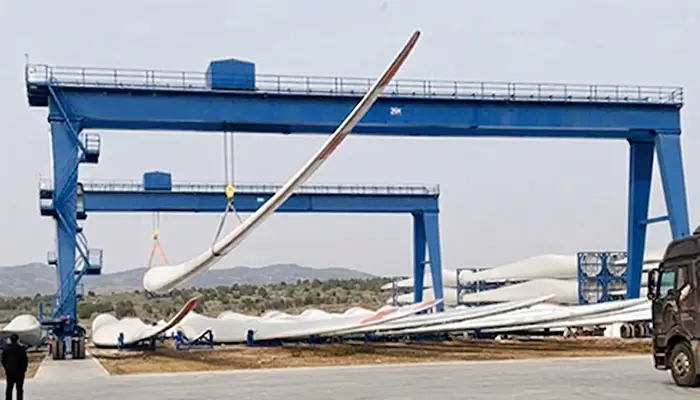
The system is built with a clear and straightforward setup:
- Two units of 20 ton RTG gantry cranes are deployed on site
- Both cranes are matched in lifting capacity and travel performance
- A synchronized control system is used for tandem operation
- Rubber-tyred travel design allows movement across the wind farm site without rails
This configuration allows the cranes to be positioned freely across different turbine locations, which is important in large open desert sites like those in Oman.
Synchronized Tandem Lifting Control System
The key part of this solution is the synchronized control between the two cranes.
In operation:
- Both cranes receive coordinated lifting commands
- Speed and lifting height are controlled together
- Operators monitor balance during the entire lifting process
- Small adjustments are made in real time to keep stability
This coordination is necessary because wind blades are long and flexible, and even small imbalance can affect their position during lifting.
Rubber-Tyred Mobility for Full Site Access
Unlike rail-mounted systems, the 20 ton RTG gantry cranes used in this project are fully mobile.
This means:
- Cranes can move directly on prepared ground
- No fixed runway beams or rail installation is required
- Equipment can shift between multiple turbine foundations
- Positioning can be adjusted based on installation progress
In Oman wind farm sites, where distances between turbines are large, this mobility reduces unnecessary waiting time and improves site coordination.
Working Principle of Tandem Lifting
The operation method is based on controlled dual lifting:
- Two cranes lift the wind blade at the same time
- Each crane supports one lifting point on the blade
- The load is shared evenly between both cranes
- Movement is slow and coordinated to avoid twisting
During transport, both cranes move together step by step. The blade stays balanced because the lifting force is distributed across two points instead of one.
Stability and Control During Operation
The main focus of this system is stability. Wind blades are long and sensitive, so the lifting process must remain controlled at all times.
To achieve this:
- Operators maintain synchronized movement between both cranes
- Load balance is checked continuously during lifting
- Adjustments are made if wind or ground conditions change
- Movement speed is kept steady to avoid sudden shifts
This controlled approach helps reduce stress on the blade and supports safe installation in outdoor wind farm environments.
Summary
The RTG crane 20T × 2 tandem system provides a practical solution for wind blade handling in Oman.
It combines:
- Two 20 ton gantry cranes working together
- Synchronized lifting control for balance
- Rubber-tyred mobility for flexible site movement
This setup is designed for real wind energy construction conditions where stability, coordination, and site flexibility are more important than fixed lifting infrastructure.
Key Technical Features
The 20 ton RTG gantry crane × 2 tandem lifting system used in this Oman wind farm project is designed with a focus on stable outdoor operation, simple control, and reliable performance under real site conditions. Each feature below is directly related to how the equipment performs during wind turbine blade handling.
Rated Capacity: 20 Ton × 2 Units
The system consists of two 20 ton rubber tyred gantry cranes, working together during lifting.
- Each crane supports part of the total load
- Combined lifting capacity is used for long wind blades
- Load is distributed instead of concentrated at one point
- Suitable for oversized wind turbine components
This setup is especially useful when handling flexible and long structures like wind blades.
Tandem Synchronized Lifting System
Both cranes operate in a coordinated lifting mode.
- Lifting speed is controlled together
- Height adjustment is synchronized
- Operators monitor balance during lifting
- Movement is kept steady to avoid stress on the blade
In wind energy projects, this type of synchronized control helps maintain stability during critical lifting steps.
Rubber-Tyred Gantry Crane Mobility System
The crane uses a rubber-tyred travel system instead of fixed rails.
- Moves directly on prepared ground
- No runway beam or rail installation required
- Can travel between different turbine positions
- Suitable for large open wind farm sites in Oman
This makes the system flexible for changing site layouts during construction.
Multi-Directional Steering for Flexible Positioning
The cranes are designed for site flexibility.
- Forward and reverse movement
- Side shifting capability
- Controlled turning in limited space
- Easy repositioning near turbine foundations
This is useful in wind farms where installation points are spread across large areas.
Outdoor Wind Farm Working Design
The structure is built for outdoor use in real environmental conditions.
- Suitable for desert and coastal wind farm sites
- Designed for heat, dust, and open wind exposure
- Stable performance on uneven ground conditions
- Continuous operation during installation phases
This is important for projects in Oman, where working conditions are often harsh and open.
Stable Structure for Long-Span Loads
Wind turbine blades are long and flexible, so structural stability is critical.
- Reinforced gantry frame design
- Balanced load distribution across the span
- Reduced bending risk during lifting
- Strong support for long components
The structure helps maintain control during both lifting and transport.
Real-Time Load Balancing Control
During tandem lifting, load balance must be controlled carefully.
- Continuous monitoring of lifting points
- Adjustment during movement if imbalance occurs
- Coordination between two crane operators
- Helps maintain smooth and safe blade handling
This feature is important when working with long wind blades in outdoor wind conditions.
Summary
The 20 ton RTG gantry crane × 2 tandem system is designed for practical wind energy construction work in Oman.
It combines:
- Dual 20 ton lifting capacity
- Synchronized tandem control
- Flexible rubber-tyred mobility
- Outdoor-ready structural design
- Real-time load balancing for safety
Together, these features support safe and stable handling of wind turbine components in real site conditions.
Advantages for Wind Energy Projects in Oman
In Oman, wind energy projects are usually built in wide desert or semi-desert regions, far from heavy industrial cities. The sites are open, flat in some areas, but often uneven in natural ground conditions. Sand, heat, and long distances between turbine positions are part of daily work. In this kind of geography, equipment choice is not only about lifting capacity. It is also about how well the system adapts to the land, the layout of the wind farm, and the way installation teams actually work on site. The 20 ton RTG gantry crane × 2 tandem system fits these conditions in a practical way.
Safe Lifting of Ultra-Long Wind Turbine Blades
Wind turbine blades used in Oman projects are long and sensitive. In open desert sites, wind influence is also stronger because there are no buildings or barriers.
- The blade is lifted from two points
- The load is shared evenly
- The blade stays more stable during lifting and movement
This is especially important in open areas where even small wind changes can affect balance.
Reduces Structural Stress During Lifting
In Oman wind farms, blades often need to be moved across long distances on site before installation.
- Spread the load across the blade length
- Reduce bending during lifting
- Lower stress during transport across uneven ground
This makes handling more controlled in real field conditions.
No Need for Rail or Fixed Gantry Infrastructure
Many wind farm sites in Oman are located in remote desert areas. Building permanent rail systems or fixed gantry foundations is not always practical.
- No rail installation required
- No fixed runway beams needed
- Cranes can move freely across the site
This matches well with temporary and fast-developing wind farm layouts.
Flexible Deployment Across Wind Farm Layout
Wind farms in Oman are usually spread over large areas, with long spacing between turbine positions.
- Easy movement from one turbine location to another
- Quick repositioning during installation stages
- Flexible adjustment based on site progress
This reduces waiting time between lifting operations.
Suitable for Desert and Uneven Terrain Conditions
Oman's wind farm geography often includes:
- Sandy soil
- Semi-compacted desert ground
- Slight uneven surfaces
The RTG crane system is designed to operate directly on such terrain without requiring fully industrialized ground preparation. This makes it more practical for early-stage construction environments.
Faster Installation Workflow
Because the cranes can move freely and do not depend on fixed infrastructure:
- Setup time on site is shorter
- Relocation between lifting points is quicker
- Coordination between installation teams becomes smoother
In large wind projects, this helps maintain a steady installation rhythm.
Lower Infrastructure Investment Cost
In many Oman wind energy projects, reducing civil construction cost is an important decision factor.
- Avoid rail track construction
- Reduce foundation work
- Lower overall site preparation cost
This makes the lifting system more suitable for large-scale renewable energy development in remote regions.
Summary
In the context of Oman's geography and industrial conditions, the 20 ton RTG gantry crane × 2 tandem system offers a practical balance.
It works well because:
- It adapts to desert terrain and open site layouts
- It reduces dependency on fixed infrastructure
- It supports safe handling of long wind turbine blades
- It matches the flexible nature of wind farm construction in remote areas
This combination of mobility, simplicity, and stable lifting makes it suitable for real wind energy projects in Oman's working environment.
Application in Oman Wind Farm
In Oman, wind farm construction sites are usually located in open desert areas with wide layouts and long distances between turbine foundations. Equipment does not stay in one fixed position for long. It moves with the progress of installation work. The 20 ton RTG gantry crane × 2 tandem system is used here as a practical lifting tool for daily wind turbine assembly work, especially for long wind blades.
Wind Blade Unloading from Transport Vehicles
Wind turbine blades arrive on site by long transport trailers. In Oman's wind farm sites, unloading is usually done in open ground areas close to the turbine field.
In this step:
- Each blade is lifted directly from transport vehicles
- Two RTG cranes may be positioned on both sides for control
- The blade is lifted carefully to avoid ground contact or bending
- The unloading area is usually temporary and changes with site progress
This operation needs controlled lifting because blades are long and sensitive.
Horizontal Lifting and Transfer Across Site
After unloading, the blade often needs to be moved horizontally across the site to the installation area.
In Oman wind farms:
- Distances between unloading point and turbine base can be long
- Ground conditions may vary (sand, compacted soil, uneven surface)
- Wind can affect stability during transport
The tandem RTG crane system helps move the blade in a stable horizontal position, keeping it balanced during travel.
Positioning at Turbine Installation Base
At the installation point, precision becomes more important than speed.
The cranes are used to:
- Align the blade with the turbine hub area
- Lower the blade slowly into installation position
- Make small adjustments to match mounting points
- Ensure stable placement before final fixing work
This step requires careful coordination between both cranes and the installation team.
Coordinated Installation with Tower Assembly Process
Wind turbine installation is not done in a single step. It is coordinated with tower assembly and other lifting activities.
In Oman projects:
- Tower sections are assembled first or in parallel
- Nacelle installation happens before blade mounting
- Cranes are repositioned depending on installation stage
The RTG crane system supports this workflow because it can move between different turbine locations without fixed rails.
Operation Under Outdoor Wind Conditions
Oman wind farms are fully outdoor working environments. There are no protective structures around lifting areas.
During operation:
- Wind conditions can affect long blades during lifting
- Operators must control movement slowly and steadily
- Tandem lifting helps reduce swinging and instability
- Adjustments are made based on real-time site conditions
The crane system is used in a controlled way, focusing on stability rather than speed.
Summary
In Oman wind farm projects, the 20 ton RTG gantry crane × 2 tandem system is used across multiple stages of installation.
It supports:
- Safe unloading of long wind blades
- Horizontal transport across large open sites
- Accurate positioning at turbine bases
- Coordination with tower and nacelle installation
- Stable operation in outdoor wind conditions
This makes it a practical lifting solution for real wind energy construction work in Oman's desert-based industrial environment.
Problems Solved
In Oman wind farm projects, lifting work is closely linked with site geography and working conditions. Large open desert areas, long transport distances, and flexible installation layouts often create practical challenges during wind turbine assembly. The 20 ton RTG gantry crane × 2 tandem system is designed to solve these field problems in a simple and direct way.
Q1: How to safely lift long wind turbine blades in Oman site conditions?
A: In Oman wind farms, wind blades are exposed to open desert wind and wide working spaces, which makes single-point lifting risky.
With two 20 ton RTG cranes working in tandem:
- The blade is supported at two lifting points
- Load is shared evenly across the structure
- Bending and uneven stress are reduced during lifting
- The blade stays more stable during movement in open air conditions
This method is commonly used in real wind farm installation work where blade length and flexibility must be controlled carefully.
Q2: How to operate in Oman's outdoor wind farm environment?
A: Wind farm sites in Oman are usually located in open desert or semi-desert regions, where working conditions are not fully controlled.
To adapt to this environment:
- Rubber-tyred mobility allows free movement on desert ground
- Cranes can travel directly between turbine positions
- Synchronized control helps maintain balance during lifting
- Operation remains stable even in uneven terrain conditions
This makes the system suitable for real outdoor construction sites, not just prepared industrial yards.
Q3: Why use two 20 ton RTG gantry cranes instead of one larger crane?
A: In wind energy projects, especially in Oman, using one large fixed crane is not always practical due to site layout and infrastructure limits.
Using two 20 ton RTG cranes in tandem provides:
- More flexible positioning across large wind farm areas
- Lower requirement for heavy civil infrastructure
- Easier relocation between turbine installation points
- Better control for long and flexible wind blades
It is a more adaptable solution for distributed wind farm construction sites.
Q4: Can the system work without rails in wind farm projects?
A: Yes. This is one of the main advantages in Oman wind energy sites.
The rubber-tyred gantry crane system operates directly on ground without:
- Rail tracks
- Fixed runway beams
- Permanent lifting foundations
This is important for wind farms built in remote desert areas, where site conditions change as construction progresses.
Q5: How does this improve wind farm installation efficiency?
A: Efficiency in Oman wind projects depends on how smoothly equipment moves between turbine locations.
This system helps by:
- Reducing time spent on repositioning cranes
- Allowing continuous lifting between different zones
- Supporting faster blade handling and installation flow
- Minimizing delays caused by infrastructure limitations
In practice, it helps keep the installation process steady and organized across large wind farm layouts.
Summary
In real wind energy projects in Oman, the main challenges are not only lifting weight, but also terrain, distance, and working conditions.
The 20 ton RTG gantry crane × 2 tandem system provides practical solutions by focusing on:
- Safe blade handling
- Adaptability to desert environments
- Flexible site mobility
- Simple, reliable operation in outdoor conditions
This makes it suitable for actual wind farm construction work where stability and practicality are more important than complex systems.
Buyer Insight
For wind energy contractors in Oman and other GCC countries, crane selection is rarely decided by lifting capacity alone. In most projects, what matters more is how the equipment behaves on site, under real working conditions in open desert environments. Wind farm sites in Oman are usually large, exposed, and spread over long distances. Turbine foundations are not close together, and ground conditions can vary from compact soil to loose sand. In this kind of environment, buyers tend to focus on practicality and long-term usability rather than complex technical features.
What Wind Energy Buyers in Oman Usually Focus On
From actual project experience in the region, most decision-making is based on a few clear points:
- Equipment must match real site conditions, not just theoretical load charts
- Long and flexible components like wind blades must be handled safely
- The crane must move easily across wide wind farm layouts
- Infrastructure cost should be kept under control
- Equipment must remain stable and reliable in outdoor desert environments
In simple terms, it is about "how it works on site every day," not just specifications on paper.
Why the RTG Crane 20 Ton × 2 Tandem System Fits These Projects
The 20 ton RTG gantry crane × 2 tandem lifting system is designed around these practical site needs in Oman wind energy projects.
It provides:
- Flexible movement across large, open wind farm areas
- Stable lifting for long and sensitive wind turbine blades
- Reduced dependence on fixed rail or permanent infrastructure
- Easier adaptation to changing installation layouts
- Reliable performance in desert and outdoor working conditions
In real project execution, this means fewer site restrictions and smoother coordination between lifting and installation teams.
Practical Value in Real Field Operation
In wind farm construction, delays often come from logistics and positioning, not just lifting capacity. Equipment that can move freely and operate consistently has a direct impact on project progress.
- Reducing waiting time between lifting operations
- Supporting continuous movement between turbine positions
- Simplifying on-site handling steps for large components
- Keeping installation flow more predictable in open terrain
Final Practical Note for Buyers
For Oman-based wind energy contractors, the key question is usually not "how strong is the crane," but rather:
Can it work smoothly across the entire wind farm without creating extra site constraints?
From this perspective, the RTG crane 20 ton × 2 tandem lifting system offers a practical and field-oriented solution that aligns with real construction conditions in GCC wind energy projects.
Inquiry Checklist for Buyers
For wind energy projects in Oman and similar GCC industrial environments, the accuracy of early technical information directly affects crane selection and site planning. Wind farm sites are usually large, spread across desert or semi-desert terrain, so clear project data helps avoid wrong equipment sizing or layout issues later.
Wind Blade Length and Weight
Wind turbine blades used in Oman projects are long and flexible, and their size directly affects lifting method design.
Buyers should confirm:
- Blade length (important for balance and lifting span)
- Actual weight per blade
- Whether lifting is single blade or batch handling
- Transport method before arrival on site
This information determines whether tandem lifting is required and how the cranes will be positioned.
Project Location and Terrain Condition
In Oman, site geography plays a major role in crane selection.
Key points to provide:
- Exact wind farm location (desert, coastal, or mixed terrain)
- Ground condition (sand, compact soil, uneven surface)
- Site accessibility for heavy equipment transport
- Distance between turbine installation points
This helps define whether rubber-tyred mobility is sufficient or if ground reinforcement is needed.
Required Lifting Span and Layout
Wind farms are spread over large areas, so layout planning is important.
Buyers should clarify:
- Distance between lifting points during operation
- Required crane span for blade handling
- Turbine spacing across the site
- Any restricted working zones or obstacles
This ensures the RTG cranes can be positioned correctly for tandem lifting.
Working Schedule and Lifting Frequency
In real wind energy projects, lifting is not a one-time task. It follows a continuous installation schedule.
Important details include:
- Number of blades to be handled per day or week
- Continuous or intermittent lifting operation
- Coordination with tower and nacelle installation teams
- Expected peak working periods
This helps determine operational efficiency requirements for the crane system.
Power Supply Conditions
Although RTG cranes are mobile, power planning is still necessary on site.
Buyers should provide:
- Available power source (generator or grid connection)
- Voltage and frequency standards used in Oman site
- Distance between power points and working zones
- Whether mobile generator support is required
This ensures stable operation during lifting cycles.
Installation Timeline Requirements
Wind farm projects in Oman often work under tight construction schedules, especially when multiple turbines are installed in phases.
Key points:
- Project start and completion timeline
- Expected crane delivery and installation period
- Coordination with other construction activities
- Any seasonal limitations (heat, wind conditions)
This helps align crane deployment with project execution stages.
Summary
A complete inquiry is not only about asking for a 20 ton RTG gantry crane solution, but also about sharing real site conditions.
For Oman wind energy projects, this checklist helps ensure:
- Proper selection of 20 ton × 2 tandem RTG crane system
- Safe handling of long wind turbine blades
- Smooth adaptation to desert site conditions
- Efficient planning of installation workflow
Clear early information reduces site adjustment later and supports a more stable wind farm installation process.
Related Products


Yuantai Cranes
Overhead Crane Manufacturer with CE, ISO, SGS, CNEX Certificates.
- Main Specifications - Capacity: 0.5–550 tons | Span: up to 40m | Speed: 0.8–12 m/min | Duty: A3–A7 | Power: 380–690V, 50/60Hz | Control: pendant/remote/cabin
- Full engineering: FEA/PLC/VFD + in-house build + global delivery + on-site support, for workshops, factories, EPC contractors, industrial projects, etc.
- Support: design, manufacturing, testing, service – end-to-end, customized lifting solutions worldwide.
How to Get an Accurate Crane Price for Your Application?
Tips: Copy the spec list, fill in your details, and paste it into the form on the right/ down-below for a quick price.
- Crane type:_____ . (e.g., overhead crane, gantry crane, jib crane)
- Max weight to lift:_____ tons. (e.g., 2t, 5t, 10t, 20t, 50t)
- Lifting height:_____ m. (How high does the hook need to reach?
- Workshop width (span):_____ m . (Distance between the two crane rails)
- Travel distance:_____ m . (How long does the crane need to move along the runway?)
- Control type:_____. (Pendant / remote / cabin Control)
- Power supply:_____. (Local voltage & frequency – e.g., 380V, 50Hz, 3-phase)
- What will it be used for?_____ (e.g., steel fabrication, concrete products, mold handling, general manufacturing, etc.)
- Any special requirements?_____ (e.g., extreme temperature, dusty or explosive environment, special paint color, etc.)
Just leave a message via the contact form and our hoist and crane engineer will contact you with in 24working hours.
Get Your Custom Quote–Quick & Easy
Fill in what you know. Skip what you don't – we'll help.Any question will be reply with 24 working hours