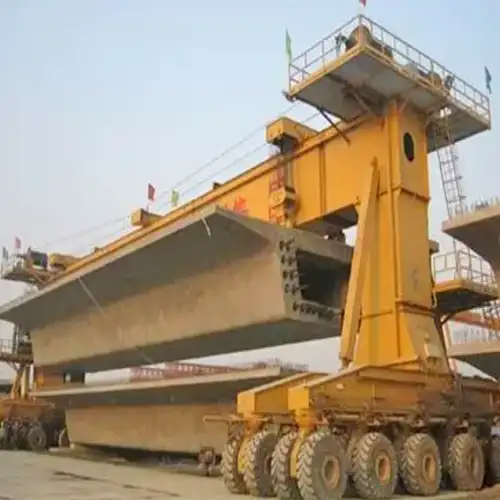
T-Frame RTG Gantry Crane10–1200 Ton for Heavy & Long Load LIfting
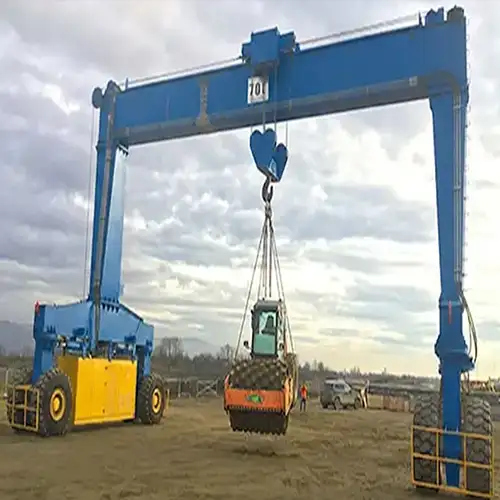
T-frame rubber tyred gantry crane for steel yards, construction sites, precast concrete, shipyards & heavy equipment handling. 10–1200 ton RTG solution.
| Crane Type | Rubber Typed Wheel RTG Gantry Crane with T Frames - T-Frame RTG Gantry Crane / Rubber Tyred Gantry Crane with Heavy Duty Lifting System, ISO A5–A7 / FEM 2m–5m |
| Crane Capacity | 10–1200 Ton (Common: 50 Ton, 100 Ton, 200 Ton, 500 Ton, 800 Ton, 1200 Ton) |
| Span Length | 10–60 m (Common: 20 m, 30 m, 40 m, 50 m) |
| Lifting Height | 6–50 m (Common: 10 m, 15 m, 20 m, 30 m, 40 m) |
| Coverage Area Type | Rectangular coverage for large outdoor yards, construction sites, assembly areas & heavy load handling zones. Operated on rubber tires without fixed rails, providing flexible movement and multi-directional handling. |
| Application | Shipyards, ports, precast concrete plants, bridge construction sites, wind power projects, steel fabrication yards & heavy facilities. Used for long steel structures, bridge sections, containers, machinery modules, precast beams & oversized equipment lift |
| Certifications | CE / ISO / SGS / Other third-party inspection |
| Customization | Options -T-frame rubber tyred gantry design, electric/hydraulic drive system, diesel generator or cable power supply, VFD, PLC, remote control, anti-sway system, load monitoring, steering modes, GPS positioning, overload protection & customized solutions. |
Crane Manufacturer: Yuantai Cranes – 30+ Years Professional Crane Manufacturer from China
Category: Single Girder Goliath Crane
Tags: rtgcrane
Your Trusted RTG Gantry Crane Manufacturer & Supplier
T-Frame RTG Crane10–1200 Ton for
Steel, Construction & Heavy Industry Material Handling
T-Frame Rubber Tyred Gantry Crane for Heavy, Long, and Irregular Load Handling
T-frame rubber tyred gantry crane for steel yards, construction sites, precast concrete, shipyards & heavy equipment handling. 10–1200 ton flexible RTG solution.
T-Frame Rubber Tyred Gantry Crane for Heavy, Long, and Irregular Load Handling (10–1200 Ton)
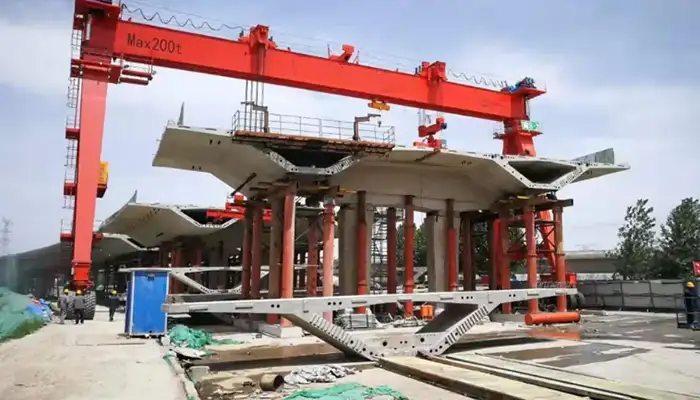
A T-frame rubber tyred gantry crane is used when lifting is not just about picking up weight and putting it down. In real projects, it becomes part of how materials move across the whole yard. From storage to installation, sometimes the same piece has to travel a long distance before it reaches the final position.
It runs on rubber tyres, so there is no fixed rail system. You can move it wherever the work is happening. That alone changes how a yard is planned and operated.
This type of RTG gantry crane system is usually chosen when normal lifting equipment is not enough for the job.
When a T-Frame RTG Crane Becomes the Practical Choice
In most cases, buyers don't start with "we need a T-frame RTG crane." It usually comes after a few practical problems appear on site.
It is selected when:
- No rail system exists, or building one would take too much time and cost
- Loads are long, heavy, or not evenly balanced, and standard cranes feel unstable
- Materials need to be moved across different working zones in the same yard
- One crane is expected to handle both lifting and internal transport work
In simple terms, it is used when the yard starts to behave like a moving production system, not a fixed point operation.
How It Works in Practical Working Conditions
On site, the crane is not used in one fixed position. It travels. It lifts, moves, and places materials where they are needed.
For example:
- Steel beams are lifted from storage and moved directly to fabrication or loading areas
- Precast segments are taken from casting zones and transported to storage or installation points
- Heavy equipment is moved step by step across the yard without reloading
It is not fast work. It is controlled work. The speed is not the main point. Stability and positioning matter more.
The T-frame structure helps keep the crane stable when loads are long or not perfectly centered. That is something buyers usually notice during real operation, not just on paper.
Why Buyers Choose T-Frame RTG Over Other Solutions
In many projects, the decision is not made by comparing specifications first. It is usually based on working experience on site.
Common reasons include:
- Rail systems are not flexible enough for changing yard layouts
- Crawler cranes are too limited in continuous yard movement
- Overhead cranes cannot be used in open outdoor areas
- Multiple lifting points are needed for long structural loads
At this point, a rubber tyred gantry crane becomes a more practical option. And when loads become more complex, the T-frame structure is usually preferred over standard designs.
Who This Crane Is Designed For
This T-frame rubber tyred gantry crane is commonly used by:
- Steel plant material handling managers
- Precast concrete yard operators
- EPC construction contractors
- Shipyard and modular construction teams
- Heavy equipment installation companies
It is not a general lifting crane. It is a yard-wide heavy material handling system.
Buyer Problems Before Choosing RTG Crane
Most buyers start with similar real working challenges:
- No rail infrastructure available
- Load is too long or uneven for standard cranes
- Frequent movement of materials across yard
- Multiple lifting points required for single load
- High cost of rail installation
- Changing yard layout during project stages
These are the typical conditions that lead to RTG crane selection.
A T-frame RTG crane is basically a mobile heavy lifting system that moves across the yard and handles large or uneven loads without needing fixed infrastructure.
It is used in steel yards, construction sites, precast plants, and industrial projects where material handling is continuous and space conditions keep changing.
Product Overview – What is a T-Frame Rubber Tyred Gantry Crane
A T-frame rubber tyred gantry crane, often called a T-frame RTG crane, is a heavy-duty mobile gantry crane used for outdoor material handling where loads are large, long, or not easy to manage with fixed lifting systems. It runs on rubber tyres, which means it can travel directly on the ground without rail installation.
In real projects, it is not just a lifting machine. It is more like a moving handling platform for the whole yard. Materials can be lifted, transported, and placed in different working zones without changing equipment.
This is why it is widely used in steel yards, precast production areas, construction sites, and industrial assembly projects where material flow is continuous.
RTG Crane Technical Specifications (10–1200 Ton Range)
Key Specifications
Capacity Range
- 10–100 ton: workshop and light construction
- 100–400 ton: precast and steel yard operations
- 400–800 ton: infrastructure and heavy modules
- 800–1200 ton: ultra-heavy lifting and tandem systems
- Span: custom design
- Lifting height: customized per project
- Lifting speed (full load): 0–1 m/min
- Lifting speed (no load): 0–2 to 0–3 m/min
- Travel speed (full load): 0–20 m/min
- Travel speed (no load): 0–25 to 0–40 m/min
- Tyre configuration: 4 / 8 / 16 / 32 wheels
- Ground pressure: ≤7–10 bar
- Gradeability: up to 3–4%
- Control system: PLC + cabin / remote control
Core Characteristics of T-Frame RTG Crane
The T-frame RTG crane is defined by a combination of structure, mobility, and load handling capability. Each part is designed to support real working conditions rather than laboratory conditions.
- Rubber tyred mobility system allows the crane to move freely across the yard without rails or fixed tracks
- Reinforced T-frame structure improves overall rigidity and reduces deformation during lifting and travel
- Wide capacity range from 10 tons up to 1200 tons, depending on project requirements and configuration
- Designed for long-span and irregular load handling, especially where lifting points are not evenly distributed
- Supports both single crane operation and tandem lifting systems for heavier or longer loads
- Can be used in temporary sites or long-term industrial yards without major infrastructure changes
In practice, the same crane may be used for both daily material transfer and heavy installation work, depending on project stage.
What Makes It Different from Standard Gantry Cranes
Compared with standard gantry cranes or fixed lifting systems, the T-frame RTG crane is designed for more flexible and complex working conditions.
The main differences are:
- It is not restricted by rail tracks, so it can operate across the entire yard area
- It is designed for multi-zone material movement, not only fixed lifting points
- It handles both lifting and transportation in one continuous workflow
- It offers better stability when dealing with long, uneven, or offset loads
In real operation, this difference becomes clear when materials need to move from storage to processing to installation without reloading or changing equipment.
The T-frame structure also plays an important role here. It helps maintain balance when the load is not perfectly centered, which is common in steel structures, precast beams, and modular components.
A T-frame rubber tyred gantry crane is used when material handling becomes a full yard operation, not just a single lifting task. It connects different working areas and keeps materials moving in a controlled and stable way.
This is why it is often selected in projects where flexibility and load stability must work together under real site conditions.
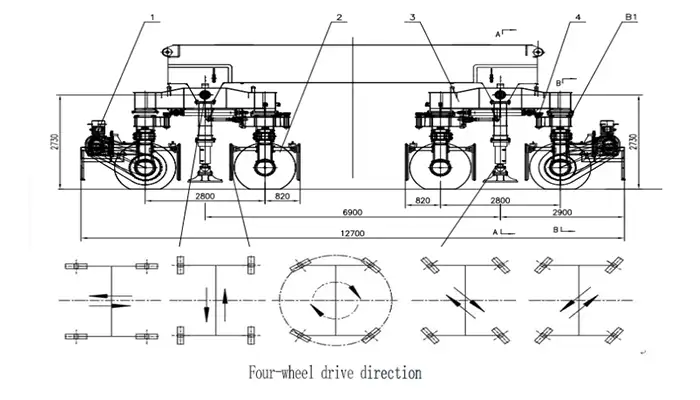
four wheel rtg gantry crane drive direction
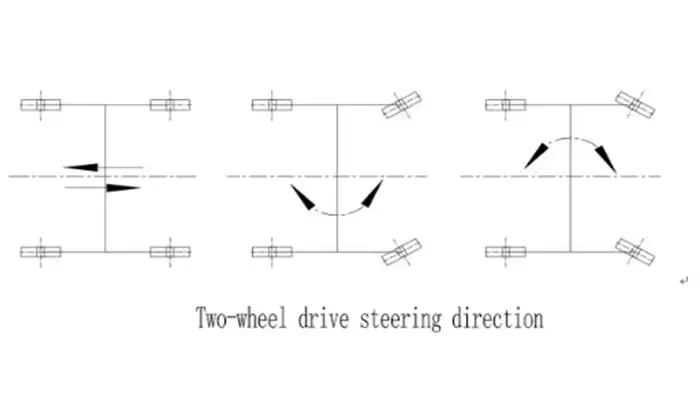
2 wheel rtg gantry crane drive steering direction
Why T-Frame Structure Matters
The T-frame design is used when the working condition is no longer a simple vertical lifting task. In real yards, loads are often long, uneven, or not perfectly centered. This is where structural behavior starts to matter as much as lifting capacity.
A standard gantry structure can handle weight, but once the load becomes longer or the lifting points are not symmetrical, the frame is under more stress during both lifting and travel. The T-frame structure is designed to deal with this type of working condition more steadily.
What the T-Frame Structure Provides in Real Operation
In practical use, the T-frame RTG crane improves how the whole crane behaves when the load is not balanced or when the crane is moving with load.
It provides:
- Higher structural rigidity for long-span loads, especially when materials extend beyond normal lifting width
- Better stability under off-center loading, which is common in steel beams, precast segments, and modular structures
- Reduced twisting during loaded travel, helping the crane move more smoothly across uneven yard conditions
- More balanced force distribution across the crane structure, so stress is not concentrated in one point
These improvements are not only structural on paper. They directly affect how stable the crane feels during real lifting and movement operations.
What It Means in Practical Working Conditions
In actual projects, load conditions are rarely perfect. The lifting points may shift slightly, or the material itself may not be evenly weighted. When the crane moves with such loads, small instability can become a bigger issue.
The T-frame structure helps reduce that sensitivity. It gives the crane more tolerance when working conditions are not ideal.
This is especially noticeable when:
- Moving long steel beams across a yard
- Transporting precast concrete segments with uneven weight distribution
- Handling assembled modules with multiple connection points
- Traveling with load across non-perfect ground surfaces
It is not about lifting more weight alone. The real focus of the T-frame design is how the crane controls the load during movement, especially when conditions are not balanced or predictable.
In many projects, that control is what makes the difference between smooth operation and repeated adjustments during lifting.
Crane Configuration Options
A T-frame rubber tyred gantry crane is usually not selected as a fixed standard model. In most real projects, it is configured based on how the yard is operated, what kind of materials are handled, and how often the crane is used during the working cycle.
Different sites have different working habits. Some run continuous daily lifting, while others only use the crane during installation stages. Because of this, configuration flexibility becomes an important part of the design process.
Power System Options (Diesel / Electric / Hybrid)
The power system is chosen based on site infrastructure and operation style.
- Diesel system is commonly used in outdoor sites where power supply is not stable or not available
- Electric system is suitable for fixed industrial yards with stable power access
- Hybrid system is used when the crane needs both flexibility and energy efficiency during different working phases
In many construction projects, power availability is not consistent across all areas of the site, so the final choice often depends on actual working conditions rather than preference.
Operation Mode (Cabin Control or Remote Operation)
The control method affects how operators interact with the crane during lifting and movement.
- Cabin control is often used for long working hours and better visibility during complex lifting tasks
- Remote control allows ground-level operation, especially useful when positioning accuracy and flexibility are required
- Some projects combine both modes, depending on lifting stage and safety requirements
In real use, the choice is usually based on how close the operator needs to be to the load during operation.
Single or Tandem RTG Crane System
Not all loads can be handled by a single crane. For long or ultra-heavy materials, a coordinated system is required.
- Single RTG crane is used for standard lifting within rated capacity
- Tandem RTG crane system uses two cranes working together for long-span or heavy loads
- Synchronization control ensures both cranes move and lift in a coordinated way
Tandem operation is commonly used in bridge construction, large steel structure handling, and modular lifting projects where load length exceeds single crane stability limits.
Lifting Tools and Attachments
Different materials require different lifting methods. The crane can be matched with various attachments depending on load type.
- Spreader beams for long or flexible loads to distribute weight evenly
- Clamps for steel plates, beams, or structural components
- Custom lifting frames for irregular or modular assemblies
- Hook systems for general lifting applications
In many cases, the lifting tool is what determines how stable the load behaves, especially for long or uneven materials.
Wind Resistance and Outdoor Adaptation Design
Since the T-frame RTG crane is used in open yards, environmental conditions must be considered in design.
- Wind resistance structure for safe operation in outdoor environments
- Anti-wind protection systems during idle or lifting conditions
- Electrical system protection for dust, rain, and temperature variation
- Reinforced components for coastal or high-corrosion areas
These adaptations are important in real projects where weather conditions can directly affect lifting safety.
Custom Span and Lifting Height
Every yard is different, so span and lifting height are usually designed based on actual layout.
- Span is adjusted according to yard width and material storage arrangement
- Lifting height is defined by stacking requirements and installation needs
- Clearance is considered for long or tall loads during movement
This part is often confirmed after reviewing the site layout and material flow plan, not before.
Typical Applications
A T-frame rubber tyred gantry crane is used in yards where materials are not only heavy, but also need to be moved across different working areas. In most real projects, the crane is selected based on both load type and required lifting capacity, not just one factor.
The capacity range typically covers 10 to 1200 tons, depending on the industry and project scale. Lower capacity models are used for general yard logistics, while higher capacity systems are used for large structural or modular lifting.
Construction & Infrastructure
Typical crane capacity: 50–600 tons (standard projects), up to 1200 tons for large bridge works
In construction sites, the crane is mainly used for structural assembly and on-site material movement. The working environment changes as the project progresses, so flexibility is important.
Typical loads include:
- Bridge beams (50–400 tons per piece depending on span)
- Large structural steel components (30–300 tons)
- Prefabricated construction modules
- Temporary site materials and heavy assemblies
This type of construction gantry crane is often selected when bridge or infrastructure elements are too large for crawler cranes or when repeated lifting across the yard is required.
Steel Industry
Typical crane capacity: 20–800 tons
Steel yards handle long, heavy, and often unevenly distributed loads. Stability during travel is a key requirement because materials are frequently moved between production, storage, and loading areas.
Typical loads include:
- Steel beams (10–80 meters in length, 20–200 tons)
- Steel plates and bundled coils (10–150 tons per bundle)
- Fabricated steel structures (50–500 tons)
- Large welded assemblies for construction or industrial use
In real operation, load shape varies a lot, so lifting balance is often more critical than maximum capacity alone.
Precast Concrete Yards
Typical crane capacity: 100–600 tons (standard precast), up to 1000+ tons for large bridge segments
Precast production requires continuous movement between casting, storage, and dispatch areas. The crane often works as part of the internal logistics system.
Typical loads include:
- Precast beams (50–400 tons depending on design)
- Bridge segments and box girders
- Concrete molds and formwork systems (10–80 tons)
- Finished precast units ready for transport
In many projects, the same crane handles both production flow and yard storage organization.
Energy & Industrial Equipment
Typical crane capacity: 50–1000 tons
Energy and industrial sites often deal with high-value equipment where controlled lifting is more important than speed.
Typical loads include:
- Power transformers (100–800 tons)
- Wind turbine components such as nacelles and towers (50–300 tons)
- Heavy industrial machinery (50–500 tons)
- Generator units and large equipment assemblies
These loads usually require precise positioning during installation, especially in confined working areas.
Shipyard & Modular Construction
Typical crane capacity: 200–1200 tons
Shipyards and modular construction projects involve some of the largest lifting tasks in industrial environments. Loads are often wide, long, and assembled in sections.
Typical loads include:
- Ship hull blocks (100–1000+ tons depending on section size)
- Offshore platform modules
- Large prefabricated building assemblies
- Multi-section structural units requiring tandem lifting
In many cases, tandem lifting with two T-frame RTG cranes is used when a single crane cannot safely handle load length or weight distribution.
Summary of Application Logic
Across all industries, the T-frame rubber tyred gantry crane is selected when:
- Loads range from 10 to 1200 tons depending on project scale
- Materials are long, heavy, or not evenly balanced
- Yard movement is required between multiple working zones
- Rail systems are not available or not practical
- Both lifting and transport functions are needed in one system
In real projects, the final crane capacity is always matched with actual load behavior, not only theoretical weight, which is why detailed project evaluation is important before final selection.
Typical Load Handling Applications & Load Handling Design Check
In most real projects, a T-frame rubber tyred gantry crane is selected after buyers clearly understand what kind of loads will be handled and how those loads behave during lifting and movement. It is not only about tonnage. Load shape, length, and stability during travel often decide the final crane configuration.
This section combines typical load examples with the key design checks buyers usually go through before confirming a rubber tyred gantry crane system.
Typical Loads Handled in Real Projects
A T-frame RTG crane is commonly used for a wide range of heavy and oversized materials across different industries. The actual load type often depends on whether the project is construction, steel processing, precast production, or heavy industrial installation.
Typical loads include:
- Long steel beams, usually 10–40 meters in length, used in structural fabrication and construction assembly
- Precast concrete bridge segments, typically 50–400 tons per piece, depending on bridge design and span
- Steel box girders and truss structures, often requiring careful lifting balance due to long span geometry
- Industrial machinery modules, including assembled production equipment or large mechanical systems
- Transformer and power equipment units, generally 100–800 tons, requiring controlled positioning during installation
- Ship hull sections and offshore blocks, often large welded structures with uneven weight distribution
- Modular building assemblies, where multiple lifting points are required during transport and installation
In practice, these loads are rarely simple blocks. Most of them are long, irregular, or partially assembled structures that require controlled movement across the yard.
Load Behavior Considerations in Real Operation
Before selecting a crane, buyers usually study how the load behaves during lifting and travel. This is one of the most important practical steps in crane selection.
Key considerations include:
- Uneven weight distribution across the load body
- Requirement for multiple lifting points instead of single-point lifting
- Load bending or deflection during lifting and transport
- Precision positioning requirements during installation or alignment work
- Combined lifting and transport operations across different yard zones
In real working conditions, these factors often affect crane stability more than the nominal weight itself. This is one reason why T-frame RTG cranes are used for long and complex load handling tasks.
Load Handling Design Check (Buyer Decision Stage)
At the final stage of selection, buyers usually confirm several key technical and operational conditions before confirming the crane configuration.
These include:
- Actual load weight, including lifting tools such as spreader beams or clamps
- Load length and lifting point layout, especially for long or segmented structures
- Center of gravity position to ensure stable lifting and travel behavior
- Ground condition and bearing capacity of the working yard, especially for high-capacity RTG systems
- Whether single crane operation is sufficient or tandem lifting is required for long or ultra-heavy loads
This step is important because it directly affects crane span, structure design, wheel configuration, and control system requirements.
Safety Systems
A T-frame rubber tyred gantry crane is often used in open yards, construction sites, and heavy industrial environments. In these conditions, loads are large, movement areas are wide, and working conditions are not always stable. Safety systems are therefore not an optional part—they are built into the crane to support daily operation and reduce operational risk during lifting and travel.
In real projects, safety is not only about preventing accidents. It is also about keeping lifting work stable when loads are long, uneven, or moving across different yard zones.
Overload Protection System
The overload protection system is designed to monitor lifting load in real time. When the actual load exceeds the rated capacity, the system will trigger an alarm and stop lifting operations.
This helps avoid:
- Overloading during lifting of heavy steel or concrete components
- Unexpected stress on the T-frame structure
- Risk caused by incorrect load estimation or lifting tool weight
In practical use, it is especially important for precast segments and steel structures where load weight can vary from piece to piece.
Anti-Tilt and Anti-Skew Control
When lifting long or uneven loads, the crane structure can be affected by load imbalance or uneven lifting points. The anti-tilt and anti-skew system helps maintain stability during both lifting and travel.
It works to:
- Reduce side tilting when load center is not aligned
- Prevent skew movement during crane travel under load
- Improve stability when handling long beams or modular assemblies
This is commonly used in steel yard and bridge construction projects where load shape is not symmetrical.
Wind Speed Monitoring System
Since this is a rubber tyred gantry crane used in outdoor environments, wind conditions can directly affect safe operation.
The wind monitoring system:
- Measures real-time wind speed during operation
- Sends warnings when wind level exceeds safe limits
- Helps stop lifting or travel operations in unsafe conditions
This is particularly important in open construction sites, shipyards, and coastal industrial areas where wind conditions can change quickly.
Emergency Stop Synchronization
The emergency stop system allows immediate shutdown of crane operations when an abnormal situation occurs.
It is designed to:
- Stop all lifting and travel movements at the same time
- Ensure both crane ends respond in a synchronized manner
- Prevent load swing or imbalance during sudden stop
In tandem lifting operations, this synchronization becomes even more important because two cranes must react together.
Travel Limit Protection
Travel limit protection ensures that the crane does not move beyond its safe working range within the yard.
It helps to:
- Prevent accidental collision with yard boundaries or stored materials
- Control crane movement within defined working zones
- Improve safety during repeated yard transportation cycles
In real operation, this system is often used in busy yards where multiple machines and materials are working in the same area.
Comparison
When buyers evaluate a T-frame rubber tyred gantry crane, the decision is usually not made in isolation. It is compared with other common lifting systems based on yard layout, load type, and working method. The key point is simple: different cranes solve different handling problems.
This section helps clarify where a T-frame RTG crane fits in real working conditions.
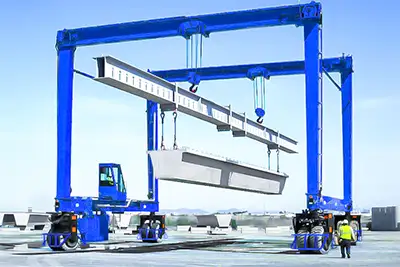
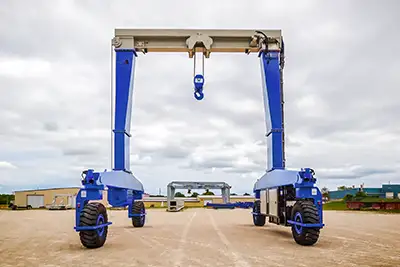
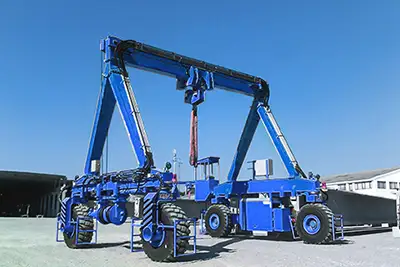
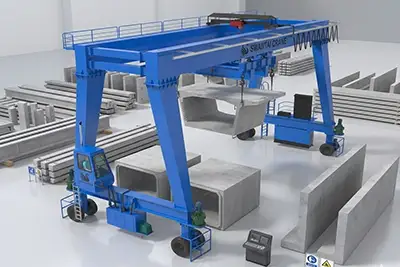
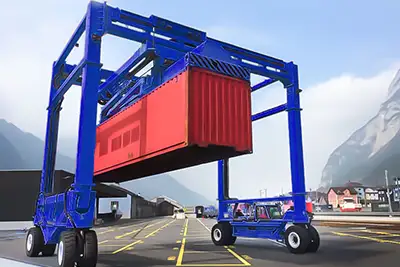
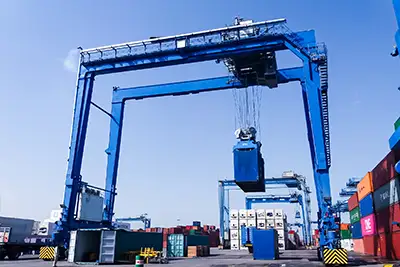
T-Frame RTG vs Rail Mounted Gantry Crane (Mobility vs Fixed System)
A rail mounted gantry crane operates on fixed tracks. It is stable and efficient, but the working path is limited by rail installation.
A T-frame RTG crane moves freely on rubber tyres, which allows it to work across the entire yard without fixed infrastructure.
- Rail mounted crane is suitable for fixed logistics routes and container yards
- T-frame RTG crane is suitable for changing yard layouts and multi-zone material handling
- Rail system requires civil foundation work, while RTG system does not
In practice, buyers choose RTG when flexibility is more important than fixed repetition.
T-Frame RTG vs Crawler Crane (Continuous Yard Movement vs Point Lifting)
A crawler crane is usually set up at one working position and performs lifting within a limited radius. It needs repositioning when the working area changes.
A T-frame RTG crane is designed for continuous movement across the yard while carrying loads.
- Crawler crane is better for single-point heavy lifting or installation
- T-frame RTG crane is better for repeated lifting and transport across large areas
- RTG reduces the need for frequent equipment relocation
In real projects, RTG is often selected when material flow is continuous rather than one-time lifting.
T-Frame RTG vs Overhead Crane (Outdoor vs Indoor Use)
An overhead crane is installed inside factories or workshops and runs on fixed building structures.
A T-frame RTG crane is used in open yards where materials are stored, processed, and transported outdoors.
- Overhead crane is limited to indoor workshop spaces
- T-frame RTG crane operates in open industrial or construction environments
- Overhead systems require building support structures, RTG does not
In simple terms, overhead cranes stay inside buildings, while RTG cranes manage outdoor yard logistics.
T-Frame RTG vs Standard RTG Crane (Heavy Irregular Loads vs General Handling)
Standard RTG cranes are designed for more regular load shapes and general yard handling tasks.
The T-frame RTG crane is designed when loads become longer, heavier, or not evenly balanced.
- Standard RTG crane is suitable for general material handling and uniform loads
- T-frame RTG crane is better for long-span, irregular, or off-center loads
- T-frame structure provides higher rigidity during loaded travel
In real projects, the T-frame version is often selected when stability during movement becomes a key concern.
Practical Decision Summary
In actual buyer decisions, the comparison is not only about crane type, but about how the yard operates.
A T-frame rubber tyred gantry crane is usually selected when:
- The yard needs flexible movement instead of fixed routes
- Loads are complex in shape or weight distribution
- Both lifting and transport are required in one system
- Site conditions change during project execution
It is chosen less for a single lifting task, and more for how material flows across the entire working yard.
Contact Us to Get Your Tailored RTG Crane Solution
Before a buyer confirms a T-frame rubber tyred gantry crane, the final check is usually very practical. It is not about whether the crane can lift a certain tonnage. It is about whether the crane matches how the yard actually works day to day.
In real projects, this type of RTG crane is selected when lifting, moving, and storage all happen in the same working space, and the material flow is not fixed.
When a T-Frame RTG Crane Is Suitable
A T-frame RTG crane is a practical choice when the working conditions include the following situations:
- Loads are heavy, long, or irregular in shape, and cannot be handled safely with standard lifting equipment
- Yard layout changes during different project stages, so fixed rail systems become difficult to plan or use
- No rail system is available on site, or installing rails would take too much time and cost
- Multiple material types are handled in the same yard, such as steel, concrete, and modular components
- Flexibility and mobility are required, meaning materials need to move between different working zones without reloading
Practical Understanding in Real Projects
In many cases, buyers do not choose this crane because of a single lifting task. They choose it because the entire yard operation needs a more flexible handling system.
For example:
- One area is for storage, another for processing, and another for dispatch
- Materials are large and cannot be easily transferred by forklift or standard cranes
- The working layout changes as the project progresses
In these situations, the T-frame RTG gantry crane becomes part of the material flow system, not just a lifting machine.
Final Buyer View
In simple terms, this crane is suitable when:
- Lifting is connected with continuous material movement
- The yard cannot rely on fixed rail infrastructure
- Load conditions are not standard or uniform
- Flexibility matters more than fixed operation paths
This is why it is widely used in steel yards, construction projects, precast production areas, and heavy industrial environments where working conditions are dynamic and not fixed from the beginning.
Get Your Tailored T Frame Rubber Tyred Gantry Crane
At this stage, most buyers already have a general idea of what they need. The next step is to match the T-frame rubber tyred gantry crane with real project conditions. This is where accurate project information becomes important, because the final crane design depends directly on how the yard is actually used.
We do not recommend selecting a crane only based on capacity. In real projects, factors like load shape, yard layout, and working frequency often affect the final configuration more than a single specification.
Please Provide the Following Project Details
To prepare a suitable T-frame RTG crane solution, please share the basic working information below:
- Load type and dimensions (steel, concrete, equipment, modular structures, etc.)
- Maximum lifting weight per single load or lifting cycle
- Required span based on yard width or working area layout
- Lifting height requirement for stacking or installation work
- Working frequency (occasional use, daily operation, or continuous handling)
- Project location and ground condition (important for wheel load and stability design)
These details help define not only the crane capacity, but also how the crane will move and operate in your yard.
What You Will Receive From Us
After reviewing your project information, we will provide a complete technical proposal based on actual working conditions, not only standard models.
- Technical configuration suggestion based on load and site conditions
- Yard layout recommendation for material flow and crane movement
- Load handling solution including lifting method and operation setup
- Formal quotation proposal with suitable T-frame RTG crane specification
In most cases, the best crane solution comes after understanding the real working flow of the yard. Once the basic project data is clear, the T-frame RTG crane can be configured to match both current operation and future expansion needs.
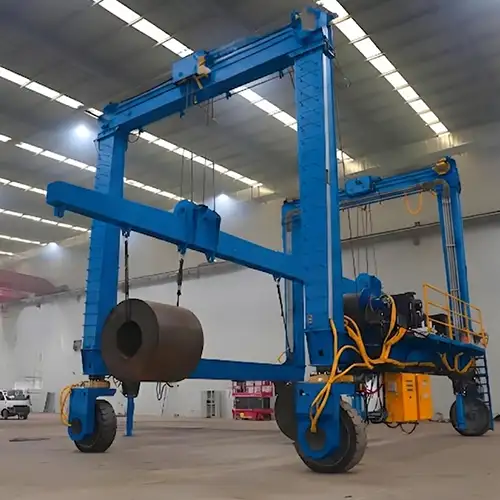
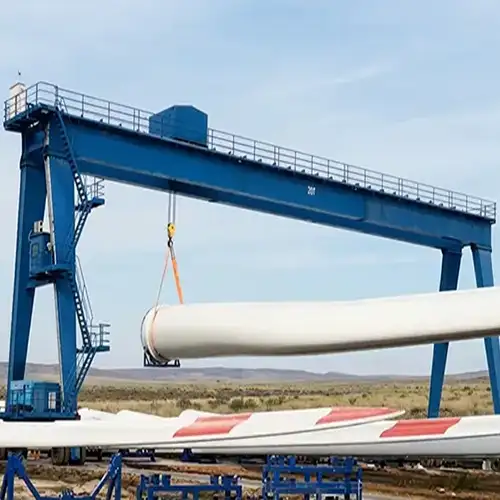

Yuantai Cranes
Overhead Crane Manufacturer with CE, ISO, SGS, CNEX Certificates.
- Main Specifications - Capacity: 0.5–550 tons | Span: up to 40m | Speed: 0.8–12 m/min | Duty: A3–A7 | Power: 380–690V, 50/60Hz | Control: pendant/remote/cabin
- Full engineering: FEA/PLC/VFD + in-house build + global delivery + on-site support, for workshops, factories, EPC contractors, industrial projects, etc.
- Support: design, manufacturing, testing, service – end-to-end, customized lifting solutions worldwide.
How to Get an Accurate Crane Price for Your Application?
Tips: Copy the spec list, fill in your details, and paste it into the form on the right/ down-below for a quick price.
- Crane type:_____ . (e.g., overhead crane, gantry crane, jib crane)
- Max weight to lift:_____ tons. (e.g., 2t, 5t, 10t, 20t, 50t)
- Lifting height:_____ m. (How high does the hook need to reach?
- Workshop width (span):_____ m . (Distance between the two crane rails)
- Travel distance:_____ m . (How long does the crane need to move along the runway?)
- Control type:_____. (Pendant / remote / cabin Control)
- Power supply:_____. (Local voltage & frequency – e.g., 380V, 50Hz, 3-phase)
- What will it be used for?_____ (e.g., steel fabrication, concrete products, mold handling, general manufacturing, etc.)
- Any special requirements?_____ (e.g., extreme temperature, dusty or explosive environment, special paint color, etc.)
Just leave a message via the contact form and our hoist and crane engineer will contact you with in 24working hours.
Get Your Custom Quote–Quick & Easy
Fill in what you know. Skip what you don't – we'll help.Any question will be reply with 24 working hours