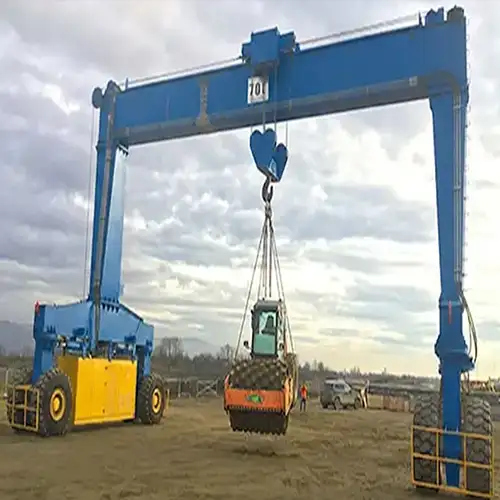
2×70T Gantry Cranes for Tandem Beam Lifting Indonesia
Indonesia precast yard: 2×70T gantry cranes with tandem lifting for I-girder handling. Stable synchronized solution for bridge beam production.
| Crane Type | Rubber Tyred Gantry Crane with T Frame Design - Rubber-Tyred Gantry Crane / T-Frame Gantry / Heavy-Duty Gantry / Dual-Crane Synchronized Lifting System / Precast Beam Handling Crane |
| Crane Capacity | 70Ton *2 Units |
| Span Length | Project-specific, selected according to casting-bed clearance, beam dimensions, storage height, transport requirements and required hook travel |
| Lifting Height | 70 ton per crane × 2 units; synchronized tandem lifting system. The actual tandem lifting capacity depends on load distribution, lifting points, synchronization and the engineered operating procedure |
| Coverage Area Type | Outdoor precast concrete yards, bridge beam production areas, casting beds, curing and storage zones, loading areas, infrastructure construction sites and large flexible material-handling yards across Indonesia |
| Application | Indonesia precast yard: 2×70T gantry cranes with tandem lifting for I-girder handling. Stable synchronized solution for handling Precast Concrete I-Girders · Bridge Beams · Long Concrete Structures · Heavy Precast Components · Bridge Components, etc. |
| Certifications | CE / ISO / SGS / Other third-party inspection |
| Customization | Rubber-Tyred Gantry Crane / T-Frame / Double Girder / Heavy-Duty Gantry / Tandem Lifting ·Travel: Rubber Tyres / Self-Propelled Travel / Multi-Directional , Site: Precast Yard / Casting Beds / Storage Yard / Flexible Layout / No Fixed Rail Infrastructure |
Crane Manufacturer: Yuantai Cranes – 30+ Years Professional Crane Manufacturer from China
Category: Indonesia
Tags: indonisia,rtgcrane
Your Trusted Rubber Tyred Gantry Crane Manufacturer & Supplier
2×70T Gantry Cranes for Tandem Beam Lifting Indonesia
Tandem Lifting Gantry Crane System for Precast Beam Handling in Indonesia
Project Overview – Indonesia Precast Beam Yard
In Indonesia infrastructure projects, contractors generally prioritize practical performance, stable operation, and long-term supplier cooperation rather than overly complex automation systems.
Project location and working environment
This project is based in Indonesia, inside a precast concrete yard that supports bridge construction work for local infrastructure development. The site is open-air, with multiple casting beds and storage zones arranged for continuous beam production.
The weather is typical tropical conditions, warm and humid for most of the year, with frequent rain periods that the equipment must still handle without interruption. In such environments, stability of machinery is not something optional, it is a daily requirement.
The yard layout is not fixed in a rigid way. It changes as production expands, so equipment needs to move and adapt without depending on permanent rail systems or complex civil foundations.
- Location: Indonesia infrastructure construction project
- Environment: outdoor precast casting yard with tropical climate conditions
- Site condition: flexible layout, multiple beam casting and storage zones
- Operation requirement: continuous daily production without long downtime
Equipment supplied for the project
The project uses two sets of 70-ton heavy-duty rubber tyred gantry cranes with T frame designed for precast beam handling. These two cranes are not working separately. They are designed to operate as a coordinated lifting pair.
In practice, both cranes lift the same beam together. One supports one end, the other supports the opposite end. They move in sync during lifting and transport inside the yard. Operators usually describe it as "two machines, one movement," because the beam must stay level from start to finish.
- Equipment type: 2 sets of 70-ton heavy-duty gantry cranes
- Rated capacity: 70 tons per unit
- Working method: tandem lifting (dual-crane synchronized operation)
- Function: lifting, transferring, and positioning precast I-girders
Application: precast I-girder handling
The main material handled in this project is precast I-girders used for bridge construction. These beams are long, heavy, and sensitive to uneven lifting force.
Once concrete curing is completed, each girder must be lifted out of the casting bed and moved to storage or loading areas. This process needs careful control because even small imbalance can affect the structure during lifting.
Typical handling requirements include:
- lifting long-span I-girders weighing up to 70 tons
- keeping both ends of the beam level during lifting
- avoiding swing when moving across yard space
- precise placement during stacking or loading
In many cases, operators rely on visual alignment and slow coordinated movement rather than speed. It is more about control than fast operation.
Tandem lifting operation mode
The key feature of this project is the tandem lifting system. Both gantry cranes work together in a synchronized way. They are controlled so that lifting speed, height, and movement stay aligned.
It is not just two cranes operating side by side. The system is designed so that the beam is always under balanced force from both ends. If one crane moves slightly faster, the system adjusts to match the other.
In daily operation, the workflow is simple but controlled:
- both cranes position on each side of the beam
- hooks are attached at lifting points on both ends
- operators start lifting at the same time
- beam is raised slowly while checking level condition
- synchronized travel moves the beam to target position
- final placement is done with low-speed adjustment
This method is often preferred in precast yards where beam length and weight make single-point lifting unsafe or impractical.
Buyer priorities in Indonesia infrastructure projects
From the buyer side, especially in Indonesia infrastructure projects, the decision is usually not based on complex automation features. Instead, it is based on whether the equipment can perform consistently under real site conditions.
Contractors often care about practical points such as:
- whether the crane can operate every day without interruption
- whether local operators can manage the system after training
- whether lifting remains stable under repetitive production cycles
- whether supplier support is available when site adjustments are needed
There is also a strong preference for long-term cooperation. Many buyers prefer working with suppliers who can stay involved after delivery, especially during installation and early operation.
In simple terms, the focus is not on "advanced features," but on whether the system can keep the yard running without trouble. That is usually the final decision point in projects like this.
Industry Background – Precast Bridge Construction
The project comes from the precast concrete bridge sector, which is closely tied to highway development, overpass construction, and large-scale infrastructure works. In Indonesia, this type of work is usually part of long-distance transport networks or urban expansion projects.
Industry focus and project type
The project comes from the precast concrete bridge sector, which is closely tied to highway development, overpass construction, and large-scale infrastructure works. In Indonesia, this type of work is usually part of long-distance transport networks or urban expansion projects.
These precast yards are not small workshops. They are production-style sites where bridge components are made in batches, then moved out for installation at different construction locations. The workflow is continuous, and equipment must support that rhythm without frequent stops.
- Industry: precast concrete bridge and infrastructure construction
- Project type: bridge beam production and transport for civil works
- Operation style: batch production with continuous yard handling
Typical buyers in this sector
Most buyers in this field are not end users of a single machine. They are engineering-driven organizations responsible for entire project execution.
Common buyer types include:
- EPC contractors handling full bridge projects from design to delivery
- Civil engineering companies responsible for structural construction works
- Infrastructure developers working on highway or regional transport projects
These buyers usually already understand lifting requirements. Their questions are often practical, such as how equipment behaves under load, how stable it is during long beams lifting, and how quickly it can be integrated into an active site.
Buyer mindset in Indonesia market
In Indonesia infrastructure projects, purchasing decisions tend to follow a practical direction rather than theoretical comparison. Field experience and trust carry more weight than specification sheets alone.
Typical decision behavior includes:
- Preference for proven and reliable engineering solutions that have been used in similar yard conditions
- Strong attention to project continuity, especially avoiding delays once precast production starts
- Long-term cooperation with suppliers is often preferred over one-time transactions
- Real site performance matters more than design-level advantages on paper
In many cases, buyers will ask a simple question during discussion: whether the equipment can keep running smoothly once it arrives on site. That question usually decides how far the conversation goes.
Material Handling Requirement
The main material handled in this project is precast concrete I-girders used for bridge construction. These components are produced in casting yards and then moved for installation in bridge assembly sections.
Material type and characteristics
The main material handled in this project is precast concrete I-girders used for bridge construction. These components are produced in casting yards and then moved for installation in bridge assembly sections.
These beams are not only heavy, but also long and rigid. Once concrete is cured, the structure becomes solid, but it also becomes sensitive to uneven force during lifting.
- Material type: precast concrete I-girders
- Application: bridge construction and highway infrastructure
- Structural nature: long-span, rigid concrete components
Weight and lifting scale
Each beam can reach up to 70 tons in weight. This requires equipment that can not only lift the load but also keep it stable during movement across the yard.
At this scale, even small imbalance during lifting can create stress along the beam body. That is why lifting method and control system are as important as capacity itself.
- Maximum weight per beam: up to 70 tons
- Load type: long and heavy precast structural element
- Risk factor: uneven stress during lifting and transport
Handling requirements in daily operation
The handling process in a precast yard is repetitive but must remain controlled every time. Each movement affects production flow.
Key requirements include:
- synchronized lifting at both ends of the beam to keep load balance
- controlled lifting height to avoid sudden stress on the structure
- accurate leveling during lifting and lowering stages
- stable movement across yard zones without beam swing
- safe placement during stacking and curing storage areas
In actual operation, operators usually lift slowly, check alignment step by step, and adjust movement carefully rather than rushing. It is a process where control matters more than speed.
Why tandem lifting becomes necessary
For long concrete beams like I-girders, lifting from a single point is not suitable. It creates uneven force distribution, which can lead to bending stress or instability during movement.
That is why tandem lifting is used. By supporting both ends of the beam at the same time, the load is distributed evenly, and the structure remains stable throughout the lifting cycle.
In practical terms:
- single-point lifting is not safe for long-span beams
- dual-end lifting keeps the beam level
- synchronized control reduces structural stress
- movement becomes more predictable and safer
This is why tandem lifting is widely used in precast bridge yards handling heavy I-girder production.
Key Technical Challenges
In precast beam handling projects, the main technical challenges are not only about lifting capacity, but more about stability control, synchronization accuracy, and adapting to real yard working conditions.
Beam stability control
In this project, the most sensitive issue is the stability of long precast I-girders during lifting. These beams are strong in final form, but during handling, they still behave like long structural elements that can react to uneven force.
When lifting force is not evenly distributed, the beam can slightly bend or twist. It may not always be visible to the eye, but the stress is already inside the structure. Over time, this can affect quality, especially if handling is repeated many times in a production cycle.
In actual yard operation, operators usually pay close attention to how the beam starts lifting from the casting bed. The first few centimeters of lift are the most critical.
- Long precast beams are sensitive to uneven lifting force
- Small imbalance can create bending stress during hoisting
- Repeated handling increases the importance of consistent control
- Initial lifting stage requires careful monitoring of beam response
Synchronized lifting requirement
Because the beam is long and heavy, one lifting point is not enough. Two cranes must work together, and not just in sequence, but in real coordination.
If one side lifts slightly faster than the other, the beam immediately loses balance. That is why synchronization is not only about starting at the same time, but also maintaining the same speed and movement during the whole lifting process.
In practice, operators need to watch both sides continuously. Even small differences in speed or height must be corrected immediately.
- Two cranes must lift at the same time and same speed
- Continuous coordination is required during lifting and travel
- Even small timing differences can affect beam balance
- Real-time adjustment is needed throughout operation
This is where tandem lifting systems become important, because manual coordination alone is difficult to maintain consistently over many cycles.
Yard operational constraints
The working environment in a precast yard is not fixed like a factory line. It changes depending on production stages, storage needs, and transport flow.
This creates several practical constraints that directly affect crane operation.
No fixed rail infrastructure
The cranes must move freely within the yard without depending on rail tracks. This allows flexibility but requires stable driving control on uneven ground conditions.
Outdoor working conditions
Rain, heat, and humidity are common in Indonesia. Equipment must maintain performance even when surface conditions change, especially during wet ground periods.
Frequent repetitive lifting cycles
Precast production is continuous. Beams are cast, cured, lifted, and moved repeatedly every day. This puts long-term mechanical and operational pressure on the system.
Variable yard layout
As production expands, storage and casting areas may be adjusted. Equipment must adapt without requiring structural changes to the site.
- No rail-based fixed operation system
- Equipment must work under outdoor tropical conditions
- High repetition of lifting cycles in daily operation
- Yard layout changes depending on production flow
Engineering Solution – Tandem Lifting Gantry System
The solution for this project is based on a dual-crane arrangement using two 70-ton heavy-duty gantry cranes. Instead of working as separate lifting units, both cranes are designed to operate as a single coordinated system during beam handling.
System configuration
The solution for this project is based on a dual-crane arrangement using two 70-ton heavy-duty gantry cranes. Instead of working as separate lifting units, both cranes are designed to operate as a single coordinated system during beam handling.
In daily operation, each crane supports one end of the precast I-girder. The movement is controlled so that lifting, travel, and lowering are kept in balance. This allows the beam to stay level throughout the entire handling process, from lifting out of the casting bed to final placement in storage or transport areas.
- Equipment setup: 2 × 70-ton heavy-duty gantry cranes
- Working mode: synchronized dual-crane lifting operation
- Function: coordinated lifting and transport of precast beams
- Operation style: joint control instead of independent movement
This structure is commonly used in precast yards where long concrete beams cannot be safely handled by a single lifting point.
Engineering concept and working logic
The core idea behind this system is not just increasing lifting capacity, but controlling how the load is shared and moved between two separate machines.
During operation, both cranes are linked through a coordinated control approach. This means lifting speed, height, and travel movement are adjusted to stay consistent on both sides. When one crane adjusts, the other follows immediately to maintain balance.
In practice, operators often describe it as "working together like one frame," even though the cranes are physically separate units.
Engineering concept alternatives used in industry
Depending on project language and supplier terminology, this system may also be described in different ways, such as:
- Tandem lifting gantry crane system
- Dual-crane synchronized lifting solution
- Coordinated beam handling system
- Paired hoisting heavy lifting configuration
- Synchronized gantry lifting system for precast yards
All these expressions refer to the same operational idea: two cranes working in real-time coordination to handle a single heavy and long structural load.
Core system principle
The key design point is that both cranes are not treated as independent machines during lifting. Instead, they function as a single coordinated lifting unit.
This approach helps in practical yard operation:
- load is shared evenly between two lifting points
- beam remains stable during lifting and movement
- operator coordination becomes more controlled and predictable
- risk of uneven stress on long precast beams is reduced
In real precast production environments, this kind of configuration is often chosen when beam length and weight exceed the safe handling range of single-crane lifting methods.
The result is a more controlled lifting process that fits the repetitive and continuous workflow of bridge beam production yards, especially in infrastructure projects where stability and consistency matter more than operational speed alone.
Technical Configuration Overview
The project is built around two heavy-duty gantry cranes, each with a lifting capacity of 70 tons. Instead of operating separately, both units are designed to work as a paired system for handling long precast bridge beams.
Rated capacity and system layout
The project is built around two heavy-duty gantry cranes, each with a lifting capacity of 70 tons. Instead of operating separately, both units are designed to work as a paired system for handling long precast bridge beams.
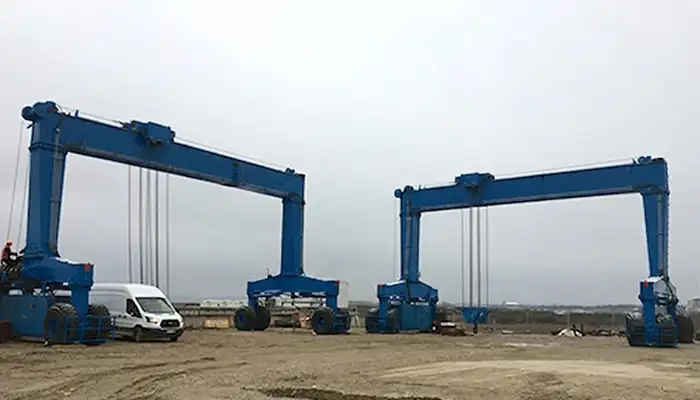
In practical yard use, this means the full lifting task is shared across two machines working together on the same load. Each crane carries one side of the beam, and the system keeps both sides aligned during lifting and movement.
- Rated capacity: 70 tons × 2 units
- Operation mode: synchronized tandem lifting
- Structure type: heavy-duty gantry crane system
- Application: precast bridge beam yard handling
This configuration is commonly used in precast yards where beam length and weight make single-point lifting unsafe or difficult to control.
Control system features
The control system is designed to keep both cranes working in balance during every stage of operation. In real working conditions, this is not only about starting together, but maintaining coordination throughout lifting, traveling, and positioning.
The system focuses on several practical control functions:
- real-time synchronized lifting control to ensure both cranes lift at the same pace
- speed balancing between two cranes to avoid load tilt during hoisting
- coordinated movement during travel so the beam remains stable while moving across the yard
- anti-swing stabilization control to reduce beam oscillation during lifting and transport
In actual operation, these functions help operators maintain control without constantly correcting imbalance manually. It supports a smoother and more predictable lifting process, especially when handling long and heavy I-girders.
Power system configuration
The cranes are powered by industrial diesel engine systems, selected for stable performance under outdoor construction conditions.
In this project, Cummins engines are used as the main power source. The choice is based on reliability and consistent output in continuous operation environments, especially in regions like Indonesia where equipment must perform under heat, humidity, and variable site conditions.
- Power system: industrial diesel engine configuration
- Engine brand: Cummins international engine system
- Design focus: reliability and field durability
This type of power setup is commonly preferred in precast yard operations because it allows stable operation even in sites where electrical infrastructure may not be fully consistent or where mobility is required across large working areas.
Key Features of Tandem Lifting System (Indonesia Precasting Yard Application)
In Indonesian precasting yards, long I-girders are usually produced in batches and moved immediately after curing. In this kind of working flow, two 70-ton gantry cranes operate together as one coordinated lifting unit.
Synchronized lifting operation in precast yard work
In Indonesian precasting yards, long I-girders are usually produced in batches and moved immediately after curing. In this kind of working flow, two 70-ton gantry cranes operate together as one coordinated lifting unit.
Both cranes lift the beam at the same time, each supporting one end. The key point in real yard operation is maintaining balance while the beam is still in contact with the casting bed and during the first lifting stage, where stress is most sensitive.
Once the beam is lifted, the system keeps both sides moving at the same speed. This helps avoid tilting, especially when the yard ground is not perfectly even or when the travel distance is long.
- Two cranes lift one beam together in synchronized mode
- Each crane supports one end of the I-girder
- Beam is kept level from lifting point to placement area
- Stable movement is maintained across open yard spaces
In Indonesia projects, operators often describe it simply as "angkat bareng, jalan bareng" (lift together, move together), which reflects the practical working style on site.
Structural safety for long precast beams
Precast I-girders used in Indonesian bridge projects are long, heavy, and often produced in high volume. During handling, the main concern is not only weight, but how the force is distributed along the beam length.
Tandem lifting helps reduce uneven stress that can occur when lifting from a single point. By supporting both ends, the load is shared more evenly, which helps prevent bending during lifting and movement.
This is especially important in tropical working conditions, where beams may be stored outdoors and handled repeatedly under changing temperature and humidity.
- Reduces uneven stress on long precast beams
- Helps prevent bending during lifting and transfer
- Maintains beam integrity during repeated yard handling
- Suitable for high-volume bridge beam production
In practice, this means fewer handling risks and more consistent quality during daily precast operations.
Flexible operation for Indonesian yard conditions
Many precasting yards in Indonesia are open-layout sites. The working area is often expanded gradually as project demand increases. Fixed rail systems are not always practical due to layout changes and cost considerations.
This tandem gantry system is suitable for such conditions because it can move freely within the yard without relying on fixed tracks. Operators can adjust travel paths based on production flow, curing zones, and storage space.
- No fixed rail infrastructure required
- Suitable for open and expandable yard layouts
- Adaptable to different precast production stages
- Works well in changing site conditions
This flexibility is important for Indonesian contractors who often manage multiple bridge projects within the same yard.
Continuous heavy-duty performance for bridge projects
In Indonesia infrastructure work, precast yards operate on continuous schedules. Beams are cast, cured, lifted, and moved in repeated cycles every day. Equipment downtime directly affects project delivery.
This tandem lifting system is designed for that type of workload. It supports repeated lifting operations without reducing stability, even when working under high humidity and outdoor exposure.
- Designed for continuous precast production cycles
- Suitable for daily bridge beam handling operations
- Stable performance under outdoor tropical conditions
- Supports long-term infrastructure project timelines
In real Indonesian project practice, reliability is often more important than speed. Equipment that can keep running consistently without interruption is usually preferred over complex systems that require frequent adjustment.
Advantages for Indonesian Infrastructure Projects
In many infrastructure projects across Indonesia, precast yards are usually located in open industrial areas where weather conditions change quickly. Heavy rain, high humidity, and long working hours are part of daily operation. Because of this, equipment selection is often based on how well it can keep working in real site conditions, not only on paper specifications.
Practical equipment needs in Indonesian construction sites
In many infrastructure projects across Indonesia, precast yards are usually located in open industrial areas where weather conditions change quickly. Heavy rain, high humidity, and long working hours are part of daily operation. Because of this, equipment selection is often based on how well it can keep working in real site conditions, not only on paper specifications.
Contractors also tend to prefer machines that local operators can understand quickly and operate without complicated procedures. In many cases, the workforce is experienced but prefers straightforward systems that are easy to maintain and control on site.
- Equipment must perform reliably under tropical weather conditions
- Simple operation is preferred for local yard teams
- Stable performance is required for long-term continuous use
- Flexibility is needed to match different yard layouts and project stages
Value of tandem lifting system in local precast projects
For precast bridge projects in Indonesia, the tandem lifting gantry system fits well with the actual working pattern of beam production yards. It supports repetitive lifting cycles while maintaining stable control over long I-girders, which are commonly used in highway and bridge construction.
Instead of relying on complex automation, the system focuses on controlled coordination between two cranes, which makes it easier to apply in real construction environments.
This brings several practical benefits:
- stable performance even during continuous beam handling work
- reduced need for complex operational adjustments during lifting
- improved safety when handling long and heavy precast girders
- consistent output for daily precast production schedules
Why Indonesian contractors prefer this type of solution
In many Indonesian infrastructure projects, decision-making is strongly influenced by long-term reliability and trust in supplier support. Contractors often look at whether the equipment can stay stable throughout the project lifecycle, not only during installation or initial use.
There is also a strong preference for predictable operation. Once a precast yard starts production, delays or unstable lifting performance can affect the entire construction timeline.
Because of this, the most valued aspects are often:
- long-term operational reliability in real field conditions
- practical design that supports daily use without complexity
- stable cooperation between equipment supplier and project team
- predictable performance that supports project scheduling
In this type of working environment, tandem lifting gantry systems are not only a technical solution, but also a practical fit for how Indonesian infrastructure projects are managed on site.
Project Results
After installation and commissioning, the two 70-ton gantry cranes were able to operate in a stable tandem lifting mode for precast I-girders used in bridge construction. The key point in actual yard operation was maintaining balance during the full lifting cycle, from lifting out of the casting bed to final placement.
Successful synchronized lifting of 70-ton I-girders
After installation and commissioning, the two 70-ton gantry cranes were able to operate in a stable tandem lifting mode for precast I-girders used in bridge construction. The key point in actual yard operation was maintaining balance during the full lifting cycle, from lifting out of the casting bed to final placement.
In daily use, the system showed consistent coordination between both cranes. The beam remained level during movement, even when traveling across uneven yard areas or longer transfer distances.
- 70-ton I-girders were lifted and moved in synchronized mode
- Stable beam balance maintained during full lifting process
- Smooth operation during transfer from casting to storage areas
Improved precast yard efficiency
In the Indonesian precasting yard environment, production flow depends heavily on how quickly beams can be lifted and cleared from casting beds. With the tandem lifting system in place, the handling process became more organized and continuous.
Instead of waiting for repeated repositioning or correction, operators could complete lifting and transport in one controlled cycle. This helped reduce idle time around casting areas and improved overall yard turnover.
- Faster clearance of casting beds after curing
- More continuous beam handling workflow
- Reduced waiting time between lifting cycles
- Better coordination between production and storage zones
Reduced risk during long beam handling operations
Handling long precast I-girders always carries risk, especially when lifting force is uneven or when movement is not fully synchronized. In this project, the tandem system helped reduce those risks by keeping both ends of the beam under controlled and balanced lifting.
Operators no longer needed to rely only on manual adjustment during lifting. The system itself helped maintain alignment, especially during the most sensitive stages such as initial lift and final lowering.
- Lower risk of beam tilt during lifting
- Reduced structural stress on long I-girders
- More controlled movement during transport
- Safer handling in outdoor yard conditions
Strengthened cooperation and trust with the contractor
Beyond technical performance, the project also built stronger cooperation between the supplier and the Indonesian contractor. The communication during planning, installation, and commissioning was continuous, especially when adjusting parameters based on actual site conditions.
In Indonesia project practice, this kind of close coordination is often important. Contractors value suppliers who stay involved during early operation, not only during delivery.
- Close technical communication during full project cycle
- On-site support during installation and commissioning
- Joint adjustment based on real yard conditions
- Improved working trust between both parties
Stable long-term performance under continuous workload
After commissioning, the system was tested under repeated daily precast operations. The cranes handled multiple lifting cycles without interruption, which is essential for bridge beam production schedules.
The equipment maintained stable operation under continuous workload conditions, including outdoor exposure and frequent lifting repetition. This reliability is especially important in Indonesian infrastructure projects where production continuity directly affects project delivery timelines.
- Stable performance under repeated daily lifting cycles
- Suitable for continuous precast production work
- Reliable operation in outdoor tropical conditions
- Consistent output supporting project schedule requirements
In practical terms, the system proved suitable for long-term use in precast yard operations where stability and continuity are more important than occasional peak performance.
FAQ – Tandem Lifting System
In precast bridge yards, tandem lifting systems are widely used to ensure safe and stable handling of long and heavy I-girders under real construction conditions.
Why is tandem lifting necessary for precast beams?
In precast bridge yards, I-girders are long and heavy, and their structure does not tolerate uneven lifting force. If the beam is lifted from a single point or without balance at both ends, it can easily bend during the initial lifting stage.
Tandem lifting solves this by supporting both ends of the beam at the same time. This keeps the load evenly distributed and helps the beam stay stable throughout the lifting and moving process.
In practical terms, it is not about lifting capacity alone. It is about keeping the beam in a safe shape while it is being handled.
How do two cranes operate in synchronization?
In real yard operation, the two gantry cranes are controlled as one coordinated system. They do not simply start together; they must maintain the same behavior throughout the entire movement.
The synchronization works by matching key actions such as lifting speed, hook height, and travel movement. When one crane adjusts, the other follows to keep the beam level.
Operators usually monitor both sides continuously during lifting, especially when the beam is leaving the casting bed or being placed in storage.
What are the risks of poor synchronization?
If the two cranes are not properly synchronized, the beam can become uneven during lifting. This creates several practical risks in the yard environment.
Common issues include beam tilting, uneven stress along the structure, and in some cases, surface cracking or deformation if the imbalance continues during movement.
In daily operation, even small differences in lifting speed can become noticeable when handling long precast girders.
- Beam tilt during lifting or movement
- Uneven stress distribution along the girder
- Possible structural damage in sensitive stages
- Reduced safety during repeated handling cycles
Can local operators manage tandem systems?
Yes, but it depends on proper training and commissioning support during the initial phase. In most Indonesian precast yards, operators are experienced with crane work, but tandem lifting requires additional coordination awareness.
After training, operators can manage the system safely because the control logic supports synchronized movement. On-site guidance during early operation helps build confidence and consistency.
In practice, once the system is familiar, operators usually find the workflow straightforward: lift together, move together, and lower together.
Is this system suitable for all precast yards?
The tandem lifting system is most suitable for yards handling long and heavy structural components, especially bridge beams and large precast concrete elements.
It is commonly used where single-crane lifting is not enough to ensure stability or where beam length exceeds safe handling limits.
Typical applications include:
- bridge I-girder production yards
- highway infrastructure precast projects
- heavy concrete structural component handling
- high-volume precast production environments
In short, it is not limited to one project type, but it is most practical where long beam stability is a daily operational requirement.
Final Buyer Insight – Indonesia Market Perspective
In Indonesia infrastructure projects, especially precast bridge construction, the decision is rarely based on lifting capacity alone. Most buyers already understand the tonnage they need. What matters more is how the equipment behaves once it is running on site every day.
How Indonesian buyers actually evaluate crane solutions
In Indonesia infrastructure projects, especially precast bridge construction, the decision is rarely based on lifting capacity alone. Most buyers already understand the tonnage they need. What matters more is how the equipment behaves once it is running on site every day.
The real evaluation usually happens during discussion about working stability, maintenance needs, and how the system fits into local site conditions. In many cases, contractors are more concerned about avoiding delays than pushing for higher technical complexity.
- Operational reliability under real site conditions
- Long-term durability during continuous precast production
- Ease of operation for local yard teams and operators
- Trust in supplier support, response time, and engineering service
Practical priorities in Indonesia precast and infrastructure projects
In actual project execution, Indonesian contractors tend to focus on keeping the construction schedule stable. Once a precast yard starts producing beams, interruptions in lifting or handling can directly affect bridge installation timelines.
Because of this, equipment is often judged by its ability to keep working without frequent adjustment or complex troubleshooting. Simple, stable, and predictable performance is usually preferred over advanced features that require specialized control.
In many project discussions, the key question is often very direct: whether the equipment can keep running smoothly under daily yard conditions.
Engineering value of the tandem lifting solution
The tandem lifting gantry system used in this project fits into that practical approach. It is not designed as a complex automation system, but as a coordinated lifting solution that can be operated consistently in real yard environments.
Both cranes work together to handle long precast beams in a controlled and stable way. This reduces operational uncertainty during lifting and helps maintain production flow in the yard.
What makes it suitable for this type of project is not only the lifting capacity, but the ability to keep performance stable over repeated cycles in outdoor conditions.
Alignment with Indonesian construction working culture
In many Indonesian infrastructure projects, construction teams value long-term cooperation and dependable execution. Equipment is expected to support the project from start to completion without creating additional operational burden.
This approach reflects a practical working culture where stability and trust are more important than short-term performance advantages.
The tandem lifting gantry solution aligns with this mindset:
- stable operation during continuous precast production
- predictable performance in real site conditions
- reduced dependence on complex operational adjustments
- long-term cooperation between contractor and supplier
Final project takeaway
In essence, the project is not only about lifting 70-ton beams. It is about ensuring that the precast yard can keep running smoothly, day after day, under real construction conditions in Indonesia.
Related Products

Yuantai Cranes
Overhead Crane Manufacturer with CE, ISO, SGS, CNEX Certificates.
- Main Specifications - Capacity: 0.5–550 tons | Span: up to 40m | Speed: 0.8–12 m/min | Duty: A3–A7 | Power: 380–690V, 50/60Hz | Control: pendant/remote/cabin
- Full engineering: FEA/PLC/VFD + in-house build + global delivery + on-site support, for workshops, factories, EPC contractors, industrial projects, etc.
- Support: design, manufacturing, testing, service – end-to-end, customized lifting solutions worldwide.
How to Get an Accurate Crane Price for Your Application?
Tips: Copy the spec list, fill in your details, and paste it into the form on the right/ down-below for a quick price.
- Crane type:_____ . (e.g., overhead crane, gantry crane, jib crane)
- Max weight to lift:_____ tons. (e.g., 2t, 5t, 10t, 20t, 50t)
- Lifting height:_____ m. (How high does the hook need to reach?
- Workshop width (span):_____ m . (Distance between the two crane rails)
- Travel distance:_____ m . (How long does the crane need to move along the runway?)
- Control type:_____. (Pendant / remote / cabin Control)
- Power supply:_____. (Local voltage & frequency – e.g., 380V, 50Hz, 3-phase)
- What will it be used for?_____ (e.g., steel fabrication, concrete products, mold handling, general manufacturing, etc.)
- Any special requirements?_____ (e.g., extreme temperature, dusty or explosive environment, special paint color, etc.)
Just leave a message via the contact form and our hoist and crane engineer will contact you with in 24working hours.
Get Your Custom Quote–Quick & Easy
Fill in what you know. Skip what you don't – we'll help.Any question will be reply with 24 working hours