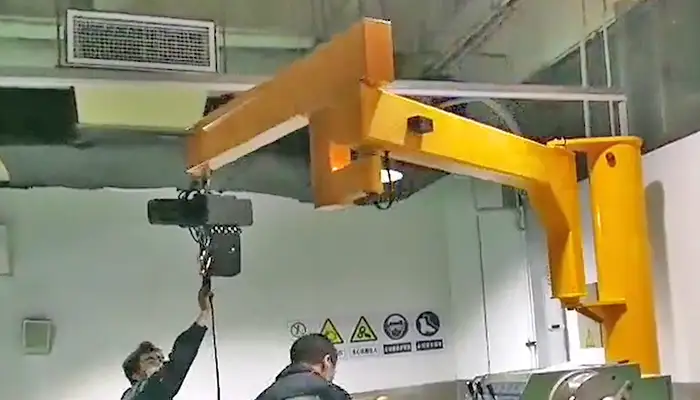
Folding Jib Crane vs Standard Jib Crane for Workstations
menu_open
Content Quick Link
Folding Jib Crane vs Standard Jib Crane: Which Is Better for Your Workstation?
Compare folding jib crane and standard jib crane for workstation lifting (125kg–2t). Learn space use, cost, installation, maintenance, and layout choice.
Most Important Takeaway
The choice between a folding jib crane and a standard jib crane is not about lifting capacity—it is about how your workspace is structured. Tight, obstacle-heavy layouts benefit from articulated reach, while open, repetitive stations perform better with a simple circular jib system.
FAQ: Folding Jib Crane vs Standard Jib Crane (Workstation Selection Guide)
This section addresses practical selection questions based on real workstation conditions, focusing on layout constraints, workflow behavior, installation complexity, and long-term operating performance.
Which jib crane is better for tight or obstacle-filled workstations?
A folding (articulated) jib crane is the more suitable choice for tight, congested, or obstacle-filled workstation layouts.
In many workshop setups where machines, benches, or structural columns limit movement, a folding arm system allows the operator to reach different lifting points without requiring a full clear swing radius.
This makes it practical for compact fabrication shops, maintenance areas, or multi-machine production cells where space optimization is more important than simple circular rotation.
When does a folding jib crane justify its higher cost?
A folding jib crane justifies its higher investment when workflow flexibility and access to multiple hard-to-reach lifting positions are critical.
In real industrial use, especially in retrofit workshops or dense production environments, the cost is offset by reduced material repositioning and improved handling efficiency.
It becomes valuable when the workstation cannot be redesigned easily and operators need a workstation lifting solution that adapts to existing constraints rather than requiring layout changes.
How does a standard jib crane improve efficiency in open layouts?
A standard jib crane improves efficiency by delivering fast, repeatable lifting operations within a clear circular working zone.
In open production floors, warehousing areas, or dedicated loading stations, the rigid boom design supports smooth pick-and-place cycles with minimal operator adjustment.
This makes it ideal for repetitive material handling tasks where speed, simplicity, and stable rotation around a pillar-mounted or wall-mounted point are more important than flexible reach.
What are the real differences in working envelope and reach behavior?
The difference is defined by movement geometry—folding systems use segmented reach paths, while standard jib cranes operate on a fixed-radius circular arc.
An articulated arm configuration allows a folding system to access multiple non-linear working zones, such as behind equipment or between closely spaced workstations.
A standard system provides a consistent swing area that is easier to predict and plan but less adaptable to obstructed environments.
How do installation and maintenance requirements compare?
Folding jib cranes require more precise installation and higher maintenance effort, while standard jib cranes are simpler to install and maintain.
Articulated systems involve multiple joints, pivot points, and load transfer sections, often requiring reinforced mounting structures and careful alignment during installation.
Standard configurations are widely used in industrial crane systems because they rely on fewer moving parts, resulting in lower maintenance frequency and longer service intervals in typical workstation use.
Which option reduces long-term operating cost in 125 kg–2 ton lifting tasks?
In open and repetitive workflows, a standard jib crane usually delivers lower long-term operating cost, while folding systems can reduce hidden operational inefficiencies in constrained layouts.
Standard workstation jib cranes minimize cost through simpler structure, lower maintenance requirements, and efficient cycle performance in stable production environments.
Folding jib cranes may have higher upfront cost, but in complex material handling scenarios they reduce downtime caused by repositioning, layout limitations, and restricted access, improving overall workflow efficiency in space-limited workshops.
Overview: Two Approaches to Workstation Lifting
Workstation jib cranes in the 125 kg to 2 ton lifting range are widely used to improve localized material handling efficiency in workshops, assembly cells, and maintenance areas.
In practical industrial layouts, two configurations are most commonly selected:
- Folding (Articulated) Jib Crane
- Standard Jib Crane (Pillar-mounted / Wall-mounted)
Both systems solve the same core problem—short-distance lifting and positioning—but they behave very differently once installed in a real workstation environment.
The key engineering difference is straightforward but critical in design selection:
A folding jib crane is built to extend reach through multiple movement points, allowing the operator to work around machines, benches, or structural obstacles without repositioning the load.
A standard jib crane is built around a fixed pivot and delivers predictable circular rotation, making it highly stable, fast to operate, and mechanically simple in open workspace conditions.
Product Structure Definition
The structural design is essential because it directly determines how each jib crane behaves inside a workstation.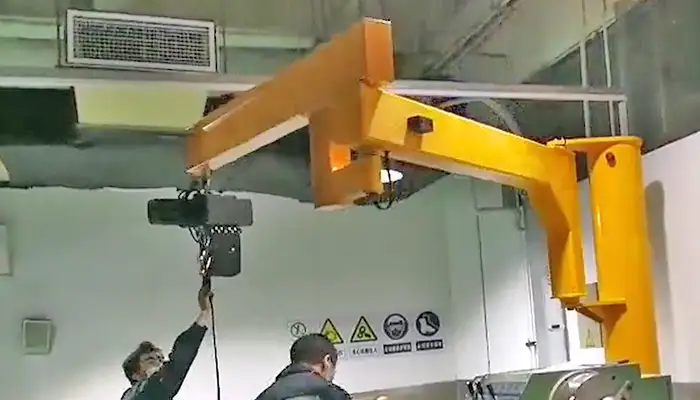
Folding / Articulated Jib Crane
A folding or articulated jib crane is built around a multi-link arm system, typically consisting of 2–3 articulated boom sections connected through pivot joints.
Key structural characteristics include:
- Multi-link arm system with 2–3 articulated sections
- Independent rotation at each joint, allowing segmented motion control
- Non-linear working path, enabling movement that is not restricted to a fixed radius
- Flexible positioning around obstacles, machines, or confined work areas
- Mounting options typically include wall-mounted, column-mounted, or workstation-frame integration
This structure allows the crane to extend reach in stages, making it suitable for environments where straight circular access is blocked or inefficient.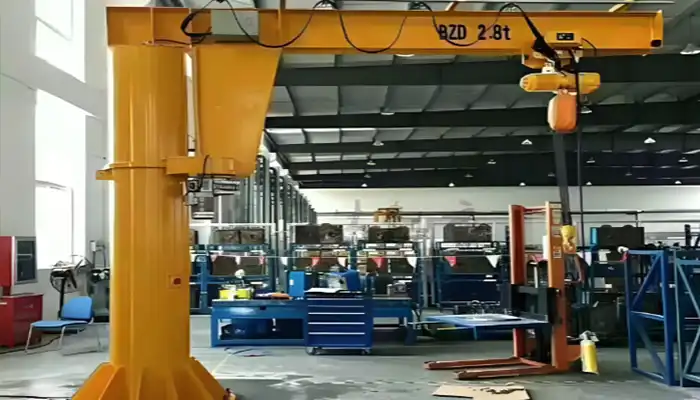
Standard I Beam Jib Crane
A standard jib crane is based on a single rigid boom system mounted on a slewing pivot, designed for rotational movement around a fixed point.
Key structural characteristics include:
- Single rigid boom supported on a slewing pivot system
- Full or partial circular rotation depending on installation constraints
- Standard configurations include pillar-mounted jib cranes and wall-mounted jib cranes
- Fixed geometric working envelope with a consistent radius throughout operation
- Simplified mechanical structure with minimal articulation points
This design prioritizes predictable motion, structural simplicity, and stable rotation performance in open workspace layouts.
Working Envelope Behavior (Key Differentiator)
The working envelope is the most important performance difference between a folding (articulated) jib crane and a standard jib crane. It defines how the crane actually behaves once installed in a real workstation layout.
| Aspect | Folding Jib Crane | Standard Jib Crane |
|---|---|---|
| Movement path | Multi-zone, segmented reach | Circular arc |
| Coverage pattern | Irregular but flexible | Uniform and predictable |
| Obstacle handling | High capability | Limited by clearance constraints |
| Precision positioning | High in complex layouts with multiple access points | High in open layouts with unobstructed swing radius |
In practical terms, a folding jib crane is designed to extend usable working space inside constrained environments, allowing the load to be repositioned through multiple directional segments. A standard jib crane, on the other hand, relies on a fixed-radius rotation system that performs best when the workspace is clear and the lifting path is consistent and unobstructed.
Obstacle & Space Adaptability
In workstation crane selection, spatial constraints usually determine whether the system performs efficiently or becomes limited in daily operation. The key difference between folding and standard jib cranes is how each system responds to physical obstacles such as machines, columns, and closely spaced work areas.
The comparison below highlights how each design behaves in real workshop layouts where space availability is not ideal or fully controlled.
| Factor | Folding Jib Crane | Standard Jib Crane |
|---|---|---|
| Design intent | Built for constrained and obstacle-heavy environments | Built for open, clear workspace rotation |
| Space requirement | Works within tight or irregular layouts | Requires clear circular swing radius |
| Obstacle handling | High adaptability around machines, columns, and workstations | Limited; movement restricted by physical obstructions |
| Reach capability | Can access multiple separated working zones (behind, between, inside cells) | Fixed radius around pivot point |
| Typical usage environment | Dense workshop layouts, retrofit areas, multi-machine cells | Open production floors, dedicated lifting stations |
| Workflow impact | Reduces need to move or reposition workpieces | Requires workspace planning around crane movement |
From a practical engineering standpoint, folding jib cranes are selected when the layout cannot be simplified or reorganized, while standard jib cranes are preferred when the workspace can be designed around a defined and unobstructed lifting radius.
Cost Structure Comparison
Cost is one of the most decisive factors in workstation crane selection, especially in the 125 kg to 2 ton range where both folding and standard jib cranes are widely used. The difference in pricing is mainly driven by structural complexity and mechanical design requirements rather than lifting capacity alone.
The breakdown below shows how each system differs in manufacturing and installation cost structure.
| Factor | Folding Jib Crane | Standard Jib Crane |
|---|---|---|
| Structural complexity | High due to articulated multi-joint arm system | Low due to single rigid boom design |
| Mechanical components | Includes multiple joints, pivot points, and balancing elements | Minimal components with single rotation pivot |
| Manufacturing cost | Higher due to precision engineering and assembly complexity | Lower due to standardized production and simpler structure |
| Installation cost | Higher; may require reinforced mounting and precise alignment | Lower; simpler foundation or wall bracket installation |
| Market positioning | Typically considered a premium workstation solution | Positioned as an economical and widely used industrial option |
| Best use case | Specialized layouts requiring flexibility and obstacle handling | General-purpose lifting in open or standardized work areas |
From a practical purchasing perspective, folding jib cranes are selected when operational flexibility justifies the additional investment, while standard jib cranes remain the cost-efficient choice for repetitive and well-structured workstation environments.
Installation Requirements
Installation complexity is another key factor that influences crane selection in workstation environments. The structural design of folding and standard jib cranes directly affects foundation requirements, alignment precision, and commissioning time.
The comparison below highlights how each system differs during installation and setup.
| Factor | Folding Jib Crane | Standard Jib Crane |
|---|---|---|
| Structural sensitivity | High sensitivity to load distribution across articulated joints | Low sensitivity due to rigid boom structure |
| Mounting requirements | Requires strong structural stiffness at mounting point | Standard mounting on pillar base or wall bracket |
| Installation complexity | Higher due to multi-joint alignment and system calibration | Lower due to simplified geometry and fewer alignment points |
| Structural reinforcement | Often requires reinforced wall, column, or workstation frame | Typically uses standard concrete foundation or existing structure |
| Alignment requirements | Precise alignment of joint geometry is critical for smooth operation | Basic alignment of pivot and rotation axis |
| Commissioning time | Longer installation and setup cycle | Faster commissioning and operational readiness |
| Adaptability to workshop | Best suited for customized or constrained layouts | Easily adaptable to standard industrial workshop structures |
In practical installation scenarios, folding jib cranes require more engineering attention during mounting due to their articulated load paths, while standard jib cranes prioritize ease of installation and faster deployment in typical workshop environments.
Maintenance Requirements
Maintenance requirements are directly influenced by the mechanical structure of the jib crane. The difference between articulated motion and rigid rotation determines inspection frequency, lubrication points, and long-term service workload.
The comparison below outlines how folding and standard jib cranes differ in routine maintenance and operational upkeep.
| Factor | Folding Jib Crane | Standard Jib Crane |
|---|---|---|
| Maintenance intensity | High due to multiple moving joints and articulated sections | Low due to simplified rigid boom structure |
| Lubrication points | Multiple articulation bearings requiring regular greasing | Limited lubrication points mainly at slewing bearing and hoist |
| Wear monitoring | Joint wear and pivot condition must be continuously monitored | Primarily focused on slewing bearing and load handling components |
| Inspection frequency | Requires scheduled and structured inspection discipline | Longer service intervals with simpler inspection routines |
| Failure risk points | Multiple joint interfaces increase potential wear locations | Fewer mechanical interfaces reduce failure risk |
| Operational downtime | Potentially higher if joints require repair or adjustment | Lower due to simpler mechanical system |
| Maintenance focus areas | Articulated joints, pins, and load transfer points | Slewing bearing, hoist system, and structural integrity |
In operational terms, folding jib cranes demand more disciplined maintenance planning due to their multi-joint design, while standard jib cranes offer a simpler maintenance profile suited for long-cycle, low-intervention industrial use.
Operational Performance (125 kg–500kg range)
Operational performance in workstation jib cranes is defined by how efficiently the system supports real lifting cycles, positioning accuracy, and operator workflow. The difference between folding and standard designs becomes more visible during daily repetitive use rather than in specification sheets.
The comparison below highlights how each crane type performs under typical industrial working conditions.
| Factor | Folding Jib Crane 125 kg–500kg | Standard Jib Crane( 500kg to 15 ton ) |
|---|---|---|
| Primary strength | Multi-position access in complex or restricted layouts | Fast and stable repetitive lifting in open layouts |
| Best application type | Assembly operations with complex part positioning | Repetitive lifting cycles and material transfer stations |
| Suitable environments | Maintenance workshops and irregular workstation layouts | Loading/unloading areas and structured production lines |
| Load handling behavior | Allows multi-step positioning without repositioning the workpiece | Optimized for direct pick-and-place within a fixed radius |
| Workflow efficiency | High in complex spatial movement tasks | High in repetitive, standardized operations |
| Movement speed | Slightly slower due to articulation and multi-joint coordination | Faster due to single-axis rotational simplicity |
| Operational limitation | Reduced speed in high-frequency repetitive tasks | Limited flexibility in obstacle-heavy environments |
From a practical operation standpoint, folding jib cranes are preferred where task complexity and reach variability dominate, while standard jib cranes are more efficient in stable, repetitive lifting environments with predictable material flow.
Suitable Application Layouts
The suitability of a jib crane is ultimately determined by the physical layout of the workspace. Folding and standard configurations are optimized for fundamentally different spatial conditions, and selecting the correct type depends on how equipment, materials, and operators are arranged within the facility.
The comparison below highlights the most appropriate application environments for each system.
| Factor | Folding Jib Crane | Standard Jib Crane |
|---|---|---|
| Layout type | Compact, dense, or irregular workshop layouts | Open and structured industrial layouts |
| Space condition | Restricted or obstacle-heavy environments | Clear and unobstructed working zones |
| Machine arrangement | Multi-machine production cells with tight spacing | Single-task or linear workstation setups |
| Flexibility requirement | High flexibility needed to navigate fixed equipment | Low flexibility requirement with predictable movement paths |
| Installation environment | Retrofit workshops with existing structural constraints | Purpose-built production floors with planned crane zones |
| Typical applications | Machine shops, maintenance stations, repair workshops | Warehousing, logistics areas, assembly lines |
| Operational priority | Access to multiple hard-to-reach positions | Fast and efficient repetitive material handling |
In practical terms, folding jib cranes are selected when the facility must adapt to existing structural limitations, while standard jib cranes are preferred in environments where the layout is designed around a defined lifting zone from the beginning.
Productivity Impact
Productivity in workstation lifting systems is not only determined by lifting speed, but also by how efficiently the crane integrates into the operator’s workflow. Folding and standard jib cranes influence handling time, operator behavior, and cycle efficiency in different ways depending on the layout and task type.
The comparison below summarizes their impact on real production performance.
| Factor | Folding Jib Crane | Standard Jib Crane |
|---|---|---|
| Handling efficiency | Reduces multiple handling steps in complex or obstructed layouts | Optimized for direct and repetitive pick-and-place cycles |
| Workspace accessibility | Improves reach into constrained or multi-zone work areas | Limited to fixed circular working radius |
| Cycle speed | Moderate due to multi-joint movement coordination | High due to simple and repeatable motion path |
| Operator training | Requires higher familiarity with articulated movement control | Easier and faster operator training |
| Workflow stability | Best in variable and irregular workflows | Best in stable, repetitive production processes |
| Overall productivity gain | High in complex spatial environments | High in structured, high-frequency operations |
In practical workshop conditions, folding jib cranes improve productivity by reducing repositioning and access limitations, while standard jib cranes increase throughput by simplifying repetitive lifting cycles and reducing operator decision time.
11. Selection Logic (Practical Engineering Rule)
Selecting between a folding jib crane and a standard jib crane is ultimately a layout-driven engineering decision. Capacity (125 kg–2 ton) is usually similar, so the real selection factor is workflow geometry, space constraints, and production behavior.
The decision framework below summarizes the most practical selection logic used in workstation planning.
| Selection Criteria | Folding Jib Crane | Standard Jib Crane |
|---|---|---|
| Workspace condition | Best for congested, irregular, or obstacle-filled layouts | Best for open, structured, and controlled layouts |
| Reach requirement | Required to access multiple non-aligned lifting points | Single circular working zone is sufficient |
| Material handling flow | Ideal when repositioning parts is difficult or inefficient | Ideal for direct, repetitive pick-and-place cycles |
| Layout flexibility | High flexibility required due to fixed machines or constraints | Low flexibility needed; workspace designed around crane |
| Production priority | Access and adaptability | Speed and consistency |
| Budget consideration | Accepts higher cost for functional flexibility | Prioritizes cost efficiency and scalability |
From an engineering standpoint, folding jib cranes are selected when the workstation must adapt to the environment, especially in retrofit or high-density production areas. Standard jib cranes are selected when the environment is designed to support the crane’s natural circular operating envelope, allowing faster and more efficient repetitive lifting.
In most real industrial applications, the decision is not about which crane is “better,” but which one aligns correctly with the physical constraints and workflow structure of the workstation.
Final Engineering Summary
Workstation jib crane selection is not a capacity-driven decision in most cases. In the 125 kg to 2 ton range, both folding and standard designs can handle similar loads. The real difference lies in how each system interacts with the workspace layout and daily workflow.
Core Design Difference
- Folding jib cranes prioritize spatial flexibility and obstacle navigation
- Standard jib cranes prioritize simplicity, speed, and cost efficiency
These two design philosophies lead to very different behavior in real workshop conditions.
Folding Jib Crane – Key Engineering Position
Folding jib cranes are developed for environments where space is limited or irregular. Their articulated arm structure allows the operator to work around physical constraints instead of reorganizing the workspace.
- Designed for complex or restricted workstation layouts
- Uses articulated arm structure for multi-point reach
Works effectively in environments with:
- Fixed machines and structural obstacles
- Narrow or irregular working zones
- Multiple lifting positions within one workstation
Reduces the need to reposition heavy workpieces during operation
Performs best in retrofit workshops or dense production cells
In practice, this type is chosen when flexibility is more valuable than speed.
Standard Jib Crane – Key Engineering Position
Standard jib cranes are built around a fixed rotation system. The movement is predictable and circular, which makes them highly efficient in open and well-organized workspaces.
- Designed for open and controlled working environments
- Uses a rigid boom with circular rotation around a fixed pivot
Works effectively in environments with:
- Clear and unobstructed swing radius
- Repetitive lifting cycles
- Standardized workstation layouts
Delivers faster cycle times and simpler maintenance
Best suited for production lines with stable workflows
This type is preferred when efficiency and simplicity are more important than reach flexibility.
Engineering Selection Principle
The most important factor in selecting between these two systems is not lifting capacity, but workspace structure.
In practical engineering planning, key considerations include:
- Layout geometry (open space vs constrained layout)
- Workflow path (repetitive movement vs multi-point access)
- Obstacle density (machines, columns, partitions)
- Handling frequency and operation cycle speed
These factors determine how effectively the crane integrates into daily production.
Final Takeaway
Folding jib cranes are best used when the workspace demands flexible reach and obstacle navigation. Standard jib cranes are best used when the workspace is open and operations are repetitive.
In real workstation design, performance is shaped more by layout conditions and workflow behavior than by the crane's rated lifting capacity.

Article by Bella ,who has been in the hoist and crane field since 2016. Bella provides overhead crane & gantry crane consultation services for clients who need a customized overhead travelling crane solution.Contact her to get free consultation.