
500kg 1Ton1 Ton Articulating Jib Crane for Workshop & CNC Use
500kg 1Tonarticulating jib crane for CNC, welding & assembly workstations. Ideal for narrow spaces with flexible arm movement and custom mounting options.
| Crane Type | Articulating Jib Crane |
| Crane Capacity | 500kg to 1Ton, and Customized. |
| Coverage Area Type | Flexible Irregular Circular Coverage Area with Multi-Joint Articulated Reach. An articulating jib crane provides non-linear, obstacle-avoiding coverage, making it ideal for tight or complex workstation layouts. |
| Application | An articulating jib crane is typically used for CNC machine tending, assembly line lifting, maintenance and repair work, and small parts handling in workshops. It is especially suitable for tight or obstructed workstations where access is limited. |
| Certifications | CE / ISO / SGS / Other third-party inspection |
| Customization | Customized material handling cranes solutions available for indoor, outdoor, hazardous, corrosive, c |
Crane Manufacturer: Yuantai Cranes – 30+ Years Professional Crane Manufacturer from China
Category: Jib Crane
Tags: jibcraneforsale
Your Trusted Rotating Jib Crane Manufacturer & Supplier
500kg 1Ton1 Ton Articulating Jib Crane for Sale Affordable Price
Good Price, Double Rail Crab Trolley for Crab Crane
500kg 1Ton articulating jib crane for CNC, welding & assembly workstations. Ideal for narrow spaces with flexible arm movement and custom mounting options.
Product Overview of Articulating Jib Crane
A 500kg 1Ton articulating jib crane is a workstation lifting device designed for small and narrow industrial areas where material handling space is limited. It uses a dual-arm structure that allows the load to move around machines, benches, and structural obstacles inside the working zone.
In practical factory use, it is commonly installed beside CNC machines, welding stations, and assembly benches. The crane helps operators lift and position parts without relying on forklifts or manual handling.
This type of 500kg 1Tonjib crane is often chosen because it fits well into single-workstation layouts. It does not require a large overhead runway system, and it can be installed close to the working point.
Key uses include:
- CNC machine loading and unloading
- Assembly cell material handling
- Maintenance and repair lifting
- Welding and fabrication support work
- Small component transfer between stations
The 500kg 1Toncapacity is widely used in industrial workshops. It is strong enough for most machine parts, but still compact enough for tight indoor spaces. In many cases, it becomes the standard lifting solution for light to medium workshop applications.
Factory direct supply is commonly available, and customization is possible based on workshop layout, lifting height, and installation conditions. Simple drawings or photos are usually enough to confirm the correct configuration.
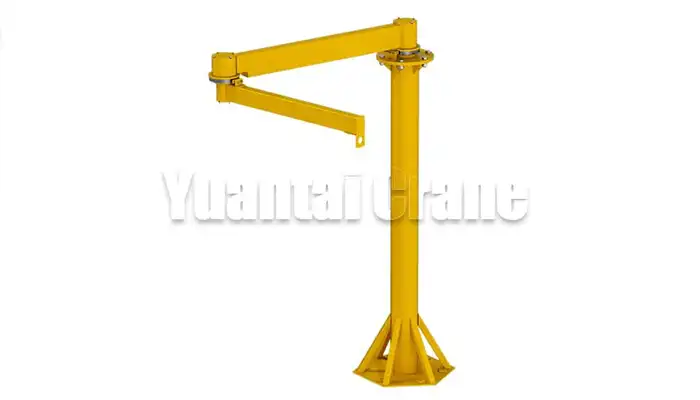
Pillar mounted articulating jib crane
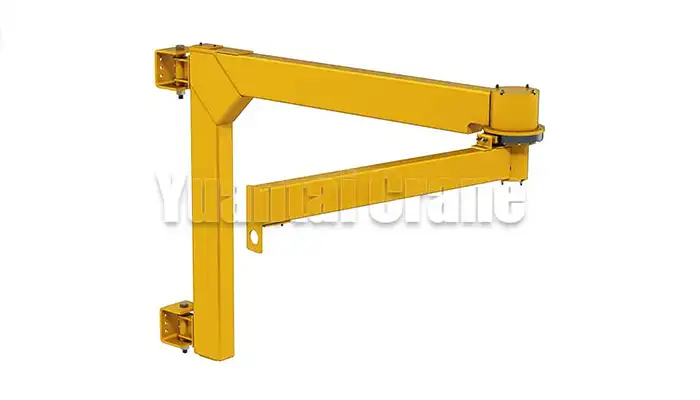
wall mounted articulating jib crane or column mounted articulating jib crane
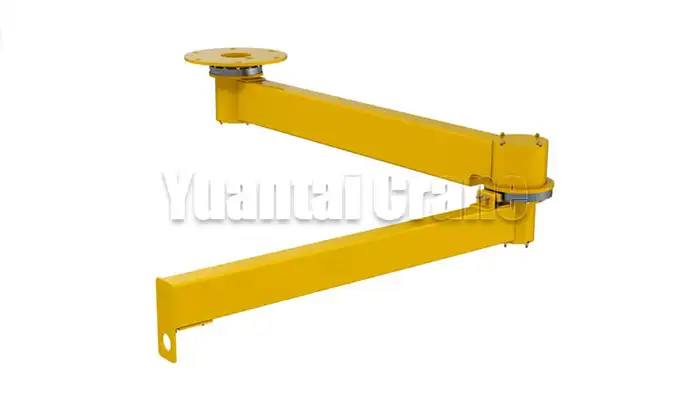
ceiling mounted articulating jib cranes
Key Features of 500kg 1Ton articulating jib crane
The 500kg 1Ton articulating jib crane is built for controlled lifting in restricted spaces. It is not only about lifting weight. It is about moving loads smoothly inside a workstation where obstacles are always present.
The dual-arm articulated structure is the main feature. It allows the crane to fold, extend, and change direction during operation. In industrial use, this helps the load move around machines, columns, and worktables without needing extra handling equipment.
Main features include:
- Dual-arm articulated design that allows flexible movement around obstacles
- 500kg 1Tonrated capacity suitable for CNC machining, assembly, and maintenance work
- Flexible rotation range for confined workstation layouts
- Smooth load positioning for precise installation and assembly tasks
- Compatible with electric chain hoist for frequent lifting cycles
- Optional mounting types including floor-mounted, wall-mounted, and column-mounted designs
- Simple structure with low maintenance requirements in daily operation
- Long service life when used under standard industrial working conditions
In many workshops, this type of crane is installed at a single workstation and used repeatedly throughout the day. The movement is simple, but controlled. Operators usually say it is easier to handle compared to manual lifting tools, especially when working in tight areas with limited access.
Technical Specifications of 500kg 1Ton articulating jib cranes
The 500kg 1Ton articulating jib crane is configured for workstation use, and most parameters are adjusted according to industrial workshop layout rather than fixed standard dimensions. In practical applications, CNC shops, assembly lines, and maintenance areas usually define the working range first, then confirm the technical setup.
Below are the typical specification ranges used in industrial projects.
- Rated capacity: 500kg to 1 Ton
- Working radius: customizable, typically 2m–6m
- Lifting height: customizable based on workshop requirement and headroom
- Rotation angle: 180° / 270° / 360° (based on structure and site layout)
- Hoist type: electric chain hoist / manual optional
- Control system: pendant control / wireless remote
- Power supply: 220V / 380V / 415V (customized according to country standard)
- Installation type: pillar / wall / column mounted
- Duty classification: light to medium duty industrial use
Each specification should match the actual working condition. For example, a CNC loading station may require shorter radius but higher positioning accuracy, while a maintenance area may need wider reach for flexible access around equipment.
Before final confirmation, it is common practice to review workshop drawings or site photos. This ensures the crane fits the industrial lifting path and avoids interference with machines, structures, or operator movement.
Working Principle of Articulating Jib Crane
A 500kg 1Ton articulating jib crane works through a dual-arm mechanical structure designed for controlled movement in restricted spaces. In industrial workshop conditions, it is used where straight-line lifting is not possible due to machines, walls, or fixtures blocking the path. The system focuses on flexible positioning rather than long-distance travel. It allows operators to move loads step by step inside a confined workstation.
How the Dual-Arm Structure Works
The crane consists of two connected arms working together to extend the lifting range.
- The first arm is fixed to the support column or wall bracket
- The second arm is connected to the end of the first arm
- The hoist is mounted at the end of the second arm
This structure allows the crane to "fold" and "extend" inside the workspace. In practical use, it behaves more like an articulated mechanical arm than a rigid boom.
Primary Arm Rotation vs Secondary Arm Movement
The movement of the crane is divided into two levels.
The primary arm rotation controls the main swing around the support point. It defines the general working direction and coverage area of the workstation.
The secondary arm movement provides additional reach inside that area. It helps the operator adjust the position of the load more precisely, especially near machines or fixtures.
In simple terms:
- Primary arm = broad movement direction
- Secondary arm = fine positioning inside the workspace
This combination allows more flexible handling than a standard jib crane.
Load Movement Path in Confined Spaces
In narrow workshops, the load does not move in a straight line. Instead, it follows a controlled path guided by the two arms.
A typical movement process includes:
- Lift the load vertically from pickup point
- Rotate primary arm to correct working direction
- Adjust secondary arm to bypass obstacles
- Position load at final installation point
This step-by-step movement is what makes the crane suitable for CNC machine areas, assembly cells, and maintenance stations where space is limited.
Why It Can Bypass Machines and Obstacles
The key advantage of an articulating jib crane is its ability to move around physical barriers.
In industrial factory layouts, obstacles may include:
- CNC machine guards
- Welding tables
- Structural columns
- Electrical cabinets
- Pipe systems
Instead of forcing a straight path, the dual-arm design allows the crane to change direction mid-movement. The load can be guided around obstacles without requiring extra floor space or repositioning equipment.
This is especially useful in workshops where machines are placed close together and aisle space is limited.
Simple Explanation of Workstation Coverage
The crane does not cover a full workshop like an overhead crane. Instead, it serves a defined workstation area.
In practical terms, it creates a flexible working zone where:
- The load can be picked up from one side
- Moved around obstacles
- And placed accurately at the required point
The coverage area depends on arm length and rotation angle. In most applications, it is designed to serve one machine, one assembly station, or one maintenance zone.
This focused coverage makes it suitable for repetitive lifting tasks in compact industrial environments, where precision and space efficiency are more important than long travel distance.
Structural Design of 500kg 1Ton articulating jib crane
The structural design of a 500kg 1Ton articulating jib crane is focused on stability, controlled movement, and safe operation in confined workstation areas. Each component is designed to handle repeated lifting cycles while maintaining smooth arm movement and precise load positioning. In practical workshop use, the structure must balance rigidity and flexibility. It must stay stable under load but still allow smooth articulation of the dual-arm system.
Main Pillar / Support Structure
The main pillar is the load-bearing foundation of the crane. It carries the full weight of the crane system and transfers lifting forces to the floor or building structure.
Typical features include:
- Heavy-duty steel column construction
- Base plate with anchor bolt fixing
- Reinforced connection points for boom system
- Designed for vertical load and rotation stress
In industrial installation, the pillar must be fixed on a reinforced concrete foundation to ensure stability during 500kg 1Tonlifting operations.
Primary Boom Construction
The primary boom is the first rotating arm connected to the pillar or wall bracket. It defines the main working direction of the crane.
Key characteristics:
- High-strength steel beam structure
- Designed for horizontal rotation around the support point
- Supports the secondary arm and hoist load
- Balanced to reduce vibration during movement
This arm usually handles the main lifting radius and determines the overall workstation coverage area.
Secondary Articulated Boom System
The secondary boom is the flexible arm connected to the end of the primary boom. It provides additional movement inside the working area.
Its main role is fine positioning.
Key points:
- Allows folding and extension movement
- Improves access around machines and obstacles
- Helps position load accurately at final point
- Reduces need for manual adjustment
In industrial workshop operation, this arm is often used for precise placement into CNC machines, fixtures, or assembly stations.
Slewing Mechanism and Bearings
The slewing system enables smooth rotation of both arms.
It typically includes:
- Heavy-duty slewing bearing or slewing ring
- Rotation joints between pillar and boom
- Lubrication points for smooth movement
- Mechanical support for load stability
The design ensures that rotation remains smooth even under full 500kg 1Tonload conditions. In daily use, this is one of the most frequently operated parts of the crane.
Hoist Trolley System Integration
The hoist is mounted at the end of the secondary arm, often with a trolley system for lateral movement along the boom.
Key elements include:
- Electric chain hoist mounting bracket
- Trolley wheels for smooth travel
- Load hook and lifting chain system
- Cable routing system for power supply
This integration allows the load to move vertically and horizontally within the workstation. In practice, it is the main component used by operators during daily lifting tasks.
End Stops and Rotation Limit Design
End stops are safety components used to control the movement range of the crane.
They are designed to prevent over-rotation and structural collision.
Key functions include:
- Limiting primary and secondary arm rotation angles
- Preventing contact with nearby machines or walls
- Protecting bearings and joints from excessive movement
- Defining safe working boundaries inside the workstation
In narrow workshop environments, rotation limits are often customized based on machine layout and obstacle positions.
The structural design of a 500kg 1Ton articulating jib crane is built around controlled flexibility. Each part—from the pillar to the secondary arm—works together to provide stable lifting and precise positioning. In industrialuse, this structure allows operators to handle loads safely inside tight workspaces without interfering with surrounding machines or production flow.
Available Installation Types
A 500kg 1Ton articulating jib crane can be installed in different ways depending on workshop layout and structural conditions. In practical projects, the installation method often decides how flexible the crane will be in daily use, as well as how much floor space it will occupy. Below are the three common installation types used in CNC workshops, fabrication areas, and maintenance facilities.
Pillar-Mounted 500kg 1Ton Articulating Jib Crane
The pillar-mounted type is a freestanding installation supported by a dedicated steel column fixed to a reinforced concrete foundation. It is the most independent and widely used configuration for workstation lifting.
This design does not rely on building walls or existing structures. It creates a dedicated lifting point inside the workshop.
Typical characteristics include:
- Independent foundation required
- Full rotation flexibility within designed range
- Suitable for new workshop planning or layout upgrades
- Stable structure for repetitive 500kg 1Tonlifting tasks
In industrial applications, this type is often installed beside CNC machines, assembly stations, or maintenance areas where a fixed and reliable lifting point is needed. It is commonly chosen when the workshop is newly built or when no suitable wall structure is available.
Wall-Mounted 500kg Articulating Jib Crane
The wall-mounted version is fixed directly onto a building wall or steel structural frame. It is designed for workshops where floor space must remain clear for machines, carts, or operator movement.
This type is more space-efficient compared to pillar-mounted systems.
Key characteristics include:
- Fixed on building wall or steel structure
- No floor occupation, keeping workspace open
- Suitable for narrow workshops and production lines along walls
- Cost-effective when strong structural support is available
In practical use, wall-mounted cranes are often installed along machining lines or assembly benches. They provide local lifting support without affecting floor traffic or material flow. However, the wall structure must be strong enough to support both lifting load and rotation forces.
Column-Mounted Articulating Jib Crane
The column-mounted type is installed on an existing structural column inside the workshop. This can be a steel support column or reinforced concrete pillar that is already part of the building structure.
It is often used in retrofit or upgrade projects.
Typical characteristics include:
- Uses existing workshop column
- No need for new foundation construction
- Ideal for upgrading older workshops
- Suitable where space is limited and structure already exists
In industrialapplications, this type is commonly used in factories that want to add lifting capability without changing the overall workshop layout. Before installation, the column must be checked for load-bearing capacity and structural condition to ensure safe operation.
Each installation type serves a different workshop condition: pillar-mounted is best for new or independent lifting stations, wall-mounted is suitable for space-saving layouts along building structures, and column-mounted is ideal for retrofit projects using existing infrastructure. In practice, the final choice depends on workshop layout, structural strength, and the required working radius of the 500kg 1Ton articulating jib crane.
Applicaiton Videos of Articulating Jib Cranes
Knuckle Jib Crane 500kg 1 Ton , Floor Mounted Ariticulating Jib Crane for Limited Space Workshops
Portable Jib Crane 500kg for Sale , Articulating Cantilever, 360 Rotating, Castor Wheel Travelling
Application Industries of 500kg 1Ton Articulating Jib Crane
A 500kg 1Ton articulating jib crane is mainly used in workstation-level material handling. It is not designed for long-distance transport, but for precise lifting inside small, structured working areas. In industrialprojects, it is widely installed where space is limited and manual handling is no longer practical. Below are the most common application industries.
CNC Machining Workshops
CNC workshops are one of the primary users of 500kg 1Ton articulating jib cranes. Machines are usually placed close together, and operators need fast and accurate loading and unloading.
Typical usage includes:
- Loading castings and machined parts into CNC machines
- Positioning tooling and fixtures
- Moving workpieces between machines and inspection tables
In practice, the crane helps reduce machine downtime and avoids forklift entry into narrow machining aisles. It is often installed directly beside each CNC machine or machining cell.
Metal Fabrication and Welding Shops
Fabrication workshops deal with irregular steel parts and welded structures. These parts are often bulky, uneven, and difficult to handle manually.
Typical applications include:
- Lifting steel plates and sections
- Moving welded assemblies between stations
- Positioning parts on welding tables
- Handling pipe sections and frames
The crane helps improve workflow between cutting, welding, and assembly areas. It also reduces manual lifting during repeated fabrication tasks.
Equipment Maintenance Workshops
Maintenance environments require flexible lifting because repair tasks are not always predictable. Components may need to be removed from machines and placed on repair benches.
Typical loads include:
- Motors
- Pumps
- Gearboxes
- Hydraulic components
- Machine assemblies
In industrial use, the crane is installed near service areas or maintenance bays. It helps technicians safely remove and reinstall heavy components without using forklifts or manual lifting.
Assembly Production Lines
Assembly lines require repeated and controlled lifting of components throughout the production process. Speed and consistency are more important than long travel distance.
Typical applications include:
- Mechanical sub-assemblies
- Electrical cabinet components
- Industrial equipment modules
- Small structural parts
The crane is often installed at individual assembly stations. It helps reduce worker fatigue and improves accuracy when positioning parts into fixtures.
Automotive Component Assembly
In automotive workshops, parts are usually standardized but still require careful handling during assembly.
Typical uses include:
- Engine components
- Gear systems
- Chassis parts
- Sub-assembly modules
The crane helps maintain production flow by allowing quick transfer of parts between storage, assembly, and inspection areas. It is especially useful in small-to-medium automotive workshops.
Pump and Motor Repair Stations
Pump and motor workshops deal with compact but heavy components that require precise lifting during repair and reassembly.
Typical loads include:
- Electric motors
- Industrial pumps
- Couplings and shafts
- Bearing housings
The articulating arm structure allows the crane to reach into tight repair spaces and position parts accurately on workbenches or assembly stands.
Warehouse and Packing Stations
In warehouse and packaging areas, lifting tasks are usually lighter but repetitive. The crane supports fast handling of goods between storage and packing zones.
Typical applications include:
- Cartons and packaged goods
- Spare parts boxes
- Small equipment
- Material bins
In practical use, it improves efficiency during order preparation and reduces manual lifting during repetitive packing operations.
Across different industries, the 500kg 1Ton articulating jib crane is mainly used where workspaces are narrow or blocked by machines, loads need to be positioned accurately, repetitive lifting is required, and forklifts are impractical inside workstations. It is widely applied in CNC machining, fabrication, maintenance, assembly, and warehouse operations, where controlled and localized lifting is required for daily production tasks.
Typical Load Handling Applications
A 500kg 1Ton articulating jib crane is designed for daily workstation lifting where loads are moderate in weight but require precise positioning. In industrial factory environments, it is mainly used for repeated handling tasks rather than long-distance transport. The crane is often installed close to machines, workbenches, or assembly points so that operators can lift and position parts directly where they are needed.
Steel Components up to 500kg
Steel parts are one of the most common load types in fabrication and machining workshops. These components are often heavy, irregular, and difficult to move manually.
Typical examples include:
- Structural steel sections
- Steel brackets and frames
- Small fabricated beams
- Cut steel plates
In practical use, the crane helps move these parts between cutting, welding, and assembly stations without requiring forklifts inside narrow work areas.
Machined Parts and Castings
Machined parts and castings are common in CNC and machining workshops. These parts usually require careful handling to avoid surface damage or positioning errors.
Typical applications include:
- CNC machined housings
- Engine components
- Cast metal blocks
- Precision machined parts
The articulating jib crane allows slow and controlled movement, which helps operators place parts accurately into machines or inspection fixtures.
Motors, Gearboxes, Pumps
Mechanical equipment handling is a key application for 500kg 1Tonjib cranes, especially in maintenance and repair workshops.
Typical loads include:
- Electric motors
- Gearboxes and reducers
- Industrial pumps
- Drive assemblies
In industrial use, these components are often removed from machines and need to be placed onto workbenches or repair stands. The crane provides stable lifting and helps reduce manual handling risks during maintenance work.
Welding Assemblies
Welded structures are often irregular in shape and difficult to balance. A 500kg 1Ton articulating jib crane is commonly used to move these parts between welding stations.
Typical applications include:
- Welded frames
- Pipe structures
- Steel assemblies
- Fabricated brackets
The crane helps position parts on welding tables and supports rotation or adjustment during assembly. This reduces physical strain on workers and improves positioning accuracy.
Tooling and Fixtures
Tooling and fixtures are frequently handled in machining and assembly environments. Although they may not always be heavy, they often require precise placement.
Typical examples include:
- Machine fixtures
- CNC tooling systems
- Molds and dies (light to medium size)
- Clamping devices
The crane helps align tooling with machines or workstations without manual lifting or adjustment, improving setup speed and consistency.
Packaging Crates and Parts Boxes
In warehouse and packing stations, the crane is used for lighter but repetitive lifting tasks. The focus here is efficiency and reduced manual labor.
Typical loads include:
- Wooden or cardboard crates
- Parts storage boxes
- Packaged equipment
- Material containers
In practice, the crane helps move goods between storage racks, packing tables, and dispatch areas. It reduces repeated lifting strain during order preparation and packaging work.
Across all applications, the 500kg 1Ton articulating jib crane is mainly used for controlled lifting in confined spaces, precise positioning near machines and workstations, and repetitive handling of moderate-weight industrial parts. It is widely used in machining, fabrication, maintenance, and packaging environments where stable and accurate load handling is required in daily operations.
Advantages of 500kg 1Ton articulating jib crane
A 500kg 1Ton articulating jib crane is mainly used where workshop space is tight and lifting tasks are repeated every day. In industrialsettings, its value is not only in lifting capacity, but in how it improves movement inside small workstations. It is often installed close to machines or assembly points, so operators can handle loads directly where work is performed.
Fits Narrow and Congested Workstations
This crane is designed for environments where space is already occupied by machines and equipment.
It works well in:
- CNC machine cells
- Assembly stations
- Welding work areas
- Maintenance corners
The dual-arm structure allows movement around obstacles without needing wide aisles or extra clearance space. In practical use, it fits into areas where forklifts or larger cranes cannot operate.
Reduces Manual Handling Effort
Manual lifting is still common in many workshops, but it increases fatigue and slows down production.
With a 500kg 1Ton articulating jib crane:
- Heavy parts are lifted mechanically
- Operators avoid repeated bending and carrying
- Risk of strain injuries is reduced
- Handling becomes more controlled
In daily operation, workers can focus more on positioning and assembly work instead of physical lifting.
Improves Loading and Positioning Accuracy
Precision is important in CNC machining and assembly work. Small positioning errors can affect production quality.
The crane helps by:
- Allowing slow and controlled movement
- Supporting fine positioning near machines
- Reducing sudden load swing during placement
- Improving alignment into fixtures or tools
In practice, this makes installation work smoother and more consistent.
Faster Workflow for Repetitive Tasks
In many workshops, the same lifting operation is repeated many times a day. Speed and consistency matter more than long travel distance.
Typical improvements include:
- Faster loading and unloading of machines
- Reduced waiting time between processes
- Shorter handling time per cycle
- More stable workflow between stations
It is commonly used in production lines where efficiency depends on repeated lifting tasks.
Safer Than Manual Lifting Methods
Safety is a key reason for installing workstation cranes. Manual handling of heavy parts often leads to accidents or long-term strain injuries.
Safety improvements include:
- Reduced direct lifting by workers
- Stable load movement with controlled operation
- Less risk of dropping heavy components
- Better control in narrow working areas
In industrial use, it provides a safer alternative to carrying or pushing heavy parts inside the workshop.
Lower Cost Than Overhead Crane Systems
Compared with full overhead crane systems, a 500kg 1Ton articulating jib crane requires less investment and simpler installation.
Cost advantages include:
- No runway beam system required
- No large structural modification needed
- Lower installation time
- Focused use for single workstation
For small to medium workshops, it provides a practical lifting solution without large infrastructure changes.
Easy Integration into Existing Workshops
One of the main advantages is that it can be added to existing production environments without major disruption.
It can be installed:
- Next to CNC machines
- Along production lines
- Inside maintenance areas
- In warehouse packing stations
In many cases, only a small foundation or structural fixing point is needed. This makes it suitable for retrofit projects where production cannot be stopped for long periods.
The 500kg 1Ton articulating jib crane is widely used because it solves practical problems in narrow workspaces. Its main advantages are better use of limited space, reduced manual handling, more accurate load positioning, improved workflow efficiency, safer operation compared to manual lifting, lower cost than full overhead crane systems, and easy installation in existing workshops. In industrialapplications, it is often chosen as a workstation-level lifting solution where flexibility and space efficiency are more important than long-distance material transport.
Articulating Jib Crane vs Standard Jib Crane
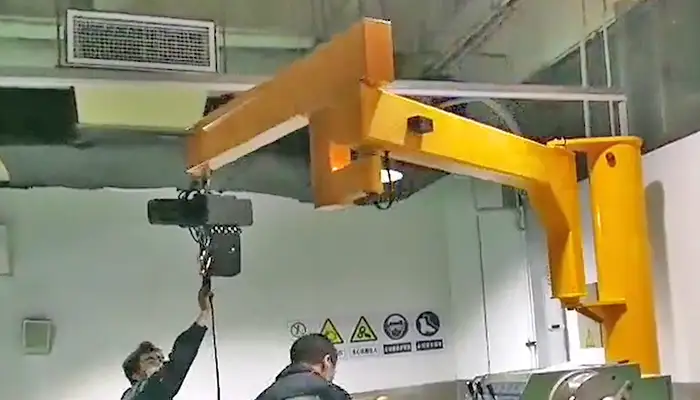
Floor mounted articulating jib crane with folding arm cantilever
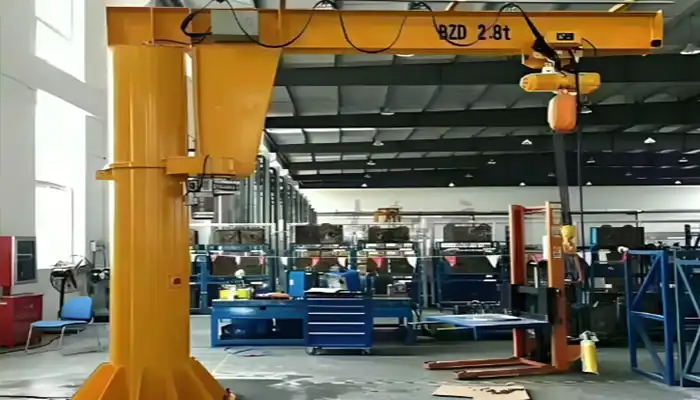
| Comparison Item | Articulating Jib Crane | Standard Jib Crane |
|---|---|---|
| Obstacle Navigation | Better ability to move around machines, columns, and fixtures in narrow workstations | Limited, movement is restricted when obstacles are in the working path |
| Arm Movement Flexibility | Dual-arm structure allows folding, extending, and multi-directional movement | Single rigid boom with fixed circular rotation |
| Positioning Precision | Higher precision for final load placement in CNC, assembly, and maintenance work | Moderate precision, mainly for general lifting and transfer |
| Suitability for Confined Areas | Designed for tight workstations and congested layouts | Less suitable when space is limited or blocked by equipment |
| Working Radius Behavior | Flexible working path with segmented reach around obstacles | Fixed circular working radius around the pillar or mounting point |
Safety Features of 500kg 1Ton articulating jib crane
A 500kg 1Ton articulating jib crane is a workstation lifting solution widely used in CNC workshops, fabrication shops, and maintenance areas where space is limited. In practical industrial use, safety design is built into both the articulating jib crane system and the hoist to ensure stable operation in narrow workstations.
Overload Protection System
- Protects the 500kg 1Tonjib crane from exceeding rated capacity
- Common in articulating jib crane workstation lifting systems
- Automatically stops hoist operation under overload condition
- Protects motor, load chain, and crane structure in daily use
Emergency Stop Control
- Standard safety feature in workshop jib crane systems
- Immediate shutdown of lifting and slewing functions
- Red emergency stop button on pendant or wireless remote control
- Used in CNC loading and industrial workstation lifting applications when abnormal movement occurs
Upper / Lower Limit Switches
- Prevent over-travel in electric chain hoist articulating jib crane setups
- Protect hook, hoist body, and lifting chain
- Common in 500kg 1Tonworkstation jib crane for CNC machine loading
- Ensures controlled vertical lifting inside confined spaces
Rotation Stops
- Controls working range of folding jib crane / knuckle jib crane design
- Prevents collision with machines, walls, and structural columns
- Defines safe operating zone for confined space lifting jib crane applications
- Adjustable based on workshop layout and working radius
Anti-Drop Hook Latch
- Basic mechanical safety device for articulated arm jib crane systems
- Secures slings, shackles, or lifting fixtures
- Prevents accidental load release during precision material handling operations
- Common in CNC machining and assembly workstation lifting
Stable Installation Structure
- Required for pillar mounted articulating jib crane 500kg 1Tonsystems
- Includes wall mounted and column mounted configurations
- Ensures stability under rated load and rotation force
- Critical for industrial workstation jib crane installation safety requirements
In industrial applications, these safety systems work together to support safe workstation lifting, CNC machine loading and unloading, maintenance lifting operations, and narrow space material handling. A properly designed 500kg 1Ton articulating jib crane system ensures controlled movement, stable load positioning, and reliable operation in daily industrial use.
Customization Options for 500kg 1Ton articulating jib crane
A 500kg 1Ton articulating jib crane is often configured as a workstation-specific lifting solution. In industrialprojects, especially CNC workshops, fabrication shops, and maintenance stations, the articulating jib crane system is rarely "one standard size". It is usually customized based on layout, working radius, and lifting task requirements. These customization options help match the crane to confined space material handling, workstation lifting applications, and industrial production line requirements.
Boom Length Customization
- Adjustable primary and secondary boom length for articulating jib crane workstation design
- Designed based on machine spacing and pickup/placement points
- Common in CNC machine loading jib crane solutions and assembly areas
- Ensures full coverage without blocking nearby equipment
Working Radius Adjustment
- Customized reach for narrow workshop jib crane applications
- Defines how far the crane can operate inside a workstation
- Suitable for obstacle bypass lifting in CNC and fabrication workshops
- Helps optimize space utilization in congested production layouts
Lifting Height Customization
- Adjusted according to workshop headroom and machine height
- Common in low headroom workstation lifting crane systems
- Ensures safe hook travel in maintenance and assembly operations
- Used in retrofit projects where building structure cannot be changed
Electric or Manual Hoist Selection
- Electric chain hoist for frequent industrial lifting operations
- Manual chain hoist for light-duty or occasional maintenance use
- Widely applied in 500kg 1Tonworkstation jib crane systems for CNC and repair workshops
- Selection depends on operating frequency and workflow intensity
Explosion-Proof Version (If Required)
- Designed for hazardous environments such as chemical or oil-related workshops
- Used in explosion-proof articulating jib crane applications (ATEX / industrial safety zones)
- Includes protected motor, control system, and electrical components
- Suitable for environments with gas, dust, or flammable materials
Corrosion-Resistant Coating for Harsh Environments
- Surface treatment for coastal, humid, or chemical exposure environments
- Improves service life of industrial workstation jib crane structures
- Common in marine workshops, outdoor yards, and heavy fabrication plants
- Optional epoxy paint or galvanized finish
Special Lifting Fixtures or Attachments
- Custom lifting tools for precision workstation lifting applications
- Includes clamps, hooks, magnets, or dedicated tooling fixtures
- Used in CNC machining, mold handling, and assembly line lifting tasks
- Improves positioning accuracy and handling safety for irregular loads
In practical use, customization is what makes a 500kg 1Ton articulating jib crane system suitable for different industries. From workstation jib crane for CNC machines to flexible assembly lifting systems, each configuration is designed to match industrial production conditions, not a fixed standard model.
Installation Requirements for 500kg 1Ton articulating jib crane
The installation of a 500kg 1Ton articulating jib crane depends strongly on workshop structure and working layout. In industrial projects, whether it is a pillar mounted articulating jib crane, wall mounted jib crane, or column mounted workstation jib crane, the installation conditions directly affect safety and performance. Before final installation, a basic site check is always required to confirm that the crane fits the industrial workstation lifting environment.
Concrete Foundation Requirement (Pillar Type)
- Required for pillar mounted 500kg 1Ton articulating jib crane systems
- Reinforced concrete base must support vertical load and rotation force
- Anchor bolts must be correctly embedded and aligned
- Common in new workshop installations and standalone lifting stations
This is the foundation of stable operation in workstation jib crane installation projects.
Structural Wall Strength (Wall-Mounted Type)
- Necessary for wall mounted articulating jib crane applications
- Wall or steel structure must support lifting load and slewing force
- Often used in narrow CNC workshops and assembly lines
- Structural reinforcement may be required for older buildings
This ensures safe operation in space-saving workstation lifting systems.
Column Load Verification (Column-Mounted Type)
- Required for column mounted jib crane retrofit installation
- Existing workshop column must be checked for load capacity
- Suitable for upgrading old factories without new foundation work
- Common in industrial retrofit workstation crane solutions
This step prevents structural overload during repeated lifting cycles.
Power Supply Requirement
- Stable industrial power supply required for electric chain hoist articulating jib crane systems
- Typically 220V / 380V / 415V depending on region
- Three-phase power is commonly used in factory environments
- Proper grounding and control wiring must be confirmed
This ensures smooth operation in CNC machine loading crane applications.
Workshop Clearance Check
- Confirms available space for arm rotation and load movement
- Includes machine positions, aisles, and overhead obstacles
- Essential for narrow space workstation jib crane installation
- Helps avoid interference with CNC machines, pipelines, or structures
Clearance planning directly affects industrial working radius and usability.
Layout Drawing Confirmation
- Required for accurate articulating jib crane design and quotation
- Includes machine layout, lifting points, and installation position
- Helps define working radius, boom length, and rotation range
- Common practice in custom workstation lifting crane projects
Even simple sketches or workshop photos can support final technical confirmation.
In industrialapplications, proper installation preparation ensures that the 500kg 1Ton articulating jib crane system operates safely, fits the workstation lifting environment, and performs efficiently in daily CNC, fabrication, and maintenance operations.
Price Factors of 500kg 1Ton articulating jib crane
The cost of a 500kg 1Ton articulating jib crane is not fixed. In industrialprojects, pricing depends on configuration, installation conditions, and customization level. The same articulating jib crane system can vary significantly depending on how it is designed for a specific workstation. Understanding these factors helps buyers control cost while still meeting industrial lifting requirements in CNC workshops, fabrication shops, and maintenance areas.
Installation Type Selection
- Pillar mounted, wall mounted, or column mounted design
- Independent foundation increases installation cost
- Wall or column mounting may reduce structural cost but depends on building condition
- Common factor in workstation jib crane price calculation
Installation method often has a direct impact on overall project cost.
Boom Length and Reach
- Longer working radius increases material and structural cost
- Affects stability design of 500kg 1Ton articulating jib crane system
- Custom reach required for CNC machine layout or multi-station coverage
- Shorter boom usually more economical for compact workstations
In practice, reach design is one of the main price drivers.
Hoist Brand and Configuration
- Electric chain hoist is standard for most workstation lifting crane applications
- Premium hoist brands increase cost but improve durability and performance
- Manual hoist reduces cost but limits efficiency
- Optional features such as dual-speed or low-headroom design affect pricing
Hoist selection directly affects daily operation quality.
Electrical System Requirements
- Control system type (pendant or wireless remote control)
- Voltage and frequency differences by country
- Additional protection systems for industrial environments
- Special wiring or control box requirements
These details are important in industrial workstation crane electrical configuration.
Special Working Environment Requirements
- Explosion-proof design for hazardous zones
- Anti-corrosion coating for coastal or chemical environments
- Dust-proof or high-temperature adaptations
- Outdoor installation protection requirements
These upgrades are common in special environment articulating jib crane applications.
Custom Engineering Needs
- Non-standard boom design or extended reach
- Special lifting attachments or fixtures
- Integration with existing production lines
- Structural reinforcement or non-standard mounting design
Custom engineering is often required for complex CNC workstation lifting solutions.
The price of a 500kg 1Ton articulating jib crane depends mainly on installation method, working radius and boom length, hoist and control system selection, electrical configuration, environmental protection requirements, and level of customization. In industrial projects, providing workshop drawings and application photos helps define accurate cost and ensures the final workstation jib crane solution matches actual industrial lifting needs without unnecessary expense or redesign.
FAQ Section (500kg 1Ton articulating jib crane)
This section answers common questions from buyers selecting a 500kg 1Ton articulating jib crane for sale, especially for CNC workshops, fabrication shops, and maintenance stations where space is limited and workstation lifting is frequent.
Is 500kg 1Tonenough for CNC machine loading?
Yes, in most cases a 500kg 1Tonjib crane is suitable for CNC machine loading and unloading.
It is commonly used for:
- Machined parts and castings
- Tooling and fixtures
- Small to medium machine components
In industrial workshop use, 500kg 1Tonis often enough for a single CNC workstation. However, the final capacity should always include lifting accessories such as slings, hooks, or fixtures to ensure safe workstation lifting crane operation.
Can it rotate 360 degrees?
Yes, but it depends on the installation type and workshop layout.
- Pillar-mounted models often support near full 360° rotation
- Wall-mounted types are usually limited by structural constraints
- Column-mounted designs depend on surrounding obstacles
In practice, rotation is adjusted based on workstation space and obstacle clearance to ensure safe operation inside narrow CNC or fabrication areas.
Can it be installed in old workshops?
The 500kg 1Ton articulating jib crane system is commonly used for retrofit projects.
It can be installed in existing workshops with:
- CNC machines already in place
- Limited floor space
- Fixed production lines
Installation options include:
- Wall-mounted on existing structure
- Column-mounted on steel columns
- Pillar-mounted with new foundation if needed
A simple layout check or workshop photo review is usually enough for confirmation.
Is electric hoist standard?
Yes, the electric chain hoist is the most common configuration for a 500kg 1Tonworkstation jib crane.
It is widely used because it offers:
- Smooth lifting and lowering control
- Suitable for frequent daily operation
- Better efficiency in CNC and assembly work
Manual hoists are optional and are mainly used for light-duty or occasional maintenance lifting tasks.
What is the lifespan of a 500kg 1Tonjib crane?
The service life depends on working conditions and maintenance, but in normal industrial use, a 500kg 1Ton articulating jib crane can operate for many years.
Typical lifespan factors include:
- Working frequency (single shift or multi-shift use)
- Load conditions and correct operation
- Regular lubrication and inspection
- Environmental conditions (dust, humidity, corrosion)
With proper maintenance, the crane can provide long-term stable service in industrial workstation lifting applications, especially in CNC machining, fabrication, and maintenance workshops.
The 500kg 1Ton articulating jib crane for CNC and workshop use is widely chosen because it is suitable for most workstation loads, flexible in installation for old and new workshops, compatible with electric hoist systems, and designed for long-term industrial operation in confined spaces.
Inquiry to Get Your Tailored Articulating Jib Cranes
To select the correct 500kg 1Ton articulating jib crane, the most important step is to confirm the industrial workshop layout and working conditions. In practical workstation jib crane projects, early technical review helps avoid wrong boom length, limited reach, or installation issues after delivery.
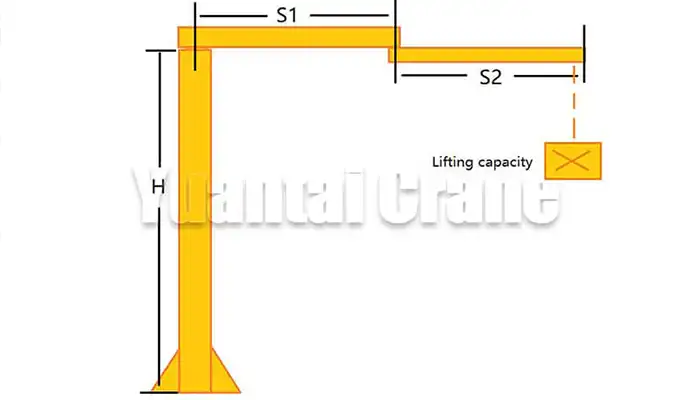
Floor mounted articulating jib crane main specifications requried to get specific price: capacity, light height, span 1 length, and span 2 length
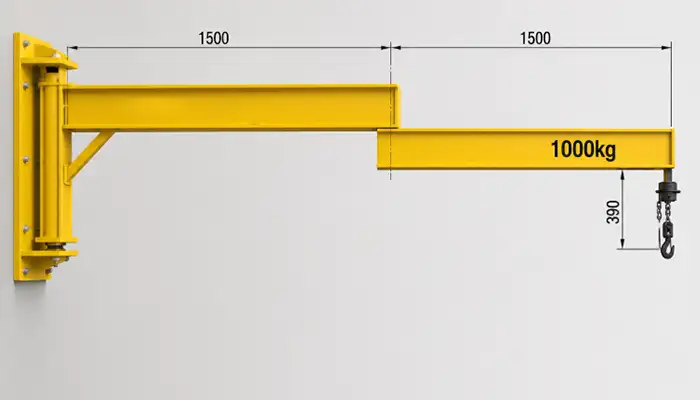
Wall mounted/ Column Mounted articulating jib crane main specifications requried to get specific price: capacity, light height, span 1 length, and span 2 length
You can send basic information below for fast evaluation and quotation.
- Request layout evaluation
- Send workshop drawings or photos
- Get quotation within 24–48 hours
- Custom design available for specific workstation needs
- Contact factory directly for technical consultation
Each item helps define the correct articulating jib crane system, including working radius, installation type, and hoist configuration. Even a simple sketch or site photo is often enough to start the design process.
Once the information is received, engineers can quickly confirm whether the 500kg 1Tonworkstation lifting jib crane fits your CNC workshop, fabrication area, or maintenance station. This ensures the final solution is practical, safe, and ready for industrialuse.

Free consultation to Confirm Parameters & Specifications and Get
Latest Crane Price & Crane Rate.
- Types of overhead cranes : _______?
- Optional: Overhead travelling crane, goliath gantry crane,Slewing jib crane, Single girder or double girder crane,small portable crane or kbk crane, etc.
- Capacity of overhead crane: _______?
- Optional: 0.25ton, 0.5 ton, 1 ton, 2 ton, 3ton, 5 ton, 10 ton,15ton, 20ton, 25 ton, 30ton,35ton, up to 550ton, etc.
- Crane span & lifting height : _______?
- Crane travelling length : _____?
- Control of overhead crane:_______?
- Optional: pendant/ remote/cabin control
- Voltage supply of overhead crane:_____?
- Eg,: 380V50/60HZ,3Phase or others,etc.
- Application/usage of crane:_______?
- Eg,: Steel mill, ,injection mold, cement,stone, concrete,granite, general manufacturing, etc.
Just leave a message via the contact form and our hoist and crane engineer will contact you with in 24working hours.
Get In Touch