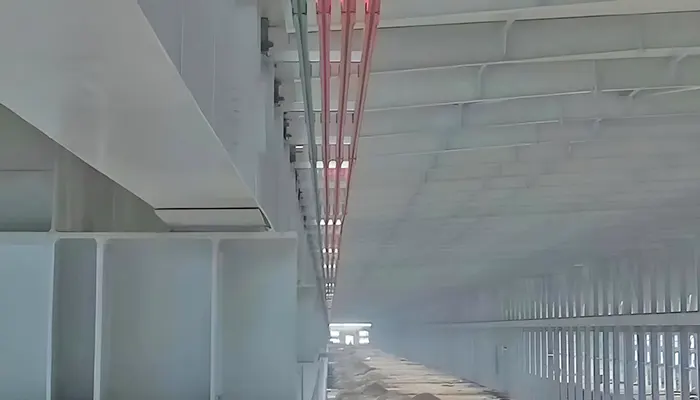
What to Consider for a 1,000-Meter Crane Runway Conductor System
Content Quick Link
What Should You Consider When Designing a Conductor System for a 1,000-Meter Crane Runway?
A 1,000-meter crane runway requires more than choosing a conductor system with the correct current rating.
For a long crane runway, the design also needs to consider thermal expansion, expansion joints, isolation zones, voltage drop, power feeds, grounding, building expansion joints, conductor support spacing, and crane collector movement.
Yuantai Cranes has supplied crane electrical and conductor systems for industrial applications, including long crane runways. From these projects, one point is clear: the longer the runway, the more important it is to coordinate the conductor system with the building structure.
Why Does Crane Runway Length Matter?
A crane conductor system is installed along the crane runway. When the runway becomes very long, temperature changes can cause the supporting steel structure to expand and contract.
Steel has a coefficient of thermal expansion of approximately:
12 × 10⁻⁶ /°C
For example, consider a 1,000-meter steel structure with a 40°C temperature change:
ΔL = α × L × ΔT
ΔL = 12 × 10⁻⁶ × 1,000 × 40
ΔL ≈ 0.48 m
The calculated thermal movement is about 480 mm.
The actual movement of the crane runway and conductor system depends on the building design, fixed points, support arrangement, installation temperature, operating temperature, and structural expansion joints.
This example shows why thermal expansion of a long crane runway cannot be ignored.
What Problems Can Thermal Expansion Cause?
If the conductor system does not have enough movement compensation, temperature changes can place stress on the system.
Possible problems include:
- Conductor misalignment
- Stress at conductor joints
- Damage to support brackets
- Conductor housing deformation
- Current collector problems
- Uneven collector contact
- Increased wear
- Electrical connection problems
- Difficult maintenance
For a short crane runway, these effects may be limited.
For a 500-meter, 800-meter, or 1,000-meter crane runway, the accumulated movement can become a major design factor.
Do Long Crane Runways Need Expansion Joints?
In many long-run conductor system applications, expansion joints are required.
An expansion joint section allows the conductor system to accommodate movement caused by temperature changes.
Instead of allowing thermal movement to accumulate across the entire conductor system, expansion joints divide the system into sections.
However, there is no standard rule that says:
One expansion joint is required for every specific number of meters.
The required number depends on the conductor system and project conditions.
The design should consider:
- Crane runway length
- Conductor system type
- Conductor material
- Installation temperature
- Minimum operating temperature
- Maximum operating temperature
- Fixed-point locations
- Sliding support locations
- Building expansion joints
- Power-feed locations
- Manufacturer's expansion-joint requirements
For this reason, how to calculate expansion joints for a crane conductor system should be based on the actual project data.
How Do You Calculate Thermal Expansion of a Crane Runway?
A basic calculation uses:
ΔL = α × L × ΔT
Where:
- ΔL = thermal expansion or contraction
- α = coefficient of thermal expansion
- L = conductor or structural length
- ΔT = temperature change
For steel, a commonly used value is approximately:
α = 12 × 10⁻⁶ /°C
Example: 500-Meter Crane Runway
Assume:
- Runway length: 500 m
- Temperature difference: 40°C
- Steel coefficient: 12 × 10⁻⁶ /°C
Then:
ΔL = 12 × 10⁻⁶ × 500 × 40
ΔL ≈ 240 mm
For a 1,000-meter runway under the same conditions:
ΔL ≈ 480 mm
This calculation is only a starting point. The conductor expansion-joint design should use the actual conductor material, installation temperature, structural arrangement, and manufacturer's technical data.
How Many Expansion Joints Does a 1,000-Meter Conductor System Need?
There is no universal answer.
The number of conductor expansion joints should be calculated according to the conductor system and installation conditions.
For example, one long crane runway project in a rolling mill required:
- 11 expansion joints
- 2 isolation zones
This does not mean every 1,000-meter crane runway needs 11 expansion joints.
It shows that a long crane conductor system may require multiple expansion sections and electrical zones when the runway, building structure, and operating temperature are considered together.
The supplier should provide the basis for the expansion-joint quantity and locations.
What Is the Difference Between an Expansion Joint and an Isolation Zone?
These two components have different purposes.
Expansion Joint
An expansion joint deals with mechanical movement caused by thermal expansion and contraction.
Its main purpose is to allow the conductor system to change length without creating excessive mechanical stress.
Isolation Zone
An isolation zone separates electrical sections of the conductor system.
It may be used for:
- Electrical separation
- Maintenance areas
- Independent crane operating zones
- Building sections
- Power distribution requirements
- Safety procedures
Therefore:
Expansion joint = mechanical movement
Isolation zone = electrical separation
A long conductor system may require both.
How Do Building Expansion Joints Affect Crane Conductor Systems?
This is an important part of long crane runway design.
A large factory building may contain structural expansion joints because different sections of the building need to move independently.
The crane runway and conductor system must take these locations into account.
For example:
Factory building
- Building expansion joint
- Crane runway structure
- Conductor support
- Conductor expansion joint
- Electrical isolation zone
The exact arrangement depends on the building design.
A conductor system should not simply cross a structural expansion joint without checking the expected movement.
When designing a crane conductor system for a large factory, the building drawings should therefore be reviewed together with the crane runway layout.
Does a Long Conductor System Need Multiple Power Feeds?
Possibly.
A long conductor system has electrical resistance along its length. As the distance from the power feed increases, voltage drop can become a concern.
The design may therefore require multiple power feeds.
The number and location of power feeds depend on:
- Total crane load
- Crane motor power
- Conductor cross-section
- Conductor material
- Operating current
- Runway length
- Simultaneous crane operation
- Allowable voltage drop
- Power supply voltage
For example, a 1,000-meter crane runway may require a different power-feed arrangement from a 100-meter runway even when the cranes have the same lifting capacity.
This is why long-distance crane power supply design should include voltage-drop calculations.
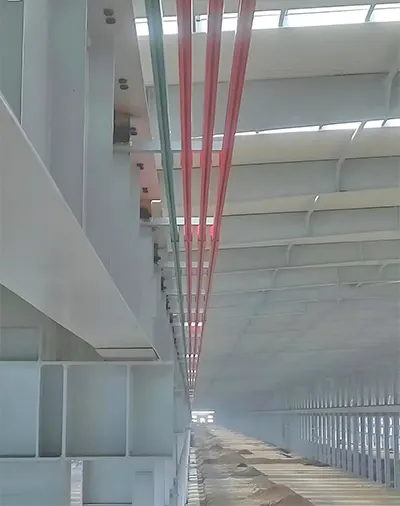
1,000-Meter Crane Runway and power supply conduct bar
What Current Capacity Should a Crane Conductor System Have?
Current capacity should be selected based on the actual crane electrical load.
The calculation normally considers:
- Hoist motor power
- Long travel motor power
- Cross travel motor power
- Crane quantity
- Duty cycle
- Simultaneous operation
- Starting current
- Ambient temperature
- Conductor installation method
Typical crane conductor systems are available in different current ratings, such as:
200 A, 300 A, 400 A, 500 A, 600 A, 800 A, 1,000 A and higher
The required rating should not be selected from crane lifting capacity alone.
A 20-ton crane, for example, does not automatically require a specific conductor current rating. The electrical load and operating conditions determine the required current.
Where Should the Ground Conductor Be Installed?
The ground conductor is another point that should be discussed during conductor system design.
Some crane electrical systems place the grounding conductor separately from the phase conductors.
From a practical safety perspective, there is a strong argument for positioning the ground bar on the outside of the conductor arrangement.
Consider a forklift or lift vehicle accidentally hitting the conductor system.
If the outside conductor is the non-current-carrying ground conductor, the risk can be lower than if a live phase conductor is exposed to the impact.
This is why some crane users specifically prefer:
Ground bar on the outside.
The final arrangement should still follow the conductor manufacturer's design and the electrical and safety requirements applicable to the project.
What Should Be Considered for Crane Conductor Support Spacing?
The conductor system needs regular mechanical support along the runway.
Support spacing depends on:
- Conductor system design
- Conductor weight
- Housing construction
- Installation environment
- Mounting method
- Temperature conditions
- Building structure
- Manufacturer specifications
The support system should also allow the required movement.
A long conductor system normally needs a combination of:
- Fixed supports
- Sliding supports
- Expansion joints
- Joint sections
- Feed sections
- End sections
The position of fixed and sliding supports is important because it determines how thermal movement is distributed through the conductor system.
What About the Current Collector?
The crane current collector runs along the conductor system and transfers electrical power to the moving crane.
For a long crane runway, collector performance is affected by conductor alignment and mechanical movement.
The design should check:
- Collector pressure
- Collector travel
- Conductor alignment
- Vertical movement
- Horizontal movement
- Joint locations
- Expansion sections
- Collector arm length
- Maintenance access
If the conductor system moves or becomes misaligned beyond the collector's allowable range, contact problems can occur.
Therefore, current collector selection for long crane runways should be considered together with the conductor expansion design.
Yuantai Cranes' Experience With Long Crane Runway Electrification
Yuantai Cranes supplies overhead cranes, gantry cranes, hoists, crane electrical systems, conductor bars, and related crane components.
For conductor-system projects, our engineering work focuses on the relationship between the crane, runway structure, power supply, and conductor installation.
For a long runway, the design review normally needs to cover:
Crane information
- Crane capacity
- Crane span
- Lifting height
- Hoisting speed
- Cross travel speed
- Long travel speed
- Crane duty
- Number of cranes
Electrical information
- Voltage
- Frequency
- Phase
- Required current
- Motor power
- Power-feed arrangement
- Control system
Building information
- Runway length
- Runway beam arrangement
- Column spacing
- Building expansion joints
- Temperature range
- Installation temperature
- Outdoor or indoor conditions
Conductor information
- Conductor type
- Current rating
- Conductor material
- Support spacing
- Fixed-point locations
- Expansion-joint locations
- Isolation zones
- Current collectors
- Ground conductor arrangement
This information allows the conductor system to be designed as part of the complete crane system.
What Information Should You Give a Crane Conductor Supplier?
If you are requesting a quotation or technical proposal for a long crane runway conductor system, provide as much of the following information as possible:
| Parameter | Example |
|---|---|
| Runway length | 1,000 m |
| Number of cranes | 2 |
| Crane capacity | 20 ton |
| Crane span | 25 m |
| Lifting height | 10 m |
| Power supply | 480 V, 60 Hz, 3 Phase |
| Total crane motor load | Project specific |
| Ambient temperature | -10°C to +45°C |
| Installation temperature | 20°C |
| Building expansion joints | Every structural section |
| Conductor system | Heavy-duty insulated conductor |
| Required current | Project calculation |
| Power feeds | To be calculated |
| Expansion joints | To be calculated |
| Isolation zones | Project requirement |
| Ground conductor | Outside position preferred |
| Environment | Indoor industrial plant |
A runway drawing is also useful, especially when it shows the building expansion joints, crane runway, power-feed points, and conductor support locations.
Long Crane Runway Design Checklist
Before finalizing a conductor system, check the following:
- Runway length
- Crane quantity
- Crane capacity
- Crane duty class
- Total electrical load
- Required current
- Voltage drop
- Number of power feeds
- Minimum temperature
- Maximum temperature
- Installation temperature
- Thermal expansion
- Building expansion joints
- Conductor expansion joints
- Isolation zones
- Fixed supports
- Sliding supports
- Current collectors
- Ground conductor position
- Maintenance access
- Applicable electrical and safety standards
Final Answer: What Is the Most Important Issue?
For a 1,000-meter crane runway, current capacity is only one part of the conductor system design.
The design should consider the entire system:
Electrical load - Voltage drop - Power feeds - Thermal expansion - Expansion joints - Building expansion joints - Isolation zones - Grounding - Current collectors - Support system
A long crane runway can experience significant thermal movement. A 1,000-meter steel structure can theoretically change length by hundreds of millimeters under a large temperature difference.
That movement needs to be managed through the building structure and the conductor system.
The practical lesson from long industrial crane applications is:
Do not design a long crane conductor system from current capacity alone. Check the electrical load, structural movement, temperature range, expansion joints, isolation zones, grounding arrangement, and power-feed locations together.
For a 500-meter, 800-meter, or 1,000-meter overhead crane runway, these details should be reviewed before the conductor system is finalized. Yuantai Cranes can evaluate the crane and conductor requirements based on the runway layout, crane specifications, electrical load, building structure, and operating temperature.

Article by Bella ,who has been in the hoist and crane field since 2016. Bella provides overhead crane & gantry crane consultation services for clients who need a customized overhead travelling crane solution.Contact her to get free consultation.
Yuantai Cranes
Overhead Crane Manufacturer with CE, ISO, SGS, CNEX Certificates.
- Main Specifications - Capacity: 0.5–550 tons | Span: up to 40m | Speed: 0.8–12 m/min | Duty: A3–A7 | Power: 380–690V, 50/60Hz | Control: pendant/remote/cabin
- Full engineering: FEA/PLC/VFD + in-house build + global delivery + on-site support, for workshops, factories, EPC contractors, industrial projects, etc.
- Support: design, manufacturing, testing, service – end-to-end, customized lifting solutions worldwide.
How to Get an Accurate Crane Price for Your Application?
Tips: Copy the spec list, fill in your details, and paste it into the form on the right/ down-below for a quick price.
- Crane type:_____ . (e.g., overhead crane, gantry crane, jib crane)
- Max weight to lift:_____ tons. (e.g., 2t, 5t, 10t, 20t, 50t)
- Lifting height:_____ m. (How high does the hook need to reach?
- Workshop width (span):_____ m . (Distance between the two crane rails)
- Travel distance:_____ m . (How long does the crane need to move along the runway?)
- Control type:_____. (Pendant / remote / cabin Control)
- Power supply:_____. (Local voltage & frequency – e.g., 380V, 50Hz, 3-phase)
- What will it be used for?_____ (e.g., steel fabrication, concrete products, mold handling, general manufacturing, etc.)
- Any special requirements?_____ (e.g., extreme temperature, dusty or explosive environment, special paint color, etc.)
Just leave a message via the contact form and our hoist and crane engineer will contact you with in 24working hours.
Get Your Custom Quote–Quick & Easy
Fill in what you know. Skip what you don't – we'll help.Any question will be reply with 24 working hours