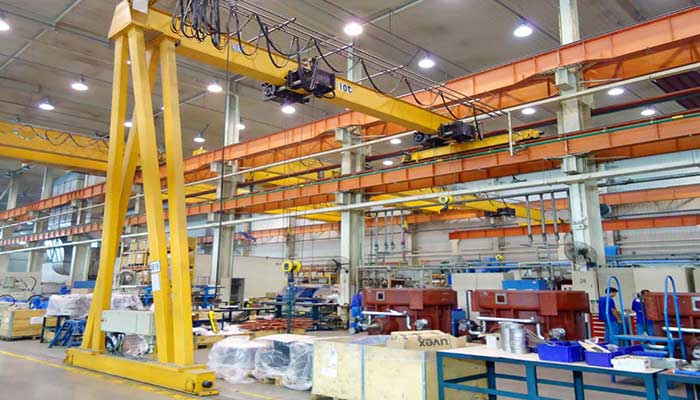
How to Choose the Right Crane for Large-Span Workshops
Content Quick Link
Learn how to select overhead, gantry, semi-gantry, and portable cranes for large-span workshops. Match crane type, span, and load to your workflow.
How to Select the Right Crane for Large-Span Workshops and Facilities
Introduction
When we talk about a large-span workshop, we mean a facility wide enough that moving materials across it becomes a real challenge without the right crane. These workshops are usually 20 meters or wider, but sometimes much larger, depending on the industry. The bigger the span, the more important it is to plan your material handling carefully.
Choosing the right crane isn’t just about lifting heavy loads—it’s about making sure the crane fits your workflow, covers the right areas, and operates efficiently. If the span, lifting capacity, or coverage zones are mismatched, you could end up with a crane that is too big, too small, or just doesn’t work the way you need.
In large-span workshops, the main types of cranes buyers usually consider are:
- Semi-Gantry Cranes – One side supported on a runway, the other on the floor, suitable for partial coverage zones.
- Gantry Cranes – Floor-supported on both sides, ideal for full coverage and heavy loads.
- Freestanding Overhead Cranes with Runway – Floor-supported on legs with a separate runway, good where the building structure doesn’t allow overhead rails.
- Portable Gantry Cranes – Modular, movable, and perfect for specific lifting points or temporary operations.
Each type has its strengths and limitations, and the best choice depends on your workshop layout, lifting needs, and workflow. In the following sections, we’ll break down how to decide which crane fits your facility and why span, coverage, and load matter so much.
Workshop Span vs. Crane Span
Before choosing a crane, it’s important to understand the difference between workshop span and crane span.
- Workshop span is simply the total width of your building from one side to the other. Think of it as the full “ceiling-to-ceiling” distance inside your facility.
- Crane span, on the other hand, is how far the crane can actually reach when it’s installed. This is the distance between the crane’s rails or supports—the space it can move across.
Here’s the key point: your crane doesn’t always need to cover the entire workshop span. In many cases, materials only need to move along certain lines, storage areas, or production zones. Installing a crane that spans the whole workshop when it isn’t needed can be expensive, take up unnecessary space, and complicate installation.
By matching the crane span to your actual lifting zones, you gain several practical benefits:
- Cost savings – Smaller spans mean less steel, fewer components, and lower installation costs.
- Space optimization – The crane takes up less room, leaving more floor space for operations, storage, or machinery.
- Operational efficiency – The crane focuses on where materials are actually moved, reducing unnecessary travel and increasing workflow speed.
- Easier maintenance – Shorter spans can make inspections, repairs, and adjustments simpler and safer.
Practical tip: Always start by mapping out your lifting zones before deciding on crane span. This step alone can save thousands of dollars and prevent costly mistakes.
Mapping Your Lifting Zones
Before you choose a crane, it's important to know exactly where you need it to operate. Not every part of the workshop needs coverage, and understanding this can save a lot of money and space.
Step 1: Identify Key Areas
Think about where lifting actually happens in your workshop. Focus on:
- Storage zones for raw materials or finished products
- Production lines where items are moved, assembled, or processed
- Loading and unloading bays for trucks or conveyors
Step 2: Determine Lifting Requirements
Once you know the zones, figure out what the crane needs to handle:
- Maximum lifting height for each zone
- Load types: uniform, bundled, long, or irregular
- Maximum weight per lift and typical daily usage
Step 3: Decide Coverage Type
Not every crane needs full workshop coverage. Decide whether you need:
- Full coverage: Crane spans the entire workshop, ideal for heavy workflow across all areas
- Zone coverage: Crane spans only specific lifting zones, saving cost and space
Practical Tip
Draw a simple layout of your workshop, marking lifting points, zones, and obstacles. This visual map makes it easier for suppliers to recommend the right crane type, span, and design.
Why Mapping Matters
Mapping your lifting zones first ensures you get a crane that fits your workflow, handles your loads, and avoids unnecessary costs.
Overview of Crane Types for Large-Span Workshops
When selecting a crane for a large-span workshop, it’s important to understand the different types of cranes available and where each works best. The choice depends on coverage needs, load weight, installation conditions, and workflow zones.
These cranes are designed for full workshop coverage. They run on runway beams across the width of the building and are ideal when materials need to move anywhere in the workshop.
- Handles heavy loads over long spans
- Suitable for continuous production lines or large manufacturing areas
- Offers high lifting heights and stable operation
Gantry cranes are floor-supported on both sides and don’t always rely on overhead runway beams. They are very flexible and can be used indoors or outdoors, depending on your facility.
- Ideal for large spans and heavy loads
- Can provide full or partial workshop coverage
Variants include:
- Full gantry cranes – cover large areas, often outdoor or open workshops
- Double girder gantry cranes – handle heavier loads and higher lifting heights
- Single girder gantry cranes – cost-effective for medium loads and smaller spans
Practical Tip: Gantry cranes are excellent when your workshop lacks overhead runway support or when you need a portable solution that can be moved along rails.
Semi-gantry cranes are a great solution for partial coverage zones. Unlike full overhead or gantry cranes, they only require one side on a runway beam, while the other side is supported by the floor.
- Ideal for specific zones along production lines or storage areas
- Cost-effective, since they need fewer structural supports than full-span cranes
- Flexible design, allowing installation in workshops where full overhead coverage isn’t practical
- Can handle medium to heavy loads, depending on design and hoist type
Practical Tip: Semi-gantry cranes work well when you don’t need the crane to move across the entire workshop span, saving both installation cost and floor space.
Freestanding Overhead Cranes with Freestanding Runway
Freestanding overhead cranes have legs on both sides and are supported by separate runway beams, making them suitable for workshops where the building structure doesn’t allow overhead runways.
- Can be installed indoors or partially outdoors
- Perfect for specific lifting zones, such as loading/unloading areas or assembly stations
- Reduces dependency on building columns or ceiling strength
- Can cover medium to large spans, depending on design
Practical Tip: These cranes are especially useful if you plan to rearrange workshop layouts in the future or need a modular solution without major structural modifications.
Portable gantry cranes are movable, floor-supported, and modular, offering maximum flexibility for temporary or specific lifting points.
- Perfect for spot lifting tasks or areas without permanent cranes
- Handles light to medium loads efficiently
- Can be moved along rails or wheels depending on design
- Quick installation and minimal infrastructure required
Practical Tip: Portable gantry cranes are excellent for maintenance work, temporary projects, or small-scale production areas, where permanent crane installation would be overkill.
Factors to Consider When Selecting a Crane
Selecting the right crane for a large-span workshop isn't just about picking a type—it's about making sure the crane matches your operational needs, space, and safety requirements. There are several practical factors buyers should carefully consider before making a decision.
Load Weight and Lifting Height
The crane must be able to safely handle the heaviest loads you expect to lift.
- Maximum load per lift
- Typical load range for daily operations
- Required lifting height to clear machinery, storage racks, or production lines
Practical Tip: Always add a 20–30% safety margin to account for bundles, irregular shapes, or unexpected conditions.
Crane Span and Travel Distance
The crane span should match your lifting zones, not necessarily the full workshop.
- Distance between supports or rails
- Travel distance along the runway or floor
- Number of cranes needed to cover all zones efficiently
Practical Tip: Mapping your lifting zones first helps you avoid oversizing the crane and wasting costs.
Frequency of Use / Duty Cycle
How often the crane will be used affects its design and components.
- Number of lifts per hour or day
- Average load per lift
- Continuous or intermittent operation
Practical Tip: High-frequency operations may require heavier-duty hoists, reinforced girders, or double girder designs.
Floor and Structural Strength
The crane type depends heavily on your building structure and floor strength.
- Can the floor support floor-mounted or freestanding cranes?
- Are overhead beams or columns strong enough for bridge cranes?
- Level surfaces for smooth operation
Practical Tip: Semi-gantry and freestanding cranes are ideal when the building structure cannot support full overhead cranes.
Power Supply and Electrical Requirements
Crane operation depends on compatible electrical supply.
- Voltage and phase available
- Special requirements: explosion-proof, variable speed, or automation
- Integration with existing plant power systems
Practical Tip: Confirm electrical compatibility early to avoid costly retrofitting later.
Environmental Conditions
Consider where and how the crane will operate.
- Indoor vs. outdoor operation
- Temperature extremes, humidity, or dust
- Corrosion protection, coatings, or weatherproofing
Practical Tip: Outdoor or harsh environments may require galvanized steel, weatherproof motors, or protective hoist covers.
Safety and Compliance Requirements
Safety isn't optional—it's essential.
- Required compliance standards (ISO, OSHA, local regulations)
- Overload protection, limit switches, and emergency stops
- Operator training and maintenance access
Practical Tip: Choose cranes that meet both legal and operational safety standards.
8. Future Expansion or Workflow Changes
Think ahead to avoid frequent upgrades or replacements.
- Potential changes in load weight or workflow zones
- Possibility of adding new cranes in the future
- Modular designs that allow span extension or higher capacity hoists
Practical Tip: Planning for future growth can save time, money, and downtime.
Practical Selection Guidelines
Choosing the right crane for your large-span workshop is not just about type—it's about making sure it fits your lifting zones, workflow, and future needs. Let's break it down so it's easier to understand.
Match Crane Type to Lifting Zones
The first step is to look at where materials need to move. Not every area needs full coverage, and using the right crane type for the right zone can save money and space.
- Full workshop coverage: Use overhead bridge cranes or full gantry cranes when materials move across the entire span of the workshop.
- Zone-specific lifting: Semi-gantry, freestanding overhead cranes, or portable gantry cranes are ideal when lifting is concentrated in specific zones or workstations.
Practical Tip: Avoid installing a full-span crane if your material movement is limited to one or two production lines. This can save on both initial cost and ongoing maintenance.
Consider Floor Preparation, Runway Alignment, and Installation Space
Even the best crane design can fail if the floor or runway is not properly prepared.
- Ensure the floor is level and strong enough for the crane type selected.
- Check that runway beams are properly aligned for smooth crane travel.
- Make sure there is enough space for installation, operation, and maintenance, including room for hooks, trolleys, and end stops.
Practical Tip: Semi-gantry and freestanding cranes require less structural support, making them easier to install in workshops without heavy overhead beams.
Choosing the Right Span and Hoist Capacity
Your crane span and hoist capacity must match the actual lifting needs, not just the workshop size.
- Measure the distance between supports to determine crane span.
- Select hoist capacity based on maximum load plus safety margin (usually 20–30%).
- Consider future lifting needs to avoid replacing or upgrading the crane too soon.
Practical Tip: A slightly longer span than needed is fine, but oversizing too much adds unnecessary cost and takes up valuable floor space.
Cases and Projects for Your References
To make crane selection easier, it helps to look at practical examples. Each scenario shows how the type of crane, span, and coverage depend on your workshop layout and lifting needs.
Case A: Large Workshop, Heavy Loads Everywhere
When your facility requires lifting heavy materials across the entire workshop, a robust solution is needed.
- Recommended Crane: Double girder overhead crane or full gantry crane
- Why: Can handle heavy loads, long spans, and full coverage
- Best Use: Continuous production lines, large steel workshops, or heavy machinery assembly
Case B: Large Workshop, Partial Zones
If materials only move along specific zones or production lines, a smaller or more flexible crane works best.
- Recommended Crane: Semi-gantry crane
- Why: Covers only the required zones, saving cost and floor space
- Best Use: Storage areas, loading zones along one side of the workshop, or partial assembly lines
Case C: Outdoor Loading or Unloading Area
For operations outside the main building, the crane must be floor-supported and able to operate in open or partially exposed areas.
- Recommended Crane: Full gantry crane
- Why: Floor-supported on both sides, can handle heavy loads outdoors, and doesn't rely on workshop structure
- Best Use: Outdoor shipping, loading/unloading bays, and temporary storage yards
Case D: Specific Workstation or Temporary Use
Some lifting tasks are small, localized, or temporary, and don't justify installing a permanent crane.
- Recommended Crane: Portable gantry crane
- Why: Movable, modular, and quick to set up for short-term lifting
- Best Use: Maintenance, small-scale assembly, or temporary projects
Practical Tip: Start by mapping your lifting needs and match the crane type to the workflow and coverage zones. This ensures you get the right crane without overspending or taking up unnecessary space.
Buyer Takeaways
Choosing the right crane for a large workshop doesn’t have to be complicated. The main idea is to focus on where and how you actually need to lift, not just the size of the building.
Here’s what buyers should keep in mind:
Pick the right crane type and span
- Use full-span cranes only if materials need to move across the entire workshop.
- For smaller areas, partial coverage cranes like semi-gantry or portable cranes are enough.
Think about load, frequency, and future needs
- Make sure the crane can handle your heaviest loads.
- Check that it can work as often as needed without wearing out quickly.
- Consider future growth or heavier loads so you don’t have to replace the crane soon.
Check installation and safety
- Make sure the floor or runway can support the crane.
- Confirm your power supply matches the crane requirements.
- Look for safety features like overload protection, limit switches, and emergency stops.
Plan smart to save money and space
- Avoid making the crane bigger than needed.
- Match crane coverage to your workflow for efficient operations.
- Proper planning reduces maintenance and keeps things running smoothly.
Quick Tip: Draw a simple map of your lifting zones. Mark where materials move, how heavy they are, and how high they need to go. This helps you pick a crane that works well without unnecessary cost or hassle.

Article by Bella ,who has been in the hoist and crane field since 2016. Bella provides overhead crane & gantry crane consultation services for clients who need a customized overhead travelling crane solution.Contact her to get free consultation.
Yuantai Cranes
Overhead Crane Manufacturer with CE, ISO, SGS, CNEX Certificates.
- Main Specifications - Capacity: 0.5–550 tons | Span: up to 40m | Speed: 0.8–12 m/min | Duty: A3–A7 | Power: 380–690V, 50/60Hz | Control: pendant/remote/cabin
- Full engineering: FEA/PLC/VFD + in-house build + global delivery + on-site support, for workshops, factories, EPC contractors, industrial projects, etc.
- Support: design, manufacturing, testing, service – end-to-end, customized lifting solutions worldwide.
How to Get an Accurate Crane Price for Your Application?
Tips: Copy the spec list, fill in your details, and paste it into the form on the right/ down-below for a quick price.
- Crane type:_____ . (e.g., overhead crane, gantry crane, jib crane)
- Max weight to lift:_____ tons. (e.g., 2t, 5t, 10t, 20t, 50t)
- Lifting height:_____ m. (How high does the hook need to reach?
- Workshop width (span):_____ m . (Distance between the two crane rails)
- Travel distance:_____ m . (How long does the crane need to move along the runway?)
- Control type:_____. (Pendant / remote / cabin Control)
- Power supply:_____. (Local voltage & frequency – e.g., 380V, 50Hz, 3-phase)
- What will it be used for?_____ (e.g., steel fabrication, concrete products, mold handling, general manufacturing, etc.)
- Any special requirements?_____ (e.g., extreme temperature, dusty or explosive environment, special paint color, etc.)
Just leave a message via the contact form and our hoist and crane engineer will contact you with in 24working hours.
Get Your Custom Quote–Quick & Easy
Fill in what you know. Skip what you don't – we'll help.Any question will be reply with 24 working hours