Outdoor Crane Protection: Avoid 2–3 Year Failures
menu_open
Content Quick Link
Outdoor Crane Protection: Why Problems Often Appear After 2–3 Years
Most Important Takeaway (Upfront)
Outdoor overhead cranes rarely fail suddenly—they degrade gradually.
The most common performance, safety, and maintenance problems emerge after 2–3 years of exposure because early design and protection decisions underestimated long-term environmental impacts.
Outdoor crane problems rarely happen all at once. Most issues develop gradually, and early decisions in design, specification, and procurement play a bigger role than operation alone. Here are the key points every buyer should remember:
- Outdoor crane failures are progressive, not sudden
Small environmental stresses accumulate over time, leading to visible problems usually after 2–3 years. - Electrical systems usually fail before structural components
Moisture, dust, and temperature cycles attack insulation, terminals, and sensors first. - Under-specifying protection is a bigger risk than under-sizing capacity
A crane with the right lifting capacity can still fail early if coatings, seals, and enclosures are inadequate. - Early design and procurement decisions determine most of the crane’s long-term reliability
Choices about environmental duty, coatings, and cable protection made at the purchase stage impact years of operation. - Proper outdoor protection significantly extends crane service life beyond 10 years
Upgraded coatings, IP-rated components, and proactive maintenance prevent premature failures and reduce downtime.
Practical takeaway: Address environmental exposure, protection, and maintenance from the start—this is the simplest way to avoid the common 2–3 year problem window for outdoor cranes.
Understanding the 2–3 Year Failure Window
Outdoor crane problems rarely start on day one. Most cranes operate smoothly for the first year or two, which often gives buyers a false sense of security. The real issues show up later, once environmental exposure begins to stack up and early protection margins are used up.
Why Early Operation Feels "Problem-Free"
In the first months—and even the first couple of years—most outdoor cranes behave exactly as expected. This is not because outdoor conditions are harmless, but because the crane still has its original protective buffer.
Several practical reasons explain this early stability:
- Factory tolerances are still tight
New gearboxes, motors, bearings, and wheel sets are assembled within precise tolerances. Minor corrosion or alignment drift has not yet reached a level that affects operation. - Fresh coatings hide environmental damage
Paint systems, galvanizing, and surface treatments are intact. Even if moisture reaches the steel surface, it has not yet broken through primers or protective layers. - Initial lubrication is doing its job
Grease inside bearings, wire ropes, and gear reducers is clean and uncontaminated. Water ingress is minimal at this stage, so friction and heat buildup remain low. - Seals and gaskets are still elastic
Rubber seals around motors, brakes, and electrical enclosures retain flexibility. They can still block dust, rain, and humidity effectively. - Electrical insulation remains dry and stable
Motor windings, cables, and control panels have not yet experienced enough moisture cycles to reduce insulation resistance or cause tracking and corrosion.
At this stage, small warning signs are easy to miss. A slightly stiff brake, a control cabinet that feels warmer than expected, or light surface rust on fasteners may not trigger concern—but these are often early indicators of what comes next.
Why Degradation Accelerates After Year Two
After roughly two to three years of outdoor service, problems tend to appear more frequently and more suddenly. This is the point where multiple forms of wear begin to overlap.
The acceleration happens for practical, measurable reasons:
- Corrosion shifts from surface-level to structural
Once coatings thin or crack, corrosion starts attacking base metal. This affects rails, bolts, wire ropes, and structural welds, not just appearance. - Repeated UV and temperature cycling breaks materials down
Daily heating and cooling cause expansion and contraction. Over time, this hardens cable jackets, weakens seals, and creates micro-cracks in paint and insulation. - Moisture finds permanent entry paths
Seals that once resisted rain begin to shrink or deform. Condensation forms inside motors and control panels, especially where temperature differences are large between day and night. - Electrical insulation loses margin
Insulation resistance drops gradually, not suddenly. By year two or three, small leaks turn into nuisance trips, unstable signals, or unexplained faults. - Fatigue effects begin to combine
Wind-induced sway, braking forces, and repeated lifting cycles create stress that was already accounted for in design—but corrosion reduces the real safety margin. - Multiple protective systems fail at the same time
Paint degradation, seal aging, and lubricant contamination often peak together. When this happens, failures seem sudden, even though the damage built up slowly.
Environmental Stress Factors Unique to Outdoor Cranes
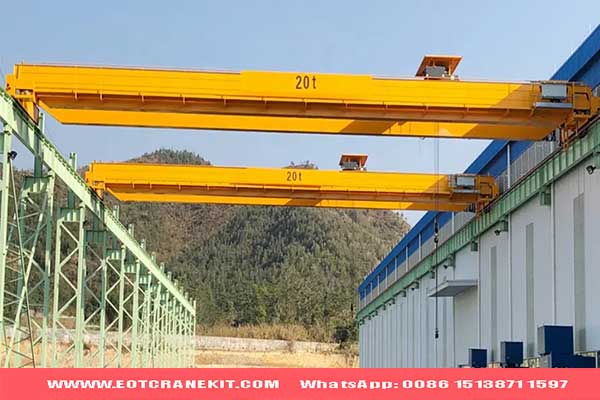
Outdoor cranes are constantly affected by their surroundings, even when they are not lifting. These environmental forces work slowly and quietly, and they tend to build on each other. Once their combined effect reaches a certain point, problems start to appear more frequently and with less warning. Outdoor gantry cranes
Moisture and Corrosion Exposure
Moisture-related damage rarely comes from a single heavy rain or storm. It builds up through repeated exposure and poor drainage. Water finds its way into places that look sealed, and once corrosion starts, it continues even during dry periods.
How moisture and corrosion act on outdoor cranes
- Rain, snow, high humidity, and airborne salt settle on steel and electrical components
- Salt fog and industrial particles hold moisture against metal surfaces
- Wet conditions become persistent, not temporary
Where these problems usually show up
- Cable trays and junction boxes where water has no exit path
- Control cabinets with corrosion starting at the base
- Motor terminal housings and brake covers
- Wire ropes showing early surface rust
What this leads to over time
- Corrosion spreading from paint damage into base material
- Increasing electrical faults caused by poor conductivity
- Bearing and gear wear due to water-contaminated lubrication
Practical point
- If water can enter once, it will continue entering unless drainage and ventilation are addressed.
Temperature Extremes and Thermal Cycling
Outdoor cranes experience constant temperature changes, often within a single day. This repeated expansion and contraction is more damaging than most buyers expect, especially when combined with moisture and load stress.
How temperature affects crane systems
- Steel structures expand in the heat and contract in cold conditions
- Insulation materials lose flexibility in low temperatures
- Lubricants degrade faster when exposed to heat
Where temperature-related issues appear first
- Rail connections, bolts, and structural joints
- Cable termination points and flexible cable sections
- Gear reducers, bearings, and motor housings
What this leads to over time
- Gradual rail misalignment and abnormal wheel wear
- Cracked or hardened cable insulation
- Increased friction, noise, and operating temperature
Practical point
- Daily temperature swings cause more long-term damage than seasonal extremes.
Wind, Dust, and Airborne Contaminants
Outdoor cranes are exposed to constant air movement. Wind applies force, while dust and chemicals slowly invade mechanical and electrical systems. These effects are easy to overlook because they are not immediately visible.
How air-related stresses affect cranes
- Wind creates side loading and continuous micro-movements
- Dust enters through ventilation openings and worn seals
- Chemical vapors settle on rubber, insulation, and contacts
Where these issues usually develop
- Welded joints and structural connection points
- Motor ventilation paths and braking assemblies
- Contactors, limit switches, and control terminals
What this leads to over time
- Fatigue cracking without apparent overload events
- Abrasive wear inside reducers and braking systems
- Accelerated aging of insulation, seals, and wiring
Practical point
- Wind and airborne contaminants do damage slowly, but the damage is cumulative and structural.
Environmental stresses do not act alone. Moisture speeds up corrosion, temperature cycling weakens protective systems, and airborne contaminants accelerate both electrical and mechanical aging. When these factors overlap, outdoor crane reliability drops quickly—often after only a few years of operation.
Components Where Problems Commonly Appear First
When outdoor crane issues begin to surface, they rarely affect all systems at once. Certain components are exposed more directly to the environment and operational stress, so they tend to fail earlier and more often. Understanding where these early failures occur helps buyers focus inspection and protection efforts where they matter most.
Electrical and Control Systems
Electrical and control components are usually the first to show trouble in outdoor cranes. They are sensitive to moisture, temperature changes, and airborne contaminants, even when housed in cabinets or enclosures.
Why these systems are vulnerable
Electrical parts depend on clean, dry conditions and stable insulation. Outdoor exposure slowly erodes these conditions, reducing safety margins without obvious external signs.
Common early failure points
- Degraded insulation resistance
Moisture absorption and aging insulation lower resistance values, leading to nuisance trips, unstable signals, and reduced motor performance. - Corroded terminals and contactors
Condensation and airborne contaminants attack exposed metal surfaces. Corrosion increases contact resistance, causing overheating and intermittent faults. - Sensor and limit switch failures
Proximity sensors, encoders, and limit switches are often installed in exposed positions. Dust and moisture infiltration cause inaccurate positioning, false alarms, or complete loss of signal.
Practical point
- Electrical problems often appear as intermittent faults first. Treat these as early warning signs, not minor inconveniences.
Hoisting Mechanism
The hoisting system carries the highest mechanical load and operates under constant stress. Outdoor exposure accelerates wear in components that are already working close to their design limits.
Why hoisting components degrade early
Moisture, temperature changes, and load cycling combine to shorten the life of ropes, brakes, and rotating parts.
Common early failure points
- Wire rope corrosion and internal strand fatigue
Surface rust is usually the first visible sign, but internal corrosion reduces rope strength long before broken wires appear. - Brake lining deterioration due to moisture
Moisture penetration hardens or softens brake linings, reducing braking torque and increasing stopping distance. - Bearing pitting in motors and gearboxes
Condensed moisture contaminates lubricants, leading to micro-pitting and early bearing failure.
Practical point
- Hoisting issues rarely fail all at once. Small performance changes often signal deeper internal damage.
Structural and Running Components
Structural and running components are designed for long service life, but outdoor conditions gradually reduce their alignment accuracy and load distribution.
Why these components are affected
Corrosion, vibration, and temperature cycling slowly change geometry and fastening integrity.
Common early failure points
- Rail corrosion and misalignment
Corrosion under rail clips and pads leads to uneven running surfaces and increased wheel forces. - End truck wheel wear from uneven rails
Misaligned or corroded rails force wheels to run with side load, accelerating flange and tread wear. - Bolt loosening due to vibration and corrosion
Repeated movement and corrosion reduce bolt preload, increasing the risk of structural movement and secondary damage.
Practical point
- Structural problems usually start as alignment or wear issues. If ignored, they transfer stress to motors, gearboxes, and wheels.
Electrical systems typically fail first, hoisting mechanisms follow, and structural components show damage last—but by then, the root cause has often been present for years. Early inspection of these high-risk components is critical to controlling long-term outdoor crane reliability.
Protection Measures That Are Often Under-Specified
Many outdoor crane problems do not come from poor operation or heavy usage. They originate much earlier, at the specification and procurement stage. Protection measures are often treated as optional or generic, even though they largely determine how the crane will perform after the first few years outdoors.
Inadequate Enclosure and Sealing Design
Enclosures and seals are the first line of defense against moisture and dust. When they are selected based on indoor assumptions, outdoor exposure quickly pushes them beyond their limits.
Why enclosure design is frequently underestimated
Buyers often focus on crane capacity and span, while enclosure protection is assumed to be "standard." In reality, small differences in sealing design can decide whether moisture stays out or becomes a permanent problem.
Common specification gaps
- IP ratings selected for indoor rather than outdoor duty
Cabinets and motors may meet basic ingress protection, but not enough for rain, wind-driven water, or dust accumulation. - Unsealed motor junction boxes
Cable entry points and covers allow moisture to migrate directly into motor windings, especially during temperature changes. - Poorly designed drainage paths
Enclosures without sloped bases, drain holes, or breathable vents trap water inside, turning cabinets into moisture reservoirs.
Practical point
- Outdoor protection requires controlled drainage and ventilation, not sealing alone.
Coating and Surface Treatment Shortcuts
Paint and surface treatment are often where cost reductions are made. Unfortunately, this is also where long-term durability is decided.
Why coating systems fail prematurely
Single-layer systems may look acceptable at delivery, but they are rarely designed for years of moisture, UV exposure, and pollution.
Common coating-related oversights
- Single-layer paint instead of multi-layer anti-corrosion systems
Without primers and intermediate coats, surface damage quickly reaches base steel. - No zinc-rich primer or epoxy intermediate layer
These layers are critical for corrosion protection, especially in humid or coastal areas. - Ignoring local corrosion classifications (C3–C5)
Applying the same coating in mild and aggressive environments leads to predictable early failure.
Practical point
- Coating selection should be driven by site corrosion class, not by appearance or short-term cost.
Cable and Hose Protection Gaps
Cables and hoses are among the most exposed components on outdoor cranes. They move constantly and face direct sunlight, temperature changes, and mechanical stress.
Why cable protection is often overlooked
Electrical cables are usually specified by voltage and current, while environmental durability receives less attention.
Common protection gaps
- Standard PVC cables used instead of cold-resistant or UV-resistant types
PVC hardens, cracks, and loses flexibility when exposed to sun or low temperatures. - No armored or conduit protection for exposed runs
Without mechanical protection, cables suffer abrasion, impact damage, and moisture ingress. - Poor strain relief and bending radius control
Incorrect routing causes internal conductor fatigue long before external damage is visible.
Practical point
- Cable failure is rarely a cable quality issue. It is usually a protection and routing issue.
Most outdoor crane failures trace back to under-specified protection, not insufficient lifting capacity. Enclosures, coatings, and cable systems must be selected for the actual environment, not assumed to be "good enough." Once protection measures are compromised, long-term reliability quickly declines.
Procurement Decisions That Create Long-Term Risk
Many long-term outdoor crane problems are not caused by how the crane is used, but by how it was purchased. Procurement decisions made early—often to speed up approval or control initial cost—can quietly introduce risks that only become visible years later.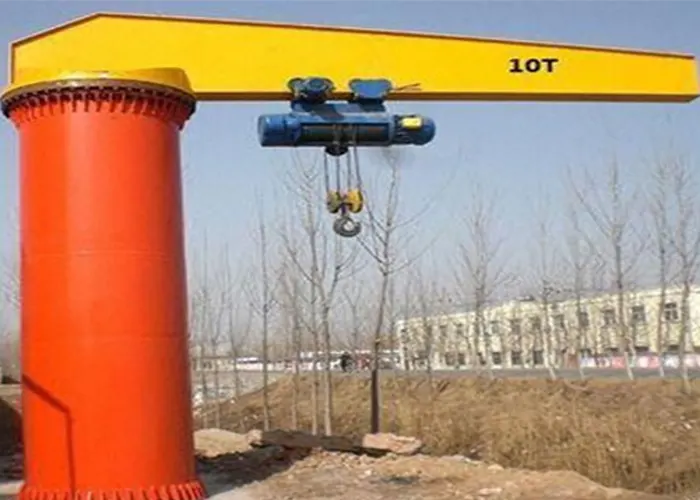 Outdoor jib crane
Focus on Rated Capacity, Not Environmental Duty
Lifting capacity is usually the first and sometimes the only parameter that receives serious attention. While capacity is important, it does not reflect how well a crane will survive outdoors.
Why this approach creates risk
A crane can be perfectly sized for the load and still fail early if it is not designed for the environment in which it operates.
Common procurement mistakes
- Capacity specified correctly, protection left vague or generic
Purchase documents may clearly state tonnage and span but describe outdoor protection in broad terms with no measurable requirements. - Outdoor use treated as "indoor + canopy"
Adding a roof or shelter does not protect against humidity, temperature cycling, wind-driven rain, or airborne contaminants.
Practical point
- Environmental duty should be specified with the same level of detail as rated lifting capacity.
Missing Lifecycle Cost Evaluation
Initial purchase price often dominates procurement decisions. Maintenance, downtime, and component replacement are treated as future concerns.
Why lifecycle costs are underestimated
Early savings look attractive on paper, while long-term costs remain hidden until failures begin.
Typical cost-related oversights
- Lower upfront cost masking higher maintenance and downtime
Reduced protection means more frequent repairs, unplanned shutdowns, and higher spare parts consumption. - No allowance for mid-life component replacement
Items such as wire ropes, brakes, seals, and cables often need replacement earlier in outdoor service, but this is not budgeted or planned.
Practical point
- The most expensive crane is often the one that appears cheapest at delivery.
Insufficient Site Information Provided to the Supplier
Suppliers can only design for the information they receive. When site conditions are not clearly described, the crane is built to assumptions that may not match reality.
Why this information gap matters
Environmental and operational details directly affect material selection, protection level, and system layout.
Common information gaps
- Climate, pollution level, and duty cycle not clearly defined
Seasonal temperature range, humidity, corrosive exposure, and actual operating frequency are often missing from inquiry documents. - Future expansion or relocation not considered
Cranes may later be moved to harsher areas or required to handle higher duty cycles without upgraded protection.
Practical point
- Incomplete site data shifts design risk from the supplier to the buyer.
Long-term outdoor crane reliability is decided before the crane is built. Procurement decisions that ignore environmental duty, lifecycle cost, and site conditions almost guarantee higher maintenance, earlier failures, and operational disruption in the years that follow.
How Buyers Can Prevent 2–3 Year Outdoor Crane Problems
Preventing early outdoor crane problems starts long before the crane is delivered. The key is to plan for environmental exposure, protection, and maintenance from day one. Small upfront actions often prevent major failures later.
Specify Outdoor Protection Clearly at Inquiry Stage
Many buyers assume "outdoor duty" is obvious. In reality, the more specific the protection requirements, the better the crane will perform long-term.
Practical ways to specify protection
- Climate zone, temperature range, corrosion class
Provide detailed local conditions, including humidity, seasonal temperature swings, and corrosive atmosphere levels. This allows the supplier to select coatings, materials, and components that can handle real-life exposure. - Indoor/outdoor transition frequency
Note how often the crane moves between sheltered and open areas, since repeated transitions increase condensation and corrosion risk. - Required enclosure and coating standards
Specify IP ratings, seal types, and coating layers (primer, epoxy, and topcoat) appropriate for your environment. Don't leave these decisions to generic standards.
Practical point
- Detailed environmental specifications upfront reduce surprises after 2–3 years.
Upgrade Protection on Critical Systems
Even a well-designed crane can benefit from targeted upgrades to vulnerable components. Focusing protection on high-risk systems pays off quickly in reliability.
Critical upgrades to consider
- Higher IP-rated motors and control cabinets
Protect sensitive electronics from moisture, dust, and condensation. - Space heaters, anti-condensation design
Keep enclosures dry in humid climates or during cold nights to prevent insulation and contact corrosion. - Galvanized or epoxy-coated structural components
Rails, girders, and bolts last longer when corrosion is slowed or prevented with durable coatings.
Practical point
- Upgrades should focus on components most exposed to environmental damage, not just overall crane appearance.
Plan Inspection and Maintenance from Day One
Maintenance is not just reactive—it must be proactive, especially for outdoor cranes. Waiting until failures appear often increases downtime and repair costs.
Maintenance strategies that work
- Annual corrosion and insulation resistance checks
Track the condition of paint, galvanizing, wire ropes, and electrical insulation. Early detection prevents small issues from becoming major repairs. - Early replacement of seals and consumables
Bearings, gaskets, hoses, and brake linings should be replaced before visible failure. - Condition-based maintenance rather than failure-based repair
Use inspection data to plan service schedules, rather than waiting for breakdowns. This approach extends crane life and reduces unplanned downtime.
Practical point
- A structured maintenance program, combined with early specification of protection, is the single most effective way to prevent 2–3 year outdoor crane failures.
By clearly specifying environmental protection, upgrading critical systems, and planning proactive maintenance, buyers can extend outdoor crane life far beyond the typical 2–3 year problem window. These actions reduce downtime, lower repair costs, and ensure the crane delivers reliable performance for many years.
FAQ: Questions This Article Solves
This section answers the most common concerns buyers face when dealing with outdoor cranes, especially regarding the 2–3 year failure window.
1. Why do outdoor cranes often perform well initially but decline after a few years?
Outdoor cranes appear problem-free during the first year or two because new components, fresh coatings, and seals provide a temporary buffer against environmental stresses. However, gradual exposure to moisture, UV, temperature cycling, and dust slowly degrades electrical insulation, hoist mechanisms, and structural surfaces. By the 2–3 year mark, these stresses combine, causing noticeable performance and reliability issues.
2. Which crane components are most vulnerable outdoors?
Certain systems are more exposed to environmental and operational stress:
- Electrical and control systems: Terminals, sensors, switches, and motor insulation degrade first due to moisture and dust.
- Hoisting mechanisms: Wire ropes, brakes, and bearings experience corrosion, fatigue, and lubricant contamination.
- Structural and running components: Rails, bolts, end trucks, and wheels suffer from corrosion, misalignment, and wear.
3. What protection measures are commonly overlooked during procurement?
Many buyers focus on crane capacity and overlook environmental protection, which directly affects longevity:
- Enclosures and sealing: IP ratings are often too low for outdoor conditions, and drainage is insufficient.
- Coatings and surface treatment: Single-layer paint or omitted primers fail in humid or corrosive environments.
- Cables and hoses: Standard PVC cables and poorly routed hoses degrade under UV, cold, or movement stress.
4. How can buyers prevent premature failure and rising maintenance costs?
Preventive measures involve planning and specification from day one:
- Clearly define environmental conditions (climate, corrosion class, temperature range) in procurement documents.
- Upgrade protection for critical systems with IP-rated enclosures, anti-condensation features, and corrosion-resistant coatings.
- Implement proactive inspection and maintenance programs, including condition-based checks, early replacement of seals and consumables, and annual electrical and corrosion assessments.
Bottom line: Early planning, proper protection, and structured maintenance can prevent most 2–3 year outdoor crane problems and ensure reliable, long-term performance.
Conclusion
Outdoor cranes are long-term assets, and their environment is rarely forgiving. Rain, dust, temperature swings, and pollution all quietly chip away at components. Often, the first signs of trouble don’t appear until 2–3 years in—when coatings peel, seals shrink or crack, and electrical systems start showing intermittent faults.
The path to long-term reliability involves three practical steps:
- Define environmental conditions clearly: Include climate, humidity, temperature extremes, and exposure to chemicals or salt.
- Prioritize protection over upfront cost: Specify coatings, IP-rated enclosures, seal types, and cable protection suitable for actual site conditions.
- Adopt a lifecycle-driven approach: Plan inspections, condition-based maintenance, and mid-life component replacement from day one.
When these steps are followed, cranes operate safely and efficiently well beyond the early years, avoiding common pitfalls that lead to downtime and unexpected repairs.
Bottom line: Outdoor protection is not optional—it’s a long-term investment in reliability, safety, and lower maintenance costs.

Article by Bella ,who has been in the hoist and crane field since 2016. Bella provides overhead crane & gantry crane consultation services for clients who need a customized overhead travelling crane solution.Contact her to get free consultation.