5 Ton Euro Wire Rope Hoist Factory Testing | Double Girder Hoist
5 Ton European Wire Rope Hoist Testing on Double Girder Overhead Crane | Factory Test
This video shows the testing process of a 5 ton European-style electric wire rope hoist installed on a double girder overhead crane.
The European-style wire rope hoist features a compact crab trolley design, providing smooth lifting, stable trolley traveling, and efficient operation. The video demonstrates the hoist running, lifting, and traveling performance before delivery to ensure reliable crane operation.
Designed according to European FEM/DIN standards, this type of electric wire rope hoist is suitable for factories, workshops, steel processing plants, machinery manufacturing, and other industrial lifting applications where high performance and long service life are required.
5 Ton lifting capacity
European-style wire rope hoist design
Crab trolley for double girder overhead cranes
Lifting and traveling test before shipment
Reliable solution for industrial material handling
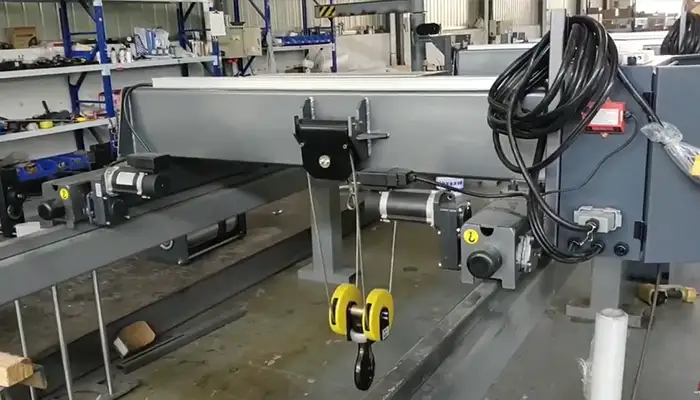 5 ton electric hoist video screen short - European style wire rope 5 ton electric hoist
FAQs About Selecting 5 Ton Double Girder Electric Hoist for Material Handling
A 5 ton double girder electric hoist is not selected only by lifting capacity. The right choice depends on how the crane works every day, including lifting frequency, workshop space, load condition, and production requirements.
When should I choose a 5 ton double girder electric hoist for material handling?
Choose a 5 ton double girder electric hoist when you need stable lifting, frequent operation, higher lifting height, or better load control.
In many factories, the lifting capacity is not the only concern. A workshop may only lift 5 tons, but the crane could run hundreds of lifting cycles every day.
For example, a machinery factory may use the crane to move motors, steel parts, and finished equipment between different production areas. In this situation, a double girder crane with a crab-style wire rope hoist provides smoother operation and longer service life compared with a lighter-duty solution.
What is the difference between a 5 ton single girder crane and double girder crane?
The main difference is structure, stability, and working duty. A single girder crane is for lighter applications, while a double girder crane is designed for heavier and more frequent operation.
A 5 ton single girder overhead crane is often selected for warehouses, maintenance workshops, or applications with fewer lifting cycles. It has a simpler structure and lower initial investment.
A double girder crane uses two bridge girders, and the wire rope hoist runs on top of the crane bridge. This design improves stability, allows higher lifting height, and performs better when the crane works continuously.
Simply speaking, if the crane is only used occasionally, a single girder crane may be enough. If the crane is part of daily production, the double girder design is usually the safer choice.
Why do many factories choose a European-style 5 ton wire rope hoist?
Factories choose European-style wire rope hoists because they offer compact design, smooth operation, and better performance for continuous industrial use.
The advantage is not only the appearance. The internal design focuses on motor efficiency, braking reliability, mechanical strength, and easier maintenance.
In actual projects, customers often compare the initial purchase price first. However, after several years of operation, many realize that downtime and maintenance costs are also important parts of the total investment.
A reliable hoist may cost more at the beginning, but it helps keep production running smoothly.
What industries use 5 ton double girder electric hoists?
5 ton double girder electric hoists are commonly used in machinery factories, steel workshops, automobile plants, equipment manufacturing, and maintenance areas.
For example, in a steel fabrication workshop, workers may lift steel structures from cutting areas to welding stations several times a day.
In a machine manufacturing plant, the crane may handle gearboxes, motors, molds, and finished machines before shipment.
The correct crane is decided by the working scene, not only by the lifting number.
Does a double girder 5 ton crane provide higher lifting height?
Yes, a double girder crane with a crab-style wire rope hoist can usually provide better lifting height because the hoist position saves overhead space.
The hoist trolley runs above the bridge girders instead of hanging below the girder. This reduces the required headroom and helps customers achieve a higher hook position.
However, the final lifting height depends on the complete building structure, runway beam design, and crane configuration.
How do engineers select the right 5 ton electric hoist?
Engineers select a 5 ton electric hoist based on capacity, working frequency, lifting height, duty class, environment, and power supply.
A common mistake is choosing only according to the lifting weight.
A 5 ton hoist lifting twice per day is very different from a 5 ton hoist working continuously on a production line.
Engineers usually check:
- Daily working hours
- Number of lifting cycles
- Load condition
- Required lifting height
- Workshop environment
- Available voltage
What working conditions require a double girder 5 ton hoist?
A double girder 5 ton hoist is suitable for factories that require frequent lifting, stable operation, and accurate load movement.
Typical applications include production workshops, steel processing areas, equipment assembly lines, and heavy maintenance sections.
However, not every 5 ton application needs a double girder crane. If the crane only performs occasional lifting work, a simpler design may provide better cost efficiency.
What information should I provide when buying a 5 ton wire rope hoist?
To select the correct 5 ton wire rope hoist, customers should provide lifting height, crane span, working duty, operation frequency, and power supply information.
The basic information includes:
- Lifting capacity: 5 ton
- Lifting height
- Crane span
- Working class
- Traveling speed requirement
- Control method
- Working environment
These details help avoid problems such as insufficient lifting height, unsuitable motors, or selecting a hoist that cannot handle the actual workload.
Can a 5 ton double girder electric hoist be customized?
Yes, a 5 ton double girder electric hoist can be customized according to project requirements.
Common customization includes lifting height, traveling speed, motor voltage, control system, duty class, and special working environments.
For example, a steel plant may require higher temperature resistance, while a machinery factory may focus more on precise positioning.
The best solution comes from matching the hoist design with the real working condition.
Why is a 5 ton double girder electric hoist a reliable material handling solution?
A 5 ton double girder electric hoist is reliable because it provides stable lifting, smooth movement, and long-term performance for industrial applications.
A crane is not only equipment for moving loads. In many factories, it directly affects production efficiency.
When the crane runs smoothly every day, workers spend less time waiting for maintenance and more time focusing on production.
That is why many factories choose a properly selected double girder electric hoist instead of simply choosing the lowest-cost option.
Related Videos

Article by Bella ,who has been in the hoist and crane field since 2016. Bella provides overhead crane & gantry crane consultation services for clients who need a customized overhead travelling crane solution.Contact her to get free consultation.
Yuantai Cranes
Overhead Crane Manufacturer with CE, ISO, SGS, CNEX Certificates.
- Main Specifications - Capacity: 0.5–550 tons | Span: up to 40m | Speed: 0.8–12 m/min | Duty: A3–A7 | Power: 380–690V, 50/60Hz | Control: pendant/remote/cabin
- Full engineering: FEA/PLC/VFD + in-house build + global delivery + on-site support, for workshops, factories, EPC contractors, industrial projects, etc.
- Support: design, manufacturing, testing, service – end-to-end, customized lifting solutions worldwide.
How to Get an Accurate Crane Price for Your Application?
Tips: Copy the spec list, fill in your details, and paste it into the form on the right/ down-below for a quick price.
- Crane type:_____ . (e.g., overhead crane, gantry crane, jib crane)
- Max weight to lift:_____ tons. (e.g., 2t, 5t, 10t, 20t, 50t)
- Lifting height:_____ m. (How high does the hook need to reach?
- Workshop width (span):_____ m . (Distance between the two crane rails)
- Travel distance:_____ m . (How long does the crane need to move along the runway?)
- Control type:_____. (Pendant / remote / cabin Control)
- Power supply:_____. (Local voltage & frequency – e.g., 380V, 50Hz, 3-phase)
- What will it be used for?_____ (e.g., steel fabrication, concrete products, mold handling, general manufacturing, etc.)
- Any special requirements?_____ (e.g., extreme temperature, dusty or explosive environment, special paint color, etc.)
Just leave a message via the contact form and our hoist and crane engineer will contact you with in 24working hours.
Get Your Custom Quote–Quick & Easy
Fill in what you know. Skip what you don't – we'll help.Any question will be reply with 24 working hours