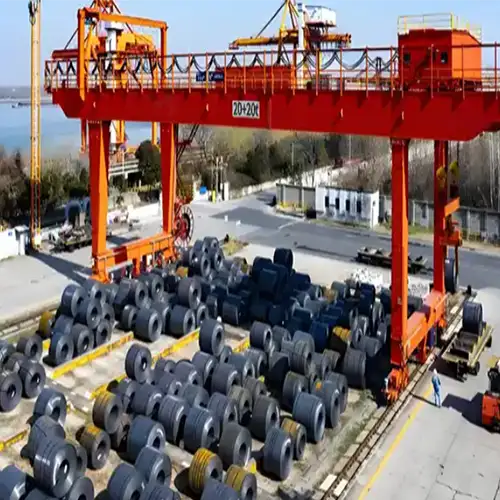
Rail Mounted Gantry Crane 10 Ton to 100 Ton + | Industrial Rail Gantry Cranes
Explore rail mounted gantry cranes for sale for steel, container, and precast handling. High-capacity RMG cranes designed for heavy industrial lifting efficiency.
| Crane Type | Rail Mounted & Rail Travelling Gantry Cranes -Industrial Material Handling, with Single/Double Girder, Single/Double Leg Design, Electric Wire Rope Hoist/Open Winch, Rail Travel, ISO A4–A8 / FEM 2M–5M, 380V/400V/415V/440V/460V, 50Hz/60Hz, 3Ph. |
| Crane Capacity | 10–100 Ton+ (Common: 10 Ton, 20 Ton, 30 Ton, 50 Ton, 75 Ton, 100 Ton) |
| Span Length | 10–40 m (Common: 15 m, 20 m, 25 m, 30 m, 35 m) |
| Lifting Height | 6–30 m (Common: 8 m, 10 m, 12 m, 15 m, 20 m) |
| Coverage Area Type | Fixed rail-supported lifting coverage for longitudinal movement across production bays, storage yards, construction areas, and industrial handling zones. |
| Application | Material handling, lifting, positioning, assembly, maintenance, loading/unloading, Precast yards, steel plants, fabrication yards, ports, warehouses, construction sites, shipyards, power projects, and heavy industrial material handling. |
| Certifications | CE / ISO / SGS / Other third-party inspection |
| Customization | Single/double girder, single/double leg, electric wire rope hoist/open winch, rail travel with VFD, pendant/remote/cabin/PLC control, and customized rail layout and lifting attachments. |
Crane Manufacturer: Yuantai Cranes – 30+ Years Professional Crane Manufacturer from China
Category: Crane on Rail
Tags:
Your Trusted Semi Gantry Crane Manufacturer & Supplier
Rail Mounted Gantry Crane 10 Ton to 100 Ton +
Industrial Rail Gantry Cranes
Explore rail mounted gantry crane features, industrial applications, environmental adaptations, and benefits for global buyers in different sectors.
Most Important Takeaway
Key Takeaways – What Questions This Guide Solves:
- Understand howrail mounted gantry cranesoptimize industrial material handling across multiple sectors.
- Identify the right crane type forheavy, medium, long, or repetitive loads.
- Learn how environmental conditions affectcrane design, durability, and safety.
- Explore automation, smart positioning, and efficiency improvements for industrial operations.
- Compare applications acrossports, steel mills, precast, tunnels, shipyards, energy, and long material yardsglobally.
Quick FAQs — Questions Solved Here
Get practical answers to common questions about rail mounted gantry cranes, their selection, features, and industrial applications.
Which rail mounted gantry crane suits my load and environment?
It depends on what you lift and where you work.
- Container terminals / freight yards:Usedouble girder heavy-duty rail gantry cranesfor continuous stacking and fast handling
- Steel mills:Needheavy-duty industrial gantry cranesfor slabs, coils, and machinery
- Precast yards:Usemedium to heavy rail travelling gantry cranesfor panels and beams
- Tunnel / underground sites:Chooselow headroom compact gantry cranes
- Pipe, timber, long materials:Usespecial beam or hook gantry cranes
Also consider environment: coastal, cold, hot, dusty, or underground conditions will change the final design.
How to choose single girder, double girder, or automated crane?
Simple rule:lighter load = simpler crane, heavier work = stronger crane
- Single girder rail gantry crane:Good for light to medium work like workshops, small yards, and low lifting frequency
- Double girder rail mounted gantry crane:Used for heavy-duty jobs like steel yards, container terminals, shipyards
- Automated gantry crane systems:Used when work is repetitive and fast, like container handling or large logistics yards
What features are needed for different environments?
Different climates need different protection.
- Coastal / ports:Anti-rust coating, sealed electrical boxes, wind protection
- Cold regions:Anti-freeze systems, heated parts, low-temperature motors
- Hot / dusty areas:Dust-proof covers, heat-resistant parts, cooling or ventilation
- Underground / tunnels:Low headroom design, compact structure, moisture protection
Each environment needs a different protection level to keep the crane stable and safe.
How do RMG cranes improve efficiency, safety, and ROI?
In simple terms, they make workfaster, safer, and more controlled.
- Efficiency:Fixed rail movement = faster and more stable material flow
- Safety:Anti-sway, overload protection, and better control systems reduce accidents
- Lower cost:Right crane size avoids overspending and reduces maintenance
- Automation-ready:Can be upgraded with PLC control and smart systems
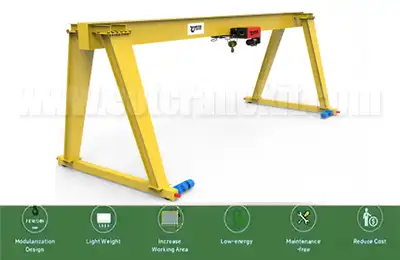
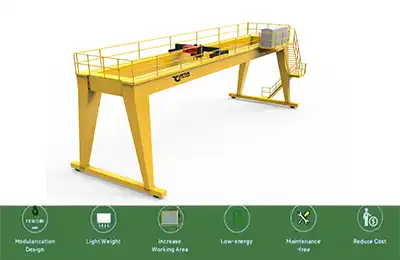
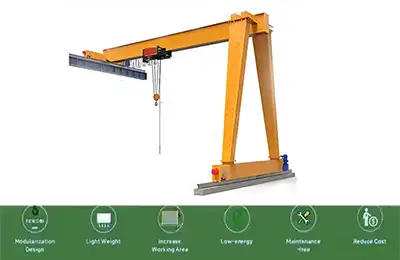
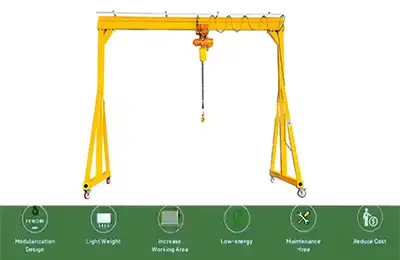
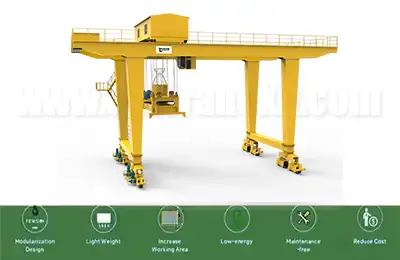
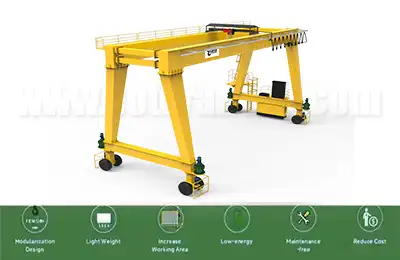
Rail Mounted and Rail Travelling Gantry Cranes
Detailed overview of rail mounted gantry cranes, their components, industrial relevance, and global usage trends.
What a Rail Mounted Gantry Crane Is
Arail mounted gantry craneis an overhead lifting system designed to travel along fixed rails, moving heavy loads in a precise and controlled path. Unlike mobile or rubber-tyred cranes, these cranes are installed on rails that define a linear working area, making them ideal for repetitive industrial operations.
In industrial projects,rail gantry cranesare commonly used for handling materials where movement is predictable and the workflow requires continuous lifting and transport. These cranes come insingle girder or double girder designs, depending on load capacity and span requirements, and are equipped with hoisting mechanisms, trolleys, and drive systems to handle materials safely and efficiently.
Core components include:
- Main gantry frame (single or double girder)
- Hoisting system (wire rope hoist, open winch, grab, or magnetic lifting system)
- Rail traveling system with motors and gearboxes
- End carriages with wheels running along steel rails
- Electrical control system (cabin, remote, or automated control)
- Optional anti-sway, load sensors, and positioning devices
These features makerail travelling gantry cranessuitable for industries that require accurate placement of loads, like steel mills, precast concrete yards, tunnel construction projects, shipyards, and heavy fabrication facilities. Click to learn on the main parts of rail mounted gantry cranes and the Differences Between Rail Gantry Cranes and Rubber-Tyred Gantry Cranes.
Why Rail Mounted Gantry Cranes Are Critical in Industrial Projects
In the world, lifting is rarely occasional. Materials move repeatedly along production or storage lines. This is whereindustrial rail mounted gantry cranesshow their value.
Typical use cases include:
- Handlingheavy steel plates, coils, and structural beams
- Movingprecast concrete panels, tunnel segments, or bridge girders
- Transportinglong materials like pipes or timber bundles
- Repetitive lifting of smaller loads such as bags or machinery components
Why they matter in practice:
- They allow safe, continuous lifting along a fixed path
- High accuracy reduces damage to products and structures
- Can be equipped with automation for anti-sway, load positioning, or remote operation
- Suitable for outdoor yards and confined industrial spaces
In many industrial projects, operators note that once the rails are installed, "the workflow becomes a system." These cranes are not just lifting equipment—they become part of the production line itself.
Global Usage Trends in Industrial Operations
Rail mounted gantry cranesandrail travelling gantry cranesare used differently depending on industrial needs and environmental conditions worldwide:
- Asia:Common in steel mills, precast yards, and heavy infrastructure projects. Durability and outdoor resistance are critical.
- Europe:High adoption in automated freight terminals, ports, and precision industrial handling facilities. Focus is on energy efficiency and positioning accuracy.
- Middle East:Use in steel plants, ports, and energy projects where heat resistance and dust-proofing are important.
- North America:Rail mounted gantry cranes are installed in intermodal yards and heavy material storage facilities, with emphasis on long-term reliability and maintenance.
- Africa & South America:Increasing use in ports, infrastructure construction, and mining logistics. Robust design and heavy-duty lifting are more important than automation in many cases.
Commonly searched terms by buyers includeindustrial gantry crane for steel handling,heavy-duty rail gantry crane for precast yard, andrail travelling gantry crane for outdoor operations.
Types of Rail Mounted Gantry Cranes for Sales
| Crane Type | Structure | Hoist System | Typical Capacity | Industrial Use | Why Popular |
|---|---|---|---|---|---|
| Light-duty Single Girder Crane | Single girder / L-frame | Single hoist / crab trolley | 1–20 tons | Workshops, small warehouses, assembly lines | Low cost, easy to install, ideal for small repetitive loads |
| Medium-duty Double Girder Crane | Double girder / A-frame | Single or double hoist | 20–80 tons | Container yards, precast yards, industrial fabrication | Balanced capacity and cost, versatile for medium loads |
| Heavy-duty Double Girder Crane | Double girder / A-frame / U-frame | Double hoist / main & auxiliary hook | 80–300 tons | Steel mills, bridge segments, shipyards, energy plants | Handles very heavy loads safely, high stability, multi-purpose |
| Low Headroom Gantry Crane | Compact single/double girder | Single or compact hoist | 5–50 tons | Tunnels, metro, underground projects | Space-saving, precise positioning, easy underground installation |
| Long Material Gantry Crane | U-frame / reinforced beam | Crab trolley / adjustable lifting beam | 5–80 tons | Pipes, timber, beams, steel | Excellent for long/uneven loads, prevents swinging, efficient outdoor yard handling |
| Precast / Repetitive Workflow Crane | Single or double girder | Crab trolley / double crab trolley | 10–80 tons | Precast production lines, assembly flow | High cycle efficiency, repeatable accuracy, modular for expansion |
Quick Takeaways for Buyers
When choosing a rail mounted gantry crane, it helps to keep the main practical points in mind. Here's a simple guide to match crane type with your operational needs:
- Light-duty cranes→ Affordable, simple to operate, best for small or occasional loads.
- Medium-duty cranes→ Versatile workhorses, ideal for containers, precast panels, and general industrial tasks.
- Heavy-duty cranes→ Stable and robust, built for high-capacity lifting and multiple industrial applications.
- Low headroom cranes→ Perfect for tunnels, metro construction, or any site with restricted vertical clearance.
- Long material cranes→ Designed to handle pipes, beams, timber, or other elongated items with balance and minimal sway.
- Precast / repetitive load cranes→ Optimized for fast cycles, high accuracy, and modular workflows in precast yards or production lines.
These takeaways give you apractical snapshotfor deciding which crane matches your workflow, load type, and space requirements without overcomplicating the choice.
Typical Hook & Lifting Devices for Rail Mounted Gantry Cranes
| Hook / Device Type | Description | Typical Load & Use | Industrial Applications |
|---|---|---|---|
| Standard Single Hook | Simple lifting hook, manually or motorized | 1–50 tons | Light to medium loads, general industrial handling, warehouses, small machinery |
| Double / Tandem Hook | Two hooks for large or long loads | 20–300+ tons | Steel plates, bridge segments, ship modules, precast concrete beams |
| C-Hook / Coil Hook | Specialized hook for coils or rolled steel | 5–150 tons | Steel mills, coil handling, plate storage, rolling mill logistics |
| Spreader Bar / Beam Lifter | Beam connecting multiple hooks to lift long or wide objects evenly | 5–100+ tons | Precast panels, timber, structural steel, pipes |
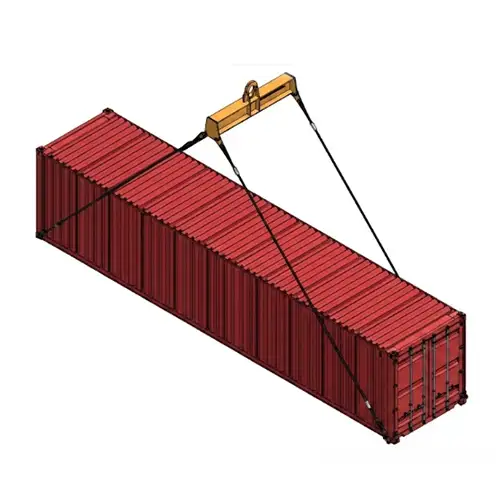
| Container Spreader (Twist Lock) | Mechanism to lock 20ft, 40ft, 45ft containers | 20–65+ tons | Container terminals, freight yards, intermodal transfer |
| Magnetic Lifter / Electromagnet | Uses magnetic force to lift ferrous metals | 5–150+ tons | Steel plates, scrap handling, steel mill yards |
| Grab / Clamshell Bucket | Mechanical grab for bulk material handling | 1–80+ tons | Sand, coal, gravel, bulk materials in ports and stockyards |
| Adjustable Hook / Sling Hook | Can move lifting points to match load shape | 5–100 tons | Long or uneven loads: beams, pipes, timber bundles |
Key Takeaways
Different hook and lifting configurations are designed for different types of materials and lifting conditions. Choosing the right setup improves handling safety, load stability, and daily operating efficiency.
- Single hook systems→ Simple, flexible, and suitable for small to medium lifting tasks.
- Double or tandem hooks→ Better for heavy loads, long materials, or applications requiring balanced lifting.
- C-hooks and coil hooks→ Common in steel mills and rolling lines for handling steel coils safely and efficiently.
- Spreader bars→ Used for long, oversized, or fragile loads that require multiple lifting points for stability.
- Container spreaders→ Standard choice for container handling operations, with twist-lock systems for secure lifting and stacking.
- Magnet and grab systems→ Suitable for scrap metal, bulk materials, or loose industrial products that cannot be handled with standard hooks.
- Adjustable hook configurations→ Flexible option for irregular-shaped loads or changing material dimensions.
In practical applications, the lifting attachment often matters as much as the crane itself. The right hook or spreader setup can improve load control, reduce material damage, and make repetitive handling operations much more efficient.
Industrial Applications of Rail Mounted Gantry Cranes
Rail mounted gantry cranes (also called rail gantry cranes or rail travelling gantry cranes) are used wherever heavy loads need precise, repetitive handling along fixed paths. They are designed for specific loads, workflows, and environments.
Industrial Applications Overview
- Container Terminals & Freight Yards:Double girder rail gantry cranes, 30–65t, stacking containers, truck/rail transfer, automation, anti-sway, windproof.
- Steel Mills & Service Centers:Heavy-duty industrial gantry cranes, 50–150t, handling slabs, coils, billets, magnets, C-hook, dual hoist, heat/corrosion protection.
- Precast & Infrastructure Projects:Single/double girder gantry cranes, 10–80t, lifting beams, panels, tunnel segments, adjustable hooks, anti-sway, dual lifting.
- Tunnel Construction & TBM Operations:Compact low-headroom rail gantry cranes, 5–50t, underground tunnels, segment handling, dust-proof, precise alignment.
- Shipyards & Marine Fabrication:Double girder heavy-duty gantry cranes, 50–300t, hull blocks, ship modules, dual/tandem hoist, windproof, anti-corrosion.
- Energy, Hydropower & Dams:Double girder gantry cranes, 50–250t, lifting turbines, generators, dam gates, precision control, extreme weather protection.
- Lumber, Pipes & Long Material Yards:Single/double girder long-material gantry cranes, 5–80t, handling pipes, timber, steel beams, dust/weather-proof, adjustable attachments.
Container Terminals and Freight Yards
In container handling systems, arail mounted gantry crane(often referred to as arail gantry craneorrail travelling gantry crane) is used where container movement follows a fixed, repetitive yard layout. The rail-guided system supports stable, high-frequency lifting cycles with consistent positioning accuracy across long operating hours.
This application is typically not about flexibility. It is about repetition, stacking density, and throughput efficiency in a controlled logistics environment.
Typical crane configuration and capacity:
- Double girder heavy-duty rail mounted gantry crane
- Capacity: 30–65 tons for single container lifting, up to 80+ tons in special tandem or heavy-duty configurations
- Span: 18–40 meters depending on yard lane design
- High-duty classification (continuous operation, multi-shift container terminals)
Common customized features:
- Container spreader with twist-lock system (20ft/40ft/45ft compatibility)
- Anti-sway control system for stable stacking at height
- PLC-based automation or semi-automation for yard coordination
- Rail alignment and positioning systems for repeatable container placement
- Windproof locking devices for outdoor port environments
Practical industrial use:
- Container stacking in high-density storage yards
- Rail-to-truck and rail-to-rail transfer operations in intermodal hubs
- Continuous 24/7 container flow in automated or semi-automated terminals
In modern ports across Europe, Asia, and North America,automated rail mounted gantry cranesare increasingly integrated into digital yard management systems to improve throughput and reduce manual handling errors.
Steel Mills and Service Centers
In steel production and distribution facilities,heavy-duty gantry cranesare used for handling dense, oversized, and often irregular steel products. Arail mounted gantry crane for steel yard operationsis designed for continuous-duty cycles under high thermal and mechanical stress.
The working environment is typically outdoor, with heavy loads and repetitive transfer cycles between storage, processing, and dispatch areas.
Typical crane configuration and capacity:
- Double girder industrial gantry crane with reinforced structure
- Capacity: 50–150 tons depending on slab, coil, or billet size
- Span: 15–50 meters for wide outdoor steel yards
- High duty classification for continuous operation
Common customized features:
- Magnetic lifting systems for steel plates and scrap handling
- C-hook systems for coil lifting in rolling mill logistics
- Dual hoist or tandem lifting for long or uneven steel loads
- Heat-resistant and anti-corrosion coatings for harsh outdoor conditions
- Heavy-duty rail reinforcement for frequent high-load travel
Practical industrial use:
- Handling steel slabs, coils, billets, and structural sections
- Feeding rolling mills and managing finished steel storage
- Continuous material flow between production and dispatch zones
Precast Concrete & Infrastructure Projects
In precast production systems, arail travelling gantry craneis widely used to support structured and repetitive material flow along casting and storage lines. The crane follows a fixed rail path, which matches the linear nature of precast production layouts.
This environment requires precision more than speed, especially when handling large concrete components.
Typical crane configuration and capacity:
- Single or double girder precast gantry crane
- Capacity: 10–80 tons depending on beam, panel, or segment size
- Span: 15–30 meters based on yard design
- Medium to heavy-duty classification depending on production scale
Common customized features:
- Synchronized dual lifting systems for large or flexible precast elements
- Adjustable hook spacing for different product sizes
- Anti-sway control for safe handling of fragile concrete components
- Modular rail extensions for flexible production expansion
Practical industrial use:
- Lifting and transporting precast beams, tunnel segments, and wall panels
- Supporting linear production flow from casting to curing and storage
- Used in metro, highway, and bridge construction supply chains
Tunnel Construction & TBM Operations
In underground and confined construction environments,rail mounted gantry cranesare designed as compact, low-headroom lifting systems. These cranes operate in tunnel shafts, TBM backup zones, and narrow underground working spaces where clearance is limited.
The focus here is controlled movement and safety under restricted conditions.
Typical crane configuration and capacity:
- Low headroom single girder or compact double girder rail gantry crane
- Capacity: 5–50 tons for segment and equipment handling
- Span: 5–15 meters depending on tunnel or shaft width
- Compact design for confined underground spaces
Common customized features:
- Reduced headroom hoist design for tunnel clearance limitations
- Dust-proof and moisture-resistant electrical systems
- Modular structure for underground installation and maintenance
- Precise positioning control for segment alignment with TBM systems
Practical industrial use:
- Handling tunnel lining segments during TBM excavation cycles
- Transporting heavy equipment and structural components underground
- Supporting continuous tunneling operations in confined environments
Shipyards & Marine Fabrication
In shipbuilding facilities,heavy-duty rail gantry cranesare used for large-scale structural assembly. These cranes support extremely heavy and oversized loads such as hull blocks and ship modules.
The working environment is typically coastal, exposed to wind, salt, and high humidity, requiring robust structural and environmental protection.
Typical crane configuration and capacity:
- Double girder heavy-duty gantry crane with large span design
- Capacity: 50–300 tons depending on ship section size
- Span: 20–60 meters for large assembly zones
- High-duty classification for heavy fabrication cycles
Common customized features:
- Wind-resistant structural design for outdoor operation
- Multi-trolley or dual-hook synchronized lifting systems
- High-precision positioning for module alignment
- Anti-corrosion coating systems for marine environments
Practical industrial use:
- Lifting hull blocks, ship modules, and marine engine assemblies
- Coordinated assembly of large ship sections
- Outdoor heavy fabrication under variable weather conditions
Energy, Hydropower & Dam Projects
In large infrastructure and energy projects,industrial gantry cranesare used for handling extremely heavy and high-value components such as turbines, gates, and generator parts.
These cranes are often project-specific and designed for long service life with high safety margins.
Typical crane configuration and capacity:
- Double girder heavy-duty rail mounted gantry crane
- Capacity: 50–250 tons depending on component size
- Span: 20–50 meters depending on installation area
- Heavy-duty intermittent or continuous operation class
Common customized features:
- High-precision load positioning systems
- Heat-resistant or cold-resistant configurations depending on region
- Advanced braking systems for controlled lowering of heavy loads
- Outdoor protection systems for extreme weather environments
Practical industrial use:
- Installation and maintenance of turbines, generators, and dam gates
- Handling oversized components in energy production facilities
- Heavy lifting in remote or harsh environments
Lumber, Pipe & Long Material Storage Yards
In long-material handling yards,rail travelling gantry cranesare used for repetitive movement of elongated and bulky materials along fixed storage lanes.
The workflow is simple but highly repetitive, focusing on efficiency and safety.
Typical crane configuration and capacity:
- Single or double girder long-material gantry crane
- Capacity: 5–80 tons depending on material density and length
- Span: 15–35 meters for storage yard coverage
- Medium to heavy-duty classification depending on application
Common customized features:
- Adjustable lifting attachments for pipes, timber, or steel beams
- Dust-proof and weather-resistant electrical systems
- Long-span beam reinforcement for stability under uneven loads
- Low-speed travel systems for precise placement
Practical industrial use:
- Handling pipes, timber bundles, and structural steel sections
- Organized storage and retrieval in outdoor industrial yards
- Continuous loading and unloading for logistics distribution
| Sector | Focus | Typical Crane | Key Features | Practical Use |
|---|---|---|---|---|
| Container Terminals & Freight Yards | Repetitive stacking & retrieval | Double girder 30–65t (up to 80t tandem) Span 18–40m | Container spreader Anti-sway PLC / semi-automation Rail positioning Windproof | Stacking containers Rail-truck transfers Automated terminal flow |
| Steel Mills & Service Centers | Heavy steel handling | Double girder 50–150t Span 15–50m | Magnet / C-hook lifting Dual hoist Heat & corrosion protection Reinforced rails | Moving slabs, coils, billets Feeding mills Dispatch flow |
| Precast & Infrastructure | Linear, precise lifting | Single / double girder 10–80t Span 15–30m | Dual-lift Adjustable hooks Anti-sway Modular rails | Beams, panels, tunnel segments Production-to-storage workflow |
| Tunnel Construction / TBM | Confined, low-headroom lifting | Compact single / double girder 5–50t Span 5–15m 45/16 Ton Gantry Cranes for Subway & Tunnel Construction Soil Handling | Low-head hoist Dust / moisture-proof Modular Precise TBM alignment | Tunnel segments Underground equipment handling |
| Shipyards & Marine Fabrication | Large, heavy modules | Double girder 50–300t Span 20–60m Shipyard Slipway Gantry Crane for Sale – Outdoor Yard Cranes | Windproof Dual / tandem hoist High-precision Anti-corrosion | Hull blocks Ship modules Marine engines |
| Energy / Hydropower / Dams | Heavy, critical components | Double girder 50–250t Span 20–50m | Precise control Climate protection Advanced brakes | Turbines Generators Dam gates |
| Lumber, Pipes & Long Material Yards | Long / bulky material | Single / double girder 5–80t Span 15–35m Rail Mounted Gantry Crane for Lumber Handling, Pipe Handling, and long Loads Handling | Adjustable attachments Dust / weather-proof Reinforced beam Slow travel | Pipes, timber, steel beams Organized storage & retrieval |
Load-Specific Considerations for Rail Mounted Gantry Cranes
When dealing withheavy industrial loads, arail mounted gantry cranemust prioritize structural rigidity, load stability, and controlled lifting behavior. This category typically includes steel plates, large machinery, heavy fabrication modules, and bridge segments used in infrastructure projects.
Heavy Loads: Steel Plates, Machinery, Bridge Segments
When dealing withheavy industrial loads, arail mounted gantry cranemust prioritize structural rigidity, load stability, and controlled lifting behavior. This category typically includes steel plates, large machinery, heavy fabrication modules, and bridge segments used in infrastructure projects.
In industrial projects, these operations are continuous and safety-critical, especially in steel mills, shipyards, and heavy construction yards. That is whydouble girder heavy-duty gantry cranesare the standard configuration.
Rail Mounted Gantry Cranes for Heavy Loads
| Load Type | Capacity & Specifications | Features | Industrial Uses |
|---|---|---|---|
| Steel Plates | 50–150 tons, double girder, span 15–40m, high-duty classification | Magnetic lifting systemsC-hooks for slabsDual trolley for large platesReinforced girder for minimal deflection | Handling slabs and plates in steel mills and service centersFeeding rolling mills and storage transfer |
| Machinery | 50–250 tons, double girder, span 20–50m, continuous or intermittent operation | Dual hoist systemHigh-torque motors for smooth acceleration/brakingPrecision rail alignmentAnti-sway control | Installation of heavy equipment in fabrication yards, power plants, and energy projectsTransport of industrial machinery between zones |
| Bridge Segments | 50–300 tons, double girder, span 25–60m, reinforced structure | Dual synchronized hoists for balanced liftingAnti-sway controlModular design for large spansPrecision positioning systems | Lifting and placing bridge segments in infrastructure projectsHandling precast concrete sections in highway/rail projects |
Typical crane configuration and selection:
- Double girderheavy-duty rail mounted gantry crane
- Capacity: 50–300 tons depending on project scale
- High-duty classification for continuous lifting cycles
- Dual trolley or synchronized hoist systems for oversized loads
Practical configuration features:
- Dual hoist system for balanced lifting of long or uneven loads
- Reinforced main girder to reduce deflection under full load
- High-torque motors for smooth acceleration and braking
- Precision rail alignment system for stable travel under heavy weight
Industrial use focus:
- Steel plate handling in steel mills
- Bridge segment lifting in infrastructure projects
- Machinery installation in large fabrication yards
- Heavy module assembly in shipyards and energy plants
In practical terms, heavy loads require not just higher capacity, butcontrolled movement and structural stiffness across the entire rail travel system.
Medium Loads: Containers, Precast Panels, Structural Components
Medium-load applications represent a balance between capacity, speed, and precision. Arail travelling gantry cranein this category is widely used in logistics yards and precast concrete production systems.
Typical materials include shipping containers, precast concrete panels, and medium-sized structural components used in construction and industrial supply chains.
Rail Travelling Gantry Cranes for Medium-Load Applications
| Load Type | Capacity & Specifications | Features | Industrial Uses |
|---|---|---|---|
| Shipping Containers | 20–80 tons, double girder rail mounted gantry crane, span 18–40m, semi-automated or manual control | Container spreader for multiple sizesAnti-sway system for stable liftingPositioning sensors for repeat accuracyWind-resistant outdoor design | Container handling in freight yards and intermodal terminalsRail-to-truck and yard stacking operations |
| Precast Concrete Panels | 20–80 tons, medium-duty gantry crane, span 18–35m, production line layout integration | Adjustable lifting beam for different panel sizesAnti-sway control for safe handlingModular crane structure for yard expansionPrecise positioning system | Precast production yardsTransport of wall panels, beams, and slabsConstruction supply chain logistics |
| Structural Steel Components | 20–80 tons, double girder configuration, span 20–40m, manual or semi-automated control | Flexible lifting attachmentsStable rail travelling systemModerate-speed operation for controlled handlingDurable outdoor structure | Steel fabrication yardsMedium-size structural assemblyIndustrial component transfer |
Medium-load rail mounted gantry cranes are mainly designed forrepeatable accuracy and workflow efficiency, not extreme lifting capacity. They perform best in layouts where materials move in a fixed production or logistics pattern.
Typical crane configuration and selection:
- Double girder rail mounted gantry crane (standard or medium-duty class)
- Capacity: 20–80 tons depending on load type
- Span: 18–40 meters for yard and production layouts
- Semi-automated or manual control systems depending on operation scale
Practical configuration features:
- Container spreader or adjustable lifting beam for different load formats
- Anti-sway control system for precise placement at height
- Modular crane structure for expansion in yard operations
- Positioning sensors for repeatable loading and unloading cycles
Industrial use focus:
- Container handling in freight yards and intermodal terminals
- Precast concrete panel movement in production yards
- Structural component transfer in industrial fabrication facilities
This category often requiresrepeatable accuracy rather than extreme lifting capacity, especially where workflow efficiency is tied to layout design.
Long Materials: Pipes, Timber, Beams
Handling long materials introduces a different set of challenges. The main issue is not only weight, but alsolength, balance, and alignment during movement. Arail mounted gantry crane for long material handlingmust ensure stability across uneven load distribution.
This type of operation is common in pipe storage yards, timber depots, and steel distribution centers.
| Load Type | Capacity & Specifications | Features | Industrial Uses |
|---|---|---|---|
| Steel Pipes | 10–80 tons, single or double girder rail mounted gantry crane, medium span, low-speed controlled travel | Pipe lifting beams or spreader beams for distributed loadAdjustable lifting points for different pipe lengthsAlignment guides to reduce swingReinforced trolley for eccentric loads | Pipe storage yardsOil & gas logistics yardsSteel distribution centersLoading/unloading transport trucks |
| Timber Bundles | 10–60 tons, single girder medium-duty gantry crane, optimized yard span, controlled travel speed | Bundle lifting clamps or timber hooksBalanced lifting points for uneven stacksAnti-sway control for long flexible loadsWeather-resistant outdoor design | Timber depotsWood processing yardsConstruction material storage areas |
| Steel Beams / Structural Sections | 20–80 tons, single or double girder configuration, yard-based span design, low-speed precision handling | Adjustable spreader beamsHigh stability rail travel systemReinforced structure for uneven load distributionPrecise positioning for alignment during stacking | Steel fabrication yardsConstruction supply chainsBridge and building structural material handling |
Long material handling with arail mounted gantry craneis less about maximum lifting capacity and more aboutbalance control, alignment accuracy, and safe travel of uneven loads across long spans.
Typical crane configuration and selection:
- Single or double girder rail gantry crane depending on load weight
- Capacity: 10–80 tons depending on pipe bundles or beam size
- Medium span design optimized for long yard coverage
- Low-speed travel system for controlled positioning
Practical configuration features:
- Specialized lifting beams or pipe hooks for distributed load handling
- Adjustable lifting points for different material lengths
- Alignment guides to prevent swinging during travel
- Reinforced trolley structure to handle eccentric loading
Industrial use focus:
- Steel pipe loading and unloading in logistics yards
- Timber bundle stacking in outdoor storage facilities
- Structural beam handling in fabrication and construction supply chains
In practical operation, success depends onload balance control during rail travel, not just lifting capacity.
Repetitive Small Loads: Bags, Components, and General Materials
For lighter but highly repetitive operations,industrial gantry cranesare used in manufacturing workshops, assembly lines, and logistics support areas. These operations focus on cycle efficiency rather than extreme capacity.
Typical loads include bags, mechanical components, packaged materials, and small industrial parts.
| Load Type | Capacity & Specifications | Features | Industrial Uses |
|---|---|---|---|
| Bags / Packaged Materials | 1–20 tons, single girder light-to-medium duty gantry crane Short to medium span High-frequency operation | Fast-cycle hoisting system for quick lifting Simple hook or small lifting attachments Lightweight trolley for fast travel Basic or semi-automated controls for repetitive lifts | Workshop and assembly line material handling Warehouse loading/unloading Internal logistics and distribution areas |
| Mechanical / Small Components | 1–15 tons, single girder Optimized for workshop or storage areas | Quick-response trolley Compact lifting attachments Anti-sway for delicate components High-frequency repetitive lifting capability | Manufacturing plants Small parts transfer Assembly line supply movement |
| General Industrial Materials | 1–20 tons, single girder, medium span Repetitive use | Lightweight structure for speed Fast hoist cycle Basic or semi-automated operation Adaptable to confined workshop spaces | Material handling in factories Internal logistics support Storage yard repetitive transfers |
Typical crane configuration and selection:
- Single girder rail mounted gantry crane (light to medium duty)
- Capacity: 1–20 tons depending on application
- Short to medium span for workshop or storage areas
- High-frequency operation capability
Practical configuration features:
- Fast cycle hoisting system for reduced lifting time
- Simple hook or small lifting attachments
- Lightweight trolley system for quick travel response
- Basic or semi-automated control systems for repetitive use
Industrial use focus:
- Assembly line material handling
- Warehouse loading and internal logistics
- Small part transfer in manufacturing plants
Here, the key requirement iscycle time efficiency and operational simplicity, not high structural complexity.
Case Notes: How Load Type Affects Crane Design and Selection
In procurement and engineering design, load type directly determinesrail mounted gantry crane configuration, capacity selection, and system design parameters.
Key technical relationships include:
- Span selection:Wider loads such as containers or precast beams require larger spans (up to 40m+), while small workshop cranes operate within shorter spans.
- Lifting height:High stacking operations (container yards or precast storage) require increased lifting height and longer hoisting ropes.
- Motor power and drive system:Heavy loads require high-torque motors and stronger braking systems to ensure controlled acceleration and stopping under full load.
Trolley selection:
- Dual trolley systems for long or uneven heavy loads
- Single trolley systems for standard container or panel handling
- Specialized trolleys for pipes, coils, or irregular materials
Duty classification:Continuous industrial environments (steel mills, ports) require high-duty class rail travelling gantry cranes, while workshops use medium or light-duty systems.In practical engineering decisions, load type is the first parameter that defines everything else—structure, rail design, hoisting system, and even automation level.
Environmental Adaptations for Rail Mounted Gantry Cranes
The working environment is one of the most important factors in selecting and designing a rail mounted gantry crane or rail travelling gantry crane. In industrial projects, the same crane structure can perform very differently depending on whether it is installed in a coastal port, desert yard, cold-region steel plant, or underground tunnel.
For buyers in different countries and industrial sectors, environmental adaptation is not an optional upgrade. It directly affects crane lifespan, maintenance cost, and operational safety.
Coastal / Port Environments (High Humidity, Salt, Strong Wind)
Coastal conditions are common in container terminals, shipyards, offshore logistics bases, and coastal steel plants. Countries such as China (coastal provinces), Singapore, UAE ports, Netherlands, Germany (North Sea ports), Japan, and the United States (West/East coast terminals) typically require strong corrosion protection strategies.
In these environments, a heavy-duty gantry crane for port operations must resist salt corrosion and wind loading while maintaining continuous operation.
| Environmental Condition | Challenges | Typical Adaptations | Industrial Applications |
|---|---|---|---|
| High Humidity | Electrical components affected by moistureCorrosion risk on exposed metal parts | Sealed electrical cabinetsHumidity control in control panelsMarine-grade coatings | Coastal steel yardsPort logistics terminals |
| Salt Exposure | Salt spray accelerates rust on rails and structuresFastener degradation | Stainless steel or galvanized fastenersC5-M anti-corrosion coatingRegular inspection & maintenance | Container handlingShipyard block lifting |
| Strong Wind | Lifting instability at heightPotential sway of spreaders and loads | Windproof locking devicesReinforced crane structureAnti-sway control systems | Outdoor container stackingCoastal shipyard module assembly |
Typical environmental challenges:
- Salt spray corrosion on steel structures and rails
- High humidity affecting electrical systems
- Strong crosswinds affecting lifting stability
- Continuous 24/7 loading cycles in port operations
Typical adaptations:
- Marine-grade anti-corrosion coating systems (C5-M level protection in many projects)
- Stainless steel or galvanized fasteners and exposed components
- Sealed electrical cabinets with humidity control
- Windproof locking devices and rail clamps
- Reinforced structural design for large-span rail gantry cranes
Industrial application focus:
- Container handling in port terminals
- Shipyard block assembly and module lifting
- Coastal steel distribution yards
Cold Climate Regions (Snow, Ice, Sub-Zero Temperatures)
Cold-region applications are common in Canada, Russia, Northern Europe (Norway, Sweden, Finland), Northern China, and parts of the United States. These areas require winterized rail mounted gantry cranes designed for stable operation under freezing conditions.
| Environmental Condition | Challenges | Typical Adaptations | Industrial Applications |
|---|---|---|---|
| Ice accumulation on rails and wheels | Slipping risk and unstable crane travelBlocked wheel movement and rail obstruction | Rail heating systems or de-icing devicesSpecial wheel design for ice clearanceAnti-freeze lubrication systems | Steel yards in Canada and RussiaNorthern port terminals and logistics yards |
| Low-temperature steel brittleness | Reduced structural toughness in extreme coldHigher risk of material fatigue and cracking | Low-temperature rated structural steelWinterized crane design packageRegular cold-weather inspection systems | Heavy-duty industrial gantry cranes in Northern EuropeMining and steel operations in Arctic regions |
| Hydraulic system performance drop | Hydraulic oil thickening at low temperaturesSlow or unstable lifting response | Cold-resistant hydraulic oilHeated hydraulic systems and enclosuresSealed lubrication systems | Hydropower plants in cold mountainous regionsInfrastructure construction projects in winter zones |
| Reduced motor and battery efficiency | Lower power output in sub-zero conditionsUnstable electrical performance | Low-temperature motors and gearboxesHeated operator cabins and control systemsInsulated electrical cabinets | Tunnel construction and energy projects in cold regionsYear-round steel production facilities |
Typical environmental challenges:
- Ice accumulation on rails and wheel systems
- Low-temperature brittleness in steel components
- Hydraulic fluid viscosity changes
- Reduced battery and motor efficiency in extreme cold
Typical adaptations:
- Low-temperature motors and gearboxes designed for sub-zero operation
- Heated rail systems or de-icing devices for wheel paths
- Cold-resistant hydraulic oils and sealed lubrication systems
- Insulated or heated operator cabins
- Reinforced braking systems for controlled movement on icy surfaces
Industrial application focus:
- Steel mills operating year-round in cold regions
- Hydropower and dam construction in mountainous or northern areas
- Tunnel construction projects in cold-weather infrastructure zones
Hot / Dry / Desert Conditions (Heat, Dust, Sand Exposure)
Hot and dry environments are typical in Middle Eastern countries (Saudi Arabia, UAE, Qatar), parts of Africa, India's inland regions, Australia, and Central Asia. These areas require cranes designed for heat resistance and dust protection.
| Condition | Challenges | Adaptations | Industrial Use |
|---|---|---|---|
| High temperatures | Motors and electronics overheat, reduced efficiency | Heat-resistant motors, cables, and control systemsVentilated or air-conditioned operator cabins | Mining logistics yardsOutdoor steel storage yards |
| Dust infiltration | Electrical and mechanical parts clogged, wear increased | Dust-proof enclosures (IP54–IP66)Sealed electrical cabinets | Bulk material handlingDesert precast concrete yards |
| Sand abrasion | Rails, wheels, and moving parts wear faster | Heavy-duty rail cleaningWheel protection systemsSpecial surface coatings | Structural steel and pipe storage yardsMining sites |
| Thermal expansion | Rail misalignment over long spans | Expansion jointsRegular rail alignment checksReinforced long-span rails | Large outdoor production and storage areas |
Typical environmental challenges:
- High ambient temperatures affecting motors and electronics
- Dust infiltration into electrical and mechanical systems
- Sand abrasion on rails, wheels, and moving parts
- Thermal expansion affecting rail alignment over long spans
Typical adaptations:
- Dust-proof enclosures for electrical panels (IP54–IP66 protection levels)
- Heat-resistant motors, cables, and control systems
- Ventilated or air-conditioned operator cabins
- Heavy-duty rail cleaning and wheel protection systems
- Special coatings to reduce heat absorption and surface degradation
Industrial application focus:
- Mining logistics yards and bulk material handling
- Outdoor steel pipe and structural storage yards
- Large precast concrete production facilities in desert regions
Confined or Underground Spaces (Low Headroom, TBM Environments)
Underground and confined-space applications are common in metro tunnel projects in China, India, Singapore, France, Germany, UAE urban infrastructure, and major city subway systems worldwide. These projects require compact and highly controlled crane systems.
| Condition | Challenges | Adaptations | Industrial Use |
|---|---|---|---|
| Low vertical and lateral clearance | Very limited space for crane movement | Low headroom crane designCompact single or double girder structures | Metro and railway tunnel projectsUnderground construction zones |
| Poor ventilation and high dust | Electrical and mechanical components prone to failure | Dust- and moisture-resistant electrical systemsSealed control panels | TBM tunnelsConfined underground maintenance areas |
| Continuous segment handling | Frequent lifts in narrow space can slow operations | High-precision positioning systemsModular crane assembly for flexibility | TBM tunnel lining segment installationEquipment transport underground |
| Integration with TBM systems | Crane must align precisely with TBM operations | Custom modular railsCompact trolley designsSynchronization with TBM workflow | Large-scale tunneling projectsUrban subway construction |
Typical environmental challenges:
- Very limited vertical and lateral clearance
- Poor ventilation and high dust levels
- Continuous segment handling in narrow spaces
- Integration with TBM (Tunnel Boring Machine) systems
Typical adaptations:
- Low headroom rail mounted gantry crane designs
- Compact single girder or specially designed double girder structures
- Modular assembly for underground installation
- High-precision positioning systems for tunnel segment alignment
- Dust- and moisture-resistant electrical systems
Industrial application focus:
- TBM tunnel segment handling and installation
- Underground equipment maintenance and transport
- Metro and railway tunnel construction projects
Extreme Weather and Mixed Climate Regions (Variable Conditions)
Some regions experience multiple environmental challenges within the same project lifecycle. This is common in India, Brazil, Turkey, South Africa, and large infrastructure projects across Southeast Asia, where cranes may face heat, rain, dust, and seasonal cold conditions.
| Condition | Challenges | Adaptations | Industrial Use |
|---|---|---|---|
| Seasonal temperature variation | Motors and structures affected by heat and cold | Multi-layer protective coatingsTemperature-resistant motors and systems | Infrastructure construction yardsMulti-phase precast facilities |
| Heavy rainfall / monsoon | Corrosion, slippery rails, water ingress in electricals | Sealed and ventilated electrical enclosuresWaterproof hoist systemsDrainage around rails | Outdoor logistics terminalsConstruction and precast yards |
| Dust during dry seasons | Dust accumulation on mechanical and electrical parts | Dust-proof enclosures (IP54–IP66)Regular cleaning & maintenance | Industrial storage yardsPrecast concrete production areas |
| Mixed outdoor and semi-indoor operations | Varying conditions can stress crane structure and alignment | Flexible rail alignmentModular crane design for quick adaptation and maintenance | Multi-phase industrial logistics and production sites |
Typical environmental challenges:
- Seasonal temperature variation
- Heavy rainfall and monsoon exposure
- Dust during dry seasons
- Mixed outdoor and semi-indoor operations
Typical adaptations:
- Multi-layer protective coating systems
- Sealed but ventilated electrical enclosures
- Flexible rail alignment systems for ground variation
- Modular crane designs for easier maintenance and upgrades
Industrial application focus:
- Infrastructure construction yards
- Multi-phase precast production facilities
- Mixed industrial logistics terminals
Practical Engineering Note for Buyers:
In procurement of a rail mounted gantry crane system, environmental conditions often determine the final specification more than load capacity alone.
Key selection logic used in industrial projects:
- Coastal environments → corrosion protection and wind resistance first
- Cold regions → thermal reliability and anti-icing systems first
- Hot/dry regions → dust protection and cooling systems first
- Tunnel projects → space limitation and precision control first
For global buyers, understanding these environmental differences is essential to avoid overdesign, underperformance, or high maintenance cost over time.
Key Features by Industry and Load
Choosing the right rail mounted gantry crane involves more than just load capacity. Industrial buyers must consider girder type, hoist system, automation options, environmental protection, and maintenance requirements. Each of these features varies depending on the sector, load type, and operating environment.
Single vs. Double Girder
The choice between single and double girder gantry cranes depends on load weight, span, and operational frequency.
Single Girder:
- Light to medium-duty applications such as precast concrete yards, small workshop handling, and timber or pipe yards
- Economical in terms of initial cost, installation, and maintenance
- Typical lifting capacity: 1–20 tons
- Span: up to 20 meters for short-to-medium storage lanes
- Best for repetitive small or long material loads in low to medium duty industrial settings
Double Girder:
- Heavy-duty and continuous-operation applications like container terminals, steel mills, shipyards, and heavy infrastructure projects
- Supports higher lifting capacity, long spans, and multi-trolley systems
- Typical lifting capacity: 30–300 tons, depending on load type
- Span: 20–60 meters for wide outdoor yards or fabrication facilities
- Better rigidity and stability for high stacking or tandem lift operations
- Preferred for heavy steel, large precast elements, bridge modules, and TBM support cranes
Industrial note: In container yards, shipyards, and large fabrication facilities, double girder cranes are standard because the span, load, and stacking height exceed what single girder cranes can safely handle.
Hoist Types
The hoist selection is critical to match the load type, weight distribution, and handling requirements:
- Wire Rope Hoist: Standard for heavy loads, long travel distance, and continuous operation. Ideal for steel plates, machinery, bridge segments, and large precast elements.
- Open Winch: Suitable for medium loads or specialized lifting tasks in infrastructure and industrial fabrication sites.
- Magnet Hoist: Used in steel yards and scrap handling facilities for fast, efficient handling of ferrous materials.
- Grab Hoist: For bulk materials like timber, pipes, or loose aggregates in storage yards or port operations.
Industrial focus: Each hoist type must be matched to both load weight and material characteristics, including temperature, moisture, and surface condition. For example, magnets require dry, clean steel surfaces to operate efficiently, while grab systems must handle variable shapes and weights.
Automation & Positioning
Modern industrial yards increasingly demand precision, repeatability, and reduced operator fatigue, which makes automation and positioning systems critical.
Key features include:
- Anti-sway systems for stable handling of containers, steel plates, and precast panels
- PLC or computerized control systems for automated or semi-automated operations
- GPS or laser tracking systems for precise placement over long travel spans
- Load sensors and smart overload protection to prevent damage to both crane and load
- Integration with yard management software in ports or industrial logistics facilities
Practical benefits:
- Reduces cycle time for repetitive lifts
- Improves placement accuracy in high stacking or confined areas
- Enhances safety by preventing collisions and overloading
Industrial sectors: Ports, container terminals, steel mills, precast concrete yards, shipyards, and TBM tunneling projects.
Outdoor Protection & Weatherproofing
For industrial gantry cranes operating outdoors, environmental adaptation is as important as capacity. Failure to protect structural and electrical components can result in premature wear, operational downtime, and high maintenance costs.
Key protective measures include:
- Anti-corrosion coatings on main girders, rails, and fasteners
- Enclosed electrical panels and hoist systems rated for moisture and dust
- Weather-resistant conductor bars, cable reels, and trolleys
- Wind-resistant structural design for coastal, port, or high-rise applications
- Temperature-rated motors and sensors for extreme climates
Industrial sectors: Container terminals, coastal shipyards, outdoor steel and timber yards, precast concrete storage, and energy projects in extreme climates.
Practical note: Protection measures should match local environmental conditions — for example, saltwater protection for ports, dust-proof systems for desert storage yards, or cold-weather motors for northern steel facilities.
Maintenance Considerations
Effective maintenance strategies extend crane life and reduce downtime, which is a major cost factor in industrial operations.
Practical measures include:
- Routine inspection of girder alignment and rail wear
- Scheduled lubrication of hoist mechanisms and trolley wheels
- Electrical system checks for moisture ingress and corrosion
- Preventive replacement of hoist ropes, cables, and contactors
- Easy-access design for parts replacement in confined or high-headroom industrial installations
Industrial benefit:
- Lower lifecycle costs
- Improved operational reliability
- Reduced unplanned downtime in high-throughput yards, steel mills, or TBM tunnel sites
Key takeaway: For industrial buyers, rail mounted gantry cranes must be selected not only by load capacity but also by girder type, hoist configuration, automation options, environmental protection, and maintenance design. Matching these features to the specific industrial sector and operating environment ensures efficient, safe, and cost-effective material handling.
Benefits of Rail Mounted Gantry Crane for Your Material Handling Operations
For industrial buyers selecting a rail mounted gantry crane, rail travelling gantry crane, or broader industrial gantry crane system, the value is not only lifting capacity. It is how the crane performs day after day under production pressure, different load types, and local environmental conditions.
Operational Efficiency
In industrial projects, efficiency is measured by how smoothly materials move along the workflow without interruption. A rail gantry crane system is designed for repetitive, fixed-path operations, which makes the material flow more predictable and stable.
This is especially important in steel mills, precast concrete yards, container terminals, and long material storage facilities, where lifting cycles are continuous.
Practical efficiency gains:
- Continuous lifting operation with stable rail-guided movement
- Reduced waiting time between loading, transport, and placement
- High-frequency operation suitable for multi-shift production sites
- Stable cycle time for repetitive handling tasks
Industrial outcome: Less variation in movement means fewer delays and more consistent production flow, especially in high-volume yards and logistics hubs.
Safety and Precision
Safety is directly linked to control accuracy in heavy-duty gantry crane operations. When handling steel plates, containers, precast segments, or long materials, even small movement errors can create risk.
Modern rail mounted gantry crane systems improve safety through controlled motion and load stabilization features.
Key safety and precision benefits:
- Anti-sway control reduces load swinging during travel
- PLC-based or semi-automated systems improve operator control
- Positioning systems ensure accurate load placement along rail paths
- Overload protection systems reduce structural and mechanical risk
Industrial outcome: Safer operations in steel yards, shipyards, tunnel projects, and container terminals, where heavy loads are lifted repeatedly in controlled environments.
Cost-Effective Material Handling
One of the most important considerations for crane buyers is total project cost, not just initial purchase price. A properly selected rail mounted gantry crane reduces unnecessary oversizing and avoids operational inefficiency.
Cost efficiency comes from:
- Matching crane type (single or double girder) to actual load requirements
- Avoiding over-designed systems that increase investment without benefit
- Reducing manual handling and auxiliary equipment needs
- Lowering maintenance cost through correct duty classification
Industrial outcome: In precast yards, steel service centers, and storage yards, correct crane selection can significantly reduce long-term operational cost and equipment redundancy.
Automation-Ready Design
Modern industrial facilities are moving toward semi-automated or fully automated material handling systems. A rail travelling gantry crane is structurally well-suited for automation because it operates on fixed rails with predictable movement paths.
Automation-related advantages:
- Compatibility with PLC control systems and remote operation
- Integration with yard management systems in container terminals
- Anti-collision and smart positioning technology
- Sensor-based load monitoring and safety control
Industrial outcome: Improved consistency, reduced operator dependency, and better coordination in container ports, steel logistics hubs, and large precast production facilities.
Adaptability to Global Environments
A key advantage of industrial gantry cranes is their ability to be customized for different environmental conditions and regional industrial standards. This is especially important for global buyers operating in diverse climates.
Environmental adaptability includes:
- Coastal environments: anti-corrosion coatings and salt-resistant electrical systems for ports in Asia, Europe, the Middle East, and North America
- Cold regions: winterized motors and anti-icing systems for Canada, Russia, and Northern Europe
- Hot and dry regions: dust-proof enclosures and heat-resistant components for Middle Eastern and African industrial zones
- Confined spaces: low headroom designs for tunnel and underground construction projects worldwide
Industrial outcome: Reliable operation regardless of location, ensuring consistent performance in steel mills, container terminals, infrastructure projects, and mining logistics yards.
Key Buyer Perspective Summary
For industrial decision-makers, the value of a rail mounted gantry crane system can be summarized in practical terms:
- Stable and predictable material flow in fixed industrial layouts
- Safer lifting operations through controlled movement and automation
- Reduced lifecycle cost through correct configuration selection
- Scalable automation for future industrial upgrades
- Reliable performance across different climates and industrial sectors
A well-selected rail mounted gantry crane is not just lifting equipment. It becomes part of the production system, directly influencing efficiency, safety, and long-term operating cost across global industrial applications.
How to Select a Rail Mounted Gantry Crane for Your Needs
When it comes to choosing a rail mounted gantry crane, the first step is simple: match your job with the right crane structure and hoist system. Think about what you lift, where you operate, and how often you need to lift it. Below is a buyer-focused guide from different angles—application, load, and practical logic.
Rail Mounted Gantry Crane Selection
| Application Area | Crane Structure | Hoist System | Key Requirements | Typical Industrial Use |
|---|---|---|---|---|
| Container logistics / port handling | Double girder rail mounted gantry crane | Single hoist / container spreader with anti-sway | Fast lifting, precise stacking, wind resistance, automation-ready | Container terminals, freight yards, intermodal hubs |
| Steel mills / heavy fabrication | Double girder or A-frame heavy-duty crane | Double hoist or main + auxiliary hook | High capacity, strong structure, low deflection, precise control | Steel plates, machinery, shipbuilding, bridge segments |
| Precast concrete / infrastructure | Double girder A-frame gantry crane | Single hoist or synchronized lifting system | Repeatable positioning, linear workflow, anti-sway | Precast yards, bridge segments, construction sites |
| Long materials (pipes, beams, timber) | U-frame or reinforced beam crane | Crab trolley / adjustable lifting beam | Stable handling, balanced loads, anti-sway control | Pipe yards, timber storage, steel distribution centers |
| Tunnel / underground projects | Low headroom rail mounted gantry crane | Compact single hoist system | Space efficiency, precise alignment, dust protection | TBM tunnels, metro construction, underground works |
| Workshop / light industrial use | Single girder or L-frame gantry crane | Single hoist / small crab trolley | Fast cycles, simple operation, low maintenance | Workshops, warehouses, assembly lines |
Quick Buyer Guide
- Heavy steel or machinery → Go with a double girder crane and double hoist for strong, stable lifting.
- Containers or freight handling → Use a double girder crane with an anti-sway spreader for precise stacking.
- Long materials like pipes, timber, or beams → Choose a U-frame crane with a crab trolley for balance and control.
- Light workshop or warehouse loads → A single girder crane with a simple hoist is fast, easy, and low maintenance.
- Tunnels or underground projects → Pick a low headroom crane with a compact hoist to fit tight spaces.
- Precast concrete or construction panels → An A-frame crane with synchronized lifting keeps repeated moves precise and safe.
Rail Mounted Gantry Crane Selection
| Load Type | Recommended Crane Structure | Hoist System Choice | Typical Industrial Use |
|---|---|---|---|
| Light loads (1–20t) | Single girder / L-frame | Single hoist / small crab trolley | Workshops, warehouses, assembly lines, small parts handling |
| Medium loads (20–80t) | Double girder / A-frame | Single hoist or double hoist | Container yards, precast panels, steel fabrication yards |
| Heavy loads (80–300t) | Double girder / A-frame / U-frame | Double hoist / main + auxiliary hook | Steel plates, machinery, bridge segments, shipyard modules |
| Long materials | U-frame / reinforced beam | Crab trolley / adjustable lifting beam | Pipe yards, timber depots, steel distribution centers |
| Confined space / tunnel | Low headroom structure | Single hoist / compact system | TBM tunnels, metro construction, underground segments |
| High-precision / repetitive handling | Single or double girder | Crab trolley / double crab trolley | Precast production lines, assembly flow systems |
Quick Understanding Rules
- Single girder → Best for light lifting work, simple structure, and lower cost.
- Double girder → Used for heavy loads where stability and higher capacity are needed.
- A-frame → Strong support for outdoor yards and wind-exposed working areas.
- U-frame → Better choice for long materials like pipes, timber, and beams.
- L-frame → Space-saving design when one side has layout restrictions.
- Low headroom → Used when working space is limited, especially underground or tunnels.
- Crab trolley → Helps with long loads or when precise movement is required.
- Double hoist → Used for very heavy loads or uneven lifting conditions where balance matters.
Get Tailored Solutions
To choose the right crane for your operation, please provide:
- Load type and weight – what you lift and how heavy it is
- Material dimensions – length, width, and height of the loads
- Lifting frequency and speed – how often and how fast you need to move loads
- Operating environment – outdoor, tunnel, coastal, cold, hot, dusty, or mixed conditions
- Space restrictions – headroom, span, and layout constraints
With this information, we can recommend the ideal crane structure, hoist system, and features to ensure safe, efficient operations and the best return on your investment.
Conclusion: Send Us An Inquiry
Selecting a rail mounted gantry crane, or in broader terms a rail travelling gantry crane or industrial gantry crane system, is not a standard purchasing decision. It is a specification-driven engineering choice that must match working conditions in production yards, logistics hubs, and infrastructure sites.
Choosing the Right Crane Depends on Working Conditions
In practical industrial projects, the correct crane selection always comes down to three core factors: load type, industry application, and operating environment.
A crane designed for a steel mill handling heavy slabs and coils will not be the same as a crane used in a precast concrete yard or a tunnel construction site. Likewise, a system operating in a coastal container terminal in Singapore or Rotterdam requires different protection compared to a dry inland steel storage yard in Central Asia or Africa.
Key decision drivers include:
- Type of material: containers, steel, precast concrete, long pipes, or general industrial components
- Working intensity: continuous operation, intermittent lifting, or project-based use
- Environment: coastal, cold climate, desert, or confined underground space
- Required precision: manual operation vs. semi-automated or fully automated systems
Correct Specification Improves Efficiency, Safety, and ROI
A properly designed rail mounted gantry crane system directly affects long-term operational performance. In industrial ity, small specification differences can lead to large changes in productivity and maintenance cost.
Practical outcomes of correct selection:
- Stable and continuous material flow in production or logistics systems
- Reduced downtime through appropriate duty classification and structural design
- Improved safety through correct hoist selection, anti-sway systems, and positioning control
- Lower lifecycle cost by avoiding overdesign or undercapacity equipment
In many industrial cases, the return on investment is not determined at the purchase stage, but through how well the crane matches actual operational conditions over years of use.
Value of Exploring Supporting Articles
To make a well-informed decision, buyers often need deeper insights beyond general specifications. Each industry and load type has specific engineering logic behind crane selection.
Readers are encouraged to explore supporting materials covering:
- Automation systems in modern rail gantry crane operations
- Industry-specific configurations for steel, precast, container, and tunnel projects
- Environmental adaptation strategies for global climates and working conditions
- -world case studies from ports, steel mills, infrastructure, and energy projects
These deeper technical insights help clarify how heavy-duty gantry cranes are adapted for different operational environments and why certain configurations are preferred in specific industries.
Final Reminder
A well-chosen rail mounted gantry crane is not simply lifting equipment. It becomes part of the industrial workflow itself.
When correctly specified and properly adapted to load type and environment, it supports:
- Continuous production efficiency
- Long-term operational safety
- Stable and predictable material handling performance
In industrial terms, it is a long-term asset that directly supports productivity, not just a capital purchase.

Yuantai Cranes
Overhead Crane Manufacturer with CE, ISO, SGS, CNEX Certificates.
- Main Specifications - Capacity: 0.5–550 tons | Span: up to 40m | Speed: 0.8–12 m/min | Duty: A3–A7 | Power: 380–690V, 50/60Hz | Control: pendant/remote/cabin
- Full engineering: FEA/PLC/VFD + in-house build + global delivery + on-site support, for workshops, factories, EPC contractors, industrial projects, etc.
- Support: design, manufacturing, testing, service – end-to-end, customized lifting solutions worldwide.
How to Get an Accurate Crane Price for Your Application?
Tips: Copy the spec list, fill in your details, and paste it into the form on the right/ down-below for a quick price.
- Crane type:_____ . (e.g., overhead crane, gantry crane, jib crane)
- Max weight to lift:_____ tons. (e.g., 2t, 5t, 10t, 20t, 50t)
- Lifting height:_____ m. (How high does the hook need to reach?
- Workshop width (span):_____ m . (Distance between the two crane rails)
- Travel distance:_____ m . (How long does the crane need to move along the runway?)
- Control type:_____. (Pendant / remote / cabin Control)
- Power supply:_____. (Local voltage & frequency – e.g., 380V, 50Hz, 3-phase)
- What will it be used for?_____ (e.g., steel fabrication, concrete products, mold handling, general manufacturing, etc.)
- Any special requirements?_____ (e.g., extreme temperature, dusty or explosive environment, special paint color, etc.)
Just leave a message via the contact form and our hoist and crane engineer will contact you with in 24working hours.
Get Your Custom Quote–Quick & Easy
Fill in what you know. Skip what you don't – we'll help.Any question will be reply with 24 working hours