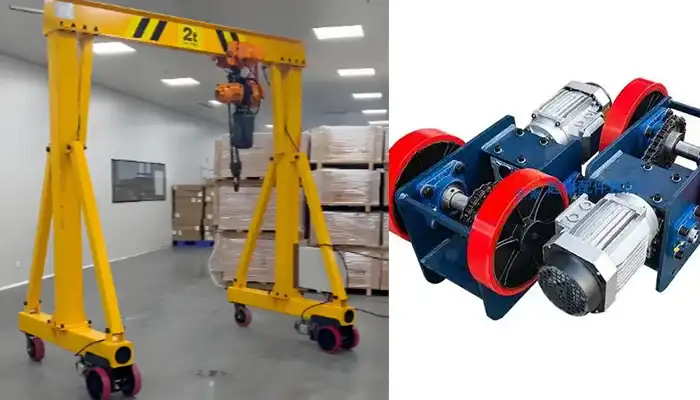
Portable Gantry Crane with Trackless Electric Drive Wheels
Content Quick Link
Learn how portable gantry cranes with trackless electric drive wheels improve workshop lifting, mobility, safety, and material handling efficiency.
Introduction: Motorized Trackless Portable Gantry Crane Systems
Portable gantry cranes and mobile gantry crane systems are widely used in workshops where overhead crane rails are not available or not practical. They provide a simple way to lift and move heavy materials such as molds, steel structures, machine parts, motors, pumps, and fabricated assemblies directly on the workshop floor.
In many practical applications, a manually pushed gantry crane is enough for light-duty work. But in real workshop conditions, once the load becomes heavier or the crane needs to travel more frequently, manual movement quickly becomes difficult. The total traveling weight includes not only the lifted load, but also the crane structure, hoist, and lifting tools. This is where motorized mobility becomes necessary.
A trackless electric drive wheel system turns a standard portable gantry crane into a motorized mobile lifting solution. Instead of relying on rails, the crane moves directly on the workshop floor using powered wheels, controlled by a wireless remote. This allows smoother travel, better control, and reduced manual labor in daily lifting operations.
In practical industrial projects, these systems are commonly used in machine workshops, injection molding plants, steel fabrication shops, maintenance areas, and rented factories where flexibility is important and fixed rail installation is not preferred.
Main Buyer Concerns Covered in This Guide
This guide focuses on the key selection points buyers usually face when choosing a trackless mobile gantry crane system. The goal is to support real purchasing decisions, not only technical descriptions.
- Drive wheel capacity selection: How to calculate total traveling weight, not just lifting capacity.
- Workshop floor suitability: Whether concrete condition, slope, and surface quality can support trackless travel.
- Drive system options: Manual, standard electric, VFD soft-start, and explosion-proof configurations.
- Control methods: Wireless remote control and safe operating distance for load handling.
- Cost comparison: Trackless gantry crane systems versus rail-mounted crane installations.
- Application limits: Where portable gantry crane mobility systems perform well, and where they should be avoided.
In simple terms, this guide helps buyers understand how a portable gantry crane with trackless electric drive wheels works in real workshop conditions, and how to select the right configuration based on load, floor condition, and daily operation needs.
What Is a Portable Gantry Crane with a Trackless Electric Drive Wheel System?
This section explains the basic structure and working principle of a portable gantry crane equipped with a trackless electric drive wheel system. It is commonly used in workshop mobility solutions, mobile lifting systems, and industrial material handling applications where rail installation is not available or not required.
Basic Definition
A portable gantry crane is a freestanding lifting system designed for moving and lifting heavy loads without depending on building structures or fixed overhead crane rails. It is widely used in workshop environments, maintenance areas, warehouses, and production lines where flexible lifting equipment is required for daily operations.
A mobile gantry crane refers to a portable gantry crane fitted with wheels or casters, allowing the entire crane structure to move across the workshop floor. In practical applications, it is used for material transfer between different working zones such as machining areas, assembly stations, and storage locations.
A trackless electric drive wheel system is a motor-driven wheel assembly installed under the crane legs. It uses an electric motor combined with a reducer and transmission system to generate movement, enabling the crane to travel forward or backward without rail tracks. The operator controls movement through a wireless remote control or pendant control system.
In practical terms, this system converts a standard portable gantry crane into a motorized mobile gantry crane that can operate directly on concrete workshop floors without requiring rail installation or fixed guide paths.
- No rail track or runway system is required for crane movement.
- Direct travel on industrial concrete or epoxy workshop floors.
- Motor-driven movement replaces manual pushing or pulling.
- Wireless remote control or pendant control is used for operation.
Main System Components
A trackless electric gantry crane system consists of mechanical, electrical, and control components working together to ensure stable lifting and reliable mobility. In real industrial applications, each part directly affects load safety, travel stability, and operating efficiency.
The steel structure provides overall support, the hoisting system handles vertical lifting, and the drive wheel system manages horizontal movement. Electrical and control systems coordinate operation and safety functions during daily use.
- Gantry crane main beam: Primary load-bearing structure supporting hoist and lifted materials.
- Supporting legs and end frames: Structural supports transferring load to the floor and maintaining balance.
- Electric hoist or manual hoist: Lifting mechanism for raising and lowering loads.
- Trackless electric drive wheels: Motorized wheels enabling rail-free crane movement.
- Polyurethane-coated drive wheels: Floor-protection wheels for epoxy and painted surfaces with reduced noise.
- Swivel casters / universal wheels: Assist directional steering and positioning flexibility.
- Gear and chain transmission system: Transfers motor power to wheel movement efficiently.
- Worm gear reducer: Provides high torque and controlled low-speed travel.
- Motor and brake system: Drives movement and ensures safe stopping performance.
- Wireless remote control: Allows operator to control crane movement from a safe distance.
- Electrical control box: Central unit for power distribution and safety protection.
- Optional VFD inverter system: Enables soft start, soft stop, and adjustable speed control for smoother operation.
- Optional explosion-proof components: Designed for hazardous environments such as chemical and paint industries.
How the Trackless Traveling System Works
The operating principle of a trackless electric drive gantry crane is based on motor-driven wheel movement combined with controlled braking and steering assistance. The system is designed for stable operation under loaded conditions in industrial environments.
When activated, the electric motor transmits power through a reducer and transmission system to the drive wheels, generating forward or reverse movement across the workshop floor. The operator manages all movements using a wireless control system for safety and flexibility.
Swivel casters assist with directional changes, while the braking system ensures immediate stopping when the control signal is released or an emergency stop is triggered. VFD-controlled systems provide smoother acceleration and deceleration, reducing load swing during transport.
- Motor drives wheel rotation through reducer and transmission system.
- Drive wheels provide forward and reverse travel on workshop floors.
- Swivel casters support steering and directional adjustment.
- Wireless remote control enables safe operator-distance control.
- Brake system ensures immediate and stable stopping response.
- VFD control enables smooth acceleration and reduces load swing during movement.
Why Choose a Trackless Mobile Gantry Crane Instead of a Rail-Mounted System?
In real industrial workshop conditions, the decision between a trackless mobile gantry crane and a rail-mounted gantry crane is usually based on one practical question: whether the lifting route needs to stay fixed or change over time. Many factories today operate with shifting layouts, moving machines, and flexible production zones, which makes trackless systems more practical in daily use.
No Rail Installation Required
A major practical advantage of a trackless portable gantry crane is that it does not require rail construction on the workshop floor. Rail-mounted crane systems depend on embedded tracks, precise alignment, and sometimes reinforced foundations, which increases both installation time and project complexity.
A trackless electric drive gantry crane operates directly on existing concrete flooring. In many workshop projects, it can be installed, tested, and put into service without civil modification, making it suitable for rented facilities or short-term production requirements.
- No embedded runway rails or floor track system required.
- No rail alignment, machining, or precision leveling work needed.
- No major civil construction or floor cutting process.
- Suitable for leased workshops, temporary production lines, and mobile projects.
- Short installation cycle compared with rail-mounted crane systems.
Flexible Working Area
Flexibility is one of the key reasons why trackless mobile gantry cranes are widely used in modern workshop environments. Unlike rail-mounted systems, the crane is not restricted to a fixed travel path and can operate wherever lifting is required.
In practical factory layouts, machines are often relocated, production lines are adjusted, and storage zones are reorganized. A trackless gantry crane can adapt to these changes without modifying infrastructure, making it suitable for dynamic production environments.
- Allows movement between multiple workstations in the same workshop.
- Suitable for flexible production layouts and changing factory setups.
- Can serve machining areas, assembly zones, storage areas, and loading points.
- Effective where overhead crane coverage is limited or unavailable.
- Brings lifting capability directly to the working position instead of fixed zones.
Lower Initial Infrastructure Cost
From a cost and project execution perspective, rail-mounted systems require additional infrastructure investment such as runway rails, foundation preparation, and installation alignment work. These steps increase both cost and implementation time.
A trackless gantry crane eliminates the need for rail infrastructure. It operates directly on the existing floor, which reduces installation complexity and allows faster deployment in production environments.
- No rail procurement or runway system installation required.
- Reduced civil engineering and structural preparation cost.
- Less disruption to ongoing production during installation.
- Faster commissioning and shorter setup time.
- Easier relocation when workshop layout changes.
Better Material Flow for Small and Medium Workshops
In many small and medium-sized workshops, material handling routes are not fixed. Loads frequently move between machines, storage areas, and assembly stations. A trackless mobile gantry crane is better suited for this type of flexible material flow.
Instead of relying heavily on forklifts or manual handling for suspended loads, the crane can move directly to the required location. This improves workflow efficiency in operations such as mold handling, steel structure movement, and equipment maintenance.
- Supports point-to-point lifting and internal workshop transport.
- Reduces dependence on forklifts for suspended load operations.
- Improves handling of molds, steel coils, and machine components.
- Reduces manual pushing and improves operational safety.
- Enables direct material movement between production processes.
Types of Trackless Electric Drive Wheel Systems for Portable Gantry Cranes
Trackless electric drive wheel systems are not a single fixed design. In real industrial use, different configurations are selected based on crane capacity, workshop floor condition, travel frequency, and control precision requirements. A light 1 ton portable gantry crane used in assembly work does not require the same drive system as a 5 ton or 8 ton system used for steel coils, molds, or machinery handling.
In practical operation, the drive system directly affects travel stability, stopping performance, load swing control, and overall safety of the mobile gantry crane system. The following are the most commonly used trackless drive wheel configurations in workshop environments.
Standard Electric Trackless Drive Wheel
The standard electric drive wheel system is the most widely used solution for portable gantry crane mobility. It provides basic powered travel without the need for rail installation and is suitable for general workshop lifting and material handling tasks.
This system typically uses an electric motor, gearbox, and chain or gear-and-chain transmission to drive the wheels. The operator controls movement through a wireless remote control, allowing forward and reverse travel at a fixed speed.
- Basic motorized travel system for trackless gantry cranes.
- Suitable for indoor workshops with standard concrete floors.
- Commonly applied to 1 ton, 2 ton, 3 ton, and 5 ton crane systems.
- Uses gear-and-chain or chain-driven transmission structure.
- Controlled by wireless remote or pendant control system.
- Used for general material handling and maintenance applications.
VFD Trackless Electric Drive Wheel System
A VFD (Variable Frequency Drive) electric drive wheel system is designed for improved motion control during crane travel. It allows motor speed adjustment instead of fixed-speed operation, which results in smoother acceleration and deceleration.
In real workshop conditions, this system is widely used where load stability is important. It helps reduce sudden movement when starting or stopping, especially when handling injection molds, steel coils, machinery, or long structural components.
- Equipped with variable frequency drive (VFD) control system.
- Provides soft start and soft stop performance.
- Allows adjustable travel speed for different operations.
- Reduces load swing during travel and positioning.
- Suitable for mold handling, steel coil transport, and machinery installation.
- Improves positioning accuracy in workshop lifting operations.
Explosion-Proof Trackless Electric Drive Wheel System
Explosion-proof trackless drive systems are designed for hazardous industrial environments where flammable gas, vapor, dust, or chemical exposure may be present. These systems use explosion-proof motors and electrical components to meet safety requirements.
In industrial applications, they are commonly used in paint workshops, chemical processing plants, and gas-related production areas. Depending on working conditions, corrosion-resistant or stainless steel transmission parts may also be used.
- Explosion-proof motor and electrical control system design.
- Includes explosion-proof control cabinet and protected wiring system.
- Transmission components may use corrosion-resistant materials.
- Suitable for paint shops, chemical plants, and gas environments.
- Must match required explosion-proof classification standards.
- Designed for safe operation in hazardous zones.
Polyurethane-Coated Electric Drive Wheel System
The polyurethane-coated drive wheel system is designed to protect workshop floors while maintaining stable crane travel performance. A polyurethane layer is applied to the wheel surface instead of bare steel, reducing direct contact with the floor.
This type of system is widely used in clean workshops, assembly plants, and warehouse environments where epoxy-coated or painted floors need protection and where low noise operation is preferred.
- Polyurethane-coated wheel tread for floor protection.
- Reduces damage to epoxy and painted concrete floors.
- Lower noise during crane travel operation.
- Provides stable traction on smooth indoor floors.
- Common in assembly lines and warehouse logistics areas.
- Suitable for clean industrial production environments.
Heavy-Duty Trackless Drive Wheel System
Heavy-duty trackless drive systems are used for larger portable gantry cranes and higher load applications. These systems are designed with higher torque motors, reinforced reducers, and stronger structural support to handle increased traveling weight.
In real industrial use, they are commonly selected for 5 ton, 8 ton, and customized heavy-duty crane systems in steel fabrication, machinery manufacturing, and heavy equipment maintenance projects.
- Designed for high-capacity mobile gantry crane applications.
- Uses high-power motor and reinforced gearbox system.
- Includes double-bearing or reinforced support structure.
- Stronger braking system for safe heavy-load operation.
- Suitable for 5 ton, 8 ton, and customized heavy-duty systems.
- Used in steel industry and heavy machinery handling projects.
AGV-Compatible or Automated Travel Drive System
AGV-compatible trackless drive systems are designed for advanced workshop automation and repeated material transport tasks. These systems can integrate with automated guided vehicle concepts or semi-automated logistics routes.
Instead of manual-only operation, the crane can follow programmed paths or controlled movement sequences. This requires careful planning of floor conditions, positioning accuracy, and safety protection systems.
- Supports integration with AGV or semi-automated systems.
- Can follow programmed or repeatable travel routes.
- Suitable for repetitive material transport operations.
- Requires floor and positioning system evaluation.
- Needs advanced safety and control integration.
- Used in automated manufacturing and logistics systems.
Key Configurations of a Motorized Portable Gantry Crane
Motorized portable gantry cranes are built from several configurable systems. In real workshop applications, each configuration affects lifting performance, travel stability, safety level, and suitability for different industrial environments such as machine shops, steel fabrication, and mold handling operations.
Crane Structure Configuration
The crane structure determines the basic lifting capacity, stability, and working height flexibility of a portable gantry crane. It is selected based on workshop space, load type, and lifting height requirements.
Common structural configurations include:
- Adjustable-height portable gantry crane for variable workshop lifting needs.
- Fixed-height mobile gantry crane for stable and repeat lifting operations.
- Single-girder portable gantry crane for light to medium-duty applications (1–5 ton typical).
- Double-girder mobile gantry crane for higher stability and heavier loads.
- Steel gantry crane for standard industrial environments with strong durability.
- Aluminum gantry crane for light-duty lifting and easy manual handling.
Hoisting Configuration
The hoisting system is responsible for vertical lifting and lowering of materials. Selection depends on load weight, lifting precision, and working frequency.
- Manual chain hoist for low-frequency and light-duty lifting tasks.
- Electric chain hoist for general industrial lifting operations.
- Electric wire rope hoist for higher capacity and longer lifting height requirements.
- Low-headroom electric hoist for workshops with limited vertical space.
- VFD lifting hoist for smoother start, stop, and better load control during precision lifting.
Traveling Configuration
The traveling system controls how the gantry crane moves across the workshop floor. In trackless systems, wheel arrangement and drive type directly affect stability and maneuverability.
- Two powered wheels plus two swivel casters for standard directional travel.
- Four powered wheel configuration for heavy-duty and stable movement.
- Drive wheels installed under gantry legs for direct load transfer and traction.
- Drive wheels installed under a mobile platform for integrated movement systems.
- Directional travel and steering arrangement for controlled workshop navigation.
Control Configuration
Control systems determine how the operator manages crane movement, lifting actions, and safety response. Wireless systems are widely used for trackless mobile gantry cranes in modern workshops.
- Pendant control for basic wired operation in simple workshop environments.
- Wireless remote control for flexible and safe distance operation.
- Wireless remote control with emergency stop function for added safety.
- VFD speed control for smooth acceleration and deceleration during travel.
- Dual-speed travel control for simple and cost-effective operation.
- Optional automated or AGV control for advanced material handling systems.
Safety Configuration
Safety configurations are essential in every motorized gantry crane system. They help prevent overload, uncontrolled movement, and operational risks during lifting and traveling.
- Electromagnetic brake for fast and reliable stopping control.
- Emergency stop button for immediate shutdown in unsafe situations.
- Overload protection system to prevent excessive lifting load.
- Travel limit control where required for defined movement range.
- Warning light and audible alarm for operation awareness in workshop areas.
- Anti-collision protection for multi-equipment working environments.
- Wheel guards and foot protection devices for operator safety.
- Load monitoring system for higher-duty or precision lifting applications.
Technical Features of Trackless Electric Drive Wheels
Trackless electric drive wheel systems are the core mobility component of a motorized portable gantry crane. Their performance depends on motor selection, transmission design, reducer configuration, wheel material, and structural support. These features directly affect load stability, travel safety, and long-term operating reliability in real workshop conditions.
Motor System
The motor system provides the driving force for trackless gantry crane movement. It is selected based on crane capacity, operating frequency, and workshop conditions such as floor resistance and travel distance.
- Motor voltage options include 220V, 380V, 400V, 415V, 440V, and customized specifications.
- Single-phase and three-phase power supply configurations available depending on site conditions.
- Motor power is selected according to crane load capacity, wheel resistance, and required travel speed.
- Four-pole motor options are commonly used for stable operation and explosion-proof applications.
Transmission System
The transmission system transfers motor power to the drive wheels and determines how smoothly the crane moves under load. Different transmission methods are selected based on torque demand and working environment.
- Gear transmission for direct and stable power transfer.
- Chain transmission for flexible mechanical connection and load adaptation.
- Gear-and-chain combined drive system for balanced strength and flexibility.
- Worm gear and worm reducer for high torque and controlled low-speed movement.
- Low-noise transmission design improves workshop working environment.
- Proper lubrication and maintenance are essential for long service life and stable performance.
Reducer and Brake System
The reducer and brake system ensures controlled torque output and safe stopping performance during crane travel. It plays a key role in load stability, especially during start and stop operations.
- WD-type worm gear reducer provides stable torque for loaded movement.
- High torque output supports safe travel under full load conditions.
- Self-locking or braking support depending on system configuration.
- Fast braking response improves operational safety during emergency stops.
- Immediate stop function is controlled through wireless remote operation.
Wheel Material and Design
Wheel design directly affects floor protection, travel resistance, and load stability. Different wheel materials are selected based on workshop floor type and working environment.
- Polyurethane-coated wheels for floor protection and reduced noise operation.
- Rubber-coated wheels for improved grip and vibration reduction.
- Steel wheels for special heavy-duty or rough floor conditions.
- Wheel diameter and load capacity must match total traveling weight.
- Wheel tread width affects floor contact area and stability during movement.
- Proper wheel selection ensures balance between traction, floor protection, and durability.
Double-Bearing Support Base
The double-bearing support base improves structural stability and load distribution during crane movement. It is especially important for frequent operation and heavier-duty applications.
- Improves load distribution across the wheel assembly.
- Enhances stability during loaded travel operations.
- Extends service life under frequent industrial use.
- Reduces vibration and risk of wheel misalignment.
How to Select the Right Trackless Drive Wheel System
Selecting a trackless electric drive wheel system for a portable gantry crane depends on real working conditions, not only lifting capacity. In practical workshop use, factors such as total moving weight, floor condition, travel path, control method, and working environment all directly affect performance, safety, and long-term reliability.
Step 1: Confirm the Required Lifting Capacity
The first step is to define the crane capacity based on actual lifting needs. In practice, many applications involve not only the rated load but also additional handling weight from tools and attachments.
- 1 ton portable gantry crane for light workshop lifting tasks.
- 2 ton mobile gantry crane for general maintenance and assembly work.
- 3 ton motorized gantry crane for mold handling and machinery movement.
- 5 ton trackless gantry crane for medium to heavy industrial applications.
- 8 ton and customized heavy-duty mobile gantry crane for special projects.
- Always consider actual lifted load plus rigging and tooling weight, not only rated capacity.
Step 2: Calculate the Total Traveling Weight
The drive wheel system must be selected based on the full traveling load. This includes the crane structure and all lifting-related components, not just the working load.
- Crane self-weight including main beam and supporting structure.
- Hoist weight (electric chain hoist or wire rope hoist).
- Rated load being lifted during operation.
- Trolley weight and movement mechanism.
- Additional lifting tools such as hooks, slings, grabs, or fixtures.
- Drive wheel capacity must match total moving load to ensure safe operation.
Step 3: Evaluate the Workshop Floor
Floor condition is one of the most important factors for trackless gantry crane operation. Even a well-designed drive system will not perform properly on weak or uneven flooring.
- Concrete floor thickness and load-bearing strength.
- Floor flatness and level condition across travel path.
- Surface cracks, pits, or uneven settlement areas.
- Epoxy-coated or painted floor surface protection requirements.
- Oil, dust, water, or chemical contamination affecting wheel traction.
- Floor slope, drainage channels, and travel stability.
- Suitability of polyurethane wheels for floor protection and smooth travel.
Step 4: Define the Required Travel Path
The travel route determines wheel arrangement, steering design, and control method. A clear understanding of movement patterns helps avoid operational issues during daily use.
- Straight-line travel for simple workshop movement.
- Forward and reverse operation for basic positioning tasks.
- Frequent turning requirements around machines or obstacles.
- Narrow aisle operation in compact workshop layouts.
- Indoor or outdoor travel conditions and surface type.
- Daily travel distance and operating frequency.
- Movement between multiple workstations or production zones.
Step 5: Select Travel Speed
Travel speed affects safety, stability, and load control. In most workshop applications, lower and controlled speed is preferred for suspended load handling.
- Standard low-speed travel for safe and stable operation.
- Adjustable VFD speed control for flexible movement requirements.
- Typical controlled speed range suitable for indoor workshop travel.
- Lower speed improves safety for suspended loads and precision positioning.
- Higher speed may be used for empty travel or non-sensitive movement.
Step 6: Choose the Control Method
Control systems determine how the operator interacts with the crane during lifting and traveling. Modern trackless systems commonly use wireless control for better visibility and safety.
- Manual pendant control for wired and simple operation.
- Wireless remote control for flexible and safe-distance operation.
- Wireless remote control with emergency stop function for added safety.
- Remote control operating distance suitable for full workshop coverage.
- Multi-function control for both lifting and traveling operations.
- AGV or automated control for repeat and programmed movement routes.
Step 7: Confirm the Working Environment
Working environment determines motor protection level, electrical design, and optional safety features such as explosion-proof or corrosion-resistant configurations.
- Normal indoor workshop conditions for standard industrial use.
- High-temperature environments requiring heat-resistant components.
- Dusty manufacturing areas requiring protection and sealing design.
- Outdoor yard operation with weather exposure considerations.
- Humid or corrosive environments requiring anti-corrosion treatment.
- Paint booths or chemical areas requiring specialized protection systems.
- Explosion-proof areas requiring certified electrical and motor systems.
Step 8: Determine Whether VFD Is Required
VFD (Variable Frequency Drive) control is used when smoother acceleration, deceleration, and precise load control are required. It is especially useful in applications where load swing must be minimized.
- Heavy and unstable load handling conditions.
- High-value molds or precision machinery transport.
- Applications requiring accurate positioning during installation.
- Frequent start and stop operations during daily use.
- Need to reduce load swing during travel and stopping phases.
- Requirement for smooth acceleration and controlled deceleration.
Portable Gantry Crane Capacity and Drive Wheel Selection Table
Selecting the correct portable gantry crane capacity and trackless drive wheel system is not only about tonnage. In practical industrial use, the final configuration depends on structural weight, working environment, floor condition, and travel performance requirements.
Recommended Selection by Capacity
In real workshop applications, portable gantry crane capacity is matched with drive wheel systems based on both lifting demand and total moving weight. Different tonnages require different motor power and wheel configurations.
- 1 ton portable gantry crane with trackless electric wheels for light-duty lifting tasks.
- 2 ton mobile gantry crane with remote-controlled drive for general workshop use.
- 3 ton motorized gantry crane for mold handling and medium equipment movement.
- 5 ton trackless gantry crane for steel handling and internal logistics operations.
- 8 ton heavy-duty mobile gantry crane for machinery installation and relocation work.
- Customized solutions available for higher load and special industrial requirements.
Factors That Change the Final Drive Wheel Specification
The final drive wheel selection depends on multiple technical and operational factors. Even cranes with the same rated capacity may require different drive systems depending on working conditions.
- Crane span affecting load distribution and structural stress.
- Crane self-weight including beam, legs, and reinforcement structure.
- Lifting height influencing stability requirements.
- Hoist type such as chain hoist or wire rope hoist.
- Travel distance and frequency of movement per shift.
- Floor friction level and surface condition.
- Wheel diameter affecting torque and ground contact.
- Number of drive wheels installed under the gantry structure.
- Required travel speed for daily operations.
- Working duty cycle and continuous operation requirements.
Industrial Applications of Trackless Mobile Gantry Cranes
Trackless mobile gantry cranes are widely used in industries where flexible lifting and internal material movement are required. They are especially useful in workshops without fixed overhead crane rails or where production layouts frequently change.
Steel Coil Loading and Unloading
In steel processing environments, trackless gantry cranes are commonly used for handling heavy coils between storage areas and production lines.
- Handling steel coils between storage yards and processing machines.
- Loading coils into slitting lines and roll-forming equipment.
- Using VFD control to reduce coil swing during movement.
- Compatible with coil lifting clamps and specialized lifting attachments.
Injection Molding Machine Mold Change
In plastic manufacturing plants, trackless gantry cranes are widely used for mold handling, especially in facilities without overhead crane coverage.
- Safe transfer of molds between storage racks and injection machines.
- Ideal for workshops without fixed overhead crane systems.
- VFD soft-start reduces impact during mold transportation.
- Wireless remote control improves operator visibility and safety.
Machinery Installation and Maintenance
Maintenance teams often rely on mobile gantry cranes for equipment installation and repair work inside large industrial workshops.
- Lifting motors, pumps, gearboxes, and machine tools.
- Transporting heavy components during repair operations.
- Crane can travel directly to the maintenance location.
Fabrication and Welding Workshops
Fabrication shops use trackless gantry cranes for flexible material handling across multiple welding and assembly stations.
- Transporting fabricated steel beams, plates, and frames.
- Supporting welding and assembly stations.
- Handling structural components during fabrication processes.
- Adaptable to changing workshop layouts.
Warehouse and Internal Logistics
In warehouse environments, trackless gantry cranes support internal logistics where forklifts are not suitable for suspended or heavy irregular loads.
- Loading equipment onto transfer platforms or carts.
- Moving heavy parts between storage zones.
- Supporting container loading and unloading tasks.
- Reducing forklift dependency for suspended lifting operations.
Automotive and Parts Manufacturing
Automotive production facilities use mobile gantry cranes for handling molds, fixtures, and heavy components in production and maintenance areas.
- Mold transfer and installation operations.
- Fixture handling for production lines.
- Engine and component lifting tasks.
- Battery pack and heavy assembly part handling.
- Assembly line maintenance support.
Equipment Repair and Service Centers
Repair workshops benefit from portable gantry cranes because they can provide lifting capability without fixed installation.
- Lifting pumps, motors, reducers, and mechanical assemblies.
- Moving repair components across different work zones.
- No need for overhead crane installation in temporary setups.
Chemical, Paint, and Hazardous Environments
In hazardous environments, trackless gantry cranes must be configured with explosion-proof and corrosion-resistant components to ensure safe operation.
- Explosion-proof gantry crane configurations for hazardous areas.
- Explosion-proof motors and electrical control systems.
- Corrosion-resistant components for chemical environments.
- Site-specific safety evaluation before installation.
Reference Cases for Motorized Trackless Gantry Cranes
Motorized trackless gantry cranes are widely used in real industrial environments where flexibility, mobility, and safe load control are required. Unlike fixed rail systems, these cranes can move directly between work areas, making them suitable for dynamic production layouts and multi-station operations.
Mold Change in an Injection Molding Workshop
In injection molding plants, mold change is a frequent operation that involves heavy and precision-sensitive components. Manual movement is often unsafe and inefficient.
- Problem: Manual gantry movement becomes difficult when handling heavy molds.
- Solution: 3 ton or 5 ton portable gantry crane equipped with VFD electric drive wheel system.
- Result: Smoother mold transfer with reduced manual labor and improved positioning accuracy.
Steel Coil Handling in a Fabrication Plant
Steel fabrication plants often require coil handling across multiple work areas, but fixed cranes may not cover the entire production layout.
- Problem: Fixed overhead crane cannot cover the full workshop area.
- Solution: Mobile gantry crane with polyurethane drive wheels and wireless remote control system.
- Result: Flexible coil loading and transfer between storage zones and processing machines.
Machinery Installation in a Rented Factory
In rented or temporary workshops, installing fixed crane rails or overhead crane systems is often not possible or not cost-effective.
- Problem: No permission or feasibility for permanent crane rail installation.
- Solution: Portable trackless gantry crane with motorized electric drive wheels.
- Result: Full lifting and material handling capability without modifying building structure.
Explosion-Proof Material Handling in a Paint Workshop
Paint workshops and chemical environments require strict safety control due to flammable gases and volatile materials.
- Problem: Standard electric motors are unsafe in hazardous environments.
- Solution: Explosion-proof trackless drive wheel system with explosion-proof electrical control cabinet.
- Result: Safer mobile lifting operation aligned with site explosion-proof requirements.
Maintenance Support for Heavy Equipment
Maintenance teams often need flexible lifting equipment that can be moved directly to different repair locations inside a plant.
- Problem: Equipment repair points are distributed across different workshop areas.
- Solution: Motorized mobile gantry crane with wireless remote control system.
- Result: Lifting capability can be brought directly to the maintenance location, improving efficiency.
Trackless Gantry Crane vs Rail-Mounted Gantry Crane vs Forklift
In real industrial material handling systems, different lifting and transport solutions are selected based on workflow structure, load type, and investment budget. Trackless gantry cranes, rail-mounted gantry cranes, and forklifts each have specific advantages and limitations in workshop and logistics applications.
Trackless Mobile Gantry Crane
A trackless mobile gantry crane is designed for flexible indoor and outdoor workshop use where fixed rails are not available or not practical. It provides controlled lifting and short-distance material movement directly on the workshop floor.
- Best suited for flexible and frequently changing workshop layouts.
- No rail installation or embedded runway system required.
- Suitable for controlled lifting and short-distance load transfer.
- Good performance for moderate travel frequency in production areas.
- Requires stable and properly prepared concrete floor conditions.
Rail-Mounted Gantry Crane
Rail-mounted gantry cranes are used in fixed production environments where material flow follows a defined and repetitive route. They are commonly installed in large factories, yards, and long-distance transport zones.
- Best for fixed and repetitive travel routes in industrial facilities.
- Suitable for long-distance material handling along rail tracks.
- Higher installation cost due to rail system and foundation work.
- Provides strong stability for continuous heavy-duty operations.
- Less flexible after installation due to fixed travel path.
Forklift
Forklifts are widely used in logistics and warehouse environments for palletized goods handling. However, their application is different from gantry crane systems, especially when dealing with suspended or oversized loads.
- Suitable for palletized goods and general warehouse logistics.
- Not ideal for suspended lifting requiring precise positioning control.
- Requires trained operators and sufficient turning and maneuvering space.
- Limited suitability for oversized molds, machinery, or long structural parts.
- Can be used alongside a mobile gantry crane within the same workshop system.
Cost vs Performance Comparison for Buyers
When selecting a trackless portable gantry crane system, buyers should evaluate not only the purchase price but also long-term operating cost, maintenance requirements, and productivity impact. In real industrial projects, cost is always linked with configuration choices such as drive system type, wheel design, and control system.
Main Cost Factors
The total cost of a motorized trackless gantry crane is influenced by multiple technical and structural parameters. Each configuration choice directly affects manufacturing cost and final system performance.
- Crane lifting capacity, which determines structural strength requirements.
- Span and lifting height affecting steel consumption and design complexity.
- Steel structure design including single or double girder configuration.
- Hoist type such as manual chain, electric chain, or wire rope hoist.
- Number of electric drive wheels required for load distribution.
- Motor power selection based on travel load and working duty cycle.
- VFD control system for smooth acceleration and deceleration performance.
- Explosion-proof configuration for hazardous working environments.
- Wireless remote control system for operational safety and flexibility.
- Wheel material selection such as polyurethane, rubber, or steel wheels.
- Shipping, installation, and on-site commissioning requirements.
Standard Electric Drive vs VFD Drive
Standard electric drive systems and VFD-controlled systems differ mainly in control precision and operating smoothness. The selection depends on load sensitivity and operational frequency.
- Standard drive systems have lower initial investment cost.
- VFD drive systems provide smoother start and stop performance.
- VFD is more suitable for frequent operation and precision load handling.
- Recommended when load swing control and positioning accuracy are important.
Standard vs Explosion-Proof Drive System
Explosion-proof trackless drive systems are designed for hazardous industrial environments where safety regulations require certified electrical and mechanical protection.
- Explosion-proof systems use specialized motors, wiring, and control cabinets.
- Higher cost compared to standard industrial drive systems.
- Mandatory in chemical, paint, gas, and flammable environments.
- Proper selection requires confirmation of site safety classification.
Polyurethane Wheels vs Standard Wheels
Wheel material selection affects floor protection, travel noise, and long-term durability. In workshop applications, polyurethane wheels are commonly used for indoor environments.
- Polyurethane wheels help protect epoxy and finished concrete floors.
- Reduced noise level during crane travel operations.
- Standard wheels may provide higher load tolerance in rough environments.
- Selection depends on floor condition, contamination level, and load requirements.
Total Cost of Ownership
The total cost of ownership (TCO) includes not only the initial purchase cost but also installation, maintenance, and long-term operational efficiency. In many cases, mobility systems reduce overall handling costs in workshop operations.
- Initial purchase cost of crane and drive system.
- Installation and commissioning cost on-site.
- Elimination of rail system and foundation construction costs.
- Routine maintenance requirements and service intervals.
- Replacement cost of wheels and wear parts over time.
- Electrical system maintenance and control component servicing.
- Productivity improvement from faster internal material handling.
- Reduced dependence on forklifts and manual handling operations.
Safety Requirements for Trackless Electric Gantry Crane Operation
Safety is a core requirement in any motorized portable gantry crane system. Because trackless electric drive cranes operate directly on workshop floors without fixed rails, proper inspection, controlled operation, and emergency protection systems are essential to reduce operational risks in real industrial environments.
Before Operation
Before starting any lifting or traveling operation, the operator should perform a full equipment inspection. This step helps ensure that the trackless gantry crane is in stable working condition and ready for safe movement.
- Inspect wheel condition for wear, cracks, or deformation.
- Check battery system or electrical power supply stability.
- Test wireless remote control function and signal response.
- Confirm brake system operation before load movement.
- Inspect chain transmission, gear system, and reducer condition.
- Check lifting components such as hook, wire rope, or chain slings.
- Confirm that the entire travel path is clear of obstacles.
During Travel
During operation, controlled movement is critical to maintaining load stability and preventing accidents. Trackless gantry cranes rely on operator discipline and smooth driving behavior.
- Keep the lifted load as low as possible during travel.
- Avoid transporting loads at excessive lifting height.
- Do not perform sudden acceleration or abrupt braking.
- Keep all personnel clear of the suspended load area.
- Never exceed the rated load capacity of the crane system.
- Avoid operation on severely uneven or damaged floor surfaces.
- Maintain clear visual contact when using wireless remote control.
Emergency Protection
Emergency protection systems are designed to stop crane movement quickly and prevent unsafe conditions during unexpected events. These systems are standard in most motorized trackless gantry crane configurations.
- Emergency stop button for immediate shutdown.
- Motor brake system for controlled stopping performance.
- Overload protection to prevent excessive lifting load.
- Warning light and audible alarm system during travel.
- Remote control signal-loss protection function.
- Travel speed limitation for safer operation control.
- Optional anti-collision protection for multi-crane environments.
Installation Requirements and Workshop Preparation
Proper installation planning is essential for safe and stable operation of a trackless electric gantry crane system. Unlike rail-mounted cranes, trackless mobile gantry cranes rely heavily on workshop floor condition, available space, and electrical setup to ensure smooth travel and lifting performance in daily industrial use.
Floor Requirements
The workshop floor is one of the most important factors for trackless gantry crane performance. Since the system travels directly on the ground, floor strength and flatness directly affect stability and safety.
- Flat and solid concrete floor with stable structural integrity.
- Adequate floor load-bearing capacity based on crane total weight.
- Limited slope to prevent uncontrolled movement during travel.
- No major cracks, pits, or loose surface conditions.
- Clear travel route without obstacles or uneven ground sections.
Electrical Requirements
Electrical configuration determines how reliably the motorized drive system performs. Proper voltage selection and cable arrangement ensure stable operation in industrial environments.
- Confirm voltage, frequency, and phase according to local standards.
- Select appropriate cable length based on travel distance.
- Provide suitable cable protection using trays or protective sleeves.
- Confirm installation location of electrical control cabinet.
- Ensure proper grounding system for electrical safety.
- Choose suitable power supply method such as cable reel, festoon system, or battery power option.
Space Requirements
Sufficient workspace is required to ensure safe crane movement, turning, and load handling. Poor space planning can limit efficiency and increase operational risks.
- Crane span and overall equipment width must match workshop layout.
- Adequate turning radius for directional movement of the crane.
- Clear clearance around machines, racks, and storage zones.
- Sufficient door height and workshop ceiling height for safe operation.
- Proper travel aisle width for smooth crane movement.
- Enough space for operator visibility and safe load control during lifting.
Maintenance Guide for Trackless Electric Drive Wheels
Trackless electric drive wheel systems work under continuous load, especially in mobile gantry crane applications. Regular inspection and preventive maintenance help keep travel performance stable, reduce unexpected downtime, and extend service life of motors, reducers, wheels, and electrical components.
Daily Inspection
Daily inspection is a basic but important step before operating a motorized trackless gantry crane. It helps identify early wear or abnormal conditions before they become operational failures.
- Check wheel tread condition for wear, cracks, or uneven contact.
- Verify brake response during start and stop operations.
- Test wireless remote control function and signal stability.
- Listen for abnormal noise or vibration during idle or movement.
- Inspect chain tension and transmission tightness.
- Check for loose bolts, mounting points, and structural connections.
Weekly and Monthly Maintenance
Weekly and monthly maintenance focuses on lubrication, electrical stability, and long-term wear prevention. These checks ensure consistent performance of the drive system under repeated industrial use.
- Lubricate chain transmission and moving mechanical parts.
- Inspect reducer oil level and refill if necessary.
- Check bearing condition for smooth rotation.
- Inspect electrical cables, connectors, and terminals.
- Test emergency stop function for safety reliability.
- Inspect polyurethane wheels for wear or surface damage.
Common Problems and Troubleshooting
In real workshop operation, certain issues may occur due to load conditions, floor quality, or electrical system performance. Identifying the cause early helps reduce downtime and repair cost.
- Crane does not move due to power supply or control failure.
- One drive wheel operates while another does not.
- Uneven travel or directional drifting during movement.
- Excessive noise from reducer or chain transmission system.
- Brake system does not release or stop correctly.
- Wireless remote control signal interruption or delay.
- Wheel slipping caused by poor floor conditions.
- VFD alarm or speed control instability during operation.
Information Buyers Should Provide Before Requesting a Quotation
Accurate quotation for a trackless electric gantry crane depends on complete technical and working condition information. In practical engineering projects, missing details often lead to incorrect drive wheel selection, improper motor sizing, or unsuitable crane configuration.
Basic Crane Information
The basic crane parameters define the overall structure and lifting capability. These values are essential for determining beam design, hoist selection, and drive system capacity.
- Required lifting capacity for the main application.
- Crane span between supporting legs.
- Required lifting height for operational clearance.
- Travel length or working distance in workshop.
- Selection of hoist type (manual, chain, or wire rope).
- Indoor or outdoor working environment condition.
Mobility and Drive Wheel Information
Since trackless gantry cranes rely on electric drive wheels, mobility data is critical for correct motor power selection and safe travel performance.
- Total estimated traveling weight including load and crane self-weight.
- Required travel speed for daily operation.
- Straight-line movement or turning and steering requirements.
- Number of drive wheels needed for load distribution.
- Workshop floor material and surface condition details.
- Requirement for polyurethane-coated wheels for floor protection.
- Need for swivel caster or universal wheel configuration.
Electrical and Control Information
Electrical configuration determines compatibility with local power systems and ensures safe and stable crane operation in different industrial environments.
- Local voltage, frequency, and phase requirements.
- Need for wireless remote control operation.
- Requirement for pendant control system.
- Need for VFD soft-start or variable speed control.
- Explosion-proof requirement for hazardous environments.
- Protection class requirement for dust, humidity, or outdoor use.
Application Information
Application details help define real working conditions and ensure the crane system is designed according to actual industrial usage instead of theoretical assumptions.
- Type of material being handled in daily operation.
- Maximum load size and physical dimensions.
- Frequency of lifting operations per day or shift.
- Number of working shifts per day in the facility.
- Workshop drawings, photos, or layout plans if available.
- Existing equipment, machines, and obstacles in travel path.
FAQ: Portable Gantry Crane with Trackless Electric Drive Wheels
This section answers common questions from buyers looking for mobile gantry cranes, trackless drive wheel systems, and wireless controlled lifting solutions used in workshops, factories, and material handling applications.
Q1. Can a portable gantry crane move without rails?
A: Yes, a portable gantry crane can operate without rails when equipped with a trackless electric drive wheel system and guided caster wheels for controlled workshop movement.
This type of system is commonly used in workshops where installing rail tracks is not practical, such as rented factories or flexible production lines. It allows point-to-point material handling without permanent infrastructure changes.
Q2. What capacity is available for trackless mobile gantry cranes?
A: Standard portable gantry crane systems are commonly designed for 1 ton to 8 ton lifting capacity, with custom heavy-duty configurations available based on total moving load and workshop conditions.
In real industrial use, selection depends not only on rated lifting capacity but also on crane self-weight, travel distance, and floor strength. This is important for steel handling, mold transfer, and machinery movement applications.
Q3. Can the system operate on an epoxy-coated workshop floor?
A: Yes, trackless gantry cranes can operate on epoxy-coated or painted concrete floors when polyurethane drive wheels are used for surface protection and stable traction.
This is commonly requested in clean workshops, assembly plants, and precision manufacturing environments where floor protection and low-noise operation are required.
Q4. Why should I choose VFD control for a mobile gantry crane?
A: VFD control is used to achieve smooth acceleration and deceleration, which improves load stability and reduces swinging during movement.
It is widely selected for mold changing, steel coil handling, and machinery installation where controlled speed and precise positioning are required in daily workshop operations.
Q5. Can the crane be controlled by wireless remote control?
A: Yes, wireless remote control is a standard configuration for trackless mobile gantry cranes and allows safe operation from a distance.
It is commonly used in industrial workshops where operators need better visibility during lifting and traveling, especially in large or crowded production areas.
Q6. Is an explosion-proof trackless drive system available?
A: Yes, explosion-proof trackless drive wheel systems are available for hazardous industrial environments such as chemical plants, paint workshops, and gas-related areas.
These systems include explosion-proof motors, electrical control cabinets, and protected wiring design to meet safety requirements in classified working zones.
Q7. Does a trackless gantry crane replace a forklift?
A: It can replace forklifts in suspended lifting and precision load handling tasks, but forklifts are still needed for pallet transport and general warehouse logistics.
In many factories, both systems are used together to improve internal material flow, especially where heavy molds, steel structures, or irregular components are involved.
Q8. What floor conditions are required?
A: The workshop floor should be solid, level, and structurally stable to ensure safe operation of a trackless electric gantry crane system.
In practical installation, floors with major cracks, uneven settlement, or steep slopes can affect wheel traction and traveling stability, so site evaluation is always recommended before selection.
Conclusion: Choosing the Right Motorized Mobility Solution
In practical workshop and industrial lifting projects, trackless electric drive wheel systems are increasingly used to convert a portable gantry crane into a flexible mobile lifting solution without rail installation. This approach is widely applied in steel fabrication, mold handling, machinery installation, and general material transfer where mobility and adaptability are required.
System Value in Real Industrial Use
Trackless electric drive wheels allow a portable gantry crane to move freely across workshop floors without relying on fixed rails or permanent runway structures. This is especially useful in factories with changing layouts or limited civil engineering conditions.
- Enables flexible material handling in different workshop zones
- Reduces dependency on fixed rail-mounted crane systems
- Improves mobility for steel, molds, and machinery transfer tasks
- Supports temporary or rented workshop environments
Key Selection Factors for Buyers
The correct trackless gantry crane configuration is not based on lifting capacity alone. In real engineering selection, multiple working conditions must be evaluated together.
- Lifting capacity and total traveling load including crane self-weight
- Workshop floor condition, flatness, and load-bearing strength
- Travel path design including straight or turning movement
- Working environment such as indoor, outdoor, or corrosive conditions
- Required control accuracy and operating safety level
Matching Drive Systems to Application Needs
Different drive wheel systems are selected based on performance requirements, load sensitivity, and operating environment in industrial applications.
- Standard electric drive wheels for general workshop mobility and light-to-medium duty use
- VFD-controlled systems for smooth start, controlled speed, and reduced load swing
- Explosion-proof configurations for chemical, paint, and hazardous production areas
- Polyurethane wheel systems for epoxy floors and noise-sensitive environments
Final Practical Consideration
In real workshop operations, a properly configured trackless mobile gantry crane improves material flow efficiency and reduces reliance on fixed infrastructure. It also helps lower installation cost compared with rail-mounted systems while maintaining stable lifting performance.
- Improves workshop flexibility for changing production layouts
- Reduces civil construction and rail installation cost
- Supports safer and more controlled lifting operations
- Suitable for a wide range of industrial applications
Request a Trackless Gantry Crane Solution
For industrial projects requiring a portable gantry crane with trackless electric drive wheels, accurate technical information helps ensure correct design, stable operation, and proper cost estimation. This is commonly used for workshop mobility upgrades, mold handling systems, steel material transfer, and machinery installation projects.
Project Requirement Submission
To design a suitable trackless mobile gantry crane solution, please provide your basic lifting and working parameters. These details help determine crane structure, drive wheel capacity, and motor configuration for real workshop conditions.
- Required lifting capacity, crane span, lifting height, and travel distance
- Workshop photos, layout drawings, or on-site operation videos
- Local voltage, frequency, and control system requirements
- Requirements for VFD control, wireless remote, polyurethane wheels, or explosion-proof design
Customized Engineering Solution
Based on your working environment and load requirements, a tailored portable gantry crane system with trackless electric drive wheels will be configured to match your application needs.
- Optimized drive wheel system based on total traveling load
- Suitable configuration for indoor, outdoor, or special industrial environments
- Optional VFD soft-start for smooth travel and load control
- Safety-oriented design including braking, overload protection, and control systems
Application Scope
Trackless gantry crane systems are widely used in modern industrial workshops where flexible material handling and non-rail mobility are required.
- Steel fabrication and structural assembly workshops
- Mold handling in injection molding industries
- Machinery installation and maintenance operations
- Warehouse and internal logistics material transfer
- Special environments such as paint and chemical plants (with explosion-proof configuration)

Article by Bella ,who has been in the hoist and crane field since 2016. Bella provides overhead crane & gantry crane consultation services for clients who need a customized overhead travelling crane solution.Contact her to get free consultation.
Yuantai Cranes
Yuantai Cranes - Global Material Handling Crane Solution Provider & Manufacturer with CE, ISO, SGS, CNEX and other Third Party Certifications.
- Main Specifications - Capacity: 0.5–550 tons | Span: up to 40m | Speed: 0.8–12 m/min | Duty: A3–A7 | Power: 380–690V, 50/60Hz | Control: pendant/remote/cabin
- Full engineering: FEA/PLC/VFD + in-house build + global delivery + on-site support, for workshops, factories, EPC contractors, industrial projects, etc.
- Support: design, manufacturing, testing, service – end-to-end, customized lifting solutions worldwide.
Get Your Custom Quote – Quick & Easy
Fill in what you know. Skip what you don't – we'll help.
- Crane type:_____ . (e.g., overhead crane, gantry crane, jib crane)
- Max weight to lift:_____ tons. (e.g., 2t, 5t, 10t, 20t, 50t)
- Lifting height:_____ m. (How high does the hook need to reach?
- Workshop width (span):_____ m . (Distance between the two crane rails)
- Travel distance:_____ m . (How long does the crane need to move along the runway?)
- Control type:_____. (Pendant / remote / cabin Control)
- Power supply:_____. (Local voltage & frequency – e.g., 380V, 50Hz, 3-phase)
- What will it be used for?_____ (e.g., steel fabrication, concrete products, mold handling, general manufacturing, etc.)
- Any special requirements?_____ (e.g., extreme temperature, dusty or explosive environment, special paint color, etc.)
Just leave a message via the contact form and our hoist and crane engineer will contact you with in 24working hours.
Inquire Yuantai Cranes