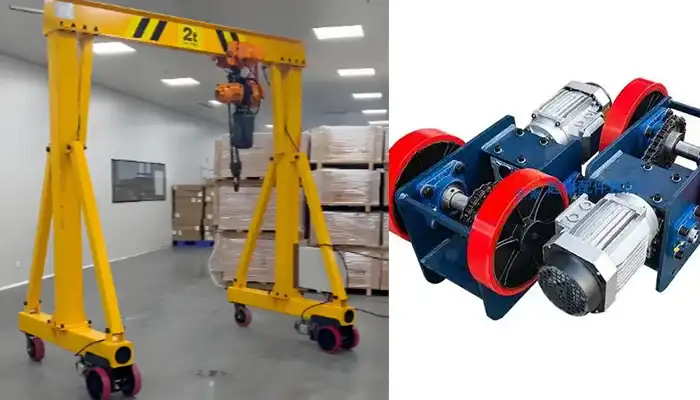
Explosion-Proof Portable Gantry Crane Drive Wheel System
Content Quick Link
Explosion-Proof Portable Gantry Crane Drive Wheel System for Buyers & Purchasing Managers
If your facility operates in oil, gas, or chemical environments, an explosion-proof portable gantry crane with a safe drive wheel system allows you to move heavy loads without installing rails, while still meeting hazardous-area safety requirements. The key value is combining mobility, explosion safety compliance, and reduced installation cost in one system.
Key Takeaways for Purchasing Decision
- Eliminates the need for fixed runway rails, reducing civil installation cost
- Designed for hazardous zones where flammable gas, vapor, or dust may exist
- Explosion-proof motor ensures safe movement under load in sensitive environments
- Sealed control cabinet protects electrical components from ignition risk
- Portable structure allows relocation within the plant as production layout changes
- Stainless steel transmission chain improves service life in chemical exposure areas
- Suitable for maintenance, installation, and material handling in refinery and chemical sites
Questions This System Helps Buyers Solve (Explosion-Proof Portable Gantry Crane Use Cases)
Industrial procurement questions and practical answers for hazardous area lifting applications in oil, gas, and chemical plants.
How can we move heavy equipment safely in an explosion-risk area without installing rails or fixed runway beams?
A trackless explosion-proof portable gantry crane with motorized drive wheel system allows safe floor-based movement of heavy equipment in hazardous zones without any rail or runway installation.
In many oil refinery maintenance areas, LNG terminals, and chemical plant workshops, buyers search for solutions that avoid shutdown-heavy civil construction and still meet hazardous area lifting requirements. A portable gantry crane for explosion-proof hazardous zone use runs directly on reinforced concrete floors using controlled drive wheel travel, so equipment like pumps, compressors, and reactor parts can be relocated safely without embedded track systems.
What crane solution is suitable for temporary lifting or changing plant layouts in chemical or refinery projects?
A mobile explosion-proof gantry crane system designed for multi-zone industrial lifting is the most practical solution for temporary or frequently changing plant layouts.
In industrial EPC projects and refinery turnaround maintenance, engineers often look for a flexible gantry crane for chemical plant maintenance and shutdown operations that can be repositioned across reactor zones, pump stations, and storage areas. Unlike fixed EOT cranes or runway gantry systems, a trackless portable lifting crane system for industrial workshops can be moved and redeployed without dismantling, making it suitable for evolving plant configurations.
How do we ensure explosion-proof compliance while still keeping crane mobility in oil, gas, and chemical plants?
Explosion-proof compliance is achieved by combining a certified flameproof motor system, sealed control cabinet, and VFD-controlled drive wheel operation within a portable gantry crane structure.
Procurement teams searching for ATEX/IECEx-style explosion-proof gantry crane systems for hazardous gas environments focus on whether mobility compromises safety certification. In practice, a hazardous area certified mobile gantry crane with explosion-proof drive motor and sealed electrical control system ensures safe operation in flammable vapor zones while maintaining controlled trackless movement across industrial floors.
Can we reduce installation cost compared to fixed gantry crane or overhead crane systems in industrial projects?
Yes, a trackless explosion-proof portable gantry crane significantly reduces installation cost by eliminating runway beams, rail systems, and civil foundation work.
In industrial procurement for refinery and chemical plant lifting equipment, buyers often search for low installation cost industrial crane solutions for temporary or flexible lifting needs. Since a portable gantry crane operates directly on floor-level drive wheels, it avoids long shutdown periods, structural steel runway installation, and heavy civil engineering work, reducing overall project cost and downtime impact.
What type of crane is safe for chemical plants with corrosive environments and flammable gas exposure?
A corrosion-resistant explosion-proof portable gantry crane with sealed electrical system and stainless steel transmission components is suitable for chemical plants and hazardous industrial environments.
In industrial search and procurement scenarios, engineers look for chemical plant explosion-proof crane systems for corrosive and flammable working conditions. A properly designed system integrates stainless steel chain transmission, flameproof motor drive wheels, and sealed control cabinet protection, making it suitable for solvent processing workshops, acid production areas, LNG facilities, and coastal petrochemical plants where both corrosion and ignition risks exist.
Why Buyers Choose Explosion-Proof Portable Gantry Cranes for Particular Industrial Uses
In oil refineries, LNG facilities, petrochemical plants, and chemical processing industries, purchasing decisions for lifting equipment are rarely based on appearance or general specifications. In industrial crane procurement practice, the decision is driven by three core factors: hazardous area safety compliance, plant downtime control, and operational flexibility inside classified explosion-risk zones.
Core Procurement Logic in Hazardous Industrial Projects
A portable explosion-proof gantry crane system with trackless drive wheel mobility is often selected because it fits these industrial-world constraints more directly than traditional fixed crane systems.
Fixed gantry cranes or EOT overhead crane systems with runway beams can certainly handle heavy lifting tasks. However, they require civil foundation work, steel runway beam installation, alignment calibration, and long plant shutdown periods. In many chemical plant maintenance or refinery turnaround projects, this level of installation work is either too time-consuming or not feasible during continuous operation.
That is why many projects shift toward a trackless explosion-proof portable gantry crane system, designed for direct floor movement using motorized explosion-proof drive wheel assemblies without rail infrastructure. The system can be deployed directly inside the workshop and repositioned as needed, without permanent crane runway structures.
Why Purchasing Managers Prefer Explosion-Proof Portable Systems
In actual industrial procurement for oil, gas, chemical plants, and gas station equipment handling, the decision usually comes down to two practical questions:
how fast can the crane be put into service, and will it pass hazardous area safety inspection?
- No runway beam or rail track system required (trackless gantry crane solution)
The crane runs directly on reinforced concrete industrial flooring using explosion-proof motorized drive wheels, reducing civil engineering work and shortening installation time in industrial workshops. - Suitable for hazardous area lifting operations (explosion-proof crane compliance requirement)
Designed for oil refinery equipment handling, chemical storage workshops, LNG facilities, and flammable vapor zones, where explosion-proof gantry crane certification and hazardous area approval (Zone 1 / Zone 2 applications) are mandatory. - Flexible adaptation to changing plant layouts (mobile industrial crane system)
A portable gantry crane system for multi-zone lifting operations can be relocated to reactor areas, pump stations, or storage zones without structural modification. - Lower shutdown impact during installation (reduced downtime crane solution)
Compared with fixed overhead bridge cranes or runway-based gantry crane systems, installation can often be completed without long production interruption or complex structural work. - Practical for maintenance and shutdown projects (refinery turnaround lifting equipment)
Widely used in refinery shutdown maintenance, pipeline replacement, pump and compressor repair, and heavy equipment installation in confined industrial zones.
How Drive Wheel Systems Solve industrial Site Problems
In industrial use, the drive wheel system is the core mobility mechanism of a trackless explosion-proof gantry crane. Without it, the crane would be restricted to fixed infrastructure and lose operational flexibility.
The explosion-proof motor drive wheel system for gantry crane travel enables controlled movement across industrial flooring even under full load conditions. Movement is regulated through frequency inverter control (VFD-controlled crane travel system), ensuring smooth acceleration and deceleration instead of sudden motion.
- Explosion-proof motor housing for hazardous gas and vapor environments
Suitable for oil refinery zones, chemical processing plants, LNG facilities, and solvent handling workshops where ignition control is critical. - Stable low-speed torque output for controlled gantry crane movement under load
Ensures safe handling of heavy equipment such as pumps, compressors, reactors, and steel structural components. - Floor-based trackless travel for indoor and semi-outdoor industrial environments
Applicable to chemical workshops, refinery yards, and industrial maintenance zones without fixed crane runway systems. - Integrated emergency stop and overload protection for industrial safety compliance
Supports hazardous area crane safety requirements and operational risk control standards.
In practical site conditions, operators often describe it as more controlled and predictable compared to fixed crane systems, especially in narrow or congested industrial layouts.
Practical Advantages in Procurement and Site Operation
From a purchasing manager and EPC project perspective, the value of a portable explosion-proof gantry crane system becomes visible during installation, inspection, and long-term operation—not just in specification sheets.
- Reduced dependence on permanent crane infrastructure such as runway beams and overhead crane structures
- Support for multi-zone lifting operations across large chemical or refinery facilities
- Compliance with explosion-proof equipment certification requirements for hazardous industrial zones
- Enables phased investment approach instead of full fixed crane system installation
- Easier relocation during plant expansion, process modification, or equipment layout changes
In many oil, gas, and chemical industry projects, this flexibility is what makes portable systems acceptable to both engineering teams and safety inspection authorities.
Simple Field industriality in Industrial Environments
In industrial working conditions, the logic is straightforward. If lifting work is temporary, frequently changing, or located in hazardous explosion-risk zones, fixed crane systems often become too rigid and expensive to modify.
A trackless explosion-proof portable gantry crane system with drive wheel mobility provides a practical balance—stable enough for heavy-duty industrial lifting, yet flexible enough for changing plant conditions and maintenance operations.
That is usually the industrial reason why buyers in oil, gas, and chemical plant procurement projects consider this type of system in the first place.
Explosion-Proof Drive Wheel System (Core Buying Component for Portable Gantry Cranes)
In explosion-proof portable gantry crane systems used in oil refineries, LNG plants, chemical processing facilities, and hazardous industrial workshops, the drive wheel system with explosion-proof motor unit is not a secondary mechanical part. In industrial procurement and engineering evaluation, it is the mobility foundation of the entire trackless gantry crane system.
If the explosion-proof drive wheel assembly for portable gantry crane operation is not properly designed, the equipment will fail in three critical areas at once: safety compliance, load stability, and site acceptance approval.
That is why in industrial projects, this component is usually reviewed first during hazardous area crane safety inspection and technical approval process.
How the explosion-proof motor drive wheel system works in industrial use
The core of the system is an explosion-proof electric motor for gantry crane drive mechanism, combined with a gear reduction unit and synchronized wheel transmission system.
Its function is simple in concept but critical in execution:
to move heavy loads safely across industrial floors in flammable gas, vapor, or chemical dust environments, without creating ignition risk.
In practical operation within oil and gas refinery maintenance zones or chemical plant production workshops, the explosion-proof motor is typically integrated with frequency inverter control (VFD-controlled drive system) to ensure smooth movement instead of abrupt acceleration.
Key working characteristics in industrial applications include:
- Explosion-proof motor housing for hazardous zone crane operation (gas and vapor environments)
Designed for classified areas where ignition control is mandatory in chemical and petrochemical industries. - Controlled temperature rise under continuous industrial duty cycles
Ensures stable operation during long maintenance shutdown or plant turnaround lifting work. - Stable torque output for heavy-duty portable gantry crane travel system
Supports smooth movement of pumps, compressors, reactors, and steel structural components. - Compatible with trackless gantry crane drive wheel assemblies for indoor and outdoor industrial use
Suitable for refinery yards, chemical workshops, and semi-outdoor plant environments.
In industrial field conditions, operators often describe the movement as "slower but controlled"—and this is intentional. In hazardous area lifting operations, control is more important than speed.
Why drive wheel stability is critical for buyers and inspection approval
For purchasing managers, EPC contractors, and plant engineers, the drive wheel system of an explosion-proof mobile gantry crane directly determines whether the equipment will pass site inspection and perform safely in industrial operations.
If the drive wheel system slips, vibrates, or moves unevenly under load, the system will fail both mechanical performance evaluation and explosion-proof safety compliance review.
That is why modern trackless explosion-proof gantry crane systems are designed with:
- Synchronized multi-wheel drive structure
- Reinforced gear reduction system for load stability
- Controlled low-speed travel design for hazardous zones
From a procurement and technical perspective, key buying considerations include:
- Load stability during gantry crane travel movement
Prevents swinging or imbalance when handling heavy equipment such as compressors, pumps, or reactor parts. - Controlled low-speed operation in confined industrial layouts
Essential for chemical plants, refinery units, and narrow maintenance corridors. - Floor adaptability for industrial crane movement systems
Suitable for epoxy-coated workshop floors, reinforced concrete yards, LNG facilities, and petrochemical service zones. - Reduced structural stress on crane frame and end beams
Smooth start/stop reduces mechanical fatigue on gantry crane structure and wheel blocks.
Frequency inverter (VFD) control and smooth explosion-proof movement
A key technical requirement in explosion-proof portable gantry crane drive wheel systems is the use of frequency inverter control (VFD-driven motor system).
In industrial operation, this is not just a speed control function—it is part of explosion risk reduction and mechanical safety strategy.
Instead of direct motor start, the system uses gradual acceleration and deceleration. This has direct safety and mechanical benefits:
- Reduced electrical spark risk during motor startup in hazardous areas
- Lower mechanical shock on gear reducer, wheels, and crane structure
- Improved load stability and reduced swing during travel in narrow plant corridors
In chemical plants and oil refinery lifting operations, even small uncontrolled movement near pipelines, reactors, or storage tanks can create operational safety risks. That is why controlled drive wheel motion is a standard requirement in hazardous area crane system design.
Why this system is critical in oil, gas, and chemical plant environments
In hazardous industrial environments, every electrically driven moving component must be evaluated for ignition risk and operational stability. The explosion-proof gantry crane drive wheel system is one of the most critical evaluation points.
Typical industrial-world industrial applications include:
- Maintenance and relocation of heavy pumps and compressors in refinery units
- Equipment movement in solvent storage and chemical processing zones
- Mobile lifting operations during plant shutdown, overhaul, and turnaround projects
- Material handling in classified explosive gas or vapor industrial areas
In these scenarios, the drive wheel system is not optional. It is a mandatory functional and safety requirement for explosion-proof portable gantry crane approval and operation in hazardous zones.
Practical takeaway for buyers and procurement engineers
In practical engineering terms, the explosion-proof drive wheel system for portable gantry crane equipment determines whether the crane is truly suitable for hazardous environments or simply a standard gantry crane adapted for mobility.
For procurement evaluation in oil, gas, and chemical industrial projects, the key decision factors are:
- Safe and certified operation in hazardous explosion-risk zones (gas, vapor, dust environments)
- Stable and synchronized movement under industrial heavy-load conditions
- Smooth VFD-controlled travel for safe crane operation in confined plant layouts
When these conditions are met, the trackless explosion-proof portable gantry crane drive wheel system becomes a fully acceptable and practical solution for industrial lifting operations in refinery, chemical, and petrochemical environments, not only in design specification but also in industrial site approval and daily operation.
Stainless Steel Chain Transmission (Durability in Chemical Plants – Explosion-Proof Gantry Crane Drive System)
In industrial procurement for chemical plants, oil terminals, LNG facilities, and refinery maintenance projects, buyers focus on transmission reliability under continuous corrosive working conditions, where drive system stability directly affects uptime and safety.
Why stainless steel chain is used in explosion-proof portable gantry crane systems
In chemical plant environments, oil refinery zones, and coastal industrial facilities, the working atmosphere often includes chemical vapor, solvent exposure, humidity, and salt corrosion. Standard carbon steel chains degrade quickly in these conditions, leading to rust, stiffness, and unstable transmission performance in trackless gantry crane drive systems.
That is why stainless steel chain transmission is widely selected for explosion-proof portable gantry crane systems operating in corrosive industrial zones.
- Corrosion resistance in chemical vapor and industrial atmospheres, suitable for acidic and solvent-heavy workshops
- Stable mechanical strength during long-term continuous operation without sudden elongation or deformation
- Reliable performance in LNG terminals, petrochemical storage yards, and marine industrial environments
- Reduced risk of chain jamming and uneven synchronization in trackless gantry crane travel systems
How stainless steel chain works in the drive wheel system (industrial function)
In a portable explosion-proof gantry crane with motorized drive wheel system, the stainless steel chain acts as the mechanical link between the gear reducer output and multiple drive wheel assemblies. When the explosion-proof motor runs, torque is transmitted through the chain to ensure synchronized wheel movement across the crane structure.
If the transmission system becomes unstable or worn, industrial operational issues appear in workshop environments.
- Uneven rotation of drive wheels leading to travel deviation or drift
- Reduced positioning accuracy during lifting and installation tasks
- Increased structural stress on end beams and wheel assemblies
- Unstable movement during low-speed controlled crane travel
With a properly designed stainless steel chain transmission system, the gantry crane maintains stable synchronized motion under load, especially in hazardous industrial areas requiring controlled movement.
Why maintenance cost matters more than initial purchase price
For procurement managers in oil, gas, and chemical plant projects, equipment selection is not based on initial cost alone. The industrial evaluation is based on lifecycle cost, maintenance frequency, and downtime risk during operation in industrial environments.
A stainless steel chain transmission system in explosion-proof gantry cranes directly influences long-term operating cost.
- Reduced maintenance frequency in corrosive chemical environments with less chain replacement demand
- Lower unplanned downtime during refinery maintenance and production operations
- Extended service life in LNG terminals, offshore platforms, and chemical storage facilities
- Improved long-term stability of trackless gantry crane travel systems under continuous use
Typical application environments in industrial projects
The stainless steel transmission chain for explosion-proof portable gantry crane systems is widely used in corrosive and high-demand industrial environments where standard components fail early due to continuous exposure.
- Chemical reactor maintenance workshops and processing units
- Oil refinery shutdown and equipment handling zones
- LNG storage facilities and gas terminal maintenance areas
- Fertilizer, acid production, and solvent chemical plants
- Coastal industrial zones with high humidity and salt exposure
In these environments, corrosion is continuous, making transmission material selection a critical part of crane reliability design in explosion-proof gantry crane systems.
Practical takeaway for buyers and engineers
In practical engineering terms, stainless steel chain transmission in explosion-proof gantry crane drive systems is not about ideal performance conditions. It is about ensuring stable operation in aggressive industrial environments where corrosion and continuous load cycles are unavoidable.
For procurement decisions involving portable explosion-proof gantry cranes in oil, gas, and chemical industries, the key evaluation factors are:
- Resistance to chemical corrosion in industrial hazardous industrial environments
- Stable torque transmission for synchronized gantry crane travel movement
- Reduced maintenance workload and fewer unexpected breakdown risks
- Reliable long-term operation in refinery and chemical plant conditions
When these conditions are met, the stainless steel chain transmission system becomes a core reliability component within the explosion-proof portable gantry crane drive wheel system, not just a mechanical accessory.
Explosion-Proof Control Cabinet (Safety Compliance Core for Industrial Gantry Cranes)
In explosion-proof portable gantry crane systems used in oil refineries, chemical plants, LNG facilities, and gas processing industries, the explosion-proof control cabinet is the main safety compliance checkpoint for hazardous area certification and site acceptance inspection, directly affecting approval and operational readiness.
What the explosion-proof control cabinet does in industrial operation
The explosion-proof control cabinet is designed as a sealed flameproof electrical enclosure for hazardous environments. Its main function is to ensure that any internal electrical fault—spark, arc, overheating, or short circuit—cannot be released into flammable gas or vapor atmosphere outside the enclosure.
In oil, gas, and chemical plant lifting operations, it acts as the central control hub for:
- Power distribution to explosion-proof drive wheel motors in portable gantry crane systems
- Operation control for crane travel movement and hoisting functions
- Emergency stop response during abnormal or unsafe conditions
- Electrical protection under overload or fault conditions in industrial crane systems
Internal safety functions in explosion-proof control systems
Inside a hazardous area certified crane control cabinet, the electrical system is structured as an industrial safety architecture designed for explosion-proof gantry crane operation in classified zones (Zone 1 / Zone 2 / dust environments).
- Overload protection system for crane drive and lifting motors
Prevents motor burnout and mechanical damage during over-capacity lifting operations. - Emergency stop safety circuit
Immediately disconnects travel and hoisting systems during abnormal conditions. - Controlled start/stop logic with VFD integration
Ensures smooth acceleration of trackless gantry crane drive wheel movement and reduces electrical surge. - Circuit isolation between control and power systems
Improves safety stability in explosive gas and chemical plant environments. - Grounding and anti-static protection design
Reduces static discharge risk in flammable vapor zones.
Why the control cabinet is the key focus in safety inspection
During crane safety certification, factory inspection, and site acceptance testing (FAT/SAT), the explosion-proof control cabinet is usually the first system reviewed by inspectors and safety engineers.
- Verification of flameproof enclosure rating for hazardous zones
- Inspection of internal wiring layout under explosion-proof electrical standards
- Testing of overload protection, emergency stop, and control response logic
- Assessment of enclosure sealing and temperature rise control in flammable environments
In many cases, the mechanical structure of the gantry crane is not the rejection point. The control cabinet determines whether the portable explosion-proof gantry crane system is approved for operation in oil, gas, or chemical plant zones.
Role of wireless remote control in industrial use
In modern explosion-proof portable gantry crane systems, wireless remote control is often integrated into the control architecture to improve operational safety and reduce operator exposure.
Operators can control lifting and travel functions from a safe distance, which is widely used in:
- Chemical transfer and solvent handling zones with vapor exposure risk
- Oil refinery maintenance and shutdown lifting operations in restricted areas
- EPC construction and temporary installation lifting projects inside industrial plants
This improves operator safety distance, visibility of lifting operations, and control precision in hazardous zone crane environments.
Why procurement teams prioritize this component
For purchasing managers and technical procurement teams, the explosion-proof control cabinet directly affects project approval speed, inspection success rate, and operational risk level.
- Delays in hazardous area certification approval
- Rework during FAT or SAT inspection stages
- Operational restrictions after installation in chemical or refinery sites
- Increased risk during industrial safety audits and regulatory inspections
That is why experienced buyers treat it as a mandatory confirmation item before purchasing explosion-proof gantry crane systems.
Practical takeaway for buyers and engineers
In industrial terms, the explosion-proof control cabinet for portable gantry crane systems is the safety control center and compliance gatekeeper of the entire crane system.
For procurement evaluation in oil, gas, and chemical plant projects, the key requirements are:
- Sealed flameproof control cabinet suitable for flammable gas and vapor environments
- Integrated overload protection, emergency stop, and controlled operation logic
- Compliance with hazardous area safety certification and inspection requirements
- Optional wireless remote control system for safer industrial operation
When these conditions are met, the explosion-proof portable gantry crane system has a higher probability of passing safety inspection and achieving stable long-term operation in hazardous industrial environments.
5. What Makes It “Portable” in Industrial Use (Explosion-Proof Portable Gantry Crane Perspective)
In industrial procurement and field application, “portable” in an explosion-proof gantry crane system does not simply mean easy to push or lightweight structure. In oil, gas, and chemical plants, portability refers to a trackless mobile gantry crane system with explosion-proof drive wheel travel capability that can be safely relocated across hazardous work zones without fixed infrastructure.
Practical meaning of portability in industrial plant operations
In industrial refinery maintenance projects, chemical plant shutdowns, and EPC installation works, lifting requirements are rarely fixed. A portable gantry crane for industrial maintenance use is often required to serve multiple zones within the same facility.
That is where mobility and flexible gantry crane operation become important in daily work:
- Repositionable across multiple lifting zones in hazardous areas
The explosion-proof portable gantry crane can move between reactor areas, pump stations, and storage zones without dismantling structural components or reinstalling runway systems. This is critical for multi-zone industrial lifting operations in chemical plants. - No embedded runway beam or rail track required
Unlike fixed overhead bridge cranes or rail-mounted gantry cranes (RMG), there is no need for rail alignment, welding, or steel structure foundation. This reduces dependence on civil construction for crane runway installation. - Suitable for indoor and semi-outdoor industrial yards
Common in chemical storage yards, refinery maintenance workshops, LNG service zones, and flammable liquid handling areas, where layout is open and frequently reconfigured. - Fast deployment for maintenance shutdown and turnaround projects
During plant shutdown maintenance, refinery turnaround, or emergency repair projects, the crane can be deployed quickly without long installation cycles or structural modification delays.
In industrial site language, engineers often describe it as “move it in, position it, and start lifting heavy equipment.”
How trackless drive wheel movement works in industrial environments
The portability of a trackless explosion-proof gantry crane system comes from its motorized drive wheel assembly and controlled frequency inverter (VFD) operation. The crane moves at low speed and stable torque across industrial flooring while carrying heavy loads.
This is especially useful in dynamic industrial environments where:
- Equipment positions change frequently in chemical production workshops
- Temporary lifting points are required during maintenance or repair work
- One crane unit serves multiple workshop zones in a petrochemical plant
- Fixed crane installation is not economically justified for short-term or multi-project use
The movement is fully controlled and not free-running. In hazardous zones, every relocation must remain stable, slow, and predictable to meet explosion-proof gantry crane safety requirements and hazardous area operational standards.
Why portability matters for procurement and project planning
For purchasing managers, EPC contractors, and plant engineers, portability directly affects total installed cost (TIC), project scheduling, and lifecycle flexibility of the lifting system.
In industrial procurement evaluation, benefits are measured in CAPEX reduction, installation time savings, and operational flexibility:
- Reduced dependency on civil engineering work, runway beam fabrication, and steel structure installation
- Faster installation compared to fixed EOT crane systems or overhead bridge crane installations
- Lower shutdown duration during equipment upgrade, plant maintenance, and refinery turnaround projects
- Ability to reuse the same portable gantry crane system across multiple production zones
- Better adaptability for future plant expansion, layout modification, or process reconfiguration
In many oil and gas, petrochemical, and chemical industry projects, plant layouts evolve continuously. A fixed crane system cannot easily adapt to these changes, while a mobile explosion-proof gantry crane with trackless drive wheel system can.
industrial-world application scenarios of portable explosion-proof gantry cranes
This type of hazardous area portable gantry crane system is commonly applied in:
- Refinery shutdown maintenance and equipment replacement zones
- Chemical reactor and mixing workshop lifting operations
- Pump, compressor, and heavy machinery replacement projects
- Tank farm maintenance and storage facility lifting areas
- Temporary construction, installation, and EPC project works inside industrial plants
In these environments, flexible lifting equipment with explosion-proof certification is often more valuable than fixed crane capacity alone, especially when work locations change frequently.
Practical takeaway for buyers and engineers
In industrial terms, portability is not about convenience. It is about operational flexibility under hazardous working conditions and changing production layouts.
For procurement teams evaluating a portable explosion-proof gantry crane system for oil, gas, and chemical plant use, the key decision factors are:
- No dependence on fixed runway beam or rail crane infrastructure
- Flexible movement across multiple hazardous lifting zones
- Faster deployment for maintenance shutdown and installation projects
- Reduced civil construction cost for crane system installation
- Improved adaptability for dynamic industrial plant operations
When these conditions are met, the trackless explosion-proof portable gantry crane with drive wheel system becomes a practical and cost-effective lifting solution for modern industrial facilities rather than a fixed-location crane installation.
6. Explosion-Proof Portable Gantry Crane Industrial Applications
In industrial procurement and site planning, explosion-proof portable gantry cranes are selected based on one simple condition: the working environment is classified as hazardous, but the lifting requirement is not fixed to one permanent location. In oil, gas, and chemical plants, this happens very often.
Oil refinery maintenance and equipment replacement zones
In oil refinery maintenance operations, lifting tasks are closely linked to shutdown schedules and emergency repair work. Equipment such as pumps, compressors, heat exchangers, and heavy pipe sections must be removed and reinstalled within limited downtime windows.
Typical use in refinery lifting operations includes:
- Pump and compressor replacement using portable gantry crane for refinery maintenance
- Heat exchanger lifting and positioning in process units
- Pipeline section handling in confined refinery maintenance zones
- Temporary heavy lifting support in oil storage and tank farm areas
In these environments, an explosion-proof gantry crane for oil refinery hazardous area use is required because flammable gas zones demand strict safety compliance and controlled crane movement.
Chemical reactor and mixing workshop lifting areas
In chemical plant production workshops, lifting requirements are often related to reactors, mixing tanks, agitators, and dosing systems. These components require periodic inspection, replacement, or internal maintenance.
Common applications of chemical plant explosion-proof portable gantry crane systems include:
- Reactor cover lifting and internal maintenance support
- Agitator motor removal and installation
- Mixing tank component handling in confined industrial workshops
- Chemical processing equipment installation and alignment work
Because chemical production layouts change frequently, a mobile gantry crane for chemical reactor maintenance provides more flexibility than fixed runway crane systems.
Gas storage and pipeline service facilities
In gas storage yards and pipeline service stations, safety requirements are strict due to explosive gas atmospheres and high-risk operational zones. Equipment movement must comply with hazardous area lifting standards.
Typical explosion-proof mobile gantry crane applications in gas industry include:
- Pipeline valve replacement and maintenance lifting
- Gas compressor repair and repositioning
- LNG storage equipment servicing operations
- Outdoor pipeline maintenance and installation support
Here, a hazardous area certified portable gantry crane with explosion-proof motor drive ensures safe operation in classified gas zones while maintaining controlled mobility.
Solvent, paint, and flammable liquid handling workshops
In solvent processing, paint manufacturing, and flammable liquid workshops, vapor concentration and ignition risk are always present. Even small electrical sparks can create serious safety concerns.
Typical lifting tasks using explosion-proof gantry crane for paint and solvent workshop use include:
- Drum and chemical container handling systems
- Mixing tank lifting and maintenance operations
- Pump and filtration unit replacement in production lines
- Equipment relocation in coating and surface treatment workshops
In these cases, a portable explosion-proof gantry crane for flammable liquid environment is preferred because it allows temporary lifting without permanent infrastructure installation.
Temporary construction and installation projects inside plants
In many industrial EPC and plant expansion projects, cranes are not permanently installed. They are used during construction, commissioning, or system upgrade phases.
Common portable gantry crane applications in industrial construction projects include:
- Installation of new production lines inside existing factories
- Heavy equipment lifting during plant expansion and retrofit projects
- Temporary material handling in confined industrial spaces
- Commissioning support for mechanical and electrical equipment installation
A trackless explosion-proof gantry crane for temporary industrial lifting projects is especially useful because it can be deployed quickly and relocated as project stages change.
Practical industrial takeaway for buyers and engineers
In industrial procurement decisions, the selection of a hazardous area explosion-proof portable gantry crane system is driven by three operational requirements:
- Safe lifting in oil, gas, and chemical hazardous zones with explosion-proof compliance
- Flexible movement across multiple workshop areas without fixed runway beams
- Reliable performance for maintenance, shutdown, and temporary installation lifting tasks
When these conditions are present, a mobile explosion-proof gantry crane with drive wheel system for industrial plants becomes a practical solution for dynamic and safety-critical environments.
7. Buying Benefits (From Procurement Perspective for Explosion-Proof Portable Gantry Crane)
For purchasing managers, EPC contractors, and plant engineers, the decision to invest in an explosion-proof portable gantry crane system with trackless drive wheel mobility is usually not based on a single parameter. It is a balance between total installed cost, hazardous area safety compliance, and long-term operational flexibility inside oil, gas, and chemical industrial sites.
Lower civil construction cost compared to runway cranes
One of the most direct advantages is the elimination of permanent runway beam structures. Unlike traditional overhead crane systems or fixed gantry cranes, a trackless portable gantry crane for industrial workshop use operates directly on reinforced concrete flooring using explosion-proof drive wheels.
This reduces:
- No steel runway beam fabrication and installation
- No column foundation or embedded rail alignment work
- No long civil engineering shutdown inside operating plants
For oil refinery and chemical plant projects, this means lower upfront CAPEX and fewer site modification approvals.
Reduced installation time and engineering workload
In industrial projects, time is often more critical than equipment cost. A mobile explosion-proof gantry crane for maintenance shutdown operations can be deployed quickly without complex structural installation.
Typical time-saving factors include:
- No runway alignment and calibration process
- No rail welding or structural modification work
- Faster commissioning with pre-assembled drive wheel system
In practice, this allows crane deployment during short plant turnaround windows, where every hour of downtime has operational cost impact.
Improved compliance with explosion-proof safety requirements
For procurement teams in hazardous industries, compliance is not optional. A hazardous area explosion-proof gantry crane system must pass safety audits before operation approval.
Key compliance advantages include:
- Explosion-proof motor system suitable for flammable gas and vapor zones
- Sealed control cabinet designed for industrial safety certification requirements
- Controlled movement system supporting safe operation in classified zones (oil, gas, chemical plants)
This helps reduce risk during inspection and improves approval success for site safety audits.
Flexible use across multiple workshop areas
Unlike fixed crane systems, a portable gantry crane with explosion-proof drive wheel system can be relocated across different production zones inside the same facility.
This flexibility supports:
- Multi-zone lifting operations in chemical processing plants
- Equipment maintenance across different refinery units
- Temporary lifting support during installation or expansion projects
For many plants, this avoids purchasing multiple fixed crane systems for different areas.
Longer service life in corrosive industrial environments
In chemical plants, offshore facilities, and refinery environments, corrosion resistance directly affects equipment lifecycle.
A stainless steel chain transmission explosion-proof gantry crane system combined with sealed drive components provides:
- Better resistance to chemical vapor and humidity exposure
- Stable mechanical transmission in aggressive industrial environments
- Reduced wear in outdoor or semi-outdoor operating conditions
This leads to fewer component replacements and more stable long-term performance.
Lower downtime during plant modifications
Industrial plants frequently undergo upgrades, expansions, and maintenance shutdowns. Fixed cranes can become a limitation during these changes.
A trackless explosion-proof portable gantry crane for plant maintenance operations helps reduce downtime by:
- Allowing quick repositioning during equipment layout changes
- Supporting temporary lifting during retrofit or installation work
- Eliminating need for permanent crane infrastructure adjustment
In industrial operation, this reduces dependency on structural modifications during plant upgrades.
Practical procurement takeaway
From a purchasing and engineering perspective, the value of this system is not only in lifting capacity. It is in how it reduces installation complexity, improves hazardous-area compliance, and supports flexible industrial operations.
For oil, gas, and chemical plant buyers, the key decision factors are:
- Lower total installed cost compared to fixed crane systems
- Faster deployment in shutdown and maintenance projects
- Reliable explosion-proof safety performance in classified zones
- Flexible reuse across multiple industrial workshop areas
- Reduced downtime and long-term maintenance burden
When these factors are combined, the explosion-proof portable gantry crane with trackless drive wheel system becomes a practical solution for dynamic and safety-critical industrial environments.
Conclusion
Explosion-proof portable gantry crane drive wheel systems are designed for facilities that need safe lifting in hazardous environments without committing to permanent crane infrastructure.
For buyers in oil, gas, and chemical industries, the main value is clear: you get explosion-proof safety compliance, portable mobility, and reduced installation cost in a single system. This makes it a practical choice for maintenance-heavy plants, flexible production layouts, and high-risk industrial zones where safety cannot be compromised.

Article by Bella ,who has been in the hoist and crane field since 2016. Bella provides overhead crane & gantry crane consultation services for clients who need a customized overhead travelling crane solution.Contact her to get free consultation.
Yuantai Cranes
Yuantai Cranes - Global Material Handling Crane Solution Provider & Manufacturer with CE, ISO, SGS, CNEX and other Third Party Certifications.
- Main Specifications - Capacity: 0.5–550 tons | Span: up to 40m | Speed: 0.8–12 m/min | Duty: A3–A7 | Power: 380–690V, 50/60Hz | Control: pendant/remote/cabin
- Full engineering: FEA/PLC/VFD + in-house build + global delivery + on-site support, for workshops, factories, EPC contractors, industrial projects, etc.
- Support: design, manufacturing, testing, service – end-to-end, customized lifting solutions worldwide.
Get Your Custom Quote – Quick & Easy
Fill in what you know. Skip what you don't – we'll help.
- Crane type:_____ . (e.g., overhead crane, gantry crane, jib crane)
- Max weight to lift:_____ tons. (e.g., 2t, 5t, 10t, 20t, 50t)
- Lifting height:_____ m. (How high does the hook need to reach?
- Workshop width (span):_____ m . (Distance between the two crane rails)
- Travel distance:_____ m . (How long does the crane need to move along the runway?)
- Control type:_____. (Pendant / remote / cabin Control)
- Power supply:_____. (Local voltage & frequency – e.g., 380V, 50Hz, 3-phase)
- What will it be used for?_____ (e.g., steel fabrication, concrete products, mold handling, general manufacturing, etc.)
- Any special requirements?_____ (e.g., extreme temperature, dusty or explosive environment, special paint color, etc.)
Just leave a message via the contact form and our hoist and crane engineer will contact you with in 24working hours.
Inquire Yuantai Cranes