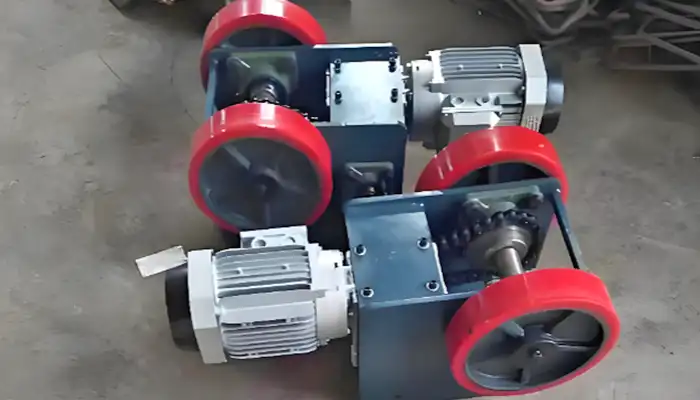
VFD Soft Start Drive Wheels for Mobile Gantry Cranes
Content Quick Link
Key Takeaway
VFD soft start drive wheel systems reduce sudden torque impact during crane travel, making portable gantry cranes safer and more stable when handling heavy loads such as steel structures and injection molds.
Key Questions This Guide Solves (VFD Soft Start Drive Wheels for Mobile Gantry Crane Systems)
In modern mobile gantry crane systems with VFD controlled drive wheel technology, buyers focus on how to improve smooth acceleration, load stability, mechanical protection, and long-term durability. These questions reflect real engineering concerns in industrial workshop cranes, trackless gantry crane systems, and warehouse material handling equipment.
Why do mobile gantry cranes need VFD soft start drive wheels instead of direct start systems?
VFD soft start drive wheel systems for mobile gantry cranes are used to eliminate the sudden torque impact caused by direct start motors.
In trackless mobile gantry crane applications for industrial workshops and warehouses, direct start systems create high inrush current and abrupt torque transfer, which leads to mechanical shock on wheels, reducer gearbox stress, and unstable crane movement during initial acceleration.
A VFD-controlled system provides gradual speed ramp-up, making it suitable for precision material handling, indoor gantry crane operations, and load-sensitive industrial lifting environments.
How does smooth acceleration reduce load swing and mechanical shock?
Smooth acceleration in a VFD controlled mobile gantry crane drive wheel system reduces sudden force transfer between the wheel, ground, and suspended load.
In real industrial gantry crane lifting operations, abrupt starts cause load swing, which affects positioning accuracy and increases stress on structural components.
By applying controlled ramp-up through a soft start VFD drive system for trackless gantry cranes, the crane moves gradually, reducing load oscillation, hook swing, and structural vibration in workshop material handling environments.
What problems occur when gantry cranes start abruptly under full load?
When a mobile gantry crane starts abruptly under full load using direct start control, several mechanical and operational problems can occur.
In industrial practice, this may lead to:
- Excessive impact stress on drive wheels and polyurethane wheel surfaces
- Gearbox and reducer overload in industrial gantry crane drive systems
- Sudden load swing affecting precision lifting and positioning accuracy
- Higher structural fatigue in trackless gantry crane frames used in workshop environments
These issues increase maintenance frequency and reduce long-term reliability in warehouse and workshop crane operations.
Where are VFD drive wheels most useful in industrial lifting operations?
VFD controlled drive wheel systems for mobile gantry cranes are most useful in environments requiring controlled movement, load precision, and frequent operation.
Typical applications include:
- Workshop gantry crane systems for assembly and fabrication operations
- Warehouse material handling systems with frequent load transfer cycles
- Trackless mobile gantry crane systems used in indoor logistics operations
- Maintenance and installation lifting in industrial plants and production lines
These environments benefit from controlled acceleration and stable low-speed movement during positioning tasks.
How does soft start control extend wheel, motor, and reducer lifespan?
A VFD soft start system in mobile gantry crane drive wheels reduces mechanical stress by controlling torque output during startup and operation.
This directly extends component lifespan in several ways:
- Reduces impact load on polyurethane-coated wheels and wheel bearings
- Minimizes torque shock on motor systems used in industrial gantry crane drives
- Lowers stress on gear reducers and transmission systems in trackless gantry cranes
- Improves overall stability in repeated daily material handling cycles in workshop environments
In long-term industrial use, this results in lower maintenance cost and improved reliability of the entire mobile gantry crane mobility system.
Introduction: VFD Soft Start Drive Wheel Systems in Trackless Mobile Gantry Cranes
In modern workshop lifting operations, VFD soft start drive wheel systems are widely used in trackless mobile gantry cranes to improve movement stability and reduce mechanical impact during travel.
What is a VFD soft start drive wheel system in a gantry crane
A VFD (Variable Frequency Drive) soft start drive wheel system is used in trackless mobile gantry cranes to control how the crane begins and stops movement on the workshop floor. Instead of applying full motor torque instantly, the system gradually increases speed.
- VFD controlled drive wheels enable gradual acceleration in portable gantry crane travel systems
- Motor speed is increased step by step instead of sudden full-power start
- Commonly used in trackless electric drive gantry cranes for industrial workshops
- Improves control during low-speed positioning and loaded movement
Why soft start control is important for heavy load movement
In practical industrial use, this is important because a portable gantry crane with electric drive wheels often carries heavy and sensitive loads. Sudden movement can create instability, even when the crane is correctly rated for 3 ton, 5 ton, or 10 ton capacity.
- Reduces sudden impact force when starting movement under full load conditions
- Improves stability during steel handling, mold transport, and machinery installation
- Helps prevent load swing in suspended lifting operations
- Enhances safety in workshop environments with frequent crane repositioning
Where VFD soft start drive wheel systems are commonly used
VFD soft start systems are widely used in industrial environments where trackless mobile gantry cranes are required to move heavy loads with controlled acceleration and stable travel performance.
- Steel fabrication workshops handling coils, beams, and structural components
- Injection molding plants requiring precise mold handling and positioning
- Machinery maintenance workshops with frequent equipment relocation tasks
- General manufacturing plants using portable gantry cranes for internal logistics
VFD Soft Start Drive Wheels for Mobile Gantry Cranes – Why Smooth Acceleration Matters
In trackless mobile gantry crane systems, the way the crane starts and stops is not just a control detail. It directly affects load stability, wheel wear, reducer life, and overall workshop safety. This guide explains how VFD soft start drive wheel systems improve movement control compared with direct start configurations, especially in 1 ton to 10 ton portable gantry crane applications used in steel handling, mold changing, and general industrial lifting.
Introduction: Understanding VFD Soft Start Drive Wheel Systems
A VFD (Variable Frequency Drive) soft start drive wheel system is used in trackless mobile gantry cranes to control how the crane begins and stops movement on the workshop floor. Instead of applying full motor torque instantly, the system gradually increases speed.
In real industrial operation, a portable gantry crane with electric drive wheels often handles heavy and sometimes sensitive loads such as molds, steel structures, or machinery components. When the crane starts too abruptly, the suspended load can swing, even if the system is correctly rated for 3 ton, 5 ton, or 10 ton capacity.
- Gradual motor acceleration reduces sudden mechanical impact on drive wheels and gearbox systems
- Improves stability of trackless gantry crane movement on epoxy or concrete workshop floors
- Helps maintain controlled travel in portable gantry crane systems used for industrial material handling
- Reduces load swing during initial crane movement in lifting operations
Soft Start vs Direct Start Drive Wheel Systems
Direct Start Drive System Behavior
Direct start systems apply full motor torque immediately when the trackless gantry crane begins moving. In simple portable gantry crane configurations, this design is still widely used because of its lower cost and straightforward electrical layout.
- Common in light duty 1 ton to 2 ton portable gantry crane drive wheel systems
- Simple control structure suitable for basic workshop material handling tasks
- Lower initial cost compared with VFD controlled gantry crane drive systems
- Can generate sudden impact load on reducer and wheel assembly during start-up
VFD Soft Start Drive System Behavior
VFD controlled drive wheels gradually increase motor speed and torque instead of applying full force at once. This is especially important for mobile gantry crane systems used in steel fabrication, mold handling, and machinery installation where load stability matters.
- Smooth acceleration and deceleration improves stability of suspended loads during travel
- Reduces shock loading on gearbox reducer, wheel shafts, and bearing assemblies
- Enhances precision control for trackless electric gantry crane movement in workshop environments
- Improves operator handling during positioning and short-distance transfer operations
Load Impact Reduction During Crane Travel
In real workshop conditions, the start and stop phase of a trackless mobile gantry crane is one of the most critical moments in daily operation. When a portable gantry crane with electric drive wheels begins movement too abruptly, the force is not only carried by the motor. It is transferred through the entire drive chain — motor, reducer, wheel axle, and finally the steel structure of the crane itself. This is why impact behavior becomes very noticeable in medium and heavy duty systems such as a 5 ton portable gantry crane, 8 ton trackless gantry crane, or higher capacity industrial mobile lifting equipment used in steel fabrication and machinery handling.
A VFD (Variable Frequency Drive) soft start system directly changes how this energy is applied. Instead of delivering full torque instantly, the motor speed increases gradually. The crane does not "jump" forward. It starts with low-speed movement, then smoothly transitions into stable travel. In practical workshop operation, this controlled acceleration helps keep both the load and the structure under stable conditions, especially when moving molds, steel coils, or heavy mechanical assemblies.
- Reduces sudden impact force on the gantry crane steel structure, including main beam deflection points, end carriage joints, and wheel support frames during initial travel
- Minimizes load swing in portable gantry crane systems used for mold changing, steel coil handling, machinery installation, and workshop material transfer, especially during low-speed positioning and short-distance movement
- Protects electric drive wheel assemblies, gearbox reducers, and chain or gear transmission systems from repeated torque shock that can cause premature wear, overheating, or misalignment in trackless crane operation
- Improves overall travel stability on different workshop floor conditions, including smooth concrete, epoxy-coated industrial flooring, painted surfaces, and floors with slight unevenness or varying friction levels
In actual industrial use, the difference between standard drive and VFD soft start systems is easy to observe. Operators often report that VFD-controlled trackless electric portable gantry crane systems feel more controlled during start, stop, and direction changes. The movement is less abrupt, and the load behaves more predictably.
This matters over time. Reduced impact means less stress on mechanical parts, fewer alignment issues in wheel systems, and more consistent performance in daily lifting cycles. In steel workshops, maintenance facilities, and logistics areas where cranes are used repeatedly throughout the day, this smoother operation helps maintain reliability without increasing structural complexity.
4. Stable Movement Under Heavy Load Conditions
In real workshop operation, a trackless mobile gantry crane is expected to stay stable not only when lifting, but also when traveling with full load. This is where many practical issues appear. A portable gantry crane with electric drive wheels carrying a 5 ton or 10 ton load behaves very differently compared with no-load movement. The structure reacts to acceleration, floor friction, and wheel grip all at the same time. VFD (Variable Frequency Drive) controlled systems are designed to manage this situation in a controlled way. Instead of sending full torque immediately, the system increases speed step by step. In workshop terms, the crane "rolls into motion" rather than jumping forward. This helps maintain balance in real working conditions such as steel handling, mold transfer, and machinery movement.
Load Behavior During Start and Stop
The most sensitive moment is the start and stop phase. When a loaded motorized gantry crane begins movement too quickly, the inertia of the load creates swing and uneven force distribution across the wheel system.
- Controlled acceleration reduces sudden inertia shock on crane structure
- Helps prevent load swing in suspended lifting operations such as molds and steel coils
- Improves operator control during low-speed positioning in workshop aisles
Stability During Continuous Travel
Once the crane is moving, stability becomes the next concern. In many factories, a trackless electric gantry crane system travels across long workshop floors with varying surface conditions. Even small inconsistencies in flooring can affect movement quality.
- VFD systems maintain consistent travel speed under changing load resistance
- Reduces vibration transfer to steel frame, end beams, and wheel assemblies
- Improves performance on epoxy-coated and industrial concrete floors
Heavy Load Applications in Real Workshops
Stable movement becomes more important as load increases. In 5 ton to 10 ton portable gantry crane applications, small instability can turn into noticeable vibration or directional deviation.
- Injection mold handling between storage racks and machines in manufacturing plants
- Steel coil transport in fabrication workshops with high floor traffic
- Machine installation and maintenance in confined industrial spaces
Practical Result in Daily Operation
In real industrial use, the benefit of VFD controlled drive wheels is not only technical. It is something operators feel during daily work. The movement becomes smoother, the crane is easier to control, and the load behaves in a more predictable way.
- More controlled start and stop in portable gantry crane travel operations
- Reduced vibration and mechanical stress on gearbox and wheel systems
- Better directional stability during turning and repositioning tasks
Over time, this stability helps maintain consistent performance of the trackless mobile gantry crane system in continuous workshop operation without unnecessary mechanical strain.
Industrial Applications of VFD Soft Start Drive Wheels
In real workshop environments, VFD soft start drive wheel systems are not only about smoother travel. They directly affect how safely a trackless mobile gantry crane can handle different types of industrial loads. Whether it is steel fabrication, mold handling, or machinery installation, controlled acceleration reduces risk during movement and improves operational accuracy in daily production work.
Steel Fabrication and Coil Handling
In steel workshops, a portable gantry crane with electric drive wheels is often used to move steel coils, plates, and welded structural parts between cutting, forming, and storage areas. These loads are heavy, and more importantly, they are sensitive to sudden movement because of their inertia and suspended lifting condition.
A VFD soft start system helps the crane begin travel in a gradual way, instead of applying full torque immediately. This makes the movement more stable when handling large diameter steel coils or long structural members. In practical operation, it reduces unnecessary swinging and helps operators maintain better control near machines.
- Reduces steel coil swing during horizontal transport in trackless gantry crane systems used in fabrication workshops
- Improves safety when positioning loads near cutting machines, press brakes, and rolling equipment
- Provides more stable movement in heavy-duty industrial logistics where frequent load transfer is required
Mold Handling in Injection Molding Workshops
Injection molding workshops rely heavily on 3 ton, 5 ton, and 10 ton portable gantry crane systems for mold installation and removal. These molds are not only heavy, but also expensive and sensitive to impact. Even a small shock during movement can cause alignment issues or surface damage.
VFD controlled drive wheels allow the crane to accelerate slowly and stop gently. This controlled motion is especially important when the crane is moving molds between storage racks and molding machines. Operators can position the load more precisely without sudden movement affecting the lifting points or fixture alignment.
- Prevents sudden impact during mold transfer in motorized gantry crane operations
- Improves positioning accuracy during mold installation and removal processes
- Reduces stress on lifting lugs, rigging points, and mold fixtures during movement
Machinery Installation and Maintenance
In machinery workshops and maintenance areas, a trackless electric gantry crane system is commonly used to move heavy equipment such as motors, gearboxes, pumps, and industrial assemblies. These operations often take place in tight spaces where precise control is required.
VFD soft start systems help reduce sudden movement when transporting these components. Instead of abrupt acceleration, the crane moves steadily, giving operators more time to adjust direction and alignment. This is particularly useful when working in crowded workshops with limited travel clearance.
- Supports safe movement of heavy machinery components in portable gantry crane maintenance applications
- Improves control in narrow aisles and complex workshop layouts with multiple obstacles
- Makes alignment and positioning easier during installation and repair work
In practical industrial use, VFD soft start drive wheel systems are widely chosen not only for comfort, but for control and protection. Across steel plants, molding workshops, and maintenance facilities, they help trackless mobile gantry cranes operate more predictably under real working loads, especially when frequent movement is required throughout the production day.
Why VFD Soft Start Matters in Industrial Use
In daily operation of a trackless mobile gantry crane, the way the crane starts and stops has a direct impact on equipment life, structural behavior, and load safety. A portable gantry crane with electric drive wheels is not only moving its own weight, but also carrying dynamic loads through uneven workshop conditions. This is why VFD soft start control is widely used in modern industrial crane drive systems. Instead of applying full motor torque immediately, the VFD system gradually increases frequency and output power. This reduces sudden mechanical stress and keeps the movement more controlled, especially in repeated lifting cycles such as steel handling, mold changing, and machinery transfer.
Extends Crane and Drive Wheel System Lifespan
One of the most practical benefits of VFD soft start is the reduction of mechanical shock at every start cycle. In real workshop conditions, a motorized gantry crane may start and stop dozens or even hundreds of times per day. Without controlled acceleration, this repeated impact gradually affects mechanical components.
- Reduces sudden torque shock on gearbox reducer systems during start-up and directional change
- Protects wheel bearings, shafts, and hubs from repeated impact loading in trackless gantry crane drive wheel assemblies
- Lowers long-term wear on chain transmission, gears, and coupling components under frequent industrial operation
In practical terms, this means fewer unexpected breakdowns and longer maintenance intervals, especially in high-frequency production environments such as fabrication shops and assembly lines.
Reduces Structural Stress and Vibration
A gantry crane structure is designed to carry vertical load, but during movement, it also experiences horizontal force, vibration, and torsional stress. When a heavy load is moved suddenly, these forces increase significantly. Over time, this can affect the alignment and stability of the entire crane structure.
VFD soft start helps reduce these dynamic effects by controlling how force is introduced into the system. The crane moves gradually instead of reacting with a sudden jolt.
- Minimizes repeated structural impact on main beam, end carriage, and leg connections in portable gantry crane systems
- Improves long-term geometric stability of the gantry crane frame under continuous industrial use
- Reduces fatigue stress accumulation in welded steel structures and load-bearing joints
In real workshop environments, this is especially important for cranes used in continuous shift operation, where structural fatigue can accumulate faster due to frequent travel cycles.
Improves Load Safety During Movement
Load safety during travel is one of the most critical concerns in trackless electric gantry crane operation. Even when lifting capacity is correctly selected, uncontrolled acceleration can still cause load swing, which increases risk during transportation.
VFD soft start systems improve this situation by making load movement more predictable. The crane does not move abruptly, and the load remains more stable during both start and stop phases.
- Reduces sudden swing in suspended loads such as molds, steel coils, and machine components
- Improves operator control during low-speed travel and precise positioning tasks in workshop environments
- Enhances overall safety in mixed-production workshops where multiple machines and operators share limited space
In practical industrial use, this improved stability is often what determines whether a portable gantry crane with VFD drive wheel system can be safely integrated into daily production workflow without increasing operational risk.
Conclusion: When to Choose VFD Soft Start Drive Wheels
VFD soft start drive wheel systems are most effective in portable gantry crane applications where load stability and controlled movement are required. They are especially suitable for 3 ton and above mobile gantry crane systems used in steel handling, mold change operations, and machinery installation.
In practical terms, smoother acceleration is not only about comfort—it directly affects safety, equipment lifespan, and operational reliability in real workshop conditions.

Article by Bella ,who has been in the hoist and crane field since 2016. Bella provides overhead crane & gantry crane consultation services for clients who need a customized overhead travelling crane solution.Contact her to get free consultation.
Yuantai Cranes
Yuantai Cranes - Global Material Handling Crane Solution Provider & Manufacturer with CE, ISO, SGS, CNEX and other Third Party Certifications.
- Main Specifications - Capacity: 0.5–550 tons | Span: up to 40m | Speed: 0.8–12 m/min | Duty: A3–A7 | Power: 380–690V, 50/60Hz | Control: pendant/remote/cabin
- Full engineering: FEA/PLC/VFD + in-house build + global delivery + on-site support, for workshops, factories, EPC contractors, industrial projects, etc.
- Support: design, manufacturing, testing, service – end-to-end, customized lifting solutions worldwide.
Get Your Custom Quote – Quick & Easy
Fill in what you know. Skip what you don't – we'll help.
- Crane type:_____ . (e.g., overhead crane, gantry crane, jib crane)
- Max weight to lift:_____ tons. (e.g., 2t, 5t, 10t, 20t, 50t)
- Lifting height:_____ m. (How high does the hook need to reach?
- Workshop width (span):_____ m . (Distance between the two crane rails)
- Travel distance:_____ m . (How long does the crane need to move along the runway?)
- Control type:_____. (Pendant / remote / cabin Control)
- Power supply:_____. (Local voltage & frequency – e.g., 380V, 50Hz, 3-phase)
- What will it be used for?_____ (e.g., steel fabrication, concrete products, mold handling, general manufacturing, etc.)
- Any special requirements?_____ (e.g., extreme temperature, dusty or explosive environment, special paint color, etc.)
Just leave a message via the contact form and our hoist and crane engineer will contact you with in 24working hours.
Inquire Yuantai Cranes