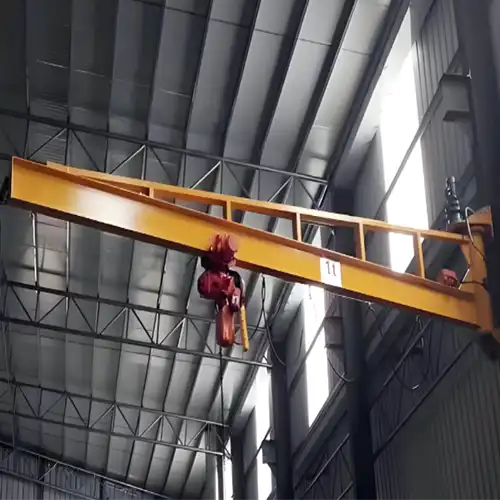
Wall-Mounted Jib Cranes for Automotive Assembly Workshops
Improve automotive assembly with wall-mounted jib cranes for engine, gearbox, axle, and tooling lifting, accurate positioning, and clear workshop floors.
| Crane Type | Wall mounted jib crane, wall column mounted /H beam mounted jib crane, with 180, 220 degree rotating cantilever. |
| Crane Capacity | 0.25 ton ~5 ton, hot sale 1 ton, 2 ton, 3 ton, 5 ton |
| Span Length | 3~6m |
| Lifting Height | Customized |
| Coverage Area Type | semi-circular (arc-shaped) coverage area along a wall or building column. |
| Application | widely used in workshops, warehouses, production lines, and machine service areas for lifting and positioning materials, components, and tools |
| Certifications | CE / ISO / SGS / Other third-party inspection |
| Customization | Customized material handling cranes solutions available for indoor, outdoor, hazardous, corrosive, c |
Crane Manufacturer: Yuantai Cranes – 30+ Years Professional Crane Manufacturer from China
Category: Auto
Tags: automotive
Your Trusted Overhead Jib Crane Manufacturer & Supplier
Wall-Mounted Jib Crane System for Automotive Parts Assembly Workshops
Most Important Takeaway
A multi wall-mounted jib crane system basically gives each automotive workstation its own lifting support, without taking up floor space.So instead of depending on forklifts all the time, or waiting for one overhead crane to serve everyone, each station just works with its own wall jib crane.
And the crane can lift, rotate, and place parts exactly where the assembly team needs them—simple, direct, and very efficient in daily production.
For automotive parts assembly, the right lifting solution is usually not the biggest crane. It is the crane that matches the workstation, the load weight, the lifting frequency, and the actual material flow. A 1 ton jib crane may be ideal for gearbox assembly, while a 2 ton jib crane or 3 ton jib crane may be needed for complete engines, axle modules, heavy fixtures, or large automotive tooling.
- A wall-mounted jib crane supports localized lifting at automotive assembly stations.
- Multiple wall jib cranes can create continuous material flow between engine, gearbox, axle, inspection, and packaging workstations.
- A wall-mounted crane keeps the floor clear for forklifts, AGVs, material carts, conveyors, and operators.
- A 1 ton jib crane is commonly used for gearboxes, engine components, battery modules, and medium assembly fixtures.
- A 2 ton jib crane is suitable for heavier automotive subassemblies, large gearboxes, axle modules, and welding fixtures.
- A 3 ton jib crane can handle complete engine assemblies, heavy transmission systems, molds, and large production tooling.
- Electric chain hoists provide controlled lifting and accurate load positioning for automotive assembly work.
- The wall, steel column, or support structure must be checked before installing a wall-mounted jib crane.
Questions Solved in This Guide (FAQ)
What is a wall-mounted jib crane for automotive parts assembly?
A wall-mounted jib crane is a workstation-level lifting device fixed to a wall or steel column, used to lift, rotate, and position automotive parts directly at the assembly station.
How does a wall jib crane improve automotive assembly line material handling?
It provides localized lifting at each workstation, reduces forklift dependence, improves flow between processes, and enables faster and safer part positioning.
Is a 1 ton jib crane suitable for gearbox and engine component assembly?
Yes, a 1 ton jib crane is commonly used for gearboxes, engine components, battery modules, and medium assembly fixtures, as long as total lifted load stays within capacity.
When should an automotive workshop choose a 2 ton jib crane?
A 2 ton jib crane is suitable when handling heavier transmissions, axle modules, large fixtures, or when additional safety margin is needed for mixed or future loads.
Can a 3 ton jib crane handle complete engines and heavy automotive fixtures?
Yes, a 3 ton jib crane is designed for complete engines, molds, heavy tooling, chassis components, and large assembly fixtures, with proper structural support.
How can multiple wall-mounted jib cranes transfer parts between assembly stations?
Adjacent wall jib cranes can be arranged with overlapping coverage, allowing parts to move step-by-step between stations with minimal forklift involvement.
Is a wall-mounted crane better than a floor-mounted jib crane for limited workshop space?
Yes, in most compact automotive workshops, a wall-mounted jib crane is preferred because it saves floor space and keeps material flow and forklift routes unobstructed.
What should be checked before installing a wall-mounted jib crane on a steel column or wall?
Structural strength, anchor bolts, bracket position, jib arm length, rotation range, dynamic load, and whether reinforcement is required must all be verified before installation.
Which electric hoist is suitable for an automotive wall jib crane system?
An electric chain hoist is typically used, with single-speed for light duty or dual-speed for frequent lifting and precise positioning in automotive assembly work.
Why Automotive Assembly Workshops Need Wall-Mounted Jib Cranes
Automotive parts assembly is repetitive, workstation-based lifting work. A component is lifted from a pallet, rack, cart, or conveyor, moved to an assembly fixture, positioned accurately, assembled, inspected, and then transferred to the next station. This process may happen hundreds of times during one shift. When lifting, positioning, and transferring are not planned well, small delays can quickly affect the entire automotive production line.
Repetitive Lifting at Every Assembly Station
Automotive parts assembly is repetitive, workstation-based lifting work. A component is lifted from a pallet, rack, cart, or conveyor, moved to an assembly fixture, positioned accurately, assembled, inspected, and then transferred to the next station.
This process may happen hundreds of times during one shift. When lifting, positioning, and transferring are not planned well, small delays can quickly affect the entire automotive production line.
Typical automotive parts handled at assembly workstations include:
- Engine blocks and engine subassemblies
- Gearboxes and transmission housings
- Axle assemblies
- Brake modules
- Suspension components
- Battery packs and battery modules
- Welding fixtures
- Testing fixtures
- Production tooling
These loads are often too heavy for safe manual lifting. However, they do not always require full workshop coverage from an overhead bridge crane.
Why a Wall-Mounted Jib Crane Is a Practical Choice
A wall-mounted jib crane for automotive assembly gives lifting coverage right at the workstation. It lifts parts directly from the line-side staging area. Then it places them exactly at the assembly position. No need to bring a forklift into the work zone every time.
A wall jib crane helps automotive workshops:
- Reduce manual lifting and worker fatigue
- Improve workstation ergonomics
- Keep forklift traffic away from assembly workers
- Maintain clear floor space for carts, AGVs, and conveyors
- Improve material flow between automotive assembly stations
- Support accurate part positioning on fixtures and workbenches
- Reduce waiting time for a shared overhead crane
In many cases, a large overhead crane provides more coverage than the workstation actually needs. A wall-mounted jib crane provides lifting support exactly where the operator works. Simple, direct, and practical.
Choosing the Right Jib Crane Capacity
The required wall jib crane capacity depends on the part weight, lifting fixture weight, hoist weight, lifting frequency, and required safety margin.
Typical automotive assembly applications include:
- 1 ton jib crane: Suitable for gearbox assembly, engine components, battery modules, small axle parts, and medium-duty assembly fixtures.
- 2 ton jib crane: Suitable for large transmission assemblies, axle modules, engine subassemblies, heavy welding fixtures, and automotive testing fixtures.
- 3 ton jib crane: Suitable for complete engines, heavy transmission systems, automotive molds, large production tooling, and heavy chassis subassemblies.
The crane capacity should not be selected based only on the component weight. The lifting beam, custom fixture, sling, hook block, and future production requirements must also be considered.
A part may weigh 800 kg, but after adding the lifting fixture and safety margin, a 1 ton jib crane may become too close for comfort.
How the Forklift and Wall Jib Crane Work Together
A wall-mounted jib crane does not replace every forklift. It supports the forklift by handling the final lifting and positioning work at the assembly station.
A typical automotive material handling workflow is:
- A forklift or AGV delivers automotive parts to the line-side staging area.
- The wall-mounted jib crane lifts the part from the pallet, rack, or transfer cart.
- The operator rotates the jib arm and positions the part at the assembly fixture.
- The component is assembled, inspected, or tested.
- The next wall jib crane or transfer cart moves the completed part to the following workstation.
In simple words, the forklift brings the part close. The wall-mounted jib crane does the careful work. The forklift is good at traveling; the jib crane is good at staying in one place and being useful. Everybody has their job.
What Is a Multi Wall-Mounted Jib Crane System?
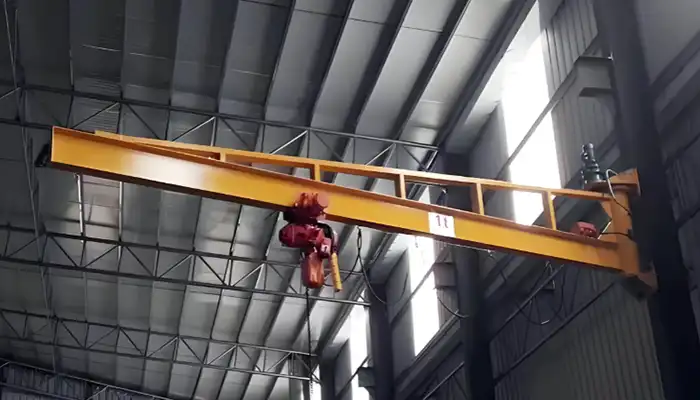
A multi wall-mounted jib crane system is made up of several wall jib cranes installed along the workshop wall.Sometimes they are fixed on reinforced concrete columns.Sometimes they are mounted on steel building columns.In some cases, they use independent support structures when the building cannot take the load directly.
Each wall-mounted crane normally includes:
- Wall-mounted jib crane bracket or steel column bracket
- Horizontal jib arm
- Manual or electric jib rotation
- Trolley running along the jib arm
- Electric chain hoist
- Pendant control or wireless remote control
- Hook block and lifting hook with safety latch
The wall-mounted jib crane lifts a component from a pallet, rack, parts trolley, transfer cart, or conveyor. The operator then rotates the jib arm and moves the load to the assembly fixture, workbench, inspection stand, or next production point.
A multi jib crane system is very useful for automotive assembly lines.Each workstation can have its own lifting area.And adjacent wall jib cranes can overlap in coverage.So parts can move from one station to the next more smoothly.This also reduces forklift travel inside the workshop.
How Wall Jib Cranes Improve Automotive Assembly Workflow
Wall-mounted jib cranes improve automotive assembly efficiency by providing dedicated workstation lifting, freeing floor space, improving positioning accuracy, and reducing forklift congestion inside production areas.
Dedicated Lifting at Each Automotive Workstation
Different automotive assembly stations have different lifting requirements. One workstation may assemble gearboxes. Another may install engine parts. Another may handle axle assemblies, brake modules, battery packs, or inspection fixtures.
A dedicated wall-mounted jib crane allows each workstation to complete its lifting tasks without waiting for a shared bridge crane or calling a forklift for every component.
This is particularly useful for repetitive assembly work. When an operator needs to lift the same type of part many times per shift, a wall jib crane becomes part of the workstation process rather than an extra piece of equipment. In other words, it stays where the work happens and is ready when needed.
Key benefits of dedicated wall jib crane lifting include:
- Faster access to lifting equipment at the assembly station
- Less waiting for a shared overhead bridge crane
- Reduced forklift movement around operators
- Better control of engine, gearbox, axle, and fixture handling
- More stable assembly rhythm during high-volume production
- Improved ergonomics for repetitive lifting tasks
No waiting, no forklift traffic, no operator trying to become a crane by lifting with their back. That last method is not recommended.
Clear Floor Space for Carts, AGVs, and Operators
A wall-mounted jib crane does not require a floor-mounted pillar or concrete foundation in the production area. This is one of the main advantages of a wall jib crane in an automotive workshop.
The floor remains clear for:
- Forklift travel lanes
- AGV routes
- Assembly carts
- Material trolleys
- Conveyor systems
- Parts racks
- Operator walkways
- Quality inspection stations
Compared with a freestanding jib crane, a wall-mounted jib crane is often better when the workshop has limited floor space. It is also better when material flow needs to stay uninterrupted.
This is especially useful in compact automotive assembly lines. Every meter of floor space matters for production. The wall-mounted jib crane uses the wall or steel column for support. So the floor stays open for forklifts, carts, and movement. Simple as that. A crane should lift the load, not become another obstacle in the aisle.
Accurate Positioning for Engines, Gearboxes, and Fixtures
Automotive assembly requires more than lifting. It requires controlled positioning.
A gearbox may need to be lowered onto a test fixture. An engine block may need to be aligned with an assembly stand. A battery module may need to be placed carefully on a production fixture. A welding jig may need to be positioned without damaging nearby components.
A wall-mounted jib crane with an electric chain hoist provides controlled lifting and lowering. With the right jib arm length, trolley travel, and hoist speed, the operator can place the load exactly where it is needed. For frequent assembly work, a dual-speed electric chain hoist is often recommended. Fast speed is used for moving the part. Slow speed is used for final positioning. Fast when moving, slow when positioning—this is usually the safe and practical way.
A wall jib crane can improve positioning accuracy by providing:
- Controlled lifting and lowering speed
- Smooth trolley travel along the jib arm
- Easy rotation within the workstation area
- Better visibility for the operator during load placement
- Stable support for assembly fixtures and production tooling
- Reduced risk of manual pushing, dragging, or sudden load movement
For a 1 ton jib crane or 2 ton jib crane used in gearbox and engine component assembly, dual-speed lifting is often a practical option. It helps operators move parts quickly, then slow down for precise positioning. For a 3 ton jib crane handling complete engines or heavy automotive fixtures, controlled lifting becomes even more important. At that level, smooth and stable movement is critical for safety and accuracy. Heavy loads do not need drama. They just need steady movement.
Less Forklift Congestion Inside the Assembly Area
Forklifts are useful for long-distance material transport, but they are not always the best choice for short-distance lifting inside an automotive assembly workstation.
A practical material handling arrangement is:
- A forklift or AGV delivers automotive parts to the line-side staging area.
- The wall-mounted jib crane lifts the part from the pallet or transfer cart.
- The operator moves the load to the assembly fixture or workbench.
- The forklift continues delivering parts to other areas of the workshop.
This arrangement reduces forklift congestion near assembly workers and improves safety around the production line.
The wall jib crane and forklift can work together more efficiently when each one handles the task it is designed for:
- Forklift or AGV: Long-distance transport between warehouse, receiving area, and production line
- Wall-mounted jib crane: Localized lifting, workstation positioning, and short-distance transfer
- Assembly operator: Controlled placement and accurate alignment of the automotive component
In other words, the forklift delivers the part, and the wall-mounted jib crane finishes the job. It's a simple teamwork setup—less traffic in the workshop, less waiting time, and fewer forklifts squeezing into the assembly station area.
Typical Automotive Applications for Wall-Mounted Jib Cranes
A wall-mounted jib crane system is widely used in automotive parts manufacturing and assembly workshops. In many cases, once a workshop installs a wall jib crane, operators quickly realize how much easier the work becomes. It's that moment where people go, "okay, this is the workstation helper we didn't know we needed." It is especially effective where lifting is repetitive, localized, and tied to a fixed production station.
General Automotive Assembly Applications
Typical automotive applications include:
- Engine assembly workstation lifting
- Gearbox and transmission assembly
- Axle and suspension module handling
- Brake system assembly
- Battery pack and battery module assembly
- Automotive welding fixture handling
- Vehicle component testing stations
- Automotive mold and tooling transfer
- Sheet metal subassembly handling
- Inspection and quality control stations
- Packaging and palletizing areas
- Maintenance and repair workstations
In industrial workshop conditions, these applications often run side by side. One station is assembling engines, another is handling gearboxes, and another is positioning welding fixtures.
A 1 ton jib crane is often enough for gearbox work and general subassembly handling. A 2 ton jib crane is commonly used for heavier modules like larger gearboxes, axle units, and heavier fixtures. For complete engines, molds, and large tooling, a 3 ton jib crane becomes the more stable and safer option.
In real production, it's all happening at the same time—different loads, different stations, different lifting needs. So in practice, it is not just "a crane for the workshop"—it is "the right wall-mounted jib crane for the right station."
Use of Specialized Lifting Attachments
A wall jib crane can also support specialized automotive lifting tools, such as lifting beams, engine lifting fixtures, gearbox lifting frames, load balancing devices, clamps, and rotation devices.
The crane does the lifting, but the attachment decides how well the job is actually done.
Because in automotive assembly, a standard hook is rarely the full story. An engine is not just "lifted"—it is guided, balanced, aligned, and carefully placed. Same crane, different fixture, completely different performance.
The crane itself is important, but the lifting attachment is often what determines whether the part can be handled safely, efficiently, and without unplanned workshop interruptions.
Choosing Between a 1 Ton, 2 Ton, and 3 Ton Jib Crane
Selecting the right wall-mounted jib crane is not just a "capacity question." In automotive workshops, it's really about matching lifting demand, workstation layout, and production rhythm. In practice, a 1 ton jib crane, 2 ton jib crane, and 3 ton jib crane each play very different roles inside the assembly line. As many engineers say on site—"same workshop, different load behavior."
1 Ton Jib Crane for Automotive Assembly
A 1 ton jib crane is commonly used for medium-duty automotive assembly work. It is suitable when the lifted part, fixture, and lifting attachment remain within the safe working load.
Typical 1 ton wall-mounted jib crane applications include:
- Gearbox assembly
- Engine components
- Small transmission housings
- Axle parts
- Suspension assemblies
- Battery modules
- Medium welding fixtures
- Testing equipment
- Automotive component inspection stations
A 1 ton jib crane is often a practical choice for automotive workstations that require frequent lifting but do not handle complete engines or heavy molds. In many workshops, this is the "workhorse zone"—not too big, not too small, just right for daily repetitive lifting. Operators often say: "it's enough for 80% of what we do."
2 Ton Jib Crane for Heavy Automotive Components
A 2 ton jib crane is suitable for heavier automotive parts, larger fixtures, and higher-capacity workstation lifting.
Typical 2 ton wall-mounted jib crane applications include:
- Large gearboxes
- Transmission assemblies
- Heavy axle modules
- Engine subassemblies
- Heavy welding fixtures
- Automotive test fixtures
- Large battery pack modules
- Production tooling and jigs
A 2 ton jib crane is often selected when a 1 ton crane looks close on paper—but in industrial life, once you add the lifting beam, fixture, hook block, and safety margin, it is no longer enough.
This is a very common workshop situation: "On paper it fits. In industrial lifting, it doesn't."
In crane selection, "almost enough capacity" is not a capacity rating. It either works safely every day, or it doesn't belong in production.
3 Ton Jib Crane for Engines, Molds, and Heavy Tooling
A 3 ton jib crane is suitable for heavy-duty automotive assembly and tooling handling applications.
Typical 3 ton wall-mounted jib crane applications include:
- Complete engine assemblies
- Heavy transmission systems
- Large axle assemblies
- Automotive molds
- Heavy welding and assembly fixtures
- Large production tooling
- Chassis subassemblies
- Heavy testing equipment
A 3 ton jib crane requires careful structural design. The lifting capacity is only one part of the calculation. The jib arm length, wall bracket design, steel column strength, anchor bolts, and crane rotation range must all be checked.
This is where engineering matters in industrial practice. A 3 ton wall-mounted jib crane does not just "lift 3 tons"—it transfers that force into the building structure through the wall or column.
A 3 ton load on a long jib arm can create significant force on the supporting structure. The crane may look compact and simple, but the engineering behind it is not. In other words: the crane looks easy… the math behind it is not.
Multi Wall-Mounted Jib Crane Layout Options
In automotive workshops, a wall-mounted jib crane system is rarely used as a single isolated unit. More often, several wall jib cranes are arranged along the production line to support different assembly stations, different loads, and different working rhythms. The key idea is simple: each workstation gets lifting support where it actually works.
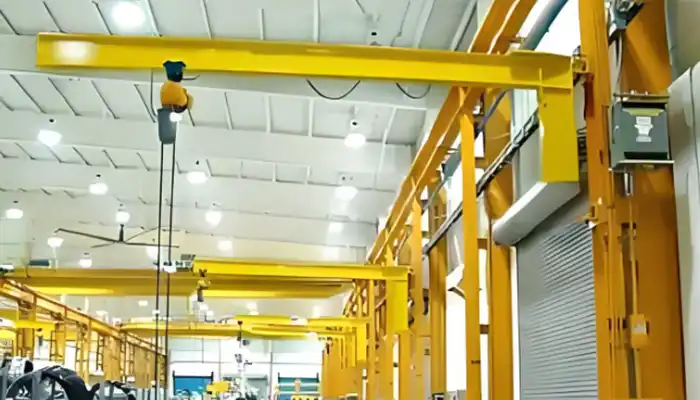
One Wall Jib Crane for One Assembly Station
This layout is suitable when each automotive workstation has frequent and independent lifting requirements.
Typical stations may include:
- Engine assembly station
- Gearbox assembly station
- Axle assembly station
- Brake assembly station
- Battery module assembly station
- Inspection station
- Testing station
- Packaging station
In this setup, each station is equipped with its own wall-mounted jib crane, often ranging from a 1 ton jib crane for medium components to a 2 ton jib crane where heavier assemblies are involved.
The advantage is very straightforward:
- Each operator has direct access to lifting equipment
- No waiting for shared crane access
- No interruption between assembly steps
- Stable workflow for repetitive production tasks
In industrial workshop terms—no "crane queue," no delay, just lift and work. This is often the most efficient layout for high-frequency automotive assembly lines where engines, gearboxes, and modules are continuously handled station by station.
One Wall-Mounted Jib Crane for Two Adjacent Workstations
A single wall jib crane can sometimes serve two adjacent workstations, especially when lifting frequency is moderate and the stations are closely spaced.
In this case, the jib arm length and rotation range must properly cover:
- Material staging area
- Assembly fixture
- Workbench
- Transfer cart position
- Safe operator working zone
This is where proper layout design really matters in industrial practice. A 2 ton jib crane, for example, may be selected in this case because it provides enough capacity margin when the crane is shared between two stations. It also handles slightly heavier mixed loads more safely and more comfortably. In real workshop conditions, that extra margin often makes the difference between smooth operation and constant "almost enough" lifting capacity.
This layout can reduce equipment cost and simplify installation, but it comes with one important rule: a shared crane works well… until both stations need it at the same time.
So the industrial design question is not only "can it reach both stations?" but also "can it handle the workflow without creating waiting time?" A shared crane is useful. A shared crane with a waiting line is less useful.
Overlapping Wall Jib Crane Coverage Along an Assembly Line
For continuous automotive assembly lines, multiple wall-mounted jib cranes can be installed with overlapping working coverage to support smooth process transfer between stations. This is more flow-oriented rather than station-isolated.
A typical workflow looks like this:
- The first wall-mounted jib crane lifts the automotive part from the staging area
- The component is positioned at the first assembly fixture
- After the first assembly process, the component is prepared for transfer
- The next wall jib crane receives and repositions the component at the next station
In this configuration, 1 ton jib cranes are often used for standard module handling, while 2 ton jib cranes are applied where heavier subassemblies or fixtures are involved. For engine blocks, molds, or heavy chassis-related components, a 3 ton jib crane may be installed at key lifting stations.
The benefit is very clear:
- Continuous material flow between stations
- Reduced forklift movement inside production zones
- Less lifting interruption between processes
- More predictable assembly rhythm
It is very similar to a relay process. Each station passes the work forward step by step. Except here, the "baton" might be a gearbox, an engine block, or a battery module—so, as often said with a slight smile: "no dropping allowed, this is not a sports game." This layout is especially effective in automotive plants where production stability matters more than anything else.
Typical Wall-Mounted Jib Crane System Configuration
Before selecting a wall-mounted jib crane system for an automotive assembly workshop, it is important to understand how the main components come together as a complete working unit.A wall jib crane is not just a lifting device—it is a workstation support system.In industrial production environments, it has to match the assembly rhythm, lifting frequency, and load characteristics of the line.
For automotive applications, especially when handling engine parts, gearboxes, axle modules, or battery assemblies, the configuration should always be chosen based on actual workshop behavior, not just theoretical lifting capacity.
Below is a typical configuration reference for an automotive wall-mounted jib crane system:
| Component | Recommended Configuration for Automotive Assembly |
|---|---|
| Crane Type | Wall-mounted jib crane / wall jib crane |
| Quantity | Based on workstation quantity and lifting frequency |
| Capacity | 250 kg, 500 kg, 1 ton jib crane, 2 ton jib crane, or 3 ton jib crane |
| Jib Arm Length | Usually 3 m to 7 m, based on workstation coverage |
| Hoist Type | Electric chain hoist |
| Trolley Type | Manual trolley or electric trolley |
| Rotation | Manual rotation or electric rotation |
| Hoist Speed | Single speed or dual speed |
| Control Method | Pendant control or wireless remote control |
| Installation | Wall bracket, steel column bracket, or reinforced support structure |
| Working Coverage | Single workstation coverage or overlapping station coverage |
After looking at the table, one thing becomes very clear in practical engineering work: there is no "universal configuration" that fits every automotive workshop. A 1 ton jib crane might be perfectly efficient in a gearbox station, while a 2 ton jib crane becomes necessary for heavier axle modules or larger welding fixtures. For engine handling or molds, a 3 ton jib crane is often the safer and more stable choice.
In industrial workshop planning, the decision is always a balance between lifting performance, layout constraints, and production efficiency.
For example:
- A high-frequency automotive assembly line may benefit from electric trolley movement and a dual-speed hoist for smoother positioning
- A light-duty workstation using a 1 ton jib crane may not need full electric rotation
- A medium-duty 2 ton jib crane often requires better control due to heavier and more sensitive loads
- A 3 ton jib crane almost always demands more structural attention and stable operation control
At the same time, it is important not to over-engineer the system.
For lower-frequency lifting tasks, a simpler configuration can often perform just as well. A manual trolley and manual rotation system may be more economical, easier to maintain, and fully sufficient for light or occasional lifting.
In many automotive workshops, the most efficient setup is not the most complex one—it is the one that matches the industrial workload without unnecessary features.If the crane only lifts a few times a day, it does not need to behave like it is working a night shift. More functions are not always better—sometimes they are just more cost, more wiring, and more maintenance headaches.
The correct wall-mounted jib crane configuration is always the one that fits the work, not the one that looks the most advanced on paper.
Important Design Considerations for a Wall-Mounted Jib Crane
Before a wall-mounted jib crane system is installed in an automotive assembly workshop, the design work must be done properly. In practice, this is the stage where many problems are either prevented—or quietly created for later. A wall jib crane looks simple, but the forces it transfers into the building structure are not simple at all. So, the design needs to be treated carefully, step by step, not guessed.
Check the Wall or Steel Column Strength
A wall-mounted jib crane transfers vertical lifting force and horizontal jib arm moment to the supporting structure. That means the wall or steel column is not just "holding it"—it is actively carrying dynamic load during operation.
Before installation, the crane supplier should confirm:
- Wall strength or steel column strength
- Wall-mounted jib crane bracket position
- Anchor bolt type and arrangement
- Jib crane lifting capacity
- Jib arm length
- Rotation angle
- Hoist and trolley weight
- Dynamic load condition
- Required reinforcement
In automotive workshops, this becomes even more important when working with a 1 ton jib crane, 2 ton jib crane, or 3 ton jib crane, because the higher the capacity, the greater the structural demand on the building.
If the existing workshop wall or steel column cannot safely support the wall jib crane, reinforcement or an independent support steel structure may be required.
This should be checked before installation, not after the first lift. "It should be strong enough" is not an engineering calculation. It is just a guess—and cranes do not work well with guesses.
Select the Correct Jib Arm Length
The jib arm should cover the actual automotive assembly work area, including the parts staging position, assembly fixture, workbench, transfer cart, and operator working zone.
However, a longer jib arm is not always better.
A longer reach increases the load moment on the wall-mounted crane bracket and supporting structure. This is especially important when using a 2 ton jib crane or 3 ton jib crane, where the structural load grows quickly with distance.
The best jib arm length is the shortest length that safely covers the required lifting area.
In real design work, this is a common mistake: "Let's just make it longer so it can reach everything." It sounds convenient—but in jib crane design, that sentence can quickly turn into extra steel, extra reinforcement, and extra cost.
So a simple rule applies: less unnecessary reach = safer structure + better performance.
Match Hoist Duty to Lifting Frequency
Automotive assembly workshops may use a wall-mounted jib crane dozens or even hundreds of times per shift. That means the electric chain hoist is not occasional equipment—it is part of daily production.
The hoist duty classification should match the actual lifting frequency.
For high-frequency lifting, consider:
- Higher-duty electric chain hoist
- Dual-speed lifting motor
- Electric trolley travel
- Electric jib rotation
- Durable pendant control
- Easy hoist maintenance access
- Reliable electrical protection
This becomes especially important for a 1 ton jib crane used in repetitive gearbox or engine component assembly, or a 2 ton jib crane handling heavier modules throughout the shift.
A crane used ten times per day and a crane used two hundred times per day may look similar, but they should not be designed the same way.
In simple workshop terms: one is "occasional helper," the other is "full-time worker."
Use the Right Lifting Attachment
Some automotive components cannot be lifted safely with a standard hook only. Depending on the part shape, center of gravity, and assembly process, the workshop may need specialized lifting tools.
Typical lifting attachments include:
- Adjustable lifting beam
- Engine lifting fixture
- Gearbox lifting frame
- Load balancing device
- Rotation device
- Lifting clamp
- Guide handle
- Vacuum lifter for sheet metal panels
This is especially common in automotive lines using wall-mounted jib cranes for engine assembly, gearbox installation, or battery module handling. The wall-mounted jib crane provides lifting power. The lifting attachment makes sure that power is applied correctly.
Or as operators sometimes put it very directly: the crane lifts it… but the fixture decides whether it behaves properly during the lift. And in automotive assembly, "proper behavior" is not optional.
Recommended Safety Features for Automotive Wall Jib Cranes
A wall-mounted jib crane system for automotive assembly should include:
- Hoist overload protection
- Upper and lower lifting limit switches
- Emergency stop button
- Hook safety latch
- Reliable hoist brake
- Electrical grounding protection
- Jib rotation limit or mechanical rotation stop
- Safe working load marking
- Warning labels around the crane operating area
- Regular inspection of wall brackets and anchor bolts
- Regular electric chain hoist inspection and lubrication
- Inspection of lifting hooks, chains, slings, and lifting fixtures
Where multiple wall jib cranes operate close together, the workshop should also define clear operating zones and crane handover procedures.Good lifting safety is usually quiet. When it is missing, everyone notices very quickly.
Conclusion
A multi wall-mounted jib crane system is a practical solution for automotive assembly workshops that need workstation-level lifting without using floor space.
A 1 ton jib crane is used for gearbox and engine components. A 2 ton jib crane handles heavier transmissions, axle modules, and larger tooling. A 3 ton jib crane is used for complete engines, molds, and heavy equipment.When properly matched to the layout, wall jib cranes improve safety, reduce manual handling, support accurate positioning, and reduce forklift congestion.
Once the flow is clear, selecting the right wall-mounted jib crane becomes simple—and more reliable.

Yuantai Cranes
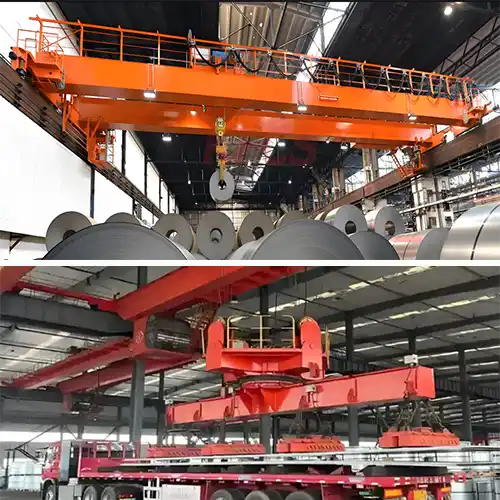
Overhead Crane Manufacturer with CE, ISO, SGS, CNEX Certificates.
- Main Specifications - Capacity: 0.5–550 tons | Span: up to 40m | Speed: 0.8–12 m/min | Duty: A3–A7 | Power: 380–690V, 50/60Hz | Control: pendant/remote/cabin
- Full engineering: FEA/PLC/VFD + in-house build + global delivery + on-site support, for workshops, factories, EPC contractors, industrial projects, etc.
- Support: design, manufacturing, testing, service – end-to-end, customized lifting solutions worldwide.
How to Get an Accurate Crane Price for Your Application?
Tips: Copy the spec list, fill in your details, and paste it into the form on the right/ down-below for a quick price.
- Crane type:_____ . (e.g., overhead crane, gantry crane, jib crane)
- Max weight to lift:_____ tons. (e.g., 2t, 5t, 10t, 20t, 50t)
- Lifting height:_____ m. (How high does the hook need to reach?
- Workshop width (span):_____ m . (Distance between the two crane rails)
- Travel distance:_____ m . (How long does the crane need to move along the runway?)
- Control type:_____. (Pendant / remote / cabin Control)
- Power supply:_____. (Local voltage & frequency – e.g., 380V, 50Hz, 3-phase)
- What will it be used for?_____ (e.g., steel fabrication, concrete products, mold handling, general manufacturing, etc.)
- Any special requirements?_____ (e.g., extreme temperature, dusty or explosive environment, special paint color, etc.)
Just leave a message via the contact form and our hoist and crane engineer will contact you with in 24working hours.
Get Your Custom Quote–Quick & Easy
Fill in what you know. Skip what you don't – we'll help.Any question will be reply with 24 working hours