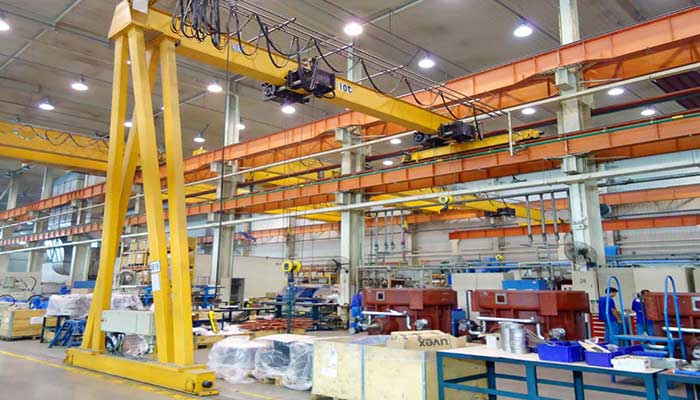
5–20 Ton Semi-Gantry vs Overhead Cranes for Wide Workshops
Content Quick Link
5–20 Ton Semi-Gantry vs. Overhead Cranes: Choosing the Right Coverage for Wide Workshops
Most Important Takeaway:
For wide workshops handling 5–20 ton loads, semi-gantry cranes offer flexible partial coverage at lower cost, while overhead cranes provide full-span coverage and higher workflow efficiency. Choosing the right type depends on workshop layout, lifting frequency, budget, and long-term maintenance considerations.
Key Takeaways (Bullets):
- Workshop Coverage: Semi-gantry cranes are ideal for partial coverage or movable lifting zones; overhead cranes provide full coverage for dense layouts.
- Cost Efficiency: Semi-gantry cranes have lower upfront costs and simpler installation; overhead cranes have higher initial costs but greater ROI for continuous operations.
- Flexibility & Mobility: Semi-gantry cranes can be moved and adapted to different lifting areas; overhead cranes are fixed but optimize repetitive workflows.
- Safety & Workflow: Proper selection ensures safer lifts, reduces bottlenecks, and improves efficiency in handling 5–20 ton loads.
- Practical Buyer Guidance: Consider load types, frequency, future workshop expansion, and mobility needs when choosing.
Semi-Gantry Cranes
A semi-gantry crane is a type of overhead crane where one side runs on wheels along the workshop floor, and the other side travels on a fixed runway. This allows lifting medium-weight loads without requiring a full overhead runway. It's a practical solution when full coverage isn't needed or structural constraints exist.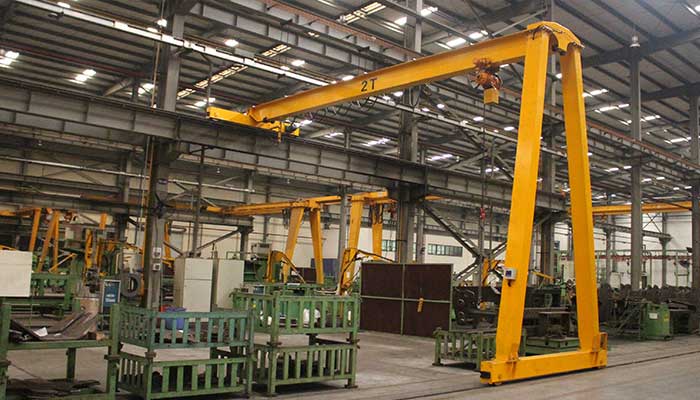
Practical Applications
Semi-gantry cranes are common in workshops that need flexible lifting in limited areas. Typical use cases include:
- Steel fabrication – moving 5–20 ton slabs, plates, or beams.
- Machinery assembly – transferring heavy components between stations.
- Partial warehouses – lifting zones under partial roof coverage or irregular layouts.
- Workshops with limited ceiling support – no need for a complete runway system.
Key Advantages
Semi-gantry cranes provide a balance of mobility, cost, and practicality:
- Flexible coverage: Move the crane along the floor to different areas of the workshop.
- Lower installation costs: Requires fewer runway beams and structural reinforcements.
- Adaptable to limited infrastructure: Works where full overhead cranes are not feasible.
- Simpler maintenance: Fewer overhead components mean quicker inspections and less downtime.
- Faster setup: Installation is quicker than full overhead cranes, reducing production interruptions.
Buyer Notes
When considering a semi-gantry crane, ask yourself:
- Do I need full workshop coverage, or just specific zones?
- What is the weight range of loads I'll be lifting regularly?
- Will the layout or workflow change in the future?
- Do I want to save on installation and maintenance costs without compromising safety?
Overhead (Bridge) Cranes
An overhead crane, also called a bridge crane, is designed to span the full width of a workshop. It usually comes as a top-running single or double girder system, running along rails installed on elevated runways. Unlike semi-gantry cranes, overhead cranes provide complete coverage across the entire floor area, making them ideal for continuous, repetitive lifting tasks.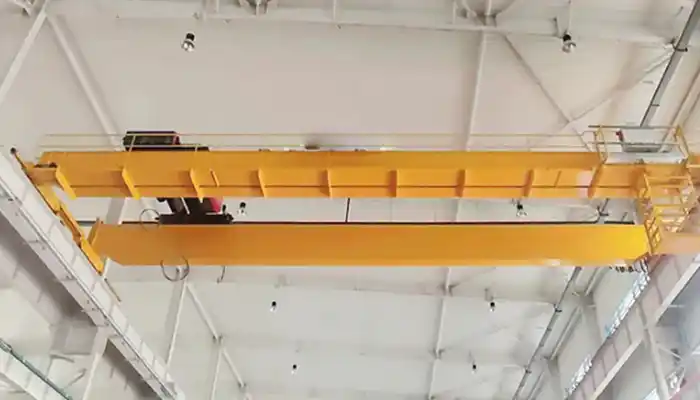
Practical Applications
Overhead cranes are suited for workshops and factories where full-span lifting and high efficiency are required. Typical use cases include:
- Steel workshops and fabrication plants – moving plates, beams, or coils across the entire workspace.
- Machinery and equipment assembly – lifting medium-heavy components safely and precisely.
- Warehouses with full coverage needs – handling 5–20 ton loads without repositioning cranes.
- High-frequency lifting operations – where workflow efficiency is critical to productivity.
Key Advantages
Overhead cranes offer several practical benefits that make them a preferred choice for many industrial buyers:
- Optimized workflow efficiency: Covers the entire workshop, reducing the need to reposition loads or cranes.
- Precise lifting of medium-heavy loads: Single or double girder designs handle 5–20 ton loads safely with accuracy.
- Long-term durability: Centralized maintenance and robust structure ensure reliability over years of operation.
- Safety and control: Advanced control systems allow smooth, stable lifts for sensitive or heavy components.
- Supports heavy-duty operations: Ideal for continuous use in demanding industrial environments.
Buyer Notes
When considering an overhead crane, think about:
- Does your workshop require full coverage from one side to the other?
- Will your operation involve frequent lifting of 5–20 ton loads?
- Are you prepared for the higher upfront cost and installation requirements in exchange for long-term efficiency?
- How important is workflow optimization and precise positioning for your production line?
Workshop Coverage Comparison
When selecting a crane for a workshop, coverage and reach are critical factors. They influence how efficiently materials move, how safe the operation is, and whether your workflow can scale in the future. Let's break it down for semi-gantry and overhead cranes.
| Feature | Semi-Gantry Crane | Overhead Crane |
|---|---|---|
| Coverage | Partial zones, movable along floor | Full workshop width, fixed on overhead rails |
| Best For | Medium workshops, flexible areas | Large workshops, continuous lifting |
| Flexibility | Can move between workstations | Fixed, precise, repetitive lifts |
| Installation | Lower cost, less runway support | Higher cost, needs reinforced runways |
| Workflow | Good for targeted lifts, may need repositioning | Continuous workflow, faster handling |
| Example | Steel workshop: cutting, welding, assembly zones | Assembly plant: 5–20 ton components moved efficiently |
Working Area & Reach
Choosing a crane starts with understanding how far it can reach and which areas it can serve.
Semi-Gantry Cranes
Semi-gantry cranes are designed for partial coverage, making them ideal for workshops where only specific zones need lifting. One side runs on the floor, allowing movement along the workspace.
Practical Implications:
- Works well in medium-sized workshops with multiple workstations.
- Repositioning may be required if lifting in different zones, taking a few minutes but avoiding full overhead runway costs.
Example:
In a steel fabrication workshop, a semi-gantry crane can handle cutting, welding, and assembly zones without needing full-span coverage.
Overhead Cranes
Overhead cranes provide full-span coverage, running along elevated rails on both sides of the workshop. Operators can lift and move loads anywhere on the floor without moving the crane.
Practical Implications:
- Ideal for continuous production lines or high-frequency lifting tasks.
- Suited for dense layouts where materials move across the entire width.
Example:
In a machinery assembly plant, an overhead crane can move 5–20 ton components from storage to assembly lines continuously and efficiently.
Flexibility
Flexibility determines how easily the crane can adapt to workflow changes.
Semi-Gantry Cranes
- Easily switches between multiple zones or workstations.
- Works well in irregular layouts or workshops with partial lifting needs.
- Adapts to workflow changes or expansions without major structural modifications.
Overhead Cranes
- Fixed cranes are less flexible but excel in high-frequency, predictable operations.
- Provides stable and precise lifting without repositioning.
- Saves time for repetitive operations in fully planned workflows.
Structural Considerations
Evaluate your workshop's floor strength, ceiling height, and runway capability before deciding.
Semi-Gantry Cranes
- One side supported on a runway, the other rides on the floor.
- Requires less overhead reinforcement, lowering installation costs.
- Suitable for workshops with limited ceiling support or partial runways.
Overhead Cranes
- Needs reinforced runways on both sides capable of supporting the crane and maximum load.
- Installation is more involved, requiring precise engineering and longer lead times.
- Provides long-term durability and safety, especially for continuous 5–20 ton operations.
Workflow & Efficiency Considerations
- Semi-Gantry Cranes: Best for targeted lifting, but frequent repositioning may slightly slow operations.
- Overhead Cranes: Offers continuous, uninterrupted workflow, ideal for high-volume or repetitive tasks.
- Consider material handling patterns: if loads frequently move across the workshop, overhead cranes reduce handling time and labor costs.
Quick Buyer Checklist
- Identify specific zones where lifting is required.
- Determine whether your workflow is fixed (high-volume) or flexible (changing workstations).
- Assess floor capacity and structural support for the crane type.
- Plan for future expansion or workflow changes.
- Estimate lifting frequency and load weight to balance efficiency vs. cost.
Cost & ROI Considerations
When it comes to investing in a crane, cost isn't just the purchase price. Buyers need to consider installation, maintenance, workflow efficiency, and long-term return on investment (ROI). Here's how semi-gantry and overhead cranes compare.
Initial Investment
Semi-Gantry Cranes
- Lower upfront cost compared to full overhead cranes.
- Requires less structural reinforcement since only one side travels on a runway.
- Faster installation, which reduces downtime.
- Example: A 10-ton semi-gantry crane in a medium workshop can start operating in weeks without heavy runway construction.
Overhead Cranes
- Higher upfront cost due to full-span runways on both sides.
- More precise engineering and installation are required.
- Justified in workshops needing continuous, high-volume lifting.
- Example: A 15-ton double-girder overhead crane in a large assembly facility streamlines material flow and reduces handling time for multiple shifts.
Maintenance & Operation
Semi-Gantry Cranes
- Simpler design with fewer overhead components.
- Less complex electrics mean lower downtime and maintenance costs.
- Suited for intermittent lifting tasks or smaller operations.
Overhead Cranes
- Centralized maintenance allows structured servicing schedules.
- Robust design ensures long-term durability, especially under heavy or frequent lifting.
- Ideal for 24/7 operations or workshops with multiple shifts.
Internal Justification
When explaining a crane purchase to management, ROI and workflow impact matter:
Semi-Gantry Cranes
- Cost-effective for limited coverage areas.
- Suitable when workflow zones are flexible or partial coverage is enough.
Overhead Cranes
- Justified in workshops that require continuous material flow.
- Reduces labor, minimizes bottlenecks, and supports long-term productivity.
- Often pays off the higher initial cost through efficiency gains over time.
Quick Buyer Checklist
- Compare installation costs vs. workflow efficiency gains.
- Factor in maintenance, downtime, and expected crane lifespan.
- Consider future expansion—overhead cranes may be more cost-effective long-term if workshop needs grow.
- Use load patterns and frequency data to determine which crane maximizes ROI.
Safety & Workflow Efficiency
Choosing the right crane isn't just about cost or coverage—it directly affects worker safety, material protection, and workflow efficiency.
Safety Considerations
Why it matters: The wrong crane can increase accidents, damage loads, and slow down operations.
Semi-Gantry Cranes
- One side rides on the floor, so operators must coordinate movement carefully.
- Flexible zones require safety procedures for multiple lifting areas.
- Best for medium-frequency lifts, but extra care is needed for floor traffic and load placement.
Overhead Cranes
- Fixed runways allow stable, precise lifting.
- Operators can plan lifts in advance, reducing collisions and load swinging.
- Suited for high-frequency operations, where predictability improves safety.
Pro Tip: Selecting the right crane reduces accidents, material damage, and unplanned downtime.
Workflow Efficiency
Matching crane type to lifting patterns is key to smooth operations.
Semi-Gantry Cranes
- Moves between zones, ideal for irregular workshop layouts.
- Repositioning takes a few minutes but allows one crane to serve multiple workstations.
- Best when lifts are occasional or moderate in frequency.
Overhead Cranes
- Provides continuous full-span coverage, reducing handling time.
- Minimizes bottlenecks in high-volume workflows.
- Optimal for frequent 5–20 ton lifts, keeping productivity consistent.
Operator Training & Accessibility
Semi-Gantry Cranes
- Operators need hands-on training to safely position the crane and move between zones.
- Training includes obstacle avoidance, floor traffic management, and proper load placement.
Overhead Cranes
- Training focuses on precision control and stable load movement.
- Emphasis on workflow optimization and safety for repetitive, high-frequency operations.
Quick Buyer Checklist
- Match crane type to lifting frequency and coverage needs.
- Ensure operator training covers crane operation and workflow patterns.
- Implement safety procedures for repositioning, floor traffic, and load handling.
- Evaluate how the crane choice affects overall workflow efficiency and material handling speed.
Practical Buyer Tips & Case Examples
Selecting the right crane isn't just about price—it's about matching the crane to your workshop, workflow, and future needs. These practical tips help buyers make informed decisions for 5–20 ton lifting operations.
Assess Your Workshop Layout
- Measure the width, length, and height of your workshop.
- Identify lifting zones and pathways to determine whether semi-gantry or overhead cranes are most suitable.
- Consider obstacles, such as machinery, storage racks, or partial roof structures, which may affect crane placement.
Tip: Semi-gantry cranes work well for specific zones or movable operations, while overhead cranes provide full-span coverage for continuous workflow.
Understand Your Lifting Needs
- Determine the frequency of 5–20 ton lifts and types of loads (steel plates, machinery, beams, etc.).
- Consider whether lifting is intermittent, repetitive, or high-volume.
- Factor in load size, shape, and weight distribution, which may influence trolley or hoist selection.
Tip: Matching crane capacity and type to load patterns ensures safety, efficiency, and equipment longevity.
Plan for Future Expansion
- Think ahead about workflow changes or workshop expansion.
- Semi-gantry cranes offer mobility and partial coverage, which can adapt to new layouts.
- Overhead cranes may require additional runways if you expand coverage areas.
Tip: Planning for growth avoids costly reinstallation or upgrades later.
Explore Hybrid or Modular Solutions
- Some suppliers offer hybrid systems combining semi-gantry flexibility with partial overhead coverage.
- Modular designs allow you to add runways or trolleys as lifting requirements grow.
- Discuss customization options with suppliers to fit your workflow precisely.
Tip: Modular solutions can save money in the long term by adapting to changing lifting needs.
Factor in Safety and Training
- Ensure operator training is included in the total cost of the crane.
- Verify that the crane complies with local and international safety standards.
- Safety features may include limit switches, overload protection, and emergency stops.
Tip: Factoring in safety and training upfront reduces downtime, accidents, and insurance risk.
Semi-Gantry Crane – Snapshot
Workshop Context: Medium-width steel fabrication workshop
Load Range: 5–10 tons
Key Features:
- One side on a fixed runway, one side floor-supported
- Provides partial coverage across workstations
- Moves easily between cutting, welding, and assembly zones
Why It Works:
- Flexible for changing layouts or limited coverage areas
- Avoids the cost of a full overhead runway
- Efficient for moderate-frequency lifting tasks
Overhead Crane – Snapshot
Workshop Context: Wide machinery assembly or industrial workshop
Load Range: 12–20 tons
Key Features:
- Top-running single or double girder crane spanning the full workshop width
- Provides continuous coverage across all zones
- Supports high-frequency, repetitive lifting tasks
Why It Works:
- Maximizes workflow efficiency and reduces material handling time
- Ideal for heavy-duty, 24/7 operations
- Stable and durable for long-term reliability
Practical Insights for Buyers
- Use semi-gantry cranes when you need flexible, movable lifting in limited areas.
- Choose overhead cranes for full-span coverage, heavy loads, and continuous operations.
- Case examples help justify decisions internally, showing how cost, coverage, and workflow align with your workshop's needs.
Conclusion: Choosing the Right Crane for 5–20 Ton Workshop Operations
Selecting the right crane for a wide workshop lifting 5–20 ton loads is more than a purchase—it affects workflow efficiency, safety, and long-term ROI.
Semi-Gantry Cranes
- Best for: Partial coverage and movable lifting zones
- Advantages: Flexible operation, lower upfront investment, easier installation
- Ideal Use: Medium-sized workshops with multiple workstations or changing layouts
Overhead Cranes
- Best for: Full-span coverage and continuous operation
- Advantages: Stable, precise lifting; optimized workflow; long-term durability
- Ideal Use: Large workshops or assembly facilities with high-frequency, repetitive lifting
Final Buyer Advice
- Assess your workshop layout: Width, height, obstacles, and lifting zones
- Understand your lifting needs: Frequency, load type, and tonnage
- Plan for the future: Workflow changes or expansion possibilities
- Consult suppliers: Explore hybrid or modular solutions and ensure safety compliance and operator training
Bottom line: Choosing the right crane type isn't just about cost—it's about matching coverage, capacity, and workflow efficiency to your workshop's specific needs. A careful evaluation ensures your investment pays off in safety, productivity, and long-term ROI.
Questions This Article Solves
This section addresses common buyer questions about semi-gantry and overhead cranes, helping you make informed decisions for 5–20 ton lifting operations.
What is the difference between semi-gantry and overhead cranes for wide workshops?
- Semi-Gantry Cranes: Designed for partial coverage, with one side on a floor track. Ideal for workshops where lifting is needed in specific zones. Flexible and movable, but may require repositioning for multiple areas.
- Overhead Cranes: Provide full-span coverage on elevated rails along both sides of the workshop. Fixed position allows continuous lifting anywhere on the floor, making them suitable for high-frequency, repetitive tasks.
Which crane type provides the most efficient coverage for 5–20 ton loads?
- For targeted lifts and flexible zones, semi-gantry cranes are efficient.
- For continuous workflow and frequent 5–20 ton lifts, overhead cranes are more efficient, reducing handling time, bottlenecks, and labor.
How can buyers justify choosing a semi-gantry crane internally and financially?
- Semi-gantry cranes have lower upfront costs and require less structural support, making them easier to justify for workshops with partial coverage needs.
- They can cover multiple zones with one crane, avoiding the cost of installing a full overhead system.
- Buyers can highlight flexibility, moderate lifting frequency, and adaptability as financial and operational benefits.
What are the cost, maintenance, and workflow implications of each crane type?
- Semi-Gantry Cranes: Lower installation and structural costs, simpler maintenance, suitable for medium-frequency lifting. Slightly slower workflow if repositioning is frequent.
- Overhead Cranes: Higher upfront cost and more complex installation, but centralized maintenance and long-term durability make them ideal for high-frequency or continuous operations. They optimize workflow and reduce handling time.
How to select the right crane based on workshop layout, lifting needs, and future expansion?
- Workshop Layout: Semi-gantry cranes suit medium-width workshops or partial zones, while overhead cranes are best for wide workshops with continuous lifting needs.
- Lifting Needs: Match the crane type to load frequency, weight, and lifting patterns.
- Future Expansion: Semi-gantry cranes offer mobility and partial coverage, while overhead cranes may require additional runways but offer long-term workflow stability.
- Buyer Tip: Consult suppliers about hybrid or modular solutions to adapt to changing workflow or expansion requirements.

Article by Bella ,who has been in the hoist and crane field since 2016. Bella provides overhead crane & gantry crane consultation services for clients who need a customized overhead travelling crane solution.Contact her to get free consultation.
Free consultation to Confirm Parameters & Specifications and Get
Latest Crane Price & Crane Rate.
- Types of overhead cranes : _______?
- Optional: Overhead travelling crane, goliath gantry crane,Slewing jib crane, Single girder or double girder crane,small portable crane or kbk crane, etc.
- Capacity of overhead crane: _______?
- Optional: 0.25ton, 0.5 ton, 1 ton, 2 ton, 3ton, 5 ton, 10 ton,15ton, 20ton, 25 ton, 30ton,35ton, up to 550ton, etc.
- Crane span & lifting height : _______?
- Crane travelling length : _____?
- Control of overhead crane:_______?
- Optional: pendant/ remote/cabin control
- Voltage supply of overhead crane:_____?
- Eg,: 380V50/60HZ,3Phase or others,etc.
- Application/usage of crane:_______?
- Eg,: Steel mill, ,injection mold, cement,stone, concrete,granite, general manufacturing, etc.
Just leave a message via the contact form and our hoist and crane engineer will contact you with in 24working hours.
Get In Touch