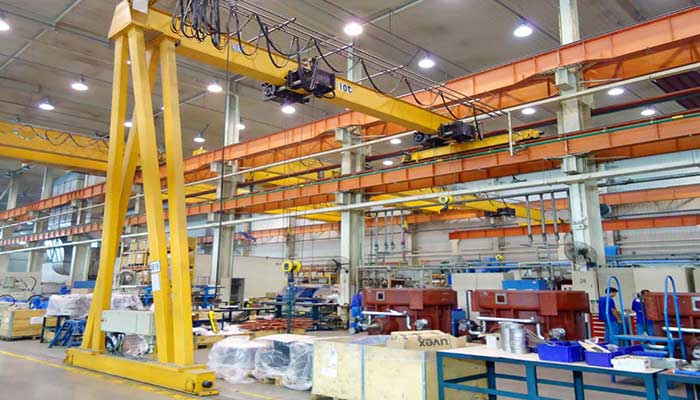
5–16 Ton Semi-Gantry Cranes for Cost-Effective Workshops
Content Quick Link
5–16 Ton Semi-Gantry Cranes: Cutting Crane Span Costs in Oversized Workshops
Semi-gantry cranes are becoming increasingly common in large workshops where space, budget, and flexibility all matter. Unlike full gantry cranes that require a full runway on both sides of the workspace, semi-gantry cranes use one side fixed and the other on wheels. This design allows them to cover a specific area of the workshop without the extra cost and installation work of a full-span crane.
For procurement teams, the biggest draw is cost efficiency. By reducing the crane span, you not only save on steel for the runway and bridge but also cut down on installation time and maintenance requirements. This can make a real difference in oversized workshops where long spans would otherwise drive up project costs quickly.
Practical considerations for buyers include the layout of the workshop, the weight and frequency of loads, and the need for flexibility. Semi-gantry cranes offer a solution that balances lifting capacity and cost, making them a practical choice for many industrial operations.
Key points:
- Semi-gantry cranes reduce installation and material costs compared to full gantry cranes.
- Ideal for workshops where full-span runways are expensive or impractical.
- Offers a flexible lifting solution for specific zones without covering the entire workshop.
- Saves on power consumption due to lighter structure and smaller drive requirements.
Semi-Gantry Cranes
A semi-gantry crane is a type of overhead crane where one side of the bridge runs on a fixed runway, while the other side is supported by a leg on wheels that moves along the floor. This setup is particularly useful in workshops where building a full-span runway on both sides would be costly or physically challenging.
Key Components
- Bridge Structure: Can be single girder or double girder, depending on load and span requirements. Single girder is lighter and more cost-effective for smaller loads, while double girder is better for heavier loads or longer spans.
- Trolley and Hoist: The trolley runs along the bridge and carries the hoist. These components handle the actual lifting, moving materials precisely within the crane's coverage area.
- Leg Configuration: One leg rides on a fixed runway, providing stability. The other leg runs on wheels along the floor, allowing the crane to move without needing a second elevated track.
Typical Capacity Range
- Semi-gantry cranes in workshops commonly handle loads from 5 to 16 tons. This range covers most medium-duty lifting needs, including handling steel plates, machinery components, and heavy manufacturing materials.
Applications
- Manufacturing Workshops: Moving raw materials or sub-assemblies between workstations.
- Steel Workshops: Handling steel plates, beams, and rolled products without requiring a full-span crane.
- Heavy Machinery Handling: Loading and unloading equipment within confined or partially open areas.
Practical Considerations
When evaluating a semi-gantry crane, consider both the maximum load and the effective span you need. It's better to match the crane's reach to the areas where materials are handled most frequently rather than covering the entire workshop. This ensures cost savings while maintaining operational efficiency.
Challenges of Oversized Workshops
Oversized workshops can bring unique problems for lifting operations. While large spaces might seem ideal for big cranes, in practice, the bigger the workshop, the more expensive and complicated the crane system becomes. Understanding these challenges is critical for buyers who want to make practical, cost-effective decisions.
High Costs of Full-Span Overhead Cranes
Long-span overhead cranes require substantial structural support. The bridge itself needs more steel, the runway beams must be stronger and longer, and installation becomes more labor-intensive. These costs can add up quickly, sometimes exceeding the budget for medium-duty lifting operations. For example:
- A 20–30 meter full-span crane could require twice the steel of a semi-gantry alternative.
- Longer runways mean higher foundation costs and more time spent on precise installation.
- Maintenance over time is more complex because the crane spans a larger area and components wear differently across the length.
Limited Installation Options Due to Building Constraints
Not every workshop was designed for heavy lifting equipment. Ceiling height, column placement, and existing machinery can restrict where a full-span crane can go. Some common constraints include:
- Columns or mezzanines that block continuous runway installation.
- Roof trusses that cannot support the weight of a long-span crane.
- Uneven floors or structural gaps that make installing full-length runways expensive or impossible.
Semi-gantry cranes can navigate these challenges because they only need a single fixed runway. The mobile leg can move along the floor, avoiding structural limitations.
Safety and Efficiency Risks with Long-Span Lifting Operations
Large spans bring their own operational hazards. When a crane is very long, small deflections in the bridge or uneven load distribution can cause instability. Additionally:
- Lifting heavy loads across a long span increases the chance of sway and load shift.
- Operators need more time and precision, which can slow down workflow.
- Long spans require more maintenance inspections to ensure safety, increasing downtime.
Operational Inefficiencies from Under-Utilized Crane Span
Even if a full-span crane is installed, it's often underused. Many workshops only need to move materials within a certain zone, but the full-length crane covers the entire area. This leads to:
- Wasted energy, as the crane motor works to cover areas that see little activity.
- Increased wear and tear on rails and trolley systems.
- Unnecessary complexity for operators who have to navigate a larger crane than required.
By contrast, semi-gantry cranes allow buyers to match the lifting solution directly to the areas of the workshop that see the most activity, improving efficiency and reducing both operational and maintenance costs.
Typical Oversized Workshops in Industrial Sectors
Oversized workshops are common across many industries. Buyers should assess their specific sector to determine the most practical crane solution:
- Steel Manufacturing and Processing: Workshops for handling steel plates, beams, billets, or coils often exceed 30–50 meters in length and 15–25 meters in width.
- Heavy Machinery Manufacturing: Assembly areas for large engines, turbines, or industrial machines require high ceilings and wide open floors.
- Shipbuilding or Marine Components: Sections for hull assembly or large marine equipment often span dozens of meters with irregular floor layouts.
- Automotive and Vehicle Production: Large stamping and assembly halls for trucks or buses often need cranes to move heavy sub-assemblies across long spans.
- Aerospace and Aviation Manufacturing: Workshops for wings, fuselage sections, or engine assemblies are oversized, with long spans and sensitive load handling requirements.
- Energy and Power Equipment Plants: Facilities for turbines, generators, or transformers require space for oversized components with flexible lifting zones.
Practical Tips for Buyers
- Measure the key work zones before committing to a full-span crane.
- Check building limitations like column placement, ceiling height, and floor strength.
- Consider load frequency and weight distribution to avoid over-specifying the crane.
- Think long-term: a smaller, targeted crane can reduce maintenance and energy costs over years.
- Match the crane type to the industry-specific workflow to maximize efficiency and ROI.
Cost-Saving Advantages of Semi-Gantry Cranes
Semi-gantry cranes are designed with practicality and cost-efficiency in mind. For workshops that are oversized but don't need a full-span crane, these cranes offer a targeted solution that keeps expenses under control without sacrificing lifting capability. Let's break down the main ways buyers can save.
Reduced Crane Span
By supporting the crane on one side with a fixed runway and using a mobile leg on the floor, semi-gantry cranes reduce the total span required. This directly lowers costs because:
- Shorter spans need less steel for the bridge.
- Runway beams can be smaller and lighter.
- Fewer structural reinforcements are required in the building.
For example, a workshop that would normally need a 30-meter full-span crane might only need a 15–20 meter semi-gantry span for most of its lifting tasks, reducing material and construction costs by up to 30–40%.
Lower Installation Costs
Installation is simpler and faster because the semi-gantry crane requires only one elevated runway. Buyers benefit from:
- Less civil work, since only one runway foundation is needed.
- Reduced labor costs during installation.
- Minimal downtime for existing workshop operations while installing the crane.
This is especially valuable in active manufacturing or steel workshops, where extended downtime can translate into significant lost productivity.
Material Savings
Semi-gantry cranes use less steel overall because the mobile leg eliminates the need for a second runway. Specific savings include:
- Smaller bridge beams for medium-duty loads (5–16 tons).
- Lower-cost wheels and supports for the mobile leg compared to a full elevated runway.
- Less reinforcement required for the building, reducing structural modification costs.
Over time, material savings also translate into lower maintenance costs, as lighter cranes put less stress on wheels, rails, and hoists.
Flexible Layouts
One of the biggest advantages is flexibility. Semi-gantry cranes can be positioned exactly where lifting is needed without installing full-length runways. This allows:
- Targeted coverage of high-traffic material zones.
- Easy reconfiguration if the workshop layout changes.
- Handling multiple workstations without the expense of a crane that spans the entire building.
For industries like steel processing or heavy machinery assembly, this flexibility ensures the crane supports actual workflow rather than just occupying space.
Energy Efficiency
Because semi-gantry cranes are lighter than full-span cranes, their motors require less power to operate. Buyers can expect:
- Lower electricity costs for daily operation.
- Reduced wear on the drive system and hoists, extending equipment life.
- Smoother operation and easier control for operators, which improves productivity and safety.
Even small reductions in energy use add up over time, making semi-gantry cranes not only cost-effective upfront but also cheaper to run in the long term.
Practical Tips for Buyers
- Evaluate which workshop zones actually need crane coverage before sizing the span.
- Check if your floor can support the mobile leg; reinforcement may still be required in very heavy-load areas.
- Consider energy-efficient hoists and motors to maximize operational savings.
- Compare material and installation costs with a full-span alternative to quantify savings before purchase.
Operational Benefits
Semi-gantry cranes don't just save money—they also make day-to-day operations smoother. For workshops that handle medium-duty loads, the operational advantages often outweigh those of a full-span crane, especially in oversized or busy environments.
Easy Installation and Relocation
Because a semi-gantry crane only requires one fixed runway, installation is straightforward. The mobile leg moves along the floor, so buyers don't have to construct a second runway or make extensive building modifications. This offers practical benefits:
- Faster setup means less downtime in production areas.
- Relocation to a different zone or reconfiguration of workshop workflow is possible without dismantling the entire crane.
- Reduced reliance on specialized installation teams; local technicians can often handle assembly.
Increased Safety Due to Predictable Load Paths
Semi-gantry cranes have clear, defined lifting paths, which reduces the risk of collisions or unbalanced loads. Operators benefit from:
- Predictable movement of heavy materials, lowering the chance of accidents.
- Simplified planning for lifts, especially in workshops with multiple workstations.
- Reduced sway and vibration compared to full-span cranes over very long distances.
For buyers, this translates into fewer safety incidents, lower insurance risks, and more consistent workflow.
Compatible with Existing Workshop Infrastructure
Many oversized workshops were not originally designed for full-span cranes. Semi-gantry cranes adapt to existing conditions, meaning:
- Columns, mezzanines, or other obstacles don't require costly modifications.
- Existing electrical supply and power systems can often support the crane without upgrades.
- Floor-mounted mobile legs can be installed on concrete floors without extensive reinforcement, as long as load capacity is checked.
This flexibility makes semi-gantry cranes ideal for retrofitting older workshops or for facilities with mixed equipment layouts.
Customizable Lifting Height and Reach Based on Workflow
One of the most practical benefits is the ability to tailor lifting parameters to actual workflow needs:
- Bridge and hoist heights can be adjusted to suit material stacks, machinery, or storage areas.
- Span length can be sized for the exact zones where lifting is needed, avoiding wasted capacity.
- For multiple workstations, the crane can serve several areas sequentially without interfering with other operations.
By focusing lifting capability only where it's needed, workshops can operate more efficiently, save energy, and reduce wear on the crane.
Practical Tips for Buyers
- Map out material flow in the workshop before sizing the crane.
- Ensure that the mobile leg path is clear of obstacles and load-bearing floors are adequate.
- Consider adjustable hoist heights for multi-level or variable-height operations.
- Use predictable lifting zones to train operators and improve safety procedures.
Practical Buyer Considerations
Selecting the right semi-gantry crane isn't just about picking a model off a catalog. Buyers need to carefully assess their workshop, lifting requirements, and future needs to make sure the crane delivers both efficiency and long-term value.
Workshop Dimensions and Load Requirements
Before choosing a crane, measure the areas where lifting will occur. Oversized workshops often have long spans, but not every corner needs crane coverage. Consider:
- Width and length of the zones where materials will be moved.
- Maximum load weights and distribution—5 to 16 tons is typical for semi-gantry cranes, but peaks should guide specification.
- Space constraints like columns, mezzanines, or equipment that limit crane movement.
Focusing on actual work zones helps prevent oversizing the crane, which saves upfront costs and reduces unnecessary energy consumption.
Floor Strength and Runway Feasibility
The mobile leg of a semi-gantry crane relies on a solid floor. Check that your concrete can handle the load, including the weight of the crane itself plus the materials lifted. Consider:
- Concrete thickness and reinforcement.
- Point loads from crane wheels and their travel paths.
- Whether runway reinforcement or additional pads are required.
Skipping this step can lead to structural issues, safety risks, and costly retrofits later.
Required Lifting Height and Reach
Not all workshops require maximum crane height. Determine:
- The height needed to clear machinery, stacked materials, or storage racks.
- Span coverage needed for the most frequent lifts.
- Any adjustable lifting requirements for different types of loads or workflows.
Tailoring lifting height and reach ensures the crane is efficient, safe, and energy-conscious.
Frequency and Type of Loads
Understanding how often the crane will be used and what it will lift is critical. Buyers should evaluate:
- Daily lifting cycles—frequent loads may require higher-duty components.
- Load types—steel plates, machinery parts, or irregular shapes can influence hoist and trolley design.
- Maximum single-lift weight vs. average weight—helps determine safety margins.
Selecting a crane based on real usage patterns prevents over-engineering and reduces maintenance costs.
Future Expansion Plans or Mobility Needs
Workshops evolve, so flexibility is key. Semi-gantry cranes are ideal because they can adapt to future changes:
- Mobile leg allows relocation within the workshop as production lines change.
- Crane span can sometimes be extended or reduced if layout modifications occur.
- Optional features like adjustable hoist speeds or control modes can accommodate different operations over time.
Planning for growth now avoids expensive upgrades or replacements later.
Practical Tips for Buyers
- Conduct a full workshop survey before requesting a quote.
- Match crane specifications to actual workflows, not theoretical maximum capacity.
- Consider floor reinforcement early to avoid costly downtime.
- Factor in future changes in workflow, production volumes, or new equipment.
Comparison With Full Gantry Cranes
When deciding between a semi-gantry and a full gantry crane, buyers need to look beyond just the price tag. Each type has advantages depending on the workshop layout, lifting needs, and operational goals. The table below summarizes the main differences:
| Feature | Semi-Gantry | Full Gantry |
|---|---|---|
| Cost | Lower upfront costs due to shorter span, lighter bridge, and fewer structural requirements. | Higher cost because it covers the full workshop span with heavier bridge and runway beams. |
| Span Coverage | Partial/targeted coverage focused on key work zones. Ideal for areas where only specific sections need lifting. | Full coverage across the entire workshop, even if some areas see little or no use. |
| Installation Complexity | Simple installation—requires only one fixed runway and floor space for the mobile leg. | Complex installation—needs two runways, precise alignment, and often more structural reinforcement. |
| Flexibility | High—mobile leg allows relocation within workshop, adjustable lifting height, and easier adaptation to workflow changes. | Medium—fixed runways limit mobility, and layout changes are difficult and costly. |
Scenarios Where Semi-Gantry Cranes Are Most Cost-Effective
Semi-gantry cranes shine in workshops that are oversized but don't require full-span coverage. Some practical examples include:
- Steel processing facilities: Handling coils or plates in specific zones without covering the entire workshop.
- Machinery assembly workshops: Lifting heavy sub-assemblies at multiple workstations, but not across the full building.
- Retrofit projects: Older workshops with columns or structural limitations that make full-span installation difficult or expensive.
- Variable workflow environments: Where production layouts change frequently, a semi-gantry crane can move to where it's needed most.
Case : 10-Ton Semi-Gantry Crane in a 50-Meter Workshop
A mid-sized steel fabrication workshop in Southeast Asia recently upgraded to a 10-ton semi-gantry crane. The workshop measured 50 meters in length and 20 meters in width, but only certain areas required heavy lifting—mainly for steel plates and machinery components.
Key Outcomes:
- Reduced Steel Usage: Only one elevated runway was needed, cutting steel requirements by approximately 35% compared to a full-span crane.
- Shorter Installation Time: The crane was fully operational in two weeks, versus the typical 4–6 weeks for a full-span solution.
- Faster ROI: Lower upfront investment and reduced energy consumption allowed the company to recover costs within 18 months.
- Operational Efficiency: The crane covered high-traffic zones with minimal obstruction to other processes, and its mobile leg allowed flexibility for future workflow changes.
This case demonstrates how semi-gantry cranes can deliver precise lifting capabilities while saving money and time in oversized workshops.
Conclusion
Semi-gantry cranes provide a practical, cost-effective alternative to full-span cranes for oversized workshops. By reducing the required crane span, buyers can save on steel, installation labor, and energy consumption without compromising safety or performance.
For procurement teams and workshop managers, the key takeaway is clear: matching crane coverage to actual workflow requirements leads to smarter investments, faster ROI, and more efficient operations. Semi-gantry cranes make sense when full-span coverage is unnecessary or structurally challenging.
If your workshop could benefit from a semi-gantry crane, it's worth exploring a customized solution. Our team can provide:
- Free consultation to assess your workshop layout, lifting requirements, and workflow.
- Detailed quotation tailored to your load capacity, span, and mobility needs.
- Technical assistance for installation planning, floor reinforcement, and safety compliance.
Contact us today to discuss your workshop needs and see how a semi-gantry crane can save you time, materials, and energy while improving operational efficiency.

Article by Bella ,who has been in the hoist and crane field since 2016. Bella provides overhead crane & gantry crane consultation services for clients who need a customized overhead travelling crane solution.Contact her to get free consultation.
Yuantai Cranes
Overhead Crane Manufacturer with CE, ISO, SGS, CNEX Certificates.
- Main Specifications - Capacity: 0.5–550 tons | Span: up to 40m | Speed: 0.8–12 m/min | Duty: A3–A7 | Power: 380–690V, 50/60Hz | Control: pendant/remote/cabin
- Full engineering: FEA/PLC/VFD + in-house build + global delivery + on-site support, for workshops, factories, EPC contractors, industrial projects, etc.
- Support: design, manufacturing, testing, service – end-to-end, customized lifting solutions worldwide.
How to Get an Accurate Crane Price for Your Application?
Tips: Copy the spec list, fill in your details, and paste it into the form on the right/ down-below for a quick price.
- Crane type:_____ . (e.g., overhead crane, gantry crane, jib crane)
- Max weight to lift:_____ tons. (e.g., 2t, 5t, 10t, 20t, 50t)
- Lifting height:_____ m. (How high does the hook need to reach?
- Workshop width (span):_____ m . (Distance between the two crane rails)
- Travel distance:_____ m . (How long does the crane need to move along the runway?)
- Control type:_____. (Pendant / remote / cabin Control)
- Power supply:_____. (Local voltage & frequency – e.g., 380V, 50Hz, 3-phase)
- What will it be used for?_____ (e.g., steel fabrication, concrete products, mold handling, general manufacturing, etc.)
- Any special requirements?_____ (e.g., extreme temperature, dusty or explosive environment, special paint color, etc.)
Just leave a message via the contact form and our hoist and crane engineer will contact you with in 24working hours.
Get Your Custom Quote–Quick & Easy
Fill in what you know. Skip what you don't – we'll help.Any question will be reply with 24 working hours