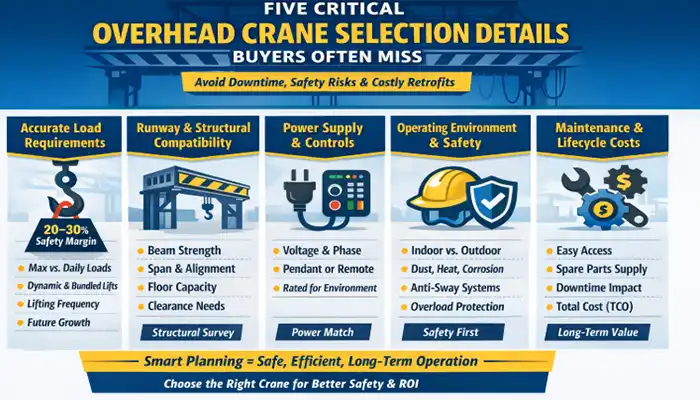
Five Critical Overhead Crane Selection Details Buyers Often Miss
menu_open
Content Quick Link
Five Critical Overhead Crane Selection Details Most Buyers Miss in the Planning Stage
Most Important Takeaway
Selecting the wrong overhead crane or EOT crane during the planning stage is the leading cause of costly downtime, safety risks, and unexpected post-installation modifications. Buyers often focus only on lifting capacity and ignore operational, environmental, and long-term lifecycle considerations.
Key Takeaways
- Holistic crane selection prevents costly mistakes: Don’t just consider lifting capacity—evaluate the full operational environment.
- Runway and structural compatibility matter most: Even the best crane cannot perform safely if the building or runway is unsuitable.
- Power supply and control system compatibility are often overlooked: Choosing the right voltage, phase, and control type ensures smooth operation.
- Environmental and safety features are critical: Anti-sway, soft-load, and overload protection reduce risks and protect both operators and materials.
- Maintenance and lifecycle costs impact ROI: Factoring in long-term serviceability avoids hidden costs and downtime.
Introduction
When it comes to choosing an overhead crane, overhead bridge crane, or EOT crane, most buyers think the key factor is lifting capacity. But here’s the catch—lifting capacity alone doesn’t guarantee smooth operation. Many industrial facilities discover the hard way that other factors matter just as much, if not more.
The truth is, a crane has to fit your facility and your workflow. If you overlook runway compatibility, control system requirements, environmental conditions, or long-term maintenance, you can face costly delays, safety hazards, and unexpected downtime.
This guide focuses on five critical details that most buyers miss in the planning stage. Paying attention to these details upfront helps procurement engineers, plant managers, and production planners make smarter, more practical decisions.
What You’ll Gain From This Guide
- Runway and structure insight: Ensure your crane operates safely within your existing building framework.
- Electrical and control clarity: Avoid power supply mismatches or unsuitable control systems.
- Environmental awareness: Understand how temperature, dust, and outdoor conditions affect crane performance.
- Maintenance foresight: Plan for inspections, spare parts, and long-term operational costs.
- Operational efficiency: Reduce downtime, improve safety, and save on unexpected retrofit costs.
In short, choosing the right crane isn’t just about lifting heavy loads. It’s about how well the crane works in your environment, how easy it is to maintain, and how it supports your production over time. Get these five details right, and you’ll save a lot of headaches later.
Detail 1: Accurate Load Requirements
One of the most common mistakes buyers make is focusing solely on the crane’s maximum lifting capacity. Yes, it’s important, but thinking only in terms of maximum load can lead to serious problems down the line. Cranes are not just rated for the heaviest lift—they need to handle your everyday workflow safely and efficiently.
Before you pick a crane, it’s important to look at the full picture of your lifting needs. That includes not just the heaviest piece of material, but the average loads, how often you lift, and whether multiple items will be lifted together. Ignoring these details can cause unnecessary stress on the crane, lead to faster wear, and even create safety risks for operators.
Key considerations for buyers:
- Maximum vs. average load: Your crane should handle your heaviest lift, but also be suitable for typical daily loads. Frequent lifts close to maximum capacity can reduce equipment life.
- Dynamic and bundled loads: Lifting multiple items at once or handling unevenly distributed loads can increase stress on the crane. Always account for these factors when planning.
- Future expansion: Don’t just plan for current operations. If production is likely to increase or product sizes may grow, your crane should be capable of handling those future needs.
- Weight distribution and lifting frequency: Uneven or frequent lifting cycles affect mechanical components differently. Consider how your workflow might impact long-term performance.
Always include a 20–30% safety margin on top of your heaviest expected load. This accounts for unexpected situations, bundled lifts, or minor miscalculations. It’s a simple step that can prevent costly downtime and extend the life of your crane.
Detail 2: Runway and Structural Compatibility
A lot of crane buyers make the mistake of looking only at the crane itself and forgetting about the building it will operate in. Even the most reliable overhead crane can’t perform safely if the runway, beams, or foundation aren’t compatible. Ignoring these factors can lead to unexpected downtime, excessive maintenance, or even structural damage.
The runway and structural setup are just as important as the crane’s lifting capacity. A crane’s wheels, hoist, and trolley all transfer weight to the runway beams. If the beams aren’t designed to handle these forces, you can end up with excessive deflection, misalignment, or safety hazards.
Key considerations for buyers:
- Runway beam deflection and span spacing: Make sure the beams can support the crane under maximum and typical loads. Excessive deflection can affect lifting precision and wear out components faster.
- Floor load-bearing capacity and foundation reinforcement: Check that the building floor and foundations can safely carry the combined weight of the crane, load, and moving trolley. Some older structures may require reinforcement.
- Crane travel path, clearance, and headroom: Verify that there’s enough space for the crane to move freely along the runway without interference. Don’t forget to account for hooks, hoists, and lifting attachments.
Conduct a structural survey before finalizing your crane selection. This includes checking the building beams, supports, and foundation. Small adjustments now can prevent costly modifications or delays later.
Detail 3: Power Supply and Control System Requirements
One of the most overlooked aspects of crane planning is the electrical and control system setup. Many buyers assume that a standard power supply and basic control options will work for any crane. In reality, mismatches in voltage, phase, or control type can lead to installation delays, operational issues, or even damage to equipment.
It’s not just about plugging the crane into the nearest outlet. The type of control system you choose—whether it’s a pendant, radio remote, or fully automated PLC system—needs to match your workflow and production requirements. At the same time, environmental factors like temperature extremes, dust, humidity, or corrosive conditions can affect electrical components if they’re not properly rated.
Key considerations for buyers:
- Voltage, phase, and frequency compatibility: Make sure your crane matches the facility’s power supply. Incorrect voltage or phase can cause equipment failure or unsafe operation.
- Control system type: Choose the control that fits your operations. Pendant controls are reliable for simple operations, radio remote allows flexible movement, and PLC automation is ideal for precise or repetitive tasks.
- Environmental conditions: Consider whether your crane will operate indoors, outdoors, or in harsh industrial conditions. Dust, moisture, heat, and corrosive substances can all reduce component life if not accounted for.
Select crane and control systems rated for outdoor, industrial, or hazardous environments when needed. Properly matching the crane’s power and control systems to your facility ensures safe, reliable operation and reduces long-term maintenance costs.
Detail 4: Operational Environment and Safety Features
A lot of crane buyers underestimate how much the operational environment affects crane performance and safety. Even a well-designed overhead crane or EOT crane can have problems if it’s not suited to the conditions where it will operate. Environmental factors—like dust, temperature, humidity, or exposure to outdoor weather—can cause components to wear out faster, reduce precision, or trigger breakdowns.
Safety features are equally important. Cranes operate in environments where people and expensive materials are present, so missing features like overload protection, anti-sway devices, or obstacle detection can create serious risks. These are not optional extras—they’re part of ensuring smooth, safe, and efficient operations.
Key considerations for buyers:
- Indoor vs. outdoor operations: Determine whether your crane will be exposed to rain, dust, or extreme temperatures. Outdoor conditions require weatherproof hoists, enclosures, and corrosion-resistant materials.
- Anti-sway, soft-load, and load-limiting devices: These features reduce swinging loads, prevent sudden jerks, and protect both the crane and the material being lifted. They’re especially important for delicate or heavy items.
- Safety features: Look for emergency stop buttons, overload protection, obstacle detection sensors, and safety interlocks. These help prevent accidents and protect operators.
Match your crane’s features to both current and future site conditions. For example, even if your facility is indoors now, consider whether expansion or outdoor storage areas may require additional protection. Planning for environmental and safety factors upfront saves time, money, and reduces operational risk.
Detail 5: Maintenance, Accessibility, and Lifecycle Costs
Many buyers focus only on the upfront purchase price when selecting an overhead crane, EOT crane, or overhead bridge crane, but that’s just the beginning. The long-term costs of maintenance, spare parts, downtime, and service requirements often exceed the initial investment. Ignoring these factors can lead to higher expenses, reduced productivity, and unexpected operational disruptions.
A crane that is difficult to inspect or maintain will inevitably require more labor, take longer to repair, and risk prolonged downtime. Similarly, limited availability of spare parts or slow technical support can turn minor issues into major production delays. Thinking about the total cost of ownership (TCO) is key for industrial lifting operations where reliability and efficiency matter.
Key considerations for buyers:
- Ease of inspection and access: Make sure mechanical and electrical components are easy to reach for routine checks, lubrication, and repair. Cranes designed with accessibility in mind reduce service time and labor costs.
- Spare parts availability and support: Check whether spare parts are readily available locally or require long lead times. Reliable technical support ensures problems are resolved quickly, minimizing downtime.
- Total cost of ownership (TCO): Factor in maintenance, service contracts, energy usage, and potential downtime over the crane’s expected lifetime. Upfront savings may cost more if TCO is ignored.
Include maintenance schedules and potential downtime costs in your planning. A small investment in easier access, proper training, or service agreements can pay off significantly over the life of the crane.
Frequently Asked Questions (FAQ)
Q1: What hidden factors affect overhead crane performance, safety, and reliability?
Overhead crane performance isn't just about lifting capacity. Hidden factors include:
- Runway and structural compatibility: Beams, foundations, and span lengths must handle both the crane and load safely. Misaligned or undersized runways can cause excessive wear or even structural failure.
- Load characteristics: Dynamic loads, bundled lifts, and frequent heavy use can stress components if not properly planned.
- Power and control systems: Mismatched voltage, phase, or control type can lead to erratic movement, downtime, or electrical damage.
- Environmental conditions: Dust, heat, humidity, corrosive substances, or outdoor exposure can degrade hoist motors, electrical systems, and structural elements.
- Safety features: Missing anti-sway, soft-load, or overload protection devices can reduce operational safety and increase material damage risk.
Understanding these factors upfront ensures a crane that performs reliably, safely, and efficiently over its lifetime.
Q2: How can buyers avoid costly post-installation modifications and downtime?
Most post-installation problems come from poor planning and overlooked details. To avoid them:
- Conduct a structural survey to confirm runway and building compatibility.
- Include safety margins for lifting operations, dynamic loads, and future expansion.
- Ensure power supply and control systems match your facility's specifications.
- Plan for environmental conditions and protective features for both indoor and outdoor operations.
- Factor in maintenance access, spare parts, and service agreements in the purchase plan.
Following these steps reduces unexpected downtime, expensive retrofits, and safety hazards.
Q3: What details ensure long-term ROI and operational efficiency for EOT cranes and overhead bridge cranes?
Long-term ROI comes from thinking beyond the purchase price:
- Choose cranes with easy maintenance and component access, which reduces labor and repair time.
- Consider the total cost of ownership (TCO): maintenance, energy use, service support, and downtime.
- Match crane features to current and future operational needs, including environmental conditions, workflow, and expansion plans.
- Incorporate safety and load-handling features, like anti-sway, soft-load mechanisms, and overload protection, to protect both operators and materials.
By focusing on these details, buyers get cranes that last longer, operate more efficiently, and deliver measurable value over their entire lifecycle.
Conclusion
Selecting the right overhead crane, overhead bridge crane, or EOT crane is about far more than simply matching lifting capacity to the heaviest load. While lifting tonnage is often the first consideration, it’s only one piece of the puzzle. Many buyers focus on it alone and overlook other factors that have a major impact on performance, safety, and long-term costs.
A thoughtful crane selection process considers several critical aspects simultaneously:
- Load requirements: Understanding both maximum and average loads, dynamic factors, bundled lifts, and future production growth ensures the crane can handle real-world operations without overloading or excessive wear.
- Runway and structural compatibility: Proper runway design, beam deflection limits, and foundation strength are essential. Without this, even a well-designed crane can cause structural stress or misalignment issues.
- Power supply and control systems: Ensuring electrical compatibility, appropriate control methods, and environmental ratings prevents operational failures and costly delays.
- Operational environment and safety features: Indoor or outdoor conditions, temperature extremes, dust, humidity, and hazardous materials all affect crane performance. Safety devices like anti-sway, soft-load, and overload protection reduce risk to both personnel and materials.
- Maintenance, accessibility, and lifecycle costs: Factoring in routine inspections, spare parts, technical support, and total cost of ownership prevents hidden expenses and keeps the crane operating reliably for decades.
By addressing all these areas during the planning stage, buyers can avoid common mistakes that lead to downtime, emergency repairs, and unplanned expenses. A crane that is properly matched to its environment, workflow, and future production needs delivers smoother operations, better safety outcomes, and measurable long-term ROI.
In practical terms, this means:
- Planning beyond immediate lifting needs, thinking about how operations will evolve over time.
- Including safety and environmental considerations to protect both staff and materials.
- Budgeting not just for the initial purchase, but for ongoing service, maintenance, and potential upgrades.
In short, holistic, forward-thinking crane selection pays off. When you evaluate all critical factors—load, runway, power, environment, and lifecycle costs—you ensure that your industrial lifting operations run efficiently, safely, and cost-effectively for years to come.

Article by Bella ,who has been in the hoist and crane field since 2016. Bella provides overhead crane & gantry crane consultation services for clients who need a customized overhead travelling crane solution.Contact her to get free consultation.