
ATEX vs IECEx vs CNEX: Explosion-Proof Crane Component Guide
menu_open
Content Quick Link
ATEX vs. IECEx vs. CNEX: Explosion-Proof Crane Component Comparison
Most Important Takeaway:
When selecting an explosion-proof crane, understanding the differences between ATEX, IECEx, and CNEX for each critical component—brakes, wire ropes, limit switches, control systems, and power supply—is essential for compliance, safety, and reliable operation in hazardous zones.
Key Takeaways (Questions This Article Solves)
- How do ATEX, IECEx, and CNEX standards differ for explosion-proof crane brakes?
- What are the requirements for wire ropes/hoist ropes under different certifications?
- How are limit switches evaluated and approved for hazardous areas?
- What are the differences in control systems certification (pendant, cabin, remote)?
- How do power supply and electrical configuration requirements differ for ATEX, IECEx, and CNEX?
- Why understanding these differences matters for domestic and export buyers of explosion-proof cranes.
Brakes (Mechanical & Electrical)
Brakes are the heart of crane safety. They don't just stop the load—they protect your equipment, your operators, and your facility in hazardous areas. Getting the right certification ensures that brakes function reliably, even in flammable or explosive environments.
Brakes are critical for lifting safety and emergency stopping. Certification standards ensure brakes perform reliably under hazardous conditions.
Brakes Certification Standards
- ATEX: Specifies performance testing, safe operation in flammable atmospheres, and certification marking.
- IECEx: Focuses on compliance testing, environmental tolerance, and global recognition.
- CNEX: Chinese national certification requires specific testing, documentation, and domestic marking.
Practical Implications:
- Check environmental ratings, load capacity, and maintenance intervals.
- Verify that brakes are compatible with hazardous zone classification.
ATEX Brakes
Under ATEX, brakes must pass strict performance testing to prove they operate safely in potentially explosive atmospheres. The certification includes marking requirements, so it's easy to confirm compliance at a glance.
- Performance must meet zone-specific operational requirements.
- Certification marks indicate suitability for flammable gas or dust environments.
- Must withstand temperature and humidity ranges typical for the facility.
IECEx Brakes
IECEx focuses on global recognition and international compliance. The brakes are tested for environmental tolerance and functionality under harsh conditions, making them suitable for export projects across multiple regions.
- Compliance testing ensures the brake works safely in different hazardous zones.
- Brakes must meet operational standards for temperature, vibration, and load.
- Internationally recognized certification simplifies export and cross-border use.
CNEX Brakes
CNEX is China's national certification system for explosion-proof equipment. It requires specific testing and detailed documentation, and all approved brakes carry domestic certification marks.
- Brakes are tested for domestic hazardous zones defined by Chinese standards.
- Certification includes official CNEX marks and detailed compliance documentation.
- Maintenance and inspection intervals are guided by CNEX standards.
Practical Implications for Brake Selection
When selecting brakes for an explosion-proof crane, consider these key points:
- Check environmental ratings to ensure the brake can operate in your plant's temperature, humidity, and dust/gas conditions.
- Verify load capacity matches the heaviest lift your crane will perform.
- Make sure maintenance intervals and inspection procedures are compatible with your operational schedule.
- Confirm that the brakes are certified for your facility's hazardous zone classification—don't assume one certification fits all zones.
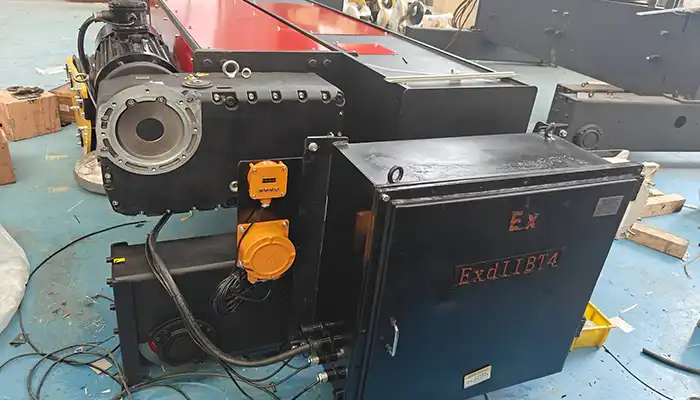 Explosion proof wire rope electric hoist
Wire Rope (Hoist Rope)
Wire ropes are the backbone of any crane operation. They carry the load, and any failure can cause serious safety issues. That's why explosion-proof standards treat wire ropes very seriously. Certification ensures the rope material, construction, and inspection meet strict safety requirements for hazardous zones.
Wire ropes are essential for safe material handling. Standards differ in terms of load testing, material, and replacement requirements.
Wire Rope Certification Standards
- ATEX: Requires certified materials, protective coatings, and inspection frequency.
- IECEx: Emphasizes traceability, load safety factors, and international testing standards.
- CNEX: Focuses on domestic standards, inspection procedures, and labeling for traceability.
Practical Implications:
- Verify rope compatibility with crane load, lifting height, and duty cycle.
- Plan replacement intervals according to hazard and operational frequency.
ATEX Wire Ropes
ATEX-certified wire ropes must use materials that are tested and approved for flammable environments. Protective coatings are often required to resist corrosion, abrasion, or sparks that could trigger ignition. Regular inspection is also mandatory.
- Material must meet ATEX-approved standards for strength and durability.
- Protective coatings prevent sparks and wear in dusty or flammable atmospheres.
- Inspection intervals are defined by the crane's operational conditions and the zone classification.
IECEx Wire Ropes
IECEx standards emphasize traceability and international testing. Each rope must be documented from production to installation, and load safety factors are clearly defined. These requirements make the ropes suitable for export projects across multiple countries.
- Full traceability of wire rope materials and production history.
- Load testing to ensure safety factors match the crane's rated lifting capacity.
- Compliance with international standards allows for multi-region use without additional certification.
CNEX Wire Ropes
CNEX focuses on domestic Chinese standards, ensuring ropes meet local safety regulations. Testing procedures, inspection, and labeling must follow national guidelines. CNEX certification also guides maintenance schedules and replacement planning.
- Domestic material and construction standards for Chinese hazardous zones.
- Clear inspection and testing procedures for local operations.
- Labeling for traceability and compliance verification.
Practical Implications for Wire Rope Selection
When choosing wire ropes for an explosion-proof crane, keep these points in mind:
- Verify that the rope's rated load matches the crane's maximum lifting weight.
- Consider lifting height, frequency, and duty cycle—high-frequency operations may require ropes with higher safety margins.
- Plan replacement intervals based on operational intensity and the type of hazardous zone.
- Ensure compatibility with ATEX, IECEx, or CNEX standards depending on where the crane will operate.
Limit Switches (Upper, Lower, Travel)
Limit switches are small but critical components on any explosion-proof crane. They prevent the crane from moving beyond its safe range, protecting both personnel and equipment. In hazardous zones, proper certification and reliable operation are not optional—they're essential for safety and compliance.
Limit switches prevent over-travel and protect personnel and equipment. Compliance is critical for all hazardous zones.
Limit Switch Certification Standards
- ATEX: Flameproof enclosure types, reliability testing, and certification marking.
- IECEx: Functional safety, redundancy, and performance under environmental stress.
- CNEX: National standard for design, testing, and documentation.
Practical Implications:
- Ensure proper installation in line with zone classification.
- Verify sensitivity and reliability under operational conditions.
ATEX Limit Switches
ATEX-certified limit switches are designed with flameproof enclosures to prevent sparks or ignition in flammable atmospheres. They also undergo strict reliability testing, and certified units carry clear marking for verification.
- Flameproof enclosure types ensure safe operation in gas or dust hazardous zones.
- Reliability testing confirms the switch functions accurately over repeated cycles.
- Certification marks provide an easy way to confirm compliance.
IECEx Limit Switches
IECEx emphasizes functional safety and redundancy. Limit switches under this standard must perform consistently, even under environmental stress like vibration, temperature fluctuations, or dust exposure.
- Functional safety ensures the crane stops reliably in all conditions.
- Redundancy reduces risk if one switch fails.
- Tested to handle harsh environmental conditions typical in industrial applications.
CNEX Limit Switches
CNEX-certified limit switches follow Chinese national standards. The certification covers design, testing, and documentation, ensuring compliance with domestic regulations for hazardous areas.
- National standards define the construction, reliability, and installation requirements.
- Testing and documentation are mandatory for verification in domestic projects.
- Labels and marking allow easy traceability for audits or inspections.
Practical Implications for Limit Switch Selection
For buyers and operators, consider these points when selecting and installing limit switches:
- Ensure installation matches your facility's hazardous zone classification. A properly installed switch is only as safe as its environment allows.
- Verify the sensitivity and reliability of switches under real operational conditions, including frequent lifting and environmental stress.
- Check that redundancy features are included where needed, especially in high-risk areas.
- Maintain inspection records to track wear and replacement schedules.
Control Systems (Pendant, Cabin, Remote)
Control systems are the brain of an explosion-proof crane. They direct motion, manage safety interlocks, and allow operators to handle heavy loads with precision. In hazardous zones, a poorly designed control system is not just inconvenient—it's dangerous. Certification ensures the system is reliable, safe, and suitable for the environment.
Control systems must be safe, explosion-proof, and user-friendly. Certification ensures the crane operates reliably.
Control System Certification Standards
- ATEX: Intrinsic safety or flameproof enclosures; certification based on hazardous zone type.
- IECEx: Global functional safety and redundancy requirements.
- CNEX: Domestic panel and wiring standards with testing and operator interface compliance.
Practical Implications:
- Confirm control systems match hazardous zone classification.
- Ensure operator interfaces, pendant, and cabin controls meet international or domestic standards.
ATEX Control Systems
ATEX-certified crane controls are designed for either intrinsic safety or flameproof enclosures, depending on the hazardous zone. Certification is directly tied to the type of environment the crane operates in.
- Intrinsic safety ensures electrical components cannot spark or ignite flammable gases or dust.
- Flameproof enclosures contain any electrical arcs that might occur inside the control panel.
- Certification marks indicate the crane control is approved for the specific zone.
IECEx Control Systems
IECEx standards focus on global compliance, functional safety, and redundancy. Controls must continue to operate safely under environmental stress or component failure.
- Functional safety ensures reliable operation even in harsh conditions like dust, heat, or vibration.
- Redundant safety systems reduce the risk of failure during critical lifting operations.
- International certification simplifies export and cross-border installation.
CNEX Control Systems
CNEX ensures domestic compliance in China. Panels, wiring, and operator interfaces are tested and documented according to national standards.
- Domestic wiring and panel standards ensure safety in hazardous zones.
- Operator interfaces, including pendants and cabin controls, meet CNEX specifications.
- Documentation and labeling allow easy verification during inspection or maintenance.
Practical Implications for Control System Selection
When selecting crane control systems, keep these points in mind:
- Confirm that the control system matches your facility's hazardous zone classification.
- Ensure that pendants, cabin controls, or remote systems are certified and user-friendly.
- Check that redundancy and fail-safe features are included where needed.
- Maintain proper documentation for inspection, training, and maintenance purposes.
Power Supply & Electrical Configuration
A properly designed power supply is critical for any explosion-proof crane. Electrical faults or sparks can be disastrous in flammable environments. Standards like ATEX, IECEx, and CNEX ensure that wiring, grounding, and voltage protection keep both personnel and equipment safe.
Correct electrical design prevents sparks and ensures safe operation in flammable atmospheres.
Power Supply Certification Standards
- ATEX: Voltage limits, grounding, cable protection, and zone-specific ratings.
- IECEx: Electrical safety, power distribution, and environmental compatibility.
- CNEX: Domestic electrical standards, cable types, and approved installation practices.
Practical Implications:
- Verify compatibility with local power supply.
- Confirm grounding, wiring, and cable routing follow the applicable standard.
ATEX Power Supply
ATEX-certified cranes must comply with strict electrical requirements to prevent ignition in hazardous zones. Voltage limits, grounding practices, and cable protection are all part of the certification.
- Voltage limits are specified for each zone to reduce the risk of sparks.
- Grounding and bonding requirements prevent stray currents and static discharge.
- Cable protection ensures wiring is resistant to mechanical damage, heat, and chemical exposure.
IECEx Power Supply
IECEx focuses on international compliance, safety, and environmental tolerance. Electrical systems are tested for compatibility with a wide range of industrial conditions.
- Electrical safety includes proper insulation, overload protection, and short-circuit prevention.
- Power distribution must maintain consistent voltage and current across all crane components.
- Environmental compatibility ensures the system functions safely in dust, humidity, and temperature extremes.
CNEX Power Supply
CNEX standards govern electrical design for domestic hazardous zones in China. Cable types, installation practices, and testing are all tightly controlled.
- Approved cable types reduce the risk of sparks and fire in flammable atmospheres.
- Installation practices ensure proper routing, spacing, and grounding of electrical components.
- Compliance documentation allows verification for inspections and maintenance.
Practical Implications for Power Supply Selection
When evaluating power supply for an explosion-proof crane:
- Verify compatibility with the local voltage, frequency, and phase configuration.
- Confirm that grounding, wiring, and cable routing follow ATEX, IECEx, or CNEX standards as applicable.
- Check cable protection and insulation for resistance to mechanical damage, heat, and chemical exposure.
- Maintain detailed electrical documentation to support inspection, maintenance, and operator safety.
Summary Table: ATEX vs. IECEx vs. CNEX for Explosion-Proof Crane Components
| Component | ATEX | IECEx | CNEX | Practical Note |
|---|---|---|---|---|
| Brakes | Performance testing, marking | Global compliance testing | Domestic testing & marking | Check load rating, environmental compatibility |
| Wire Rope | Certified material, inspection | Traceable, load tested | Domestic traceability, labeling | Plan replacement intervals |
| Limit Switch | Flameproof enclosure, marking | Functional safety | Domestic testing & documentation | Confirm sensitivity & zone compatibility |
| Control System | Intrinsic safety or flameproof | Redundancy & functional safety | Domestic panels & wiring standards | Ensure operator interface compliance |
| Power Supply | Voltage limits, grounding | Electrical safety, distribution | Domestic wiring & cable approval | Confirm local supply compatibility |
Conclusion
Understanding how ATEX, IECEx, and CNEX apply to each explosion-proof crane component is not optional—it's essential. Brakes, wire ropes, limit switches, control systems, and power supply all have specific requirements, and overlooking them can create serious safety and operational risks.
Key Takeaways for Buyers
- Verify Certification for Each Component
Ensure brakes, wire ropes, limit switches, controls, and power systems are certified for your specific hazardous zone—domestic or export. - Compliance Protects Operations
Following ATEX, IECEx, or CNEX standards reduces operational risk, prevents downtime, and supports legal compliance. - Choose Reliable Suppliers
Work with suppliers experienced in explosion-proof crane standards. Transparency in documentation, testing, and post-sale support is key. - Plan for Long-Term Reliability
Proper certification ensures components perform safely over the crane's entire lifecycle, minimizing maintenance issues and unexpected failures.
For buyers in China or international markets, attention to component-level certification is critical. A careful, systematic review of ATEX, IECEx, and CNEX differences allows you to make informed, safe, and cost-effective decisions when selecting explosion-proof cranes. In short: check each component, confirm certification, and work with a trusted supplier—your operations and team will thank you.

Article by Bella ,who has been in the hoist and crane field since 2016. Bella provides overhead crane & gantry crane consultation services for clients who need a customized overhead travelling crane solution.Contact her to get free consultation.