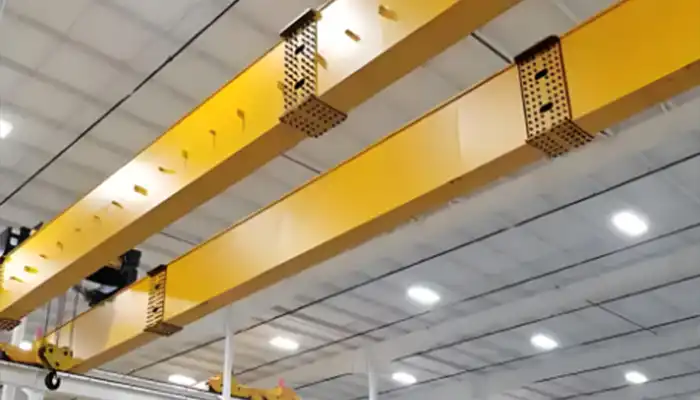
40 Ton Overhead Cranes for Heavy Engineering Workshops
Content Quick Link
Overhead Cranes for Heavy Engineering Workshops: What Makes a Design Suitable?
Summary Takeaway:
Here's your summary takeaway transformed into clear bullet points for the top of the article:
- Selecting an overhead crane for heavy engineering workshops requires more than just lifting capacity.
- Ensure load stability for long, uneven, or irregular components.
- Consider workshop layout constraints including low headroom, uneven columns, and obstacles.
- Use custom fixtures and beam spreaders for specialized lifting tasks.
- Integrate the crane with existing material handling systems for smooth workflow.
- Finalize key specifications: span, lifting height, duty class, control mode, and power supply.
- Plan for long-term maintenance and spare parts availability to maximize uptime.
- Proper planning upfront helps reduce costs, improve safety, and boost operational efficiency.
Introduction
Heavy engineering workshops deal with big, awkward, and often uneven loads every single day. That is why the 40 Ton overhead crane has become a common lifting choice across machinery manufacturing, fabrication yards, and large engineering plants. It delivers enough capacity to handle demanding lifts while still fitting into most workshop structures without major reconstruction. That balance matters more than many buyers realize.
Choosing the right 40 ton overhead crane design is not only about capacity. It is about making sure the crane can safely pick up long workpieces, handle heavy welded assemblies, and move them smoothly across a workshop that might already be crowded with machines, fixtures, and production lines. The wrong design creates bottlenecks. The right design improves workflow for years.
This guide explains what buyers should focus on when selecting a 40 Ton crane for heavy engineering environments. It breaks down real-world applications, the reasons why this capacity is so common, and the design points that directly affect performance and long-term reliability.
Role of Overhead Crane in Heavy Engineering Workshops
Typical Applications
A 40 Ton crane is used for far more than simply "lifting heavy stuff." In heavy engineering workshops, it supports a wide range of tasks where stability, reach, and precise movement make a real difference.
Key applications include:
- Handling machine frames and large welded structures
These workpieces are long, uneven, and sensitive to deformation, so the crane must keep them steady throughout the lift. - Lifting long beams, shafts, plates, molds, and irregular components
Workshops often deal with items that do not have a predictable center of gravity. Buyers need cranes that can handle shifting loads. - Loading and unloading CNC machines, boring mills, and machining centers
These machines usually sit close together, meaning the crane must offer good side and end approaches. - Supporting assembly lines in machinery and equipment manufacturing
The crane often performs repetitive lifting along a fixed path—precision, consistent speed control, and reliability matter here.
This variety of tasks is why the 40 Ton crane is considered a "workhorse" in heavy engineering settings. It covers a broad range of real operational needs without overburdening the building structure.
Why 40 Tons Is a Common Capacity
In many heavy engineering workshops, 40 tons sits in a practical sweet spot. It can lift heavy welded frames, medium-sized equipment bodies, and long fabricated components without pushing workshop limits. At the same time, the crane is still relatively easy to install compared to larger 50- or 60-ton units.
Why 40 tons is chosen so often:
- Strong enough for heavy-duty work
It covers the lifting requirements of machinery plants, fabrication yards, and repair workshops without being oversized. - Manageable structural impact
A 40 Ton overhead crane typically does not require extensive reinforcement of the building columns or runway beams, which helps control project costs. - Fits into most workshop heights and spans
Engineers can usually integrate a 40 Ton crane into existing bays with minor layout adjustments. - Efficient to operate and maintain
Components such as double-girder hoists, end carriages, and control systems are standardized and widely supported.
In short, many workshops choose a 40 Ton crane because it offers the right blend of capacity, stability, and adaptability for day-to-day heavy engineering tasks.
Buyer Concern 1: Stable Lifting of Long, Uneven, or Irregular Loads
When buyers in heavy engineering workshops choose a 40 Ton overhead crane, the first worry that usually comes up is stability. Long weldments, machine frames, shafts, plates, and irregular assemblies do not behave like compact blocks. They twist, swing, and shift weight unpredictably. If the crane design is not prepared for these conditions, daily operations become stressful and slow. In some cases, unsafe. This section explains the real challenges, the design requirements that solve them, and the questions every buyer should raise before finalizing a crane configuration.

Challenges
Long or uneven loads behave differently from standard lifting tasks. Even experienced operators can struggle when the crane design is not optimized for this kind of work.
Common challenges include:
- Load swing and deflection
Long beams or welded frames tend to flex under their own weight, especially when lifted from a single point or with a narrow trolley. This creates side sway and makes precision work harder. - Uneven center of gravity
Fabricated parts are rarely perfectly balanced. One end may be heavier, which causes tilting or rotating during the lift. - Maintaining horizontal stability over long spans
In workshops with wide bays, the crane must keep the load level while traveling long distances. Any imbalance becomes more noticeable and risky as the load moves farther from the pick-up point.
These issues are common, but they are manageable when the crane design is correct.
Design Requirements
To lift long or irregular loads safely, a 40 Ton overhead crane must incorporate design features that directly address stability and flexibility.
Key design requirements:
- Double-girder configuration for increased stiffness
This reduces bridge deflection and provides a stable platform for lifting long, heavy components. - Anti-sway systems or VFD-controlled motions
Smooth acceleration and deceleration help reduce swing, especially when dealing with awkward pieces. - Wider trolley gauge for better load distribution
A wider wheelbase on the trolley improves balance and reduces the risk of load tilt. - Optional two-hook or dual-trolley configuration
Two hooks allow the operator to support the load at multiple points, especially useful for long shafts, beams, or frames where a single hook will not maintain stability.
When these elements work together, the crane can handle long and uneven loads with far more consistency and safety.
What Buyers Should Ask Suppliers
To make sure the crane will perform safely in real workshop conditions, buyers should ask suppliers direct and practical questions—not just about capacity, but about stability.
Essential questions to ask:
- What is the maximum allowable deflection for long components?
This helps ensure the crane structure is stiff enough for precision handling. - What lifting points do you recommend for the workshop's typical load shapes?
A good supplier should provide guidance for fixture design, spreader beams, or lifting attachments. - Can the load test simulate uneven or irregular loads?
Many testing procedures use standard weights, but for heavy engineering workshops, a more realistic demonstration is often necessary.
Buyer Concern 2: Need for Custom Beam Spreaders or Lifting Fixtures
In many heavy engineering workshops, a standard hook is simply not enough. Long beams, fabricated frames, and complex assemblies require support at multiple points, otherwise the load bends, twists, or becomes unstable during lifting. This is why many buyers end up needing custom beam spreaders or lifting fixtures designed specifically for their products. The challenge is that fixtures do not work in isolation—they directly influence the crane's structural design, hook approach, and even motor sizing. Understanding how these elements connect will help buyers choose equipment that fits their daily operation, not just general lifting needs.
When Custom Fixtures Are Required
Some loads are simply too long, too flexible, or too irregular to lift safely with a single central hook. Even experienced riggers prefer fixtures that stabilize the load from the start.
Typical situations where custom fixtures are needed:
- Lifting long beams, welded frames, or fabricated assemblies
These items can bend under their own weight if not supported properly, causing stress on both the crane and the load. - Handling mixed shapes—rectangular, cylindrical, or asymmetrical
When every piece coming out of the workshop is different, a fixed hook arrangement becomes inefficient and risky.
Custom fixtures help maintain load geometry and reduce operator stress, especially during delicate positioning or turning operations.
Types of Fixtures
Buyers often have more options than they realize. Each type of fixture solves a different lifting challenge, and choosing the right one can dramatically improve workflow.
Common lifting fixture options include:
- Beam spreaders
These distribute load across two or more lifting points to prevent bending and improve stability. - Rotating spreaders
Useful when the load must be rotated during installation or assembly, such as positioning machine frames or pipe sections. - C-hooks, clamps, and lifting beams
Ideal for workshops handling coils, plate bundles, or components without easy attachment points.
In many cases, the supplier will design these fixtures alongside the crane to ensure compatibility and proper load handling.
Impact on Crane Design
Adding fixtures is not just a matter of choosing accessories; they change the entire lifting system. This is a point many buyers don't consider early enough in the project.
Key impacts include:
- Additional deadweight considerations
A heavy spreader or lifting beam adds its own weight to the total lifted load, reducing the margin between safe working load and actual load. - Required hook approach and lifting height
Spreaders increase the vertical and horizontal space required to pick up a load. Workshops with low ceilings or tight aisles must confirm that the crane can still reach all required positions. - Adjusting hoist motor power and drum length
Heavier fixtures or wider load distribution sometimes require stronger hoist motors, longer rope drums, or modified lifting speeds to maintain safe performance.
Discussing fixture requirements early helps avoid redesigns later and ensures the 40 Ton overhead crane works smoothly with the loads your workshop lifts every day.
Buyer Concern 3: Designing the Crane for Irregular Workshop Layouts
Many heavy engineering workshops were not originally built with large overhead cranes in mind. Machines get added over the years, production lines shift, and structural columns rarely follow a perfect grid. As a result, buyers often worry about whether a 40 Ton overhead crane can actually fit and move safely within a non-standard space. The good news is that with proper engineering adjustments, most irregular layouts can support a fully functional crane system—provided the right information is shared early in the design phase.
Layout Challenges
Workshops involved in fabrication and heavy machinery manufacturing often face layout constraints. These challenges can directly affect crane design, hook coverage, and even lifting safety.
Common layout issues include:
- Uneven column spacing
Older buildings or expanded workshops rarely maintain consistent spacing, which affects how the runway beam and end carriages are designed. - Limited headroom
Low ceilings, ventilation ducts, and overhead utilities can restrict lifting height and trolley design. - Obstructed areas due to tall machines or furnaces
CNC machining centers, welding stations, furnaces, and vertical boring mills often interfere with full-span crane movement. - Partial-span usage
Some workshops only need crane coverage in certain areas, requiring non-standard spans or modified runway lengths.
Understanding these constraints early helps avoid redesigns and ensures the crane fits the workflow instead of disrupting it.
Engineering Adjustments
Crane manufacturers can modify structural and mechanical designs to match complicated workshop layouts. These adjustments allow buyers to keep their existing building and still run a 40 Ton crane efficiently.
Possible engineering solutions include:
- Custom girder lengths and end carriage designs
Tailored spans help align the crane with irregular building grids and existing runway beams. - Asymmetric wheelbases
When columns or walls are unevenly spaced, the crane's wheelbase can be adjusted to reduce side forces and improve stability. - Reduced end approach
Short-end carriages or compact trolley frames allow the crane to travel closer to walls or machinery, maximizing available workspace. - Box-end girders for tighter spaces
These provide higher stiffness and better clearance when space is limited or when the crane must navigate around obstacles.
Each adjustment must be calculated carefully to maintain structural integrity and smooth movement along the runway.
What Buyers Should Prepare
A well-designed crane begins with accurate workshop information. The more detail you can provide, the better the engineering team can optimize the crane layout for your space.
Useful documents and materials include:
- Workshop drawings (DWG / PDF)
These show building dimensions, column spacing, machine positions, and runway options. - Photos and videos of critical areas
Visual references help engineers understand clearance issues or obstacles that do not appear in drawings. - Lifting flow diagrams
A simple sketch showing how materials move through the workshop helps determine the required coverage area and travel path.
Sharing these items early ensures your 40 Ton overhead crane is engineered specifically for your building, not adapted at the last minute.
Buyer Concern 4: Whether Low-Headroom Trolley Designs Are Needed
Not every heavy engineering workshop has the luxury of generous ceiling height. Many facilities—especially older production buildings—were not designed with modern 40 Ton cranes in mind. Because of this, buyers often wonder whether a low-headroom trolley design is necessary to achieve the lifting height they need without rebuilding parts of the workshop. In many cases, the answer depends on the actual clearance above the crane runway and the vertical space required for the heaviest lifts.
When Low-Headroom Is Essential
Low-headroom trolley designs become critical when a workshop has tight vertical space or varying lifting height requirements. These environments can severely limit the crane's operating envelope unless the hoist and trolley are engineered to fit within tighter dimensions.
Common situations where low-headroom is required include:
- Workshops with low building height
In older fabrication and machinery plants, ceiling height is often fixed and cannot be increased, making every centimeter of lifting height matter. - Areas where lifting height varies dramatically
Some production zones may require deeper hooks for assembling tall equipment, while other zones have ducting or beams that restrict headroom. - Retrofitting cranes into old buildings
When a new 40 Ton crane replaces an older unit, the existing structural steel may restrict the space available for modern hoist systems.
A quick headroom assessment early in the planning stage helps avoid expensive structural modifications later.
Low-Headroom Options
Crane manufacturers can provide different trolley and hoist configurations to fit into tight spaces. Each option works best in specific building layouts or lifting workflows.
Common low-headroom solutions include:
- Compact European-style hoists
These hoists use a short drum and compact motor placement to reduce the distance between the hook and the beam. - Low-headroom double-rail trolleys
For 40 Ton lifting, this design allows the hoist to sit between the girders, maximizing lifting height without compromising load stability. - Side-mounted hoisting mechanisms
The hoist is mounted beside the girders rather than below them, creating additional clearance when every millimeter counts.
These options help ensure that even in restricted workshops, the crane performs at full capacity.
Benefits
Choosing a low-headroom design does not just solve clearance issues. It can also improve overall workflow and reduce project cost.
Key advantages include:
- More usable lifting height
This is especially important when handling tall machinery, deep weldments, or large fabricated assemblies. - Reduced need to modify building structure
Avoiding roof raises, beam relocations, and ductwork changes can save significant time and cost. - Shorter installation time
Low-headroom cranes often integrate more compact components, allowing quicker alignment and commissioning.
Buyer Concern 5: Integration with Existing Material Handling Systems
In heavy engineering workshops, a 40 Ton overhead crane rarely works alone. Most facilities already operate an ecosystem of handling equipment, and buyers want assurance that the new crane will fit smoothly into the existing workflow. Poor integration can slow production, cause control conflicts, or even introduce safety risks. A well-planned integration ensures the 40 Ton crane supports the entire material flow of the plant—not just single lifting tasks.
Typical Systems in Heavy Engineering
Large engineering shops rely on multiple types of handling equipment, each serving a different stage of production. Understanding what already exists is the first step in planning a 40 Ton crane installation.
Common systems that must be coordinated with the new crane include:
- Floor conveyors
Used to transport heavy frames, weldments, or partially completed assemblies across long distances. - Transfer carts
Often handle finished or semi-finished structures that need precise placement under the crane. - Jib cranes
Installed near workstations for lighter, more localized lifting tasks; they must not interfere with bridge travel. - Gantry cranes in adjacent bays
Movement between bays needs clear zoning to avoid collisions, especially when handling oversized components. - Chain hoists at workstations
Used for fine adjustments or smaller parts that accompany large assemblies lifted by the main crane.
Each system has its own operating pattern, and the overhead crane should complement—not disrupt—the flow.
Integration Requirements
To ensure seamless operation, the 40 Ton overhead crane must match or coordinate with the performance and control standards of the equipment already in place.
Key integration requirements include:
- Matching travel speeds and control logic
The crane's trolley and bridge speed should align with surrounding systems to avoid bottlenecks during assembly or line movement. - Centralized or remote control systems
Many modern plants use unified control stations. The crane must be compatible with wired or wireless systems that supervise multiple machines. - Synchronization when multiple cranes share a bay
Shared bays often require cranes to operate in coordinated zones, especially during crossover movements or tandem lifts involving smaller cranes.
Well-planned integration avoids abrupt movements, misalignment issues, and potential operational conflicts.
Safety & Control Considerations
When multiple handling systems operate in the same workshop, safety becomes even more critical. Buyers need clear strategies to protect equipment, loads, and people.
Essential safety and control features include:
- Anti-collision sensors
Prevents the 40 Ton crane from approaching gantry cranes, jib cranes, or other overhead cranes in the same runway. - Zone control
Divides the workshop into active and restricted areas. The crane automatically limits its travel when entering sensitive zones. - Load sharing between cranes (for tandem lifts)
When lifting oversized assemblies, two cranes may need to work together. Proper load-sharing controls ensure synchronized movement and prevent dangerous load imbalance.
Key Specifications Buyers Should Finalize Before Ordering
Before committing to a 40 Ton overhead crane, buyers should clearly define the technical specifications. These details determine the crane's performance, cost, and long-term reliability. A well-prepared specification sheet also helps suppliers design a crane that fits your workshop layout and operational needs without costly revisions later.
Rated Capacity
The first and most important question is whether your operation needs a fixed 40 Ton hook or a 40/10 dual-hook system.
- 40 Ton single hook
Suitable for general heavy lifting such as machine frames, molds, or fabrication assemblies. - 40/10 dual-hook configuration
Allows the main 40 Ton hook to handle heavy items while the auxiliary 10-ton hook manages smaller positioning tasks. Useful for workshops that frequently rotate, flip, or precisely align components.
Span and Lifting Height
The crane must match the actual workshop dimensions—incorrect sizing leads to structural changes or installation delays.
- Span (center-to-center runway distance)
Required for ensuring smooth bridge travel across the full bay. - Lifting height
Critical for handling tall equipment, assembly tasks, or stacking operations. Buyers should check clearance above oversized components like vertical machining centers or welding fixtures.
Duty Class (ISO / FEM / CMAA)
The duty class defines how intensively the crane can be used. Heavy engineering shops often require mid- to high-duty ratings.
- ISO / FEM standards
FEM 2M / 3M or ISO M5 / M6 depending on load frequency. - CMAA
Class D or E for more demanding applications.
Selecting the correct duty class avoids premature wear and ensures stable lifting performance.
Required Lifting Speed and Travel Speed
Speed selections depend on load characteristics and workflow expectations.
- Hoisting speed
Faster speeds improve productivity but must still allow safe handling of uneven or long components. - Trolley speed
Should be matched with the workshop's layout, especially if precise positioning is required. - Bridge travel speed
Higher speeds help with long-distance movement across large bays.
Variable frequency drives (VFD) are often recommended for smooth acceleration and better load control.
Control Mode: Pendant, Remote, or Cabin
Each control option fits different working environments.
- Pendant control
Simple and reliable for general workshops. - Remote control
Offers flexible movement, clear visibility, and safer distance from hazardous lifting zones. - Operator cabin
Used for long-distance operations or high-lift applications, especially in heavy engineering yards.
Selecting the right control mode improves safety and daily workflow.
Power Supply Requirements
Buyers should confirm the plant's electrical conditions:
- Common options include 380V, 400V, 415V, 440V, depending on region
- Frequency: 50 Hz or 60 Hz
- Phase: usually three-phase industrial supply
Mismatched voltage can lead to overheating, control failures, or motor damage, so clarity is essential.
Environmental Conditions
A 40 Ton crane in a heavy engineering workshop must operate safely under various conditions.
- Dust from grinding, cutting, or machining
- Heat from furnaces, welding stations, or nearby machinery
- Welding fumes affecting electrical cabinets or sensors
- Outdoor exposure if the crane works in partially open bays
Buyers should specify any environmental risks so suppliers can apply the right protections—sealed motors, heat-resistant cables, dust-proof panels, or corrosion-resistant coatings.
Cost Implications of Customized Designs
When planning a 40 Ton overhead crane, buyers quickly realize that customization affects the overall budget. While tailored features are often necessary for heavy engineering workshops, each added specification—whether for safety, workflow, or space constraints—can increase the cost. Understanding which factors drive price and where savings are possible helps buyers make informed decisions.
Factors Increasing Cost
Several design choices directly impact the cost of a 40 Ton crane. The more specialized the solution, the higher the initial investment.
Key cost-driving factors include:
- Custom fixtures
Beam spreaders, rotating spreaders, or specialized clamps require extra engineering and manufacturing time. - Low-headroom hoist design
Compact hoists or European-style low-headroom trolleys involve more sophisticated mechanics to fit restricted vertical space. - Asymmetric girder or special end carriages
Non-standard structural components tailored to irregular workshop layouts increase fabrication complexity. - Higher duty classification
Selecting a duty class beyond what is operationally necessary adds to the crane's structural reinforcement, motors, and control system costs. - Advanced automation or anti-sway systems
Features such as variable frequency drives (VFDs), remote control, or anti-sway devices improve precision and safety but add to the price.
Areas to Optimize for Cost Control
Not all customizations are strictly necessary. Smart buyers can control costs by balancing functionality with standard solutions.
Practical strategies include:
- Standardizing as many components as possible
Using standard trolleys, hooks, hoists, and control panels reduces manufacturing and maintenance costs. - Sharing runways with existing cranes
Integrating the 40 Ton crane onto existing runway structures avoids expensive new construction. - Choosing the right duty class
Avoid over-engineering by selecting a duty classification that meets actual operational frequency rather than building in excessive safety margins.
By evaluating which features are essential and which can follow standard designs, buyers can achieve a balance between performance, safety, and budget.
Practical Tips for Heavy Engineering Buyers
Buying a 40 Ton overhead crane for heavy engineering workshops is not just about picking capacity and span. There are many practical details that can affect safety, efficiency, and long-term operation. Smart buyers focus on real-world issues that may not appear in basic specifications.
Load Planning
Proper load planning ensures that the crane can handle all types of components safely, especially long or irregular items.
- Provide load diagrams for typical long items
Include weights, lengths, lifting points, and center-of-gravity positions so the supplier can recommend optimal crane configurations. - Specify lifting frequency and flow
Understanding how often items are lifted helps determine duty class, hoist speed, and optional features like anti-sway or dual hooks.
Structural and Mechanical Verification
Crane performance depends on how well its structure and mechanisms are engineered for your specific loads and layout.
- Ask for girder deflection reports
Ensure the bridge beam can handle maximum loads with minimal deflection, maintaining stability and safety. - Request a 3D layout visualization before manufacturing
Helps confirm clearances, runway integration, and obstacle avoidance in complex workshops.
Maintenance and Operation Planning
Long-term reliability depends on spare parts availability and proper operation.
- Confirm spare parts availability for at least 10 years
This ensures minimal downtime and easier maintenance over the crane's lifespan. - Check whether onsite installation and operator training are included
Proper installation and operator knowledge are crucial for safe and efficient crane operation, especially with specialized features like low-headroom trolleys or dual-hook systems.
Final Advice
Paying attention to these practical tips can save significant time and cost in the long run. A crane that is technically capable but not optimized for your workshop layout, load types, or operational flow may create more headaches than it solves.
By preparing detailed load information, verifying structural performance, and confirming long-term support, buyers ensure that a 40 Ton overhead crane is a true asset for their heavy engineering operations.
Conclusion
Choosing a 40 Ton overhead crane for a heavy engineering workshop is about more than just lifting capacity. The right crane combines structural rigidity, customized features, and compatibility with your specific workshop layout. Long beams, heavy assemblies, and irregular components demand careful engineering to maintain safety and efficiency during everyday operations.
Buyers must consider not only the crane's rated capacity but also design variations like dual-hook systems, low-headroom trolleys, anti-sway devices, and custom beam spreaders. Every adjustment—from girder length to hoist selection—affects performance and long-term reliability. Ignoring these details can lead to operational delays, unnecessary maintenance costs, or even safety risks.
Practical advice: Consult with a qualified crane manufacturer who can evaluate your workshop, review your load types and material flow, and propose a tailored solution. A well-engineered 40 Ton overhead crane will not only handle your heaviest items safely but also optimize workflow, reduce downtime, and provide reliable service for years to come.

Article by Bella ,who has been in the hoist and crane field since 2016. Bella provides overhead crane & gantry crane consultation services for clients who need a customized overhead travelling crane solution.Contact her to get free consultation.
Free consultation to Confirm Parameters & Specifications and Get
Latest Crane Price & Crane Rate.
- Types of overhead cranes : _______?
- Optional: Overhead travelling crane, goliath gantry crane,Slewing jib crane, Single girder or double girder crane,small portable crane or kbk crane, etc.
- Capacity of overhead crane: _______?
- Optional: 0.25ton, 0.5 ton, 1 ton, 2 ton, 3ton, 5 ton, 10 ton,15ton, 20ton, 25 ton, 30ton,35ton, up to 550ton, etc.
- Crane span & lifting height : _______?
- Crane travelling length : _____?
- Control of overhead crane:_______?
- Optional: pendant/ remote/cabin control
- Voltage supply of overhead crane:_____?
- Eg,: 380V50/60HZ,3Phase or others,etc.
- Application/usage of crane:_______?
- Eg,: Steel mill, ,injection mold, cement,stone, concrete,granite, general manufacturing, etc.
Just leave a message via the contact form and our hoist and crane engineer will contact you with in 24working hours.
Get In Touch