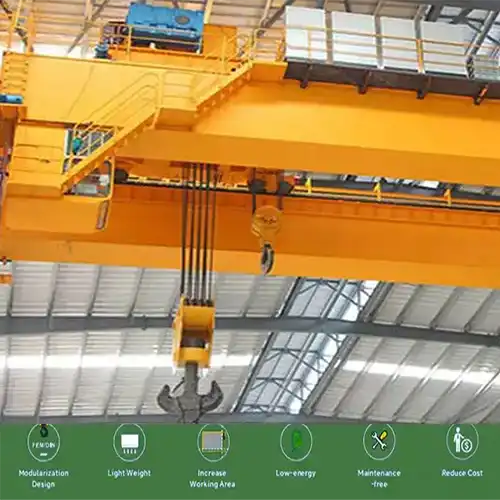
Overhead Cranes for Indian Steel Industry – Heavy Duty Eot Cranes
A practical guide to selecting, engineering & importing steel mill overhead travelling cranes for Indian steel plants, rolling mills & casting facilities.
| Crane Type | Steel mill heavy duty overhead cranes |
| Crane Capacity | 3 ton to 320 ton |
| Crane Span | As your request |
| Lifting Height | Customized. |
| Application | Material handling, lifting, positioning, assembly, maintenance, loading/unloading, |
| Certifications | CE / ISO / SGS / Other third-party inspection |
| Customization | Customized material handling cranes solutions available for indoor, outdoor, hazardous, corrosive, cleanroom, and heavy-duty industrial applications. |
Category: India
Tags: India
Overhead Cranes for India's Steel Industry – Complete Guide
A Practical Guide to Selecting, Engineering, and Importing Overhead Cranes for Indian Steel Plants, Rolling Mills, and Casting Facilities.
Overhead Cranes for India's Steel Industry: A Complete Procurement & Engineering Guide for Integrated Steel Plants, Rolling Mills, and Casting Facilities
If you are purchasing an overhead crane for an Indian steel plant, the decision must go beyond simple lifting capacity. The right crane depends on plant type, duty classification, heat environment, and production frequency. Choosing incorrectly can disrupt production, increase maintenance costs, and create safety risks.
In India's expanding steel industry, the wrong crane specification can lead to:
- Unplanned downtime and production delays
- Premature brake, gearbox, or hoist failures
- Safety compliance issues in high-risk metallurgical operations
- Higher long-term maintenance and lifecycle costs
The right metallurgical overhead crane ensures:
- Continuous production stability across BOF, LF, and rolling mill operations
- Compliance with ISO, FEM, and DIN standards
- Safe handling of molten steel and heavy slabs
- Long-term reliability with reduced maintenance and operational risk
Key Takeaways for Steel Plant Buyers
- Integrated steel plants need heavy-duty FEM A7–A8 steel mill cranes, not standard EOT cranes.
- Rolling mills typically use 15–32 ton overhead cranes, but specifications must match actual duty cycles.
- Ladle cranes with 100–350 ton capacity require redundant braking, heat-resistant motors, and insulation systems.
- High-demand steel clusters in Odisha, Jharkhand, Gujarat, and Karnataka represent the prime zones for crane procurement.
- EPC-driven projects provide opportunities for early crane specification involvement and larger contract scope.
- Lifecycle cost matters more than initial price when selecting metallurgical cranes.
- ISO, FEM, and DIN compliance simplifies importing overhead cranes into India and reduces integration risk.
In short, the crane you choose directly impacts production continuity, safety, and long-term efficiency. Selecting carefully ensures smooth operations and reduces costly downtime in India's growing steel sector.
Questions This Guide Solves
- What type of overhead crane is required for BOF, LF, and continuous casting shops?
- What is the typical crane capacity used in Indian rolling mills?
- Where are the major steel mill locations in India with crane demand?
- What technical standards apply to steel mill cranes in India?
- How do I select between double girder and four girder ladle cranes?
- What should Indian buyers verify before importing a steel mill crane from China?
- Which plant types offer the best opportunity for heavy-duty overhead crane supply?
Overview of India's Steel Industry and Its Impact on Overhead Crane Demand
India is now the world's second-largest crude steel producer. Annual production is over 160 million tons and still growing. That growth is not just good news for the steel sector. It directly drives demand for overhead cranes in steel plants. When steel production increases, lifting demand increases. More furnaces. Heavier ladles. Faster casting. Longer operating hours. All of this means cranes must work harder and longer every day. An overhead crane for the India steel industry is not a light workshop tool. It moves molten steel, slabs, billets, and coils. It supports production in high-temperature, high-risk areas. In many cases, the crane runs 18 to 24 hours a day. Simply put, higher steel output means higher crane requirements.
Integrated Steel Plants and Rolling Mills
India is building new steel plants and expanding existing ones. Integrated steel plants are increasing BOF furnace capacity. Rolling mills are upgrading production lines. Continuous casting machines are operating at higher speeds. This directly affects crane specifications. When production expands, cranes must have:
- Higher lifting capacity
- Stronger structure with lower deflection
- Higher duty class (A6–A8 under FEM standards)
- Reliable braking systems
- Better heat protection
- Brakes wear faster
- Gearboxes overheat
- Motors fail earlier
- Maintenance cost rises
Growth of Private Steel Manufacturers
In states like Gujarat, Karnataka, Maharashtra, and Odisha, private steel companies are expanding quickly. These newer plants are often more automated and more focused on efficiency. Private steel plant buyers typically look at:
- Total lifecycle cost
- Spare parts availability
- Technical documentation quality
- Compliance with ISO and FEM standards
- Long-term maintenance planning
Modernization of BOF and Continuous Casting Units
Many Indian steel plants are upgrading BOF shops, LF refining units, and continuous casting machines. These are high-temperature, heavy-duty areas inside the plant. Crane requirements in these zones usually include:
- 100 to 350 ton ladle cranes
- Charging cranes for scrap or hot metal
- Casting cranes with synchronized lifting
- Heavy-duty four girder bridge cranes
- Dual braking systems for safety
- Heat-resistant motors and electrical parts
- Insulated operator cabins
- Anti-sway control systems
- A7 or A8 working classification
Why Steel Production Capacity Determines Crane Specification
The size of a steel plant directly determines the crane design. When production increases, it leads to:
- More lifting cycles per hour
- Heavier average loads
- Longer daily working time
- Higher ambient temperatures
- Stricter safety supervision
- Required lifting capacity
- Crane duty class
- Brake configuration
- Motor cooling system
- Steel structure fatigue rating
- Electrical protection level
- Maximum load weight
- Daily lifting frequency
- Furnace temperature in working area
- Required working class
- Future expansion plans
Summary
India's steel production growth is directly increasing demand for heavy-duty overhead cranes. Expansion of integrated steel plants, modernization of BOF and CCM units, and growth of private steel companies all require stronger, safer, and higher-class lifting systems. In a steel plant, cranes are not optional equipment. They are part of the production flow. When steel output rises, crane performance must rise with it.
Major Steel Mill Locations in India: Where Crane Demand Is Concentrated
India's steel industry is geographically concentrated. Plants cluster near iron ore mines, coal belts, ports, and industrial corridors. Understanding these locations is essential for crane buyers, as it determines the type of cranes needed, duty classification, and regional service requirements.
Eastern India – Integrated Steel and Metallurgical Crane Demand
Eastern India is the traditional steel belt of the country, home to India's oldest and largest integrated steel plants. These facilities are often high-capacity, continuously operating, and require heavy-duty metallurgical cranes to handle molten steel and slabs safely and efficiently. Key States:
- Odisha
- Jharkhand
- Chhattisgarh
- West Bengal
- Large blast furnace operations
- BOF-based steelmaking
- Continuous casting lines
- High-capacity slab production
- Ladle cranes: 100–350 tons
- Heavy-duty A7–A8 duty class steel mill cranes
- Four-girder bridge cranes
- Slab yard bridge cranes
Western India – Expansion and Port-Based Steel Production
Western India has become a major hub for modern, private steel production. Many plants here are export-oriented and rely on ports for raw material import and steel shipments. The demand here focuses on newer, technologically advanced cranes for both production and logistics. Key States:
- Gujarat
- Maharashtra
- Karnataka
- Modern private steel plants
- Export-focused slab and coil production
- EPC-managed plant expansions and new construction
- Casting cranes for modern furnaces
- Slab handling cranes
- Double girder EOT cranes
- Coil yard cranes
Southern India – Rolling Mills and Medium-Capacity Crane Demand
Southern India hosts a variety of medium-sized steel plants, including rolling mills and fabrication units. While these plants handle less molten steel than integrated plants, their operations still require dependable overhead cranes for daily production tasks. Key States:
- Karnataka
- Andhra Pradesh
- Tamil Nadu
- Rebar and billet rolling mills
- Section mills
- Medium-scale fabrication plants
- 15 ton overhead crane
- 20 ton overhead crane
- 32 ton double girder bridge crane
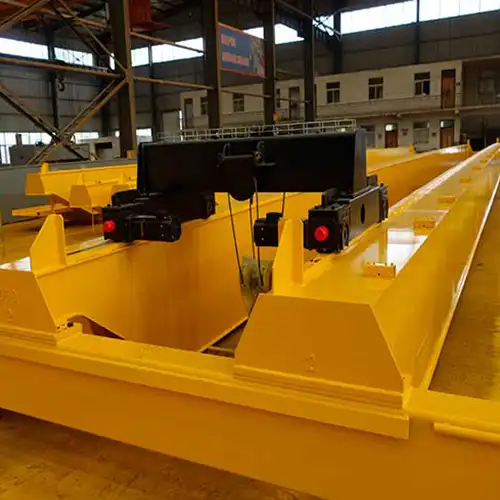
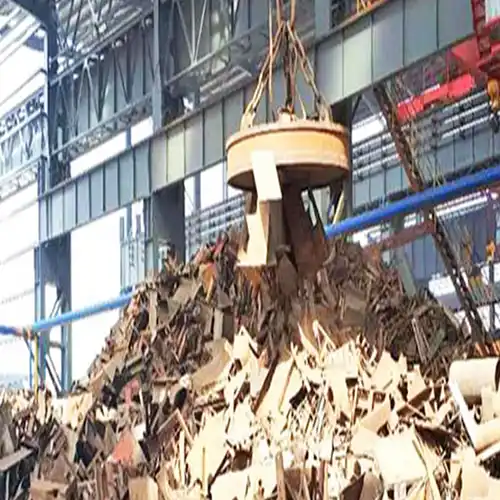
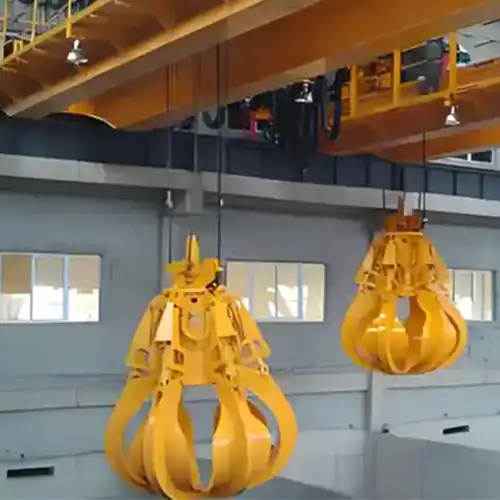
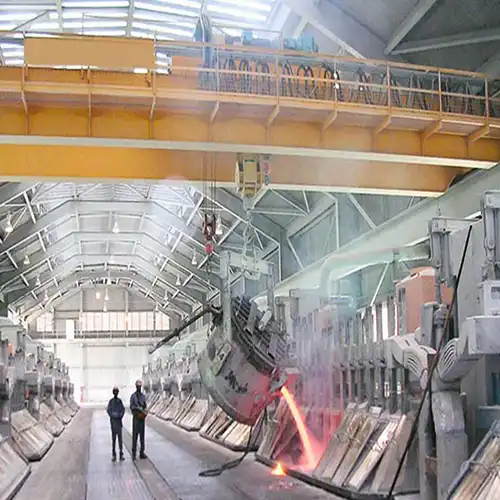
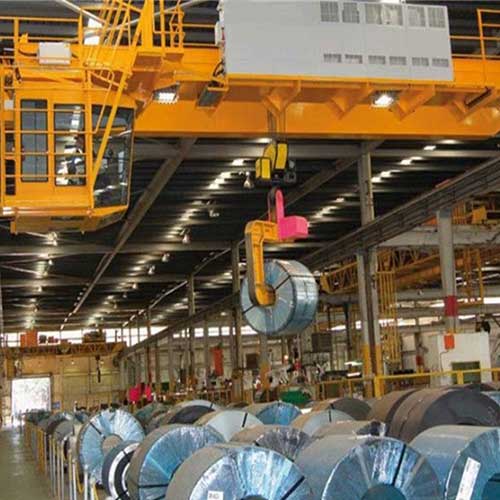
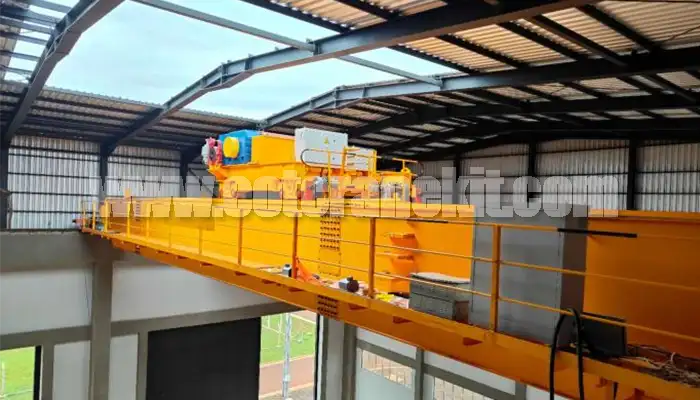
Tailored overhead cranes solutions for steel mill industrial sectors, all types of steel mill cranes for various loads handling, such as steel scrap, ladle, billet, steel coil, steel pipe, beam , plate handling, etc.
Matching Steel Plant Type with the Correct Overhead Crane
Choosing the right overhead crane begins with understanding the type of steel plant and the specific lifting tasks it performs. Each plant has unique operations, and not all cranes are built the same. Matching the crane to the plant ensures safety, operational efficiency, and long-term reliability.
Integrated Steel Plants
Integrated steel plants are the largest and most complex facilities in India. They handle everything from raw iron to finished slabs, so they require heavy-duty cranes capable of moving molten steel, large ladles, and slabs safely and continuously. Operations:
- BOF shop (handling molten steel)
- LF shop (refining and alloying)
- Continuous casting machine (CCM)
- Slab yard
- Ladle crane (100–350 tons): Moves molten steel safely between furnaces and casting units
- Charging crane: Feeds scrap and raw materials into furnaces
- Casting crane: Supports continuous casting operations
- Four-girder metallurgical crane: Handles very heavy loads with high stability
- Dual braking system for critical lifts
- Heat-resistant insulation to protect motors and electrical components
- FEM A7–A8 duty class for continuous heavy lifting
- Redundant safety systems for operator and plant protection
Rolling Mills
Rolling mills shape steel into bars, billets, and sections. The loads are smaller than in integrated plants, but operations are frequent and often continuous, requiring precise medium-capacity cranes. Operations:
- Billet reheating
- Bar rolling
- Section rolling
- 15 ton overhead crane
- 20 ton overhead crane
- 32 ton workshop crane
- Electromagnetic lifting for steel billets
- Grab bucket system for bulk material
- Heavy-duty hoist systems for frequent lifting
Continuous Casting Units (CCM)
Continuous casting units turn molten steel into slabs, blooms, or billets. Here, precision is critical because any vibration or misalignment can affect product quality. Cranes in CCM areas must provide smooth, controlled operation under high temperatures. Operational Requirements:
- Smooth variable speed control to match casting speed
- Synchronized lifting mechanisms for balanced loads
- Precision positioning for accurate slab transfer
- Heat-protected trolley systems for furnace proximity
- 50–180 ton casting crane
Steel Service Centers and Coil Processing Plants
These facilities handle finished steel products rather than molten metal. Cranes here focus on moving coils, sheets, and processed steel efficiently while minimizing damage to valuable inventory. Applications:
- Slitting lines
- Pickling units
- Galvanizing plants
- Coil warehouses
- 10–32 ton EOT cranes
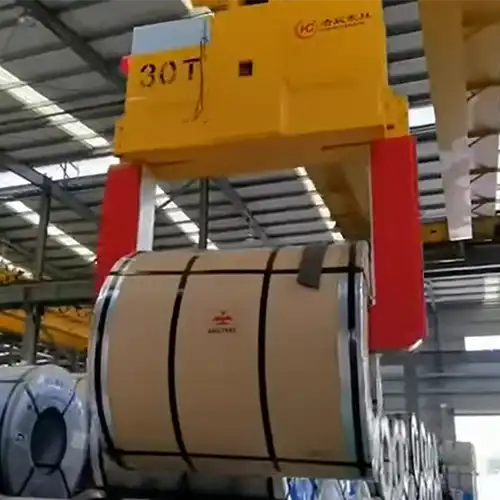
- C-hook cranes for safe coil handling
- Double girder overhead cranes for heavier coil loads
Engineering Standards and Compliance Requirements for Steel Mill Cranes in India
When buying a steel mill crane in India, understanding engineering standards and compliance requirements is critical. A crane is not just a lifting device—it is a core part of production. If it is under-specified, the results are costly: downtime, safety risks, and higher maintenance costs. Standards help buyers choose cranes that can handle the extreme conditions of steel production, including heat, heavy loads, and continuous operation. Following recognized standards ensures compatibility, reliability, and long-term service life.
FEM Duty Classification (A5–A8)
FEM (Fédération Européenne de la Manutention) duty classes define the intensity and frequency of crane operation. For steel mill applications:
- A5–A6: Medium duty, suitable for smaller workshops or light billet handling
- A7–A8: Heavy duty, designed for continuous operation in integrated steel plants, including BOF, LF, and CCM operations
ISO and DIN Compatibility
Cranes supplied to Indian steel plants should comply with:
- ISO standards for quality, safety, and structural design
- DIN standards for load-bearing components and mechanical reliability
Heat Protection Standards
Steel mills are high-temperature environments. Cranes in furnace bays or near casting lines must withstand radiant heat and ambient temperatures that can exceed 50–60°C. Key heat protection features include:
- Insulated motors and gearboxes
- Heat-resistant electrical wiring and panels
- Protective covers for hoists and trolleys
Brake Redundancy Requirements
For metallurgical cranes, brakes are a safety-critical component. Recommended features:
- Dual independent braking systems for critical lifts
- Emergency mechanical brakes
- Brake monitoring for wear and performance
Structural Deflection Limits
Bridge and gantry cranes must maintain stability under load. Excessive deflection can lead to:
- Misalignment of trolleys and hoists
- Uneven wear on wheels and rails
- Safety hazards during lifting
Buyer Takeaway
Understanding and enforcing these engineering standards prevents under-specification and long-term production risk. When evaluating suppliers for metallurgical cranes, Indian buyers should confirm:
- FEM duty class matches operational intensity
- ISO/DIN compliance of all critical components
- Heat-resistant design for furnace and casting areas
- Redundant braking systems
- Structural limits for load stability
Typical Crane Capacities Used in Indian Steel Applications
Selecting the correct crane capacity is a crucial decision for steel plants in India. Over-sized cranes increase upfront cost, while under-sized cranes can lead to frequent downtime, higher maintenance, and even safety risks. The choice depends on plant type, lifting operations, and load characteristics. Indian steel mills, whether rolling mills, integrated plants, or coil processing units, require cranes designed to match their production scale and duty cycle. Here's a practical guide to typical crane capacities and how they are used in Indian steel operations.
15 Ton Overhead Crane
For small to medium loads, a 15 ton overhead crane is often used in workshops and rolling mill support areas. These cranes may seem modest, but they must be reliable, as frequent handling of billets, small slabs, or maintenance equipment can quickly wear out under-specification. Typical Applications:
- Moving machinery and tools in maintenance bays
- Handling billets or small slabs in rolling mill support areas
20–32 Ton Overhead Crane
Medium-capacity cranes in the 20 ton overhead cranes–32 ton overhead cranes range are widely used across rolling mills and steel service centers. These cranes handle billets, sections, and medium-size slabs and are often equipped with double girder designs for increased stability and lifespan. Typical Applications:
- Transferring billets between reheating furnaces and rolling lines
- Handling medium-size slabs or sections
- Supporting coil storage and warehouse operations
50–100 Ton Overhead Crane
For heavier loads, slab yards, and medium casting operations, cranes in the 50–100 ton and above overhead crane for heavy lifting range are essential. These cranes operate frequently, moving slabs, billets, and semi-finished products across large distances inside the plant. Typical Applications:
- Transferring slabs from casting machines to storage yards
- Supporting medium casting operations in BOF and LF shops
- Handling heavy billets in integrated steel plants
100–350 Ton Ladle Crane
At the top end of steel mill operations, ladle cranes carry molten steel between BOF, LF, and casting units. These cranes are the backbone of metallurgical operations and must function under extreme heat, heavy loads, and continuous cycles. Typical Applications:
- Molten steel transfer in BOF and LF operations
- Handling large ladles continuously during casting
- Supporting full-scale metallurgical production
Importing Overhead Cranes into India: What Buyers Must Evaluate
For Indian steel plants, importing a steel mill crane from abroad can be an efficient way to access advanced technology, higher lifting capacities, and reliable performance. However, buyers must carefully evaluate suppliers and technical details to ensure the crane integrates smoothly into local operations. Overhead cranes sourced from China, for example, are widely used in India, but selecting the right CE-certified crane requires more than just reviewing specifications. Before placing an order, buyers should confirm that the supplier provides comprehensive documentation and clear technical guidance. This ensures the crane will meet site conditions, plant production requirements, and safety standards.
Key Evaluation Points
- Design and Drawings: Verify general arrangement drawings and detailed layout plans. These confirm that the crane fits the plant's structural beams, workshop dimensions, and rail alignment.
- Electrical and Control Systems: Electrical schematics and wiring diagrams should be provided. For overhead cranes imported into India, compatibility with local power supply, voltage, and frequency is essential.
- Inspection and Certification: Third-party inspection reports and load test certifications ensure the crane has been manufactured and tested according to international standards. A CE-certified crane for India demonstrates compliance with European safety and quality norms, providing extra assurance.
- Manufacturing and Delivery: Understand the manufacturing lead time and shipping schedule. Delays in delivery can disrupt plant expansion or modernization timelines.
- Spare Parts and Maintenance: A clear spare parts plan helps prevent unexpected downtime. Buyers should confirm availability, shipping, and expected replacement intervals.
- Installation Coordination: Coordinate with local contractors or suppliers for crane installation. Even CE-certified cranes require proper alignment, commissioning, and operator training to function optimally.
Why This Matters
Careful evaluation minimizes the risk of mismatch between the imported crane and Indian site conditions. This protects production schedules, reduces maintenance challenges, and ensures safety. By confirming technical documentation, inspection certificates, and installation support in advance, buyers can confidently select an overhead crane supplier from China that delivers long-term reliability and compliance. This process ensures that imported steel mill cranes integrate seamlessly into Indian plants, supporting everything from ladle handling in BOF shops to slab transfers in rolling mills.
Why Chinese Steel Mill Crane Manufacturers Are Competitive in India
For Indian steel mills looking to upgrade or expand their crane infrastructure, Chinese steel mill crane manufacturers have become a reliable and practical choice. They combine technical expertise with cost-efficient solutions, making them appealing to procurement teams across integrated plants, rolling mills, and coil processing facilities.
Cost-Performance Advantage
Chinese manufacturers offer competitive pricing without compromising quality. This allows Indian steel buyers to procure high-capacity cranes—such as double girder overhead cranes—while keeping project budgets under control. Cost-effectiveness is particularly important for medium to large-scale expansions and modernization projects.
Custom Engineering Flexibility
One major strength of metallurgical crane suppliers from China is their ability to provide customized solutions. They can tailor cranes for:
- Ladle handling in BOF/LF shops
- Casting operations in CCM units
- Slab and coil handling in yards and warehouses
Large-Tonnage Crane Manufacturing Capability
Chinese manufacturers are capable of producing heavy-duty cranes with capacities up to 350 tons or more. This makes them suitable for integrated steel plants, where ladle cranes, casting cranes, and four-girder metallurgical cranes are essential for daily operations. Buyers in India benefit from proven large-tonnage solutions without relying on multiple suppliers.
International Standards Compliance
Most leading Chinese suppliers design and manufacture cranes that comply with ISO and FEM standards, ensuring compatibility with international safety, quality, and engineering norms. Compliance simplifies integration into Indian plants and reduces risk during inspection and commissioning.
Experience in Heavy-Duty Metallurgical Applications
China has decades of experience in metallurgical crane applications, including BOF, LF, CCM, and rolling mill operations. This expertise ensures that cranes are engineered to withstand extreme heat, heavy loads, and continuous production cycles—critical requirements for Indian steel mills.
Why It Matters for Buyers
By choosing a China steel mill crane manufacturer or metallurgical crane supplier, Indian buyers gain:
- Cost-effective, high-capacity cranes
- Custom-engineered solutions for plant-specific operations
- Compliance with international standards
- Proven experience in heavy-duty steel applications
- Reliable long-term performance with reduced downtime
FAQ – Questions This Guide Solves
This section answers the most common questions Indian steel mill crane buyers face, helping procurement teams make informed decisions when selecting and sourcing overhead cranes.
Q1: What type of overhead crane is required for BOF, LF, and continuous casting shops?
Integrated steel plants require heavy-duty metallurgical cranes. BOF and LF shops typically use 100–350 ton ladle cranes with dual brakes and heat protection. Continuous casting units (CCM) use 50–180 ton casting cranes with precise positioning, synchronized lifting, and heat-resistant trolleys.
Q2: What is the typical crane capacity used in Indian rolling mills?
Rolling mills generally use medium-capacity cranes ranging from 15 to 32 tons. These cranes handle billets, bars, and sections, often equipped with double girders, electromagnetic lifting, or grab systems for efficiency and reliability.
Q3: Where are the major steel mill locations in India with high crane demand?
Crane demand is concentrated in:
- Eastern India: Odisha, Jharkhand, Chhattisgarh, West Bengal (large integrated steel plants like Tata Steel and SAIL)
- Western India: Gujarat, Maharashtra, Karnataka (port-based, modern private plants like JSW Steel, AMNS India)
- Southern India: Karnataka, Andhra Pradesh, Tamil Nadu (rolling mills and medium-capacity steel plants)
Q4: What technical standards apply to steel mill cranes in India?
Buyers should ensure compliance with:
- FEM duty classification (A5–A8) for operational intensity
- ISO and DIN standards for structural and mechanical reliability
- Heat protection and insulation standards for furnace areas
- Redundant braking and safety systems for operator protection
Q5: How do I select between double girder and four girder ladle cranes?
The choice depends on load capacity and plant operations:
- Double girder cranes: Efficient for medium-heavy loads (up to 180 tons), suitable for slab handling or medium casting units
- Four girder cranes: Provide maximum stability for extreme loads (100–350 tons), ideal for ladle cranes in BOF and LF shops
Q6: What should Indian buyers verify before importing a steel mill crane from China?
Verify:
- General arrangement and electrical drawings
- Load test and third-party inspection certificates
- Manufacturing lead time and delivery schedule
- Spare parts availability and maintenance support
- Installation coordination and compatibility with Indian site conditions
Q7: Which plant types offer the best opportunity for heavy-duty overhead crane supply?
The highest-value opportunities are in:
- Integrated steel plants with BOF, LF, CCM, and slab yards
- Rolling mills for billets, bars, and sections
- Service centers and coil processing plants for medium-duty cranes
Conclusion: Selecting the Right Overhead Crane Partner for India's Steel Expansion
India's steel industry is growing rapidly, with larger plants, more complex processes, and higher technical standards. In this environment, overhead cranes are far from auxiliary—they are critical pieces of production equipment in BOF shops, rolling mills, and casting units.
Choosing the right steel mill crane is about more than just price. Buyers should focus on:
- Matching the crane type to the specific plant process and load requirements
- Verifying FEM duty classification and redundant safety systems
- Considering regional plant conditions and operational intensity
- Evaluating the supplier's engineering and customization capabilities
- Prioritizing lifecycle reliability over upfront cost
For example:
- Integrated steel plants require heavy-duty ladle cranes and four-girder metallurgical cranes to safely handle molten steel and large slabs.
- Rolling mills need 15–32 ton overhead cranes to ensure steady billet, bar, and section handling.
- EPC-driven projects benefit from involving crane suppliers early to secure technical alignment and smoother installation.
A correctly specified and engineered overhead crane delivers:
- Continuous, reliable production
- Enhanced worker safety
- Compliance with audits and industry standards
- Long service life with lower maintenance costs
In India's competitive steel sector, operational stability is a direct advantage. The overhead crane you choose can make the difference between smooth production and costly downtime. Selecting the right crane partner ensures your plant runs efficiently, safely, and reliably for years to come.
Latest project
150 Ton Overhead Crane Installation Feedback – Paraguay Case
QDX 150 ton overhead crane in action in Paraguay. Installation photos, video, and client feedback show performance, safety, and heavy-lifting efficiency.
Free consultation to Confirm Parameters & Specifications and Get
Latest Crane Price & Crane Rate.
- Types of overhead cranes : _______?
- Optional: Overhead travelling crane, goliath gantry crane,Slewing jib crane, Single girder or double girder crane,small portable crane or kbk crane, etc.
- Capacity of overhead crane: _______?
- Optional: 0.25ton, 0.5 ton, 1 ton, 2 ton, 3ton, 5 ton, 10 ton,15ton, 20ton, 25 ton, 30ton,35ton, up to 550ton, etc.
- Crane span & lifting height : _______?
- Crane travelling length : _____?
- Control of overhead crane:_______?
- Optional: pendant/ remote/cabin control
- Voltage supply of overhead crane:_____?
- Eg,: 380V50/60HZ,3Phase or others,etc.
- Application/usage of crane:_______?
- Eg,: Steel mill, ,injection mold, cement,stone, concrete,granite, general manufacturing, etc.
Just leave a message via the contact form and our hoist and crane engineer will contact you with in 24working hours.
Get In Touch