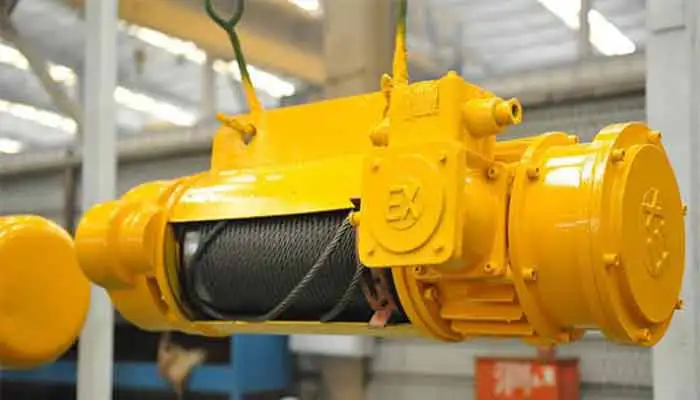
Monorail Crane Systems for Chemical Buildings Guide
Monorail crane systems for chemical buildings in water treatment plants. Compact, corrosion-resistant lifting solutions for maintenance efficiency.
| Crane Type | Monorail crane with fixed rail/beam and electric chain or wire rope hoist; 0.5–10 ton; ISO A3–A5 / FEM 1Am–3M; 380/400/415V, 50Hz, 3Ph; corrosion-resistant and optional explosion-proof configurations available. |
| Crane Capacity | 0.5–10 ton; selected according to equipment weight, maintenance load, hoist weight, and lifting frequency. |
| Span Length | Linear travel along a fixed monorail; typically 10–50 m+ track length, with straight, curved, or application-specific layouts available. |
| Lifting Height | 3–15 m; customized according to building height, equipment clearance, and maintenance requirements. |
| Coverage Area Type | Linear lifting coverage along the monorail; chemical buildings, pump rooms, treatment halls, equipment areas, maintenance zones, filter rooms, service platforms, and designated lifting points. |
| Application | Pump maintenance, motor and gearbox replacement, valve handling, chemical equipment maintenance, wastewater treatment equipment servicing, filtration systems, and mechanical equipment installation. |
| Certifications | CE / ISO / SGS / Other third-party inspection |
| Customization | Customized monorail length and layout, I-beam or enclosed track, electric chain or wire rope hoist, electric/manual trolley, pendant or radio control, stainless-steel components, corrosion protection, and explosion-proof options where required. |
Crane Manufacturer: Yuantai Cranes – 30+ Years Professional Crane Manufacturer from China
Category: Featured
Tags: monorails,explosionproofcrane
Your Trusted Overhead Monorail Crane Manufacturer & Supplier
Monorail Crane Systems for Chemical Buildings in Water Treatment Plants
Compact, Corrosion-Resistant Lifting Solutions for Maintenance Efficiency
Most Important Takeaway
In chemical buildings of water treatment plants, monorail crane systems are not selected for heavy lifting—but for corrosion resistance, compact installation, and long-term maintenance reliability in chemically aggressive environments.
If the crane fails here, it is not due to overload—it is due to environmental corrosion and poor system integration.
Key Buyer Questions This Page Answers
- What is the best crane system for chemical dosing rooms in water treatment plants?
- Why are monorail cranes preferred in confined chemical buildings?
- How do you design a corrosion-resistant overhead lifting system?
- What crane type reduces maintenance cost in chemical environments?
- How to choose between monorail crane and overhead bridge crane?
Monorail Crane Systems for Chemical Buildings in Water Treatment Plants
Chemical buildings in water treatment plants are not designed for large-scale lifting operations. They are tight, controlled spaces where equipment is arranged closely, and maintenance work is usually repetitive and localized. In these conditions, the choice of crane system is less about size and more about practicality.
What works well in an open workshop often does not fit here. That is why many engineers move toward simpler lifting solutions that match the real working layout.
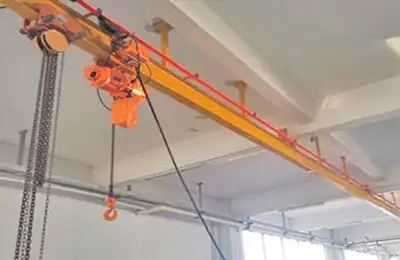
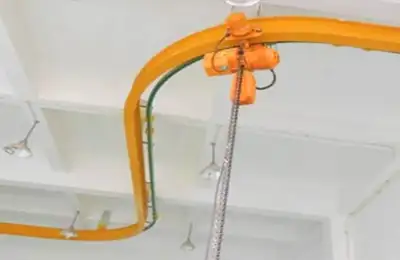
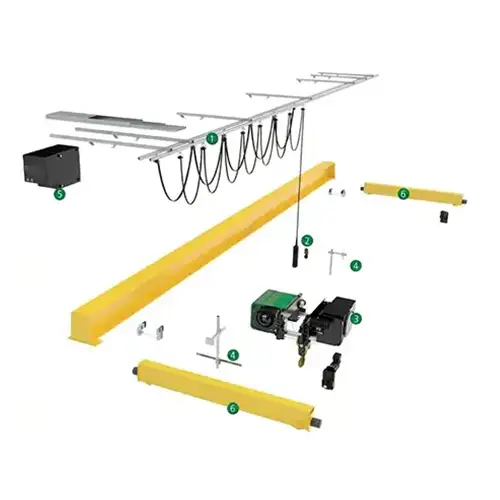
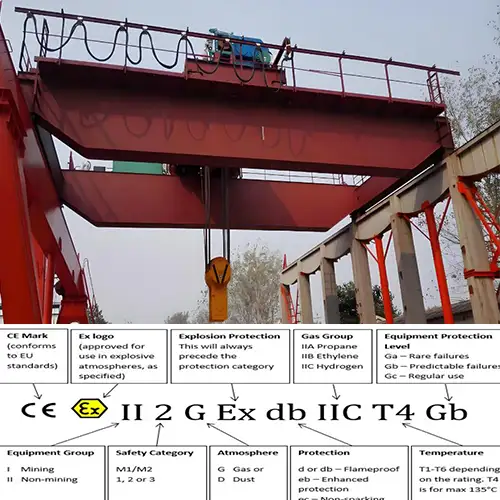
curverd track monorail cranes- explosion proof chain hoist and explosion proof wire rope hoist available.
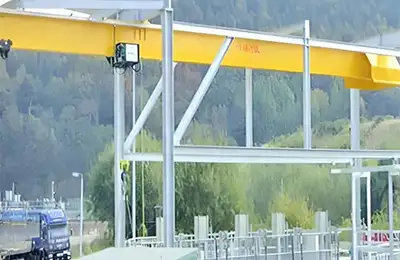
Why Monorail Cranes Are Used in Chemical Buildings
Chemical buildings in water treatment plants are usually compact. Inside, you will find dosing pumps, chemical tanks, pipelines, and electrical panels all placed close together. There is very little open space left for large equipment. In this kind of environment, every meter of space matters. Adding a big lifting system can easily block access or interfere with maintenance work.
Why traditional bridge cranes are often not suitable
A standard overhead bridge crane needs more structure. It requires runway beams on both sides, enough headroom, and an open area for the trolley to move across.
In chemical buildings, this is often difficult to achieve.
- Space is already limited by pipelines and tanks
- Building structure may not support a full crane system easily
- Installation cost becomes higher due to extra steel work
- The crane may be more than what the application actually needs
In many cases, a full bridge crane simply feels "too much" for the job.
Why monorail crane systems fit better
A monorail crane moves along a single fixed track. It does not need a full bridge structure, and it works in a straight or slightly curved line.
This makes it much easier to use in chemical buildings where the work is arranged in a linear way.
- It follows a fixed lifting path along equipment lines
- It can be installed under existing beams or roof structures
- It requires less space and simpler steel support
- It matches maintenance tasks that are repetitive and localized
In simple terms, it is designed for "point-to-point" lifting rather than full-area coverage.
How maintenance work is actually done
Most lifting jobs in chemical buildings are not complex. They are usually small, repeated tasks.
For example:
- Removing a dosing pump for inspection
- Replacing a small chemical tank
- Lifting valves or piping sections during repair
The movement is usually the same every time: lift, move a short distance, and lower. Because of this, a monorail system is often enough.
Simpler operation in real working conditions
Chemical rooms are not easy places to work. There may be humidity, chemical smell, and safety equipment requirements. Operators do not want a complicated lifting system in this environment.
A monorail crane keeps things simple.
- One clear lifting path
- Easy operation without complex movement planning
- Faster setup during maintenance work
- Less chance of operator confusion in tight spaces
Practical reason behind the choice
In real water treatment plant projects, monorail cranes are not chosen because they are advanced or powerful. They are chosen because they fit the working condition.
They are simple, direct, and suitable for narrow chemical buildings where maintenance work happens along fixed lines.
In short, they match how people actually work inside these spaces.
Typical Applications Include
- Chemical dosing pump maintenance
- Tank replacement and installation
- Valve and pipeline servicing
- Metering skid handling
Engineering Challenges in Chemical Environments
Before selecting or designing a monorail crane system for a chemical building in a water treatment plant, it is important to understand the working environment. These spaces are not neutral industrial areas. They are active chemical zones where both the atmosphere and layout place continuous pressure on equipment. In practice, the crane is not working in isolation. It is operating inside a system that is already crowded, humid, and chemically active. That is where most design challenges come from.
Corrosive Atmosphere
Chemical buildings often contain gases and vapors released from dosing and treatment processes. Over time, these conditions affect metal surfaces, electrical parts, and moving components.
Typical exposure conditions include:
- Acidic or alkaline vapors in the air
- Chemical splashes during tank filling or pump operation
- Continuous humidity, especially in enclosed rooms
This combination slowly attacks unprotected surfaces. It may not cause immediate failure, but it reduces service life and increases maintenance frequency.
Because of this, corrosion protection is not an optional feature. It is part of the basic design requirement.
Structural Constraints
Unlike open workshops, chemical buildings are usually built with compact layouts. The available space for crane installation is limited from the beginning.
Common structural limitations include:
- Low headroom that restricts lifting height
- Dense routing of pipes, valves, and electrical cables
- Narrow aisles that leave little room for maintenance access
In many cases, the crane must fit into the building rather than the building being designed around the crane.
This is why monorail systems are often preferred—they require less structural modification and can follow existing building lines.
Operational Requirements
The way equipment is used in chemical buildings is also different from heavy industrial workshops. The lifting demand is usually frequent but not heavy.
Typical operational needs include:
- Regular lifting of pumps, valves, and small tanks
- Light-to-medium load handling rather than heavy production lifting
- Precise positioning when installing or removing equipment
- Safe operation close to chemical pipelines and dosing systems
The focus is not on lifting large weights. It is on doing repeated maintenance tasks safely and without disturbing nearby equipment.
In real operation, even small positioning errors can create safety risks or slow down maintenance work. That is why controlled movement and stable operation are more important than raw lifting capacity.
Practical Understanding of the Environment
When these three factors—corrosion, space limits, and operational needs—are combined, it becomes clear why standard crane designs often do not fit chemical buildings.
It is not just about installing a crane. It is about making sure the system can survive in a chemically active environment, work within tight structural limits, and still support daily maintenance tasks without adding complexity.
This is the real engineering challenge behind selecting a monorail crane system for water treatment plant chemical buildings.
Why Monorail Crane Systems Are the Best Fit
After understanding the limitations of chemical buildings, the next step is to see why monorail crane systems are often chosen in real water treatment plant projects. The main reason is not complexity or lifting power. It is how well the system matches the space and maintenance pattern. In these environments, the crane is not expected to do everything. It is expected to do a specific job in a simple and reliable way.
Compact Structural Design for Tight Spaces
Chemical buildings rarely have extra space for heavy crane structures. Most of the time, the roof beams and steel framework are already supporting pipes, cables, and process equipment.
A monorail crane fits into this situation more naturally.
- It can be installed directly along existing beams
- It does not require full runway beams on both sides
- It avoids major changes to building structure
- It works well in low headroom conditions
In many projects, engineers prefer it simply because it "fits without forcing changes." That is a practical advantage in crowded plant layouts.
For chemical buildings, this kind of compact design often makes installation faster and more straightforward.
Linear Maintenance Coverage
Unlike production workshops where lifting is spread across a large area, chemical buildings usually have a clear process layout. Equipment is arranged in lines—pumps here, tanks there, pipelines running along the same direction.
Monorail cranes match this layout well because they move in a straight or guided path.
Typical use cases include:
- Maintenance along chemical dosing lines
- Pump room service and replacement work
- Equipment handling in narrow corridors between systems
Instead of trying to cover the whole room, the crane follows the actual maintenance route. This makes daily work more direct and easier to manage.
In real operation, technicians often prefer this because the lifting path is predictable. There is no need for repeated repositioning.
Lower Installation and Civil Cost
Another practical reason for choosing monorail systems is cost control—not just equipment cost, but overall installation effort.
Compared to a full bridge crane system, monorail cranes usually require less structural work.
This often results in:
- Reduced steel structure usage
- Shorter installation time on site
- Less need for building reinforcement
- Simpler coordination with civil construction
In chemical building projects, this matters because crane installation is often part of a larger system upgrade or plant expansion. Saving time and structural modification helps keep the project moving without unnecessary delays.
It is not about cutting corners. It is about avoiding construction work that does not bring real operational benefit.
Reduced Corrosion Exposure
One detail that is sometimes overlooked is how much surface area is exposed to the chemical environment.
A monorail crane system has a smaller and more compact structure. This naturally reduces the amount of exposed metal in the building.
That leads to:
- Fewer surfaces affected by chemical vapors
- Lower risk of long-term corrosion buildup
- Easier protection with coatings or stainless components
- Reduced maintenance frequency over time
In water treatment plants, where humidity and chemical exposure are continuous, this becomes a practical advantage.
Less exposure does not eliminate corrosion, but it slows it down. In real projects, that directly affects maintenance cost and equipment lifespan.
Practical Summary
Monorail crane systems are not selected because they replace all other crane types. They are selected because they match a very specific working condition.
In chemical buildings, where space is limited, maintenance is linear, and corrosion is constant, a simpler system often works better than a larger one.
That is why monorail cranes remain a common and practical choice in water treatment plant chemical areas.
Key Engineering Design Principles
In chemical buildings of water treatment plants, a monorail crane is not treated as a heavy lifting machine. It is closer to a maintenance tool that must survive a harsh environment every day. The design focus is very different from general workshop cranes. Most problems in these areas do not come from overloading. They come from slow damage caused by corrosion, humidity, and poor protection of electrical parts. That is why the design principles below are important in real projects.
Corrosion-Resistant Crane Design (Critical Factor)
In chemical environments, corrosion is usually the first issue that shortens equipment life. It often starts small—on bolts, joints, or cable surfaces—and slowly spreads if protection is not strong enough.
For monorail crane systems in chemical buildings, long-term exposure needs to be considered from the beginning.
Recommended practical design choices include:
- Stainless steel parts in key load and contact areas
- Epoxy-coated steel surfaces to reduce chemical attack
- Galvanized monorail beams for improved resistance
- Sealed hoist housing to block vapor and dust entry
- Corrosion-resistant bolts and connection parts
In real projects, engineers often say, "once the coating fails, the crane ages quickly." This is true. Surface protection is not just finishing work—it is the main defense line.
Enclosed Electrical Systems for Chemical Plants
Electrical systems are usually more sensitive than mechanical parts in chemical environments. Moisture and vapor can easily enter if protection is not properly designed.
To improve reliability, electrical systems should include:
- IP65 or IP66 control panels for dust and water protection
- Moisture-resistant electrical components
- Anti-condensation heaters inside control cabinets
- Well-sealed cable routing systems
In practice, many unexpected stoppages come from electrical issues, not mechanical failure. The crane may still look fine, but control instability starts when humidity enters the system.
That is why electrical protection is treated as a core requirement, not an optional upgrade.
Controlled Motion for Safe Chemical Operation
In chemical buildings, lifting work is often close to pipes, valves, and dosing systems. Sudden movement can easily create risk, especially when handling liquid containers or chemical equipment.
To improve safety and stability, modern monorail crane systems often use:
- Variable Frequency Drive (VFD) for smooth movement
- Soft start and soft stop to avoid sudden impact
- Stable speed control during load transfer
- Precise positioning for installation and maintenance work
This is not only about comfort. It helps reduce swinging, splashing, and accidental contact with nearby equipment.
In real maintenance work, stable movement often makes the operation safer and easier to control in tight spaces.
Modular Maintenance Design
Chemical buildings often cannot afford long shutdown times. Maintenance needs to be quick, and systems must be easy to repair without full disassembly.
A practical monorail crane design usually includes:
- Segmented rail structures for partial replacement
- Modular hoist and trolley components
- Easy inspection and lubrication access points
- Simple replacement of worn parts without removing the full system
This reduces downtime. Instead of stopping the whole crane, only the affected part is serviced.
In real plant operation, this is often what maintenance teams value most—fast access and minimal interruption.
Practical Understanding of the Design Approach
All these design points lead to one simple idea: in chemical buildings, crane design is not about making the system complex. It is about making it stable, protected, and easy to maintain.
A good monorail crane does not try to do everything. It focuses on working reliably in a harsh environment and supporting daily maintenance without adding extra problems.
This is what makes it suitable for water treatment plant chemical areas.
Layout Design for Chemical Building Monorail Systems
In chemical buildings of water treatment plants, the layout of a monorail crane system is just as important as the crane itself. Even a well-built crane can become difficult to use if the rail path is not planned properly. The goal is simple: make maintenance work smooth, safe, and predictable in a tight space. Unlike open workshops, chemical buildings do not give much freedom for changes later. Pipes, tanks, and electrical routes are usually fixed, so the crane layout must follow the real equipment arrangement from the beginning.
Common Layout Types
Monorail crane systems can be arranged in different ways depending on the building shape and maintenance path.
Straight-line monorail along equipment rows
This is the most common layout. The crane runs in a single direction, usually above pumps or dosing systems. It is simple and easy to maintain.
- Suitable for linear pump stations or dosing lines
- Easy installation along existing beams
- Clear and predictable lifting path
Curved rail systems for multi-zone coverage
In some chemical buildings, equipment is not arranged in a straight line. A curved monorail allows the crane to follow the process flow.
- Useful when equipment is arranged in sections
- Helps reduce manual handling between zones
- Requires careful design of turning radius and support points
L-shaped layouts for compact pump rooms
When space is limited but maintenance areas are connected at right angles, an L-shaped system is often used.
- Fits compact building corners
- Allows coverage of two working zones
- Common in small chemical dosing rooms
In real projects, layout decisions are usually based on maintenance access, not appearance. The crane path must follow where people actually work.
Design Priorities in Real Projects
A good monorail layout is not just about fitting the crane into the building. It is about ensuring safe and efficient operation over the full service life.
Avoid interference with pipelines and valves
Chemical buildings are full of pipes and control systems. The crane path must be planned carefully to avoid contact or obstruction.
- Keep safe distance from pipe joints and flanges
- Avoid passing directly over sensitive control equipment
- Consider future maintenance space, not only current layout
Ensure full hook travel coverage
The crane must reach all required maintenance points without manual lifting or repositioning.
- Check every pump and tank position in advance
- Confirm the hook can reach the full service area
- Avoid "dead zones" where lifting is not possible
Maintain safe maintenance clearance zones
Safety is not only about lifting capacity. It is also about working space around the load.
- Leave enough space for operators during lifting
- Avoid tight gaps between crane path and equipment
- Ensure safe movement even when wearing protective gear
In practice, this is often where problems appear. A layout may look fine on drawings, but becomes difficult on site if clearance is not carefully considered.
Practical View of Layout Planning
In chemical buildings, a monorail crane layout should always follow one principle: design for the maintenance route, not just the building shape.
If maintenance workers can move safely, lift smoothly, and reach all equipment without obstacles, the layout is correct. If they need to adjust position repeatedly or work around obstacles, the design needs improvement.
A simple and well-planned layout often performs better than a complex one, especially in environments where space and time are limited.
Installation Considerations
In many water treatment plant projects, the monorail crane system itself is well designed, but problems often appear during installation. Not because the equipment is wrong, but because the site conditions are not fully prepared. Chemical buildings are especially sensitive in this stage because space is limited and piping and electrical systems are already tightly arranged. A good installation plan is usually what decides whether the crane will work smoothly in the long term or become difficult to maintain later.
Structural Verification
Before installing a monorail crane, the first step is to confirm whether the building structure can safely support it. In chemical buildings, this is often underestimated because the crane looks small compared to full bridge systems.
But even a compact system still transfers load to the building beams.
Key checks include:
- Confirming beam load capacity at installation points
- Checking whether existing steel structures can handle dynamic loads
- Evaluating vibration behavior during lifting operations
- Controlling deflection to avoid uneven rail movement
In practice, small deflections that seem acceptable on drawings can still cause uneven travel or long-term misalignment. That is why structural confirmation is not just paperwork—it directly affects real operation quality.
Electrical Compatibility
Chemical buildings are not friendly environments for electrical systems. Humidity, vapor, and occasional chemical exposure can slowly damage unprotected components if installation is not handled carefully.
Electrical compatibility should be addressed during installation, not after commissioning.
Important points include:
- Using corrosion-resistant power supply systems such as enclosed busbars or protected cable routes
- Ensuring stable grounding to avoid leakage issues in humid conditions
- Keeping electrical components away from direct chemical exposure areas
- Checking sealing conditions of junction boxes and control panels after installation
A common issue in real projects is delayed electrical failure. The crane may run well at first, but moisture slowly enters weak protection points and causes instability later.
Installation Timing
One of the most practical issues in chemical building projects is timing. Many installations are done after piping and equipment are already in place, which makes crane installation more difficult than necessary.
For monorail crane systems, timing has a direct impact on installation quality.
Best practice includes:
- Installing monorail rails before full piping congestion occurs
- Leaving clear access routes for lifting equipment during installation
- Coordinating early with plant layout engineers and piping designers
- Planning crane positions during the initial layout stage, not after construction is finished
In real projects, when installation is delayed, workers often need to work around pipes and tanks. This increases installation time and can limit the ideal crane path.
Practical Understanding of Installation
Installation in chemical buildings is not only about fixing steel and connecting power. It is about integrating a lifting system into an already crowded environment without disturbing existing equipment.
If structural strength, electrical protection, and installation timing are considered early, the monorail crane system usually performs smoothly and requires less adjustment later.
But if these points are ignored, even a well-designed crane can become difficult to operate in daily maintenance work.
Lifecycle Cost Advantage
A monorail crane system used in a chemical building is not just a piece of lifting equipment. In most water treatment plants, it becomes part of the long-term maintenance setup. Once installed, it is expected to work quietly in the background for many years with minimal interruption. Because of this, the real cost is not only the purchase price. The bigger factor is what happens during daily operation, maintenance, and repair over time.
Hidden Costs in Poor Designs
On paper, two crane systems may look similar. But in real operation inside chemical environments, the difference in design quality quickly shows up in maintenance cost and downtime.
Some of the most common hidden costs include:
- Frequent corrosion repair on beams, hooks, and exposed metal parts
- Electrical failures caused by moisture entering control boxes or cables
- Unexpected downtime during pump or tank maintenance work
- Repeated replacement of components that were not designed for chemical exposure
These issues often do not appear immediately after installation. They build up slowly. At first, it may be small repairs. Later, it becomes frequent interruptions to maintenance work.
In a water treatment plant, even short downtime can affect the overall process flow, especially when chemical dosing systems are involved.
Cost Optimization Strategy
Reducing lifecycle cost is not about choosing the cheapest system. It is about selecting a system that avoids repeated problems in a difficult environment.
Invest in corrosion protection upfront
Protective coatings, stainless components, and sealed systems may increase initial cost slightly, but they significantly reduce repair work later. In chemical buildings, this is one of the most important decisions.
Choose low-maintenance hoist systems
A hoist that requires frequent servicing or adjustment will increase long-term labor and downtime. Systems designed for stable operation with minimal intervention are more suitable for continuous plant environments.
Avoid over-engineering heavy-duty capacity
Many buyers select higher lifting capacity than needed "just in case." In chemical buildings, this often leads to unnecessary cost and more complex equipment without real benefit. Matching the crane capacity to actual maintenance loads is usually more practical.
Practical View of Lifecycle Value
In real water treatment plant projects, the value of a monorail crane system is not judged on installation day. It is judged years later, during daily maintenance work.
A well-chosen system may not look impressive, but it works consistently, requires fewer repairs, and keeps maintenance tasks simple. Over time, this reduces both direct repair costs and indirect downtime costs.
That is where the real lifecycle advantage comes from—not in the initial investment, but in how stable the system remains after years of use in a chemical environment.
When Monorail Cranes Are NOT Suitable
Monorail crane systems work well in chemical buildings where lifting is simple, linear, and maintenance-focused. But they are not the right solution for every situation in a water treatment plant or industrial facility. In real projects, choosing the wrong crane type usually does not show problems immediately. It becomes clear later, when operators need more flexibility or higher lifting capacity than the system can provide.
When multi-directional lifting is required
Monorail cranes move along a fixed line. This works well when equipment is arranged in a straight or clearly defined path. But in some workshops or utility areas, lifting is not that simple.
If the work requires movement in multiple directions, a monorail system becomes limiting.
Typical cases include:
- Equipment that needs to be moved across different zones
- Irregular layouts where maintenance points are scattered
- Situations where repositioning loads frequently is required
In these cases, a system with wider coverage is usually more practical.
When heavy production lifting dominates
Monorail cranes are mainly designed for light to medium-duty maintenance work. In chemical buildings, this is usually enough. But in some parts of a plant, lifting demand can be much higher.
If the operation regularly involves heavy loads, the limitation becomes clear.
- Loads above 10–20 tons used frequently
- Continuous handling of large equipment or structural parts
- Production-focused lifting rather than maintenance tasks
In such conditions, a monorail system is not designed to handle the workload efficiently over time.
When complex workshop coverage is needed
Some facilities are not simple linear layouts. They are wide, open, or divided into multiple working zones. In these environments, maintenance and production tasks are spread across different areas.
A monorail crane cannot easily cover these types of spaces.
Situations include:
- Large workshops with multiple service zones
- Production halls requiring full-area coverage
- Facilities where lifting points change frequently
Here, a fixed single-line system becomes too restrictive for daily operation.
Better alternatives in these cases
When the conditions go beyond what a monorail system can handle, other crane types are usually considered.
- A bridge overhead crane system is suitable for full-area coverage and flexible movement across the workshop
- A double girder crane is more appropriate for heavy-duty lifting and large equipment handling
These systems require more structure and investment, but they provide the flexibility and capacity needed for complex or heavy-duty operations.
Practical understanding for buyers
The key point is simple. A monorail crane is not a universal solution—it is a targeted one.
It works best in chemical buildings where lifting is linear, frequent, and maintenance-oriented. When the operation moves beyond that pattern, switching to a bridge or double girder crane is usually the more practical decision.
Choosing the right system is less about preference and more about matching the crane to how the site actually works day to day.
FAQ
What is a monorail crane system used for in chemical buildings?
A monorail crane system is mainly used for maintenance work inside chemical buildings of water treatment plants. It helps operators lift and move equipment like dosing pumps, small chemical tanks, valves, and pipeline components.
In most cases, the lifting path is fixed along a process line, so the crane is used for point-to-point maintenance rather than full-area material handling.
- Pump maintenance and replacement
- Chemical dosing system servicing
- Small equipment installation and removal
Why are monorail cranes preferred in water treatment plants?
Monorail cranes are widely used because they fit the real working conditions inside chemical buildings. These spaces are usually narrow, crowded, and full of pipelines, leaving little room for large crane systems.
They are preferred because:
- They take up less structural space
- They are easier to install in existing buildings
- They match linear maintenance routes
- They reduce unnecessary construction cost
In simple terms, they work well where a full overhead crane would be too large or unnecessary.
How do you protect a crane in a chemical environment?
Protection in chemical buildings is mainly about preventing corrosion and moisture damage. Without proper protection, even a well-built crane will degrade over time.
Common protection methods include:
- Using stainless steel or corrosion-resistant materials
- Applying epoxy or anti-corrosion coatings on steel parts
- Installing sealed hoist housings to block vapor and dust
- Using IP65/IP66 electrical enclosures for control systems
- Designing enclosed cable routing to reduce exposure
These measures help the crane stay stable in humid and chemically active environments.
What is the difference between a monorail crane and an overhead crane?
The main difference is how they move and how much area they can cover.
- A monorail crane moves along a single fixed track. It is designed for linear lifting and follows a set path, usually along equipment lines.
- A overhead bridge crane moves across a full workshop area using a bridge and runway system, allowing multi-directional movement.
In practice, monorail cranes are used for focused maintenance tasks, while overhead cranes are used for broader material handling across large spaces.
Are monorail cranes suitable for heavy lifting?
Monorail cranes are generally designed for light to medium-duty applications. They are commonly used in maintenance work where loads are not extremely heavy but require frequent and precise handling.
Typical usage includes:
- Equipment under moderate weight ranges
- Repetitive maintenance lifting tasks
- Controlled positioning in confined areas
For heavy production lifting or loads above typical maintenance requirements, systems like double girder overhead cranes are usually more appropriate.
Conclusion
Monorail crane systems in chemical buildings of water treatment plants are specialized solutions designed for compact spaces, corrosive environments, and maintenance-focused operations.
For buyers and plant engineers, the key selection logic is clear:
Choose not based on maximum lifting capacity, but on corrosion resistance, layout compatibility, and long-term maintenance efficiency.
A properly designed system ensures:
- Lower lifecycle cost
- Higher operational safety
- Reduced downtime
- Longer service life in aggressive chemical environments

Yuantai Cranes
Overhead Crane Manufacturer with CE, ISO, SGS, CNEX Certificates.
- Main Specifications - Capacity: 0.5–550 tons | Span: up to 40m | Speed: 0.8–12 m/min | Duty: A3–A7 | Power: 380–690V, 50/60Hz | Control: pendant/remote/cabin
- Full engineering: FEA/PLC/VFD + in-house build + global delivery + on-site support, for workshops, factories, EPC contractors, industrial projects, etc.
- Support: design, manufacturing, testing, service – end-to-end, customized lifting solutions worldwide.
How to Get an Accurate Crane Price for Your Application?
Tips: Copy the spec list, fill in your details, and paste it into the form on the right/ down-below for a quick price.
- Crane type:_____ . (e.g., overhead crane, gantry crane, jib crane)
- Max weight to lift:_____ tons. (e.g., 2t, 5t, 10t, 20t, 50t)
- Lifting height:_____ m. (How high does the hook need to reach?
- Workshop width (span):_____ m . (Distance between the two crane rails)
- Travel distance:_____ m . (How long does the crane need to move along the runway?)
- Control type:_____. (Pendant / remote / cabin Control)
- Power supply:_____. (Local voltage & frequency – e.g., 380V, 50Hz, 3-phase)
- What will it be used for?_____ (e.g., steel fabrication, concrete products, mold handling, general manufacturing, etc.)
- Any special requirements?_____ (e.g., extreme temperature, dusty or explosive environment, special paint color, etc.)
Just leave a message via the contact form and our hoist and crane engineer will contact you with in 24working hours.
Get Your Custom Quote–Quick & Easy
Fill in what you know. Skip what you don't – we'll help.Any question will be reply with 24 working hours