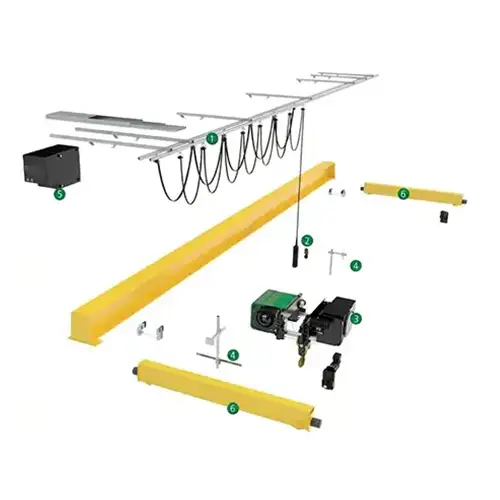
Explosion-Proof Overhead Crane Kits |1–20 Ton Modular Crane Sets
Explosion-proof overhead crane kits 1–20 ton includs modular crane sets, CNEX compliance, components, selection & safety design guide.Get modular crane kit!
| Crane Type | Explosion-Proof Overhead Crane Kits from 1–20 Ton, supplied as modular crane sets for safe material handling in hazardous areas, with customized Ex protection, lifting equipment, controls, and crane electrification. |
| Crane Capacity | 1–20 Ton modular explosion-proof overhead crane systems. |
| Span Length | Typically 7.5–28 m; customized according to workshop width, runway arrangement, and required lifting coverage. |
| Lifting Height | Typically 6–20 m; customized according to building height and process requirements. |
| Coverage Area Type | Crane Compatibility-Explosion-Proof EOT Crane, Single Girder Overhead Crane, Double Girder Overhead Crane, Bridge Crane, and modular crane systems for hazardous industrial environments. |
| Application | Oil & gas, petrochemical, chemical plants, refineries, paint facilities, fuel storage, pharmaceutical production, hazardous warehouses, and other gas- or dust-prone industrial areas. |
| Certifications | CE / ISO / SGS / Other third-party inspection |
| Customization | Customized capacity, span, lifting height, runway length, single/double girder configuration, explosion-proof grade, hoist type, duty class, control method, power supply, crane wheels, electrical components, and safety devices. |
Crane Manufacturer: Yuantai Cranes – 30+ Years Professional Crane Manufacturer from China
Category: Crane Kit Parts
Tags: explosionproofcrane
Your Trusted Explosion Proof Overhead Crane Manufacturer & Supplier
Explosion-Proof Overhead Crane Kits 1–20 Ton for Sale
1–20 Ton Modular Crane Sets without Main Girder- Economical Explosion Proof Crane Solution
MOST IMPORTANT TAKEAWAY
Explosion-proof overhead crane kits (1–20 ton) are modular, engineered crane systems designed for hazardous environments, where flammable gases or combustible dust may exist. Unlike standard crane kits, every component—from hoist to electrical system—is designed to eliminate ignition risks while allowing flexible on-site assembly and local fabrication of steel structures.
Correct selection depends on ATEX zone classification, lifting capacity (1–20 ton), duty cycle, and system integration level.
- Explosion-proof crane kits are modular systems, not pre-assembled cranes
- Available capacity range typically covers 1 ton to 20 ton overhead crane systems
- Explosion protection applies to hoist, motors, electrical panels, and control systems
- Steel structure can often be locally fabricated while critical components are supplied certified
- ATEX zone classification determines protection level (Zone 1, 2, 21, 22)
- System compatibility is critical for safe installation and long-term operation
- Proper selection reduces installation risk, compliance issues, and lifecycle cost
QUESTIONS THIS GUIDE ANSWERS
- What is an explosion-proof overhead crane kit?
- What industries require 1–20 ton explosion-proof crane systems?
- Which components are included in a crane kit set?
- What is the difference between crane kits and fully assembled cranes?
- How do ATEX zones affect crane kit configuration?
- How to choose the right 1 ton, 5 ton, 10 ton, or 20 ton crane kit?
- Which parts must be explosion-proof in a modular crane system?
- Can crane steel structures be fabricated locally?
- What safety systems are required in explosion-proof crane kits?
Introduction: Why Explosion-Proof Crane Kits Are Used
Explosion-proof overhead crane kits are designed for hazardous environments where flammable gas, vapor, or dust may be present. In these conditions, even a small spark or high surface temperature can create serious safety risks, so controlled lifting systems are required from the start.
Hazardous environments require controlled lifting systems
Explosion-proof overhead crane kits are used in areas where flammable gas, vapor, or dust may be present. In these conditions, a normal overhead crane is not suitable because even a small spark or high surface temperature can create safety risks. These crane kits are designed to control ignition risk from the start, covering hoist, motors, electrical systems, and control components.
Why crane kits are commonly chosen
Instead of a fully assembled crane, many projects prefer a modular kit structure. It is easier to transport, install, and adapt to real site conditions.
Main practical reasons include:
- Easier shipping and handling in parts
- Option for local fabrication of crane steel structure
- Lower logistics and installation complexity
- Flexible configuration for different workshop sizes
- Suitable for 1 ton to 20 ton overhead crane systems
Typical application areas
Explosion-proof crane kits are widely used in industries where safety rules are strict and ignition risks exist, such as:
- Chemical and solvent production plants
- Oil and gas facilities
- Paint and coating workshops
- Dust-prone material handling areas
- Wastewater and biogas-related environments
These applications require stable lifting performance while ensuring strict control of ignition risks in daily operations.
System safety and overall purpose
An explosion-proof crane kit is not just a lifting product. It is a safety-focused system designed for hazardous environments, where every component works together to prevent ignition risks while ensuring stable lifting performance.
Hazardous Area Classification for Crane Kits
Explosion-proof design depends on environmental risk, not crane size
The selection of explosion-proof overhead crane kits is based on hazardous area classification, not lifting capacity. Gas and dust conditions determine the protection level required for motors, electrical systems, and control components.
Hazardous area classification table
| Hazard Type | Zone | Risk Condition | Meaning in Operation | Impact on Crane Kit Design |
|---|---|---|---|---|
| Gas | Zone 1 | Frequent explosive atmosphere likely | Gas or vapor may appear during normal operation | Higher protection level required for motors, wiring, and enclosures |
| Gas | Zone 2 | Occasional short-duration risk | Gas appears only in abnormal or rare situations | Standard explosion-proof protection with controlled sealing |
| Dust | Zone 21 | Frequent combustible dust presence | Dust cloud may exist during normal operation | Strong sealing design for motors and electrical parts |
| Dust | Zone 22 | Occasional dust risk | Dust appears briefly or under abnormal conditions | Moderate protection with dust-resistant design |
How these zones affect crane kit design
These classifications directly influence how a 1 ton to 20 ton explosion-proof overhead crane kit is configured:
- Motor protection level selection (flameproof or increased safety type)
- Electrical enclosure design and sealing class
- Cable entry systems and junction box protection
- Surface temperature control of key components
- Overall system certification requirements for hazardous zones
Zone classification is the starting point before any crane selection. Even if two projects both use a 10 ton crane kit, the design will be completely different if one is Zone 2 and the other is Zone 21.
What Is an Explosion-Proof Overhead Crane Kit?
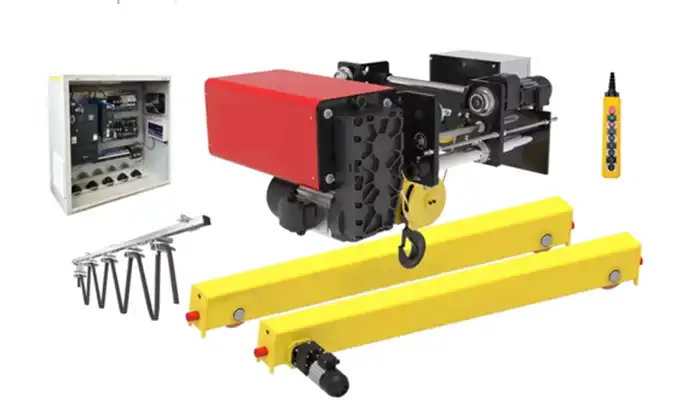
An explosion-proof crane kit is a pre-engineered modular lifting system including certified components, designed for assembly into a full overhead crane.
Typical kit components:
- Explosion-proof electric hoist (1–20 ton capacity range)
- End carriages and travel drive units
- Explosion-proof motors and gearboxes
- Electrical control cabinet (sealed and certified)
- Control system (pendant or wireless remote)
- Safety devices and limit switches
Optional:
- Locally fabricated crane bridge structure (single or double girder)
This modular concept allows flexible sourcing and reduced project cost.
Explosion-Proof Hoists: Core of the Crane Kit
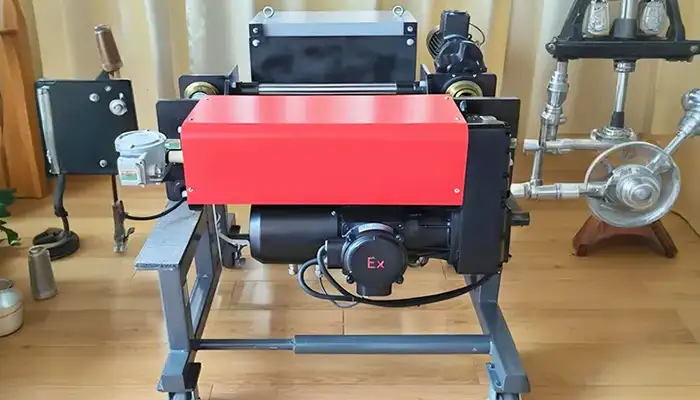
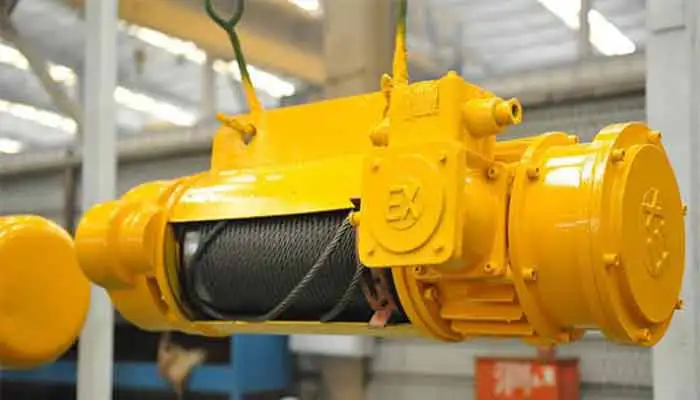
The hoist is the most critical safety component in any explosion-proof crane kit.
Key features include:
- Flameproof motor housing
- Spark-free braking system
- Temperature-controlled operation
- Sealed electrical components
- Chain or wire rope configurations depending on load duty
Available for 1 ton, 2 ton, 5 ton, 10 ton, 15 ton, and 20 ton overhead crane kits
Core Components in a Crane Kit System
In an explosion-proof overhead crane kit, safety is not handled by a single component. It is built into the whole system. From mechanical movement to electrical control, every part must work without creating sparks, overheating, or unsafe electrical exposure. This becomes especially important for 1 ton to 20 ton crane kit systems, where different duty levels still follow the same safety logic.
Every part is designed to avoid ignition risk
Explosion-proof crane safety is not achieved by one upgraded part. It is achieved by system coordination. Each component must eliminate ignition sources such as sparks, overheating, or electrical exposure during real operation. This is critical in both light-duty (1 ton) and heavy-duty (up to 20 ton) crane kit systems.
Mechanical components
Mechanical parts handle movement and load transfer. They must operate smoothly to avoid friction-related ignition risks or overheating.
- Explosion-proof travel motors
Designed with sealed housings to prevent internal sparks from reaching the external hazardous environment. - Gearboxes with controlled heat generation
Engineered to manage temperature stability during continuous or repeated lifting cycles. - Wheel and rail systems designed for stable operation
Ensures smooth travel, reducing abnormal friction, vibration, and mechanical stress during operation.
Electrical systems
Electrical systems are one of the most sensitive areas in hazardous environments. Every connection must be fully protected and sealed to prevent ignition risks.
- Explosion-proof control panels
Fully enclosed systems that prevent internal electrical sparks from escaping into the external environment. - Sealed junction boxes
Protect cable connections from dust, gas, and vapor exposure. - Certified wiring and protection barriers
All cables and interfaces maintain insulation and stable energy transfer under hazardous conditions.
Safety systems
Safety systems ensure the crane responds correctly when abnormal conditions occur. They protect both operators and equipment in real industrial environments.
- Overload protection
Prevents lifting beyond rated capacity across 1 ton to 20 ton systems. - Limit switches
Control upper and lower travel positions to prevent mechanical overrun. - Emergency stop systems
Allows immediate shutdown of all crane movements in unsafe situations. - Alarm indicators (audio and visual)
Provide clear warning signals during operation or fault conditions.
A crane kit becomes explosion-proof not because of a single component upgrade, but because all mechanical, electrical, and safety systems are designed together to eliminate ignition risks during operation.
Control Systems and Operator Safety
In explosion-proof overhead crane kits, the control system is not only about operating the crane. It is also about ensuring every movement remains stable, predictable, and safe in hazardous environments. Whether it is a 1 ton light-duty kit or a 20 ton heavy-duty system, the control logic follows one principle: no uncontrolled movement and no exposed ignition source.
Main control options used in crane kits
- ATEX-certified pendant controls
Wired explosion-proof control system with direct and stable command response, commonly used in fixed workshop layouts. - Explosion-proof wireless remote controls
Provides flexible operation from a safe distance while maintaining sealed and certified safety design. - Frequency inverter control for smooth motion
Controls acceleration and deceleration to reduce mechanical shock and improve load stability. - Redundant emergency stop architecture
Multiple stop points ensure the crane can be shut down immediately even if one control layer fails.
How operator safety is ensured in practice
- Controlled lifting and travel speed to avoid sudden load movement
- Precise positioning to reduce unnecessary repeated adjustments
- Continuous system feedback to monitor motor and operational conditions
- Stable response behavior under both light load (1–5 ton) and heavy load (10–20 ton) conditions
The control system in an explosion-proof crane kit ensures operator actions remain smooth and predictable. It reduces sudden movement, avoids unsafe switching, and maintains controlled crane behavior even in hazardous working environments.
Modular Design Advantage: Crane Kits vs Full Cranes
Explosion-proof overhead crane kits are designed as modular systems. Instead of delivering a complete crane structure, the system is divided into key components that can be assembled on site. This approach is widely used in 1 ton to 20 ton crane projects, especially where installation conditions, transport limits, or workshop constraints must be considered.
Why crane kits are different from fully assembled cranes
A fully assembled crane is delivered as a complete rigid structure, while a crane kit separates the system into modular components such as hoist, motors, electrical systems, and structural interfaces. This difference allows more flexibility in transportation, installation, and final site adaptation.
In explosion-proof applications, especially across 1 ton to 20 ton systems, this modular approach also helps better align the crane configuration with real industrial conditions instead of fixed factory assembly limits.
Practical advantages of crane kits
- Lower transport cost (no full steel structure shipment)
Only key components such as hoist, motors, and electrical systems are shipped, reducing volume and making international logistics more efficient. - Easier installation in remote locations
The system can be assembled on site even where crane access or transport entry is limited. - Local fabrication of crane girders
Main steel structures can be produced locally based on actual workshop span, height, and layout requirements for better fit. - Scalable configuration from 1 ton to 20 ton systems
The same modular concept supports both light-duty maintenance cranes and heavy industrial applications without changing system logic.
Engineering benefits in real project use
- Standardized interfaces between components
Each module is designed with consistent connection points to reduce mismatch during installation. - Reduced commissioning time
Pre-matched system configuration allows faster on-site testing and adjustment compared to full custom assembly. - Simplified spare parts management
Standardized components make long-term maintenance and replacement more efficient and predictable.
System delivery and real-world installation logic
A crane kit does not replace a fully assembled crane. It changes the way the crane is delivered and built. Instead of transporting a complete structure, it delivers a coordinated system that can be assembled closer to the actual working environment.
This approach provides better flexibility in design adaptation, installation planning, and site-based optimization, especially for industrial projects with varying structural and safety requirements.
Industrial Applications of Explosion-Proof Overhead Crane Kits (1–20 Ton)
Explosion-proof overhead crane kits are used in environments where flammable gas, vapor, or combustible dust may appear during normal production or maintenance work. In these areas, standard lifting systems are not suitable, so explosion-proof crane kit systems designed for hazardous zones (Zone 1, Zone 2, Zone 21, Zone 22) are required. These systems typically cover the 1 ton to 20 ton range, supporting both light maintenance lifting and heavy industrial equipment handling.
Where explosion-proof crane kits are used in real industrial environments
Explosion-proof crane kits are selected based on real industrial risk conditions rather than only lifting capacity. Depending on the industry, the same 10 ton system may require different protection levels, control configurations, and structural layouts. In most cases, the crane steel structure is fabricated locally, while key components such as hoists, motors, and electrical systems are supplied as a matched explosion-proof kit.
Petrochemical and chemical processing plants
In chemical plants, explosive gas atmosphere can exist around reactors, pipelines, and transfer systems. Explosion-proof bridge crane kits are commonly used for maintenance and equipment replacement.
- Typical lifting capacity: 10–20 ton overhead crane kit systems
- Typical handling tasks: chemical reactors, heat exchangers, large pumps, pipeline assemblies, valve blocks
- Application focus: stable operation in ATEX Zone 1 and Zone 2 environments during shutdown and maintenance work
These projects often require ATEX-certified crane systems designed for continuous industrial exposure conditions.
Oil storage, refining, and energy facilities
Oil refineries and fuel storage terminals require explosion-proof lifting systems due to flammable liquids and vapor. Cranes are usually installed in maintenance bays or production halls.
- Typical lifting capacity: 5–20 ton explosion-proof crane kit systems
- Typical handling tasks: compressors, refinery pumps, storage tank components, heat exchangers, pipeline sections
- Application focus: ignition control and safe operation in oil and gas hazardous zones
These applications often use oil refinery overhead crane kits designed for both indoor and semi-outdoor environments.
Pharmaceutical and solvent-based production areas
In pharmaceutical and solvent-based production, certain zones still require explosion-proof protection due to chemical vapor risks.
- Typical lifting capacity: 1–10 ton crane kit systems
- Typical handling tasks: stainless steel mixing tanks, reactors, production vessels, packaging modules
- Application focus: smooth and precise lifting for controlled production processes
These systems are commonly used in solvent environment explosion-proof crane kits where stable motion is critical.
Paint, coating, and resin production workshops
Paint and coating plants contain solvent vapors, especially in mixing and filling areas. Explosion-proof crane systems are required to ensure safe operation.
- Typical lifting capacity: 3–10 ton explosion-proof overhead crane kits
- Typical handling tasks: paint mixing tanks, resin barrels, chemical containers, agitators
- Application focus: frequent lifting in solvent vapor environments with controlled electrical safety
These are typical solvent-based explosion-proof crane kit applications in coating production lines.
Grain, flour, and dust explosion environments
In grain and flour industries, fine dust particles can create explosion risks. Dust accumulation requires sealed and controlled equipment design.
- Typical lifting capacity: 1–10 ton dust explosion-proof crane kits
- Typical handling tasks: silo components, conveyors, bucket elevators, filters, bulk material containers
- Application focus: operation in Zone 21 and Zone 22 dust hazard areas with sealed motors and electrical protection
These systems are widely used as dust explosion-proof overhead crane kits in bulk material industries.
Coal handling and mining systems
Coal processing and mining environments combine heavy dust exposure with high-duty lifting requirements.
- Typical lifting capacity: 10–20 ton heavy-duty explosion-proof crane kits
- Typical handling tasks: crushers, conveyors, motors, coal transfer systems, bulk handling equipment
- Application focus: continuous operation in high-dust industrial environments
These are typical mining explosion-proof bridge crane kit applications designed for long-term industrial duty cycles.
Wastewater treatment and biogas facilities
Wastewater treatment plants may produce biogas such as methane, creating low but continuous explosion risks in enclosed areas.
- Typical lifting capacity: 1–5 ton explosion-proof crane kits
- Typical handling tasks: pumps, valves, screening equipment, aeration systems, maintenance modules
- Application focus: compact lifting solutions for biogas exposure zones
These systems are commonly used in wastewater treatment explosion-proof crane applications for maintenance operations.
Practical understanding for industrial buyers
Across all industries, explosion-proof crane kits are selected based on hazardous classification, material type, and duty cycle rather than only tonnage. The same 10 ton system may require different configurations depending on whether it is used in chemical, oil, or dust-heavy environments.
In practice, the final selection always depends on three combined factors: site hazard level, handling conditions, and real operating frequency.
Selection Guide for Buyers (1–20 Ton Explosion-Proof Crane Kits)
Simple way to choose the right crane kit
Explosion-proof crane kits are not selected by tonnage alone. You need to match the crane with the working risk, duty level, and site conditions. The table below shows it in a clear and simple way.
Selection table (easy reference)
| What you need to check | Simple example in real use |
|---|---|
| Lifting capacity (1–20 ton) | 1–5 ton for small pumps, tools, maintenance parts 10–20 ton for reactors, compressors, heavy process equipment |
| Hazardous area (ATEX zone) | Zone 1: high gas risk chemical areas Zone 2: lower gas risk workshops Zone 21/22: dust areas like grain, flour, coal handling |
| Working duty | Light duty: occasional maintenance lifting Heavy duty: frequent lifting in production lines |
| Indoor or outdoor use | Indoor: chemical workshop or production hall Outdoor: oil storage yard or refinery yard with weather exposure |
| Power supply | 380V industrial plant standard 480V refinery or overseas industrial systems |
| Span and lifting height | 6–10 m span for small workshops 15–25 m span for large industrial plants |
| Control method | Pendant control for basic operation Remote control or inverter system for smoother and precise lifting |
Simple takeaway
A proper explosion-proof crane kit is not chosen by tonnage alone. It must match the real working condition.
- Hazard level of the area
- Working frequency and duty cycle
- Site size and installation condition
- Type and weight of equipment being handled
When these points are matched correctly, the crane system works safely and with stable performance in daily operation.
QUESTIONS THIS GUIDE ANSWERS
This section summarizes the most common technical and selection questions related to explosion-proof overhead crane kits, helping buyers understand system structure, applications, and safety requirements in hazardous environments.
What is an explosion-proof overhead crane kit?
A: It is a modular crane system designed for lifting in hazardous areas where gas, vapor, or dust may be present.
Explanation:
- Supplied as matched components such as hoist, motors, electrical system, and controls
- Designed for safe assembly into a complete overhead crane system on site
- Used in ATEX-classified environments where ignition risk must be controlled
What industries require 1–20 ton explosion-proof crane systems?
A: Industries with flammable gas, solvent vapor, or combustible dust conditions.
Explanation:
- Chemical and petrochemical plants handling reactors and process equipment
- Oil refineries and storage yards lifting pumps, compressors, and pipelines
- Grain, flour, coal, and powder processing facilities with dust risk
- Paint, coating, pharmaceutical, and wastewater treatment plants
Which components are included in a crane kit set?
A: A complete set includes explosion-proof lifting, driving, and control components.
Explanation:
- Explosion-proof electric hoist (1–20 ton range)
- Travel motors, gearboxes, and end carriages
- Electrical control cabinet and junction boxes
- Pendant or wireless control system with safety devices
What is the difference between crane kits and fully assembled cranes?
A: Crane kits are shipped as parts for on-site assembly, while full cranes are pre-built structures.
Explanation:
- Kits allow local fabrication of steel girders and runway beams
- Full cranes reduce installation work but increase transport size
- Kits are more flexible for overseas projects or limited site access
How do ATEX zones affect crane kit configuration?
A: ATEX zones determine the level of explosion protection required.
Explanation:
- Zone 1 / 21: higher risk, requires stricter sealing and protection
- Zone 2 / 22: lower risk, standard explosion-proof design is used
- Affects motor type, electrical enclosure, and certification level
How to choose the right 1 ton, 5 ton, 10 ton, or 20 ton crane kit?
A: Selection depends on real lifting needs, environment, and working duty.
Explanation:
- 1–5 ton: maintenance tools, pumps, small equipment
- 5–10 ton: tanks, machinery, production line components
- 10–20 ton: reactors, compressors, heavy industrial modules
- Duty cycle and future load changes should also be considered
Which parts must be explosion-proof in a modular crane system?
A: All components that may generate heat, spark, or electrical energy.
Explanation:
- Hoist motor and travel motors
- Electrical control cabinet and wiring systems
- Junction boxes and control interfaces
- Any component operating in hazardous zones
Can crane steel structures be fabricated locally?
A: Yes, in most crane kit projects the steel structure can be locally made.
Explanation:
- Main girders and runway beams are often produced on-site
- Only certified explosion-proof components are supplied by the manufacturer
- This reduces transport cost and improves site adaptability
What safety systems are required in explosion-proof crane kits?
A: Basic and emergency safety systems are required for controlled operation.
Explanation:
- Overload protection to prevent over-capacity lifting
- Limit switches for safe travel and lifting range control
- Emergency stop system for instant shutdown
- Brake system and alarm indicators for operational safety
CONCLUSION
Explosion-proof overhead crane kits (1–20 ton) are not just lifting equipment—they are modular safety systems designed for hazardous industrial environments.
Their key advantage lies in combining:
- Certified explosion-proof components
- Flexible crane kit structure
- Scalable lifting capacity (1–20 ton)
- Local fabrication compatibility
- Full system integration for safety compliance
For buyers, the real value is not just the crane itself, but a complete, configurable, and compliant lifting system tailored to hazardous working conditions.

Yuantai Cranes
Overhead Crane Manufacturer with CE, ISO, SGS, CNEX Certificates.
- Main Specifications - Capacity: 0.5–550 tons | Span: up to 40m | Speed: 0.8–12 m/min | Duty: A3–A7 | Power: 380–690V, 50/60Hz | Control: pendant/remote/cabin
- Full engineering: FEA/PLC/VFD + in-house build + global delivery + on-site support, for workshops, factories, EPC contractors, industrial projects, etc.
- Support: design, manufacturing, testing, service – end-to-end, customized lifting solutions worldwide.
How to Get an Accurate Crane Price for Your Application?
Tips: Copy the spec list, fill in your details, and paste it into the form on the right/ down-below for a quick price.
- Crane type:_____ . (e.g., overhead crane, gantry crane, jib crane)
- Max weight to lift:_____ tons. (e.g., 2t, 5t, 10t, 20t, 50t)
- Lifting height:_____ m. (How high does the hook need to reach?
- Workshop width (span):_____ m . (Distance between the two crane rails)
- Travel distance:_____ m . (How long does the crane need to move along the runway?)
- Control type:_____. (Pendant / remote / cabin Control)
- Power supply:_____. (Local voltage & frequency – e.g., 380V, 50Hz, 3-phase)
- What will it be used for?_____ (e.g., steel fabrication, concrete products, mold handling, general manufacturing, etc.)
- Any special requirements?_____ (e.g., extreme temperature, dusty or explosive environment, special paint color, etc.)
Just leave a message via the contact form and our hoist and crane engineer will contact you with in 24working hours.
Get Your Custom Quote–Quick & Easy
Fill in what you know. Skip what you don't – we'll help.Any question will be reply with 24 working hours