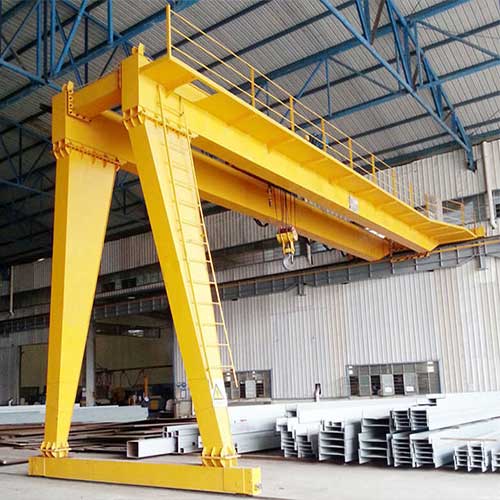
Gantry vs Bridge Crane: Optimize Floor Space & Material Flow
Compare gantry and bridge cranes to improve industrial floor space, workflow, and material handling. Find the best crane type for efficiency and safety.
| Crane Type | Overhead/bridge crane or gantry crane; single- or double-girder; double-girder typically above 20 ton; ISO A3–A8 / FEM 1Am–5M; 380/400/415V, 50Hz, 3Ph; optional VFD, radio/cabin control, positioning, anti-collision, and automation. |
| Crane Capacity | 1–500 ton; capacity selected according to load weight, lifting attachment weight, handling frequency, and material-flow requirements. |
| Span Length | 7.5–35 m+; bridge crane runway and gantry crane rail/travel length customized to the working area. |
| Lifting Height | 4–30 m; customized according to building height, storage height, equipment clearance, and lifting path. |
| Coverage Area Type | Bridge cranes provide elevated rectangular coverage along building runways; gantry cranes provide ground-supported rectangular coverage along floor rails or travel paths. |
| Application | Material handling, production, fabrication, assembly, maintenance, machinery handling, warehouses, steel yards, loading areas, and outdoor storage. |
| Certifications | CE / ISO / SGS / Other third-party inspection |
| Customization | Customized single- or double-girder design, overhead/bridge or gantry configuration, wire rope/chain hoist,pendant/radio/cabin control, and application-specific lifting attachments, positioning, anti-collision, and automation. |
Crane Manufacturer: Yuantai Cranes – 30+ Years Professional Crane Manufacturer from China
Category: Featured
Tags:
Your Trusted Outdoor Crane Manufacturer & Supplier
Gantry Crane vs Bridge Crane
Optimizing Ground Space and Material Flow for Industrial Operations
Key Takeaways (Immediate Insight for Buyers)
Most Important Takeaway:
Choosing the right crane type—gantry or bridge—directly affects your factory floor efficiency, ground space utilization, material flow, and overall operational cost. The decision should balance floor space availability, workflow optimization, installation feasibility, and long-term productivity.
Key Takeaways in Bullet Points:
- Bridge cranes maximize usable ground space by running overhead, freeing floor area for storage, forklifts, and workers.
- Gantry cranes offer flexibility for outdoor yards or temporary installations, ideal when building structures are absent.
- Material flow efficiency is higher with bridge cranes in continuous indoor production lines.
- Gantry cranes can be relocated and adjusted, but may reduce efficiency if floor space is obstructed.
- Decision factors include crane type, production layout, lifting capacity, workflow needs, and budget.
Introduction
In any industrial facility—whether it's a steel mill, warehouse, or production workshop—the crane you choose can make a big difference in how efficiently your floor space is used and how smoothly materials move through your operation. Choosing between a gantry crane and an overhead bridge crane isn't just about lifting capacity or initial cost. It's about floor layout, workflow efficiency, and long-term operational ease.
A crane isn't just a lifting tool; it's part of your material handling system. Pick the wrong type, and you might end up with blocked aisles, inefficient paths for forklifts, or large areas of unused floor space. Choose the right one, and you can optimize ground space, streamline material flow, and make daily operations safer and faster.
Purpose: Why Crane Choice Matters
- Crane selection directly impacts aisle width, storage layout, and floor accessibility.
- Efficient crane choice improves speed and accuracy in lifting and moving materials.
- Less floor congestion reduces safety risks for workers and equipment.
Scope: What This Comparison Covers
This guide focuses on comparing overhead bridge cranes and gantry cranes, highlighting the most relevant types for industrial buyers and planners:
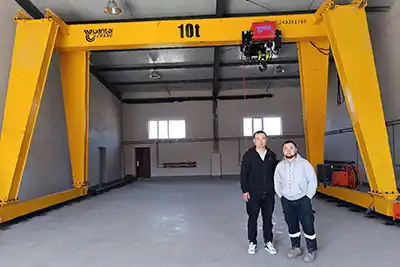
- Single Girder Gantry Crane – lightweight design, shorter spans, ideal for small to medium loads, and easier to install or relocate.
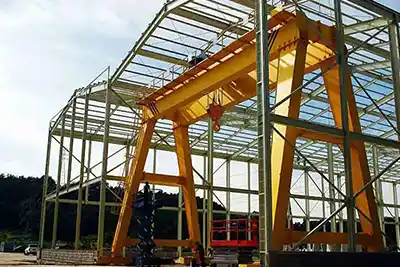
- Double Girder Gantry Crane – supports heavier loads and longer spans, offering higher stability for demanding outdoor or indoor applications.
- Rail-Mounted Gantry Crane – fixed on rails, designed for precise material movement in outdoor yards or dedicated pathways.
- Single Girder Overhead Bridge Crane – lighter, indoor option for short-span production areas.
- Double Girder Overhead Bridge Crane – heavy-duty indoor crane for large spans and high-capacity lifting.
We'll examine each type in terms of ground space utilization and material flow efficiency, helping you decide which crane fits your factory floor or outdoor yard.
- Understand whether a fixed or movable solution suits your operation.
- Identify how each crane integrates with your current floor layout or storage system.
- Evaluate trade-offs between installation complexity, cost, and workflow efficiency.
Gantry Cranes: Ground Space and Material Handling
A gantry crane is essentially a crane on a self-supporting frame, often shaped like a portal, with a hoist that travels along rails. These cranes can be fixed in place or mobile, depending on the application. Unlike overhead bridge cranes, gantry cranes have legs that reach down to the floor, which means they interact directly with your factory or yard space.
Key practical point: Gantry cranes are more flexible for locations without permanent building structures, but their legs do occupy floor space that could otherwise be used for storage or vehicle movement.
Gantry Crane Types: Features, Applications, and Space Use
Practical Tips for Ground Space and Material Flow
- Gantry cranes take up floor space because of their legs, unlike overhead bridge cranes that run above the floor.
- Choose based on workflow:
- Double girder or rail-mounted gantries for heavy, continuous operations.
- Portable or semi-gantry cranes for smaller, intermittent tasks or temporary setups. - Plan the layout first: Ensure aisles, storage areas, and crane travel paths are clear to avoid blocking materials or forklifts.
- Outdoor vs Indoor: Gantries are better for outdoor or flexible setups, while bridge cranes are ideal for indoor operations where maximizing floor space is key.
| Gantry Crane Type | Main Features | Where It's Used | Ground Space & Material Flow Notes |
|---|---|---|---|
| Single Girder Gantry Crane | Light, short to medium spans Simple design Easy to install | Small factories Workshops Light material handling | Legs take some floor space but compact Easy to fit in smaller areas Flexible for moving light loads |
| Double Girder Gantry Crane | Heavy-duty Long spans Stable Supports heavy loads | Steel mills Outdoor yards High-capacity operations | Legs occupy more space Very stable for heavy lifting Helps move large materials efficiently |
| Rail-Mounted Gantry Crane | Runs on fixed rails Precise movement Medium to heavy loads | Outdoor stockyards Shipping yards Steel handling | Needs fixed path planning Rails occupy space but allow accurate material positioning |
| Portable Gantry Crane | Small Mobile Easy to move Moderate capacity | Temporary production zones Small workshops Maintenance tasks | Can be moved out of the way when not in use Flexible use of floor space Workflow depends on placement |
| Semi-Gantry Crane | One side supported by wall or column Other side has legs | Workshops with limited space Partial indoor operations | Reduces floor footprint on one side Allows better aisle clearance Limited coverage compared to full gantry |
| Rubber-Tyred Gantry Crane (RTG) | Large outdoor crane on tires Moves heavy loads | Container yards Steel yards Ports | Takes up significant space but fully mobile Ideal for large outdoor areas Efficient material flow if yard layout is planned |
Single Girder Gantry Crane
- Lightweight and economical.
- Short to medium spans.
- Ideal for small factories or lighter material handling tasks.
Double Girder Gantry Crane
- Supports heavier loads and longer spans.
- Provides higher stability and durability, especially for outdoor yards or steel mills.
- Suitable for continuous high-capacity operations.
Rail-Mounted Gantry Crane
- Installed on rails for precise movement along a fixed path.
- Often used in outdoor stockyards, shipping yards, or steel handling operations.
- Provides accurate positioning, but less flexibility compared to mobile gantries.
Portable Gantry Crane
- Mobile and easy to relocate.
- Works well in small workshops or temporary lifting zones.
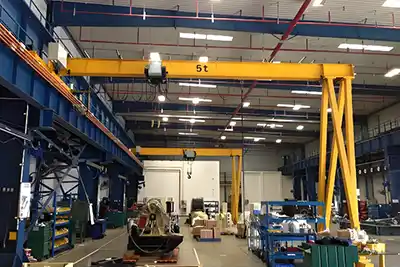
Semi-Gantry Crane
- One side supported by a wall or column; the other side has legs on the floor.
- Useful where space or structure constraints exist.
Rubber-Tyred Gantry Crane (RTG)
- Large outdoor cranes on rubber tires.
- Commonly used in container yards or heavy steel handling areas.
Applications
Gantry cranes are versatile and widely used in areas where permanent overhead structures may not exist:
- Outdoor stockyards and warehouses.
- Steel mill handling, including billets, slabs, and coils.
- Construction sites or temporary production zones.
- Container yards and shipping terminals (RTG cranes).
Practical insight: Gantry cranes are often the first choice when you need flexibility in outdoor operations or when building an overhead crane runway is not feasible.
Ground Space Considerations of Gantry Cranes
Floor Space Impact
While gantry cranes are flexible, their legs take up floor space. This can influence:
- Storage layout and stacking of materials.
- Aisle widths for forklifts and trucks.
- Vehicle movement and worker pathways.
Key Points
- Flexible placement is possible; you don't need a building to support them.
- Rail-mounted gantries require fixed paths, so layout planning is essential.
- Mobile or portable gantries can be moved to free up space when not in use.
Material Flow Considerations
Material movement efficiency depends on the crane type and layout:
- Short spans may require repositioning of the crane, slowing down operations.
- Travel speed is typically lower compared to fixed overhead bridge cranes.
- Rail-mounted or double girder gantries improve precision but still occupy ground space.
- Mobile gantries allow flexible material flow but require careful planning to avoid collisions or workflow interruptions.
Practical advice: Always evaluate span length, lifting frequency, and ground obstacles before selecting a gantry crane. Doing so ensures smoother material flow and reduces downtime on the production floor.
Bridge Cranes: Ground Space and Material Handling
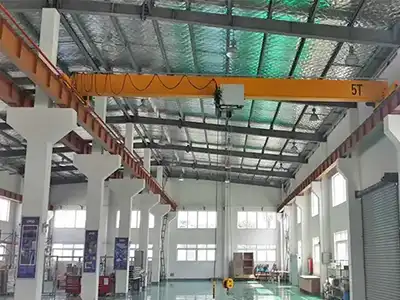
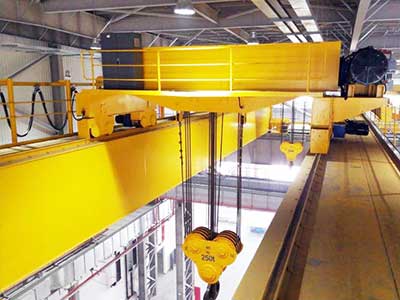
A bridge crane is an overhead crane that travels on elevated rails across a factory, workshop, or production line. Unlike gantry cranes, bridge cranes are supported above the floor, either by building columns or by an independent runway. This design keeps the floor area clear, making it easier to store materials, move forklifts, and keep workflows smooth.
Key practical point: Bridge cranes are ideal when maximizing usable floor space is important, especially for high-frequency or continuous operations.
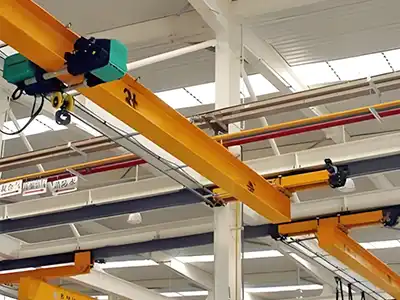
Bridge Crane Types: Features, Applications, and Space Use
Practical Tips for Ground Space and Material Flow
- Bridge cranes run above the floor, keeping aisles and work areas clear for forklifts and workers.
- Choose the crane type based on load capacity and span requirements:
- Top-running double girder cranes for heavy-duty, continuous operations.
- Single girder or under-running cranes for smaller, lighter-load facilities. - Plan the runway layout carefully to ensure maximum coverage and material flow efficiency.
- Bridge cranes are best for indoor operations where maximizing floor space and workflow efficiency is critical.
| Bridge Crane Type | Main Features | Where It's Used | Ground Space & Material Flow Notes |
|---|---|---|---|
| Top-Running Bridge Crane | Rails mounted on top of runway beams Supports heavy loads Long spans High stability | Large factories Workshops with heavy machinery Steel mills and production lines | Minimal footprint Floor is completely clear Ideal for continuous material flow |
| Under-Running Crane | Travels under runway rails Often uses existing building structure for support Suitable for light to medium loads | Workshops with limited overhead space Indoor factories with smaller spans | Floor remains open Lightweight loads handled efficiently Good for facilities with low ceiling height |
| Single Girder Overhead Crane | One main girder carries hoist and trolley Light to medium capacity Shorter spans Easier to install and maintain | Small to medium factories Workshops and assembly areas | Minimal floor interference Flexible for smaller production lines Cost-effective solution |
| Double Girder Overhead Crane | Two main girders carry hoist and trolley Supports heavy loads Longer spans Stable and durable for high-frequency operations | Large factories Heavy machinery plants Continuous production lines | Floor fully clear Optimized for fast and precise material handling Ideal for high-volume operations |
Top-Running Bridge Crane
- Rails are mounted on top of the runway beams.
- Typically used for heavy loads and long spans.
- Provides higher lifting capacity and stability.
Under-Running Crane
- Travels under the runway rails, often using the factory's existing structure for support.
- Good for lighter loads or facilities with limited overhead clearance.
Single Girder Overhead Crane
- One main girder carrying the hoist and trolley.
- Ideal for light to medium loads and shorter spans.
- Easier and cheaper to install and maintain.
Double Girder Overhead Crane
- Two main girders carry the hoist and trolley.
- Supports heavier loads and longer spans.
- Better for continuous, heavy-duty operations in factories or workshops.
Applications
Bridge cranes are mainly used in indoor industrial operations, where floor space is valuable:
- Factories and workshops.
- Heavy machinery plants.
- Assembly lines and production areas.
- Material handling zones requiring frequent, precise lifting.
Practical insight: Bridge cranes are best when you want continuous material flow without floor obstruction, making them highly efficient for busy production lines.
Ground Space Considerations of Overhead Bridge Cranes
Floor Space and Layout Advantages
- Minimal footprint: Crane legs are above the floor, so storage, forklifts, and workers can move freely.
- Open floor space: No structural legs blocking aisles or work areas.
- Layout flexibility: While the crane is fixed to the runway, it allows dense material stacking and easy equipment movement.
Key Points
- Excellent for facilities where every square meter counts.
- Reduces the risk of congestion or accidents compared to gantry cranes with floor legs.
Material Flow Considerations
- Continuous coverage: The crane can travel the full length of the production line or workshop without repositioning.
- Faster operation: Travel speeds are higher and hoist positioning is more precise, reducing delays.
- Efficient workflow: Multiple lifts and operations can happen without interfering with forklifts or workers.
Practical advice: For high-frequency, indoor operations, a top-running double girder crane is usually the best choice for both speed and reliability. Single girder or under-running cranes work well in smaller or lighter-load facilities.
Ground Space Utilization Comparison
Footprint Analysis
One of the biggest differences between gantry cranes and bridge cranes is how much floor space they take. Gantry cranes have legs that touch the ground, which can occupy significant space and sometimes interfere with material storage or vehicle movement. In contrast, bridge cranes run on elevated rails, leaving the entire floor free for pallets, forklifts, and workers.
- Gantry crane legs block some areas of the floor.
- Bridge cranes maximize usable floor space by keeping pathways clear.
- Consider the impact on aisle widths and storage layout when choosing a crane.
Workflow Impact
The type of crane you choose directly affects the flow of materials and how smoothly operations run. Gantry cranes can occasionally create obstacles in busy work areas, slowing down forklifts or other floor operations. Bridge cranes, running overhead, maintain clear pathways and minimize workflow interruptions.
- Gantry cranes may require careful floor planning to avoid bottlenecks.
- Bridge cranes enable smoother material movement and faster production cycles.
Layout Flexibility
Gantry cranes offer flexibility—they can be relocated or adjusted to fit different yard layouts. This is useful in outdoor stockyards or temporary setups. Bridge cranes, on the other hand, are fixed in place, but because they run above the floor, they allow for denser material storage and optimized workflows indoors.
- Gantry: adaptable to changing layouts, ideal for temporary operations.
- Bridge: fixed but maximizes efficiency and storage density.
Keywords & Long-Tail Phrases
factory floor efficiency, optimize material handling, save ground space with overhead cranes, industrial production layout.
Material Flow Efficiency Comparison
Travel Path & Reach
How far and freely a crane can move affects material flow. Gantry cranes are limited by leg span and may need repositioning for longer distances. Bridge cranes provide full coverage over the production area, allowing materials to move without floor obstruction.
- Gantry cranes may slow workflow if repositioning is needed.
- Bridge cranes enable continuous material movement.
Load Handling & Speed
Bridge cranes are generally faster in operation. They reduce delays in high-frequency lifting operations because they travel overhead without floor obstacles and can handle multiple lifts efficiently.
- Bridge cranes reduce downtime and improve production speed.
- Gantry cranes may be slower, especially if mobility or repositioning is required.
Multi-Point Operations & Safety
Bridge cranes can serve multiple workstations at the same time. Fewer obstructions on the floor also improve worker safety, minimizing the risk of collisions with forklifts, carts, or other equipment.
- Bridge cranes improve safety and operational efficiency.
- Gantry cranes require more careful floor planning to maintain safety.
Buyer Decision-Making Guide
When to Choose a Gantry Crane
- Outdoor yards or open-air production areas.
- Temporary installations or relocatable operations.
- Uneven ground surfaces or sites without building structures.
- Situations requiring flexible layout adjustments.
When to Choose a Bridge Crane
- Indoor workshops or factories with permanent operations.
- Environments where maximizing floor space is critical.
- High-frequency, continuous lifting operations.
- Operations requiring faster, precise material handling.
Other Considerations for Buyers
- Cost vs long-term efficiency: Gantry cranes may be cheaper initially, but bridge cranes can improve productivity over time.
- Installation complexity and structural support: Bridge cranes need building support or a dedicated runway; gantries may be easier to install outdoors.
- Lifting capacity and span requirements: Double girder cranes—gantry or bridge—are better for heavier loads.
Practical Tip: Think about the long-term workflow, not just the initial installation cost. The right choice improves material flow, safety, and production efficiency over years.
Case Study Insights
Outdoor Stockyard Example
In large outdoor stockyards, gantry cranes are highly effective for handling heavy materials such as steel billets, slabs, or large structural components. Their mobility and flexible placement allow operators to lift and move materials across open areas without needing permanent building support.
- Handles heavy and irregularly sized loads efficiently.
- Can be relocated as stockyard layout changes.
- Floor space can be partially blocked by crane legs, so layout planning is essential.
Indoor Factory Example
In indoor production facilities, bridge cranes provide continuous coverage over assembly lines or manufacturing zones. Running on elevated rails, they keep the floor clear, which allows forklifts, workers, and pallets to move freely while materials are lifted directly where needed.
- Maximizes usable floor space.
- Improves production line efficiency with precise positioning.
- Supports high-frequency lifting without workflow interruptions.
Key Metrics to Measure Efficiency
- Ground space saved: Compare floor area blocked by gantry legs vs overhead bridge crane.
- Number of lifts per hour: Measure material handling efficiency.
- Production efficiency: Overall impact on workflow, including reduced downtime and improved material flow.
Summary Insight
- Gantry cranes excel in outdoor or flexible setups where mobility is needed.
- Bridge cranes shine indoors, where continuous workflow, floor space optimization, and precise material handling are critical.
- Choosing the right crane type directly impacts material flow, safety, and productivity in industrial operations.
Conclusion
Choosing the right crane type can make a big difference in floor space usage, workflow efficiency, and overall productivity.
- Bridge Cranes: Best suited for indoor factories and workshops, where maximizing floor space and maintaining continuous, high-frequency operations are critical. Their overhead design keeps aisles clear and supports precise, fast material handling.
- Gantry Cranes: Ideal for outdoor yards, open-air production, or temporary setups. They offer flexibility and mobility but occupy floor space with their legs, which may reduce efficiency in dense production areas.
Final Recommendation for Buyers
Before selecting a crane, carefully consider:
- Production layout: Indoor vs outdoor, aisle width, and storage density.
- Workflow needs: Frequency of lifts, multi-point operations, and travel path requirements.
- Ground space: How much floor area can be dedicated to crane legs or runway support.
- Lifting frequency and capacity: Light, medium, or heavy loads; short vs long spans.
- Budget and long-term efficiency: Initial cost vs productivity gains over time.
Frequently Asked Questions (FAQ)
1. Which crane type saves more floor space?
Answer:
Bridge cranes save the most floor space because they run on elevated rails and don't have legs touching the floor. This allows forklifts, pallets, and workers to move freely underneath.
Gantry cranes, on the other hand, have legs that occupy floor space, which can reduce usable storage or block aisles in dense production areas.
Key takeaway: If maximizing factory floor efficiency is a priority, bridge cranes are generally the better choice.
2. How does crane choice affect material handling and production workflow?
- Bridge cranes provide continuous coverage over production lines or workshops, allowing fast, precise material movement with minimal downtime. Multiple stations can be served simultaneously, improving industrial workflow.
- Gantry cranes offer flexible placement and mobility, which is ideal for outdoor yards or temporary operations, but moving the crane or repositioning it for longer spans may slow down material handling.
Key takeaway: Crane type directly impacts material flow, lift speed, and operational efficiency.
3. When is a gantry crane better than a bridge crane, and vice versa?
Gantry cranes are best for:
- Outdoor stockyards or open-air production.
- Temporary or relocatable operations.
- Uneven ground surfaces or sites without buildings.
Bridge cranes are best for:
- Indoor factories, workshops, or assembly lines.
- Continuous, high-frequency lifting operations.
- Situations where floor space must be maximized for pallets, forklifts, or workers.
Key takeaway: Consider operation environment, workflow needs, and floor layout when choosing between gantry and bridge cranes.
4. What are the cost, installation, and flexibility trade-offs?
- Gantry cranes are often less expensive initially and easier to install outdoors without building support. They offer mobility and layout flexibility but occupy more floor space.
- Bridge cranes may require higher upfront cost, building support, or runway installation. However, they optimize floor space, material flow, and safety, which can save costs in the long run through increased operational efficiency.
Key takeaway: Balance budget, installation complexity, and long-term workflow efficiency before making a decision.




Yuantai Cranes
Overhead Crane Manufacturer with CE, ISO, SGS, CNEX Certificates.
- Main Specifications - Capacity: 0.5–550 tons | Span: up to 40m | Speed: 0.8–12 m/min | Duty: A3–A7 | Power: 380–690V, 50/60Hz | Control: pendant/remote/cabin
- Full engineering: FEA/PLC/VFD + in-house build + global delivery + on-site support, for workshops, factories, EPC contractors, industrial projects, etc.
- Support: design, manufacturing, testing, service – end-to-end, customized lifting solutions worldwide.
How to Get an Accurate Crane Price for Your Application?
Tips: Copy the spec list, fill in your details, and paste it into the form on the right/ down-below for a quick price.
- Crane type:_____ . (e.g., overhead crane, gantry crane, jib crane)
- Max weight to lift:_____ tons. (e.g., 2t, 5t, 10t, 20t, 50t)
- Lifting height:_____ m. (How high does the hook need to reach?
- Workshop width (span):_____ m . (Distance between the two crane rails)
- Travel distance:_____ m . (How long does the crane need to move along the runway?)
- Control type:_____. (Pendant / remote / cabin Control)
- Power supply:_____. (Local voltage & frequency – e.g., 380V, 50Hz, 3-phase)
- What will it be used for?_____ (e.g., steel fabrication, concrete products, mold handling, general manufacturing, etc.)
- Any special requirements?_____ (e.g., extreme temperature, dusty or explosive environment, special paint color, etc.)
Just leave a message via the contact form and our hoist and crane engineer will contact you with in 24working hours.
Get Your Custom Quote–Quick & Easy
Fill in what you know. Skip what you don't – we'll help.Any question will be reply with 24 working hours