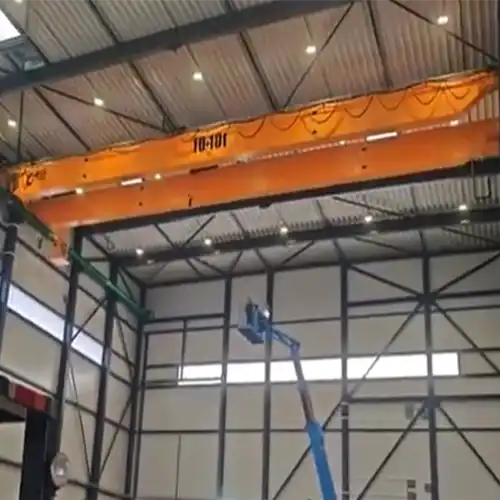
Dual-Trolley 20-Ton Overhead Crane for High-Capacity PV Lines
Boost PV module production with a dual-trolley 20-ton double girder crane. Efficient, safe, and flexible handling for high-capacity solar panel lines.
| Crane Type | 20 ton double-girder overhead/EOT crane with dual trolley and two lifting mechanisms; independent or synchronized trolley operation; electric wire rope hoists or open winches; ISO A5–A8 / FEM 2M–5M duty class; 380/400/415V, 50Hz, 3Ph; |
| Crane Capacity | 20 ton (20,000 kg) rated lifting capacity; dual-trolley configuration can be engineered for independent or coordinated lifting according to load distribution and handling requirements. |
| Span Length | 10–30 m span; runway length and working range customized according to PV production-line layout. |
| Lifting Height | 6–15 m; customized according to factory height, production equipment, storage requirements, and required lifting clearance. |
| Coverage Area Type | Rectangular crane-bay coverage along the runway; PV production lines, equipment installation areas, assembly zones, maintenance areas, warehouses, material-transfer areas, and loading zones. |
| Application | Handling PV production equipment, glass, frames, modules, molds, machinery, production tooling, steel structures, and heavy components during PV module manufacturing, installation, maintenance, and material transfer. |
| Certifications | CE / ISO / SGS / Other third-party inspection |
| Customization | Customized for 20 ton load handling; double-girder structure, double trolley, wire rope hoists or open winches, synchronized or independent trolley operation, VFD control, pendant/radio/cabin control, positioning, weighing, and production-line automation. |
Crane Manufacturer: Yuantai Cranes – 30+ Years Professional Crane Manufacturer from China
Category: Featured
Tags:
Your Trusted Overhead Crane Manufacturer & Supplier
20 Ton Overhead Crane with Double Trolley for Sale
Dual-Trolley 20-Ton Double Girder Crane Supports High-Capacity PV Module Production Lines
Most Important Takeaway
For PV module production lines, a dual-trolley 20-ton double girder crane dramatically increases efficiency, handles large and heavy solar panels safely, and reduces downtime—making it a critical investment for high-throughput, modern PV factories.
Key Takeaways
- Dual-trolley cranes allow simultaneous lifting of multiple PV modules, boosting workflow speed.
- A 20-ton lifting capacity is ideal for large-format PV panels and production materials.
- Double girder construction provides high stability, longer span coverage, and safe heavy lifting.
- Advanced features like anti-sway, overload protection, and precise trolley control improve safety and reduce module damage.
- Optimized for high-capacity PV module assembly lines, ensuring smooth material handling and minimal bottlenecks.
- Flexible design supports future production line expansion or handling larger modules.
Introduction
In modern PV module production, speed and precision aren't just nice to have—they're essential. Solar panels are getting bigger and heavier every year. Handling them with small hoists or by hand isn't just slow; it's risky. Modules can be damaged, and workers can get hurt. That's where a dual-trolley 20-ton double girder crane comes in.
This type of crane lets you move panels safely across the production line, from laminators to stacking stations, without slowing anything down. It's built to handle heavy loads steadily, keeping operations smooth and reducing the chances of mistakes. For production managers, it's not just lifting equipment—it's a practical solution that keeps the line running efficiently, day in and day out.
Production Line Requirements
Efficient PV module production depends on three critical factors: module size and weight, line throughput, and workflow safety. Each factor directly affects which crane solution keeps production running smoothly.
Module Size and Weight
PV panels are larger and heavier than ever before, and this matters when planning crane operations. A crane that isn't sized properly can slow production or even damage valuable modules.
- Width: 1,000–2,500 mm
- Length: 1,500–2,500 mm
- Weight per bundle: up to 25–30 tons
Key points to consider:
- Cranes must be designed to handle these sizes and weights safely.
- Bundled panels increase the load, requiring accurate capacity planning.
- Using an underpowered crane risks module damage and slower production.
Throughput Demands
High-capacity production lines move fast, and lifting equipment must keep up. Even short delays during panel transfers can accumulate, reducing overall efficiency.
Here's what to keep in mind:
- Multiple lifts per hour are standard on busy lines.
- Manual repositioning or small hoists can create bottlenecks.
- Even a few minutes of delay per lift adds up across the day, cutting total output.
A crane that can match the line's speed ensures:
- Smooth transport between workstations.
- Minimal idle time for workers and machinery.
- Continuous, predictable material flow throughout the production line.
Safety and Workflow
Worker safety and module protection are equally important. A crane must move modules steadily, avoiding sudden jerks or collisions, while fitting seamlessly into the workflow.
The benefits of a well-integrated crane include:
- Smooth handling of panels, reducing the risk of breakage.
- Lower chance of operator injuries.
- Steady flow across cutting, laminating, stacking, and packaging stations.
- Simplified operations for downstream processes like assembly and shipping.
Advantages of a Dual-Trolley Crane
In high-capacity PV module production lines, a dual-trolley crane is not just a lifting device—it's a versatile material handling solution. With two independent trolleys on a single double girder bridge, operators can manage multiple modules at once, lift heavier loads, and handle complex workflows more efficiently. The design reduces downtime, improves precision, and keeps the production line moving smoothly.
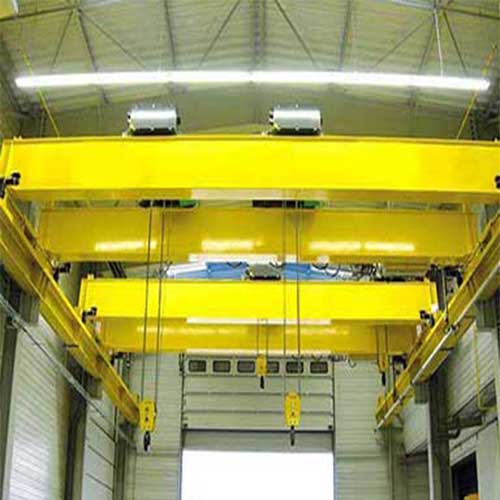
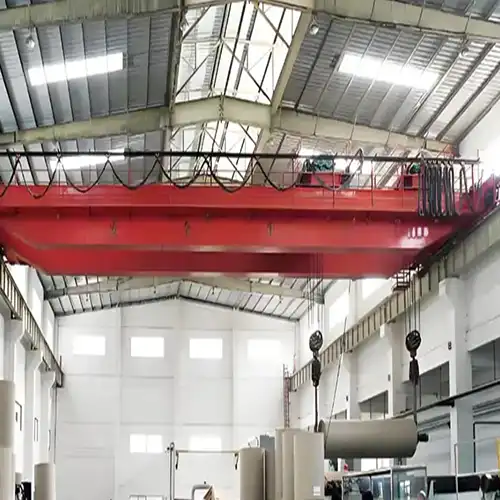
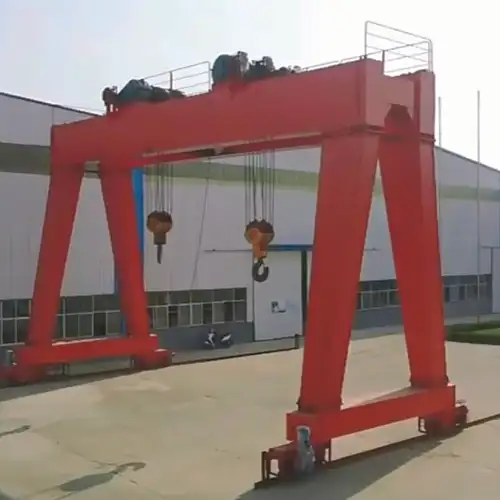
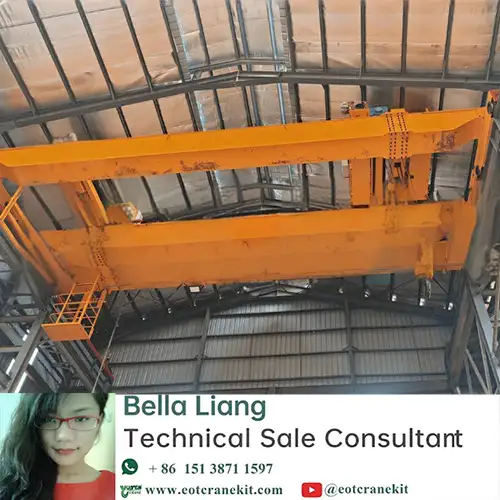
Double girder gantry crane with double trolley
Independent or Tandem Operation
One of the biggest benefits of a dual-trolley crane is the ability to operate either independently or in tandem. You can lift two separate modules at the same time, or synchronize both trolleys to lift a single, longer load. This flexibility is especially valuable in PV production lines that handle varied module sizes or require precise placement on assembly or stacking stations.
- Simultaneous module handling: Two panels can be moved between stations at once, saving several minutes per lift.
- Handling long or bulky loads: When panels exceed the width of one trolley, the second trolley can be synchronized to lift and position them safely.
- Reduced crane footprint: One crane with two trolleys does the work of two separate single-trolley cranes, simplifying installation and workflow.
- Operational versatility: Independent operation allows maintenance or small adjustments on one trolley while the other keeps the line moving.
Increased Lifting Flexibility
Dual trolleys provide greater adaptability to different loads. PV modules aren't always uniform in size, and production lines often have to handle bundles of panels, jigs, or other materials that require precise lifting points. Being able to adjust each trolley's position allows operators to lift uneven or irregular loads safely, reducing the risk of damage.
- Precise load positioning: Trolleys can be moved independently to align perfectly with the panel's center of gravity.
- Accommodates irregular or bulky panels: Handles larger bundles without putting stress on the crane or modules.
- Reduces handling errors: Less chance of misalignment or collisions during transfers.
- Supports multiple applications: Useful for stacking, sorting, or moving modules to inspection and packaging stations.
Reduced Downtime
Dual-trolley cranes are designed for continuous operation, even during maintenance or minor repairs. If one trolley requires inspection, the other can continue to operate, ensuring the production line isn't halted. For high-throughput PV module factories, even small interruptions can cause bottlenecks and reduce overall output.
- Maintenance without stopping production: One trolley remains operational while the other is serviced.
- Minimized workflow disruption: Keeps modules moving, reducing stress on operators and downstream processes.
- Higher reliability: Production managers can plan routine inspections without affecting throughput.
- Cost savings: Less downtime means more panels produced per shift and fewer labor hours wasted.
Better Space Utilization
Space in PV module production facilities is often limited, and ceiling-mounted cranes must navigate between machines, workstations, and storage areas. Dual-trolley cranes can cover wide spans efficiently while avoiding interference with other equipment. This makes them ideal for dense, high-capacity production layouts.
- Maximized workshop space: Wide coverage allows fewer cranes to handle more modules.
- Efficient workflow integration: Modules move along optimized paths without blocking other machines.
- Reduced need for extra equipment: A single dual-trolley crane can replace multiple single-trolley cranes or forklifts.
- Safer operations: By keeping lifts predictable and organized, the crane reduces congestion and potential hazards.
Key Technical Features of the 20-Ton Double Girder Crane
A dual-trolley 20-ton double girder crane is more than just a heavy-lifting machine. Its technical design ensures reliable, precise, and safe material handling for high-capacity PV module production lines. Understanding its core features helps production managers choose the right crane for their workflow, capacity, and safety requirements.
Heavy Lifting Capacity
The crane's 20-ton maximum load makes it capable of handling not just individual PV panels but also bundles, inverter assemblies, and stacking pallets. This level of capacity ensures that even the heaviest modules move safely across the line without overloading the system.
- Lifts large-format PV panels with ease.
- Moves bundled modules or assembly materials in a single lift, saving time.
- Reduces the need for multiple lifts, increasing line efficiency.
- Supports a variety of production tasks, from stacking to packaging.
Double Girder Design
A double girder structure provides high rigidity and stability, which is especially important for long spans in large workshops. Unlike single girder cranes, double girders minimize vibration and sway, ensuring modules remain steady during movement.
- Stable lifting over long distances, even at full load.
- Reduced risk of module damage caused by sway or vibration.
- Supports dual-trolley operation without compromising safety or precision.
- Ideal for wide workshop layouts in high-capacity PV production lines.
Precision Controls
Modern cranes come with advanced control systems to make handling safer and more accurate. Operators can use remote control or cabin operation, with smooth start and stop functions and anti-sway technology to prevent sudden jolts.
- Precise positioning of panels on stacking, laminating, or assembly stations.
- Reduced risk of accidental collisions with machinery or other modules.
- Smooth motion improves safety for operators and prevents material damage.
- Flexible operation modes to suit different line layouts and operator preferences.
Safety Features
Safety is critical in high-volume PV production. Dual-trolley cranes are equipped with multiple safety systems, including:
- Overload protection, preventing lifting beyond capacity.
- Emergency stop systems for instant shutdown if needed.
- Trolley collision prevention, ensuring trolleys don't interfere with each other during simultaneous operations.
- Protects both operators and PV modules.
- Reduces risk of costly production stoppages.
- Meets regulatory safety standards for industrial lifting equipment.
Maintenance-Friendly Design
High-capacity production lines need cranes that are reliable day in and day out. This crane is designed for easy inspection, maintenance, and component replacement, allowing continuous operation without significant downtime.
- Simple access for routine checks and lubrication.
- Reduces unplanned downtime from mechanical issues.
- Extends crane lifespan and keeps operational costs manageable.
- Supports continuous high-volume operation, essential for fast-moving PV lines.
Workflow Integration in PV Production Lines
A dual-trolley 20-ton double girder crane doesn't just lift heavy panels—it shapes how material moves across the entire PV module production line. When integrated correctly, it can streamline operations, reduce bottlenecks, and protect both workers and modules. Understanding how the crane fits into daily workflow is key to maximizing its value.
Loading and Unloading Modules
The crane plays a central role in transporting modules between production stations. Whether moving panels from laminators to stacking areas or preparing them for packaging, safe and precise lifting is essential.
- Ensures modules are handled gently, minimizing scratches, cracks, or other damage.
- Supports smooth transitions between cutting, laminating, and stacking stations.
- Reduces the need for forklifts or manual handling, improving overall efficiency.
- Keeps production lines running at consistent speed, even with large or heavy panels.
Parallel Trolley Operation
With two trolleys, the crane can perform simultaneous tasks, boosting throughput without adding more equipment. One trolley can transport finished modules while the second prepares raw panels for the next stage.
- Minimizes idle time between lifts, keeping the production line flowing.
- Allows continuous operations even during high-demand periods.
- Reduces congestion on the shop floor, as multiple modules can move simultaneously.
- Provides flexibility to handle different module sizes or batch requirements at the same time.
Optimized Layout
Ceiling-mounted double girder cranes save floor space and provide clear pathways for operators and other machinery. Proper placement ensures the crane enhances rather than disrupts workflow.
- Maximizes available workshop space without interfering with other equipment.
- Keeps production paths organized and predictable, reducing collisions.
- Simplifies movement of modules along cutting, laminating, stacking, and packaging lines.
- Supports future layout changes or line expansions without major crane adjustments.
Reducing Manual Handling Risks
By handling panels mechanically, the crane reduces the need for human lifting, which protects both operators and modules. This is particularly important in high-capacity PV production where panels are heavy and fragile.
- Protects workers from injuries caused by repetitive lifting or awkward loads.
- Reduces panel damage caused by improper handling or accidental drops.
- Improves overall safety and efficiency on the production floor.
- Supports consistent workflow even during peak production periods.
Real Benefits for Your Industrial Needs
A dual-trolley 20-ton double girder crane doesn't just exist on paper—it has measurable effects on PV module production lines. When implemented correctly, it directly improves efficiency, reduces costs, and provides flexibility for future growth. These impacts go beyond lifting panels—they affect workflow, production schedules, and long-term operational planning.
Higher Production Efficiency
By moving PV modules quickly and safely, the crane keeps the production line running continuously, even during peak operations. Faster handling reduces bottlenecks and ensures each station—from laminating to stacking—is supplied with materials on time.
- Reduces waiting time between workstations.
- Increases throughput per shift without adding labor.
- Ensures smooth workflow even with large or irregular modules.
- Allows production managers to focus on optimizing line processes rather than handling logistics manually.
Reduced Costs
Investing in a high-capacity crane can save money in multiple ways. Handling modules mechanically reduces the chance of damage, decreases labor costs, and minimizes downtime caused by slow manual movement.
- Lower risk of panel breakage, which can be expensive in high-volume lines.
- Fewer labor hours spent moving heavy panels manually.
- Less downtime due to module misplacement or inefficient transport.
- Improved overall return on investment over the crane's lifespan.
Future-Proof Investment
PV module production lines are constantly evolving, with larger panels and higher throughput becoming standard. A dual-trolley crane is built to adapt to future demands, allowing factories to expand or reconfigure workflows without major upgrades.
- Handles larger modules or heavier bundles as production scales.
- Flexible trolley operation supports changing workflow needs.
- Reduces the need for additional lifting equipment in the future.
- Ensures long-term usability and consistent production performance.
Buyer Considerations
Choosing the right crane for a high-capacity PV module production line is more than just picking a model off a catalog. Production managers need to consider technical requirements, customization options, and long-term return on investment to ensure the crane fits current and future needs.
Pre-Purchase Checklist
Before making a purchase, it's critical to evaluate the specific needs of your production line. The right crane depends on the workshop layout, load characteristics, and operational speed.
- Span: Ensure the crane can cover the full width of your production line without leaving blind spots.
- Lifting height: Confirm sufficient clearance for stacked modules and machinery.
- Trolley speed: Check that trolley movement matches production line throughput.
- Power supply: Verify compatibility with your facility's electrical system.
- Load requirements: Confirm maximum load capacity fits current and future module weights and bundles.
Customization Options
Every PV production line has unique challenges, and a standard crane may not meet all requirements. Considering customization can optimize safety and efficiency.
- Dual-speed hoists for handling both heavy bundles and single panels efficiently.
- Anti-sway systems to reduce load movement and protect delicate PV modules.
- Protective covers to handle dust, humidity, or outdoor environments safely.
- Remote or cabin controls to match operator preferences and workflow layout.
ROI Assessment
A crane is a long-term investment. Understanding the potential return on investment helps justify the purchase and plan budgets.
- Compare crane cost versus efficiency gains from faster handling.
- Calculate savings from reduced module damage and fewer replacements.
- Factor in labor savings from minimized manual handling.
- Consider long-term flexibility—whether the crane can adapt to larger modules or future line expansions.
FAQ: Dual-Trolley 20-Ton Double Girder Crane for PV Production Lines
1. Why is a dual-trolley crane better than a single-trolley crane for PV production lines?
A dual-trolley crane offers more flexibility and efficiency than a single-trolley setup. With two trolleys, operators can move two modules at once or combine them for longer or heavier loads. This reduces waiting time between stations, keeps production flowing, and allows the crane to adapt to different module sizes and bundles without slowing the line.
2. How does a 20-ton double girder crane improve efficiency in high-capacity solar module assembly?
The 20-ton capacity allows the crane to lift large panels or multiple modules in one go, minimizing manual handling and cycle time. The double girder design ensures stability over long spans, reducing sway and vibration while moving heavy loads. Combined with dual-trolley operation, it keeps modules moving continuously, even during maintenance or when handling multiple batches simultaneously.
3. What technical features ensure safe handling of large PV modules?
Safety is built into every aspect of a dual-trolley crane. Key features include:
- Overload protection to prevent lifting beyond capacity
- Anti-sway systems for stable load movement
- Emergency stops for immediate shutdown if needed
- Precision controls for smooth start/stop and accurate positioning
These features protect both the PV modules and operators while ensuring smooth workflow and reduced risk of damage or injury.
4. How can production managers integrate dual-trolley cranes into existing workflows?
Integration begins with assessing your line layout and module flow. A dual-trolley crane can:
- Move modules between laminators, stacking, and packaging stations
- Operate trolleys in parallel for raw and finished modules
- Reduce reliance on forklifts or manual labor, keeping the line organized and safe
Proper planning ensures the crane enhances workflow rather than disrupting it, maximizing throughput and operational efficiency.
5. What factors should buyers consider before purchasing a dual-trolley double girder crane?
Before buying, production managers should evaluate:
- Span and lifting height to cover all stations
- Load requirements for current and future module sizes
- Trolley speed and control options for workflow compatibility
- Customization options like anti-sway systems, dual-speed hoists, and protective covers
- ROI assessment: cost versus efficiency gains, labor savings, and reduced module damage
This ensures the crane meets both current production needs and future scalability.
Conclusion
Investing in a dual-trolley 20-ton double girder crane can make a real difference for high-capacity PV module production lines. It's not just about lifting heavy panels—it's about moving modules safely, efficiently, and precisely across the entire workflow.
This type of crane improves lifting efficiency, reduces the risk of module damage, and keeps the production line running smoothly with minimal downtime. Its flexible design allows operators to handle larger modules or multiple panels at once, while dual-trolley operation ensures continuous movement even during maintenance.
For production managers and crane buyers, the benefits are clear:
- Optimized workflow: Modules move faster and more predictably between stations.
- Reduced operational costs: Less damage, lower labor requirements, and fewer delays.
- Future-ready scalability: The crane adapts to larger panels or expanded production lines without major upgrades.
In short, a dual-trolley 20-ton double girder crane transforms lifting equipment from a simple tool into a key component of production efficiency and reliability. For any PV module factory aiming to maintain high throughput and safe operations, it's an investment that pays off day after day.


Yuantai Cranes
Overhead Crane Manufacturer with CE, ISO, SGS, CNEX Certificates.
- Main Specifications - Capacity: 0.5–550 tons | Span: up to 40m | Speed: 0.8–12 m/min | Duty: A3–A7 | Power: 380–690V, 50/60Hz | Control: pendant/remote/cabin
- Full engineering: FEA/PLC/VFD + in-house build + global delivery + on-site support, for workshops, factories, EPC contractors, industrial projects, etc.
- Support: design, manufacturing, testing, service – end-to-end, customized lifting solutions worldwide.
How to Get an Accurate Crane Price for Your Application?
Tips: Copy the spec list, fill in your details, and paste it into the form on the right/ down-below for a quick price.
- Crane type:_____ . (e.g., overhead crane, gantry crane, jib crane)
- Max weight to lift:_____ tons. (e.g., 2t, 5t, 10t, 20t, 50t)
- Lifting height:_____ m. (How high does the hook need to reach?
- Workshop width (span):_____ m . (Distance between the two crane rails)
- Travel distance:_____ m . (How long does the crane need to move along the runway?)
- Control type:_____. (Pendant / remote / cabin Control)
- Power supply:_____. (Local voltage & frequency – e.g., 380V, 50Hz, 3-phase)
- What will it be used for?_____ (e.g., steel fabrication, concrete products, mold handling, general manufacturing, etc.)
- Any special requirements?_____ (e.g., extreme temperature, dusty or explosive environment, special paint color, etc.)
Just leave a message via the contact form and our hoist and crane engineer will contact you with in 24working hours.
Get Your Custom Quote–Quick & Easy
Fill in what you know. Skip what you don't – we'll help.Any question will be reply with 24 working hours