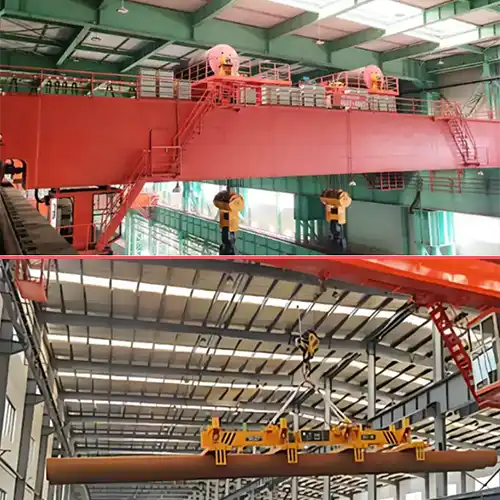
Double-Hoist vs. Spreader Overhead Cranes Cost, Energy, and Maintenance Comparison
Compare double-hoist and spreader overhead cranes. Learn differences in cost, energy use, and maintenance to choose the right crane for your operations.
| Crane Type | Double-girder overhead/EOT crane; double-hoist or spreader-beam configuration; ISO A5–A8 / FEM 2M–5M; 380/400/415V, 50Hz, 3Ph.Spreader beam, lifting beam, C-hook, coil clamp, tong, magnet, grab or customized lifting frame |
| Crane Capacity | 10–500 ton+ |
| Span Length | 10–35 m+ |
| Lifting Height | 6–30 m+ |
| Coverage Area Type | Rectangular indoor work areas covered by overhead runway beams. Double-hoist: two lifting points for long or unbalanced loads. Spreader: one hoist connected to a beam that distributes the load across multiple lifting points. |
| Application | Steel plants, fabrication shops, machinery manufacturing, precast plants, warehouses, shipyards and heavy assembly. |
| Certifications | CE / ISO / SGS / Other third-party inspection |
| Customization | Capacity, span, lifting height, duty class and lifting configuration; double hoists for synchronized lifting or spreader beam for long/large loads; VFD, load monitoring, positioning and anti-sway available. |
Crane Manufacturer: Yuantai Cranes – 30+ Years Professional Crane Manufacturer from China
Category: Featured
Tags:
Your Trusted Overhead Crane Manufacturer & Supplier
Double-Hoist vs. Spreader Overhead Cranes
Cost, Energy, and Maintenance Comparison
Introduction
Purpose of This Comparison
Choosing the right overhead crane can make a real difference in how smoothly a workshop or plant runs. Double-hoist cranes and spreader cranes are two common options, but they serve slightly different purposes and come with their own costs, energy requirements, and maintenance needs. This guide is here to break it down clearly, so you know what to expect before making a purchase.
- Evaluate double-hoist cranes: understand where they excel and where they may fall short.
- Examine spreader beam cranes: see how they perform for wide or awkward loads.
- Compare three critical factors: upfront and long-term cost, energy usage, and routine maintenance.
- Help buyers in manufacturing, construction, and logistics make practical, informed decisions.
Scope of the Comparison
This comparison isn't just theoretical—it's practical. We focus on real-world applications where overhead cranes are part of daily operations. Whether you're lifting steel plates in a factory, moving machinery in a construction yard, or handling pallets in a warehouse, these insights apply.
- Industries covered: manufacturing plants, steel mills, construction sites, logistics warehouses.
- Load types considered: from heavy, long, or oversized items to wide or awkward-shaped loads.
- Decision-making help: provides information for both first-time buyers and experienced maintenance teams.
Why This Matters
Picking the wrong crane can lead to unexpected costs, higher energy bills, or downtime for maintenance. By comparing double-hoist and spreader cranes upfront, you can avoid surprises and choose the solution that actually fits your workflow.
- Cost savings: avoid overspending on unnecessary features.
- Energy efficiency: know which crane type consumes less power for your typical loads.
- Maintenance planning: understand which crane will be easier to maintain and keep running smoothly.
Crane Configurations Overview
Double-Hoist Cranes
Double-hoist cranes are designed with two hoists mounted on a single bridge. This setup gives you the flexibility to lift loads either together or independently, depending on what the task requires. They are particularly useful when you need to handle heavy or unusually shaped items that a single hoist would struggle with.
- Dual operation options: hoists can work in tandem for extra lifting power or independently for handling two separate loads.
- Load capacity: ideal for heavy, bulky, or oversized materials that require careful control.
- Applications: commonly found in steel mills, shipyards, and large manufacturing plants.
- Advantages: reduces the need for multiple crane setups and can handle larger projects efficiently.
- Considerations: slightly more complex operation and higher energy use compared to single-hoist cranes.
Spreader Beam Cranes
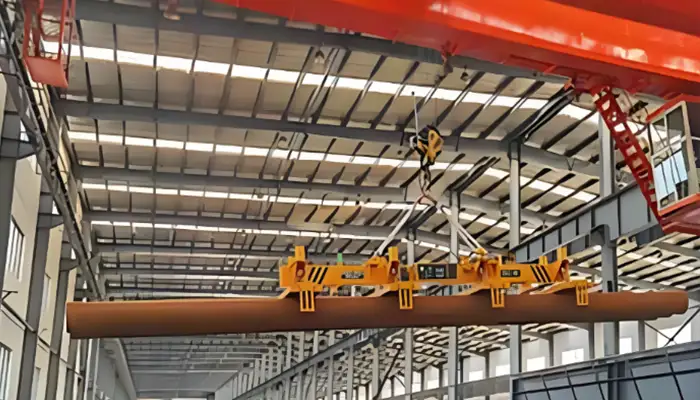
Spreader beam cranes take a different approach. Instead of adding extra hoists, they use a horizontal beam to distribute the weight of the load evenly. This method is excellent for lifting wide, long, or awkwardly shaped items without bending or damaging them. Spreader beams can either work with your existing crane or operate as part of a complete crane system.
- Load distribution: spreads the weight across multiple points, reducing strain on the crane and the load itself.
- Flexibility: can be used with existing overhead cranes or as standalone lifting systems.
- Applications: suitable for logistics warehouses, construction sites, and factories dealing with wide or delicate items.
- Advantages: improves stability and safety when handling difficult loads.
- Considerations: may require additional rigging equipment and planning for proper attachment points.

| Feature | Double-Hoist Cranes | Spreader Beam Cranes |
|---|---|---|
| Design | Two hoists mounted on a single bridge; can lift together or independently. | Horizontal beam distributes load; can work standalone or with existing crane. |
| Load Capacity | Ideal for heavy, bulky, or oversized materials. | Best for wide, long, or awkward-shaped loads. |
| Operation Options | Hoists can work in tandem or independently for flexibility. | Distributes weight evenly; reduces strain on crane and load. |
| Applications | Steel mills, shipyards, large manufacturing plants. | Logistics warehouses, construction sites, factories handling wide or delicate items. |
| Advantages | Reduces need for multiple cranes; handles larger projects efficiently. | Improves stability and safety when handling difficult loads. |
| Considerations | Slightly complex operation; higher energy use. | May require extra rigging and careful attachment planning. |
Cost Comparison
Initial Purchase & Installation
When it comes to upfront costs, double-hoist and spreader beam cranes can be quite different. Double-hoist cranes tend to be pricier because of their more complex design and higher load capacities. You're essentially paying for extra lifting power and versatility.
- Double-Hoist Cranes: higher initial investment due to dual hoists, reinforced bridge structure, and heavier-duty motors.
- Spreader Beam Cranes: usually lower cost since the beam itself is simpler, but if you need to integrate it with an existing crane, there could be additional installation expenses.
- Practical tip: factor in site modifications, electrical upgrades, or mounting adjustments—these can add up quickly.
Operational Costs
Over time, how much a crane costs to run can make a bigger impact than the initial purchase price. Double-hoist cranes often draw more energy because they operate two hoists, and their more complex systems may need maintenance more often. Spreader beam cranes, on the other hand, generally use less energy, but you might spend extra on rigging gear and setup time.
- Double-Hoist Cranes: higher electricity use and more frequent mechanical checks or adjustments.
- Spreader Beam Cranes: lower power consumption, simpler routine checks, but potential added labor for rigging or beam placement.
- Practical tip: consider typical daily lifting cycles—more frequent lifts will amplify energy and maintenance costs for heavier cranes.
Total Cost of Ownership
Looking at the long-term picture, double-hoist cranes usually come out more expensive overall, because energy and maintenance costs add up over years of use. Spreader beam cranes tend to be more cost-effective in the long run, especially if you can use them with your existing crane systems and infrastructure.
- Double-Hoist Cranes: higher lifetime costs, but you get more lifting versatility and capacity.
- Spreader Beam Cranes: lower lifetime costs, easier to maintain, and often more predictable expenses.
- Practical tip: when budgeting, always include energy, scheduled maintenance, unexpected repairs, and downtime—these often exceed the initial purchase price.
| Cost Factor | Double-Hoist Cranes | Spreader Beam Cranes |
|---|---|---|
| Initial Purchase & Installation | Higher upfront cost due to dual hoists, reinforced bridge, and heavy-duty motors. Extra lifting power adds to investment. | Lower initial cost; integration with existing cranes may add expenses. Simpler beam design reduces upfront cost. |
| Operational Costs | Higher electricity consumption and more frequent maintenance due to dual hoist operation. | Lower energy use; simpler routine checks, but may require extra rigging labor for setup. |
| Total Cost of Ownership | Higher long-term costs from energy use and maintenance; versatile and handles heavy loads. | Lower lifetime costs; easier maintenance, predictable expenses, especially with existing crane systems. |
Energy Efficiency
Double-Hoist Cranes
Double-hoist cranes are powerful, no doubt about it, but that power comes with a cost—higher energy consumption. Running two hoists simultaneously requires more electricity, and the motors are usually stronger to handle the combined loads. That said, there are ways to make them more energy-efficient without losing performance.
- Energy demand: operating two hoists at the same time naturally consumes more power.
- Efficiency improvements: modern Variable Frequency Drives (VFDs) can optimize motor speed and reduce energy spikes.
- Load-sensing technologies: adjusting power based on the actual load being lifted helps avoid wasted energy.
- Practical tip: schedule heavy lifts during off-peak hours if electricity costs vary by time—this can save money over the long run.
Spreader Beam Cranes
Spreader beam cranes take a different approach. By distributing the weight of the load evenly across multiple points, these cranes reduce the strain on the lifting mechanism. Less strain means less energy is needed to perform the same lift, which makes spreader beams a smart choice for repeated lifting of wide or awkward loads.
- Lower energy use: weight distribution reduces peak load on motors.
- Consistent performance: lifts remain stable without overworking the crane.
- Practical tip: for facilities that handle large, flat, or delicate items regularly, using a spreader beam can noticeably lower your monthly power bill.
- Integration benefits: using a spreader with an existing crane often avoids adding extra high-power motors, keeping energy costs down.
| Energy Aspect | Double-Hoist Cranes | Spreader Beam Cranes |
|---|---|---|
| Energy Demand | Higher consumption due to two hoists running simultaneously; stronger motors required. | Lower energy use; weight distribution reduces strain on motors. |
| Efficiency Improvements | VFDs and load-sensing technologies can optimize motor performance and reduce spikes. | Stable lifts without overworking the crane; avoids adding extra high-power motors. |
| Practical Tips | Schedule heavy lifts during off-peak hours to save energy costs. | Regularly lifting large, flat, or delicate items saves energy and prevents load stress. |
Maintenance Considerations
Double-Hoist Cranes
Double-hoist cranes are robust machines, but their complexity comes with extra responsibilities. With two hoists operating on the same bridge, there's more that can wear out, and higher loads mean more stress on mechanical and electrical components. Regular maintenance isn't optional—it's essential to keep operations safe and uninterrupted.
- Regular checks required: hoists, brakes, motors, and cables all need frequent inspection.
- Higher maintenance costs: more components mean more parts that can wear or fail.
- Downtime considerations: scheduling maintenance can disrupt operations if not planned carefully.
- Practical tip: keep a detailed maintenance log and train staff to spot early signs of wear; catching small issues early prevents costly repairs later.
Spreader Beam Cranes
Spreader beam cranes are simpler by design, which translates into easier upkeep. With fewer moving parts and no dual hoist system, maintenance is straightforward and generally less frequent. That means less downtime and more consistent productivity, which is often a big advantage in busy workshops or warehouses.
- Simpler design: fewer mechanical parts and no complex hoist coordination.
- Lower maintenance requirements: routine inspections are quick and less costly.
- Reduced downtime: operations can continue with minimal interruption.
- Practical tip: even though maintenance is simpler, check beam connections and rigging points regularly—this ensures long-term safety and stability.
| Maintenance Aspect | Double-Hoist Cranes | Spreader Beam Cranes |
|---|---|---|
| Design Complexity | Two hoists on one bridge; more components that can wear or fail. | Simpler design with fewer moving parts; easier upkeep. |
| Inspection & Checks | Frequent checks of hoists, brakes, motors, and cables required. | Routine inspections are quick and less costly. |
| Downtime | Higher potential downtime due to maintenance needs. | Reduced downtime; operations continue with minimal interruption. |
| Practical Tips | Keep detailed logs and train staff to spot early wear signs to prevent costly repairs. | Check beam connections and rigging points regularly for safety and stability. |
Application Suitability
Double-Hoist Cranes
Double-hoist cranes shine when you need to lift heavy or oversized loads that a single hoist just can't handle safely. Their dual hoist design allows precise control over large items, making them a staple in industries where heavy lifting is part of daily operations.
- Heavy-duty lifting: perfect for steel plates, machinery, or oversized components.
- Industry use: commonly found in steel manufacturing plants, shipyards, and large construction projects.
- Operational flexibility: two hoists can work together for massive loads or separately for handling multiple smaller items at once.
- Practical tip: before choosing a double-hoist crane, check the maximum load for your heaviest items and consider if tandem operation will be needed regularly.
Spreader Beam Cranes
Spreader beam cranes excel at lifting wide, long, or awkwardly shaped loads. By distributing the weight evenly, they reduce the risk of damage to both the load and the crane itself. They're especially useful in settings where precision and load stability are important.
- Load type suitability: wide metal sheets, long beams, or delicate equipment.
- Industry use: logistics centers, heavy equipment handling, modular construction, and any facility that moves large but not necessarily extremely heavy items.
- Safety advantage: even load distribution reduces bending or twisting during lifts, which can prevent accidents.
- Practical tip: ensure the spreader beam matches the width and attachment points of your load; a misfit can create unsafe lifting conditions.
| Application Aspect | Double-Hoist Cranes | Spreader Beam Cranes |
|---|---|---|
| Load Type | Heavy or oversized loads; precise control for large items. | Wide, long, or awkward-shaped loads; reduces risk of damage. |
| Industry Use | Steel manufacturing, shipyards, large construction projects. | Logistics centers, heavy equipment handling, modular construction. |
| Operational Advantage | Two hoists can operate together for heavy loads or separately for multiple smaller loads. | Even load distribution prevents bending or twisting, ensuring safe and stable lifts. |
| Practical Tips | Check max load and whether tandem operation is needed before selection. | Match spreader beam width and attachment points to the load to ensure safety. |
Conclusion
Double-Hoist Cranes
Double-hoist cranes are powerful and versatile machines that can handle heavy and oversized loads with ease. They give operators flexibility and strength for demanding lifting tasks. However, this capability comes with higher upfront costs, increased energy consumption, and more involved maintenance.
- Pros: high lifting capacity, dual operation options, suitable for heavy-duty environments.
- Cons: higher purchase price, increased energy use, more frequent maintenance.
- Practical takeaway: ideal if your workflow regularly involves heavy or oversized items that a single hoist cannot handle safely.
Spreader Beam Cranes
Spreader beam cranes focus on stability and even load distribution. They're generally simpler, easier to maintain, and more energy-efficient than double-hoist cranes. For lifting wide or awkwardly shaped loads, they provide a practical, cost-effective solution.
- Pros: lower operational and maintenance costs, stable lifting of wide or delicate loads, easy integration with existing cranes.
- Cons: less suitable for extremely heavy loads compared to dual hoist setups.
- Practical takeaway: ideal for facilities handling long, wide, or irregularly shaped materials that don't require maximum lifting power.
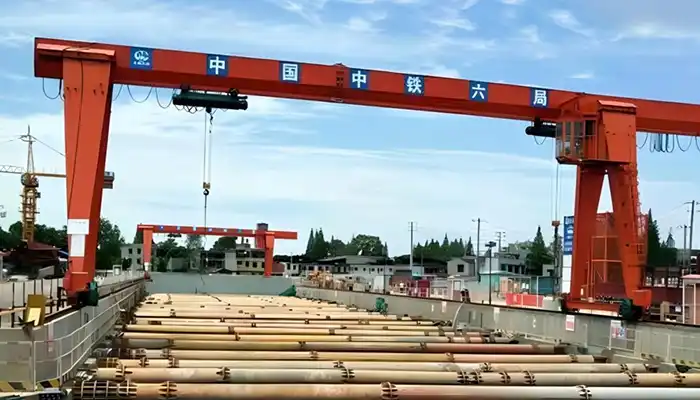
double hoist gantry crane
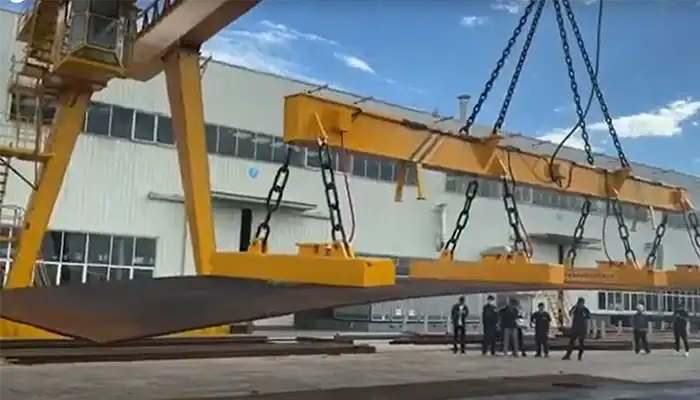
gantry crane with magnetic speader, customized below hook devices are provided as per your lifting objects or loads
Recommendation
Choosing the right crane isn't just about buying the most powerful one—it's about matching the crane to your specific operational needs.
- Assess load types: heavy, oversized vs. wide or awkward shapes.
- Consider lifting frequency: daily heavy lifts vs. occasional wide loads.
- Factor in budget and maintenance capacity: higher upfront and running costs vs. long-term simplicity.
- Practical tip: sometimes a combination approach works—using a double-hoist crane for heavy lifts and a spreader beam for wider or delicate items can maximize productivity and safety.




Yuantai Cranes
Overhead Crane Manufacturer with CE, ISO, SGS, CNEX Certificates.
- Main Specifications - Capacity: 0.5–550 tons | Span: up to 40m | Speed: 0.8–12 m/min | Duty: A3–A7 | Power: 380–690V, 50/60Hz | Control: pendant/remote/cabin
- Full engineering: FEA/PLC/VFD + in-house build + global delivery + on-site support, for workshops, factories, EPC contractors, industrial projects, etc.
- Support: design, manufacturing, testing, service – end-to-end, customized lifting solutions worldwide.
How to Get an Accurate Crane Price for Your Application?
Tips: Copy the spec list, fill in your details, and paste it into the form on the right/ down-below for a quick price.
- Crane type:_____ . (e.g., overhead crane, gantry crane, jib crane)
- Max weight to lift:_____ tons. (e.g., 2t, 5t, 10t, 20t, 50t)
- Lifting height:_____ m. (How high does the hook need to reach?
- Workshop width (span):_____ m . (Distance between the two crane rails)
- Travel distance:_____ m . (How long does the crane need to move along the runway?)
- Control type:_____. (Pendant / remote / cabin Control)
- Power supply:_____. (Local voltage & frequency – e.g., 380V, 50Hz, 3-phase)
- What will it be used for?_____ (e.g., steel fabrication, concrete products, mold handling, general manufacturing, etc.)
- Any special requirements?_____ (e.g., extreme temperature, dusty or explosive environment, special paint color, etc.)
Just leave a message via the contact form and our hoist and crane engineer will contact you with in 24working hours.
Get Your Custom Quote–Quick & Easy
Fill in what you know. Skip what you don't – we'll help.Any question will be reply with 24 working hours