Busbar Specification for Overhead Crane Buyers Guide
Content Quick Link
Busbar Specification for Overhead Crane Buyers -Practical Guide to Accurate Quotation and Reliable Power Supply
Most Important Takeaway
If you only provide rated current, system length, number of poles, and crane application, a supplier can already give you a fast and usable busbar quotation. Missing these basics is the main reason for delays and incorrect pricing.
- What information is required for a busbar system quotation
- How to match a conductor rail system with your overhead crane
- How to avoid undersizing, overheating, or frequent collector failure
- What factors impact price, durability, and maintenance cost
- How to choose between different busbar types and materials
- What crane buyers often overlook in real projects
Why Busbar Specification Matters in Overhead Crane Projects
When buyers focus on the electric overhead crane itself, the busbar system is often treated as a small accessory. That's where problems start. The busbar (conductor rail) is the backbone of the power supply for crane travel, and if it is not matched correctly, the crane will not run smoothly—no matter how good the hoist or trolley is. A well-specified busbar system keeps the crane running steadily. A poorly specified one leads to constant interruptions, overheating, and maintenance calls. It's not complicated, but it does require attention to a few key details.
How Busbar Selection Affects Crane Operation
The performance of an electric overhead crane depends heavily on how stable and consistent the power supply is. The busbar plays a direct role in:
- Crane travel stability: If the current supply is unstable, the crane may jerk during long travel or slow down unexpectedly. This becomes more obvious on longer runways or higher-speed cranes.
- Electrical safety: Poor insulation, undersized conductors, or low-quality collectors can lead to sparking. In dusty or humid environments, that quickly turns into a safety risk.
- Maintenance frequency: Frequent collector wear, carbon brush damage, or loose contact points usually come back to improper busbar selection. This means more downtime and more spare parts.
- Long-term operating cost: A cheaper busbar may save money upfront, but if it causes repeated failures or requires frequent replacement, the total cost will be much higher over time.
What Happens When the Busbar Is Not Properly Specified
This is where most buyers run into trouble. The issues don't always show up immediately—they build up after installation.
- Voltage drop along the runway: On longer systems, an undersized busbar cannot maintain stable voltage, especially when the crane is far from the power feed point.
- Sparking between collector and conductor: This often happens when the collector is not matched to the busbar type or when the system cannot handle the actual current load.
- Overheating of conductor rails: If the rated current is too low for the crane's power demand, the busbar will heat up during operation. This shortens its lifespan and increases failure risk.
- Unexpected crane stoppages: Intermittent contact or power loss can stop the crane during operation, which is a serious issue in production lines or material handling processes.
Practical Reminder for Crane Buyers
If you are specifying an overhead crane or upgrading an existing system, don't treat the busbar as a standard item. It should be selected based on actual working conditions.
- Match the busbar rated current with the crane's total power
- Consider runway length and feeding method early in the design
- Check environmental conditions such as dust, humidity, or outdoor exposure
- Make sure the collector system is compatible and durable
Even a simple confirmation at the beginning can prevent a lot of trouble later.
Why Busbar Specification Matters in Overhead Crane Projects
When buyers focus on the crane itself, the busbar system is often treated as a small accessory. That's where problems start. The busbar (conductor rail) is the backbone of the power supply for crane travel, and if it is not matched correctly, the crane will not run smoothly—no matter how good the hoist or trolley is.
A well-specified busbar system keeps the crane running steadily. A poorly specified one leads to constant interruptions, overheating, and maintenance calls. It's not complicated, but it does require attention to a few key details.
Core Electrical Parameters for Busbar Selection
Before choosing any busbar system for an overhead crane, lock in the electrical basics. Keep it simple—these few values drive the whole design and quotation. If these are off, everything that follows will need adjustment.
What to Provide
These are the core inputs a supplier needs to size and quote the busbar system correctly. Even for a quick quotation, these should be clear.
- Rated current (A): Covers total crane load (hoist + trolley + long travel).
Typical ranges: 100–250A (light), 250–630A (medium), higher for heavy duty. - Voltage / frequency: Common: 380–415V / 50Hz or 440V / 60Hz.
Must match your site power supply. - Number of poles: 4P (3P + PE) → standard for most overhead cranes, 5P (3P + N + PE) → when neutral is required
If You Don't Have Full Data
This situation is common, especially in early-stage inquiries. You don't need to stop the process—there are still practical ways to move forward.
- Crane capacity (e.g., 10 ton, 20 ton overhead crane)
- Motor power (kW) or nameplate data
With this information, the supplier can estimate the required current and suggest a suitable busbar configuration.
Quick Checks (Avoid Rework)
These quick checks help prevent under-sizing or repeated revisions later. A small correction at this stage can save time on installation and commissioning.
- Include all running motors when estimating current
- Add a safety margin (about 20–30%)
- If multiple cranes share the line, use combined load
- Don't assume current from tonnage alone
Get these right first. Everything else—busbar type, layout, and accessories—can then be matched without guesswork.
Why These Parameters Matter
Before choosing any busbar system for an overhead crane, lock in the electrical basics. Keep it simple—these few values drive the whole design and quotation. If these are off, everything that follows will need adjustment.
The performance of the system depends entirely on getting these parameters correct at the beginning. Once the rated current, voltage, and pole configuration are defined properly, the busbar layout, conductor size, and accessories can all be matched accurately without redesign.
Choosing the Right Busbar Type
Once the electrical parameters are clear, the next step is selecting the right busbar (conductor rail) type. This choice affects not just price, but also safety, lifespan, and how often you'll deal with maintenance. There's no one-size-fits-all option—what works in a light workshop may not hold up in a heavy-duty crane application.
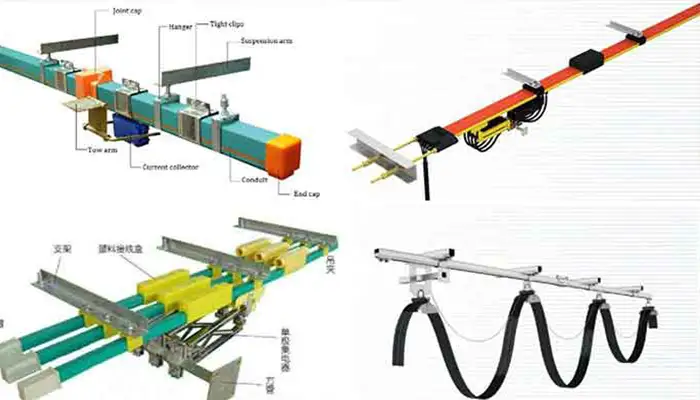
Enclosed Busbar System
This is the most commonly used solution for overhead cranes in general workshops. It's designed with a protective housing, which makes it safer and cleaner to operate.
- Fully enclosed structure reduces risk of accidental contact
- Better protection against dust and debris
- Suitable for indoor environments with moderate duty
In many cases, this is the default choice when there are no extreme conditions.
Single Pole Conductor Rail
For higher loads and tougher working conditions, a single pole conductor rail system is often the better option. Each conductor is separated, which improves heat dissipation and current capacity.
- Handles higher current more effectively
- Performs better in heavy-duty and high-frequency operations
- Easier to maintain or replace individual poles
This type is commonly used in steel mills, large-span cranes, or high-duty (A5–A8) applications.
Copper vs. Aluminum Conductor
Material selection plays a big role in both performance and cost. It's not just about price—it's about how the system behaves over time.
Copper conductor
- Higher conductivity
- Lower energy loss
- Longer service life
- Higher initial cost
Aluminum conductor
- More economical upfront
- Lighter weight
- Suitable for standard-duty cranes
If the crane runs frequently or carries heavy loads, copper usually pays off over time.
Practical Selection Advice
Choosing the wrong type may not show problems immediately, but it will show up in operation. Heat buildup, wear, and unstable contact are common signs.
- For light-duty indoor cranes, enclosed busbar systems are usually sufficient
- For heavy-duty or continuous operation, consider single pole systems
- For harsh environments (dust, heat, corrosion), prioritize durability and protection
- Avoid choosing based on price alone—maintenance and downtime cost more later
For applications like steel handling or high-temperature workshops, it's safer to invest in a more robust system from the start.
System Length and Layout Considerations
When planning a busbar system for an overhead crane, the runway length and layout are not just installation details. They directly affect voltage stability, mechanical alignment, and overall system cost. A small mistake in measurement or layout planning can lead to repeated adjustment work after installation.
Define Total Length in Meters
Start with the full travel distance of the crane. This includes the complete runway where the busbar will be installed.
- Measure the actual rail-to-rail operating length
- Include both crane travel directions
- Confirm whether there are multiple crane spans sharing the same line
Even a few meters of difference can change the number of busbar sections, supports, and feeders required.
Confirm Layout: Straight or With Curves
Busbar systems are designed differently depending on the runway geometry. This needs to be clarified early.
- Straight layout is the most common and simplest installation
- Curved sections require special conductor rail segments and careful alignment
- Complex layouts may need additional connectors or support points
If curves exist, even slight ones, they must be clearly shown in drawings or sketches.
Check Expansion Requirements
For longer crane runways, temperature changes can cause the system to expand or contract. This is often overlooked during early planning.
- Expansion joints are needed for long continuous lines
- Prevents rail deformation and misalignment
- Helps maintain stable contact between collector and conductor
Without proper expansion design, issues like rail bending or contact loss may appear after continuous operation.
Practical Installation Note
In real workshop conditions, layout planning often gets rushed. But once the busbar is installed, changes are not easy.
- Always confirm layout before final quotation
- Share simple drawings if available
- For long spans, consider expansion points from the beginning
A properly planned layout ensures smoother crane travel and reduces long-term maintenance problems.
Collector System (Often Overlooked but Critical)
The current collector is the part that transfers power from the busbar to the moving crane. It looks simple, but in daily operation it carries constant mechanical and electrical stress. When this part is not properly selected, problems usually show up early—sometimes even during commissioning.
Select the Right Collector Type and Configuration
Different crane systems require different collector structures. The choice depends on busbar type, installation method, and operating conditions.
- Single-arm or double-arm collectors for standard overhead cranes
- Spring-loaded designs for stable contact pressure
- Multiple collector units for higher current or multi-pole systems
The key is stable contact. If the pressure is inconsistent, power interruption and sparking can occur during crane movement.
Confirm Quantity and Current Rating
Collector sizing is not only about one unit—it is about the full system working together.
- Match collector current rating with busbar rated current
- Confirm number of collectors per crane (based on poles and load)
- Ensure redundancy for high-duty or continuous operation systems
Undersized collectors may overheat or wear quickly, especially in frequent start-stop operations.
Ensure Compatibility with Crane Speed and Duty Cycle
Collector performance is directly affected by how the crane operates in real conditions.
- Higher crane travel speed requires stable and responsive contact
- Frequent operation cycles increase wear on contact surfaces
- Heavy-duty cranes (A5–A8) need more durable collector designs
If the collector cannot keep stable contact at speed, you may see intermittent power loss or sparking along the runway.
Practical Maintenance Insight
In real workshop operation, collector issues are one of the most common maintenance calls. The problem is usually not the busbar itself, but poor matching between collector and working conditions.
- Worn contact surfaces are often caused by incorrect pressure or alignment
- Dust and debris can accelerate wear if protection is insufficient
- Irregular maintenance leads to unstable power transmission
A well-matched collector system reduces downtime and keeps the crane running smoothly over long cycles.
Matching Busbar with Crane Operating Conditions
A busbar system cannot be selected in isolation. It must follow how the overhead crane actually works on site. Two cranes with the same capacity may still need different busbar designs if their duty, speed, or usage frequency is different. This is where many mismatches happen in real projects.
Crane Type (Single Girder or Double Girder)
The structure of the crane affects load distribution and power demand.
- Single girder overhead crane: Usually lighter duty, lower power demand, and shorter operating cycles. Enclosed busbar systems are often sufficient.
- Double girder overhead crane: Handles heavier loads and more frequent operation. Requires more stable current supply and stronger conductor rail design.
The difference is not just structural—it affects how stable the power transmission must be during movement.
Travel Speed and Operation Frequency
How often and how fast the crane moves has a direct impact on busbar performance.
- Low-frequency cranes can use standard configurations without stress
- High-frequency operation increases contact wear on collectors and rails
- Faster travel speed requires better alignment and stable contact pressure
In practice, if a crane runs all day in a production line, the busbar system must be designed for continuous contact, not occasional use.
Duty Classification (A3 to A8)
Duty class is one of the most important references when selecting a busbar system.
- A3–A4: light duty, occasional use, standard busbar systems are usually enough
- A5–A6: medium duty, regular operation, needs more stable contact and better material quality
- A7–A8: heavy duty, continuous or near-continuous operation, requires high durability and strict alignment control
The higher the duty class, the more important it becomes to avoid contact instability or overheating.
Practical Selection Note
In real crane applications, problems rarely come from the crane itself. They often come from mismatched supporting systems like the busbar.
- A high-duty crane with a light-duty busbar will wear out quickly
- A high-speed crane needs stable collector contact, not just higher current rating
- Duty level should guide material and structure choice, not just price
Matching the busbar to operating conditions ensures stable power supply and reduces interruptions during daily production work.
Installation and Environment Requirements
Busbar performance is not only decided by electrical sizing. In actual overhead crane projects, the installation condition and working environment often have an even stronger impact on service life and stability. A system that works well in a clean workshop may behave very differently in a dusty or outdoor site.
Indoor or Outdoor Installation
The first point is the installation environment, and this should always be confirmed clearly at the beginning.
- Indoor installation: Generally more stable conditions, less exposure to rain, wind, or direct sunlight. Standard enclosed busbar systems are often suitable.
- Outdoor installation: Requires stronger protection against weather changes, UV exposure, and water ingress. Temperature variation also needs to be considered.
Outdoor systems usually need higher protection levels and more durable housing materials.
Mounting Position Along Runway Beam or Structure
Where the busbar is installed also affects performance and maintenance accessibility.
- Mounted on crane runway beam side for standard workshop layouts
- Installed on separate support structures when space is limited or multiple cranes operate
- Position must allow safe distance from moving crane parts
Good installation positioning helps maintain stable contact between collector and conductor rail, while also making inspection and replacement easier.
Exposure to Dust, Humidity, or Corrosive Conditions
Environmental conditions often determine how long the system will run without issues.
- High dust environments (cement plants, steel workshops) can affect contact quality
- High humidity may increase oxidation risk on exposed components
- Corrosive environments (chemical plants, coastal areas) require special protection measures
These factors directly influence wear rate, electrical contact stability, and maintenance frequency.
Practical Selection Note
In real crane applications, environment is often underestimated during early planning. But it becomes very visible during operation.
- Dust and moisture can lead to unstable contact or sparking
- Standard systems may fail earlier in corrosive environments
- Maintenance intervals become shorter if protection level is not matched
For outdoor or harsh industrial conditions, it is safer to select a higher IP-rated and corrosion-resistant busbar system from the start, instead of upgrading later after issues appear.
Power Feeding Design
In a busbar system for overhead cranes, the way power is fed into the conductor rail is not a small detail. It directly affects voltage stability, current distribution, and how smoothly the crane travels along the runway. A good feeding design keeps performance stable across the whole working range, not just near the power point.
End Feed for Short Distances
End feed is the simplest power input method, usually used in shorter runway systems.
- Power is supplied from one end of the busbar line
- Suitable for short crane travel distances
- Simple installation and lower cost
In practice, this works well when the total runway length is limited and voltage drop is not a concern. However, for longer spans, performance may become uneven as the crane moves farther away from the feeding point.
Center Feed for Balanced Distribution
Center feed improves power balance by supplying electricity from the middle of the busbar line.
- Reduces voltage drop at both ends of the runway
- Improves current distribution along the system
- More stable operation compared to single-end feeding
This method is often used when the runway is medium length and stable performance is required across the full travel distance.
Multi-Point Feeding for Long Runway Systems
For long travel distances or high-power cranes, a single feeding point is usually not enough. Multi-point feeding solves this issue.
- Power is supplied at multiple locations along the busbar
- Reduces voltage drop over long distances
- Improves stability for high-duty or continuous operation cranes
This setup is commonly used in large workshops, steel plants, and long-span crane systems, where consistent performance is required across the entire runway.
Practical Selection Note
Feeding design is often overlooked during early planning, but it becomes very obvious during operation.
- Poor feeding design can cause voltage drop at far ends
- Uneven power distribution may affect crane speed and stability
- High-load systems require more than a single feeding point
A properly designed feeding system ensures the crane runs smoothly from one end of the workshop to the other, without noticeable performance difference along the way.
Special Requirements and Compliance
In many overhead crane projects, basic electrical sizing is not enough. Some working environments and industry standards require additional technical protection and certification. These requirements often decide whether a busbar system is suitable for long-term use in a specific plant.
IP Protection Level (Dust and Water Resistance)
The IP rating defines how well the busbar system is protected against external elements.
- IP54: basic protection against dust and splashing water, suitable for general indoor workshops
- IP65: higher sealing level, better protection for dusty or semi-outdoor environments
In real use, higher IP ratings help reduce failure caused by dust buildup, moisture, and accidental splashing, especially in heavy industrial sites.
Fire-Resistant or Flame-Retardant Materials
In some industrial environments, material safety becomes a key requirement.
- Flame-retardant insulation reduces risk of fire spread
- Suitable for workshops with high electrical load or heat exposure
- Often required in steel plants, power stations, or enclosed industrial halls
This is not only about compliance, but also about reducing risk during long continuous operation.
Explosion-Proof Requirements
For hazardous environments, standard busbar systems are not sufficient.
- Required in chemical plants, gas environments, or dust-explosive areas
- Components must meet explosion-proof design standards
- Electrical contact design must avoid spark risk under operation
In these cases, the entire power supply system must be designed as part of the safety system, not just as a power distribution line.
Certification Standards (CE, ISO, and Others)
Certifications are often required for international projects or regulated industries.
- CE certification: common requirement for European markets
- ISO standards: quality and manufacturing process control
- Additional regional standards depending on project location
These certifications ensure the system meets recognized safety and performance requirements.
Practical Selection Note
In real crane projects, compliance is often checked during approval, not after installation.
- Ignoring IP level may lead to early failure in harsh environments
- Missing flame or explosion-proof requirements can stop project acceptance
- Certification gaps may delay export or project approval
It is always better to confirm these requirements at the quotation stage, rather than modifying the system later.
Minimum Information for Fast Quotation
In early project stages, buyers often don't have complete technical drawings or final electrical data. That's normal. But a few basic inputs are still enough to get a practical and workable busbar quotation without waiting for full engineering confirmation.
What You Should Provide First
Even if the project is still under planning, these four points are enough to start:
- Rated current (A): This is the key value for sizing the conductor rail. It defines the capacity of the whole system.
- Busbar length (meters): The total runway distance where the busbar will be installed. This directly affects cost and configuration.
- Number of poles: Usually 4P or 5P, depending on whether a neutral line is needed in the crane system.
- Crane application: Simple description such as overhead crane, gantry crane, workshop crane, or steel handling crane.
Why This Level of Detail Is Enough
At quotation stage, the goal is not final engineering accuracy, but a reliable system estimate. With the four items above, a supplier can:
- Estimate conductor size and insulation level
- Select a suitable busbar type (enclosed or single pole system)
- Calculate basic accessories such as collectors and feeders
- Provide a budgetary price for project planning
It keeps the process moving without waiting for full design approval.
Practical Tip for Buyers
In real projects, many delays come from overthinking at the inquiry stage. You don't need every technical detail before asking for a price.
- Start with basic crane and power data
- Refine later when layout drawings are ready
- Use the initial quotation for budget approval or comparison
A simple input is often enough to move the project forward without slowing down planning decisions.
Busbar System – Buyer Reference for Overhead Crane Projects
When crane buyers request a busbar quotation, missing or unclear data often slows down the process. This reference table helps you quickly understand what information is needed and how each parameter affects the final selection. It is designed for practical use in real project inquiries, not just theory.
Busbar System – Buyer Reference Table for Overhead Cranes
| Category | Required Information | Typical Options / Range | Why It Matters | Buyer Reference Tip |
|---|---|---|---|---|
| Electrical Basics | Rated current (A) | 100A – 1250A+ | Defines conductor size and system capacity | If unknown, provide crane capacity or motor kW |
| Electrical Basics | Voltage & frequency | 380–415V / 50Hz, 440V / 60Hz | Ensures system matches site power | Must match plant electrical standard |
| Electrical Basics | Number of poles | 4P / 5P | Determines wiring structure | 4P is standard for most overhead cranes |
| System Design | Total length (m) | 10m – 500m+ | Affects cost and voltage drop | Measure full crane runway travel distance |
| System Design | Layout type | Straight / curved / multi-span | Impacts installation complexity | Curves require special sections |
| Busbar Type | Structure type | Enclosed / single pole | Affects safety and duty level | Enclosed for workshops, single pole for heavy duty |
| Busbar Material | Conductor material | Copper / Aluminum | Impacts efficiency and cost | Copper = better performance, Aluminum = economical |
| Collector System | Collector type | Single arm / double arm | Ensures power transfer stability | Must match busbar system design |
| Collector System | Quantity | Based on crane configuration | Affects reliability | Higher duty cranes may need more collectors |
| Operation | Crane type | Single girder / double girder | Affects load and power demand | Double girder usually higher duty |
| Operation | Duty class | A3 – A8 | Defines working intensity | Higher class = stronger system required |
| Operation | Travel speed | Low / medium / high speed | Affects contact stability | High speed needs better collector quality |
| Installation | Location | Indoor / outdoor | Affects protection level | Outdoor needs higher IP rating |
| Environment | Conditions | Dust / humidity / corrosion | Impacts lifespan | Steel mill or coastal areas need stronger protection |
| Power Feed | Feeding method | End / center / multi-point | Affects voltage stability | Long runways often need multi-point feed |
| Compliance | Protection level | IP54 / IP65 | Safety against dust and water | Higher IP for harsh environments |
| Compliance | Certification | CE / ISO / project standards | Required for approval | Important for export or regulated projects |
Quick Quotation Reminder
For early-stage inquiry or budget quotation, you don't need full engineering details. In most cases, these four inputs are enough to move forward:
- Rated current (A)
- Busbar length (m)
- Number of poles
- Crane application
With this information, suppliers can quickly estimate a suitable busbar system and provide a realistic quotation for planning or comparison purposes.
For overhead crane buyers, specifying a busbar system is not just a technical step—it is a key decision that affects performance, safety, and long-term cost.
By focusing on a few essential parameters and understanding how operating conditions influence selection, you can avoid common mistakes such as undersized systems or frequent maintenance issues. A well-matched busbar system ensures stable power supply, smoother crane operation, and better overall project efficiency.
If you are planning a crane project, it is always worth aligning the busbar specification with the crane design from the beginning, rather than treating it as an afterthought.
Busbar System Selection – Frequently Asked Questions
These FAQs help crane buyers quickly understand how to select, match, and evaluate a busbar (conductor rail) system for overhead crane applications, and avoid common design mistakes that lead to downtime or extra cost.
What information is required for a busbar system quotation?
To prepare an accurate quotation, suppliers usually need a few key parameters from the crane system.
- Rated current (A) of the crane system
- Total busbar length (runway length in meters)
- Number of poles (4P or 5P configuration)
- Crane application type (overhead crane, gantry crane, workshop use, etc.)
With this basic information, a complete technical and budgetary solution can be provided quickly.
How to match a conductor rail system with your overhead crane?
Matching depends on crane duty, power demand, and operating conditions.
- Light-duty cranes usually use enclosed busbar systems
- Heavy-duty cranes require single pole or high-capacity systems
- Long runways may need multi-point feeding for stability
- High-frequency operation requires stronger collector performance
The key is to match electrical capacity and operating intensity, not just crane tonnage.
How to avoid undersizing, overheating, or frequent collector failure?
Most failures come from incorrect sizing or poor matching between components.
- Always calculate total motor load, not just crane capacity
- Add a 20–30% safety margin for current selection
- Match collector rating with busbar capacity
- Consider duty class (A3–A8) for real operating load
Proper design prevents overheating, voltage drop, and premature wear of contact parts.
What factors impact price, durability, and maintenance cost?
Busbar system cost is influenced by both design and operating environment.
- Conductor material (copper vs aluminum)
- System type (enclosed vs single pole)
- Protection level (IP rating, outdoor suitability)
- Installation length and feeding method
Lower initial cost systems may increase maintenance and replacement costs over time.
How to choose between different busbar types and materials?
Selection depends on duty level and working environment.
- Enclosed busbar: suitable for general indoor crane systems
- Single pole system: suitable for heavy-duty and high-current applications
- Copper conductor: higher performance, longer lifespan, higher cost
- Aluminum conductor: more economical, suitable for standard duty
The correct choice balances performance, budget, and long-term maintenance needs.
What do crane buyers often overlook in real projects?
Many issues appear after installation due to early-stage planning gaps.
- Ignoring installation environment (dust, humidity, corrosion)
- Underspecifying feeding method for long runways
- Not matching collector quality with duty cycle
- Focusing only on crane tonnage instead of full system load
Proper planning of the busbar system helps avoid downtime and reduces long-term operating risks.

Article by Bella ,who has been in the hoist and crane field since 2016. Bella provides overhead crane & gantry crane consultation services for clients who need a customized overhead travelling crane solution.Contact her to get free consultation.
Yuantai Cranes
Overhead Crane Manufacturer with CE, ISO, SGS, CNEX Certificates.
- Main Specifications - Capacity: 0.5–550 tons | Span: up to 40m | Speed: 0.8–12 m/min | Duty: A3–A7 | Power: 380–690V, 50/60Hz | Control: pendant/remote/cabin
- Full engineering: FEA/PLC/VFD + in-house build + global delivery + on-site support, for workshops, factories, EPC contractors, industrial projects, etc.
- Support: design, manufacturing, testing, service – end-to-end, customized lifting solutions worldwide.
How to Get an Accurate Crane Price for Your Application?
Tips: Copy the spec list, fill in your details, and paste it into the form on the right/ down-below for a quick price.
- Crane type:_____ . (e.g., overhead crane, gantry crane, jib crane)
- Max weight to lift:_____ tons. (e.g., 2t, 5t, 10t, 20t, 50t)
- Lifting height:_____ m. (How high does the hook need to reach?
- Workshop width (span):_____ m . (Distance between the two crane rails)
- Travel distance:_____ m . (How long does the crane need to move along the runway?)
- Control type:_____. (Pendant / remote / cabin Control)
- Power supply:_____. (Local voltage & frequency – e.g., 380V, 50Hz, 3-phase)
- What will it be used for?_____ (e.g., steel fabrication, concrete products, mold handling, general manufacturing, etc.)
- Any special requirements?_____ (e.g., extreme temperature, dusty or explosive environment, special paint color, etc.)
Just leave a message via the contact form and our hoist and crane engineer will contact you with in 24working hours.
Get Your Custom Quote–Quick & Easy
Fill in what you know. Skip what you don't – we'll help.Any question will be reply with 24 working hours