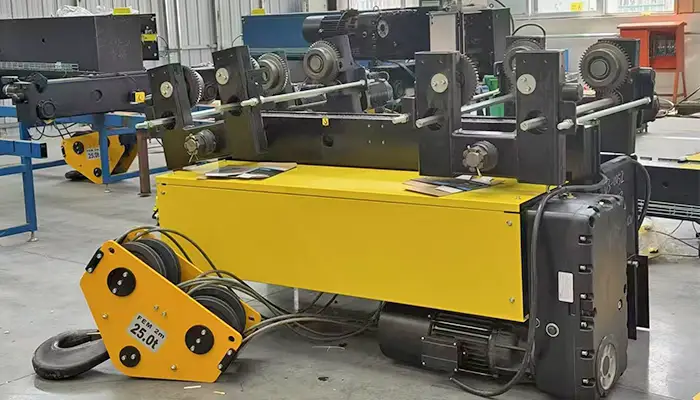
25 Ton Electric Hoist on 25 Ton Single Girder Gantry Crane
Content Quick Link
Most Important Takeaway
A 25 ton electric wire rope hoist used on a 25 ton gantry crane / single girder gantry crane 25 ton / single girder goliath crane 25 ton must be engineered as a unified lifting system. The real design challenge is not lifting capacity alone, but ensuring girder stiffness, wheel load distribution, and dynamic load control remain safe and stable under full 25 ton working conditions.
- A 25 ton electric hoist must be structurally matched with a properly designed 25 ton gantry crane system
- The single girder gantry crane 25 ton requires strict control of deflection and beam stiffness under full load
- A single girder goliath crane 25 ton must manage both hoisting load and trolley movement stress
- Wheel load distribution becomes critical when combining hoist self-weight + rated 25 ton load
- Duty class alignment between hoist and crane determines long-term fatigue resistance
- Electrical system (400V 50Hz 3P) must support stable dual-speed lifting and braking coordination
Questions This Guide Solves
In a 25 ton gantry crane system with electric hoist, real engineering risks are not only about rated capacity. They are about how the hoist, girder, wheels, and electrical system behave together under real working conditions. The following questions reflect the most common technical concerns in a single girder gantry crane 25 ton system and single girder goliath crane 25 ton applications.
Can a 25 ton electric hoist safely operate on a single girder gantry crane 25 ton system?
Yes, a 25 ton electric hoist can operate safely on a single girder gantry crane 25 ton system, but only when the crane structure is properly designed for the full working load condition, not just the rated capacity.
Safety depends on:
- Beam stiffness and deflection control under full 25 ton load
- Correct wheel load distribution across the rail system
- Stable trolley travel without excessive vibration
- Proper matching of hoist self-weight and crane structural design
If any of these conditions are not met, the system may still lift the load, but operational stability and long-term durability will be compromised.
What structural conditions are required for a 25 ton gantry crane to handle full load safely?
A 25 ton gantry crane must be designed as a complete structural system, not only for static strength but also for working stability.
Key structural requirements include:
- Controlled girder deflection under full span loading (e.g., 11.5m)
- Adequate torsional stiffness for trolley movement
- Balanced end carriage geometry and wheel alignment
- Foundation capable of resisting repeated dynamic loads
In real operation, these conditions ensure the crane maintains geometry stability, meaning the hook, trolley, and rail system remain aligned during lifting and travel.
How does wheel load distribution work in a single girder goliath crane 25 ton setup?
In a single girder goliath crane 25 ton system, wheel load distribution is not fixed. It changes depending on trolley position, load weight, and movement conditions.
In practice:
- The total load (hoist + trolley + payload) is transferred through the girder to end carriages
- Each wheel carries a portion of the total load
- Wheel pressure changes as the trolley moves along the span
Critical conditions occur when:
- The trolley is near mid-span (maximum bending load)
- The load is at full 25 ton capacity
- The crane is accelerating or braking
This is why accurate wheel load calculation is essential to prevent uneven rail wear and long-term foundation stress.
Why is girder deflection critical in single girder crane systems at 25 ton capacity?
Girder deflection directly affects how the 25 ton electric hoist behaves during lifting and travel. Even small deflection changes can alter alignment conditions.
If deflection is not controlled:
- Hoist alignment may shift under full load
- Wire rope angle may become uneven on the drum
- Trolley movement may feel unstable
- Rail and wheel contact conditions may become inconsistent
In a single girder gantry crane 25 ton system, deflection is not only a strength issue but also a precision issue affecting operational smoothness and long-term wear behavior.
What risks occur if hoist and crane duty class are mismatched?
Duty class mismatch occurs when the 25 ton electric hoist and single girder gantry crane 25 ton system are designed for different working intensities.
Common risks include:
- Motor overheating during continuous operation
- Brake wear due to excessive cycling
- Accelerated structural fatigue in girder and weld zones
- Reduced service life compared to design expectations
This mismatch does not usually cause immediate failure, but it significantly reduces long-term reliability and increases maintenance frequency.
How do dynamic loads affect real operation of a 25 ton lifting system?
Dynamic loads occur during movement, braking, acceleration, and speed changes. A 25 ton electric hoist rarely operates under purely static conditions.
In real operation:
- Load swing generates additional side forces
- Braking creates temporary shock loads in the structure
- Acceleration changes wheel pressure distribution
- Speed transitions introduce short-term stress peaks
In a single girder goliath crane 25 ton system, these repeated dynamic effects influence fatigue life, wheel wear, and long-term structural stability.
Proper control of speed, braking, and electrical coordination is essential to keep these effects within safe operational limits.
System Definition: 25 Ton Electric Hoist on 25 Ton Gantry Crane
A 25 ton electric hoist on a 25 ton gantry crane is one complete lifting system, not two separate machines. In real workshops, steel yards, or fabrication plants, the hoist and crane always work together. The hoist lifts the load, but the crane structure carries and moves it.
If one part is not properly matched, the whole system becomes unstable during operation. That is why engineers always check the hoist and crane as a set, not individually.
25 ton electric hoist as the lifting core
The 25 ton electric wire rope hoist is the part that actually lifts the load. It is the working unit of the system.
In simple terms:
- It lifts and lowers up to 25 tons
- It holds the load using a brake system when stopped
- It uses a wire rope and drum to pull the load up and down
- It usually has two speeds: fast lifting and slow lifting
In real use, slow speed is very important. Operators use it when the load is close to the ground or when precise positioning is needed. Fast speed is used when moving without needing fine control.
The hoist also has its own weight. This is important because the crane must carry both the load and the hoist itself.
25 ton gantry crane as the load-bearing structure
The 25 ton gantry crane, including the single girder gantry crane 25 ton, is the steel structure that supports the hoist and moves it across the working area.
Its main job is not lifting directly, but carrying the load safely across the span.
Key functions include:
- Supporting the weight of the hoist and the 25 ton load
- Allowing the hoist to move left and right along the beam
- Transferring all load into the end carriages and rails
- Keeping the structure stable during movement
In a single girder gantry crane 25 ton, the main beam carries both bending force and movement stress. If the beam is not stiff enough, users may notice small bending or vibration during travel.
A single girder goliath crane 25 ton is usually used outdoors. Wind, uneven ground, and long working hours make the structure work under more variable conditions, so stability becomes even more important.
Trolley, girder, and rail system: the full load path
The load does not go straight to the ground. It moves step by step through the system.
Here is the simple load path:
- The hook holds the load
- The wire rope transfers it to the hoist
- The hoist passes the force to the trolley
- The trolley wheels press the load onto the crane girder
- The girder sends the load to both sides of the crane
- The end carriages move the force to the rails
- The rails finally transfer it into the ground
Each step must work smoothly. If one part is weak or not well matched, the whole system will feel it during operation.
For example, if the trolley load is uneven, one rail may wear faster. If the girder is too flexible, the hook position may shift slightly during travel. These are small issues, but they matter in daily use.
Key idea: treat it as one complete system
The most important point is this: a 25 ton electric hoist and a 25 ton gantry crane must be treated as one system.
In real projects, problems often happen when people select them separately. On paper, both may look correct. But in actual use, the system may not behave smoothly.
A properly matched system should feel simple:
- The hoist lifts smoothly without shaking
- The crane moves steadily across the rails
- There is no sudden vibration during start or stop
- The load stays stable during positioning
When everything is matched correctly, the operator does not need to "adjust" or compensate during lifting. The system behaves the same every time, whether lifting light loads or full 25 tons.
That is the real goal when designing and selecting a 25 ton gantry crane system with electric hoist.
Structural Role of Single Girder in 25 Ton Lifting Applications
In a 25 ton lifting system, the choice of a single girder structure is not just a design preference. It directly affects how safely and smoothly the crane carries load during real operation. When a 25 ton electric hoist runs on a single girder gantry crane 25 ton, the main beam becomes the key structural element that decides stability, deflection, and long-term durability.
In practice, the girder is doing constant work every time the hoist lifts, travels, or stops. So its role is not static—it is always under changing stress.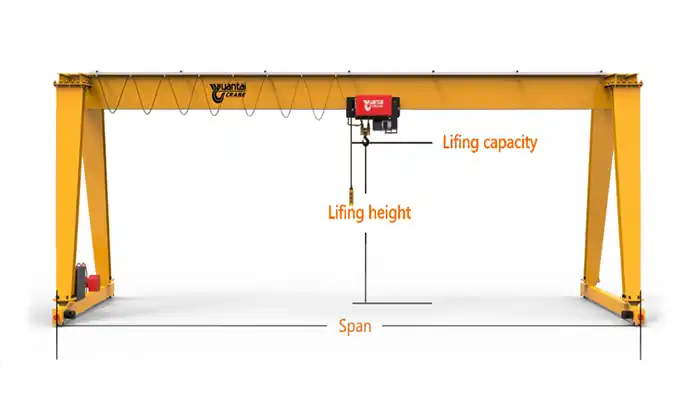
25 ton single girder gantry crane
Single girder gantry crane 25 ton vs 25 ton double girder gantry crane systems
The single girder gantry crane 25 ton uses one main beam to support the trolley and hoist. This makes the structure simpler and lighter, but it also means the beam carries all bending and torsional forces by itself.
In comparison:
- A single girder system has one main load path
- A double girder system splits the load between two beams
- Double girder cranes usually have higher stiffness and lower deflection
- Single girder cranes are more compact and easier to install
For a 25 ton electric hoist, the single girder design can still work well, but only if the beam is properly engineered. It must handle not only vertical load, but also movement forces from the trolley.
In real use, the key difference is how the beam behaves during travel. A double girder crane feels more rigid. A single girder crane may show slight flex if not designed with enough stiffness.
Box girder reinforcement in European crane design
Most modern single girder gantry crane 25 ton systems use a box girder structure, especially in European-style designs.
A box girder is basically a closed steel section. It is stronger than an open beam because it resists twisting better.
In simple terms:
- Open beams are easier to bend and twist
- Box girders resist both bending and torsion
- They provide more stable movement for the trolley
- They reduce vibration during load travel
For a 25 ton gantry crane, box girder design is commonly used because it helps control deformation across the 11–12 meter span. Without it, the beam may twist slightly when the hoist moves from one side to another.
In real workshop conditions, this is important because even small twisting can affect hook position accuracy during precision lifting.
Torsional stiffness requirements under full load
Torsional stiffness means how well the crane beam resists twisting when the load is not perfectly centered. This is a common situation in real operation, especially when the trolley moves or when the load swings slightly.
For a 25 ton electric hoist on a single girder gantry crane 25 ton, torsional stiffness becomes critical because:
- The hoist weight is concentrated on one moving trolley
- The load is not always centered during lifting
- Acceleration and braking create side forces
- Outdoor conditions (in a single girder goliath crane 25 ton) can add wind pressure
If torsional stiffness is not enough, the beam may twist slightly. This does not always cause immediate failure, but it leads to:
- Uneven wheel pressure on rails
- Faster wear on one side of the crane
- Slight hook swing during movement
- Reduced positioning accuracy
To avoid this, European crane design usually focuses on:
- Reinforced box girder sections
- Controlled deflection limits (not just strength)
- Balanced wheel spacing on end carriages
- Stable trolley travel path
Focus: ensuring safe structural behavior under 25 ton rated lifting
At the end, the main goal of the single girder gantry crane 25 ton structure is simple: it must stay stable under full 25 ton load without distortion that affects operation.
In real industrial use, safety is not only about "can it lift 25 tons." It is also about:
- Does the beam stay stable during travel
- Does the trolley move smoothly across the span
- Does the hook remain aligned during lifting
- Does the structure behave the same under repeated cycles
When a 25 ton electric hoist is properly matched with a well-designed single girder system, the crane should feel controlled and predictable. No sudden bending, no uneven movement, and no structural "flex feeling" during operation.
That stable behavior is what defines a properly engineered 25 ton lifting system in real working conditions.
Load Transfer in a Single Girder Goliath Crane 25 Ton System
In a single girder goliath crane 25 ton system, the load does not act in one place. It moves step by step through the structure, starting from the hook and ending at the ground rails. In real operation, this load path is always active whenever a 25 ton electric hoist lifts or travels with a load.
Understanding this path is important because stress does not spread evenly. It concentrates at specific points, especially during movement, braking, and full-load lifting.
Hook load → wire rope → drum → hoist frame
The first stage starts at the lifting point.
- The hook carries the full working load (up to 25 tons)
- The wire rope transfers the force upward to the drum
- The drum winds the rope and converts rotation into lifting motion
- The hoist frame holds the drum, gearbox, and motor assembly
At this stage, the load is still "vertical and controlled," but internal stress already exists in the rope and drum groove. If the load is lifted suddenly or unevenly, this is where impact begins.
In practical use, operators may notice rope vibration or slight drum noise when the load is not lifted smoothly. That is the first sign of uneven force transfer.
Hoist → trolley wheels
Once the hoist carries the load, the force is transferred into the trolley system.
- The hoist body is fixed onto the trolley frame
- The trolley wheels carry the full vertical load plus hoist self-weight
- Wheel contact with the girder creates rolling pressure
This is one of the most sensitive points in a single girder goliath crane 25 ton system.
Key real-world behaviors include:
- Uneven wheel loading if the hoist is not centered
- Increased rail pressure during acceleration
- Slight vibration when starting or stopping movement
- Higher wear on one wheel set if alignment is off
In simple terms, this is where the load changes from "lifting" to "moving." That transition creates extra stress.
Trolley → main girder of single girder goliath crane 25 ton
At this stage, the load enters the main structural beam.
- The trolley wheels press directly on the girder flange
- The single girder goliath crane 25 ton beam carries bending stress
- Load position changes create shifting moment distribution
This is the main structural working zone.
In practice:
- When the trolley is in the middle of the span, bending stress is highest
- When it moves to one side, torsional stress increases
- Rapid movement creates dynamic amplification of stress
If the girder is not stiff enough, users may notice slight downward deflection or side-to-side twisting during travel. It may not be dangerous immediately, but it affects long-term alignment and smoothness.
Girder → end carriages → rail system
The final stage transfers all load to the ground.
- The girder sends force to both end carriages
- End carriage wheels distribute the load onto rails
- Rails transfer the force into the concrete foundation
This is where the system finally "closes the loop" into the ground.
Important practical points:
- If wheel load is uneven, one rail will wear faster
- Poor alignment increases rolling resistance
- Weak foundation can cause long-term settlement
- Repeated loading affects rail straightness over time
In a single girder goliath crane 25 ton, this stage is very important because outdoor installations often face small ground shifts, temperature changes, and long travel distances.
Focus: identifying stress concentration points in real operation
Although the load moves through the whole system, stress is not evenly distributed. In a working 25 ton gantry crane system with electric hoist, the main stress concentration points are usually:
- Wire rope and drum contact area during lifting start
- Trolley wheel contact with girder during movement
- Mid-span of the single girder under full load
- End carriage wheel zones during directional change
- Rail contact points under repeated travel cycles
In real industrial use, problems rarely appear suddenly. They usually start from small signs:
- Slight noise during trolley travel
- Uneven wheel marks on rails
- Small changes in hook position during movement
- Gradual increase in vibration under full load
These are early indicators that load transfer is not perfectly balanced.
When a 25 ton electric hoist works correctly with a properly designed single girder goliath crane 25 ton, the load path should feel smooth and predictable. No sudden resistance, no uneven rolling, and no visible structural distortion during normal operation.
That steady behavior is the real confirmation that the load transfer system is working correctly under real working conditions.
Wheel Load Distribution in 25 Ton Gantry Crane Systems
In a 25 ton gantry crane system with electric hoist, wheel load distribution is one of the most practical engineering points that directly affects rail life and running stability. A 25 ton electric hoist does not only lift the rated load—it also adds its own weight, and both forces finally concentrate on the crane wheels and rails.
In real operation, the crane may look stable from a distance, but the actual pressure on each wheel changes depending on position, movement, and load condition.
Maximum wheel pressure under full 25 ton lifting
When the crane is lifting the full 25 ton load, the force is transferred to the wheels through the girder and end carriages.
In simple terms:
- The total load includes 25 ton payload + hoist + trolley + beam contribution
- This combined load is shared between four or more crane wheels
- The distribution is not always perfectly equal in real working conditions
In a single girder gantry crane 25 ton, the wheel load becomes highest when:
- The trolley is positioned near mid-span
- The load is lifted at full capacity
- The crane is stationary or moving slowly
At this moment, each wheel carries a peak pressure value. If the rail foundation or wheel design is not matched properly, this is where long-term deformation can begin.
Effect of 25 ton electric hoist self-weight
Many buyers focus only on the 25 ton lifting capacity, but in real engineering, the 25 ton electric hoist itself adds a noticeable load to the system.
This includes:
- Hoist body (motor, gearbox, frame)
- Wire rope and drum assembly
- Trolley structure and driving system
In practice, this self-weight is not small. It directly increases wheel pressure even before any load is lifted.
What this means in real use:
- Even when empty, the crane is already under structural load
- Wheel pressure changes depending on hoist position along the beam
- One side of the crane may carry slightly higher load during travel
- Rail wear begins from day one, not only under full load conditions
This is why wheel load calculation must always include hoist weight, not just rated lifting capacity.
Load variation during acceleration and braking
Wheel load is not constant. It changes every time the crane starts, stops, or changes direction.
During real operation:
- Acceleration creates forward or backward force shift
- Braking creates sudden load transfer to leading wheels
- Trolley movement adds lateral force on the girder
- Load swing slightly increases dynamic impact
In a 25 ton gantry crane system, these changes are small but repeated thousands of times during service life.
Typical effects include:
- One wheel temporarily carrying higher load during braking
- Slight slipping or micro-skid on rail surface
- Increased pressure on end carriage wheels during direction change
- Uneven wear pattern on rail head over time
These are not immediate failures, but they slowly affect alignment and running smoothness.
Focus: preventing rail fatigue and uneven wheel wear
The real purpose of controlling wheel load distribution is simple: protect the rail system and ensure long service life.
In practical crane operation, rail and wheel issues usually start in small ways:
- One rail shows faster polishing or wear marks
- Wheels develop uneven contact surfaces
- Small vibration appears during trolley movement
- Increased rolling resistance over time
To avoid this in a single girder gantry crane 25 ton system, the following points matter:
- Correct wheel load calculation including hoist self-weight
- Proper alignment of rails during installation
- Balanced girder stiffness to avoid uneven deflection
- Controlled acceleration and braking speed settings
- Regular inspection of wheel contact patterns
When the system is properly designed, wheel pressure remains stable, and the crane moves smoothly without pulling to one side.
In real industrial use, a well-balanced system should feel simple: the crane travels evenly, wheels rotate smoothly, and rails show uniform contact wear over time. That is the condition where the 25 ton electric hoist and gantry crane system is working within safe mechanical limits.
Deflection Control in Single Girder Gantry Crane 25 Ton Design
In a single girder gantry crane 25 ton system, deflection control is one of the most important structural conditions that affects real operating behavior. It is not just a design number on paper. In daily use, deflection decides whether the 25 ton electric hoist runs smoothly or starts to feel slightly unstable during lifting and travel.
Even when the crane is correctly rated for 25 tons, excessive beam deflection will still cause alignment problems, rope angle deviation, and uneven trolley movement.
Importance of L/700-type deflection control standards
In most European-style crane designs, deflection limits are commonly controlled around values such as L/700 or similar engineering criteria. Here, L means the span of the crane beam, and the ratio defines how much it is allowed to bend under full load.
For a 25 ton gantry crane with an 11.5m span, this control is important because:
- The beam must stay within a small vertical movement range under full load
- The structure should return to its original position after unloading
- Repeated loading should not cause permanent deformation
- The crane must maintain consistent geometry during travel
In simple terms, deflection control is about keeping the crane "level enough" so the hoist behaves predictably. If the beam bends too much, the whole system starts to feel uneven during operation.
How deflection affects hoist alignment and rope angle
When a 25 ton electric hoist lifts a load, it relies on vertical alignment between the hook, wire rope, and drum. If the crane girder deflects too much, this alignment is affected.
In real operation, this can cause:
- Slight tilt of the hoist position during full load lifting
- Change in wire rope angle relative to the drum
- Uneven rope winding on the drum surface
- Small side force acting on trolley wheels
At first, these effects may look minor. But over time, they can lead to:
- Uneven wire rope wear
- Increased brake load during holding
- Slight hook swing during positioning work
- Extra stress on trolley wheel flanges
In a single girder gantry crane 25 ton system, this is especially noticeable when the trolley moves near mid-span, where deflection is usually highest.
Structural stiffness requirements for 25 ton gantry crane beams
Stiffness is what controls deflection. A stronger beam is not only about thickness, but about how the structure resists bending and twisting under load.
For a 25 ton gantry crane, the beam must be designed to handle:
- Full 25 ton lifting load
- Self-weight of the 25 ton electric hoist and trolley system
- Dynamic load during acceleration and braking
- Uneven load position along the 11.5m span
In practical terms, the beam must remain stable under different working conditions, not just at one fixed point.
Common stiffness design considerations include:
- Box girder structure to improve bending resistance
- Reinforced top and bottom flange plates
- Internal stiffeners to control local deformation
- Balanced design to reduce torsional twist during trolley movement
In real workshop conditions, a properly stiff crane beam will show very small visible movement during full load lifting. The operator may feel the system is "solid" rather than flexible.
Focus: maintaining geometric stability under full load
The real goal of deflection control is not only structural safety, but also geometric stability during operation. In a working single girder gantry crane 25 ton system, geometry means the relationship between the hook, trolley, beam, and rails.
When deflection is well controlled:
- The hook stays close to vertical alignment
- The trolley runs smoothly across the span
- The wire rope winds evenly on the drum
- Load positioning becomes more predictable
When deflection is too high:
- The system feels uneven during travel
- Small alignment corrections are needed during lifting
- Wear on wheels and rails increases over time
- Operator control becomes less precise
In real industrial use, good deflection control is often noticed more in "feel" than in numbers. The crane moves smoothly, stops cleanly, and behaves consistently under full 25 ton load.
That stability is what ensures the 25 ton electric hoist and gantry crane system maintains reliable performance throughout its working life.
Duty Class Matching Between Hoist and Crane System
In a 25 ton gantry crane system with electric hoist, capacity is only one part of the selection. The real working condition depends on how often the crane lifts, how long it runs each day, and how heavy the load cycles are. This is where duty class matching becomes important.
A 25 ton electric hoist and a single girder gantry crane 25 ton may both be correctly rated for 25 tons, but if their working duty levels are not aligned, the system will wear out faster than expected.
Working group classification of 25 ton electric hoist
The 25 ton electric wire rope hoist is classified based on how frequently and how heavily it is used. This is often described using FEM or ISO duty groups.
In practical terms, duty class reflects:
- How many lifting cycles per hour or per day
- Whether loads are light, medium, or near full capacity
- How long the hoist runs continuously without rest
- The intensity of braking and acceleration cycles
For example:
- A lower duty class hoist is used for occasional lifting
- A medium duty hoist is suitable for regular workshop use
- A heavy duty hoist is designed for continuous industrial operations
In real projects, this matters because a 25 ton electric hoist working close to its limit all the time will generate more heat in the motor, gearbox, and brake system. If the duty class is too low, overheating starts showing during long shifts.
Fatigue design of single girder gantry crane 25 ton
The single girder gantry crane 25 ton is not only designed for strength, but also for fatigue resistance. Fatigue means how the structure behaves under repeated loading over time.
Even if the crane is safe for one lift, it must also survive thousands of cycles.
In real design, fatigue considerations include:
- Repeated bending of the main girder under moving load
- Wheel contact stress on rails during travel
- Stress changes during start and stop cycles
- Local stress concentration at welded joints
A 25 ton gantry crane used in daily production will experience constant load variation. The structure must handle this without developing cracks or permanent deformation over time.
This is why European-style cranes often use box girder designs and controlled stress distribution instead of only focusing on maximum load capacity.
Why mismatch leads to overheating and structural fatigue
When the duty class of the 25 ton electric hoist does not match the design of the single girder gantry crane 25 ton, problems usually do not appear immediately. They develop slowly during operation.
Typical mismatch situations include:
- Hoist used too frequently for its design level
- Crane structure exposed to higher cycle loads than expected
- Continuous operation without sufficient cooling time
- Frequent full-load lifting combined with fast travel speed
In practice, this leads to two main types of issues:
1. Hoist overheating
- Motor temperature rises during long operation
- Brake system becomes less responsive under heat
- Gearbox wear increases over time
- Maintenance intervals become shorter
2. Crane structural fatigue
- Welded joints experience repeated stress cycles
- Slight deformation may appear in the girder over long use
- Wheel and rail wear increases faster than normal
- Small cracks can develop in high-stress areas if not inspected
In a single girder gantry crane 25 ton system, these problems usually show up after months or years of use, not immediately after installation. That is why duty matching is often more important than initial static strength.
Focus: ensuring long-term operational reliability
The main purpose of duty class matching is simple: keeping the system stable over its full service life.
In real industrial use, a properly matched system should:
- Run continuously without abnormal heating
- Maintain stable lifting speed and braking response
- Show even wear on wheels and rails
- Require predictable and scheduled maintenance
When a 25 ton electric hoist is correctly matched with a properly designed single girder gantry crane 25 ton, the system does not feel stressed during normal operation. It runs consistently, even under repeated full-load cycles.
That consistency is what defines long-term reliability in real working environments, where cranes are expected to perform every day without interruption.
Dynamic Load Effects in Single Girder Goliath Crane 25 Ton Operation
In a single girder goliath crane 25 ton system, the rated capacity only describes static lifting ability. In real operation, the crane is almost never working under static conditions. The load is moving, stopping, starting again, and sometimes swinging slightly. This is where dynamic load effects become important.
A 25 ton electric hoist may be rated correctly, but once motion begins, the actual force inside the structure changes continuously. These changes are what the operator feels as smooth or rough running.
Load swing during trolley movement
When the trolley moves along the beam, the load does not stay perfectly still. Even a small movement creates swing.
In practical terms:
- The hook behaves like a pendulum
- Acceleration causes the load to lag behind
- Deceleration causes the load to move forward
On a single girder goliath crane 25 ton, this effect is more noticeable when:
- The span is long (around 11.5m or similar)
- The load is lifted high from the ground
- The trolley speed changes suddenly
This swing creates extra side force on the crane structure. It is not part of the rated 25 ton static load, but it still affects wheels, girder, and rail contact.
In daily use, operators often reduce speed near precise positioning to control this movement. That is why smooth speed control is important, not just lifting power.
Shock load during braking
Braking is one of the most critical moments in crane operation. When a 25 ton electric hoist or trolley system stops suddenly, the force does not disappear—it transfers into the structure.
This is called shock load.
In real operation:
- The trolley decelerates
- The suspended load continues moving due to inertia
- Force shifts back into the wire rope and girder
- End carriages absorb part of the impact
In a single girder goliath crane 25 ton, repeated braking under load can create:
- Temporary peak wheel pressure on rails
- Extra stress on girder connection points
- Increased wear on trolley wheels
- Slight vibration after stopping
It does not usually cause immediate damage, but over time it increases fatigue in structural parts.
This is why controlled braking systems and smooth speed reduction are important in real industrial use.
Stress amplification under fast/slow hoisting transitions
Modern 25 ton electric hoists often use dual-speed operation: fast lifting for efficiency and slow lifting for precision. The transition between these speeds is another source of dynamic stress.
When speed changes:
- Motor torque changes quickly
- Wire rope tension is adjusted suddenly
- Load position may shift slightly
- Structural force distribution changes for a short moment
In a single girder goliath crane 25 ton system, these transitions can cause small but repeated stress amplification, especially when handling near full 25 ton load.
Typical effects include:
- Slight rope vibration during speed change
- Temporary increase in gearbox load
- Momentary bending change in the girder
- Small shift in trolley wheel pressure
These effects are normal, but they must be controlled through proper electrical tuning and smooth acceleration settings.
Focus: real-world operating behavior beyond static capacity
The key point is simple: a crane system is not working at a fixed 25 ton load in real life. It is always moving, stopping, and adjusting.
So in a single girder goliath crane 25 ton system with a 25 ton electric hoist, real performance depends on how well it handles:
- Load movement without excessive swing
- Safe and smooth braking without impact shocks
- Stable speed transitions during lifting
- Consistent structural behavior under repeated cycles
A well-designed system should feel controlled during operation. The load should not "pull" the crane, and the crane should not feel unstable during movement.
In practice, good dynamic performance is what separates a system that only meets rated capacity from one that performs reliably in daily industrial work.
Electrical Coordination (400V 50Hz 3P System)
In a 25 ton gantry crane system with electric hoist, the electrical system is not just a power supply. It controls how smoothly the crane lifts, stops, and protects itself during operation. A 25 ton electric hoist running on a 400V 50Hz 3-phase system depends heavily on stable electrical coordination to maintain safe and predictable movement.
In real workshops, even if the mechanical structure is strong, poor electrical control will still make the crane feel unstable or difficult to operate.
Motor performance stability in 25 ton electric hoists
The motor is the driving force of the 25 ton electric hoist. Under full load conditions, it must deliver consistent torque without overheating or speed fluctuation.
In practical operation:
- The motor must handle full 25 ton lifting without voltage drop issues
- Stable 400V 50Hz supply ensures consistent torque output
- Voltage imbalance can cause uneven lifting or overheating
- Proper motor design prevents excessive current during start-up
In real industrial use, operators can often feel the difference. A stable system lifts smoothly without hesitation. An unstable one may feel slightly delayed or uneven during heavy lifting.
This is why electrical stability is just as important as mechanical strength in a single girder gantry crane 25 ton system.
Dual-speed lifting control (fast/slow operation)
Most 25 ton electric hoists use a dual-speed system. This means the hoist has two lifting speeds:
- Fast speed for general lifting and lowering
- Slow speed for precise positioning
In real working conditions:
- Fast speed improves efficiency when moving heavy loads over long distances
- Slow speed is used near the ground or during alignment work
- Switching between speeds must be smooth to avoid load shock
If the transition is not well controlled, the load may slightly jerk or swing. This is especially noticeable in a single girder goliath crane 25 ton system, where long travel distances make movement more visible.
Proper speed control helps the operator maintain better control over load positioning, especially when handling full 25 ton capacity.
Brake + limit switch coordination for safe stopping
The braking system and limit switches work together to control safety during lifting and lowering. In a 25 ton electric hoist, this coordination is critical because the load energy is very high.
In simple terms:
- The brake holds the load when motion stops
- The limit switch prevents over-travel in upward or downward direction
- Both systems must activate in the correct sequence
In real operation:
- The brake engages immediately when power is cut or stop command is given
- The limit switch provides final protection if operator control fails
- Slow-down limit (if equipped) reduces speed before final stop
- Emergency limit cuts power to prevent over-hoisting
If this coordination is not correct, risks include:
- Hook block over-travel
- Wire rope over-winding or slack issues
- Sudden stopping impact on structure
- Increased wear on gearbox and brake components
In a single girder gantry crane 25 ton system, proper coordination ensures that stopping is smooth rather than abrupt, even under full load.
Focus: ensuring controlled and safe lifting behavior
The main goal of electrical coordination is simple: make the crane behave in a controlled and predictable way under all working conditions.
In a properly designed 25 ton electric hoist system on a gantry crane, the operator should experience:
- Smooth start without sudden jerk
- Stable lifting speed under full load
- Controlled transition between fast and slow speeds
- Reliable stopping without shock impact
- Automatic protection during abnormal operation
When electrical control is well matched with mechanical design, the whole single girder gantry crane 25 ton system feels easy to operate. The load responds naturally, without delay or instability.
In real industrial use, this is what ensures safety is not dependent only on operator skill, but built into the system itself.
Installation and Structural Requirements for 25 Ton Gantry Crane Systems
In a 25 ton gantry crane system with electric hoist, installation quality directly affects long-term performance. Even if the 25 ton electric hoist and single girder gantry crane 25 ton are correctly designed, poor installation can introduce stress that the structure was never meant to carry.
In real projects, many operational problems are not caused by design failure, but by small installation errors that accumulate under repeated 25 ton working cycles.
Rail alignment accuracy
Rail alignment is the first condition that must be controlled during installation. The crane wheels depend on rails to guide movement, so even small deviations will affect running behavior.
In practical terms:
- Rails must be installed in a straight and parallel position
- Distance between rails must match design specification
- Level difference between rails must be minimal and consistent
- Joint gaps should be smooth to avoid wheel impact
In a single girder gantry crane 25 ton system, poor rail alignment can lead to:
- Uneven wheel load distribution
- Increased rolling resistance during travel
- Side force on girder and end carriages
- Premature wear on wheel flanges
In real operation, operators may feel the crane "pulling" slightly to one side. That is often a sign of rail alignment issues, not hoist problems.
Foundation flatness and stiffness
The foundation is what transfers all crane loads into the ground. If it is not stable, the entire system will gradually lose alignment.
Key requirements include:
- Concrete surface must be level and properly cured
- Foundation must support repeated dynamic loading under 25 ton capacity
- No soft or uneven settlement areas under rail supports
- Anchor bolts must be installed with correct tension and spacing
In a 25 ton gantry crane system, foundation issues can cause:
- Slow rail deformation over time
- Changes in wheel contact pattern
- Increased vibration during loaded travel
- Misalignment between crane legs
In practical use, these problems often appear gradually. The crane may feel normal at first, but after repeated lifting cycles, small deviations become noticeable in movement smoothness.
End carriage wheel alignment tolerance
End carriages connect the crane structure to the rails through wheel sets. Their alignment must be precise, because they carry the final load transfer before it reaches the ground.
During installation:
- Wheels must sit evenly on both rails
- Axial alignment must match crane span design
- No diagonal skew between left and right end carriages
- Wheel spacing must remain consistent under load
In a single girder gantry crane 25 ton system, poor wheel alignment can cause:
- Uneven wheel wear on one side
- Increased stress on girder connection points
- Slight diagonal movement during travel
- Noise and vibration during operation
Even a small deviation here can affect the entire system behavior. Over time, it may also increase fatigue in both wheels and rail surfaces.
Focus: preventing installation-induced structural stress
The main purpose of correct installation is to ensure the crane does not carry "hidden stress" from the beginning of its service life.
In real industrial conditions, a properly installed 25 ton electric hoist and gantry crane system should:
- Move smoothly along the full span
- Maintain even wheel contact on both rails
- Lift and lower without structural hesitation
- Show stable behavior under full 25 ton load
If installation is not correct, the system may still work, but it will carry extra stress internally. This often leads to:
- Faster wear of wheels and rails
- Increased vibration during travel
- Reduced structural fatigue life
- Higher maintenance frequency
In practical terms, good installation does not make the crane stronger—it simply allows the single girder gantry crane 25 ton system to perform as designed, without added stress from misalignment or uneven foundations.
Common Engineering Mistakes in 25 Ton Gantry Crane Selection
In a 25 ton gantry crane system with electric hoist, most serious problems do not come from the equipment itself. They usually come from selection decisions made before manufacturing or installation. A 25 ton electric hoist may be correctly rated, but if it is paired with the wrong single girder gantry crane 25 ton structure, the system will not behave properly in real operation.
In industrial projects, these mistakes often show up only after installation, when correction becomes expensive and time-consuming.
Selecting 25 ton electric hoist without beam verification
One of the most common issues is choosing a 25 ton electric hoist first, then trying to match it later with a crane beam.
In practice:
- Buyers confirm lifting capacity first
- Then select or reuse an existing crane structure
- Beam stiffness and span details are not checked early
This creates a mismatch risk, especially in single girder gantry crane 25 ton systems, where the beam carries all bending load.
If the beam is not properly verified:
- Deflection may exceed acceptable limits under full load
- Trolley movement may feel uneven
- Long-term structural fatigue increases
- Load positioning becomes less stable
The hoist may be correct, but the structure becomes the weak point.
Ignoring wheel load calculation in single girder gantry crane 25 ton
Wheel load is often underestimated during early design discussions. Many users focus only on "25 ton capacity" without checking how that load is transferred to wheels and rails.
In a single girder gantry crane 25 ton system:
- Total load includes hoist + trolley + lifted material
- This load is divided across multiple wheels
- Position of the trolley changes wheel pressure constantly
If wheel load is not calculated correctly:
- One rail may carry more stress than the other
- Wheel flanges may wear unevenly
- Rail deformation may appear over time
- Travel resistance may increase
In real operation, this is one of the most common reasons for early rail maintenance.
Underestimating dynamic load effects
Static capacity is not the same as working condition. A 25 ton electric hoist rarely operates under fully static conditions.
During real use:
- The load swings slightly during travel
- Braking creates temporary force spikes
- Acceleration changes wheel pressure distribution
- Speed transitions create short-term stress peaks
In a single girder goliath crane 25 ton system, these effects are repeated many times per day.
If dynamic loads are not considered:
- Structural fatigue develops faster than expected
- Wheel and rail wear increases
- Operators may feel vibration during movement
- Long-term maintenance costs rise
These effects are gradual, but they directly affect service life.
Duty class mismatch in single girder goliath crane 25 ton systems
Another frequent mistake is mismatching duty class between components.
A 25 ton electric hoist and a single girder gantry crane 25 ton or single girder goliath crane 25 ton must share similar working intensity levels.
Common mismatch situations include:
- Hoist designed for light or medium duty used in continuous operation
- Crane structure designed for lower cycle rates used in heavy production
- Frequent full-load lifting without thermal consideration
When duty class is not aligned:
- Hoist motor may overheat during long shifts
- Brake wear increases faster
- Structural fatigue appears earlier than expected
- Maintenance intervals become shorter
In real industrial environments, this is often the reason why systems fail earlier than their theoretical design life.
Focus: avoiding costly design and installation failures
The main goal in selecting a 25 ton gantry crane system with electric hoist is not only to meet capacity requirements, but to ensure all technical parameters work together under real conditions.
A properly selected system should:
- Match hoist capacity with beam stiffness and span
- Include correct wheel load and rail design
- Account for dynamic load behavior during operation
- Maintain consistent duty class across all components
When these factors are considered early, the system behaves predictably in operation. When they are ignored, problems usually appear after installation, when changes are difficult and expensive.
In practical terms, careful selection at the beginning prevents most of the operational issues that appear later in a single girder gantry crane 25 ton or single girder goliath crane 25 ton system.
Engineering Recommendation for Buyers
In a 25 ton gantry crane system with electric hoist, the safest purchasing approach is not to treat components separately. A 25 ton electric hoist and a single girder gantry crane 25 ton must be evaluated together as one working system. This is especially important for European-style designs and outdoor single girder goliath crane 25 ton applications, where structure, travel behavior, and load distribution all interact during daily operation.
In real projects, most long-term issues come from incomplete coordination during procurement, not from the equipment itself.
Always evaluate 25 ton electric hoist + gantry crane as one system
The first rule is simple: do not separate hoist selection from crane structure design.
In practical terms:
- The 25 ton electric hoist defines lifting force and self-weight
- The single girder gantry crane 25 ton defines how that force is carried and moved
- The trolley and wheels define how load is transferred to the rails
If these are selected independently:
- The beam may not match real wheel load conditions
- Deflection behavior may not suit the hoist position
- Travel performance may feel uneven under full load
In real workshop use, the system must behave as one unit. The hoist should not "outperform" the crane structure, and the crane should not limit the hoist unnecessarily.
Request combined structural and load calculation report
A proper supplier should provide a combined engineering report, not separate documents for hoist and crane.
This report should include:
- Total system load calculation (including hoist + trolley + rated load)
- Beam stress and deflection analysis under full 25 ton condition
- Wheel load distribution across all travel positions
- Dynamic load consideration during movement and braking
For a single girder gantry crane 25 ton system, this combined calculation is important because it shows real working behavior, not just rated capacity.
Without this data, buyers are essentially making assumptions about how the system will perform under real working conditions.
Confirm deflection, wheel load, and duty class compatibility
Three technical points should always be checked before final approval:
1. Deflection control
- Ensure beam deflection stays within safe engineering limits
- Confirm stable geometry under full load across the 11.5m span
- Check that hoist alignment remains consistent during travel
2. Wheel load distribution
- Verify maximum wheel pressure under full 25 ton lifting condition
- Include hoist self-weight in calculation
- Ensure rail and foundation can handle repeated loading cycles
3. Duty class compatibility
- Match hoist working group with crane structural design level
- Confirm expected lifting frequency and daily operating hours
- Avoid combining light-duty components with heavy-duty production use
In a single girder goliath crane 25 ton system, these three factors decide whether the crane will run smoothly or require frequent maintenance.
Focus: reducing procurement risk and ensuring safe commissioning
The purpose of these recommendations is not only technical accuracy, but also practical risk control during procurement and installation.
In real industrial projects, a properly planned 25 ton gantry crane system with electric hoist should:
- Install without major design changes on site
- Operate smoothly during initial load testing
- Maintain stable performance under full 25 ton operation
- Require predictable and scheduled maintenance only
When hoist, crane structure, and working conditions are designed together from the beginning, commissioning becomes straightforward. There are fewer adjustments, fewer unexpected stresses, and more stable long-term performance.
In practical terms, good engineering coordination at the procurement stage is what ensures the single girder gantry crane 25 ton system performs safely and consistently throughout its service life.
Conclusion
A 25 ton electric hoist operating on a 25 ton gantry crane, single girder gantry crane 25 ton, or single girder goliath crane 25 ton must be designed as a fully integrated lifting system. Safe operation depends on proper control of structural deflection, wheel load distribution, duty class compatibility, and dynamic load behavior rather than nominal lifting capacity alone.
For buyers, the key decision factor is not just selecting a 25 ton rating, but ensuring the entire gantry crane system is engineered to handle real-world operational stress with long-term stability and safety.

Article by Bella ,who has been in the hoist and crane field since 2016. Bella provides overhead crane & gantry crane consultation services for clients who need a customized overhead travelling crane solution.Contact her to get free consultation.
Yuantai Cranes
Yuantai Cranes - Global Material Handling Crane Solution Provider & Manufacturer with CE, ISO, SGS, CNEX and other Third Party Certifications.
- Main Specifications - Capacity: 0.5–550 tons | Span: up to 40m | Speed: 0.8–12 m/min | Duty: A3–A7 | Power: 380–690V, 50/60Hz | Control: pendant/remote/cabin
- Full engineering: FEA/PLC/VFD + in-house build + global delivery + on-site support, for workshops, factories, EPC contractors, industrial projects, etc.
- Support: design, manufacturing, testing, service – end-to-end, customized lifting solutions worldwide.
Get Your Custom Quote – Quick & Easy
Fill in what you know. Skip what you don't – we'll help.
- Crane type:_____ . (e.g., overhead crane, gantry crane, jib crane)
- Max weight to lift:_____ tons. (e.g., 2t, 5t, 10t, 20t, 50t)
- Lifting height:_____ m. (How high does the hook need to reach?
- Workshop width (span):_____ m . (Distance between the two crane rails)
- Travel distance:_____ m . (How long does the crane need to move along the runway?)
- Control type:_____. (Pendant / remote / cabin Control)
- Power supply:_____. (Local voltage & frequency – e.g., 380V, 50Hz, 3-phase)
- What will it be used for?_____ (e.g., steel fabrication, concrete products, mold handling, general manufacturing, etc.)
- Any special requirements?_____ (e.g., extreme temperature, dusty or explosive environment, special paint color, etc.)
Just leave a message via the contact form and our hoist and crane engineer will contact you with in 24working hours.
Inquire Yuantai Cranes