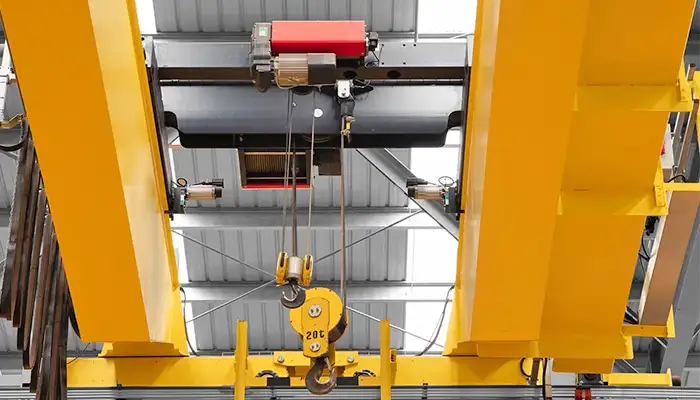
5 to 10 Ton Low-Maintenance Hoists for CNC Cranes
Content Quick Link
5 to 10 Ton Low-Maintenance Hoists for CNC Cranes: Save Time, Reduce Downtime
Introduction
In CNC metalworking workshops, the overhead crane is more than just a lifting tool — it's part of the daily production rhythm. When you're moving heavy plates, flanges, or tube sheets from one CNC machine to another, the crane hoist has to perform reliably every time. If it doesn't, production slows down, operators wait, and deadlines slip.
That's where low-maintenance hoists come in. They're designed to run longer with less downtime, so your workflow isn't interrupted by unexpected repairs or constant servicing.
Why Hoists Matter in CNC Production Lines
- Supports daily lifting of heavy components like steel plates, angle bars, and tube sheets.
- Feeds materials directly into machines — lifting accuracy affects part alignment and machining precision.
- Transfers parts between machines quickly to keep up with production schedules.
- Handles repetitive cycles in multi-shift operations, especially in workshops running 16–24 hours a day.
Why Low-Maintenance Hoists Are a Smart Choice
Traditional hoists need regular greasing, gearbox checks, and motor cleaning. For busy CNC shops, that means added cost and downtime — not ideal when you're on tight delivery timelines.
Low-maintenance hoists are engineered to reduce all that. They're sealed, protected, and built to last longer between service intervals.
- Fewer inspections thanks to sealed bearings and lifetime-lubricated parts.
- Less downtime because major components are enclosed and protected from dust, heat, and moisture.
- Lower maintenance costs with fewer consumables, less technician time, and reduced risk of part failure.
In short, these hoists keep your production moving and your maintenance team free to focus on more critical issues. It's a practical upgrade for any workshop handling steel and structural components daily.
What Is a Low-Maintenance Hoist?
Low-maintenance hoists are built to keep working smoothly without the constant fuss of regular upkeep. Unlike traditional hoists that demand frequent greasing and manual checks, these hoists come with smart designs that cut down on the need for hands-on maintenance.
They're especially useful in CNC workshops where production never really stops and the crane has to perform day in and day out without fail.
- Sealed bearings mean fewer grease points, so you don't have to spend as much time on lubrication.
- Lifetime-lubricated gearboxes reduce mechanical wear, which extends the life of key parts.
- Dust- and moisture-resistant enclosures protect the hoist's internal systems from harsh workshop conditions.
- These hoists work well both as wire rope hoists and electric chain hoists, depending on your lifting capacity and workshop layout.
Why They're Perfect for CNC Production Lines
Most CNC workshops run at least one or two shifts daily, sometimes even more. During that time, heavy steel parts and structural components are constantly moving between machines—drilling, punching, or marking stations. If the hoist fails or needs frequent maintenance, it quickly creates bottlenecks and delays.
Low-maintenance hoists help keep your production line moving steadily, providing reliability and peace of mind, especially in setups where parts are handled repeatedly or automated systems are involved.
Here's what makes these hoists a great fit for CNC lines:
- Less routine servicing means your maintenance crew can focus on other important tasks, and your downtime drops.
- Fewer breakdowns translate to higher uptime, keeping production consistent and on schedule.
- They help operators handle loads more precisely, lowering the chance of damaging costly parts.
- Smoother, more controlled operation means better safety during load positioning, which is critical when aligning parts in CNC machines.
In other words, low-maintenance hoists aren't just convenient—they're essential for busy CNC workshops that can't afford interruptions.
Typical Capacities of Maintenance Hoists and Electric Hoists for CNC Workshop Cranes
Selecting the right capacity for your maintenance hoist or electric hoist is crucial to ensure safe and efficient handling in CNC workshops. Different hoist sizes suit various lifting tasks based on the weight and type of materials being moved along the production line.
Here's a guide to typical hoist capacities and their common uses in CNC metalworking environments:
- 1 to 3 tons
Maintenance hoists and electric hoists in this range are used for light lifting tasks such as handling small steel plates, fixtures, and tooling in compact CNC centers. - 5 tons
This capacity is standard for most CNC workshops, suitable for lifting flanges, angle sections, and medium-sized structural parts in drilling and marking operations. - 10 tons
Ideal for medium-duty lifting of thick steel plates, tube sheets, or other components transferred between automated CNC machines. - 15 to 20 tons
Used for heavy-duty applications like lifting long beams, boiler shells, or heat exchanger parts on larger CNC beds or production lines. - 25 to 32 tons
Less common, but electric hoists of this capacity serve large fabrication plants with automated processes or oversized, heavy components.
Key points to consider:
- The 5 to 10-ton range is the most frequently used capacity for maintenance hoists and electric hoists in CNC workshops, handling mid-weight parts repeatedly during multiple shifts.
- Hoists in this capacity range usually meet duty classifications A5 to A6, meaning they are built for regular to heavy use in demanding production environments.
- Variable speed control is an important feature, enabling precise positioning and smooth lifting and lowering, which helps reduce shocks and wear on both the hoist and the load.
- Maintenance-friendly designs in these hoists contribute to less downtime, reducing the need for frequent servicing while maintaining consistent performance.
Long-Term Cost and Service Planning
When buying a crane hoist for a CNC production line, it's easy to focus on the initial price tag. But in reality, the ongoing costs of maintenance, repairs, and downtime often have a much bigger impact on your budget. A well-chosen low-maintenance hoist can save you time and money in the long run.
Why Long-Term Costs Matter
Downtime in a CNC workshop isn't just lost productivity — it's a domino effect that can delay shipments, increase labor costs, and even damage your reputation. Regular maintenance stops, emergency repairs, and part replacements all add up over the crane's life. So, it pays off to think beyond upfront costs and consider how the hoist will perform over years of use.
Cost-Saving Advantages of Low-Maintenance Hoists
Low-maintenance hoists are designed to reduce the frequency and complexity of servicing. Here's how that translates into savings for your workshop:
- Longer intervals between routine services — oil changes, motor inspections, and gearbox checks happen less often, sometimes extending from every 3–6 months on standard hoists to 12–18 months on maintenance-friendly models.
- Lower component wear — sealed bearings and lifetime-lubricated gears experience less mechanical friction, which means fewer parts wear out or need replacement.
- Reduced reliance on service teams — with fewer breakdowns and less routine maintenance, your in-house team won't be tied up fixing crane problems, and you won't need urgent external contractors as often.
- Extended equipment lifespan — better design and protective features mean your hoist lasts longer before needing major overhauls or replacement, improving your return on investment over 5 to 10 years.
Practical Example
Think of a typical workshop using a standard electric hoist. Maintenance might be scheduled every 3 to 6 months, requiring time for disassembly, cleaning, lubricating, and testing. If unexpected wear happens, additional downtime and repair costs can pile up.
Now, compare that to a low-maintenance hoist designed for harsh CNC environments. It can run 12 to 18 months with only simple visual checks and minor lubrication, cutting your annual service visits in half or more. Over several years, those saved hours and expenses add up — freeing your team to focus on production, not repairs.
Conclusion
Keeping the big picture in mind when choosing your crane hoist will help you avoid surprises and keep your CNC line running smoothly for years to come.
Choosing the Right Hoist for Your CNC Line Crane
When selecting a low-maintenance hoist for a CNC production environment, consider both your current process and future needs.
Factors to Consider:
- Lifting Capacity: Based on part weights — most CNC workshops fall in the 5 to 10 ton range
- Frequency of Use: Multiple shifts and high-cycle operations call for A5/A6-rated hoists
- Speed Control: Variable-speed hoists are ideal for controlled positioning and safety
- Lifting Height & Hook Approach: Match your hoist to your machine bed height and layout constraints
- Environmental Conditions: Consider IP rating, heat/dust protection, or explosion-proof models if needed
Conclusion
In busy CNC production lines, a hoist that requires little maintenance isn’t just a convenience — it’s essential. Low-maintenance hoists help you avoid unexpected delays, reduce wear on your equipment, and keep your production running smoothly through every shift.
If your work involves lifting flanges, steel plates, angle bars, or other heavy parts, investing in a reliable 5 to 10 ton low-maintenance hoist means fewer repair headaches and more consistent performance day after day.
Let’s make lifting in your CNC workshop easier, safer, and more efficient.
- Request a Quote: Get detailed pricing on a workshop crane system with a low-maintenance hoist tailored to your needs.
- Send Us Your Specs: Share your load requirements, workshop layout, and usage patterns, and we’ll help you pick the right hoist model.
- Talk to Our Engineers: Have questions about duty class, speed control, or installation? Our experts are ready to guide you.
Just reach out today — and get started with a hoist that works as hard as your machines do.

Article by Bella ,who has been in the hoist and crane field since 2016. Bella provides overhead crane & gantry crane consultation services for clients who need a customized overhead travelling crane solution.Contact her to get free consultation.
Yuantai Cranes
Overhead Crane Manufacturer with CE, ISO, SGS, CNEX Certificates.
- Main Specifications - Capacity: 0.5–550 tons | Span: up to 40m | Speed: 0.8–12 m/min | Duty: A3–A7 | Power: 380–690V, 50/60Hz | Control: pendant/remote/cabin
- Full engineering: FEA/PLC/VFD + in-house build + global delivery + on-site support, for workshops, factories, EPC contractors, industrial projects, etc.
- Support: design, manufacturing, testing, service – end-to-end, customized lifting solutions worldwide.
How to Get an Accurate Crane Price for Your Application?
Tips: Copy the spec list, fill in your details, and paste it into the form on the right/ down-below for a quick price.
- Crane type:_____ . (e.g., overhead crane, gantry crane, jib crane)
- Max weight to lift:_____ tons. (e.g., 2t, 5t, 10t, 20t, 50t)
- Lifting height:_____ m. (How high does the hook need to reach?
- Workshop width (span):_____ m . (Distance between the two crane rails)
- Travel distance:_____ m . (How long does the crane need to move along the runway?)
- Control type:_____. (Pendant / remote / cabin Control)
- Power supply:_____. (Local voltage & frequency – e.g., 380V, 50Hz, 3-phase)
- What will it be used for?_____ (e.g., steel fabrication, concrete products, mold handling, general manufacturing, etc.)
- Any special requirements?_____ (e.g., extreme temperature, dusty or explosive environment, special paint color, etc.)
Just leave a message via the contact form and our hoist and crane engineer will contact you with in 24working hours.
Get Your Custom Quote–Quick & Easy
Fill in what you know. Skip what you don't – we'll help.Any question will be reply with 24 working hours