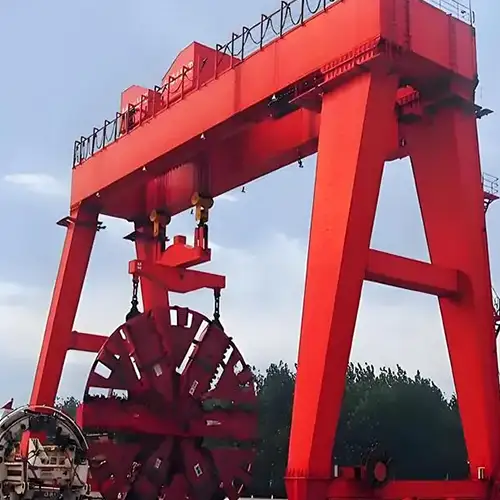
100–400t TBM Gantry Crane for Metro & Underground Lifting
Heavy-duty 100–400t TBM gantry crane for cutterhead lifting, shield assembly, and tunnel segment handling in metro, railway, highway, and hydropower projects.
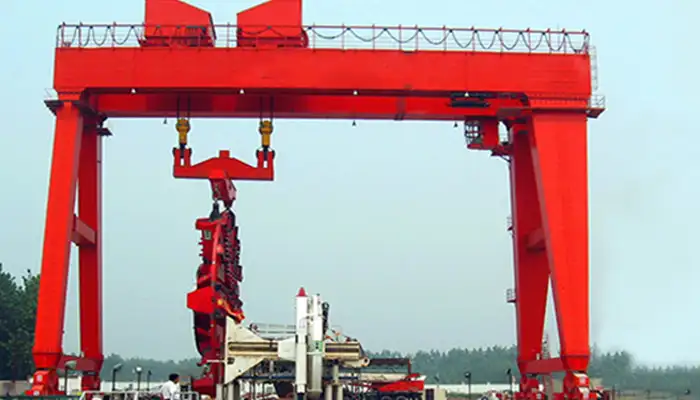
| Crane Type | TBM gantry cranes are typically double girder, U-frame, rail-mounted gantry cranes designed for tunnel construction projects. |
| Crane Capacity | 50–400 tons, with 100t, 200t, 300t, and 400t being the most common capacities for metro and tunnel construction projects. |
| Span Length | Customized. |
| Lifting Height | Customized. |
| Coverage Area Type | Rectangular Rail-Mounted Coverage Area |
| Application | TBM gantry cranes are mainly used for TBM assembly and disassembly, cutterhead lifting, tunnel segment handling, equipment maintenance, and heavy material transportation in metro, subway, railway, highway tunnel, and underground infrastructure constructio |
| Certifications | CE / ISO / SGS / Other third-party inspection |
| Customization | Customized material handling cranes solutions available for indoor, outdoor, hazardous, corrosive, c |
Crane Manufacturer: Yuantai Cranes – 30+ Years Professional Crane Manufacturer from China
Category: Construction
Tags: Construction
Your Trusted Gantry Crane Manufacturer & Supplier
TBM GANTRY CRANE
TBM Tunnel Boring Machine Gantry Crane for Metro and Underground Construction
Overview – Typical Capacity and Application Scope
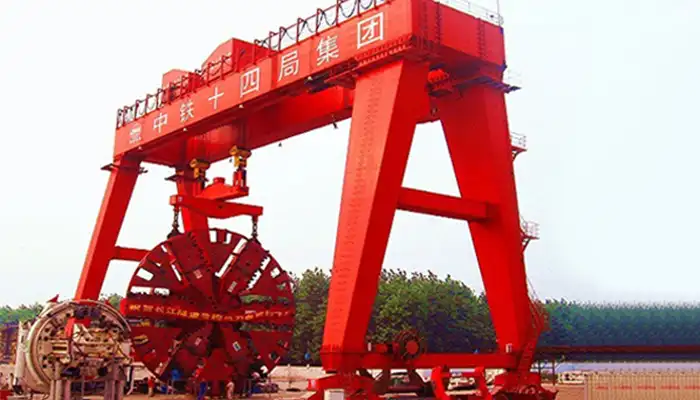
The TBM gantry crane (shield tunnel gantry crane) is a heavy lifting system , a subway double girder rail mounted gantry cranes , used in metro tunnel construction, subway shield tunneling projects, and underground construction lifting work. It is mainly installed in launching shafts or station pits where the tunnel boring machine (TBM) is assembled and later disassembled after completion. In practical site conditions, this type of crane is not a standard off-the-shelf machine. It is usually a project-based configuration, designed according to the TBM cutterhead weight, shield machine length, and shaft depth. Sometimes the space is tight, sometimes the load is extremely heavy—so the design always follows real engineering drawings, not theory. You will often hear site engineers simply say: "we need a TBM gantry crane that fits this shaft and this cutterhead." That is exactly how selection starts.
Typical capacity ranges in real TBM projects
Different tunnel projects require different lifting capacities. In most cases, the shield tunnel gantry crane system is selected within the following ranges:
- 100t–130t TBM gantry crane for metro tunnel construction
Used in small to medium subway stations and urban tunnel shafts.
Suitable for standard shield machine assembly and segment lifting. - 100t + 100t dual hoist gantry crane for shield tunneling machine lifting
Common in metro projects where synchronized lifting is required.
Often used for cutterhead installation and balanced lifting in narrow shafts. - 200t / 200t+200t heavy-duty TBM gantry crane system for metro projects
Typical configuration for large metro tunnels.
Handles shield body, cutterhead, and heavy components in one lifting cycle. - 400t shield tunnel gantry crane for large-diameter TBM cutterhead lifting
Used in large infrastructure projects such as cross-river tunnels or deep railway tunnels.
Selected when cutterhead weight is extremely high and lifting height is demanding.
Main application scope in underground construction
The TBM rail mounted gantry crane system is widely used in different types of tunnel engineering. In real projects, it is almost always part of the main construction equipment in the shaft area.
- Metro and subway tunnel construction using shield tunneling method
- Railway shield tunneling projects for long-distance underground lines
- Highway and road tunnel excavation with large TBM machines
- Hydropower diversion tunnel construction in mountainous areas
- Large-diameter TBM underground construction projects with deep shafts
In most cases, one crane is responsible for multiple tasks: lifting, assembly, installation, and later maintenance support. This reduces equipment changeover and keeps the tunneling cycle moving.
Practical usage notes from real projects
In actual underground tunnel lifting crane system applications, a few things are always considered on site:
- Shaft size often limits crane span selection (commonly 18–36m range)
- Lifting height must match deep excavation requirements
- Synchronized lifting is required for cutterhead installation
- Continuous lifting cycles are common during segment erection
So when engineers talk about a TBM gantry crane for metro tunnel construction, they are usually referring to a full working system, not just a lifting machine.
TBM Gantry Crane – Technical Specifications Overview
This TBM gantry crane system is designed for underground shield tunneling projects, including metro, railway, and large-diameter TBM installation works. The configuration varies depending on lifting capacity, tunnel shaft size, and installation depth requirements. Typical designs include 100t–400t single or dual-hoist systems, with synchronized lifting capability for heavy cutterhead and shield body handling.
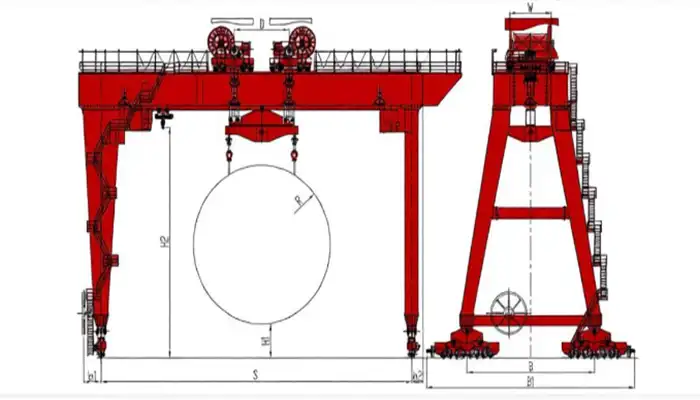
400t Heavy Duty TBM Gantry Crane
- Lifting Capacity: 400t
- Working Class: A3
- Span Range: 33m – 34m
- Lifting Height: Main hook: 23–24m (below/above rail), Auxiliary hook: 22–26m
- Lifting Speed (Main): 0.09–0.9 m/min
- Auxiliary Hook Speed: 7 m/min
- Trolley Travel Speed: 1.15–11.5 m/min
- Crane Travel Speed: 1.6–16 m/min
- Rail Type: QU100
- Power Supply: 3-phase AC 380V, 50Hz
- Max Wheel Load: ~405–415 kN
200t + 200t Dual Hoist TBM Gantry Crane
- Lifting Capacity: 200t + 200t (main) + 10t auxiliary
- Working Class: A4
- Span Range: 33m – 34m
- Lifting Height: 48m total (24m above rail + 24m below rail)
- Lifting Speed: 0.09–0.9 m/min
- Trolley Speed: 1.15–11.5 m/min
- Crane Travel Speed: 1.6–16 m/min
- Rail Type: QU100
- Power Supply: 3-phase AC 380V, 50Hz
- Max Wheel Load: ~270–290 kN
100t + 100t / 100t–130t TBM Gantry Crane
- Lifting Capacity: 100t / 130t / 100t + 100t
- Working Class: A4
- Span Range: 20m – 24m (typical adjustable range)
- Lifting Height: ~9.8m + 30m (varies by shaft design)
- Lifting Speed: 0.37–6 m/min
- Trolley Speed: 2.5–25 m/min
- Crane Travel Speed: 1.4–14 m/min
- Rail Type: QU80
- Power Supply: 3-phase AC 380V, 50Hz
- Max Wheel Load: ~230–280 kN
General Design Notes - Important for Buyers
- All systems are designed for shield tunneling machine lifting crane operations
- Suitable for metro tunnel gantry crane, railway tunnel construction crane, and TBM installation projects
- Supports single hoist, dual hoist, and synchronized lifting configurations
- Designed for deep shaft underground construction lifting systems
- Recommended rail systems: QU80 / QU100 heavy-duty crane rail
Main Application of Shield Tunnel Gantry Crane
The shield tunnel gantry crane system (TBM gantry crane) is not used in one fixed environment. It is designed for different underground construction conditions, and each project type has its own lifting rhythm, space limitation, and load requirement. In real tunnel engineering, the crane is often installed at the very beginning of the shaft construction stage and stays in service until TBM breakthrough or retrieval. In most projects, the selection is directly linked to typical capacity ranges (100t–400t) and corresponding dual hoist or single gantry configurations, depending on TBM size and construction method.
Metro and Subway Tunnel Construction
In metro projects, the metro tunnel gantry crane is usually installed inside launching shafts, station pits, or intermediate shafts. These locations are narrow, deep, and busy. Lifting work is continuous, especially during TBM assembly and segment erection stages.
Typical site operations include:
- TBM cutterhead lifting crane installation and alignment before shield machine assembly begins
- shield tunneling machine lifting equipment operations for assembling shield body sections one by one
- tunnel segment handling crane work for precast concrete lining installation during daily excavation cycles
- repeated lifting of support equipment such as pipes, motors, and auxiliary TBM parts
Typical capacity & configurations used:
- 100t–130t double girder TBM gantry crane for small metro shafts
- 100t + 100t dual hoist shield tunnel gantry crane system for cutterhead and shield body synchronization
- 200t class heavy-duty TBM gantry crane for standard metro station shafts
- span usually 20–36m, lifting height 30–40m depending on station depth
In metro construction, timing is always tight. So the crane is expected to support continuous lifting without interruption, especially during shield launch and early tunneling stages.
Railway and High-Speed Rail Tunnels
Railway tunnel projects usually involve longer distances and more difficult terrain. Many of them pass through mountains or deep geological zones, which means heavier components and deeper shafts.
In these cases, a railway tunnel gantry crane system is selected with higher lifting capacity and stronger structural rigidity.
Typical operations include:
- TBM launching and retrieval lifting operations, often involving large cutterhead assemblies
- lifting and positioning of shield machine components in deep underground shafts
- heavy-duty underground lifting operations in confined construction pits, sometimes with limited working clearance
- support for long-cycle excavation where TBM runs continuously for months or even years
Typical capacity & configurations used:
- 200t + 200t dual hoist gantry crane system for large TBM cutterhead installation
- 300t–400t heavy-duty TBM gantry crane for deep railway tunnels
- span commonly 24–36m, with reinforced structure for long span stability
- high-duty class (A4–A5) for continuous lifting cycles
For high-speed rail projects, precision is important, but stability is even more critical because lifting is often done at deeper levels with limited access space.
Highway and Road Tunnel Projects
Highway tunnel construction often uses large-diameter TBMs, especially for cross-river tunnels, urban expressway tunnels, or multi-lane underground roads. These projects usually require higher lifting capacity and stronger gantry structure.
A TBM installation gantry crane system in these projects is mainly responsible for heavy assembly work.
Typical operations include:
- installation and positioning of large TBM components during initial setup
- lifting and placement of precast concrete tunnel segments during lining construction
- handling of shield body sections inside wide tunnel shafts
- repetitive lifting cycles during full-face excavation operations
Typical capacity & configurations used:
- 200t–300t TBM gantry crane for standard highway tunnel projects
- 400t shield tunnel gantry crane for large diameter TBM excavation (cross-river tunnels)
- dual trolley system for synchronized cutterhead lifting
- span often 22–34m, designed for wider tunnel shafts
In practical terms, these cranes are working under high load conditions for long durations, especially when large diameter shield machines are used.
Hydropower and Underground Infrastructure Tunnels
Hydropower and water diversion tunnels are often located in mountainous or remote areas. The working environment is more open in some cases, but the lifting depth and equipment weight can still be significant.
In these projects, a hydropower tunnel lifting crane or water diversion tunnel gantry crane is commonly used for TBM operations.
Typical operations include:
- lifting and assembling TBM equipment in deep excavation shafts
- underground TBM component installation and maintenance lifting
- handling of shield tunneling machine sections during construction stages
- support for long-distance tunnel excavation and water channel development
Typical capacity & configurations used:
- 100t–200t TBM gantry crane for medium hydropower tunnels
- 200t–400t gantry crane for large water diversion TBM projects
- simplified double trolley system depending on installation layout
- span typically 20–30m, adapted to shaft geometry and terrain conditions
These projects usually require stable long-term operation, because shutdowns are costly and difficult to recover in remote construction environments.
Practical Summary from Real Project Use
Across all these applications, the shield tunnel gantry crane system is always tied closely to TBM workflow. It is not just a lifting tool, but part of the construction sequence.
In most projects, engineers focus on three things:
- whether the crane can handle TBM cutterhead lifting and shield assembly safely
- whether it supports continuous tunnel segment handling without delay
- whether it fits the actual shaft space and underground construction conditions
That is why selection always comes back to real site drawings, not only standard specifications.
Main Functions of TBM Gantry Crane System
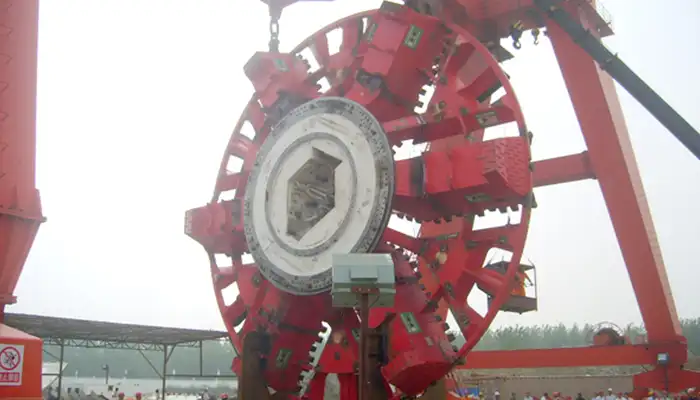
The TBM gantry crane / shield tunnel gantry crane system is designed to support the full working cycle of a tunnel boring machine. In real underground construction, it is not used for a single task. It moves with the project—from TBM assembly, to excavation, to maintenance and final retrieval.
TBM Cutterhead Lifting and Installation
This is the most critical lifting stage in any TBM project. The cutterhead is usually the heaviest single component, and it must be positioned with high accuracy inside a confined shaft.
Typical operations include:
- TBM cutterhead lifting system for 100t–400t loads, depending on tunnel diameter and geology conditions
- precise alignment and positioning of the shield machine cutterhead during assembly
- synchronized lifting using dual trolley systems inside narrow launching shafts
- controlled lowering and installation into shield body sections
Typical capacity & configuration used:
- 100t–130t systems for small metro cutterhead installation
- 200t + 200t dual hoist TBM gantry crane system for standard metro projects
- 400t heavy-duty shield tunnel gantry crane for large diameter TBM cutters
- low-speed hoist system with VFD control for fine positioning
Shield Machine Assembly
Shield machine assembly is a step-by-step process where each section of the TBM is lifted and installed inside the shaft. This stage usually takes several days or even weeks depending on project size.
Typical operations include:
- shield body lifting and precise positioning in sequence
- modular TBM installation support for multiple structural sections
- coordination between lifting, welding, and alignment teams
- repeated lifting of heavy cylindrical components in confined space
Typical capacity & configuration used:
- 100t–200t TBM gantry crane systems for standard metro shield assembly
- dual trolley configuration for alternating lifting tasks
- span typically 20–36m depending on shaft layout
- A4–A5 duty class for continuous installation cycles
Tunnel Segment Handling
Tunnel segment handling is one of the most repetitive and continuous operations in metro tunneling. After TBM excavation, segments must be lifted and installed immediately to support the tunnel lining.
Typical operations include:
- tunnel segment handling crane for precast concrete segments
- repetitive lifting cycles during daily excavation progress
- precise placement of segments for tunnel lining formation
- stacking and feeding segments into shield machine working area
Typical capacity & configuration used:
- 100t–130t systems for smaller metro segments
- 100t + 100t dual hoist systems for high-efficiency segment lifting
- high-speed trolley travel for repetitive handling
- stable low-speed hoisting for positioning accuracy
Maintenance and Repair Operations
During long TBM excavation cycles, maintenance work is unavoidable. The gantry crane also plays a key role in supporting repair and replacement tasks inside underground shafts.
Typical operations include:
- TBM maintenance gantry crane operations during downtime
- gearbox lifting and installation work
- hydraulic system removal and replacement
- lifting of worn or damaged underground components
Typical capacity & configuration used:
- 100t–200t maintenance lifting setups depending on TBM size
- compact lifting mode for restricted maintenance space
- flexible operation mode between main and auxiliary hoists
- designed for safe operation during long construction cycles
Typical TBM Gantry Crane Configurations
In real tunnel engineering projects, TBM gantry crane systems are not selected randomly. They are matched according to TBM diameter, cutterhead weight, shaft depth, and construction cycle. In practice, most configurations fall into three common capacity layouts used in metro, railway, and large underground tunneling projects.
100t–130t Compact TBM Gantry Crane
This configuration is commonly used in small metro tunnel construction projects where shaft space is limited and TBM size is relatively small. It is often the first choice for urban subway stations and short-distance tunneling sections.
Typical features and usage include:
- compact shield tunnel gantry crane system designed for narrow shafts
- suitable for repetitive tunnel segment handling and small shield machine assembly
- optimized structure for limited underground construction space
- fast installation and flexible operation in metro station pits
Typical capacity application:
- 100 ton gantry crane for tunnel construction in small metro projects
- suitable for TBM cutterhead weights in the lower range
- span usually 18–30m depending on shaft geometry
200t + 200t Dual Hoist System
This is one of the most commonly used configurations in metro TBM installation projects. It is designed for synchronized lifting of heavy shield machine components, especially cutterheads and large shield body sections.
Typical features and usage include:
- dual hoist TBM gantry crane system with synchronized control
- used for balanced lifting of large TBM components
- flexible switching between tandem lifting and independent operation
- widely applied in standard metro and urban underground projects
Typical capacity application:
- 200t + 200t shield machine lifting crane system for metro tunnels
- suitable for medium to large TBM cutterhead installation
- span usually 22–36m with reinforced structure design
- supports continuous construction cycles in shield tunneling projects
400t Heavy Duty TBM Gantry Crane
This configuration is used in large diameter TBM projects, especially in deep shafts, river-crossing tunnels, and major infrastructure developments. It is designed for extreme lifting conditions where both weight and height are critical factors.
Typical features and usage include:
- 400 ton shield tunnel gantry crane system for heavy TBM cutterhead lifting
- deep shaft underground construction lifting equipment with high structural stability
- designed for large diameter TBM assembly and retrieval operations
- supports long-term heavy-duty tunneling cycles
Typical capacity application:
- 400 ton gantry crane TBM project for large metro or railway tunnels
- used for cutterheads in large-diameter shield machines
- span typically 24–36m with reinforced girder structure
- high-duty class operation for continuous underground work
Application Summary – Underground Construction Use
The TBM gantry crane system / shield tunnel gantry crane is widely used across different types of underground engineering projects. In real construction sites, it is usually installed at the early stage of shaft excavation and remains in operation throughout the full TBM cycle—from assembly to excavation and final retrieval.
It plays a central role in metro and underground construction lifting operations, especially where large components need to be moved repeatedly in confined shaft environments.
Main application areas include:
- metro tunnel construction projects using shield tunneling method
- subway shield tunneling engineering for urban rail transit systems
- railway underground tunnel excavation in mountain and long-distance routes
- hydropower tunnel construction for water diversion and dam projects
- large-scale underground construction lifting projects with TBM equipment
In practical terms, the shield tunnel gantry crane system is responsible for ensuring that all heavy lifting inside the shaft is performed safely and in sequence. It handles cutterhead installation, shield body assembly, and continuous tunnel segment lifting without interrupting the excavation cycle.
How to Select a TBM Gantry Crane
Selecting a TBM gantry crane / shield tunnel gantry crane system is usually based on real underground construction conditions rather than theoretical capacity alone. In metro tunnel construction and shield tunneling projects, engineers need to match the crane with TBM cutterhead weight, shaft depth, span limits, and lifting cycle requirements to ensure stable long-term operation in confined spaces.
In practice, this selection process is often described as choosing a tunnel construction lifting crane solution for TBM installation and segment handling, not just picking a standard gantry crane model.
Overview – How to Select a TBM Gantry Crane
Selecting a TBM gantry crane / shield tunnel gantry crane system depends on real tunnel construction conditions rather than standard crane parameters. In metro tunnel projects, railway shield tunneling, and underground excavation works, the crane must match TBM size, shaft constraints, and continuous lifting cycles.
Key selection points (compact view):
- Tunnel diameter → determines span of the shield tunnel gantry crane system
- TBM weight & cutterhead size → defines required lifting capacity (100t–400t range)
- Shaft dimensions & space limits → affect crane layout and compact design requirement
- Lifting capacity requirement → single hoist or dual hoist (100t, 200t, 400t configurations)
- Span & lifting height → typically 18–36m span, 30–40m lifting height for deep shafts
- Lifting frequency → continuous segment handling vs heavy cutterhead lifting cycles
- Site environment → dust, humidity, corrosion risk in underground construction conditions
- Power supply stability → 3-phase 380V with VFD control for synchronized lifting
- Future expansion → possible TBM upgrades or additional tunnel phases
In practical terms, choosing a TBM gantry crane for metro tunnel construction is about matching the crane to the full underground workflow—cutterhead lifting, shield assembly, and tunnel segment handling—rather than focusing only on rated capacity.
Tunnel Diameter Considerations
- Large-diameter tunnels require wider span TBM gantry crane systems for metro tunnel construction
- Small and medium metro tunnels usually use compact shield tunnel gantry crane configurations
- Diameter also affects cutterhead installation clearance and segment lifting space
This is a key factor when defining a customized underground tunnel lifting crane system for TBM assembly.
TBM Weight and Cutterhead Size
- Cutterhead is the heaviest single component in most TBM installations
- Shield body weight determines total lifting capacity requirement
- Large projects often require 200t–400t heavy-duty TBM gantry crane systems
This is why many buyers search for how to choose TBM gantry crane capacity for shield tunneling projects, especially in metro and railway tunnels.
Shaft Dimensions and Site Limitations
- Narrow shafts require compact shield tunnel gantry crane designs for limited space
- Deep shafts require higher lifting height and longer hook travel
- Working clearance influences trolley movement and installation layout
This is a common constraint in underground construction lifting crane system design for metro stations and launching shafts.
Required Lifting Capacity
- 100t–130t TBM gantry crane for small metro tunnel construction projects
- 100t + 100t dual hoist gantry crane for shield machine installation and synchronized lifting
- 200t–400t heavy-duty gantry crane for TBM cutterhead lifting in large infrastructure tunnels
Capacity selection always includes safety margin for dynamic loads in shield tunneling machine lifting operations.
Span and Lifting Height Requirements
- Span typically ranges from 18–36m for tunnel construction lifting equipment
- Lifting height ranges from 30–40m in deep metro tunnel construction projects
- Deeper shafts require extended hook travel for cutterhead installation
These parameters ensure compatibility with TBM gantry crane systems for underground excavation projects.
Frequency of Lifting Operations
- Daily tunnel segment handling crane operations during metro excavation
- Heavy lifting during cutterhead installation and retrieval stages
- Long-duty cycles requiring A3–A5 class crane systems
This is critical in shield tunneling equipment working under continuous construction schedules.
Environmental Conditions
- Dust generated during excavation impacts mechanical wear
- High humidity in shafts affects electrical and structural components
- Corrosive conditions in wet geology zones
- Outdoor exposure at launching and retrieval shafts
These factors influence selection of corrosion-resistant TBM gantry crane systems for underground construction projects.
Power Supply Requirements
- Standard supply: 3-phase AC, 50Hz, 380V for TBM gantry crane systems
- VFD control for precision lifting and smooth acceleration
- Stable voltage required for dual hoist synchronization in shield machine lifting
- Backup power planning for remote tunnel construction sites
This ensures reliable operation of the tunnel boring machine lifting crane system under continuous load conditions.
Future Project Expansion Considerations
- Possible upgrade from segment handling to full TBM cutterhead lifting crane requirements
- Additional shafts may require extended span or modified gantry crane structure design
- Future TBM size increase may require higher capacity shield tunnel gantry crane systems
- Potential conversion from single hoist to dual hoist synchronized lifting configuration
- Expansion of project phases may require reuse of TBM gantry crane across multiple tunnel sections
Planning ahead helps avoid replacing the entire shield tunnel gantry crane system for metro and infrastructure projects, reducing long-term cost and downtime.
Operational Challenges in Tunnel Construction Projects
In real metro tunnel construction and shield tunneling projects, the working environment inside launching shafts and underground stations is often more difficult than surface lifting operations. A TBM gantry crane / shield tunnel gantry crane system must operate under tight space, high load concentration, and continuous excavation schedules.
Confined Working Space
Tunnel shafts provide very limited space for crane installation and movement.
- Restricted installation area affects crane span layout
- Limited clearance for TBM assembly and segment handling
- Requires compact shield tunnel gantry crane design for underground shafts
High Safety Requirements
Safety standards are strict in underground construction lifting operations.
- Risk increases during heavy TBM cutterhead lifting crane operations
- Multi-team coordination is required inside shafts
- Safety systems must support continuous monitoring
Continuous Construction Schedules
TBM tunneling is a 24/7 operation in many projects.
- Continuous tunnel segment handling crane work during excavation
- Minimal downtime allowed for maintenance
- High-duty class operation required for gantry crane system
Heavy Concentrated Loads
TBM components create extreme point loads.
- Cutterhead and shield body are very heavy single lifts
- Requires 200t–400t TBM gantry crane system in large projects
- Load distribution must remain stable during lifting
Deep Shaft Lifting Conditions
Many metro and railway tunnels use deep vertical shafts.
- Increased lifting height demand (often 30–40m)
- Long hook travel affects stability control
- Requires precise underground tunnel lifting crane system design
Complex Installation Alignment
TBM assembly requires high positioning accuracy.
- Cutterhead alignment must match shield body precisely
- Dual hoist synchronization is often required
- Small errors affect full TBM installation process
Safety Considerations for TBM Gantry Crane Operations
In shield tunnel construction and TBM installation projects, safety is a core requirement for every lifting cycle. A TBM gantry crane / shield tunnel gantry crane system must operate under strict inspection and control standards due to heavy loads, confined shaft conditions, and continuous working schedules.
Load Testing Requirements
Before operation, the crane must pass full load verification.
- Static and dynamic load testing for TBM gantry crane system
- Verification under maximum rated capacity conditions
- Ensures safe operation in real tunneling cycles
Synchronized Hoist Inspection
Dual hoist systems must operate in balance.
- Regular inspection of synchronized lifting system
- Ensures stable shield machine lifting crane operation
- Prevents uneven load distribution
Wire Rope and Hook Inspection
Critical lifting components require frequent checks.
- Wire rope wear monitoring
- Hook deformation and fatigue inspection
- Essential for tunnel construction lifting crane safety control
Emergency Protection Systems
Safety systems must respond instantly in abnormal conditions.
- Overload protection systems
- Emergency stop functions
- Limit switches for travel and lifting range
Operator Visibility and Communication
Underground visibility is limited.
- Use of signal systems and intercom communication
- Coordination between ground and shaft operators
- Required in all TBM gantry crane for metro tunnel construction projects
Wind and Weather Monitoring
Even underground sites can be affected at shaft openings.
- Wind monitoring at launching shaft entrances
- Weather impact during open-air lifting sections
- Safety control during extreme conditions
Preventive Maintenance Planning
Regular maintenance ensures long-term reliability.
- Scheduled inspection of hoisting and travel systems
- Lubrication and mechanical wear control
- Reduces downtime in continuous shield tunnel gantry crane operations
Typical TBM Gantry Crane Project Configurations
In real metro, railway, hydropower, and road tunnel construction projects, a TBM gantry crane / shield tunnel gantry crane system is always configured based on actual TBM size, shaft depth, and lifting cycle requirements. Below are common engineering-based configuration examples used in underground construction lifting projects.
Metro Tunnel Project Example
In metro and subway tunnel construction, the shield tunnel gantry crane system is designed for compact shafts and continuous segment handling work.
- Tunnel diameter: 6m–10m metro shield tunnels
- Crane capacity: 100t–200t (standard metro TBM gantry crane system)
- Span: 20–30m typical launching shaft layout
- Lifting height: 25–40m depending on station depth
Main lifting tasks:
- TBM cutterhead lifting and installation
- shield machine assembly and disassembly
- tunnel segment handling crane operations for precast lining
- auxiliary equipment lifting in confined shafts
This type is widely used in metro tunnel gantry crane applications and subway construction lifting crane systems, where space is limited but lifting frequency is high.
Railway Tunnel Project Example
Railway tunnel projects usually involve deeper shafts and heavier TBM equipment, especially in mountain or long-distance tunneling conditions.
- Tunnel diameter: 8m–14m railway shield tunnels
- Crane capacity: 200t–400t heavy-duty TBM gantry crane system
- Span: 24–36m for larger excavation shafts
- Lifting height: 30–45m deep shaft lifting requirements
Main lifting tasks:
- TBM launching and retrieval operations
- heavy cutterhead and shield body lifting
- shield machine component installation
- continuous underground construction lifting support
This configuration is commonly referred to as a railway tunnel gantry crane system or heavy lifting gantry crane for tunnel boring projects.
Hydropower Tunnel Project Example
Hydropower and water diversion tunnels often require long-distance excavation with variable geological conditions.
- Tunnel diameter: 5m–12m water diversion tunnels
- Crane capacity: 100t–300t TBM gantry crane systems
- Span: 20–30m depending on shaft layout
- Lifting height: 25–35m typical hydropower shaft depth
Main lifting tasks:
- TBM assembly and underground installation lifting
- shield tunneling machine handling
- maintenance and replacement of TBM components
- long-cycle excavation support operations
This type is widely used in hydropower tunnel lifting crane applications and water diversion tunnel gantry crane systems, especially in remote construction sites.
Large Diameter Road Tunnel Example
Large infrastructure road tunnels require high-capacity TBM systems for urban expressways or cross-river projects.
- Tunnel diameter: 10m–16m large road tunnels
- Crane capacity: 200t–400t shield tunnel gantry crane system
- Span: 25–36m wide shaft configurations
- Lifting height: 30–40m deep excavation lifting requirements
Main lifting tasks:
- large TBM cutterhead lifting and installation
- shield body assembly and segment handling
- precast lining segment installation
- full-cycle tunnel construction lifting operations
This configuration is typically referred to as a large diameter TBM gantry crane system or highway tunnel construction lifting crane solution, used in high-load infrastructure projects.
Common Questions from TBM Crane Buyers
In TBM gantry crane / shield tunnel gantry crane system procurement, buyers usually come from metro construction companies, railway contractors, or tunneling engineering teams. Their questions are very practical, focused on capacity, configuration, and real site conditions rather than theoretical specifications.
What capacity crane is needed for TBM cutterhead lifting?
Most TBM cutterheads require a 100t–400t TBM gantry crane system, depending on tunnel diameter and geology.
In metro projects, 100t–200t is common, while large diameter shield machines in river-crossing or railway tunnels may require 400t heavy-duty gantry crane systems. The final selection is always based on actual cutterhead weight plus safety margin.
Why are dual trolley cranes commonly used in tunnel projects?
Dual trolley systems are widely used because TBM components are heavy and need balanced lifting.
They allow synchronized lifting in shield machine installation, especially during cutterhead alignment. At the same time, each trolley can also operate independently for tunnel segment handling crane tasks, improving flexibility on site.
Can TBM gantry cranes handle both cutterheads and tunnel segments?
Yes, most shield tunnel gantry crane systems are designed for multiple functions.
One configuration supports both heavy lifting (cutterhead and shield body) and repetitive work like precast concrete segment handling. This reduces the need for multiple lifting systems in underground construction sites.
What safety systems are required for tunnel lifting operations?
Safety systems are critical in all underground tunnel lifting crane applications.
Common requirements include overload protection, limit switches, emergency stop systems, and synchronized hoist monitoring. In confined shafts, communication systems between operators are also essential.
How is synchronized lifting achieved?
Synchronized lifting is achieved through electrical control systems and frequency regulation.
In a dual hoist TBM gantry crane system, both hoists are controlled through a central PLC system to maintain equal load distribution. This is especially important during cutterhead installation and large shield assembly.
What is the difference between a TBM crane and a regular gantry crane?
A TBM gantry crane is designed specifically for shield tunneling machine lifting operations, not general material handling.
It must handle higher concentrated loads, deeper shafts, and more precise alignment tasks such as cutterhead installation and tunnel segment positioning. Standard gantry cranes cannot meet these underground construction requirements.
How do confined shaft dimensions affect crane design?
Shaft size directly determines crane span, structure height, and installation layout.
In narrow shafts, a compact shield tunnel gantry crane system is required, while deeper shafts require higher lifting height and longer hook travel. Space limitation is one of the most important design constraints in metro tunneling projects.
What information is required for crane selection and quotation?
To design a proper TBM gantry crane system for tunnel construction, buyers usually need to provide:
- TBM cutterhead weight and shield machine dimensions
- tunnel diameter and project type (metro, railway, hydropower, etc.)
- shaft depth and available span
- lifting height requirement
- duty cycle and frequency of lifting operations
- site power supply conditions and environmental factors
This information ensures accurate selection of a customized underground construction lifting crane solution suitable for real project conditions.
Operational Challenges in Tunnel Construction Projects
In real metro tunnel construction and shield tunneling projects, the working environment inside launching shafts and underground stations is often more difficult than surface lifting operations. A TBM gantry crane / shield tunnel gantry crane system must operate under tight space, high load concentration, and continuous excavation schedules.
Confined Working Space
Tunnel shafts provide very limited space for crane installation and movement.
- Restricted installation area affects crane span layout
- Limited clearance for TBM assembly and segment handling
- Requires compact shield tunnel gantry crane design for underground shafts
High Safety Requirements
Safety standards are strict in underground construction lifting operations.
- Risk increases during heavy TBM cutterhead lifting crane operations
- Multi-team coordination is required inside shafts
- Safety systems must support continuous monitoring
Continuous Construction Schedules
TBM tunneling is a 24/7 operation in many projects.
- Continuous tunnel segment handling crane work during excavation
- Minimal downtime allowed for maintenance
- High-duty class operation required for gantry crane system
Heavy Concentrated Loads
TBM components create extreme point loads.
- Cutterhead and shield body are very heavy single lifts
- Requires 200t–400t TBM gantry crane system in large projects
- Load distribution must remain stable during lifting
Deep Shaft Lifting Conditions
Many metro and railway tunnels use deep vertical shafts.
- Increased lifting height demand (often 30–40m)
- Long hook travel affects stability control
- Requires precise underground tunnel lifting crane system design
Complex Installation Alignment
TBM assembly requires high positioning accuracy.
- Cutterhead alignment must match shield body precisely
- Dual hoist synchronization is often required
- Small errors affect full TBM installation process
Request a TBM Gantry Crane Solution
A TBM gantry crane / shield tunnel gantry crane system is always designed based on real project conditions. To support accurate engineering, buyers can provide key technical data below. This helps define the correct 100t–400t underground tunnel lifting crane system for TBM cutterhead lifting, shield machine assembly, and tunnel segment handling.
Technical Consultation
Initial discussion to understand project requirements and feasibility.
- Project type: ☐ Metro tunnel / ☐ Railway tunnel / ☐ Highway tunnel / ☐ Hydropower tunnel
- Tunnel diameter: __________ m
- TBM type: __________ (EPB / Slurry / Open / Other)
- Main lifting purpose: ☐ Cutterhead / ☐ Shield body / ☐ Segment handling / ☐ Full TBM assembly
- Estimated TBM weight: __________ ton
- Expected crane capacity range (if known): __________ ton
- Special site conditions: __________________________________________
Crane Layout Design
Used to design how the crane fits into the tunnel shaft.
- Shaft width: __________ m
- Shaft length: __________ m
- Shaft depth: __________ m
- Required span: __________ m (typical 18–36m)
- Required lifting height: __________ m (typical 25–40m)
- Ground/shaft layout drawing available: ☐ Yes / ☐ No
- Installation space restrictions: __________________________________________
Capacity and Configuration Recommendation
Defines crane tonnage and structure type.
- Required lifting capacity: ☐ 100t / ☐ 130t / ☐ 200t / ☐ 200t+200t / ☐ 400t
- Lifting method: ☐ Single hoist / ☐ Dual hoist synchronized system
- Cutterhead lifting requirement: __________ ton
- Shield body lifting requirement: __________ ton
- Segment handling frequency: __________ cycles/day
- Preference for compact design: ☐ Yes / ☐ No
Project-Based Engineering Support
Engineering support for design and execution stage.
- Project location: __________________________
- Environmental condition: ☐ Dry / ☐ Humid / ☐ High corrosion / ☐ Underground water
- Duty class requirement: ☐ A3 / ☐ A4 / ☐ A5
- Operation mode: ☐ Day shift / ☐ 24-hour continuous
- Special safety requirements: __________________________________________
- Installation assistance required: ☐ Yes / ☐ No
Quotation and Technical Proposal Request
Final stage for engineering solution and pricing.
- Required delivery time: __________ weeks/months
- Budget range (optional): __________
- Installation timeline: __________________________________________
- Preferred crane configuration: __________________________________________
- Additional requirements: __________________________________________
This structured information allows engineers to design a tailored shield tunnel gantry crane system for TBM projects, ensuring correct capacity selection, safe lifting performance, and compatibility with real underground construction conditions.

Yuantai Cranes
Overhead Crane Manufacturer with CE, ISO, SGS, CNEX Certificates.
- Main Specifications - Capacity: 0.5–550 tons | Span: up to 40m | Speed: 0.8–12 m/min | Duty: A3–A7 | Power: 380–690V, 50/60Hz | Control: pendant/remote/cabin
- Full engineering: FEA/PLC/VFD + in-house build + global delivery + on-site support, for workshops, factories, EPC contractors, industrial projects, etc.
- Support: design, manufacturing, testing, service – end-to-end, customized lifting solutions worldwide.
How to Get an Accurate Crane Price for Your Application?
Tips: Copy the spec list, fill in your details, and paste it into the form on the right/ down-below for a quick price.
- Crane type:_____ . (e.g., overhead crane, gantry crane, jib crane)
- Max weight to lift:_____ tons. (e.g., 2t, 5t, 10t, 20t, 50t)
- Lifting height:_____ m. (How high does the hook need to reach?
- Workshop width (span):_____ m . (Distance between the two crane rails)
- Travel distance:_____ m . (How long does the crane need to move along the runway?)
- Control type:_____. (Pendant / remote / cabin Control)
- Power supply:_____. (Local voltage & frequency – e.g., 380V, 50Hz, 3-phase)
- What will it be used for?_____ (e.g., steel fabrication, concrete products, mold handling, general manufacturing, etc.)
- Any special requirements?_____ (e.g., extreme temperature, dusty or explosive environment, special paint color, etc.)
Just leave a message via the contact form and our hoist and crane engineer will contact you with in 24working hours.
Get Your Custom Quote–Quick & Easy
Fill in what you know. Skip what you don't – we'll help.Any question will be reply with 24 working hours