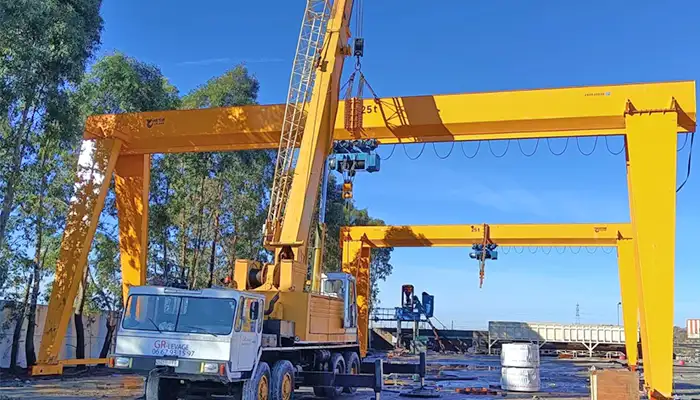
Structural Load Behavior of 25T 11.5M Single Girder Gantry Crane Guide
Content Quick Link
Structural Load Behavior of 25T 11.5M Single Girder Gantry Crane Guide
25T 11.5m single girder gantry crane structural load behavior, dynamic load factors, deflection, and real lifting stress analysis.
Most Important Takeaway
A 25 ton single girder gantry crane does not operate under “static 25T conditions” in real life—its structural design is governed by dynamic load amplification, trolley movement effects, and short-duration shock forces that can push actual girder stress well beyond nominal rated capacity.
Key Takeaways
- Rated 25T capacity represents ideal static lifting conditions, not real operating stress
- Dynamic load factors can increase structural demand by 20%–40% during lifting
- Trolley movement shifts bending moments and creates peak mid-span stress zones
- Short shock loads during hoisting or braking are the most critical structural risk
- Beam stiffness and deflection control are as important as strength design
Questions This Guide Solves for a 25 Ton Gantry Crane System
This guide is built around real working behavior of a 25 ton gantry crane, especially in configurations such as a 25 ton electric hoist gantry crane, 25 ton single beam gantry crane, and 25 ton single girder goliath gantry crane operating across an 11.5 m span. The focus is not theoretical capacity, but actual structural response under lifting cycles, movement, and impact conditions. Below are the key engineering questions this guide addresses in practical design and operation scenarios.
Why does a 25 ton gantry crane experience higher stress than its rated load?
A 25 ton gantry crane often experiences stress levels higher than its nominal rating because the rated capacity only reflects static lifting conditions. In real operation, additional forces are introduced.
In a 25 ton electric hoist gantry crane, stress increases due to:
- Hoisting acceleration and deceleration effects
- Rope tension fluctuation during load pick-up
- Trolley movement across the span
- Short-duration shock forces during operation
For a 25 ton single girder goliath gantry crane, these combined effects mean the girder is frequently working under equivalent loads higher than 25 tons, even if the lifted weight itself remains unchanged.
How do dynamic load factors affect a 11.5 m single girder crane structure?
In a 25 ton single beam gantry crane, dynamic load factors directly increase bending moment and deflection across the 11.5 m span. These factors come from real motion, not static assumptions.
In a 25 ton electric hoist gantry crane, dynamic amplification occurs when:
- The hoist starts or stops under load
- The trolley accelerates or brakes along the runway
- Load swing introduces lateral force components
This means the girder of a 25 ton gantry crane does not only carry 25 tons; it carries a temporarily amplified equivalent load that increases stress and deflection response during operation cycles.
Why is mid-span deflection the most critical design consideration?
For a 25 ton single girder goliath gantry crane, mid-span is the location where bending moment reaches its maximum under full load conditions. This makes deflection at this point a key indicator of structural performance.
In a 25 ton gantry crane, mid-span deflection matters because:
- It represents maximum structural bending under load
- It affects trolley travel stability
- It influences wheel-rail contact behavior
- It reflects overall girder stiffness under combined loading
In a 25 ton electric hoist gantry crane, excessive mid-span deflection can also lead to misalignment issues over repeated cycles.
What happens to beam stress when the trolley moves under full load?
When the trolley of a 25 ton gantry crane moves under full load, the stress distribution along the girder changes continuously. The beam is no longer in a fixed bending state.
In a 25 ton single beam gantry crane, this movement causes:
- Shifting bending moment along the 11.5 m span
- Peak stress transfer from mid-span toward support regions
- Temporary asymmetrical loading on the girder
- Combined vertical and inertia effects during acceleration and braking
For a 25 ton electric hoist gantry crane, the most critical condition often occurs during movement, not when the load is stationary.
Why do shock loads matter more than static lifting capacity?
In a 25 ton gantry crane, shock loads create short-duration stress peaks that can exceed normal operating levels. These are not reflected in static capacity ratings.
For a 25 ton single girder goliath gantry crane, shock loads typically occur during:
- Sudden load pick-up from slack rope
- Emergency braking of trolley movement
- Rapid hoisting start under full load
Although these events are brief, they produce high stress spikes that directly affect welds, flange-web joints, and transition areas. Over time, repeated shock cycles influence fatigue life more than single overload conditions.
How should engineers evaluate real-world crane load conditions?
Engineering evaluation of a 25 ton electric hoist gantry crane must go beyond static load checking. Real-world behavior includes a combination of static, dynamic, and impact effects throughout the full working cycle.
For a 25 ton gantry crane, proper evaluation should include:
- Static load condition at different trolley positions
- Dynamic amplification during hoisting and travel
- Shock load scenarios during start-stop operations
- Full-cycle fatigue consideration based on duty class
In a 25 ton single beam gantry crane, system-level analysis is essential because the girder, trolley, hoist, and runway all interact under load. Only a combined evaluation reflects actual structural behavior in industrial operation.
Structural Load Conditions in a 25 Ton Gantry Crane
A 25 ton gantry crane is always defined by its rated lifting capacity, but in real working conditions, a 25 ton electric hoist gantry crane behaves very differently from what the nameplate suggests. The structure is not dealing with a fixed load only. It is going through continuous changes during lifting, traveling, and stopping. In practice, this is where structural behavior becomes more complex than simple static calculation.
A 25 ton single beam gantry crane or 25 ton single girder goliath gantry crane is especially sensitive to these changes because the main girder carries almost all bending and torsional demand. Once the trolley starts moving, the load condition is no longer stable. It becomes a shifting system across the 11.5 m span, and the stress pattern changes every moment.
Rated capacity vs real operation behavior in a 25 ton gantry crane
The rated capacity of a 25 ton gantry crane is tested under ideal conditions. The load is lifted slowly, kept stable, and no sudden movement is applied. Under this condition, stress is predictable and evenly distributed across the girder.
However, in real workshops, a 25 ton electric hoist gantry crane is rarely used in a static way. The hoist starts, the rope tension changes, and the trolley begins traveling. These movements introduce extra forces that are not included in the nominal 25 ton rating.
For a 25 ton single beam gantry crane, this difference becomes more obvious because there is only one main girder carrying all the load.
- Rated 25 ton = static lifting test condition with minimal movement
- Actual working load = 25 ton + hoisting acceleration + trolley inertia
- Load appears heavier during start, stop, and positioning stages
- Stress response depends on motion, not only weight
In simple terms, a 25 ton single girder goliath gantry crane is never just "holding 25 tons." It is managing changing force conditions throughout the lifting cycle.
Combined loading effects in a 25 ton single girder gantry crane system
A 25 ton single beam gantry crane has a straightforward structure, but that simplicity also means the main girder carries all structural responsibility. There is no secondary girder to share or balance the load path.
When operating a 25 ton electric hoist gantry crane, the beam is exposed to multiple forces at the same time. Vertical bending from the lifted load is only one part of the equation. Horizontal movement and trolley acceleration add additional stress layers.
- Single girder design means direct load transfer through one main beam
- A 25 ton single girder goliath gantry crane experiences bending + torsion together
- Trolley movement shifts stress along the 11.5 m span
- Local stress concentration increases near mid-span and wheel contact zones
In real industrial use, this combined loading effect is what determines fatigue life, not the static 25 ton rating alone.
System integration in a 25 ton electric hoist gantry crane
A 25 ton electric hoist gantry crane is not just a hoist mounted on a beam. It is a connected mechanical system where every component affects the others. The hoist, trolley, girder, and runway beams all respond together when load is applied.
When lifting 25 tons, the hoist generates vertical force first. That force is transferred to the trolley, then to the girder of the 25 ton gantry crane, and finally into the runway structure. Any change in motion or alignment affects the entire system.
- Hoist generates lifting force and initial impact during load pick-up
- Trolley distributes the load along the span of a 25 ton single beam gantry crane
- Girder absorbs bending stress and transfers it to end carriages
- Runway beams carry final structural load into building columns
In a 25 ton single girder goliath gantry crane, this system interaction becomes critical because stiffness is limited to one main beam, making load distribution more sensitive to misalignment or sudden movement.
Full lifting cycle behavior in a 25 ton gantry crane system
When evaluating a 25 ton gantry crane, many calculations are still based on static load at mid-span. That approach is incomplete for real operation. A 25 ton electric hoist gantry crane goes through a full working cycle where load conditions constantly change.
The actual cycle includes lifting, acceleration, trolley travel, braking, and final positioning. Each stage produces different stress behavior in the 25 ton single beam gantry crane structure.
- Load pick-up introduces initial dynamic shock
- Hoisting acceleration changes rope tension and beam reaction
- Trolley travel shifts bending moment along the girder span
- Braking and stopping create short-term peak stress conditions
For a 25 ton single girder goliath gantry crane, the maximum structural demand may not occur at rest position. It often appears during movement, especially when load is suspended and the trolley is accelerating or stopping.
- Static condition = one snapshot of load behavior
- Full cycle = multiple changing stress states
- Fatigue is driven by repetition of movement, not single lifting events
- Real design must reflect operational behavior of a 25 ton gantry crane
In practical engineering projects, this is where real safety margin is defined. A 25 ton electric hoist gantry crane must be designed for continuous motion, not just static lifting capacity.
Static Load Behavior: Baseline Structural Response of a 25 Ton Gantry Crane
In a 25 ton gantry crane, the static load condition is the most basic reference point used in structural design. It describes how a 25 ton electric hoist gantry crane behaves when the rated load is lifted without any movement—no trolley travel, no acceleration, and no braking effects. For a 25 ton single beam gantry crane or 25 ton single girder goliath gantry crane, this condition is important because it defines the initial bending shape and stress distribution of the main girder under controlled assumptions.
However, even in this "still" condition, the structure is not actually free from load complexity. The girder is already carrying multiple combined weights, and the mid-span section becomes the critical reference point for bending analysis.
Load condition when 25T is lifted without motion in a 25 ton gantry crane
When a 25 ton gantry crane lifts a full rated load and the trolley is completely stationary, the system is in its baseline structural state. This is the condition typically used for theoretical stress and deflection checks.
For a 25 ton electric hoist gantry crane, the load is suspended vertically with no horizontal movement. The hoist rope tension is stable, and the girder experiences a consistent downward force.
- Load is fully suspended at a fixed point
- No trolley acceleration or deceleration forces are involved
- Structural response is purely vertical bending
- Represents the baseline condition for design verification
In a 25 ton single beam gantry crane, this is the moment when the main girder shows its maximum theoretical bending shape under static assumptions.
Stress distribution across 11.5 m span in a 25 ton single girder goliath gantry crane
In a 25 ton single girder goliath gantry crane, stress is not evenly distributed along the 11.5 m span. Instead, it follows a clear bending pattern governed by beam mechanics. The highest stress occurs near the mid-span region, where bending moment reaches its peak.
As the span increases, the central section carries most of the structural demand, while end regions mainly transfer reactions to the supports.
- Maximum stress concentration occurs at mid-span
- Gradual reduction of bending stress toward end carriages
- Shear force increases near support points
- Girder flange zones carry primary tensile and compressive stress
In practical workshop design of a 25 ton gantry crane, this stress pattern is the foundation for selecting section modulus and flange thickness.
Mid-span bending moment under stationary trolley position in a 25 ton electric hoist gantry crane
For a 25 ton electric hoist gantry crane, when the trolley is positioned at mid-span, the bending moment reaches its highest static value. This is the most critical location for structural checking in basic design calculations.
The reason is simple: the load is farthest from both supports, so the girder must resist maximum downward deflection and internal bending stress.
- Mid-span position creates maximum bending moment
- Load is symmetrically distributed to both supports
- Girder experiences highest fiber stress at top and bottom flanges
- Critical point for checking yielding and deflection limits
For a 25 ton single beam gantry crane, this condition is often used as the primary reference case in structural design reports.
Contribution of self-weight, trolley weight, and rated load in a 25 ton gantry crane
Even without movement, a 25 ton gantry crane is already under multiple permanent and operational loads. The rated 25T load is only one part of the total force acting on the structure.
In a 25 ton single girder goliath gantry crane, three main components contribute to total static stress:
Self-weight of girder
- The main beam weight creates continuous downward bending along the full span
- This is always present, even without any load lifting
Trolley structural weight
- Adds a concentrated load that travels along the girder
- Increases local deflection depending on position
Rated lifted load (25T)
- Dominant vertical force in the system
- Governs maximum bending moment and stress level
In real design of a 25 ton electric hoist gantry crane, these three loads are combined to define the baseline structural response before any dynamic factors are considered.
Initial deflection profile under ideal static condition of a 25 ton single beam gantry crane
When a 25 ton single beam gantry crane is in static loaded condition, the girder deflects downward in a smooth curve. This deflection is predictable and follows the bending moment distribution along the 11.5 m span.
For a 25 ton gantry crane, this initial deflection is used to evaluate serviceability limits, alignment accuracy, and rail contact behavior.
- Maximum deflection occurs at mid-span
- Deflection curve is symmetrical under central loading
- End supports remain relatively stable with minimal vertical movement
- Overall stiffness depends on section design and material grade
In a 25 ton electric hoist gantry crane, this static deflection is only the starting point. In real operation, movement and dynamic effects will increase this deformation further, which is why static analysis alone is not sufficient for final structural validation.
Dynamic Load Factor and Real Operating Amplification in a 25 Ton Gantry Crane
In a 25 ton gantry crane, the most important difference between design calculation and real working behavior comes from dynamic effects. A 25 ton electric hoist gantry crane is never lifting under purely static conditions once it enters daily production use. The moment the hoist starts, stops, or changes speed, the structure begins to experience additional forces that are not part of the rated 25T static assumption.
For a 25 ton single beam gantry crane or 25 ton single girder goliath gantry crane, this is especially critical because the entire load path is concentrated into one main girder. Any dynamic amplification directly increases bending stress and deflection response without redistribution to a second girder.
Why lifting is never purely static in a 25 ton electric hoist gantry crane
In real industrial operation, a 25 ton electric hoist gantry crane does not lift load in a slow, perfectly controlled vertical motion. Even experienced operators introduce small variations in speed, especially during load pick-up and positioning.
When the hook takes up slack, or when the load is just leaving the ground, the system transitions from zero tension to full load in a very short time. That transition creates additional force in the structure.
- Load pick-up always includes a short transient force spike
- Hoist speed is not perfectly constant during operation
- Rope tension changes during engagement and lifting
- Sudden engagement creates momentary overload effect
For a 25 ton single girder goliath gantry crane, this means the actual structural demand is higher than the nominal 25 ton value, even if the load itself never exceeds the rating.
Dynamic amplification sources in a 25 ton gantry crane system
A 25 ton gantry crane experiences dynamic amplification mainly from three practical sources. These effects are not theoretical—they come directly from how electric hoist systems operate in workshops, steel yards, and fabrication plants.
- Hoisting acceleration and deceleration
When the 25 ton electric hoist gantry crane starts lifting, the motor does not reach steady speed instantly. Acceleration creates additional upward force, while deceleration introduces sudden load redistribution into the girder. - Motor start-stop inertia
Every start or stop of a 25 ton single beam gantry crane introduces inertia effects. The drive system and rotating parts resist change in motion, which transfers additional stress into the structure. - Rope tension fluctuation
As the load is lifted, the wire rope transitions from slack to fully tensioned. This transition is not smooth. It produces a short impact force that increases peak stress in the girder.
In a 25 ton single girder goliath gantry crane, these three effects overlap during normal operation cycles, which is why real load demand is always higher than static assumptions.
Typical dynamic load increase ranges in a 25 ton gantry crane
For a 25 ton gantry crane, dynamic load increase is commonly expressed using a factor applied to the rated load. This factor depends on operating conditions, control quality, and duty class of the system.
In typical industrial use of a 25 ton electric hoist gantry crane, the dynamic factor is not fixed but usually falls within a practical range based on real field behavior.
- Light and controlled operation: around 1.1–1.2
- Standard workshop use: around 1.2–1.3
- Heavy-duty or frequent start-stop operation: up to 1.4 or slightly higher
This means a 25 ton single beam gantry crane may temporarily behave as if it is carrying a much higher equivalent load during lifting transitions, even though the actual lifted weight remains 25 tons.
Effective structural load example in a 25 ton single girder goliath gantry crane
To understand real structural demand, engineers often convert dynamic effects into an equivalent load. This helps evaluate girder stress and deflection under realistic working conditions.
For a 25 ton gantry crane, the effective load can be estimated as:
- 25T × 1.2 = 30T equivalent load (normal operation case)
- 25T × 1.3 = 32.5T equivalent load (typical industrial cycle)
- 25T × 1.4 = 35T equivalent load (harsh or frequent dynamic use)
In a 25 ton electric hoist gantry crane, this equivalent load directly affects bending moment in the girder. The 11.5 m span responds with increased deflection and higher stress in flange regions.
For a 25 ton single girder goliath gantry crane, this is the point where design margin becomes critical. The beam must not only support 25 tons, but also safely absorb these temporary amplified conditions without permanent deformation.
Impact on fatigue life of a 25 ton gantry crane structure
The long-term behavior of a 25 ton gantry crane is not determined by a single lifting event. It is determined by repeated cycles of dynamic loading. Each time the 25 ton electric hoist gantry crane starts, stops, or moves a load, the girder experiences stress variation.
Over time, these repeated fluctuations affect fatigue performance more than static overloads.
- Repeated dynamic cycles gradually reduce fatigue strength
- Stress variation occurs even if load never exceeds 25T
- High-frequency operation increases cumulative structural wear
- Welded joints in a 25 ton single beam gantry crane are especially sensitive
In a 25 ton single girder goliath gantry crane, fatigue damage typically develops in high-stress zones such as mid-span flanges and welded connections. This is why dynamic load factor is not just a calculation detail—it directly influences service life and maintenance planning in real industrial environments.
Trolley Movement and Shifting Bending Moment Behavior in a 25 Ton Gantry Crane
In a 25 ton gantry crane, the structural condition changes immediately once the trolley starts moving. A 25 ton electric hoist gantry crane is not working under a fixed load point anymore—the load begins to travel along the 11.5 m span, and the girder response shifts continuously. For a 25 ton single beam gantry crane or 25 ton single girder goliath gantry crane, this movement is one of the main reasons real bending stress is higher than static mid-span assumptions.
When the load is in motion, the girder is no longer in a single stable bending state. It is moving through multiple moment conditions within one lifting cycle.
Load migration effect along the 11.5 m span in a 25 ton electric hoist gantry crane
As the trolley of a 25 ton electric hoist gantry crane moves, the 25 ton load is effectively "carried" from one end of the girder to the other. This creates a continuous migration of bending moment along the beam.
At different positions, the internal stress pattern changes:
- Near one end: lower bending moment but higher local reaction force
- Mid-span: maximum bending moment condition
- Moving zone: constantly changing stress distribution
In a 25 ton single girder goliath gantry crane, this means the girder is never in a steady structural state during travel. The stress point is always shifting with trolley movement.
Maximum bending moment concentration at mid-span of a 25 ton single beam gantry crane
For a 25 ton single beam gantry crane, the most critical static reference point remains the mid-span position. When the trolley carrying the full 25 ton load reaches the center of the 11.5 m span, the bending moment reaches its highest theoretical value.
This is the condition used in basic structural verification, but in real operation it is also a transitional point during movement.
- Mid-span produces highest bending moment under full load
- Load is equally distributed to both supports at this position
- Flange stress reaches maximum tensile and compressive values
- Deflection curve reaches its peak downward shape
In a 25 ton gantry crane, this point is not just a calculation case—it is a real passing condition every time the trolley travels across the span.
Stress redistribution when trolley moves off-center in a 25 ton single girder goliath gantry crane
Once the trolley of a 25 ton single girder goliath gantry crane moves away from mid-span, the stress pattern changes immediately. The load becomes closer to one support, and the beam no longer behaves symmetrically.
This creates uneven force distribution:
- One side support carries higher reaction force
- Bending moment reduces on one side and increases on the other
- Girder experiences asymmetric stress along its length
- Torsional effects may appear in single girder design
For a 25 ton electric hoist gantry crane, this off-center loading condition is actually the most frequent state during real operation, not the mid-span condition.
Interaction between horizontal travel acceleration, load swing, and rail alignment in a 25 ton gantry crane
When the trolley of a 25 ton gantry crane moves, the structural response is not only vertical bending. Several secondary effects interact at the same time, especially in real workshop conditions.
- Horizontal travel acceleration
When a 25 ton electric hoist gantry crane starts or stops trolley movement, inertia forces create additional horizontal load. This force is transferred into the girder and end carriages, increasing local stress. - Load swing effect
During movement, the suspended 25 ton load may swing slightly. In a 25 ton single beam gantry crane, this swing introduces dynamic lateral force, which increases moment variation in the girder. - Rail alignment imperfections
If runway rails are not perfectly aligned, wheel contact becomes uneven. A 25 ton single girder goliath gantry crane will transmit this irregularity directly into the main beam, causing local stress spikes.
When these three factors combine, the structural response becomes more complex than simple vertical bending analysis.
Why moving load conditions govern real structural design of a 25 ton electric hoist gantry crane
In engineering design, a 25 ton electric hoist gantry crane is not governed by one static position. It is governed by continuous movement across the full span. The trolley travels, stops, restarts, and carries load through repeated cycles.
For a 25 ton gantry crane, this means:
- Maximum stress does not stay at one fixed location
- Structural demand changes during every trolley movement
- Fatigue behavior is driven by repeated shifting loads
- Real design must consider full travel cycle, not single position
In a 25 ton single beam gantry crane, this is especially important because there is only one main load path. Every movement directly affects girder bending and deflection.
In practical industrial projects, the real design condition is not "holding 25 tons." It is managing a moving 25 ton load across 11.5 meters, repeatedly, under varying speed, alignment, and operator control.
Mid-Span Deflection Behavior Under Combined Loading in a 25 Ton Gantry Crane
In a 25 ton gantry crane, mid-span deflection is one of the most practical indicators of how the structure behaves under real working conditions. A 25 ton electric hoist gantry crane does not maintain a fixed deflection shape during operation. Instead, the girder continuously changes its deformation profile as the load is lifted, moved, and stopped.
For a 25 ton single beam gantry crane or 25 ton single girder goliath gantry crane, this deflection behavior is more sensitive because the entire span is supported by one main girder. Any change in load position or dynamic effect immediately reflects in visible beam deformation.
Combined effect of static load, dynamic amplification, and trolley position in a 25 ton electric hoist gantry crane
In a 25 ton electric hoist gantry crane, mid-span deflection is the result of multiple loading conditions acting together. It is never caused by a single factor alone.
When the 25 ton load is lifted, the girder already experiences static bending. Once motion begins, dynamic effects and trolley movement increase or redistribute that deflection.
- Static load creates baseline downward bending
- Dynamic amplification increases temporary deflection peaks
- Moving trolley position shifts maximum deflection point along the span
In a 25 ton single girder goliath gantry crane, these effects overlap during normal operation cycles, meaning the girder does not return to a perfectly stable shape until the system is fully at rest.
Deflection curve changes during operation cycle of a 25 ton single beam gantry crane
The deflection curve of a 25 ton single beam gantry crane is not fixed. It changes depending on where the trolley is and what stage of operation the crane is in.
During a typical lifting cycle of a 25 ton gantry crane, the beam goes through different deformation shapes:
- Load pick-up stage: sudden downward deflection increase
- Hoisting stage: stabilized but elevated deflection curve
- Trolley movement: shifting peak deflection along span
- Stopping/positioning: temporary overshoot before stabilization
For a 25 ton electric hoist gantry crane, this means the girder is constantly adjusting its shape in response to changing load conditions rather than maintaining a single equilibrium curve.
Serviceability vs structural safety limits in a 25 ton gantry crane
In a 25 ton gantry crane, design evaluation is not only about whether the structure can carry the load without failure. It also depends on whether deflection remains within acceptable service limits.
There are two different but connected design checks:
- Structural safety limit
Ensures the 25 ton single girder goliath gantry crane does not reach yielding or permanent deformation under maximum combined loading. - Serviceability limit
Controls how much deflection is acceptable during normal operation of a 25 ton electric hoist gantry crane, even if the structure is still safe.
Excessive deflection may not break the crane immediately, but it affects operation quality and long-term stability.
Impact of excessive deflection on rails, wheels, and fatigue life in a 25 ton gantry crane
When a 25 ton single beam gantry crane experiences high deflection, the impact is not limited to the girder itself. It affects the entire crane system, including wheels, rails, and supporting structure.
- Rail alignment impact
Excessive deflection changes wheel position relative to the runway rails. In a 25 ton gantry crane, this can create uneven contact and gradual misalignment over time. - Wheel contact pressure variation
When the girder bends too much, wheel loads are redistributed unevenly. A 25 ton electric hoist gantry crane may experience higher pressure on one side wheel set, increasing wear. - Long-term structural fatigue
Repeated deflection cycles cause stress variation in welded zones. In a 25 ton single girder goliath gantry crane, this is often where fatigue cracks begin to develop over long service periods.
Importance of span-to-deflection ratio control in a 25 ton single girder goliath gantry crane
For a 25 ton gantry crane, controlling deflection is not only about stiffness. It is about maintaining predictable geometry during repeated operation cycles.
The span-to-deflection ratio is commonly used to evaluate how stable the girder remains under load. For a 25 ton electric hoist gantry crane, tighter control of this ratio helps maintain smooth trolley travel and reduces mechanical stress on wheels and rails.
- Controls deformation under combined loading
- Improves trolley travel stability across 11.5 m span
- Reduces uneven wheel load distribution
- Helps extend fatigue life of the 25 ton single beam gantry crane structure
In practical industrial use, a 25 ton single girder goliath gantry crane with poor deflection control may still lift the rated load, but long-term operation becomes less stable, with increased maintenance demand on rails, wheels, and structural joints.
Shock Loads and Short-Duration Peak Stress Events in a 25 Ton Gantry Crane
In a 25 ton gantry crane, shock loading refers to short-duration force spikes that occur during abnormal or non-smooth operation. A 25 ton electric hoist gantry crane is designed to carry 25 tons under controlled lifting, but in real working conditions, the load is often introduced or stopped in a way that creates brief impact forces.
For a 25 ton single beam gantry crane or 25 ton single girder goliath gantry crane, these shock events are critical because the structure responds immediately without load redistribution. Even if the duration is very short, the stress level can be much higher than normal static or dynamic operation.
Definition of shock loading in crane operation for a 25 ton electric hoist gantry crane
In a 25 ton electric hoist gantry crane, shock loading is not a continuous force. It is a sudden spike that happens during transition moments—when the system moves from no load to full load, or when motion is suddenly stopped.
Unlike static or normal dynamic loading, shock load does not follow a smooth curve. It appears as a sharp peak in stress response.
- Very short duration force increase
- Occurs during sudden load engagement or braking
- Not part of normal steady-state lifting condition
- Can exceed rated load momentarily without visible warning
In a 25 ton gantry crane, this is one of the most critical conditions considered in real engineering practice.
Common real-world causes of shock loads in a 25 ton single girder goliath gantry crane
In actual industrial use, a 25 ton single girder goliath gantry crane experiences shock loads during several routine but uncontrolled operations. These events are not rare—they occur in daily handling if operation is not carefully controlled.
- Sudden load pick-up from slack rope
When a 25 ton electric hoist gantry crane lifts a load that is not fully tensioned, the rope tightens suddenly. This creates an immediate impact force transmitted into the girder. - Emergency braking during trolley travel
If a 25 ton single beam gantry crane stops trolley movement abruptly, inertia forces cause a short-term spike in bending stress along the span. - Rapid hoisting start under full load
When lifting begins too quickly, the transition from zero to full load creates a sudden stress jump in the structure of a 25 ton gantry crane.
In all these cases, the load itself does not change, but the way force is applied changes the structural response.
Characteristics of shock loads in a 25 ton electric hoist gantry crane
Shock loads in a 25 ton electric hoist gantry crane have a very specific behavior pattern that makes them different from normal operating loads. They are easy to miss in basic analysis because they last only for a short time, but their intensity is high.
- Very short duration
The peak force occurs in milliseconds or seconds, not in steady operation time. - Extremely high stress peaks
A 25 ton single girder goliath gantry crane may temporarily experience stress levels higher than those calculated under static 25 ton conditions. - Localized structural response
The effect is concentrated in specific areas like welds and joints rather than distributed evenly across the girder.
In a 25 ton gantry crane, these characteristics make shock loading more important for fatigue and connection design than for basic lifting capacity checks.
Critical structural risk areas in a 25 ton single beam gantry crane
In a 25 ton single beam gantry crane, shock loads do not affect the entire structure uniformly. Instead, they concentrate in specific high-stress regions where geometry changes or force transfer occurs.
- Welded joints at mid-span
Mid-span is already a high bending zone. In a 25 ton gantry crane, shock loads increase stress concentration at welded seams in this region. - Flange-web connections
These are key load transfer points in a 25 ton electric hoist gantry crane girder. Sudden force spikes can cause localized stress peaks and long-term fatigue risk. - End beam transition zones
In a 25 ton single girder goliath gantry crane, the connection between girder and end carriages experiences sudden force redistribution during braking or impact events.
These zones are not typically where failure occurs immediately, but they are where fatigue damage accumulates over repeated shock cycles.
Engineering importance of shock load consideration in a 25 ton gantry crane
In practical design of a 25 ton gantry crane, shock loads are not treated as rare accidents. They are expected operational conditions that must be included in structural safety margins.
A 25 ton electric hoist gantry crane that performs well under static and dynamic conditions may still suffer long-term damage if shock loading is not properly controlled or accounted for.
- Short-term peaks influence long-term fatigue life
- Repeated shocks weaken welded connections gradually
- Structural design must consider worst-case operational behavior
- Operator control quality directly affects structural lifespan
For a 25 ton single girder goliath gantry crane, controlling shock load is often more important than increasing nominal capacity, because it directly affects durability and maintenance frequency in real industrial environments.
Structural Design Margin and Safety Considerations in a 25 Ton Gantry Crane
In a 25 ton gantry crane, structural safety cannot be evaluated only from the rated lifting capacity. A 25 ton electric hoist gantry crane may be labeled as "25 ton," but in real operation the structure is exposed to dynamic amplification, trolley movement, and repeated shock events. For a 25 ton single beam gantry crane or 25 ton single girder goliath gantry crane, the real engineering question is not "can it lift 25 tons once," but "can it survive repeated working cycles without degradation."
Rated capacity is only a reference point. Structural design margin is what keeps the system stable over time.
Why rated capacity alone is not a design benchmark in a 25 ton electric hoist gantry crane
A 25 ton electric hoist gantry crane operates under continuously changing conditions. The rated capacity is measured under controlled lifting tests, where load is applied smoothly and held in a stable position. This does not represent actual workshop operation.
In real use, the crane experiences:
- Load acceleration during hoisting
- Trolley travel across the 11.5 m span
- Sudden stopping and positioning
- Rope tension fluctuations and minor impact forces
For a 25 ton single girder goliath gantry crane, these factors increase actual structural demand beyond the nominal 25 ton rating. That is why rated capacity alone cannot be used as a full design indicator.
Importance of safety margin under repeated dynamic cycles in a 25 ton gantry crane
A 25 ton gantry crane is not a single-use structure. It is a repetitive working system. Every lifting cycle introduces stress variation in the girder, welds, and connection zones.
Over time, these repeated cycles accumulate damage even if the load never exceeds 25 tons.
- Each cycle introduces stress fluctuation in the girder
- Dynamic and shock effects repeat hundreds or thousands of times
- Small stress peaks accumulate into fatigue damage
- Safety margin compensates for long-term degradation
In a 25 ton single beam gantry crane, this safety margin is what separates stable long-term operation from early maintenance problems such as weld cracking or excessive deflection growth.
Relationship between yield strength, fatigue resistance, and load repetition frequency in a 25 ton single girder goliath gantry crane
For a 25 ton single girder goliath gantry crane, structural design is based on more than just material strength. Three key factors must be considered together: yield strength, fatigue resistance, and how often the crane is used.
- Yield strength
This defines the maximum stress a 25 ton gantry crane girder can handle without permanent deformation. It protects against single extreme overloads. - Fatigue resistance
Even if stress is below yield strength, repeated cycles in a 25 ton electric hoist gantry crane gradually weaken welded joints and stress zones. - Load repetition frequency
The more often a 25 ton single beam gantry crane operates, the more stress cycles accumulate, increasing fatigue risk over time.
In practical engineering, fatigue resistance is often more critical than yield strength because most cranes fail from long-term cyclic loading, not one-time overload.
Deflection control standards in industrial crane design for a 25 ton gantry crane
In a 25 ton gantry crane, deflection is not only a geometric issue. It directly affects operation stability, wheel contact, and rail alignment. A 25 ton electric hoist gantry crane must maintain controlled deflection under combined static and dynamic loading.
Typical design focus includes:
- Limiting mid-span deflection under full 25 ton load
- Controlling additional deflection from dynamic amplification
- Ensuring stable trolley travel across the span
- Maintaining consistent wheel-rail contact pressure
For a 25 ton single girder goliath gantry crane, excessive deflection can cause uneven wheel loading, which then accelerates rail wear and increases long-term maintenance requirements.
Why under-designed beams fail due to fatigue rather than single overload in a 25 ton single beam gantry crane
In real-world operation of a 25 ton single beam gantry crane, structural failure is rarely caused by a single overload event. Instead, it develops gradually due to fatigue.
The process is usually slow and not immediately visible:
- Repeated dynamic loading creates micro-stress variations
- Welded joints in a 25 ton gantry crane begin to accumulate micro-cracks
- Stress concentration areas expand over time
- Deflection slowly increases beyond original design values
A 25 ton electric hoist gantry crane may operate normally for a long period, but if design margin is insufficient, fatigue damage builds silently until maintenance issues appear.
This is why structural design for a 25 ton single girder goliath gantry crane must always prioritize fatigue behavior and repeated loading conditions rather than relying only on static strength checks.
System-Level Interaction of Crane Components in a 25 Ton Gantry Crane
In a 25 ton gantry crane, the structural behavior cannot be understood by looking at a single component alone. A 25 ton electric hoist gantry crane works as a connected mechanical system where every part influences how the load is finally transferred into the building structure. For a 25 ton single beam gantry crane or 25 ton single girder goliath gantry crane, this system interaction is especially important because the load path is relatively direct, with fewer structural redundancies.
In real operation, the crane behaves as one continuous load chain rather than separate mechanical parts working independently.
Load transfer path in a 25 ton electric hoist gantry crane
The load in a 25 ton electric hoist gantry crane does not act directly on the runway or building. It follows a defined mechanical path, and each stage introduces its own structural response.
The typical load transfer sequence is:
- Hoist → trolley frame → girder → end carriages → runway beams
In a 25 ton gantry crane, this means the lifting force is first generated by the hoist, then passed into the trolley structure. From there, the force enters the main girder, which carries bending stress across the 11.5 m span. Finally, the end carriages transfer the load into runway beams and then into the supporting columns.
In a 25 ton single girder goliath gantry crane, this path is more critical because there is only one main beam carrying the full bending demand, making load distribution less forgiving to imbalance or misalignment.
Influence of trolley wheel spacing on load distribution in a 25 ton single beam gantry crane
In a 25 ton single beam gantry crane, trolley wheel spacing plays a direct role in how load is distributed into the girder. The spacing determines how concentrated or spread out the applied force is on the main beam.
When wheel spacing is optimized:
- Load is distributed more evenly across the girder flange
- Local stress concentration is reduced
- Mid-span deflection becomes more predictable
When wheel spacing is not properly designed:
- Localized stress increases at contact points
- Uneven bending may appear along the span
- A 25 ton gantry crane may experience higher fatigue in flange areas
For a 25 ton electric hoist gantry crane, this design detail directly affects long-term wheel wear and rail contact conditions, especially during repeated trolley travel cycles.
Effect of crane duty class on structural behavior of a 25 ton gantry crane
The duty class of a 25 ton gantry crane defines how frequently and how intensively the crane is used. It is not just a usage label—it directly affects structural fatigue and design life.
For a 25 ton electric hoist gantry crane, different duty levels change how the structure behaves over time:
- Low duty operation
Fewer cycles, lower fatigue accumulation, reduced dynamic impact frequency - Medium duty operation
Regular lifting cycles, noticeable fatigue effects in welded zones over time - Heavy duty operation
Frequent starts and stops, higher dynamic amplification in a 25 ton single girder goliath gantry crane, and faster fatigue accumulation
The same 25 ton gantry crane can behave very differently depending on how often it operates and how aggressively it is used.
Importance of coordinated engineering design instead of isolated component selection in a 25 ton electric hoist gantry crane
In a 25 ton electric hoist gantry crane, structural safety depends on how well all components are designed to work together. Selecting a hoist, trolley, or girder independently without system-level coordination can create imbalance in load distribution.
For example:
- A high-capacity hoist installed on an under-designed girder in a 25 ton single beam gantry crane may increase deflection beyond acceptable limits
- A mismatched trolley wheel design may create uneven load transfer into the girder
- Runway beams not designed for real reaction forces may develop alignment issues over time
In a 25 ton single girder goliath gantry crane, these mismatches are more sensitive because there is limited structural redundancy. The system must be designed as a complete load path, not as separate purchased components.
- System-level design ensures consistent load transfer behavior
- All components must match in capacity, stiffness, and duty class
- Structural performance depends on interaction, not individual rating
- Real reliability comes from integrated engineering design, not isolated selection
In practical industrial projects, a 25 ton gantry crane performs reliably only when hoist, trolley, girder, and runway are engineered as one coordinated system with consistent load behavior across the entire structure.
Conclusion
The structural behavior of a 25T–11.5M single girder gantry crane is defined by real operating conditions rather than nominal capacity. Dynamic lifting effects, trolley movement, and shock loading create significantly higher stress levels than static calculations suggest. Therefore, safe and reliable crane design depends on controlling deflection, managing dynamic amplification, and ensuring sufficient structural margin across the entire lifting cycle—not just meeting the rated 25 ton requirement.

Article by Bella ,who has been in the hoist and crane field since 2016. Bella provides overhead crane & gantry crane consultation services for clients who need a customized overhead travelling crane solution.Contact her to get free consultation.
Yuantai Cranes
Yuantai Cranes - Global Material Handling Crane Solution Provider & Manufacturer with CE, ISO, SGS, CNEX and other Third Party Certifications.
- Main Specifications - Capacity: 0.5–550 tons | Span: up to 40m | Speed: 0.8–12 m/min | Duty: A3–A7 | Power: 380–690V, 50/60Hz | Control: pendant/remote/cabin
- Full engineering: FEA/PLC/VFD + in-house build + global delivery + on-site support, for workshops, factories, EPC contractors, industrial projects, etc.
- Support: design, manufacturing, testing, service – end-to-end, customized lifting solutions worldwide.
Get Your Custom Quote – Quick & Easy
Fill in what you know. Skip what you don't – we'll help.
- Crane type:_____ . (e.g., overhead crane, gantry crane, jib crane)
- Max weight to lift:_____ tons. (e.g., 2t, 5t, 10t, 20t, 50t)
- Lifting height:_____ m. (How high does the hook need to reach?
- Workshop width (span):_____ m . (Distance between the two crane rails)
- Travel distance:_____ m . (How long does the crane need to move along the runway?)
- Control type:_____. (Pendant / remote / cabin Control)
- Power supply:_____. (Local voltage & frequency – e.g., 380V, 50Hz, 3-phase)
- What will it be used for?_____ (e.g., steel fabrication, concrete products, mold handling, general manufacturing, etc.)
- Any special requirements?_____ (e.g., extreme temperature, dusty or explosive environment, special paint color, etc.)
Just leave a message via the contact form and our hoist and crane engineer will contact you with in 24working hours.
Inquire Yuantai Cranes