Straddle Carrier Six Steering Modes for Yard & Industry Operation
Content Quick Link
Straddle Carrier Steering Guide for Buyers – Six Modes for Efficient Yard & Industrial Operations
Learn which straddle carrier steering mode fits your yard, load, or industrial site. Maximize space, efficiency, and safety with six advanced movement modes.
Key Takeaway
Choosing a multi-mode straddle carrier enables buyers to:
- Save yard space and increase stacking density
- Reduce handling time per container
- Minimize load damage and operational risk
- Optimize workflow across container yards, ports, warehouses, and industrial sites
Introduction
Straddle carriers are not just big trucks—they are specialized machines designed to lift, transport, and place containers or heavy loads safely and accurately. In industrial yards, ports, and warehouses, precision is more than a convenience; it's essential to avoid damage, delays, and safety hazards. These machines handle everything from standard shipping containers to oversized loads, and the way they move makes all the difference in efficiency.
Multi-directional movement is a key feature that sets modern straddle carriers apart. Unlike simple forklifts or trucks, these carriers can move forward, backward, sideways, diagonally, and even rotate in place. This flexibility improves workflow, reduces time spent repositioning loads, and helps operators navigate crowded or tight spaces without risking collisions.
Understanding the steering and movement options is critical for buyers who want to make informed decisions about which carrier suits their yard layout, container sizes, or industrial needs. By choosing the right machine, operators can optimize both speed and safety, while maximizing the use of available space.
Why Steering Modes Matter
- Adapt to any yard configuration: Whether lanes are narrow, container stacks are high, or the space is irregular, the right steering mode ensures smooth movement.
- Handle different load types: Heavier containers or awkwardly shaped materials require more precise control, which advanced steering modes provide.
- Improve operational flow: Fewer adjustments and repositioning steps mean containers move faster from truck to stack or production line.
- Enhance safety: Proper steering prevents tipping, collisions, and cargo damage, which is critical in daily industrial operations.
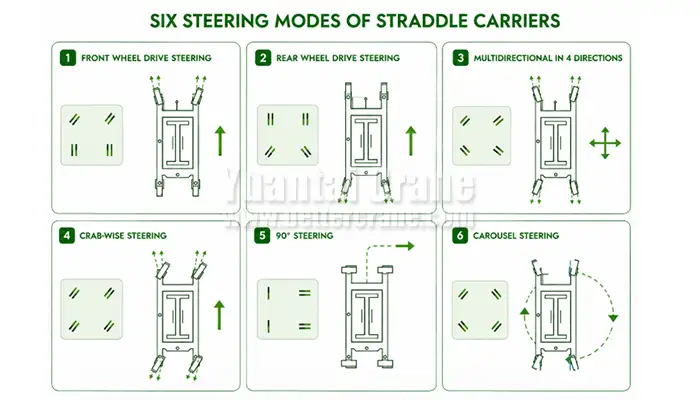
Six Main Steering Modes
- Front-Wheel Steering – Simple and reliable for standard forward/backward travel.
- Rear-Wheel Steering – Tight turns in narrow lanes with more precise control.
- Multidirectional Steering – Move forward, backward, sideways, and diagonally.
- Crab-Wise Steering – Slide directly sideways into tight lanes or automated systems.
- 90° Steering – Make instant lateral shifts without moving forward or backward first.
- Carousel Steering – Rotate in place to orient loads in confined spaces.
Operational Impact
These modes are not just technical specifications—they directly affect how fast, safe, and efficient a yard or industrial operation can run. For buyers, understanding them is the first step in selecting the right straddle carrier for their unique workflow needs.
Straddle Carrier Movements
Straddle carriers are versatile because they don't just move forward and backward like a truck. Their design allows operators to perform a variety of movements—each suited to a specific task, yard layout, or load type. Understanding these movements helps buyers choose the right model for their operations and ensures operators can work safely and efficiently.
Forward and Backward Travel
This is the most basic movement, but it's more than just "go straight." Forward and backward travel is essential for transporting containers between storage areas, loading docks, or trucks.
- Practical Use: Moving containers from stacking areas to trucks or from trucks to storage lanes.
- Operational Tip: Even on straight lanes, keep an eye on load balance and ground conditions to avoid shifting or tipping.
- Buyer Insight: If your operation mostly involves long, open lanes, a carrier with strong front/rear-wheel travel and high-speed forward/backward capability may be sufficient.
Turning Maneuvers
Turning with a straddle carrier is different from a regular vehicle. Front- or rear-wheel steering allows smooth lane changes and corner navigation while carrying heavy containers.
- Practical Use: Maneuvering around corners, lane intersections, or moving between parallel rows of containers.
- Safety Note: Understanding turning radius and container overhang is critical—mistakes here can lead to collisions.
- Buyer Insight: For yards with narrow lanes or older stacking layouts, rear-wheel steering can reduce repositioning steps and improve safety.
Lateral and Diagonal Movements
Advanced movements like crab-wise and multidirectional steering allow the carrier to move sideways or diagonally without first driving forward or backward. This is particularly useful in tight yards, congested stacking zones, or when aligning containers with automated systems.
- Practical Use: Sliding a container directly into a narrow lane or positioning it between closely stacked rows.
- Efficiency Tip: These movements reduce unnecessary repositioning and save time in busy operations.
- Buyer Insight: If your yard is space-constrained, carriers with lateral and diagonal movement options help maximize lane efficiency and stacking density.
Combined Movements
Some operations require even more complex motion. 90° steering and carousel rotation let the carrier rotate in place or shift sideways and forward simultaneously, making them essential in confined or crowded areas.
- Scenario Example: Rotating the carrier in place to align a container for truck loading or unloading without multiple forward/backward adjustments.
- Operational Tip: Slow, controlled movements are key to maintaining load stability during rotations.
- Buyer Insight: Facilities handling oversized or irregular containers benefit most from carriers with combined movement capabilities, as one machine can perform tasks that might otherwise require multiple units.
Six Steering Modes
Straddle carriers are designed with multiple steering modes to handle a variety of yard layouts, load types, and operational challenges. Each mode offers specific benefits, and understanding them helps buyers choose the right carrier for their facility, while ensuring operators can work efficiently and safely.
Front-Wheel Drive Steering
Front-wheel drive is the standard steering mode for most general transport tasks. Only the front wheels pivot while the rear wheels follow, giving predictable, controlled movement.
- Practical Use: Transport containers along standard lanes or move loads from trucks to stacking areas.
- Operational Tip: Keep speed moderate when fully loaded to prevent load sway.
- Buyer Insight: Ideal for open yards with long lanes where complex maneuvers are rarely required.
Rear-Wheel Drive Steering
Rear-wheel steering allows the rear wheels to pivot while the front wheels follow. This reduces the turning radius and improves maneuverability in confined spaces.
- Practical Use: Navigating narrow lanes, older yard layouts, or tight corners between stacked containers.
- Efficiency Tip: Fewer repositioning steps mean faster container placement in dense yards.
- Buyer Insight: Choose this mode if your yard has limited space or irregular stacking patterns.
Multidirectional Steering (4 Directions)
Multidirectional steering enables the carrier to move forward, backward, sideways, and diagonally, all without repositioning. This mode is valuable when precise alignment is required in confined areas.
- Practical Use: Aligning containers in narrow lanes or moving diagonally between closely spaced stacks.
- Operational Tip: Combine with slow, controlled speed to maintain load stability.
- Buyer Insight: Excellent for yards with complex layouts or industrial facilities where space is tight and multiple containers are handled simultaneously.
Crab-Wise Steering
Crab-wise steering allows the straddle carrier to move directly sideways. This is perfect for tight lanes or when aligning with automated stacking or transport systems.
- Practical Use: Sliding a container into a narrow stack without forward/backward adjustments.
- Safety Tip: Operators must monitor load stability, especially on slightly uneven surfaces.
- Buyer Insight: In congested ports or warehouses, crab-wise movement reduces unnecessary repositioning and saves operational time.
90° Steering
90° steering provides instant lateral movement without any forward or backward travel. This mode is highly efficient for space-constrained operations.
- Practical Use: Move containers sideways between tightly stacked rows or position loads adjacent to equipment.
- Operational Tip: Use slowly to prevent load tipping, especially with heavier containers.
- Buyer Insight: Ideal for maximizing stacking density in container yards or warehouse aisles.
Carousel Steering
Carousel steering enables the carrier to rotate in place, pivoting around its center. This is useful when traditional forward/backward turning is limited by surrounding obstacles.
- Practical Use: Reorient containers for truck loading/unloading or align awkward loads in confined areas.
- Efficiency Tip: Combine with lateral adjustments for precise placement without multiple maneuvers.
- Buyer Insight: Especially valuable for handling oversized containers or irregular industrial loads, reducing the need for additional machines.
Mechanisms and Control Systems
Straddle carriers aren't just about moving containers—they rely on a mix of mechanical, hydraulic, and electronic systems to make complex maneuvers safe and reliable. Understanding these systems helps buyers evaluate which carrier model suits their operational needs.
Mechanical Linkages
Mechanical linkages form the foundation for basic front- and rear-wheel steering. They are straightforward, durable, and easy to maintain.
- Practical Use: Ideal for standard forward/backward travel in open yards or general transport.
- Maintenance Tip: Regularly inspect steering joints to prevent drift or uneven wheel wear.
- Buyer Insight: If your operation doesn't require frequent lateral or rotational moves, mechanical steering alone can be sufficient and cost-effective.
Hydraulic Systems
Hydraulic systems provide the power and flexibility needed for advanced maneuvers, including crab-wise, 90°, and carousel steering. Smooth hydraulic actuation ensures precise lateral and rotational movement, even with fully loaded containers.
- Practical Use: Slide containers sideways into tight stacks or rotate in place without repositioning the carrier.
- Maintenance Tip: Check hoses, fluids, and actuators regularly to avoid leaks or sudden loss of steering control.
- Buyer Insight: For yards with narrow lanes, high-density stacks, or heavy loads, hydraulic-assisted carriers prevent tipping and improve precision.
Advanced Electronic Controls
Modern carriers often integrate electronic systems for multidirectional movement or semi-automated operation. Sensors, feedback loops, and drive controls allow diagonal or combined maneuvers with minimal operator input.
- Practical Use: Move diagonally between stacked containers, align loads with automated equipment, or perform complex positioning in industrial sites.
- Operational Tip: Ensure operators are trained to read system feedback and respond to alerts. Small miscalibrations can affect container placement.
- Buyer Insight: Electronic-assisted carriers are worth considering if you plan to integrate automation or need precise, repeatable movements.
Safety Sensors and Feedback Systems
All advanced steering modes depend on sensors to maintain stability and prevent collisions. These include wheel angle sensors, load detection systems, and anti-collision alerts.
- Practical Use: Maintain stability during sideways, diagonal, or rotational movements in high-traffic or confined areas.
- Maintenance Tip: Regularly calibrate sensors, keep cameras clean, and respond immediately to alerts.
- Buyer Insight: For insurance and risk management, carriers with well-designed safety systems reduce load damage and operational incidents.
Operational Considerations
Even the most capable straddle carrier will underperform without attention to operational factors. Buyers need to consider load, speed, operator skill, and maintenance to get the most out of multi-mode steering.
Load Stability
Maintaining balance is critical, especially during crab-wise, diagonal, or carousel movements. An uneven or shifting load increases the risk of tipping, collisions, or cargo damage.
- Practical Tip: Check load distribution before performing lateral or rotational movements.
- Buyer Insight: Choosing a carrier with hydraulic or electronic-assisted steering helps maintain stability for heavier or irregular loads.
Speed Limitations
Not all movements should be performed at full speed. Advanced steering modes require controlled, slower movement to ensure safety and accuracy.
- Operational Tip: Operators should reduce speed when maneuvering between closely stacked containers or in narrow lanes.
- Buyer Insight: Slow, deliberate movements reduce accidents, prevent load sway, and improve precision, which is critical in high-density yards.
Operator Training
Multi-mode steering adds flexibility, but also complexity. Operators must practice each mode to understand vehicle behavior, especially when combining lateral, diagonal, and rotational movements.
- Practical Tip: Hands-on training in real yard conditions helps operators anticipate carrier response under different loads.
- Buyer Insight: Well-trained operators minimize handling errors, reduce repositioning, and improve throughput.
Maintenance
Routine inspection of wheels, hydraulic systems, linkages, and electronic controls ensures all steering modes work reliably. Neglect can lead to downtime or unsafe movements.
- Practical Tip: Schedule preventive maintenance and document checks.
- Buyer Insight: Regular maintenance prolongs equipment life, avoids costly repairs, and keeps operations smooth.
Buyer Decision-Making Guidance
When it comes to choosing a straddle carrier, it's not just about picking a machine—it's about matching the steering capabilities to your yard layout, load types, and operational needs. Knowing which mode to rely on in which scenario makes a real difference in efficiency, safety, and cost management.
Choosing the Right Steering Mode
- Front-Wheel Drive: Best for general forward/backward movements and standard yard alignment. Easy to operate and predictable for most container lanes.
- Rear-Wheel Drive: Ideal for tight turns, older stacks, or narrow lanes where a reduced turning radius is critical.
- Multidirectional Steering: Allows precise movement in confined areas. Forward, backward, sideways, or diagonal—it's perfect for tight yards or tricky placements.
- Crab-Wise Steering: Lets the carrier move directly sideways. Essential for narrow lanes or when aligning with automated stacking systems.
- 90° Steering: Instant lateral shifts save repositioning time and increase handling efficiency in crowded spaces.
- Carousel Steering: Rotate in place when space is limited or forward/backward movement isn't feasible. Great for aligning containers exactly where they need to go.
Practical Buyer Tips
- Match Modes to Yard Layout: Consider your lane widths, stacking density, and traffic flow. Narrow lanes or congested stacks require crab-wise or 90° steering.
- Consider Load Types: Heavier or irregular loads benefit from hydraulic or electronic-assisted steering for stability and control.
- Plan for Automation: If you're integrating semi- or fully automated workflows, choose models with electronic feedback systems to maximize precision.
- Operator Training: Skilled operators make a huge difference. Hands-on practice with all modes ensures smoother operations and fewer errors.
- Preventive Maintenance: Regular checks on wheels, hydraulics, and electronic systems keep all steering modes working reliably and reduce downtime.
Benefits by Industrial Sector
Straddle carriers with multi-mode steering don't just move containers—they adapt to your operation. Choosing the right steering options delivers measurable benefits across ports, manufacturing plants, warehouses, and special industrial projects.
Container Yards & Ports
In busy container yards and port operations, space is at a premium. Every centimeter counts when stacking containers and moving them between trucks or cranes.
- High-density stacking & rapid repositioning: Using crab-wise or 90° steering lets operators slide containers sideways directly into place. Carousel rotations reduce unnecessary forward/backward movements.
- Operational efficiency: Fewer repositioning steps mean faster container handling and smoother workflow.
- Buyer insight: Investing in multi-mode straddle carriers can reduce the need for extra yard space or additional handling equipment, which lowers both capital and operational costs.
Industrial Manufacturing Plants
In production facilities, straddle carriers aren't just for containers—they move heavy machinery, steel coils, and other bulky materials. Precision is key.
- Precise placement: Multidirectional and carousel steering allow operators to navigate tight production areas without disrupting workflow.
- Avoiding delays: The right steering modes prevent unnecessary repositioning, reducing the risk of production slowdowns.
- Buyer insight: Properly matched steering modes help maintain smooth operations, keeping deadlines and production schedules on track.
Logistics & Warehousing
Inside warehouses, efficiency and accuracy are critical. Misaligned loads or slow repositioning can cost time and money.
- Faster internal transport: Forward/backward steering handles bulk movement, while crab-wise or lateral modes enable fine alignment. Carousel steering assists with orientation adjustments.
- Reduced handling errors: Operators can place containers or pallets precisely, which lowers the risk of damage.
- Buyer insight: Optimized steering directly reduces labor costs, improves throughput, and minimizes material loss.
Special Projects / Industrial Infrastructure
Some industrial projects involve oversized, awkward, or unusually shaped loads that standard forklifts or cranes cannot handle efficiently.
- Flexible handling: 90° and multidirectional steering allow safe sideways or diagonal alignment in confined or awkward spaces.
- Equipment efficiency: One multi-mode straddle carrier can replace several smaller machines.
- Buyer insight: This flexibility reduces capital expenditure and streamlines operations, making complex projects more manageable with fewer resources.
Practical Tips for Buyers
Buying a straddle carrier isn't just about specs—it's about matching the machine to your yard, your loads, and how your operation runs day to day. Here are some practical points that help you make the right choice and get the most out of your investment.
Evaluate Your Yard Layout
Before you pick a carrier, take a good look at your lanes and stacking areas. Narrow or congested lanes need more than basic forward/backward movement.
- Crab and 90° steering: These modes let operators slide containers directly sideways into position.
- Why it matters: Reduces the number of repositioning moves, keeps traffic flowing, and allows higher-density stacking without crowding.
Match Steering to Load Size and Type
Not all loads behave the same. Heavier containers, steel coils, or oversized items can make advanced steering more challenging.
- Hydraulic or electronic-assisted modes: These provide the extra control needed for heavy or uneven loads.
- Practical tip: Ask about load capacity limits for each steering mode and make sure your operations stay within safe margins.
Plan for Automation Integration
If you're thinking ahead to semi- or fully automated operations, not all straddle carriers are created equal.
- Feedback-enabled models: Multi-mode carriers with sensors and electronic controls allow smooth integration with yard management or automated stacking systems.
- Buyer insight: Choosing a model that supports automation today can save you costly retrofits later.
Invest in Operator Training and Preventive Maintenance
Even the best multi-mode carrier won't perform at its best without skilled operators and proper maintenance.
- Training: Hands-on practice in all steering modes—front/rear, crab, 90°, carousel—is essential for safety and efficiency.
- Maintenance: Regular checks on wheels, hydraulic systems, and electronic controls prevent downtime and maintain precision.
- Outcome: Fewer accidents, reduced load damage, and longer equipment life.
ROI and Strategic Value
Investing in a multi-mode straddle carrier isn't just about having the latest steering technology—it's about real, measurable benefits that improve efficiency, safety, and overall operational performance. Understanding how these advantages translate into return on investment helps buyers make informed decisions.
Time Savings
Multi-mode steering reduces unnecessary repositioning, letting operators place containers or loads in fewer moves.
- Fewer steps, more output: Sideways, diagonal, or carousel movements mean operators don't have to drive back and forth repeatedly.
- Operational impact: Less driving time per container adds up, improving throughput across the yard or warehouse.
Space Optimization
Yard and warehouse space is limited. Smart steering lets you make the most of every square meter.
- Lateral and crab movements: Slide containers directly into narrow lanes or tight stacks.
- Outcome: Higher stacking density and more efficient use of space without adding infrastructure or extra equipment.
Safety and Reliability
Handling heavy containers or machinery is risky. The right steering modes help reduce incidents and protect your investment.
- Reduced collisions and tipping: Operators can position loads precisely, even in congested areas.
- Cost benefits: Fewer accidents mean lower repair bills, less downtime, and decreased insurance premiums.
Versatility Across Industrial Sectors
A single multi-mode straddle carrier can handle multiple tasks across different industries.
- From container yards to warehouses and manufacturing plants: One machine can replace several smaller units.
- Buyer advantage: Reduced capital expenditure and simplified fleet management.
Advantages of Multi-Mode Steering
Multi-mode steering isn't just a technical feature—it directly affects how efficiently, safely, and accurately operators can handle containers or heavy loads. For buyers, understanding these advantages helps in selecting the right straddle carrier for the job.
Maximum Maneuverability
Advanced steering modes let operators move in ways conventional carriers cannot.
- Tight spaces are no problem: Navigate narrow lanes, congested stacks, or industrial workshops without needing extra equipment.
- Practical impact: Reduces the need for multiple repositioning steps, saving time and avoiding operational bottlenecks.
Enhanced Precision
When handling heavy or awkward loads, precision matters.
- Fine adjustments: Lateral slides, diagonal moves, or carousel rotations let operators align containers or machinery exactly where needed.
- Benefit for buyers: Prevents load misalignment, reduces damage, and improves safety compliance.
Reduced Repositioning Steps
Multi-mode steering allows direct movement to the target position.
- Less driving, less wear: Operators don't need to go forward, reverse, and turn repeatedly.
- Operational advantage: Speeds up workflows, decreases wheel and steering system wear, and increases overall throughput.
Supports Automation
Modern yards and industrial sites increasingly integrate semi- or fully automated systems.
- Electronic and sensor integration: Multi-mode carriers work seamlessly with automated stacking or transport workflows.
- Buyer insight: Enhances operational efficiency and reduces labor requirements without compromising load safety.
Frequently Asked Questions (FAQ)
Straddle carriers can seem complex, especially with multiple steering modes. Here are answers to common buyer questions, drawn from real operational scenarios.
Which steering mode works best for narrow lanes or congested stacks?
A: Crab-wise or 90° steering.
- These modes let the carrier slide directly sideways into place.
- Reduces multiple forward/backward adjustments and speeds up yard operations.
- Ideal for container yards, ports, or industrial spaces with limited lane width.
How can I move the carrier diagonally without repositioning?
A: Use multidirectional steering.
- Combines forward, backward, sideways, and diagonal movement.
- Perfect for tight spaces or closely stacked containers.
- Minimizes repositioning steps and avoids collisions.
How do I rotate the carrier in place when space is limited?
A: Carousel steering.
- The carrier pivots around its center without moving forward or backward.
- Useful for aligning containers with trucks, automated systems, or tight industrial spots.
- Slow, controlled movement ensures load stability.
How can I maintain load stability during sideways or complex maneuvers?
A: Combine proper operator training with hydraulic or electronic-assisted control.
- Skilled operators control speed and monitor load balance.
- Regular maintenance of steering joints, hydraulics, and sensors ensures smooth and safe operation.
- Stability is critical for preventing tipping, collisions, and cargo damage.
Get Your Tailred Straddle Carriers
Multi-mode steering is more than a feature—it’s a practical solution that improves workflow efficiency, safety, and precision in real-world industrial operations.
For buyers, choosing the right straddle carrier with advanced steering modes brings measurable benefits:
- Improves throughput and operational safety: Fewer repositioning steps mean faster container handling and reduced risk of accidents.
- Optimizes space and reduces handling time: Lateral and diagonal moves allow higher density stacking and precise placement.
- Adapts to diverse industrial sectors: Works for container yards, ports, logistics warehouses, industrial plants, and special projects.
A well-planned yard layout, trained operators, and regular maintenance ensure your investment in a multi-mode straddle carrier delivers consistent productivity gains and long-term operational reliability.

Article by Bella ,who has been in the hoist and crane field since 2016. Bella provides overhead crane & gantry crane consultation services for clients who need a customized overhead travelling crane solution.Contact her to get free consultation.
Yuantai Cranes
Yuantai Cranes - Global Material Handling Crane Solution Provider & Manufacturer with CE, ISO, SGS, CNEX and other Third Party Certifications.
- Main Specifications - Capacity: 0.5–550 tons | Span: up to 40m | Speed: 0.8–12 m/min | Duty: A3–A7 | Power: 380–690V, 50/60Hz | Control: pendant/remote/cabin
- Full engineering: FEA/PLC/VFD + in-house build + global delivery + on-site support, for workshops, factories, EPC contractors, industrial projects, etc.
- Support: design, manufacturing, testing, service – end-to-end, customized lifting solutions worldwide.
Get Your Custom Quote – Quick & Easy
Fill in what you know. Skip what you don't – we'll help.
- Crane type:_____ . (e.g., overhead crane, gantry crane, jib crane)
- Max weight to lift:_____ tons. (e.g., 2t, 5t, 10t, 20t, 50t)
- Lifting height:_____ m. (How high does the hook need to reach?
- Workshop width (span):_____ m . (Distance between the two crane rails)
- Travel distance:_____ m . (How long does the crane need to move along the runway?)
- Control type:_____. (Pendant / remote / cabin Control)
- Power supply:_____. (Local voltage & frequency – e.g., 380V, 50Hz, 3-phase)
- What will it be used for?_____ (e.g., steel fabrication, concrete products, mold handling, general manufacturing, etc.)
- Any special requirements?_____ (e.g., extreme temperature, dusty or explosive environment, special paint color, etc.)
Just leave a message via the contact form and our hoist and crane engineer will contact you with in 24working hours.
Inquire Yuantai Cranes