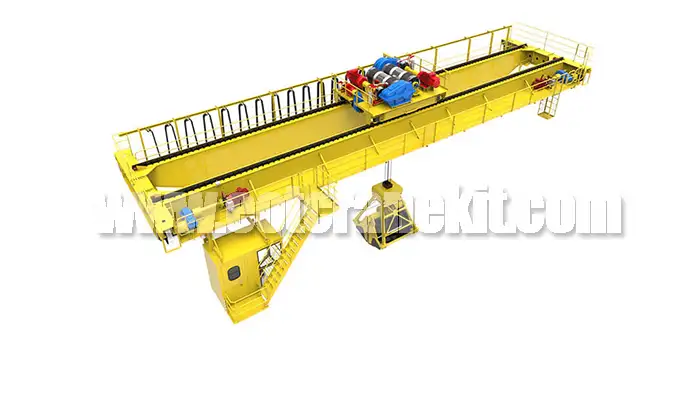
Sludge Crane Systems: Grab Bucket & Sludge Handling Design Guide
Content Quick Link
Key Takeaways
Sludge treatment crane systems fail far more often due to corrosion, moisture damage, and chemical exposure than actual lifting overload—so proper sludge crane, sludge grab bucket crane, and sludge handling crane design must prioritize environmental protection over raw capacity.
- Sludge cranes operate in one of the most corrosive and humid industrial environments
- Sludge grab bucket cranes are the most commonly used solution for semi-solid sludge lifting and transfer
- Sludge handling cranes must be designed for continuous exposure to moisture, chemical vapor, and abrasive residues
- Protection systems (IP rating, sealing, coatings) are more critical than overload safety margin
- Maintenance accessibility directly affects long-term reliability in wastewater treatment plants
Introduction: Why Sludge Crane Systems Require Special Design
Sludge treatment areas in wastewater plants involve continuous exposure to wet sludge, chemical residues, and high humidity, making them one of the most demanding environments for overhead lifting systems. Standard industrial cranes often fail early when used in sludge pits, thickener tanks, or dewatering workshops.
In these applications, sludge cranes, sludge grab bucket cranes, and sludge handling crane systems are not just lifting equipment—they are continuous-duty environmental machines.
Working Environment of Sludge Handling Crane Systems
Sludge treatment areas are not stable or clean working spaces. They stay humid most of the time, and the air often carries moisture mixed with chemical vapor. Even when the plant is not running at full load, the crane structure is still exposed to a slow, continuous attack from the environment.
This is why sludge crane systems and sludge grab bucket crane equipment behave differently compared with normal workshop cranes. The environment itself becomes part of the load on the equipment.
Working Conditions You Will Actually Find on Site
Sludge treatment environments are constantly wet, chemically active, and mechanically harsh. These conditions directly affect crane structure, electrical systems, and moving parts over long-term operation.
Constant humidity and condensation on steel structures
In sludge treatment halls, the air is almost always wet. Steel beams, trolley frames, and even handrails often feel damp to the touch.
- Water droplets form on crane beams during temperature changes
- Condensation can appear inside metal covers and electrical boxes
- Dry surfaces are rare, especially near sludge tanks or basins
In simple terms: the crane is never fully "dry" in operation.
Corrosive gases and chemical vapors from sludge processing
Sludge is not just wet waste. It releases gases during treatment depending on the chemical process.
- Hydrogen sulfide and ammonia are common in wastewater zones
- These gases slowly attack paint layers and exposed metal
- Smell may not always be strong, but corrosion continues in the background
This is a slow process. Damage is not immediate, but it builds up over time.
Sticky and abrasive sludge affecting moving parts
Sludge is a mixed material and behaves differently depending on treatment stage and composition.
- Thick sludge can stick to grab buckets and hooks
- Fine particles act like sand and increase wear on moving parts
- Deposits often build up around trolley wheels and guide areas
This makes protective design and regular cleaning essential for sludge handling crane systems.
Frequent splashing during lifting and dumping
During lifting and discharge operations, splashing is almost unavoidable in sludge handling.
- Sludge splashes may contain water, solids, and chemicals
- Hoisting components can be directly exposed during operation
- Cable systems and lower crane structures are most affected
This is not occasional exposure—it happens repeatedly in daily operation.
How These Conditions Affect Crane Performance
In sludge treatment environments, continuous exposure to moisture, gases, and abrasive materials directly reduces the reliability and service life of crane systems. The impact is gradual but accumulates over time across all major components.
Faster corrosion of steel structures
Even well-painted structures slowly degrade in sludge environments.
- Rust often starts at joints, bolts, and edges
- Moisture trapped under coatings accelerates corrosion
- Structural appearance changes first, then strength over time
This is why sludge crane design always requires strong anti-corrosion protection.
Electrical system instability caused by moisture
Electrical components are highly sensitive to humidity in sludge environments.
- Moisture reduces insulation performance inside motors
- Control panels may develop leakage or short circuits
- Faults often appear intermittently rather than immediately
This is one of the most common failure sources in sludge handling crane systems.
Gearbox and lubrication problems
Gearboxes in standard crane designs are not fully isolated from the environment.
- Moisture can enter through seals over time
- Lubrication oil becomes contaminated
- Gear wear increases and operating noise becomes higher
Once lubrication quality drops, performance decline becomes continuous and unavoidable.
Shorter service life of mechanical parts
When all environmental factors combine, overall wear increases across the system.
- Hoist mechanisms require more frequent maintenance
- Wire ropes degrade faster in humid conditions
- Trolley wheels and rails lose smooth operation earlier
In practice, the service cycle is shorter compared with standard indoor crane applications.
Practical Tips for You
A sludge handling crane does not fail because it is overloaded. It fails because it is constantly exposed to a wet, chemical, and corrosive working environment.
This is the real engineering challenge behind sludge crane systems and sludge grab bucket crane applications, where protection and durability matter more than simple lifting capacity.
Types of Sludge Crane Systems in Wastewater Plants
In wastewater treatment facilities, sludge lifting is not handled by a single standard crane design. Different working zones, sludge consistency, and operational requirements lead to different sludge crane system configurations. Some cranes support maintenance work, while others are dedicated to continuous sludge removal.
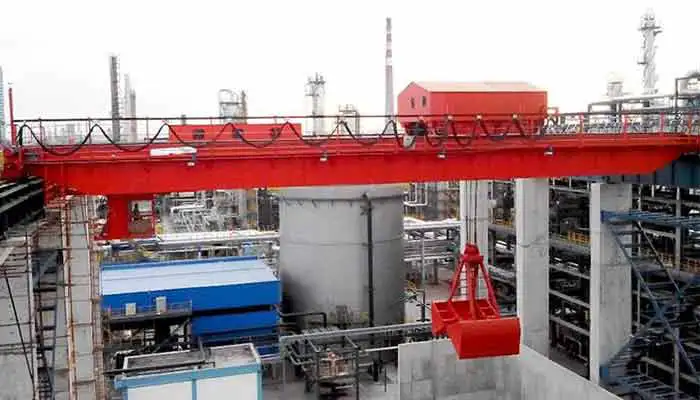 clamshell grab bucket overhead crane
 Sludge Handling Crane (General System)
A sludge handling crane is mainly used as a support system in wastewater plants. It is not always involved in direct sludge lifting. Instead, it functions as a flexible maintenance and auxiliary lifting tool across treatment units.
Typical usage includes:
- Lifting sludge pumps for inspection or replacement
- Handling mechanical scrapers in sedimentation tanks
- Moving dewatering machines and filter components
- Assisting general equipment maintenance inside treatment buildings
This type of crane is commonly used where equipment requires frequent servicing rather than continuous sludge removal.
In practical terms, it serves as a general-purpose overhead lifting system rather than a dedicated sludge processing machine.
Sludge Grab Bucket Crane (Core Sludge Lifting Solution)
The sludge grab bucket crane is the primary system for direct sludge handling. It is designed for continuous or repeated lifting of semi-solid or thick sludge from tanks, pits, or basins.
It is typically equipped with a mechanical or hydraulic grab bucket that opens and closes under load.
Key characteristics
- Handles sticky and heavy sludge without losing grip
The grab bucket is designed for uneven, wet, and dense materials. It can lift sludge with irregular consistency. - Commonly used in sludge pits, thickener tanks, and sediment basins
These are the main zones where sludge accumulates and requires regular removal. - Works in continuous cycle: grab → lift → transport → discharge
Operation is repetitive and often runs for long periods during sludge extraction cycles. - Requires strong sealing and anti-corrosion design
Because it operates directly above sludge, both hoisting and electrical systems must resist moisture and chemical exposure.
In many wastewater projects, this is the most heavily utilized sludge crane system.
Specialized Sludge Treatment Crane Systems
Some wastewater plants require customized crane solutions based on layout, capacity, and environmental conditions. These systems are not standard designs and are adapted to specific project requirements.
Common specialized configurations include:
- Bridge-type sludge cranes for tank coverage
Used in indoor sludge tanks or basins, allowing multi-tank coverage via rail travel. - Gantry-type sludge handling cranes for outdoor basins
Suitable for open sludge ponds or large sedimentation areas without building support. - High-protection or explosion-resistant designs
Applied in chemical sludge zones where gas presence or high humidity requires enhanced sealing and safety features.
These systems are selected when standard sludge handling or grab bucket crane designs cannot fully meet site conditions.
Practical Tips for You
In wastewater treatment plants, sludge crane systems are not a single standardized solution.
- Sludge handling cranes support maintenance and auxiliary lifting work
- Sludge grab bucket cranes handle direct sludge removal operations
- Specialized systems are designed for complex layouts and harsh environments
Each system has a defined role. The correct selection depends on how sludge is processed, transferred, and removed during daily plant operation.
Engineering Design Requirements for Sludge Crane Systems
Sludge crane systems are not designed like standard workshop cranes. The priority is not only lifting capacity, but long-term survival in a continuously wet, corrosive, and chemically active environment. Every subsystem—structure, electrical, hoisting, and maintenance layout—must be designed as part of an environmental protection system rather than a simple mechanical structure.
Corrosion Protection System
In sludge environments, corrosion begins early if protection is not properly designed. It typically starts at joints, edges, and moisture-retaining areas.
To slow down degradation, multi-layer protection strategies are required instead of single coating systems.
- Multi-layer industrial coating systems for steel structure
Typical systems include primer, intermediate coating, and top protective layer to reduce direct exposure to moisture and chemical vapor. - Optional stainless-steel components in high-exposure zones
Used selectively in splash zones or near sludge tanks for improved resistance. - Drainage-friendly beam design to avoid sludge accumulation
Structural shapes should prevent water and sludge retention through slope surfaces and drainage gaps. - Long-term anti-corrosion lifecycle planning
Repainting and inspection cycles should be planned based on humidity and chemical exposure levels.
High-Humidity Electrical Protection
Electrical systems are highly sensitive in sludge handling environments, where even minor moisture intrusion can affect performance.
- Fully sealed electrical cabinets with high IP protection rating
Control panels must be tightly sealed to block water vapor and dust ingress. - Moisture-resistant cable routing systems
Waterproof conduits or protective sleeves reduce exposure to condensation and splashes. - Anti-condensation heaters inside control panels
Internal heaters help control humidity caused by temperature differences. - Sealed connectors to prevent vapor penetration
All electrical joints should be designed to block moisture entry points.
Sealed Hoisting Mechanism Design
The hoisting system is directly exposed to wet sludge conditions and requires strong protection against moisture and contamination.
- Fully enclosed motors for sludge grab bucket cranes
Motors are designed with sealed housings to reduce exposure during continuous operation. - Sealed gearbox systems with reinforced lubrication protection
Prevents water ingress and oil contamination that leads to premature wear. - Dust and moisture isolation in brake and drum assemblies
Ensures stable braking performance in splash and particle-heavy environments. - Enhanced thermal protection for continuous wet operation
Prevents overheating under sealed and high-duty working conditions.
Maintenance-Oriented Structural Design
Sludge treatment plants often have limited access space and harsh working surfaces. Therefore, crane design must simplify maintenance operations as much as possible.
- Easy-access inspection points for hoist and grab systems
Key components should be serviceable without dismantling major structures. - Modular components for fast replacement in harsh environments
Motors, brakes, and control modules should support quick replacement to reduce downtime. - Elevated electrical installation zones away from sludge splash areas
Electrical systems should be positioned away from direct contamination zones. - Walkways and platforms designed for wet, slippery conditions
Maintenance access should include anti-slip surfaces and proper drainage design.
Practical Tips for You
A sludge crane system is not only about lifting capacity. It is about surviving a continuously wet, corrosive, and chemically active environment throughout its entire service life.
That is why design decisions in sludge handling cranes, sludge grab bucket cranes, and sludge treatment crane systems always start from protection, sealing, and maintenance practicality—not load capacity alone.
Selection Guide: Choosing the Right Sludge Crane System
Selecting a sludge crane system is not only about tonnage or span. In wastewater treatment plants, real working conditions matter more than theoretical lifting capacity. The same crane can perform very differently depending on whether it is used in a sludge pit, thickener tank, or maintenance zone. The correct selection follows three key directions: what you lift, where you work, and how you maintain it.
Based on Operation Type
Continuous sludge removal → Sludge grab bucket crane
When the main task is continuous sludge removal from tanks or basins, a sludge grab bucket crane is the most practical solution.
- Designed for repeated lifting cycles: grab, lift, move, discharge
- Works directly above sludge pits or thickener tanks
- Suitable for semi-solid, wet, or layered sludge conditions
- Often operates continuously during daily treatment cycles
In this case, the crane becomes part of the treatment process rather than auxiliary equipment.
Equipment maintenance lifting → Sludge handling crane
If the primary requirement is equipment servicing rather than sludge removal, a sludge handling crane is more suitable.
- Used for lifting pumps, scrapers, and filter units
- Supports maintenance and replacement work inside treatment plants
- Operates intermittently rather than continuously
- Requires stable movement and good positioning accuracy
This type is commonly used in indoor treatment halls with frequent maintenance needs.
Mixed operation → Combined overhead sludge crane system
Some wastewater plants require both sludge removal and maintenance lifting in the same working area.
- Handles both grab bucket and maintenance lifting tasks
- Flexible configuration depending on working zones
- Reduces the need for multiple crane systems
- Requires balanced design between durability and flexibility
This is often selected for complex plant layouts or limited space conditions.
Based on Environmental Severity
Moderate humidity → Standard anti-corrosion crane system
In environments with moderate humidity levels:
- Standard coated steel structures are usually sufficient
- Basic protection for motors and electrical systems
- Regular maintenance required but less intensive
- Suitable for small to medium wastewater facilities
High humidity + chemical vapor → Fully sealed sludge crane system
When moisture and chemical gases are continuously present:
- Fully sealed electrical cabinets are required
- Strong corrosion-resistant coating systems are necessary
- Motors and gearboxes need better isolation
- Designed for long-term operation with minimal shutdowns
This is the most common condition in sludge treatment plants.
Extreme wastewater zones → Heavy-duty sludge handling crane with enhanced protection
In highly aggressive environments such as chemical sludge zones:
- All components require reinforced protection design
- Electrical, mechanical, and structural systems must be upgraded
- Sealing performance becomes a priority over cost
- Maintenance intervals are longer, but reliability must be higher
Based on Maintenance Capability
Limited maintenance access → Fully sealed, low-maintenance design
When maintenance access or resources are limited:
- Fully sealed systems reduce inspection frequency
- Components are protected from direct sludge exposure
- Lower risk of environmental damage due to fewer open parts
- Focus is on operational reliability rather than service flexibility
Common in compact or remote wastewater facilities.
Skilled maintenance team → Modular and serviceable crane systems
If a strong maintenance team is available:
- Modular design enables faster part replacement
- Equipment can be serviced without full system shutdown
- Flexible configuration allows future upgrades
- Easier management of wear parts such as brakes, motors, and gearboxes
Suitable for large municipal or industrial wastewater plants.
Practical Tips for You
Choosing a sludge crane system is not about selecting the strongest crane. It is about matching the crane to the actual operation of the plant.
- If sludge is moved continuously → sludge grab bucket crane
- If equipment is maintained frequently → sludge handling crane
- If both tasks exist → combined system
In all cases, environmental conditions and maintenance capability determine how long the system will operate reliably.
Common Problems in Sludge Crane Operation
In sludge treatment plants, crane problems rarely begin with overload or incorrect lifting. Most issues develop gradually from the working environment itself. Moisture, chemical vapor, and abrasive sludge work together over time, causing slow but continuous performance degradation in sludge crane systems.
The following problems are commonly observed in sludge handling cranes, sludge grab bucket cranes, and general wastewater lifting systems.
Corrosion of structural steel leading to weakened crane beams
Steel structures in sludge environments are under constant exposure to humidity and chemical gases.
- Rust often starts at weld joints, bolt connections, and beam edges
- Moisture trapped under coatings accelerates hidden corrosion
- Over time, structural rigidity can gradually decrease
In many cases, the issue is not visible at the early stage. It develops slowly beneath the coating layer.
Electrical failures due to moisture penetration
Electrical systems are highly sensitive in sludge treatment environments.
- Humidity enters control cabinets through weak sealing points
- Motor insulation performance can degrade over time
- Intermittent faults may appear before complete failure
This is one of the most common downtime causes in sludge handling crane systems, especially in high-humidity areas.
Grab bucket wear from abrasive sludge materials
Sludge is not a uniform material. It often contains solid particles mixed with water and chemicals.
- Abrasive particles cause wear on bucket edges and hinges
- Sticky sludge increases mechanical stress during opening and closing
- Uneven loading accelerates fatigue in moving parts
For sludge grab bucket cranes, this is a normal wear issue that requires regular inspection and maintenance.
Gearbox leakage and lubrication failure
Gearboxes operate under continuous load and are exposed to harsh environmental conditions.
- Seals may degrade under moisture and chemical exposure
- Lubricating oil can become contaminated with water
- Internal wear increases when lubrication quality drops
Once leakage begins, performance degradation becomes gradual but continuous.
Reduced efficiency due to sludge buildup on crane components
Sludge accumulation is often overlooked but has a direct impact on crane efficiency.
- Sludge sticks to trolley wheels, hooks, and structural surfaces
- Additional weight and resistance reduce smooth movement
- Cleaning becomes more difficult if not managed regularly
This does not stop crane operation immediately, but it gradually reduces working efficiency over time.
Practical Tips for You
Most sludge crane problems do not occur suddenly. They develop step by step due to environmental exposure.
- Moisture gradually affects electrical system stability
- Chemical exposure weakens coatings and steel structures
- Sludge particles increase mechanical wear on moving parts
That is why sludge crane systems must be designed and maintained based on real environmental conditions, not only lifting capacity requirements.
Engineering Best Practices for Long-Term Reliability
In sludge treatment plants, crane reliability is not achieved through higher lifting speed or stronger motors. It is achieved by protecting the system from its working environment. Many failures that appear after several years are actually design-related rather than operation-related.
The following engineering practices are commonly applied in sludge crane systems, sludge grab bucket cranes, and sludge handling crane designs to ensure long-term stable operation in wastewater facilities.
Prioritize sealing and protection over lifting speed
In sludge environments, operational reliability is more important than speed.
- Sealed motors and gearboxes reduce moisture-related failures
- Proper enclosure of electrical systems prevents hidden faults
- Stable, controlled operation is more valuable than fast cycle time
In practice, a slightly slower but reliable crane performs better than a fast system requiring frequent maintenance.
Use corrosion-resistant coatings as a standard requirement, not an option
Corrosion protection is a basic requirement in sludge crane design, not an upgrade feature.
- Multi-layer coating systems should be applied to all steel structures
- Areas near sludge tanks require higher protection levels
- Re-coating cycles should be included in long-term maintenance planning
Without proper coating protection, even well-designed sludge handling crane systems will experience early structural degradation.
Design crane systems specifically for sludge environments, not adapted general cranes
A common mistake is adapting standard overhead cranes for sludge applications.
- General cranes are not designed for continuous humidity exposure
- Structural drainage and sealing details are often missing in modified designs
- Electrical protection levels are usually insufficient for wastewater zones
A sludge crane system should be designed from the beginning for wastewater conditions, not modified afterward.
Ensure grab bucket compatibility with sludge density and composition
For sludge grab bucket cranes, bucket design must match actual working material conditions.
- Thick sludge requires stronger closing force and tighter sealing
- Mixed sludge with solids requires wear-resistant cutting edges
- Light sludge may require faster cycle design instead of heavy-duty force
Improper bucket selection leads to reduced efficiency and accelerated wear.
Plan maintenance access from the design stage
Maintenance conditions in sludge treatment plants are often difficult, so access must be considered in the design phase.
- Inspection points should be accessible without full disassembly
- Key components should be modular for fast replacement
- Electrical and mechanical parts should be kept away from splash zones
- Safe access platforms are required in wet environments
Good maintenance design reduces downtime more effectively than any performance upgrade.
Practical Tips for You
Long-term performance of sludge crane systems depends on a simple principle: environmental protection comes first.
- Protect equipment before focusing on performance
- Design for real sludge environment, not general industrial use
- Ensure maintenance is practical, not theoretical
When these principles are followed, sludge handling crane and sludge grab bucket crane systems can operate more reliably in demanding wastewater treatment conditions.
Key Questions This Guide Solves
This section clarifies the practical decisions commonly encountered when selecting or evaluating sludge crane systems in wastewater treatment projects. The focus is not theory, but real engineering considerations that affect design, purchase, and long-term operation.
What type of crane is best for sludge treatment plants?
There is no single universal crane model. The best choice depends on how sludge is handled within the plant.
- Sludge grab bucket cranes are used for direct sludge lifting and removal from tanks or pits
- Sludge handling cranes are suitable for maintenance work and equipment servicing inside treatment facilities
- Combined systems are used when both sludge removal and maintenance lifting are required in the same area
In most wastewater plants, the correct solution is not one crane type, but a combination matched to different working zones.
When should you use a sludge grab bucket crane instead of a standard hoist crane?
A standard hoist crane is designed for clean industrial environments and stable lifting conditions. It is not suitable for continuous sludge exposure.
A sludge grab bucket crane should be used when:
- The material is semi-solid or thick sludge
- Direct lifting and discharge of sludge is required
- Operation is repetitive and continuous
- The working area is a sludge pit, thickener tank, or sediment basin
In simple terms, when the crane directly interacts with sludge, a grab bucket system is the practical solution.
How does high humidity affect sludge handling crane performance?
High humidity is one of the main factors causing long-term performance degradation in sludge crane systems.
- Moisture gradually enters electrical cabinets if sealing is insufficient
- Condensation can form inside motors and control systems
- Metal surfaces corrode faster, especially at joints and welds
- Lubrication systems may degrade due to water contamination
The effect is slow but continuous. It often appears first as small electrical faults or increased maintenance frequency.
What design features prevent corrosion and electrical failure in sludge cranes?
In sludge environments, protection design is more important than pure mechanical strength.
Key design features include:
- Multi-layer anti-corrosion coating systems for all steel structures
- Fully sealed electrical cabinets with high protection rating
- Moisture-resistant cable routing and sealed connectors
- Anti-condensation heaters inside control panels
- Sealed motors and gearboxes designed for humid operation
These systems work together. If one layer is weak, the entire system becomes vulnerable over time.
How to choose a reliable sludge handling crane system for long-term operation?
Long-term reliability is not determined by a single specification. It depends on how well the crane matches real site conditions.
- Match crane type with actual sludge handling process
- Evaluate humidity level and chemical exposure in the plant
- Consider maintenance capability and access conditions
- Ensure grab bucket design matches sludge density and composition
- Prioritize sealing, corrosion protection, and serviceability over speed
A reliable system is one that continues to operate in wet and corrosive conditions without frequent intervention.
Conclusion
Sludge crane systems, including sludge grab bucket cranes and sludge handling cranes, are specialized lifting solutions designed for one of the most aggressive industrial environments in wastewater treatment plants. Their performance depends less on lifting capacity and more on corrosion resistance, sealing integrity, and environmental adaptability.
A properly engineered system ensures stable sludge lifting operations, reduces downtime, and significantly extends equipment lifespan in high-humidity and chemically aggressive conditions.

Article by Bella ,who has been in the hoist and crane field since 2016. Bella provides overhead crane & gantry crane consultation services for clients who need a customized overhead travelling crane solution.Contact her to get free consultation.
Yuantai Cranes
Overhead Crane Manufacturer with CE, ISO, SGS, CNEX Certificates.
- Main Specifications - Capacity: 0.5–550 tons | Span: up to 40m | Speed: 0.8–12 m/min | Duty: A3–A7 | Power: 380–690V, 50/60Hz | Control: pendant/remote/cabin
- Full engineering: FEA/PLC/VFD + in-house build + global delivery + on-site support, for workshops, factories, EPC contractors, industrial projects, etc.
- Support: design, manufacturing, testing, service – end-to-end, customized lifting solutions worldwide.
How to Get an Accurate Crane Price for Your Application?
Tips: Copy the spec list, fill in your details, and paste it into the form on the right/ down-below for a quick price.
- Crane type:_____ . (e.g., overhead crane, gantry crane, jib crane)
- Max weight to lift:_____ tons. (e.g., 2t, 5t, 10t, 20t, 50t)
- Lifting height:_____ m. (How high does the hook need to reach?
- Workshop width (span):_____ m . (Distance between the two crane rails)
- Travel distance:_____ m . (How long does the crane need to move along the runway?)
- Control type:_____. (Pendant / remote / cabin Control)
- Power supply:_____. (Local voltage & frequency – e.g., 380V, 50Hz, 3-phase)
- What will it be used for?_____ (e.g., steel fabrication, concrete products, mold handling, general manufacturing, etc.)
- Any special requirements?_____ (e.g., extreme temperature, dusty or explosive environment, special paint color, etc.)
Just leave a message via the contact form and our hoist and crane engineer will contact you with in 24working hours.
Get Your Custom Quote–Quick & Easy
Fill in what you know. Skip what you don't – we'll help.Any question will be reply with 24 working hours