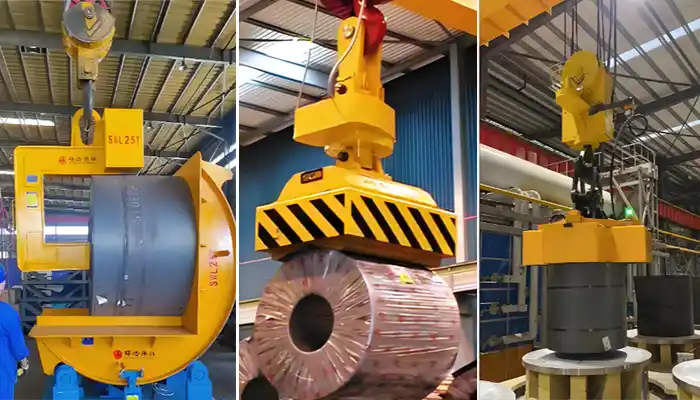
C-Hook vs Electromagnet: Select Right Steel Coil Handling Cranes
Content Quick Link
C-Hooks vs Electromagnets: Selecting the Right Steel Coil Handling Cranes
Most Important Takeaway (Lead Paragraph)
Choosing the wrong lifting attachment for steel coils can lead to damage, operational delays, and increased maintenance costs. Buyers must understand the differences between C-hooks and electromagnets, considering coil size, weight, material type, handling frequency, and safety requirements to ensure efficient and safe operations.
Key Takeaways (Bullets / Questions Solved)
- Which lifting solution is best for my steel coils?
C-hooks offer precision and minimal surface contact, while electromagnets allow faster, non-contact lifts of uniform coils. - How do coil size, weight, and shape affect attachment choice?
Heavy or irregular coils may benefit from C-hooks, whereas tightly wound, standard coils can be handled efficiently with electromagnets. - What are the safety and operational trade-offs?
Electromagnets require continuous power and may fail in case of power loss, while C-hooks rely on mechanical control but need skilled operators to avoid tipping or swinging. - How does handling frequency impact crane selection?
High-speed production lines or dense storage yards often prefer electromagnets for cycle efficiency, while low-frequency, heavy-duty operations can rely on C-hooks for stability. - What maintenance or inspection practices are critical?
C-hooks require routine checks for structural integrity and wear, electromagnets need inspection of coils, wiring, and control systems. - How does material type influence attachment choice?
Coils with thin gauge, coated steel, or sensitive finishes may be better suited to C-hooks to prevent surface damage.
Steel Coil Handling Comes with Real Challenges
Moving steel coils in mills, warehouses, or steel service centers is a daily reality—but it's not easy. Coils differ in weight, size, and surface finish, and each variation brings its own handling challenges. Lift it wrong, and you risk scratches, edge damage, or worse—an unsafe swing that could injure workers.
Why this matters
- Protecting the steel surface is crucial to avoid losses or rework.
- Improper handling can create downtime and disrupt operations.
- Safety hazards increase if attachments and lifting methods are mismatched.
The Role of the Crane Attachment
Not all crane attachments are created equal. Whether it's a C-hook or an electromagnet, the device you choose determines how well the crane can handle your steel coils. A mismatch can lead to damaged products, lost time, and higher maintenance costs. A well-chosen attachment keeps operations smooth, predictable, and safe.
Practical considerations for buyers:- Load type and coil weight: Heavier or irregular coils are often safer with C-hooks. Uniform, tightly wound coils may lift efficiently with electromagnets.
- Surface sensitivity: Thin-gauge, coated, or polished steel needs attachments that prevent scratches.
- Handling frequency: Fast-paced, high-volume yards may need electromagnets for speed, while low-frequency, heavy loads work better with mechanical C-hooks.
- Crane compatibility: Ensure the attachment matches crane capacity, lifting height, and travel speed.
- Maintenance & inspection: C-hooks rely on structural integrity and regular checks; electromagnets need electrical inspections and power reliability monitoring.
Why Getting It Right Matters
Selecting the right crane attachment isn't just a technical choice—it directly affects your yard's efficiency, safety, and product quality. A careful evaluation of your coils, lifting requirements, and crane setup helps avoid costly mistakes and keeps your operations running reliably.
Quick takeaway:- Correct attachment → safer handling, fewer damaged coils.
- Right match for your crane → predictable lifts, less downtime.
- Informed choice → lower maintenance costs and smoother operations.
Lifting Attachments for Steel Coil Handling
C-Hooks: Mechanical Lifting for Precision and Stability
C-hooks are a classic mechanical solution for lifting steel coils. Their U-shaped design slides into the coil's inner diameter, allowing for vertical lifts with minimal surface contact. This makes them ideal for coated or finished steel where surface protection is critical.
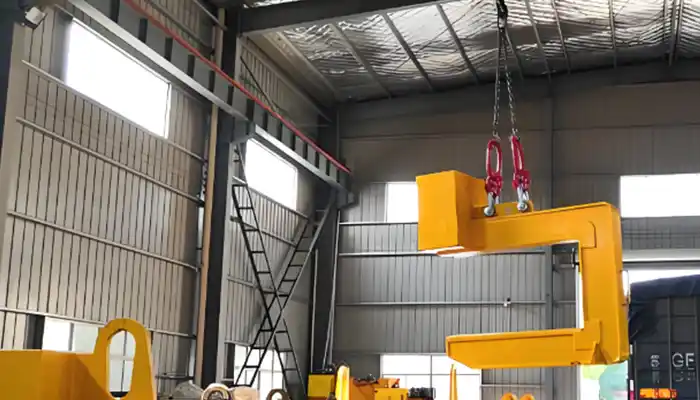 C hook overhead crane system for steel coil handling
How they work:
- The hook is inserted into the coil, then lifted by the crane hoist.
- Gravity and coil weight help stabilize the load during transport.
- Operators can rotate or reposition coils with precision once lifted.
- Handling heavy or irregular coils that may vary in diameter.
- Situations requiring careful protection of steel surfaces.
- Low-to-medium frequency operations where precision matters more than speed.
- Minimal risk of scratching or denting the coil.
- Can handle uneven or mixed coil diameters reliably.
- Does not rely on electrical power, so operations continue even during outages.
- Requires skilled operators to prevent load swing or tipping.
- Lifting speed is lower, making them less suited for high-volume lines.
- Correct insertion and alignment are essential to avoid coil deformation.
Electromagnets: Fast, Non-Contact Lifting
Electromagnets lift steel using magnetic fields rather than mechanical contact. This allows for faster handling and is often favored in high-volume yards or production lines where efficiency is critical.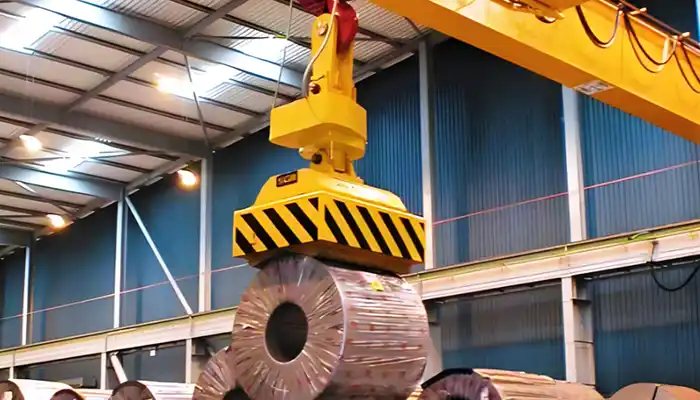 Magnetic overhead crane systems for steel coil handling with types of electromagentic liftors
- The magnet generates a magnetic field that attaches to the steel coil.
- Once lifted, the field holds the coil securely during transport.
- Power is switched off to release the load safely at the destination.
- Standard, uniform steel coils or plates with consistent size and weight.
- High-speed operations with tight production schedules.
- Dense storage yards where lifting multiple coils quickly increases efficiency.
- Faster cycle times compared to mechanical hooks.
- Can lift multiple uniform coils at once in some configurations.
- Reduces risk of scratching or denting steel surfaces.
- Requires a stable and reliable power supply.
- Not suitable for non-ferrous metals or mixed-material loads.
- Magnetic strength must match coil weight to prevent accidental drops.
- Surface coatings, rust, or scale can reduce magnetic efficiency.
Comparison Factors
Load Type & Coil Characteristics
The type of steel you handle determines a lot about which attachment will work best. Not all coils are the same—diameters, weights, and steel grades vary widely, and each affects stability and handling safety. Understanding these differences helps prevent accidents and protects your material.
Key points to consider:- Diameter and weight: Larger or irregular coils often require the stability of a C-hook, while uniform coils can be lifted efficiently with an electromagnet.
- Steel grade: Thicker, heavier steel can be safely lifted with either attachment, but delicate or coated steels may need C-hooks to avoid surface damage.
- Coil condition: Hot-rolled, cold-rolled, or coated steel may behave differently during lifts; plan accordingly.
Handling Frequency & Yard Layout
How often you move steel and the layout of your yard will influence the best choice of crane attachment. High-frequency operations demand efficiency, while tight storage spaces need precision.
Key points to consider:- Single vs. multiple lifts: Electromagnets can speed up repetitive lifts, especially when handling standard coils in bulk. C-hooks excel for single, precise placements.
- Yard design: Narrow lanes, dense stacks, or tight corners favor attachments that allow controlled, stable movement.
- Operational workflow: Consider the crane's path, travel length, and positioning for each coil to reduce swing and potential collisions.
Surface Protection & Damage Risks
Steel coils often have sensitive surfaces. Scratches, dents, or coating damage can result in rejected material and financial loss. Your attachment choice directly affects how the surface holds up.
Key points to consider:- Coating sensitivity: Painted, galvanized, or polished coils are more prone to scratches—C-hooks are generally safer.
- Mechanical contact: Electromagnets avoid edge contact but may leave marks if the surface is uneven or scaled.
- Handling care: Proper insertion, controlled lifts, and careful lowering are critical regardless of attachment.
Operational Speed & Cycle Efficiency
Time is money, and crane cycle efficiency is a key metric in steel handling operations. Choosing the right attachment impacts how quickly you can move material without compromising safety.
Key points to consider:- Fast lifts: Electromagnets excel in high-speed operations with uniform loads.
- Precision handling: C-hooks allow careful placement of heavy or irregular coils where accuracy is more important than speed.
- Cycle planning: Factor in travel distance, lift rotation, and stacking or unstacking procedures to select the most efficient attachment.
Energy & Maintenance Considerations
Every attachment has ongoing costs. Buyers must consider energy requirements, mechanical wear, and maintenance needs to avoid unexpected downtime.
Key points to consider:- Power consumption: Electromagnets require electricity for every lift; check that your crane system can support the load.
- Mechanical wear: C-hooks are simpler, with less dependency on power but still need regular inspection for wear and alignment.
- Downtime impact: Choose an attachment that balances operational speed with predictable maintenance schedules to minimize production interruptions.
Operational Tips for Buyers
Matching Attachment Type with Crane Capacity
Before purchasing a C-hook or an electromagnet, it's essential to understand your crane's capabilities. Single-girder and double-girder cranes have different load limits, lifting heights, and stability characteristics, and the attachment must be compatible to avoid overloading or unsafe lifts.
Key tips:- Check crane load limits: Ensure the attachment plus coil weight does not exceed the rated crane capacity.
- Consider crane type: Double-girder cranes handle heavier loads more safely, making them ideal for large coils with C-hooks or high-capacity electromagnets.
- Plan lift height and span: Make sure the crane can reach the storage location without excessive swing or angle stress on the coil.
Selecting Spreaders, Lifting Frames, or Adjustable C-Hooks
Sometimes a standard C-hook or magnet isn't enough, especially for unusual coil sizes or bundled steel. Using the right lifting accessory improves safety and efficiency.
Practical guidance:- Adjustable C-hooks: Ideal for mixed coil diameters or irregular sizes, allowing a snug fit without damaging the coil.
- Spreader bars or lifting frames: Useful for large bundles, slabs, or multi-coil lifts to distribute weight evenly.
- Electromagnet combinations: Consider using modular or multiple-magnet setups for heavier loads to increase stability.
Safety Protocols During Lift, Transport, and Placement
Even the right attachment can't prevent accidents if proper safety procedures aren't followed. Buyers should ensure operators are trained and that protocols are in place for every phase of the lift.
Key safety measures:- Pre-lift inspection: Check hooks, magnets, wiring, and crane alignment before every lift.
- Controlled lifts: Avoid sudden starts, stops, or swings; move coils slowly in tight spaces.
- Clear travel paths: Make sure the crane path is free from obstacles and personnel.
- Load placement: Lower coils carefully, ensuring they sit stably on racks or the ground without sliding or tipping.
- Emergency planning: Operators should know what to do in case of power failure (for magnets) or hook misalignment (for C-hooks).
Application Suitability & Decision Matrix
Matching Attachments to Different Steel Products
Not every lifting attachment works for every type of steel load. Understanding which attachment fits which scenario can save time, reduce damage, and improve safety. The table below provides practical guidance for common steel handling applications.
| Steel Product | C-Hook | Electromagnet | Practical Notes |
|---|---|---|---|
| Standard steel coils | ✅ Good for precise placement, minimal surface damage | ✅ Efficient for high-volume, uniform coils | Choose C-hook for careful handling, magnet for speed and multiple lifts |
| Irregular coils | ✅ Best choice due to mechanical control | ⚠ Not recommended; uneven shape reduces magnetic grip | C-hook avoids slipping or damage; magnets may be unstable |
| Bundled steel billets | ✅ Works well with adjustable C-hooks or spreaders | ⚠ Limited use; requires specialized magnet configuration | Use lifting frames or multiple hooks for heavier bundles |
| Slabs and sheet bundles | ✅ Stable with spreader bars | ✅ Can work if surface contact is sufficient | For coated or delicate slabs, prefer C-hooks to prevent scratching; magnets for standard steel |
Quick Recommendations Based on Operation Type
Different facilities have different priorities. Your handling frequency, crane capacity, and yard layout all matter when choosing between C-hooks and electromagnets.
Guidelines for buyers:
- Low-frequency, heavy loads: C-hooks or lifting frames provide stability and safety for rare, heavy lifts.
- High-speed operations: Electromagnets increase cycle efficiency for uniform coils and slabs, reducing waiting times.
- Mixed-size or irregular products: Adjustable C-hooks and spreaders allow precise handling without damaging steel.
- Dense yard layouts: C-hooks offer controlled placement in tight lanes, while magnets can lift multiple coils quickly if the layout allows.
Practical Takeaway
Choosing the right attachment depends on steel type, load size, handling frequency, and yard design. C-hooks excel in precision and protection, while electromagnets excel in speed and efficiency. Buyers should evaluate each factor carefully to maximize safety and productivity.
Cost Considerations
Initial Investment vs. Operational Costs
When choosing between C-hooks and electromagnets, buyers often focus first on price—but the total cost includes more than just the upfront investment. Understanding both initial and ongoing expenses is critical to making a smart choice.
Key points to consider:- Upfront costs: Electromagnets generally require a higher initial investment due to the electrical components, power supply, and control systems. C-hooks are simpler and cheaper to purchase.
- Operational costs: Electromagnets consume electricity for every lift, and require periodic inspection of wiring, coils, and power systems. C-hooks rely mostly on mechanical checks, which are simpler and less frequent.
- Installation costs: Some cranes may need modifications to support high-capacity magnets, while C-hooks usually require minimal adjustments.
Long-Term ROI Based on Efficiency and Maintenance
Cost savings over time depend on more than just initial price. The right attachment improves workflow, reduces damage, and lowers maintenance burdens, which all add up to a measurable return on investment.
Key points to consider:- Handling efficiency: Electromagnets can reduce cycle times and increase throughput in high-volume operations, potentially offsetting higher energy and maintenance costs.
- Maintenance and downtime: C-hooks have fewer mechanical components, which can mean fewer breakdowns, but slower lifts may reduce overall efficiency. Electromagnets require more frequent inspection but offer faster handling if properly maintained.
- Product protection: Minimizing damage to steel reduces replacement costs and rejects, which can significantly impact ROI over time.
- Operational lifespan: Both attachments last longer when used correctly, but electromagnets depend on reliable power and careful monitoring to avoid early failure.
Practical Takeaway for Buyers
The choice between C-hooks and electromagnets should balance initial cost, operational efficiency, and maintenance requirements. Buyers should consider not just purchase price, but also how the attachment will perform over years of handling steel, the speed of operations, and long-term material protection.
FAQ / Buyer Concerns
How do I know if my crane can support an electromagnet's weight?
This is one of the first questions buyers ask. Electromagnets add extra weight to your crane trolley, and it's essential to make sure your crane's rated capacity can handle both the magnet and the load.
Practical guidance:- Check your crane's maximum lifting capacity and compare it with the combined weight of the magnet and the steel coil.
- Consider dynamic effects: lifting, moving, and stopping the load increases the effective stress on the crane structure.
- Consult the crane manufacturer or supplier if you plan to retrofit an existing crane with a high-capacity electromagnet.
Can C-hooks handle mixed-size coils without adjustment?
C-hooks are simple but need careful selection to fit the coil's inner diameter. Buyers often wonder if they can lift different coils without constantly swapping hooks.
Practical guidance:- Standard C-hooks work best with a narrow range of coil diameters.
- Adjustable C-hooks or multiple hook sizes allow safe handling of mixed coils without damaging the steel.
- Always check the coil's weight and diameter before lifting to prevent tipping or deformation.
What happens if there's a power failure during magnet lifting?
Electromagnets rely on continuous electrical power, so a sudden outage can be a real concern for safety.
Practical guidance:- Use magnets with built-in backup systems or battery-holding circuits for temporary power during lifts.
- Always lower the load to a safe position immediately if power fails.
- Train operators to respond quickly and safely to unexpected power interruptions.
How often should C-hooks or magnets be inspected?
Regular inspection is key to preventing accidents and reducing maintenance costs. Buyers often ask about inspection frequency to plan downtime efficiently.
Practical guidance:- C-hooks: Inspect for structural wear, cracks, and alignment at least monthly or before heavy lifts.
- Electromagnets: Inspect coils, wiring, and control systems daily or weekly depending on usage, plus a detailed inspection monthly.
- Document all inspections to track wear patterns and plan replacements before failures occur.
Are there attachments for mixed operations (coils + billets)?
Many yards handle a combination of steel products. Buyers want attachments that can work across multiple types of loads without needing multiple cranes.
Practical guidance:- Adjustable C-hooks, lifting frames, or modular spreaders allow handling both coils and billets.
- Electromagnets can handle billets if weight and magnetic compatibility are considered, but care is needed with irregular shapes.
- Evaluate your operation's mix of products before investing to avoid multiple, incompatible attachments.
How does attachment choice affect warehouse layout and crane spacing?
Attachment type influences crane design, aisle width, and storage patterns. Buyers often overlook this until installation.
Practical guidance:- C-hooks require enough clearance for insertion and rotation of the coil.
- Electromagnets allow faster lifting but need space for safe travel and multiple-coil lifts.
- Consider aisle width, stack height, and the number of cranes sharing the same runway to prevent collisions and ensure efficient workflow.
Practical Takeaway for Buyers
These FAQs highlight the key considerations for buyers when choosing between C-hooks and electromagnets. Knowing crane capacity, coil size, operational safety, and layout constraints ensures you make a practical decision that maximizes efficiency and protects both operators and steel products.
Conclusion
Why the Attachment Choice Matters
Selecting the right lifting attachment—C-hook or electromagnet—directly affects safety, efficiency, and the lifespan of your crane. It’s not just about lifting steel; it’s about protecting your equipment, your product, and your people.
Key points to remember:
- Safety first: The correct attachment reduces coil swing, tipping, and risk of accidents.
- Efficiency matters: Electromagnets speed up high-volume handling, while C-hooks provide precision for heavy or irregular coils.
- Crane longevity: Using the proper attachment within crane capacity prevents overloading and unnecessary wear.
Factors Buyers Must Consider
Making an informed decision requires more than comparing price tags. Consider how your operation actually works day-to-day.
Focus areas:
- Load type and coil size – match the attachment to the steel you handle most.
- Handling frequency – high-speed operations benefit from magnets; low-frequency, heavy-duty work often favors C-hooks.
- Yard layout – tight lanes and storage patterns influence which attachment is safer and more practical.
- Maintenance requirements – plan inspections and servicing to keep attachments and cranes in top condition.
Practical Takeaway
For crane buyers, the message is simple: a well-chosen lifting attachment reduces downtime, protects your steel, and improves productivity. Spend time evaluating your coils, crane capacity, and operational workflow. The right choice today prevents costly mistakes tomorrow and keeps your yard running smoothly.

Article by Bella ,who has been in the hoist and crane field since 2016. Bella provides overhead crane & gantry crane consultation services for clients who need a customized overhead travelling crane solution.Contact her to get free consultation.
Yuantai Cranes
Overhead Crane Manufacturer with CE, ISO, SGS, CNEX Certificates.
- Main Specifications - Capacity: 0.5–550 tons | Span: up to 40m | Speed: 0.8–12 m/min | Duty: A3–A7 | Power: 380–690V, 50/60Hz | Control: pendant/remote/cabin
- Full engineering: FEA/PLC/VFD + in-house build + global delivery + on-site support, for workshops, factories, EPC contractors, industrial projects, etc.
- Support: design, manufacturing, testing, service – end-to-end, customized lifting solutions worldwide.
How to Get an Accurate Crane Price for Your Application?
Tips: Copy the spec list, fill in your details, and paste it into the form on the right/ down-below for a quick price.
- Crane type:_____ . (e.g., overhead crane, gantry crane, jib crane)
- Max weight to lift:_____ tons. (e.g., 2t, 5t, 10t, 20t, 50t)
- Lifting height:_____ m. (How high does the hook need to reach?
- Workshop width (span):_____ m . (Distance between the two crane rails)
- Travel distance:_____ m . (How long does the crane need to move along the runway?)
- Control type:_____. (Pendant / remote / cabin Control)
- Power supply:_____. (Local voltage & frequency – e.g., 380V, 50Hz, 3-phase)
- What will it be used for?_____ (e.g., steel fabrication, concrete products, mold handling, general manufacturing, etc.)
- Any special requirements?_____ (e.g., extreme temperature, dusty or explosive environment, special paint color, etc.)
Just leave a message via the contact form and our hoist and crane engineer will contact you with in 24working hours.
Get Your Custom Quote–Quick & Easy
Fill in what you know. Skip what you don't – we'll help.Any question will be reply with 24 working hours