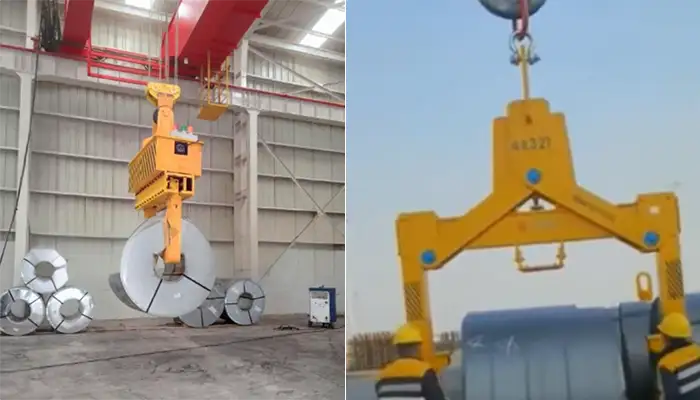
Electric Coil Clamp vs Mechanical Tong: Which Is Better for Steel Coil Handling?
Content Quick Link
Introduction: Choosing the Right Steel Coil Handling Solution Matters
Steel coils are heavy and high-value loads. Handling them safely requires the right lifting equipment. A suitable coil handling solution helps prevent coil damage, improve crane operation efficiency, and reduce safety risks during daily production.
For horizontal steel coil handling with overhead cranes, two common lifting solutions are widely used:
- Electric Coil Clamp – a motor-driven coil lifting attachment with controlled gripping force, suitable for frequent handling, high-value coils, and automated production lines.
- Mechanical Tong / Mechanical Coil Grab – a simple and reliable mechanical lifting device, often used for heavy-duty coil handling with lower investment requirements.
Both solutions have their own advantages. The best choice depends on several factors, including:
- Coil weight and dimensions
- Coil material and surface requirements
- Handling frequency
- Working environment
- Crane capacity and control method
- Automation requirements
What Is an Electric Coil Clamp for Horizontal Steel Coil Handling?
Learn how an electric coil clamp works, its main features, typical applications, and when it is the right choice for horizontal steel coil handling with an overhead crane.
Definition and Working Principle
An electric coil clamp is a motor-driven lifting attachment installed under an overhead crane. It is designed for lifting and moving horizontal steel coils safely in steel plants, coil processing lines, and storage yards.
The clamp uses an electric drive system to open and close the gripping mechanism. It can hold the coil from the inner diameter (ID) or the outer diameter (OD), depending on the coil type and handling requirement.
In a typical steel coil handling operation, the process looks simple:
- The overhead crane moves the electric coil clamp above the coil.
- The operator adjusts the clamp position and aligns it with the coil center.
- The electric drive starts and closes the gripping arms.
- The clamp holds the coil firmly.
- The crane lifts and moves the coil to the next position.
- After placing the coil, the clamp opens and releases the load.
Sounds easy, right? But in actual steel plants, coil alignment and gripping control are very important. A small positioning error may scratch the coil surface or affect production flow, especially when handling finished coils.
Compared with a traditional mechanical tong, an electric coil clamp gives the operator better control over the lifting process. This makes it more suitable for frequent coil movement and applications where coil quality matters.
Main Features of Electric Coil Clamp
An electric coil clamp for horizontal steel coil handling is mainly selected when customers need better control, safer operation, and higher handling efficiency.
Main advantages include:
- Adjustable clamping force
The electric system allows the gripping force to be adjusted according to coil weight and material.
This helps avoid excessive pressure on thin coils or finished steel surfaces. - High positioning accuracy
The clamp can open, close, and align more accurately.
This is useful when operators handle different coil sizes during daily production. - Better coil protection
For products such as galvanized steel coils, stainless steel coils, and aluminum coils, surface protection is often a key concern.
Controlled gripping reduces the risk of scratches, edge damage, and coil deformation. - Suitable for automatic crane systems
Electric coil clamps can connect with PLC systems, remote control systems, and automated overhead cranes.
This makes them easier to use in smart warehouses and automatic production lines. - Remote control operation available
Operators can control the clamping and releasing process from a safer distance.
In some steel plants, this helps reduce direct contact between workers and heavy loads. - Suitable for frequent lifting cycles
When a coil handling crane moves dozens or hundreds of coils every day, operation speed and repeatability become important.
Electric coil clamps are designed for this type of continuous work.
Typical Applications of Electric Coil Clamp
Electric coil clamps are commonly used in places where steel coils need frequent and careful handling.
Common applications include:
- Steel service centers
Used for loading, unloading, stacking, and transferring finished steel coils between storage areas and processing equipment. - Automotive steel plants
Used for handling precision steel coils where surface quality requirements are higher. - Galvanizing lines
Used for moving coated steel coils while reducing damage to the zinc-coated surface. - Stainless steel production facilities
Used for handling high-value stainless steel coils that require careful lifting. - Smart steel warehouses
Used together with automated cranes, warehouse management systems, and remote operation systems.
When Should You Choose an Electric Coil Clamp?
In most projects, customers choose an electric coil clamp when:
- The coil surface must be protected.
- The handling frequency is high.
- Coil sizes change often.
- The plant plans future automation.
- The crane needs remote or automatic operation.
However, it is not always the only option. For some heavy-duty steel yards with standard coil sizes and lower handling frequency, a mechanical tong may still be a practical choice.
The final selection usually depends on the coil weight, coil dimensions, crane capacity, working cycle, and production requirements. A good coil handling solution should match the real working condition, not just the equipment specification.
What Is a Mechanical Tong for Horizontal Steel Coil Handling?
Learn how a mechanical tong works, its main features, typical applications, and when it is the right choice for horizontal steel coil handling with an overhead crane.
Definition and Working Principle
A mechanical tong is a traditional lifting attachment used with an overhead crane for horizontal steel coil handling. It uses the weight of the coil and a mechanical linkage system to create gripping force.
Unlike an electric coil clamp, a mechanical tong does not need electric power to hold the coil. The gripping action happens through the mechanical structure itself. When the crane lifts the load, the tong automatically locks and grips the coil.
This simple working principle has made mechanical tongs widely used in steel mills and coil storage yards for many years.
The typical working process includes:
- The overhead crane lowers the mechanical tong onto the steel coil.
- The tong jaws enter the coil inner diameter or contact the designed lifting position.
- When the crane starts lifting, the coil weight activates the mechanical locking system.
- The tong grips the coil and lifts it together with the crane.
- After the coil is placed on the ground or storage rack, the load is released and the tong opens automatically.
In daily operation, the biggest advantage of a mechanical tong is simplicity. There are fewer electrical components to check, and operators can quickly understand how the device works.
However, the performance depends more on the mechanical design, coil condition, and operator operation. For example, the tong must match the coil size correctly. If the coil diameter or weight range does not fit, the gripping effect may not be ideal.
Main Features of Mechanical Tong
A mechanical coil tong for steel coil lifting is often selected for applications that need a reliable and cost-effective lifting solution.
Main advantages include:
- Simple structure
The mechanical tong uses a linkage and locking mechanism instead of motors, sensors, and control systems.
This makes the structure easier to understand and operate. - Lower investment cost
Compared with electric coil clamps, mechanical tongs usually require less initial investment.
They are a practical choice for projects where budget control is important. - Easy maintenance
Daily maintenance mainly focuses on mechanical parts such as:Pins, Bushings, Bearings, Locking components, Wear parts . Most maintenance work can be completed by the plant's own maintenance team. - Long service life
With regular inspection and proper operation, mechanical tongs can work for many years in heavy-duty lifting environments. - Reliable in harsh environments
Mechanical tongs do not rely on electrical systems during lifting.
This makes them suitable for dusty steel yards, outdoor storage areas, and heavy industrial environments.
Typical Applications of Mechanical Tong
Mechanical tongs are commonly used where steel coils are handled under stable working conditions and automation is not the main requirement.
Common applications include:
- Steel mills
Used for moving raw steel coils, semi-finished coils, and production materials inside the plant. - Raw material yards
Used for loading, unloading, and transferring coils between storage areas and production sections. - Heavy coil storage areas
Suitable for large coil handling where coil sizes and lifting methods remain relatively consistent. - Low-frequency lifting operations
A good choice for facilities that move coils occasionally rather than continuously throughout the day.
When Should You Choose a Mechanical Tong?
In many projects, customers select a mechanical tong when:
- Coil sizes are relatively fixed.
- The lifting frequency is not very high.
- The working environment is rough or dusty.
- The plant prefers simple equipment with easy maintenance.
- The project requires a lower-cost coil lifting solution.
However, mechanical tongs may not be the best option for every application. For example, when handling high-value finished coils, frequent production cycles, or automated warehouse operations, customers often require better control and may choose an electric coil clamp instead.
The final decision should consider:
- Coil weight range
- Coil diameter and width
- Lifting frequency
- Coil surface requirements
- Crane working conditions
- Automation level
A mechanical tong remains a reliable choice for many steel coil handling applications, especially where simplicity, durability, and cost control are the main priorities.
Electric Coil Clamp vs Mechanical Tong: Key Comparison
When customers compare an electric coil clamp and a mechanical tong for horizontal steel coil handling, safety is usually the first topic they consider.
Steel coils are heavy loads. Once a coil is lifted several meters above the ground, any problem with gripping, positioning, or operation can create safety risks and production losses.
Both lifting solutions can work safely when they are correctly designed and operated. However, they use different gripping methods, which leads to different safety characteristics.
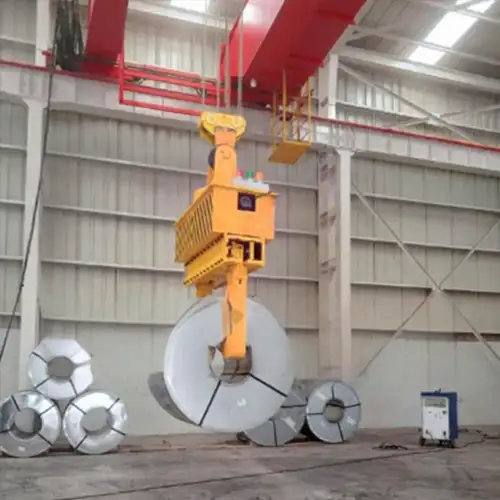
Electric motorized steel coil clamp for horizontal steel coil handling
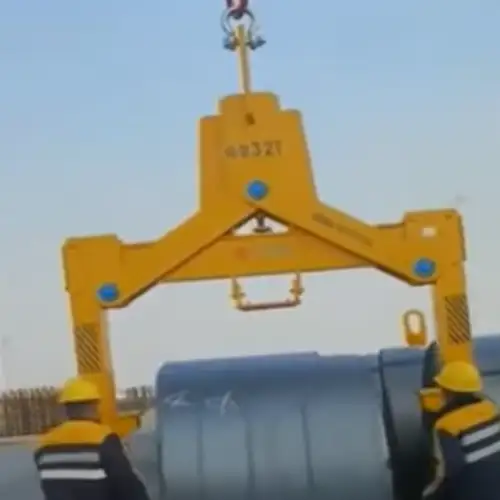
Mechanical coil handling crane for your reference
Safety Performance Comparison
Compare the safety performance of electric coil clamps and mechanical tongs for horizontal steel coil handling, including gripping control, safety features, and operation requirements.
| Comparison | Electric Coil Clamp | Mechanical Tong |
|---|---|---|
| How it grips the coil | Uses an electric drive to control the gripping force. | Uses the coil weight and a mechanical locking structure. |
| Gripping force | Adjustable for different coil weights and materials. | Fixed by the mechanical design. |
| Coil protection | Better for protecting coil surfaces and reducing deformation. | Depends on the tong design and operator's positioning. |
| Best for | Finished coils, galvanized coils, stainless steel coils, and automotive steel coils. | Raw material coils and standard steel coils. |
| Safety features | Can include load monitoring, position detection, limit switches, and fault alarms. | Relies on a mechanical locking mechanism. No electronic monitoring is required. |
| Power requirement | Requires electrical power to grip and release the coil. | No electrical power is needed for gripping. |
| Power failure | Should include backup protection, such as a mechanical lock or emergency holding device. | Not affected by electrical power failure during gripping. |
| Maintenance | Check motors, cables, sensors, and control components regularly. | Check pins, bearings, springs, and locking parts regularly. |
| Operator skill | Easier to operate consistently. | Correct positioning is important before lifting. |
| Possible risks | Electrical components need regular maintenance. | Wrong positioning may cause coil scratches, edge damage, or unstable lifting. |
| Typical applications | Steel service centers, processing lines, and automated warehouses. | Steel mills, raw material yards, and heavy coil storage areas. |
Electric Coil Clamp Safety Performance
An electric coil clamp uses an electric drive system to control the opening, closing, and gripping process. The clamping force can be adjusted according to the coil weight and handling requirements.
Advantages:
- Controlled gripping force
The electric system allows engineers to set the proper gripping force for different coil types.
This is useful when handling thin steel coils, galvanized coils, stainless steel coils, or other products where surface damage must be avoided. - Reduces coil deformation risk
Excessive gripping force may affect the coil shape, especially for lighter or thinner coils.
With controlled operation, an electric coil clamp helps reduce this risk. - Suitable for expensive finished coils
When the coil itself has a high value, such as automotive steel or precision stainless steel, customers usually pay more attention to surface protection and stable lifting. - Additional safety monitoring available
Depending on the design, electric coil clamps can include features such as: Load monitoring, Clamp position detection, Limit switches, Remote control feedback, Fault alarms, etc. These functions help operators understand the working status before and during lifting.
Potential Concerns:
Requires electrical system maintenance
Electric coil clamps include motors, control components, sensors, and electrical connections.
Regular inspection is needed to keep the system working properly.
Maintenance usually includes checking:
- Motor condition
- Cable connections
- Control components
- Sensors and limit switches
Needs backup protection during power failure
Since the gripping system depends on electrical power, the design should consider what happens if power is lost during lifting.
Common solutions include:
- Mechanical locking protection
- Emergency power supply
- Safety holding mechanisms
The specific design depends on the lifting capacity and project requirements.
Mechanical Tong Safety Performance
A mechanical tong uses the load weight and mechanical linkage structure to create gripping force. The tong locks automatically when the crane lifts the coil.
Because it does not need electric power for gripping, its safety principle is different from an electric coil clamp.
Advantages:
- Mechanical locking structure
The tong relies on a mechanical mechanism to hold the coil.
When the crane lifts the load, the weight activates the locking action. - No electrical failure risk during gripping
The gripping process does not depend on motors, sensors, or control systems.
This makes mechanical tongs suitable for simple lifting operations and harsh working environments.
Potential Concerns:
Operator experience is important
Mechanical tongs usually require operators to correctly position the tong before lifting.
Operators need to pay attention to:
- Coil size matching
- Tong position
- Lifting angle
- Complete engagement before lifting
Incorrect operation may damage coils
If the tong is not suitable for the coil size or is not positioned correctly, problems may occur, such as:
- Coil edge damage
- Surface scratches
- Unstable lifting
- Coil slipping risk
Which One Provides Better Safety?
The answer depends on the application.
For high-value steel coils, frequent production handling, and automated crane systems, an electric coil clamp usually provides better control and monitoring.
For heavy-duty coil yards, fixed coil sizes, and simple lifting operations, a mechanical tong can provide reliable performance with a simpler structure.
In real projects, safety does not only depend on the lifting device itself. It also depends on:
- Correct equipment selection
- Proper crane capacity matching
- Regular inspection
- Operator training
- Following safe lifting procedures
A suitable coil handling solution should match the actual working conditions rather than simply choosing the more advanced option.
Coil Protection and Damage Prevention
When handling steel coils, protecting the coil surface is often one of the most important concerns, especially for finished products with higher market value.
A small scratch, edge deformation, or shape change may affect the next production process. For example, automotive steel coils, galvanized coils, and stainless steel coils usually have stricter surface quality requirements than raw material coils.
The difference mainly comes from how the lifting device creates and controls the gripping force.
An electric coil clamp uses an electric drive system to control the clamping action. The operator or control system can adjust the gripping force according to the coil condition.
A mechanical tong relies on mechanical structure and the coil weight to create gripping force. It works well for many standard coil handling applications, but the control level depends more on the tong design and operation experience.
The comparison below shows the general difference:
| Factor | Electric Coil Clamp | Mechanical Tong |
|---|---|---|
| Clamping control | Excellent | Limited |
| Thin coil handling | Better | Depends on design |
| Surface protection | Higher | Medium |
| Precision products | Recommended | Limited |
In actual steel plants, the choice depends on the coil type and production requirements.
For example:
- A steel service center handling galvanized steel coils or stainless steel coils may prefer an electric coil clamp because surface quality is a priority.
- A raw material yard handling standard heavy steel coils may choose a mechanical tong because the lifting requirements are simpler.
However, an electric coil clamp is not automatically the best choice for every project. The coil weight, coil dimensions, handling frequency, and crane working condition still need to be checked.
For customers handling high-value coils, frequent lifting cycles, or automated production lines, better gripping control can help reduce coil damage risks and improve long-term operating efficiency. For simpler applications, a properly designed mechanical tong can still provide reliable coil handling performance.
Load Capacity and Coil Size Flexibility
Coil weight is important, but coil size changes and production conditions also affect the selection of a suitable horizontal steel coil handling device.
| Item | Electric Coil Clamp | Mechanical Tong |
|---|---|---|
| Coil weight | Handles different coil weights more easily. | Best for similar coil weights. |
| Coil diameter (OD) | Suitable for different coil diameters. | Best for standard coil diameters. |
| Coil width | Can handle different coil widths. | Best for fixed coil widths. |
| Coil inner diameter (ID) | Easy to adapt to different inner diameters. | Should match the specified inner diameter. |
| Coil temperature | Can be customized for hot or cold coils. | Can also be customized, but mainly used for standard working conditions. |
| Different coil sizes | Better for handling multiple coil sizes. | Better for one or a few standard coil sizes. |
| Frequent product changes | Easy to adjust for different products. | Less suitable for frequent changes. |
| Production type | Good for flexible and automated production lines. | Good for fixed production and repetitive lifting. |
| Best application | Steel service centers, automotive plants, and processing lines. | Steel mills, raw material yards, and storage areas. |
Important Coil Information Before Selection
When selecting a lifting device for horizontal steel coil handling, load capacity is only one part of the decision. The coil size range and production conditions are also important.
In many steel plants, the same crane may handle different coils during one shift. Some coils may be wider, heavier, or have different inner diameters. The lifting attachment needs to match these changes to keep the operation safe and stable.
Before choosing between an electric coil clamp and a mechanical tong, customers should check the following coil information:
- Coil weight
The maximum and minimum coil weight determine the required lifting capacity.
A coil clamp designed for a 30-ton coil may not be suitable for lighter or much heavier coils without proper adjustment. - Coil diameter
The outer diameter (OD) affects the gripping position and lifting stability.
Different coil diameters may require different clamp ranges or tong designs. - Coil width
Wider coils create different load conditions during lifting.
The lifting device should match the coil width to avoid unstable movement. - Coil inner diameter
The inner diameter (ID) is especially important for inside gripping solutions.
The clamp or tong must fit correctly into the coil opening before lifting. - Coil temperature
Hot coils from rolling mills may require special designs and materials.
The lifting device should be selected according to the actual coil temperature and working environment.
Electric Coil Clamp Flexibility
An electric coil clamp is usually more flexible when handling different coil conditions.
Suitable for:
- Different coil sizes
The clamping mechanism can be adjusted to handle a wider range of coil dimensions. - Frequent product changes
In plants where coil specifications change often, operators can adjust the equipment more easily. - Automated production
Electric coil clamps can connect with crane control systems and support automatic coil handling processes.
For example, an automotive steel plant may handle multiple coil sizes every day. In this case, flexibility becomes important because operators need to move different products without changing lifting equipment frequently.
Mechanical Tong Flexibility
A mechanical tong works well when the coil specifications remain relatively stable.
Suitable for:
- Standard coil dimensions
When most coils have similar weight, diameter, and width, a mechanical tong can provide reliable performance. - Fixed production conditions
For production areas where the same type of coil is handled repeatedly, a simple mechanical solution may be enough.
For example, a raw material storage yard that handles similar steel coils every day may not need the additional adjustment functions of an electric coil clamp.
How to Choose Based on Coil Variation?
In real projects, the key question is not only:
"How heavy is the coil?"
It is also:
"How often do the coil conditions change?"
If the plant handles:
- Different coil weights
- Different coil diameters
- Different coil materials
- Frequent production changes
an electric coil clamp is usually a better choice.
If the plant handles:
- Similar coil sizes
- Fixed production processes
- Lower lifting frequency
a mechanical tong can be a practical and economical solution.
The final selection should match the actual coil handling process, crane capacity, and future production requirements.
Automation and Smart Factory Compatibility
More steel plants are moving toward automatic coil handling systems. The selection between an electric coil clamp and a mechanical tong depends on the crane system, production process, and future automation plan.
| Item | Electric Coil Clamp | Mechanical Tong |
|---|---|---|
| Working method | Electric control system | Mechanical locking system |
| Remote control | ✔ Supported | ✖ Not supported |
| PLC communication | ✔ Can connect with crane PLC systems | ✖ Not available |
| Automatic gripping & releasing | ✔ Supported | ✖ Manual operation |
| Load monitoring | ✔ Can use sensors and feedback | ✖ Not available |
| Warehouse automation | ✔ Suitable for automated warehouses | ✖ Not suitable |
| System integration | ✔ Works with crane control and factory management systems | Limited integration |
| Operator involvement | Less manual operation | More manual operation |
| Best for | Smart factories, automated crane systems, steel service centers | Traditional steel yards, manual crane operation, raw material storage |
| Main limitation | Higher initial investment and electrical maintenance | Not suitable for unmanned operation or automation |
Why Automation Compatibility Matters
Today, more steel plants are looking at automatic coil handling systems. The reason is simple. Production lines run faster, coil movement happens more often, and fewer manual steps are preferred.
When customers choose between an electric coil clamp and a mechanical tong, they usually ask:
Can this lifting device work with our crane control system?
Can we use it for future automation?
The answer depends on the working method, crane system, and production requirements.
Electric Coil Clamp for Automatic Coil Handling
An electric coil clamp uses an electric drive and control system to complete the gripping and releasing process.
It can connect with the overhead crane system and provide more control during coil handling.
It supports:
- Remote control
Operators can control the coil clamp from a safe area.
This helps when handling large coils or working in areas where direct operation is difficult. - PLC communication
The electric coil clamp can exchange signals with the crane PLC system.
This allows the clamp status and crane movement to work together. - Automatic gripping and releasing
The system can control when the clamp closes, holds the coil, and releases it.
This reduces repeated manual actions during production. - Load monitoring
Sensors can check lifting conditions and provide feedback to the control system. - Warehouse automation
Electric coil clamps can work with automatic storage cranes, production tracking systems, and smart warehouse solutions.
Best Applications for Electric Coil Clamp
Intelligent factories
Factories that use:
- Digital production systems
- Automatic material transportation
- Smart warehouse management
often choose electric coil clamps because the equipment can communicate with other systems.
Automated crane systems
For example, in a steel coil warehouse, an automatic crane may need to:
- Find the correct coil location
- Pick up the coil
- Move it to another area
- Place it at the required position
This process needs a lifting device that can receive commands and send operation feedback. An electric coil clamp fits this type of application better.
Mechanical Tong for Traditional Coil Handling
A mechanical tong works mainly with manual crane operation.
The operator controls:
- Crane movement
- Tong positioning
- Lifting process
- Coil release
The mechanical structure creates the gripping force when the crane lifts the coil.
Suitable for:
- Manual crane operation
The operator watches the coil position and controls the lifting process step by step. - Traditional steel yards
Many storage yards handle similar coil types every day. In these cases, a mechanical tong can meet normal lifting needs.
For example, a raw material yard may handle the same type of steel coil several times a day. The operator knows the coil size, the lifting position, and the working process. A mechanical tong can work well in this condition.
Limitations of Mechanical Tong in Automation
- Less suitable for unmanned operation
Mechanical tongs usually need an operator to position the tong correctly before lifting. - Limited system integration
They normally do not provide operation data or feedback to factory management systems. - More dependent on operator experience
Correct positioning is important. A new operator may need more time to become familiar with the lifting process.
Which One Is Better for Future Production?
There is no single answer. It depends on the factory plan.
Choose an electric coil clamp when the plant needs:
- Automatic overhead crane operation
- Remote control
- Smart warehouse connection
- Frequent coil handling
- Production data monitoring
Choose a mechanical tong when the plant needs:
- Simple lifting operation
- Lower equipment investment
- Fixed coil sizes
- Manual crane operation
In many projects, customers start with manual handling and later upgrade to automation. So it is worth considering not only the current working condition, but also the future development of the steel plant.
Maintenance and Operating Cost Comparison
When choosing a steel coil handling device, customers usually look beyond the purchase price. Maintenance requirements and daily operating costs also affect the long-term value of the equipment.
| Item | Electric Coil Clamp | Mechanical Tong |
|---|---|---|
| Structure | Electric motor, gearbox, sensors, and control system | Mechanical structure with pins, bearings, springs, and locking parts |
| Main maintenance | Motor, gearbox, sensors, control system, electrical components | Pins, bearings, springs, locking mechanism |
| Maintenance frequency | Regular electrical and mechanical inspection | Mainly mechanical inspection |
| Repair difficulty | Requires electrical maintenance knowledge | Simple mechanical repair |
| Operating efficiency | Higher. Reduces manual operation and improves handling speed. | Depends more on the operator and lifting process. |
| Manual operation | Less manual work with remote or automatic control | More manual positioning and operation |
| Maintenance cost | Higher | Lower |
| Downtime | May take longer if electrical faults occur | Usually quicker to inspect and repair |
| Best for | High-frequency lifting, automated production lines, and steel service centers | Low-frequency lifting, steel mills, and raw material yards |
| Main advantage | Higher efficiency and supports automation | Simple structure, easy maintenance, and lower operating cost |
1. Why Should Customers Consider Maintenance Cost?
When choosing a steel coil handling device, customers usually look beyond the purchase price. Maintenance requirements and daily operating costs also affect the long-term value of the equipment.
A lifting attachment that works well but requires frequent repair may interrupt production. On the other hand, a simple device with lower maintenance needs may be a better choice for some working conditions.
The maintenance difference between an electric coil clamp and a mechanical tong mainly comes from their different structures.
2. Electric Coil Clamp Maintenance
An electric coil clamp uses motors, sensors, and control components to operate the gripping process. Because it has more electrical parts, regular inspection is important.
Main maintenance items:
- Electric motor
Check motor operation, abnormal noise, overheating, and connection conditions. - Gearbox
Inspect lubrication condition, gear wear, and transmission performance. - Sensors
Check position sensors and feedback signals to make sure the clamp opens and closes correctly. - Control system
Check PLC communication, control buttons, remote control signals, and alarm functions. - Electrical components
Inspect cables, connectors, electrical boxes, and protection devices.
Advantages:
- Higher efficiency
The electric system controls the gripping process more accurately.
For plants handling many coils every day, this can reduce operation time. - Reduced manual operation
Operators do not need to manually adjust every lifting step.
Remote control and automatic functions can reduce repeated work.
For example, in a steel service center handling dozens of coils per shift, reducing manual adjustments can help keep the production flow stable.
Electric Coil Clamp vs Mechanical Tong: Cost Comparison
When selecting a steel coil lifting device, the purchase price is important. However, customers should also consider operation cost, maintenance, coil protection, and future automation needs.
| Cost Factor | Electric Coil Clamp | Mechanical Tong |
|---|---|---|
| Initial investment | Medium–High | Low |
| Equipment structure | Electric motor, sensors, control system, gearbox | Mechanical arms, pins, springs, locking parts |
| Purchase cost | Higher | Lower |
| Coil damage cost | Lower risk. Better for finished and high-value coils. | Higher risk if not positioned correctly. |
| Labor cost | Lower. Supports remote control and automatic operation. | Higher. Requires more manual operation. |
| Handling efficiency | Higher. Suitable for frequent lifting. | Good for low-frequency lifting. |
| Maintenance cost | Higher. Electrical and mechanical parts require inspection. | Lower. Simple mechanical maintenance. |
| Repair time | May be longer if electrical faults occur. | Usually faster and easier to repair. |
| Production downtime | Lower in automated production when properly maintained. | May increase with manual handling in high-volume operations. |
| Automation compatibility | Excellent. Supports PLC, smart warehouses, and automatic cranes. | Limited. Mainly for manual crane operation. |
| Best for | Steel service centers, processing lines, and automated factories. | Steel mills, raw material yards, and traditional storage areas. |
| Best value | High-volume production and long-term efficiency. | Low-budget projects and simple lifting applications. |
Initial Investment Comparison
A mechanical tong usually costs less at the beginning.
The reason is simple. It uses a mechanical structure and does not need:
- Electric motors
- Sensors
- Control systems
- Electrical components
An electric coil clamp requires more systems to control the gripping process. Therefore, the initial investment is usually higher.
| Equipment | Investment Level |
|---|---|
| Mechanical Tong | Low |
| Electric Coil Clamp | Medium–High |
Why Does the Price Difference Exist?
The two solutions work in different ways.
A mechanical tong mainly uses:
- Mechanical arms
- Pins
- Springs
- Locking parts
The structure is simple. The manufacturing cost is lower.
An electric coil clamp adds:
- Drive motor
- Gear system
- Control unit
- Sensors
- Safety monitoring
These parts help control the lifting process but also increase the equipment cost.
Long-Term Cost Considerations
In real steel coil handling projects, customers usually do not make decisions based only on the quotation price.
They also check:
- How much does it cost to operate every day?
- How much risk is there during lifting?
- How many coils need to be moved per shift?
- Does the factory plan automation in the future?
Coil Damage and Labor Cost
Coil Damage Losses
Steel coils can have high value.
For example:
- Automotive steel coils
- Stainless steel coils
- Galvanized steel coils
A small surface scratch or coil deformation may affect the next production process.
An electric coil clamp can control the gripping force better, which helps reduce damage risk for sensitive products.
However, for raw material coils where surface quality is less critical, a mechanical tong may already meet the requirement.
Labor Cost
The operation method also affects cost.
With a mechanical tong, the operator usually needs to:
- Position the tong manually
- Check the gripping condition
- Control lifting and releasing
An electric coil clamp can reduce some manual steps through:
- Remote operation
- Automatic gripping
- Crane system connection
For plants that handle many coils every day, reducing manual work can save time.
Handling Efficiency and Production Downtime
Handling frequency changes the cost calculation.
A small storage yard may move only a few coils per day. A mechanical tong may work well.
But a steel processing line may move dozens or hundreds of coils every day. In this case, faster and more consistent operation becomes more important.
The question is not only:
"How much does the lifting device cost?"
It is also:
"How much does the equipment cost every time we move a coil?"
Production Downtime
Production interruption can create hidden costs.
Customers should consider:
- Maintenance time
- Repair speed
- Spare parts availability
- Impact on production flow
A simple mechanical device may be easier to repair.
An electric system may need more technical maintenance, but it can provide better control and automation functions.
It depends on the working environment and production requirements.
Automation Requirements and Final Selection
Future factory plans also affect the decision.
If the plant plans to use:
- Automatic overhead cranes
- Smart warehouses
- Remote crane operation
- Digital production management
an electric coil clamp usually fits better.
If the plant mainly uses:
- Manual crane operation
- Fixed coil sizes
- Traditional storage methods
a mechanical tong can be a practical choice.
Which One Provides Better Value?
A mechanical tong is usually a better choice when:
- The initial budget is limited.
- Coil sizes do not change often.
- The lifting frequency is low.
- Manual operation is acceptable.
An electric coil clamp is usually a better choice when:
- The plant handles many coils every day.
- Coil surface protection is important.
- Labor cost is high.
- Automation is part of the production plan.
In many projects, customers choose a higher initial investment because they want lower operating pressure later.
But this does not mean electric coil clamps always win.
The right choice depends on the real working condition:
- Coil type
- Lifting frequency
- Crane system
- Operator method
- Future automation plan
A good coil handling solution should match the production process, not only the equipment price.
How to Choose Between Electric Coil Clamp and Mechanical Tong?
Choosing between an electric coil clamp and a mechanical tong depends on the actual coil handling conditions. There is no single answer for every steel plant. Some customers focus on coil protection. Some care more about investment cost. Others plan for future automation.
Quick Selection Table: Electric Coil Clamp vs Mechanical Tong
Choose Electric Coil Clamp When:
✔ Handling high-value steel coils
✔ Coil surface quality is important
✔ Handling frequency is high
✔ Automation is required
✔ Coil sizes vary frequently
✔ Production efficiency is a priority
Choose Mechanical Tong When:
✔ Budget is the main concern
✔ Handling raw material coils
✔ Operation frequency is low
✔ Coil specifications are consistent
✔ Simple maintenance is preferred
| Selection Factor | Electric Coil Clamp | Mechanical Tong |
|---|---|---|
| Coil value | Recommended for high-value coils such as automotive steel, stainless steel, and galvanized coils | Suitable for standard raw material coils |
| Surface protection requirement | Better choice when coil surface quality is important | Suitable when minor surface impact is acceptable |
| Handling frequency | Best for frequent lifting cycles and continuous production lines | Better for occasional or low-frequency lifting |
| Coil size variation | Suitable for different coil weights, diameters, and widths | Better for fixed coil sizes and standard conditions |
| Automation requirement | Supports remote control, PLC communication, and automatic crane systems | Mainly used for manual crane operation |
| Production efficiency | Helps reduce manual steps and improve handling consistency | Suitable for simple lifting processes |
| Initial investment | Higher equipment investment | Lower purchase cost |
| Maintenance requirement | Requires inspection of motors, sensors, and electrical systems | Simple maintenance of pins, bearings, and mechanical parts |
| Working environment | Suitable for modern processing lines and smart factories | Suitable for traditional steel yards and harsh environments |
| Best application | Steel service centers, automotive plants, galvanizing lines, automated warehouses | Steel mills, raw material yards, storage areas |
Quick rule:
- Choose an Electric Coil Clamp when coil quality, efficiency, and automation matter more.
- Choose a Mechanical Tong when simplicity, reliability, and lower investment are the main goals.
What Factors Should Be Checked Before Choosing?
Choosing between an electric coil clamp and a mechanical tong depends on the actual coil handling conditions.
There is no single answer for every steel plant.
Some customers focus on coil protection. Some care more about investment cost. Others plan for future automation.
Before making a decision, customers should check:
- What type of coils are being handled?
- How often does the crane move coils every day?
- Are coil sizes fixed or changing?
- Does the plant need automatic operation?
- What level of maintenance can the team support?
Based on these factors, the selection becomes clearer.
Choose Electric Coil Clamp When:
An electric coil clamp is usually a better choice for plants that need more control, higher handling frequency, and better integration with crane systems.
✔ Handling high-value steel coils
For products such as:
- Automotive steel coils
- Stainless steel coils
- Galvanized steel coils
- Precision steel products
coil protection becomes very important.
The electric coil clamp can control the gripping process and help reduce surface damage.
✔ Coil surface quality is important
If scratches, deformation, or edge damage may affect the next process, customers usually prefer a lifting device with better control.
For example, a steel service center handling finished coils may pay more attention to surface protection than a raw material storage yard.
✔ Handling frequency is high
When a crane moves coils many times per shift, small differences become important.
An electric coil clamp can help:
- Reduce repeated manual operation
- Improve lifting consistency
- Keep the production flow stable
Questions to Ask Before Selecting a Coil Handling Device
Before selecting an electric coil clamp or mechanical tong for horizontal steel coil handling, customers should provide the actual working information.
In many projects, the first quotation is not the final solution. The lifting device needs to match the coil size, crane condition, and production process.
The more details customers provide, the easier it is to select the right steel coil lifting attachment and avoid problems after installation.
Coil Information
The coil details decide the basic design of the lifting device.
Customers should provide:
- Maximum coil weight
What is the heaviest coil to be lifted? - Minimum coil weight
What is the lightest coil handled by the crane? - Coil outer diameter (OD)
This affects the gripping position and lifting stability. - Coil inner diameter (ID)
Important for inside gripping coil clamps and tongs. - Coil width
The lifting device needs to match the coil length and load balance. - Coil material
For example:
Carbon steel, Stainless steel, Galvanized steel, Aluminum coil, etc. Different materials may have different surface protection requirements. - Coil temperature
Hot coils may require special materials and designs. Customers should provide the actual working temperature.
Crane Information
The coil handling device must match the existing overhead crane.
Customers should provide:
- Crane capacity
The crane lifting capacity should be enough for the coil weight plus the lifting attachment weight. - Crane span
The span affects the working area and coil transportation route. - Lifting height
This helps confirm the required lifting distance and hook position. - Hook type
Provide the existing hook details or photos to confirm connection design. - Control method
For example:
Pendant control, Remote control, Cabin control, PLC automatic control,
Working Conditions
The working environment also affects equipment selection.
Customers should provide:
- Indoor or outdoor operation
Outdoor applications may require additional protection against rain, dust, and temperature changes. - Working hours per day
For example:
2–4 hours/day, 8 hours/day, Continuous operation - Lifting frequency
How many coils are moved per hour or per shift? - Automation requirement
Does the customer need:
Manual operation? Remote control?Automatic gripping and releasing?Integration with smart warehouse systems?
Why These Details Matter?
A coil handling device should fit the real working condition.
For example:
- A warehouse moving 5 coils per day may choose a simple mechanical tong.
- A steel processing line moving 100 coils per day may need an electric coil clamp with automation features.
Providing complete information at the quotation stage helps engineers design the right solution, avoid unnecessary functions, and provide a more accurate price.
Electric Coil Clamp is the better choice for modern steel processing plants requiring safety, precision, automation, and frequent handling.Mechanical Tong remains an economical and reliable solution for heavy-duty applications where simplicity and low cost are priorities.
Electric Coil Clamp vs Mechanical Tong for Horizontal Steel Coil Handling FAQs
Find the answers to common questions about electric coil clamps and mechanical tongs for horizontal steel coil handling. Learn the differences in safety, cost, maintenance, automation, and application selection.What is the difference between an electric coil clamp and a mechanical tong?
An electric coil clamp uses an electric drive system to control gripping and releasing, while a mechanical tong uses the coil weight and mechanical structure to create gripping force.
For example, Yuantai Crane electric coil clamps use an electric control system to adjust the gripping process and can be integrated with overhead crane automation. Yuantai Crane mechanical tongs use a simple mechanical locking structure for reliable coil lifting in traditional steel handling applications.
The main difference is:
- Electric coil clamp → uses motor control and adjustable gripping force.
- Mechanical tong → uses mechanical locking and lifting force.
Which one is better for horizontal steel coil handling?
There is no single answer. The better choice depends on the coil type, lifting frequency, production process, and automation requirements.
Choose an electric coil clamp when:
- The plant handles many coils every day.
- Coil surface protection is important.
- Coil sizes change often.
- Automation is required.
Choose a mechanical tong when:
- Coil types are fixed.
- The lifting frequency is low.
- The plant needs a simple and cost-effective solution.
For example, Yuantai Crane usually recommends electric coil clamps for steel service centers and automated steel processing lines, while mechanical tongs are often suitable for raw material yards and standard coil handling operations.
Is an electric coil clamp safer than a mechanical tong?
Both can provide safe coil lifting when they are correctly designed, installed, and operated.
An electric coil clamp provides:
- Controlled gripping force.
- Position monitoring.
- Better control during lifting.
A mechanical tong provides:
- Mechanical locking.
- Simple operation.
- No electrical system during gripping.
For example, Yuantai Crane designs coil lifting attachments based on coil weight, coil dimensions, crane capacity, and working environment instead of selecting one solution for all projects.
Can an electric coil clamp reduce steel coil damage?
Yes. An electric coil clamp can reduce the risk of coil damage by controlling the gripping force more accurately.
It works well for:
- Galvanized steel coils.
- Stainless steel coils.
- Automotive steel coils.
- Finished steel products.
For example, Yuantai Crane electric coil clamps are often used for applications where customers need better surface protection and stable coil handling.
However, the clamp still needs to match:
- Coil diameter.
- Coil width.
- Coil weight.
- Material condition.
When should I choose a mechanical tong?
Choose a mechanical tong when the coil handling condition is simple and the plant does not need advanced control functions.
A mechanical tong is suitable when:
- Coil sizes stay the same.
- The crane moves coils occasionally.
- The plant does not need automation.
- Maintenance needs to stay simple.
Common applications include:
- Steel mills.
- Raw material yards.
- Coil storage areas.
For example, Yuantai Crane mechanical coil tongs are suitable for customers who handle standard steel coils under fixed working conditions and prefer easy maintenance.
When should I choose an electric coil clamp?
Choose an electric coil clamp when the plant needs better control, higher efficiency, or automation capability.
It is suitable for:
- High-value steel coils.
- Frequent coil movement.
- Different coil sizes.
- Automatic overhead crane systems.
For example, Yuantai Crane provides electric coil clamp solutions for steel service centers, automobile steel plants, and smart steel warehouses where customers need stable and repeatable coil handling.
Can an electric coil clamp work with an automatic overhead crane?
Yes. An electric coil clamp can connect with automatic overhead crane systems through control communication.
It can support:
- PLC communication.
- Remote control.
- Automatic gripping and releasing.
- Load monitoring.
For example, Yuantai Crane electric coil clamps can be designed to work with automated EOT cranes for steel coil storage and production line transportation.
Does a mechanical tong need electricity?
No. A mechanical tong does not need electricity to grip the coil.
The gripping force comes from:
- Mechanical structure.
- Coil weight.
- Locking mechanism.
For example, Yuantai Crane mechanical tongs are designed for simple lifting operations where customers prefer a mechanical solution without additional electrical systems.
Which one has lower maintenance cost?
Usually, a mechanical tong has lower maintenance requirements because it has fewer components.
A mechanical tong mainly checks:
- Pins.
- Bearings.
- Springs.
- Locking parts.
An electric coil clamp requires inspection of:
- Motor.
- Gearbox.
- Sensors.
- Control system.
- Electrical components.
For example, Yuantai Crane helps customers select maintenance-friendly designs according to working hours, lifting frequency, and local maintenance capability.
Is an electric coil clamp more expensive than a mechanical tong?
Yes. An electric coil clamp usually has a higher initial price because it includes more control and electrical components.
The cost difference comes from:
- Electric motor.
- Control unit.
- Sensors.
- Safety functions.
For example, Yuantai Crane provides both electric coil clamps and mechanical tongs so customers can choose according to budget, production requirements, and future automation plans.
What information is needed before selecting a coil handling device?
Before quotation, customers should provide coil details, crane information, and working conditions.
Coil information:
- Maximum coil weight.
- Minimum coil weight.
- Coil outer diameter.
- Coil inner diameter.
- Coil width.
- Coil material.
- Coil temperature.
Crane information:
- Crane capacity.
- Crane span.
- Lifting height.
- Hook type.
- Control method.
Working conditions:
- Indoor or outdoor operation.
- Working hours per day.
- Lifting frequency.
- Automation requirement.
For example, Yuantai Crane engineers normally check these parameters before designing a coil clamp or tong to ensure the lifting device matches the customer's actual working condition.

Article by Bella ,who has been in the hoist and crane field since 2016. Bella provides overhead crane & gantry crane consultation services for clients who need a customized overhead travelling crane solution.Contact her to get free consultation.
Free consultation to Confirm Parameters & Specifications and Get
Latest Crane Price & Crane Rate.
- Types of overhead cranes : _______?
- Optional: Overhead travelling crane, goliath gantry crane,Slewing jib crane, Single girder or double girder crane,small portable crane or kbk crane, etc.
- Capacity of overhead crane: _______?
- Optional: 0.25ton, 0.5 ton, 1 ton, 2 ton, 3ton, 5 ton, 10 ton,15ton, 20ton, 25 ton, 30ton,35ton, up to 550ton, etc.
- Crane span & lifting height : _______?
- Crane travelling length : _____?
- Control of overhead crane:_______?
- Optional: pendant/ remote/cabin control
- Voltage supply of overhead crane:_____?
- Eg,: 380V50/60HZ,3Phase or others,etc.
- Application/usage of crane:_______?
- Eg,: Steel mill, ,injection mold, cement,stone, concrete,granite, general manufacturing, etc.
Just leave a message via the contact form and our hoist and crane engineer will contact you with in 24working hours.
Get In Touch