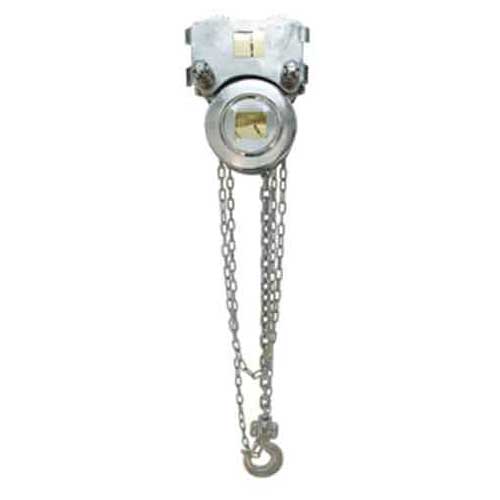
Low Headroom Stainless Steel Chain Hoist for Better Hook Height
Low headroom stainless steel chain hoist- low headroom chain block & low headroom trolley conbination, compact hoist design for better hook height.Click!
| Crane Type | Low Headroom Stainless Steel Chain Hoist / Anti-Corrosion Low Profile Chain Hoist, ISO M3–M6 / FEM 1Am–3M |
| Crane Capacity | 0.5–10 Ton (Common: 0.5 Ton, 1 Ton, 2 Ton, 3 Ton, 5 Ton) |
| Lifting Height | 3–20 m (Common: 3 m, 6 m, 9 m, 12 m) |
| Coverage Area Type | Installation Type:Low-profile fixed, push trolley, or electric trolley design for limited headroom workshops, cleanrooms, food plants, pharmaceutical facilities, and corrosion environments. |
| Application | Designed for low-ceiling production areas, food processing, pharmaceutical plants, chemical facilities, marine environments, and clean manufacturing. Used for material handling, equipment lifting, assembly, maintenance, and precision positioning. |
| Certifications | CE / ISO / SGS / Other third-party inspection |
| Customization | Customized with 304/316 stainless steel components, low headroom design, corrosion protection, cleanroom grade, IP protection, VFD control, remote control, overload protection, and custom lifting solutions. |
Crane Manufacturer: Yuantai Cranes – 30+ Years Professional Crane Manufacturer from China
Category: Hoist
Tags: lowheadroomcrane,stainlesssteel,chainhoist
Your Trusted Stainless Steel Chain Hoists Manufacturer & Supplier
Stainless Low Headroom Chain Block& Trolley
Compact Hoist Design, Better Hook Height
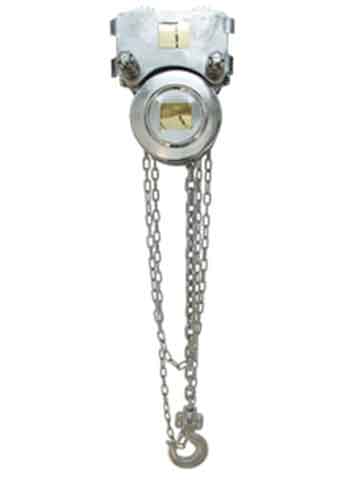
Stainless Low Headroom Chain Block& Trolle
These low headroom trolley chain hoists are fantastic for space-saving application . The low headroom stainless steel hoist and trolley has been carefully designed and constructed to accommodate the manual chain hoist case's curvature, allowing the low headroom hoist to travel higher than most other regular designed hoist/trolley combinations.
Furthermore, the low profile chain hoist and trolley are both compact and small in size, which will largely reduced the headroom dimension and providing the maximum lift height feasible underneath the stainless steel hoist.
Headroom of chain hoists
What's the headroom of the chain block?
For a better understanding, the headroom of chain hoists is seen as the space between where the hoist trolley rides on the beam to the load point on the hook when load chain and hoist hook in its uppermost position shown on the right drawing .
Headroom of the chain hoists refers to the space from the point on the hook where the load will be hanging to the point where the hoist, or hoist and trolley, connects with the support structure such as an I beam or jib crane or gantry crane which the chain hoist hangs from.
Features of low headroom stainless steel chain hoist
- Stainless steel structure for lightweight strength
- Economical low profile and low headroom hoist and trolley combination
- For small and narrow places, a compact and low headroom design is ideal.
- Heat-treated lightweight manganese alloy chain that can be utilized on both tapered and flat flange beams.
- Top and bottom hooks are made of forged steel and have locks and safety latch.
- Precision low headroom travelling trolley for smooth, effortless operation
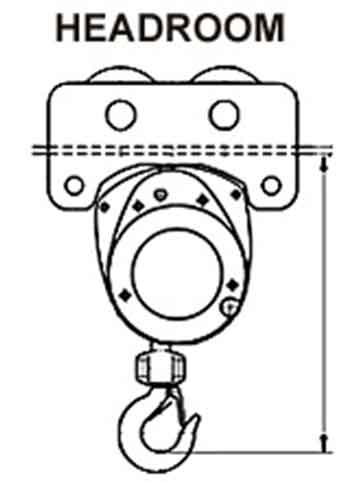
Headroom of stainless chain block
Stainless steel chain hoist with low headroom design
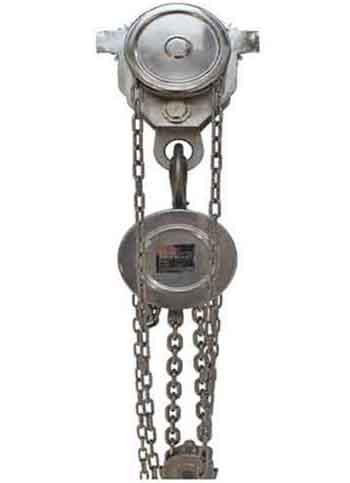
Advantage of low headroom chain blocks
- Designed for minimal distance from beam to lifting hook, the stainless hoist and trolley are perfect choices for low headroom and narrow space applications.
- Low headroom chain hoist is the fantastic option for the hoisting work under the low to very low ceiling height such as in the applications of mining and ships, etc.
- Various low headroom hoists are available with various designs and configuration, including the low headroom chain blocks, stainless steel chain blocks and explosion proof low headroom chain hoist, etc. Contact us to get your customized low headroom chain hoists .
Details of low headroom stainless steel hoists
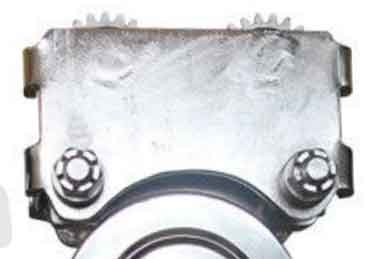
- Low headroom design for limited and narrow space place
- Provide maximum hook height possible under hoist.
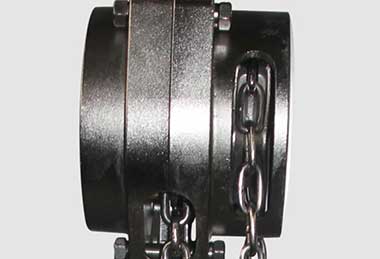
- Guide wheel, lifting sprocket, nut, hand zipper wheel, support rod, cover, left and right wall panels are all made of 304 stainless steel.
- Anti-corrosion, anti-magnetic, acid and alkali resistance
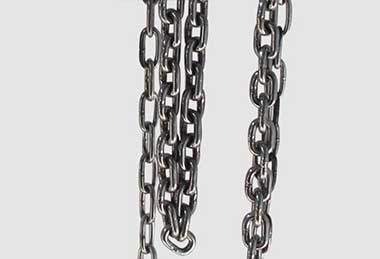
- The lifting chain and hand zipper are made of 304 stainless steel,
- Anti-corrosion, anti-magnetic, acid and alkali resistance
- Higher-strength chain; fine welding at the counterpart, suitable for sudden overweight operations.
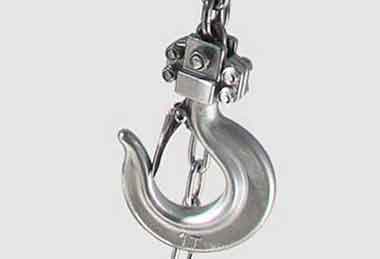
- Hook beam splint, cable plate and hook are all made of 304 stainless steel.
- The upper and lower hooks are forged and equipped with a safety card to make the items more difficult to fall off.
- Strong anti-extrusion strength, not easy to deform, not easy to break
Stainless Steel Electric Chain Hoist FAQ
Find practical answers for selecting and using stainless steel electric chain hoists in corrosive, hygienic, and industrial environments. This FAQ helps buyers understand capacities, applications, configurations, and maintenance for real workshop conditions.
What industries should use stainless steel electric chain hoists?
Answer: Industries with corrosive, hygienic, or high-moisture environments benefit most.
• Common in food processing, dairy plants, and slaughterhouses requiring hygiene
• Widely used in chemical, pharmaceutical, and paper industries with acid or alkali exposure
• Suitable for sewage treatment plants and marine environments with high humidity
• Prevents rust contamination and extends equipment lifespan
What lifting capacity is suitable for typical industrial workshops?
Answer: Most applications require 1 ton to 5 ton capacity depending on load type.
• 1–2 ton: maintenance, assembly lines, small equipment
• 3–5 ton: general manufacturing, pumps, stainless tanks
• 7.5–10 ton: heavy-duty chemical or industrial equipment
• Always allow a 25%–30% safety margin above actual load
What loads are typically handled by stainless steel chain hoists?
Answer: They handle equipment, tanks, and corrosion-sensitive materials.
• Stainless steel tanks, pipes, and valves in processing plants
• Pumps and motors in maintenance workshops
• Bulk materials in wet or corrosive environments
• Ideal where rust contamination must be avoided
Should I choose hook mounted or trolley type hoist?
Answer: Hook-mounted is for fixed lifting, while trolley type allows horizontal movement.
• Hook-mounted: simple and cost-effective for fixed stations
• Manual trolley: occasional movement along beams
• Electric trolley: frequent travel in production lines
• Common in overhead crane and monorail systems
How does stainless steel improve performance in harsh environments?
Answer: Stainless steel prevents corrosion and maintains mechanical strength.
• Resistant to acid, alkali, moisture, and oxidation
• Maintains breaking load and elongation properties
• No coating failure like painted hoists
• Ensures long-term reliability in aggressive environments
What lifting speed is best for different applications?
Answer: Lower speeds suit heavy loads, higher speeds suit light-duty tasks.
• 0.45–0.9 m/min: heavy loads and precise positioning
• 1.0–2.25 m/min: general industrial lifting
• Stable speeds improve safety and control
• Speed selection affects productivity and efficiency
How much maintenance is required for stainless steel hoists?
Answer: Maintenance is minimal with only periodic lubrication needed.
• No daily cleaning due to anti-rust surface
• Regular chain lubrication and inspection required
• Lower maintenance costs than standard hoists
• Reduced downtime in production environments
Can stainless steel hoists be used in cleanroom or food-grade environments?
Answer: Yes, they are designed for hygienic and contamination-sensitive environments.
• Smooth surfaces reduce contamination risk
• Resistant to washdowns and cleaning chemicals
• Suitable for pharmaceutical and food industries
• Supports strict hygiene standards
Can the hoist be used outdoors or in humid environments?
Answer: Yes, it performs reliably in outdoor and high-humidity conditions.
• Resistant to rain, moisture, and corrosion
• Suitable for docks, marine, and open-air sites
• No rust damage over long-term exposure
• Ideal for unprotected installations
Is stainless steel hoist worth the higher initial cost?
Answer: Yes, it offers better long-term value in corrosive environments.
• Eliminates rust-related failures and repairs
• Reduces maintenance and replacement costs
• Extends service life significantly
• Improves return on investment in harsh conditions

Yuantai Cranes
Overhead Crane Manufacturer with CE, ISO, SGS, CNEX Certificates.
- Main Specifications - Capacity: 0.5–550 tons | Span: up to 40m | Speed: 0.8–12 m/min | Duty: A3–A7 | Power: 380–690V, 50/60Hz | Control: pendant/remote/cabin
- Full engineering: FEA/PLC/VFD + in-house build + global delivery + on-site support, for workshops, factories, EPC contractors, industrial projects, etc.
- Support: design, manufacturing, testing, service – end-to-end, customized lifting solutions worldwide.
How to Get an Accurate Crane Price for Your Application?
Tips: Copy the spec list, fill in your details, and paste it into the form on the right/ down-below for a quick price.
- Crane type:_____ . (e.g., overhead crane, gantry crane, jib crane)
- Max weight to lift:_____ tons. (e.g., 2t, 5t, 10t, 20t, 50t)
- Lifting height:_____ m. (How high does the hook need to reach?
- Workshop width (span):_____ m . (Distance between the two crane rails)
- Travel distance:_____ m . (How long does the crane need to move along the runway?)
- Control type:_____. (Pendant / remote / cabin Control)
- Power supply:_____. (Local voltage & frequency – e.g., 380V, 50Hz, 3-phase)
- What will it be used for?_____ (e.g., steel fabrication, concrete products, mold handling, general manufacturing, etc.)
- Any special requirements?_____ (e.g., extreme temperature, dusty or explosive environment, special paint color, etc.)
Just leave a message via the contact form and our hoist and crane engineer will contact you with in 24working hours.
Get Your Custom Quote–Quick & Easy
Fill in what you know. Skip what you don't – we'll help.Any question will be reply with 24 working hours