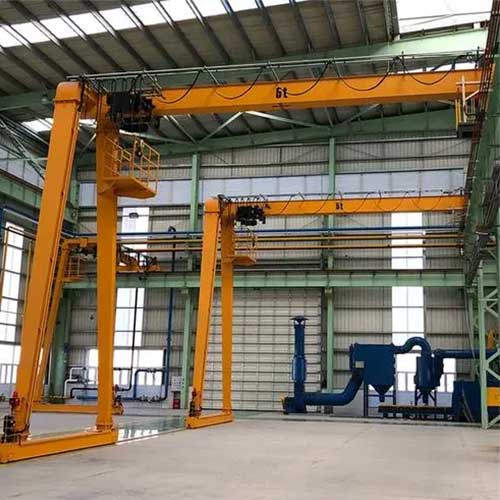
3–12 Ton Semi-Gantry Cranes for Efficient Production Lifting
3–12 ton semi-gantry cranes ideal for production lines. Localized lifting, flexible workflows, and lower investment make them perfect for small to medium workshops.
| Crane Type | 3–12 ton semi-gantry crane with one leg running on a floor rail and the opposite side supported by an existing building runway or elevated rail; single- or double-girder design; electric chain or wire rope hoist; ISO A3–A5 / FEM 1Am–3M ; 380/400/415V, 50H |
| Crane Capacity | 3–12 ton rated lifting capacity for handling machinery, steel components, equipment, molds, pallets, and other production loads. |
| Span Length | 7.5–25 m span; customized according to building layout, runway arrangement, and required lifting coverage. |
| Lifting Height | 4–10 m; customized according to building height, production equipment, storage height, and required clearance. |
| Coverage Area Type | Rectangular working coverage along the semi-gantry runway; production lines, workshops, machine areas, assembly stations, maintenance zones, warehouses, loading areas, and material storage zones. |
| Application | Production lifting, machine loading and unloading, equipment assembly, workshop material handling, maintenance, fabrication, warehouse handling, and production-line support. |
| Certifications | CE / ISO / SGS / Other third-party inspection |
| Customization | Customized 3–12 ton capacity, span, lifting height, single- or double-girder structure, electric wire rope or chain hoist, manual/electric trolley, rail-mounted or floor-supported legs, pendant/radio remote/cabin control, and application-specific lifting |
Crane Manufacturer: Yuantai Cranes – 30+ Years Professional Crane Manufacturer from China
Category: Featured
Tags:
Your Trusted Gantry Crane Manufacturer & Supplier
3–12 Ton Semi-Gantry Cranes for Production Lines
Local Lifting, Lower Investment
Most Important Takeaway
Semi-gantry cranes with 3–12 ton capacity provide production lines with precise local lifting, flexible operation, and lower capital investment compared to full gantry or bridge cranes, boosting efficiency without overspending.
Key Takeaways
- Semi-gantry cranes are ideal for small to medium production lines, enabling local lifting at specific workstations.
- Lower investment and reduced civil/structural work make them cost-effective overhead lifting solutions.
- They support flexible layout changes, quick installation, and low operational costs.
- Suitable for industries like automotive assembly, electronics manufacturing, small metal fabrication, and light machinery workshops.
- Choosing the right crane capacity (3–12 ton) ensures safety, efficiency, and future scalability.
Introduction
Efficient production lines depend heavily on material handling. If lifting and moving components around the line is slow or awkward, it quickly creates bottlenecks that impact output. At the same time, companies need to keep an eye on costs—installing a large, full-coverage overhead crane for every small workstation isn’t always practical or necessary.
This is where semi-gantry cranes come in. With capacities ranging from 3 to 12 tons, these cranes offer localized lifting exactly where it’s needed on the production floor. Because they rely on a single leg plus a runway on one side, they require less structural support than full gantry cranes, which reduces installation time and overall expenditure.
Using a semi-gantry crane lets you lift materials efficiently while keeping floor space open for other operations. These cranes are particularly useful for production lines handling medium-sized components, assemblies, or raw materials that don’t need a full-span bridge crane.
Practical benefits at a glance:
- Targeted lifting: Move heavy items directly to workstations without extra handling.
- Lower investment: Less civil work and fewer structural supports than full gantry systems.
- Flexible layout: Can be relocated or adjusted as production requirements change.
- Quick installation: Faster commissioning saves both time and labor costs.
- Safety and compliance: Meets CE and ISO standards, ensuring secure operation in industrial settings.
What Is a Semi-Gantry Crane?
Learn the definition, practical applications, and core components of semi-gantry cranes for small to medium production lines.
Definition
A semi-gantry crane is a type of overhead crane designed for localized lifting in industrial production areas. Unlike full gantry cranes that span an entire workshop, a semi-gantry crane is supported on one leg on the floor, while the other side rests on a fixed runway. This partial support reduces structural requirements and keeps costs down.
These cranes are most commonly available in 3–12 ton capacities, making them ideal for small to medium-sized production lines. They can handle components, assemblies, or materials that are too heavy for manual lifting but don't require a full-span bridge crane.
Practical points:
- Perfect for production areas with limited space or multiple workstations.
- Allows lifting exactly where materials are needed without rearranging the entire floor layout.
- Supports operations where frequent relocation or flexible workflows are required.
Core Components
A semi-gantry crane may look simple, but it combines several critical components that make it reliable and versatile:
- Electric hoist (wire rope or chain): Provides smooth and precise lifting. Choice depends on load weight, lifting speed, and production environment.
- Beam and single-leg structure: Supports the hoist while minimizing floor and ceiling requirements. Some models have wheels for mobility, allowing the crane to move between stations.
- Runway: Anchored on one side, it provides partial coverage of the workstation and supports the crane's travel along the line.
Practical tip: When evaluating a semi-gantry crane, check the hoist type, lifting height, and span length to ensure it meets your production needs.
Comparison with Other Cranes
Understand the differences between semi-gantry cranes, single girder bridge cranes, and full gantry cranes to make informed lifting decisions for your workshop.
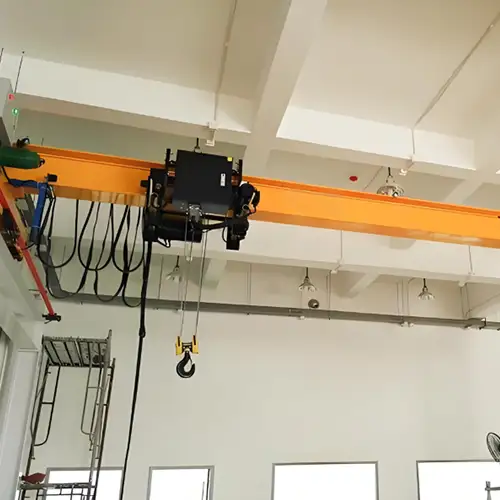

Single Girder Bridge Cranes
Single girder bridge cranes span the full width of a workshop, providing complete coverage for moving materials across the entire floor.
Advantages:
- Full workspace coverage
- Smooth, reliable operation for medium loads
Considerations:
- Higher upfront investment
- Requires more civil and structural work
- Longer installation and commissioning time
Full Gantry Cranes
Full gantry cranes are designed for heavy-duty lifting and often used outdoors or in large industrial yards. They can handle very large loads across long spans.
Advantages:
- Capable of lifting very heavy loads
- Suitable for large-scale or outdoor operations
Considerations:
- High structural and foundation requirements
- Less practical for small or medium workshops
- Higher cost for installation and maintenance
Semi-Gantry Cranes
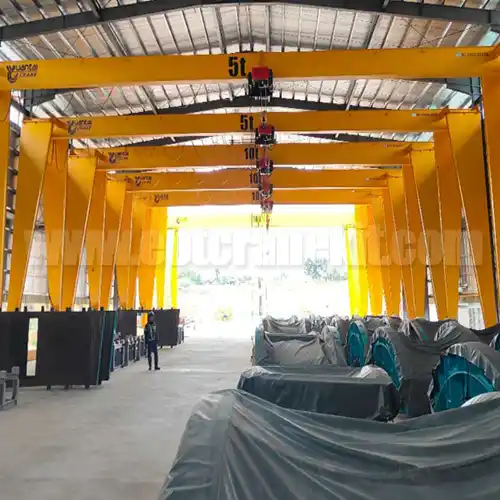
Semi-gantry cranes provide a middle-ground solution for production lines that need targeted lifting without excessive cost or floor disruption. They use a single leg on the floor and a runway on one side, allowing localized lifting at specific workstations.
Advantages:
- Lower investment compared to full gantry or bridge cranes
- Minimal civil or structural work required
- Flexible installation, suitable for evolving layouts
- Reduces floor space disruption
Considerations:
- Coverage is limited to the crane's travel along the runway
- Not ideal for full workshop coverage or extremely heavy loads
For small to medium production lines where space, cost, and flexibility are important, semi-gantry cranes offer the best balance between lifting capability and investment. They provide practical, localized solutions without overbuilding the workshop infrastructure.
Benefits for Production Lines
Semi-gantry cranes provide localized, flexible, and cost-effective lifting solutions that improve efficiency on small to medium production lines.
Local Lifting
Semi-gantry cranes lift materials exactly where they're needed, cutting down on manual handling and saving time on the production line.
- Precise placement at workstations
- Reduces material handling delays
- Minimizes risk of damage during transfer
Flexibility
Their moveable or modular design adapts easily to changes in production layout. Lifting height can also be adjusted for different components or tasks.
- Can relocate between stations if needed
- Adjustable for varied production tasks
- Supports evolving workflows without major changes
Efficiency
By taking the strain off workers and streamlining lifting, these cranes help increase throughput. They also allow multiple operations simultaneously without blocking the line.
- Less worker fatigue and faster operations
- Enables simultaneous workstation use
- Smooth material flow along production line
Lower Investment
Semi-gantry cranes require minimal civil or structural work, making them a cost-effective alternative to full gantry or bridge cranes. Energy and maintenance costs are also lower.
- Fewer structural requirements
- Reduced installation costs
- Lower energy consumption and upkeep
Practical Buyer Considerations
Key factors to evaluate before purchasing a semi-gantry crane, ensuring safety, efficiency, and suitability for your production line.
Capacity Selection
Choose a crane capacity (3, 5, 8, or 12 ton) that fits both current and future production requirements.
- Avoid overloading or underutilization
- Plan for potential production growth
Installation Space
Check floor clearance, aisle width, and how the crane integrates with existing equipment.
- Ensure smooth crane travel
- Maintain safe working zones
Customization
Consider hoist covers for dust or outdoor use, corrosion protection, or semi-automation for repetitive lifting tasks.
- Adapt to environmental conditions
- Improve productivity and equipment lifespan
Safety Compliance
Ensure CE or ISO certification, overload protection, and emergency stop systems are included.
- Meet industrial safety standards
- Reduce workplace accidents
Cases for References
Real-world examples showing how semi-gantry cranes support different production lines and workflows efficiently.
Automotive Component Line
A 5-ton semi-gantry crane lifts parts directly at individual workstations, minimizing manual handling and keeping the line running smoothly.
- Supports precise placement of components
- Reduces production delays
- Fits multiple stations in limited floor space
Electronics Assembly
A 3-ton adjustable semi-gantry crane handles small to medium components efficiently, making the most of tight assembly areas.
- Flexible for different tasks
- Saves space while boosting productivity
- Easy to move between workstations
Metal Fabrication Shop
A 12-ton semi-gantry crane handles heavy assemblies while keeping costs lower than a full gantry system.
- Supports multiple local lifting tasks
- Reduces upfront investment
- Durable and low-maintenance solution
Questions Solved
Answers to common buyer questions about semi-gantry cranes, capacities, cost savings, and installation options.
1. What is a semi-gantry crane, and how does it differ from full gantry or single girder cranes?
A semi-gantry crane is supported on one leg on the floor and one side on a fixed runway, offering partial coverage of the workspace. Unlike full gantry cranes, it doesn't span the entire area, which reduces installation cost and structural requirements. Compared with single girder bridge cranes, it provides localized lifting instead of full-floor coverage, making it ideal for small to medium production lines.
- Partial support for reduced civil work
- Localized lifting at specific workstations
- Flexible layout for evolving production needs
2. Why is a 3–12 ton semi-gantry crane ideal for production lines?
Cranes in the 3–12 ton range match the needs of small and medium production lines. They are strong enough for most assembly components or medium-weight materials, but compact enough to fit tight workspaces without overbuilding the floor or ceiling structure.
- Handles medium-duty loads efficiently
- Fits limited spaces and multiple workstations
- Supports flexible lifting without excessive investment
3. How can these cranes reduce capital expenditure and operational costs?
Semi-gantry cranes require less structural support and civil work than full gantry or bridge cranes. Installation is faster, and energy use is lower due to lighter hoists and rails. Maintenance is also simpler, which reduces long-term operational costs.
- Lower upfront investment
- Reduced foundation or runway construction
- Energy-efficient lifting
- Less frequent maintenance compared with larger cranes
4. What installation and customization options are available for small production spaces?
These cranes can be fixed or mobile, depending on your layout. Optional features include:
- Hoist covers for dust or outdoor protection
- Corrosion-resistant coatings for harsh environments
- Semi-automation for repetitive lifting tasks
- Adjustable lifting height to suit various components
These options help small production areas adapt the crane to workflow needs while keeping installation simple.
5. How to select the right semi-gantry crane for local lifting tasks?
Selecting the right crane depends on a few key factors:
- Capacity: Match the crane's tonnage (3, 5, 8, 12 ton) to current and projected load requirements.
- Space: Check floor clearance, aisle width, and integration with existing equipment.
- Workflow needs: Consider mobility, modularity, and lifting height.
- Safety: Ensure CE or ISO certification, overload protection, and emergency stops.
Choosing carefully ensures efficient, safe, and cost-effective local lifting that meets production demands.
Conclusion
3–12 ton semi-gantry cranes offer production lines a practical and cost-effective solution for lifting and moving materials. They combine localized lifting, operational flexibility, and lower investment compared with full gantry or bridge cranes.
When choosing a semi-gantry crane, buyers should focus on a few key points:
- Capacity: Select the right tonnage (3, 5, 8, or 12 ton) based on current production needs and possible future growth.
- Layout and Space: Consider floor clearance, aisle width, and integration with existing equipment to ensure smooth operation and safety.
- Customization: Add features like hoist covers for dust or outdoor use, corrosion protection, or semi-automation for repetitive tasks.
- Safety and Compliance: Make sure the crane has CE or ISO certification, overload protection, and emergency stop systems to protect operators and materials.
By balancing these factors, companies can maximize productivity, reduce manual handling, and maintain a smooth workflow while keeping costs under control. Semi-gantry cranes are especially suitable for small to medium production lines in industries like automotive assembly, electronics, metal fabrication, and light machinery workshops.
In short, a well-planned semi-gantry crane installation not only streamlines material handling but also protects your budget and adapts to evolving production needs, making it a practical and reliable choice for modern industrial operations.



Yuantai Cranes
Overhead Crane Manufacturer with CE, ISO, SGS, CNEX Certificates.
- Main Specifications - Capacity: 0.5–550 tons | Span: up to 40m | Speed: 0.8–12 m/min | Duty: A3–A7 | Power: 380–690V, 50/60Hz | Control: pendant/remote/cabin
- Full engineering: FEA/PLC/VFD + in-house build + global delivery + on-site support, for workshops, factories, EPC contractors, industrial projects, etc.
- Support: design, manufacturing, testing, service – end-to-end, customized lifting solutions worldwide.
How to Get an Accurate Crane Price for Your Application?
Tips: Copy the spec list, fill in your details, and paste it into the form on the right/ down-below for a quick price.
- Crane type:_____ . (e.g., overhead crane, gantry crane, jib crane)
- Max weight to lift:_____ tons. (e.g., 2t, 5t, 10t, 20t, 50t)
- Lifting height:_____ m. (How high does the hook need to reach?
- Workshop width (span):_____ m . (Distance between the two crane rails)
- Travel distance:_____ m . (How long does the crane need to move along the runway?)
- Control type:_____. (Pendant / remote / cabin Control)
- Power supply:_____. (Local voltage & frequency – e.g., 380V, 50Hz, 3-phase)
- What will it be used for?_____ (e.g., steel fabrication, concrete products, mold handling, general manufacturing, etc.)
- Any special requirements?_____ (e.g., extreme temperature, dusty or explosive environment, special paint color, etc.)
Just leave a message via the contact form and our hoist and crane engineer will contact you with in 24working hours.
Get Your Custom Quote–Quick & Easy
Fill in what you know. Skip what you don't – we'll help.Any question will be reply with 24 working hours