Tandem Lifting Overhead Cranes: Risks & Buyer Guide
In-depth guide to tandem lifting with overhead cranes. Understand load sharing, synchronization, overload risks, retrofit checks, and safe crane buyer solutions.
| Crane Type | Tandem lifting overhead/EOT crane system using two coordinated cranes or two lifting mechanisms; typically double-girder for heavy loads; electric wire rope hoists or open winches; remote synchronized control; ISO A5–A8 / FEM 2M–5M duty class; 380/400/415 |
| Crane Capacity | Typically 20–500 ton total tandem lifting capacity; each crane or hoist is rated according to the required load-sharing arrangement and synchronized lifting configuration. |
| Span Length | Typically 15–35 m span; runway length and coordinated working range customized according to the facility layout and load path. |
| Lifting Height | Typically 6–30 m; customized according to load dimensions, building height, installation clearance, and lifting process. |
| Coverage Area Type | Shared crane-bay coverage for coordinated lifting; workshops, fabrication bays, assembly areas, maintenance zones, machinery installation areas, warehouses, and heavy-load handling zones. |
| Application | Heavy machinery lifting, long and oversized loads, steel structures, bridge sections, vessels, molds, transformers, precast components, equipment installation, and synchronized industrial material handling. |
| Certifications | CE / ISO / SGS / Other third-party inspection |
| Customization | Customized total lifting capacity, individual crane/hoist capacity, two-crane or dual-hoist configuration, electric wire rope hoists or open winches, synchronized trolley and crane travel, PLC control, load monitoring, positioning, anti-collision, specifi |
Crane Manufacturer: Yuantai Cranes – 30+ Years Professional Crane Manufacturer from China
Category: Featured
Tags:
Your Trusted Overhead Crane Manufacturer & Supplier
Tandem Lifting Overhead Cranes
A Comprehensive Buyer Guide to Advantages, Risks, and Safe Implementation
Most Important Takeaway
Tandem lifting with overhead cranes is a load-sharing system that must be engineered as a synchronized mechanical and electrical unit. When properly designed with matched hoists, electronic synchronization, structural verification, and formal lift planning, it improves lifting capacity utilization, load stability, vertical clearance, and operational efficiency. When improvised or under-engineered, it introduces latent overload, desynchronization, structural torsion, and safety device conflicts that are often invisible until equipment damage or an accident occurs.
Key Takeaways for Crane Buyers
- Tandem lifting increases effective lifting capability without necessarily installing a single oversized crane.
- Load sharing must be electronically controlled; visual coordination is insufficient.
- Latent overload can occur even when total weight equals combined rated capacity.
- Lowering operations can generate more risk than lifting due to sudden load transfer.
- Long-span travel magnifies small speed differences into significant misalignment.
- Limit switches and anti-collision systems must be integrated into tandem logic.
- Turning loads in tandem requires dedicated procedures and speed restrictions.
- Retrofitting an existing overhead crane demands structural and electrical review.
- A documented lift plan and trained operators are essential for multi-point lifting.
Questions Answered in This Guide
- Is tandem lifting dangerous with overhead cranes?
- When is tandem lifting the best solution?
- How does uneven load sharing damage hoists?
- What engineering controls are required?
- Can two cranes lift one load safely?
- How do you prevent overload during lowering?
- What should be verified before converting to dual hoists?
- How should crane buyers evaluate tandem-ready systems?
Tandem Lifting in Overhead Crane Operations
Tandem lifting in overhead crane operations means one load is lifted by two hoists or two bridge cranes at the same time. It sounds straightforward. Two hooks, one object, lift together. In practice, it is more complex than that.
The moment two lifting devices connect to the same load, they stop acting as separate machines. They become a connected mechanical system. The load links them together. Any movement from one side affects the other.
You will typically find tandem lifting in facilities where loads are either too heavy for a single hook point or too long to remain stable under one lifting position. Common applications include:
- Steel fabrication shops handling long structural beams
- Precast concrete plants lifting wall panels or bridge components
- Wind tower manufacturing and heavy energy equipment assembly
- Pressure vessel and tank production
- Large equipment frame fabrication
- Machining operations turning oversized castings
In these environments, tandem lifting is not unusual. It is often part of daily production.
From Manual Coordination to Synchronized Control
In earlier crane systems, tandem lifting depended largely on operator skill. Two crane operators would coordinate by radio or hand signals. They would try to match lifting speed and travel motion by judgment. Sometimes the lift went smoothly. Other times, one side would move slightly ahead, and the load would shift before anyone realized it.
Typical characteristics of traditional tandem lifting included:
- Independent control stations
- No electronic speed matching
- Visual checks for alignment
- Separate limit switches
- No real-time load feedback per hoist
That approach relied heavily on experience. Experience still matters. But modern overhead crane operations demand more predictable control.
Today, tandem lifting systems often use integrated motion control. A single operator can control both hoists through a master and slave configuration. Variable frequency drives are programmed with identical speed curves, allowing both lifting devices to accelerate and decelerate at nearly the same rate.
Modern tandem systems may include:
- VFD-controlled hoisting and travel motions
- Master/slave radio transmitters
- Electronic load cells on each hoist
- Shared motion logic between cranes
- Synchronized deceleration and braking settings
This does not eliminate risk. It reduces variability. That is an important difference.

Advantages of Tandem Lifting in Overhead Crane Applications
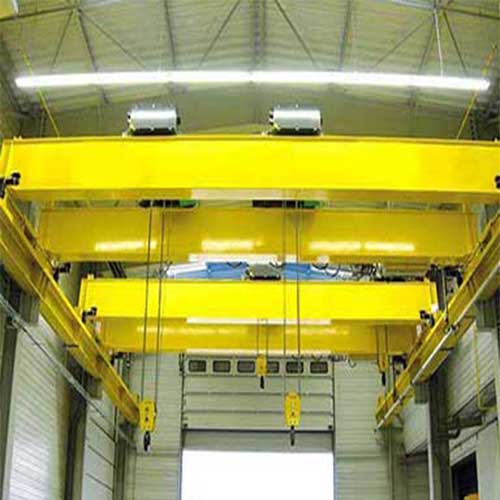
Tandem lifting is used when one hook is not enough. The load may be too heavy, too long, or hard to control from a single point. Two hoists working together give better balance and more control, while improving safety and efficiency in crane operations.
Increased Effective Lifting Capacity
The most obvious benefit of tandem lifting is higher lifting capacity. By using two hoists, each rated for a portion of the total load, you can handle larger loads safely while reducing stress on the crane structure.
For example, two 5-ton hoists can lift a 10-ton load in theory. Weight is distributed between two points instead of one, which helps avoid unnecessary strain.
Benefits include:
- Avoiding the cost of one oversized 10-ton hoist
- Reducing wheel loads on end trucks
- Reducing stress on bridge girders
- Avoiding reinforcement of runway beams
- Lowering building modification costs
Lower total system cost and easier installation make this a practical solution for many facilities. However, synchronization is key—one hoist lifting slightly faster than the other can overload equipment, so electronic controls are essential.
Better Stability for Long or Flexible Loads
Long beams, fabricated frames, tanks, and large precast elements don't behave like compact loads. A single lift point can cause bending, twisting, and excessive swing.
Two lifting points provide much better stability, keeping the load level and easier to control.
Advantages include:
- Reduced bending during lifting
- Better load balance and level positioning
- Lower swing and twisting
- Protection of painted or machined surfaces
- Improved access for welding or assembly
In steel fabrication or precast concrete plants, this helps prevent product damage and keeps operations smoother. Two hooks simply hold the load more evenly, improving safety and quality.
More Lifting Height in Low Buildings
Older workshops often have limited ceiling height. Spreader beams and long slings take up vertical space under the hook, reducing lifting height.
Tandem lifting allows hooks to connect directly to anchor points on the load, removing the need for bulky below-the-hook devices.
Benefits include:
- Increased usable lifting height
- Better hook approach for stacking or placement
- Fewer clearance issues
- Easier handling of large parts
This simple change often solves day-to-day production constraints without requiring structural modifications to the building.
Improved Productivity and Easier Handling
Tandem lifting also simplifies handling when parts have multiple anchor points at different elevations. Operators can attach directly without complicated sling adjustments.
This improves workflow and ergonomics in fabrication shops.
Practical benefits include:
- Faster rigging and setup
- Less manual repositioning of loads
- Better control during placement and rotation
- Smoother, safer load rotation
- Reduced physical strain on operators
- Improved welding angles and accessibility
- Faster overall workflow and production efficiency
Over time, these small improvements significantly enhance operational efficiency and reduce workplace fatigue.
The Hidden Risks of Tandem Lifting
Tandem lifting seems straightforward: two hoists share the load, doubling capacity and improving stability. In reality, the risks are dynamic, appearing during movement rather than while the load is stationary. Most failures occur not from exceeding total load capacity but from uneven load sharing.
Latent Capacity Overload
Latent overload happens when one hoist temporarily carries more than its rated load due to imperfect synchronization. This is one of the most common hidden risks.
For example:
- Total load: 10 tons
- Two hoists rated at 5 tons each
- During lifting, one hoist briefly carries 7–8 tons
Even brief overload can:
- Stress gear teeth in reducers
- Stretch wire ropes beyond their elastic limits
- Overload or overheat brakes
- Cause motor overcurrent
- Induce fatigue cracks in bridge or trolley structures
- Shorten equipment life
Many overload limiters only respond during lifting, not lowering. That is why synchronized speed control and load monitoring are critical in engineered tandem systems.
Lowering Imbalance
Lowering often presents greater risk than lifting. If one hook reaches the ground first, the second may absorb most of the load suddenly.
Consequences include:
- Instant load transfer
- Shock loading
- Brake stress
- Rope tension spikes
To mitigate risk, tandem cranes should have:
- Matched brake torque settings
- Controlled deceleration ramps
- Synchronized lowering speeds
- Clear operator procedures for landing loads
Lowering is an active process and requires the same level of planning as lifting.
Travel Speed Mismatch
When two cranes travel together, even small speed differences become significant over long runways. A 2% difference over 100 feet can create misalignment.
Impacts include:
- Increased sling angles
- Side loading on hooks and trolleys
- Bridge skew
- Uneven wheel loading
- Accelerated runway rail wear
- Increased structural fatigue
Electronic synchronization, using VFDs or master/slave logic, is essential to avoid long-term damage.
Safety Device Interference
Safety devices like limit switches and anti-collision sensors are necessary but can cause hazards if independent.
Examples:
- Limit switches triggering only one crane
- Anti-collision sensors stopping one crane but not the other
- End-stop proximity sensors acting independently
For tandem lifting, safety devices must be integrated into the control logic so that both cranes respond simultaneously, with synchronized deceleration and stop commands.
Center of Gravity Miscalculation
Knowing total weight is not enough. The center of gravity (COG) must be identified to prevent uneven load sharing.
Issues caused by COG errors:
- Uneven rope tension
- Tilted load orientation
- Overload on one hoist
- Increased swing during travel
Preventive measures:
- Confirm documented weight and COG data
- Identify lifting points clearly
- Perform a controlled pre-lift test
A slow test lift can reveal imbalances before full travel begins.
Turning and Rotational Hazards
Rotating loads with two hoists is the riskiest maneuver. Dynamic load transfer can cause one hoist to lift while the other lowers slightly.
Risks include:
- Constant rope tension changes
- Critical reliance on brake systems
- Sudden movement from small speed differences
- Load shifts if acceleration or braking is uneven
Safe rotation requires:
- Low-speed, controlled operation
- Matched acceleration and deceleration settings
- Clear operator communication
- Formal turning procedures
Most tandem lifting accidents occur during turning, not straight lifts or travel.
Why These Risks Matter
The risks may seem minor in isolation, but they are cumulative. Small imbalances today can reduce component life and increase long-term costs.
Consequences of repeated minor overloads:
- Shortened gearbox and reducer life
- Accelerated brake wear
- Wire rope fatigue
- Structural stress accumulation
- Higher maintenance and replacement costs
Tandem lifting is safe only when synchronized controls, load monitoring, and operational discipline are engineered from the start. Otherwise, localized overload occurs even when total rated capacity is not exceeded.
Engineering Controls Required for Safe Tandem Lifting
Tandem lifting is only as safe as the engineering behind it. Simply connecting two hoists to a load is not enough. Proper mechanical, electrical, and monitoring controls are essential to ensure load sharing, synchronized movement, and full operator visibility.
Mechanical Requirements
The mechanical setup of the cranes and hoists is fundamental. Any difference in hoist or bridge characteristics can cause uneven load distribution and create hidden stresses.
Key mechanical requirements include:
- Identical hoist models to ensure matched lifting speed, braking behavior, and rated capacity
- Matched rope reeving to prevent one hoist from pulling harder than the other
- Equal drum diameters to avoid differences in rope speed and lift height
- Verified bridge torsional capacity to handle twisting from uneven loads
- Structural runway evaluation to ensure rails and supports can handle combined and dynamic forces
Proper mechanical preparation reduces unexpected overloads and extends equipment life.
Electrical and Control Requirements
Electrical and control systems are critical to synchronize hoists and maintain safe operation. Without proper controls, two independent hoists cannot act as a coordinated unit.
Essential electrical and control features include:
- Master/slave remote control operation for one operator to manage both hoists simultaneously
- VFD-based synchronized lifting to ensure matched lift and lower speeds
- Matched acceleration and deceleration ramps to prevent sudden load shifts
- Interconnected limit switch communication so both hoists respond together to physical limits
- Coordinated anti-collision logic to prevent one crane stopping while the other continues
These features transform two separate hoists into a predictable, coordinated lifting system.
Monitoring Requirements
Even with proper mechanical and electrical systems, operators need real-time feedback to maintain safe tandem lifting.
Key monitoring elements include:
- Individual load cells per hoist to measure the exact load on each hoist
- Real-time load display for immediate awareness of load distribution
- Overload interlocks to automatically stop a lift if a hoist exceeds capacity
- Tandem mode indicator lights showing clearly when cranes are operating in tandem
- Event logging for diagnostics, maintenance planning, and safety audits
Monitoring adds a crucial safety layer, catching issues before they become mechanical failures or accidents.
Summary
Safe tandem lifting depends on three pillars: mechanical preparation, synchronized control, and continuous monitoring. Each element ensures smooth movement, balanced load sharing, and adherence to hoist capacity limits.
When these engineering controls are in place, tandem lifting becomes a practical and repeatable production solution. Without them, it remains a risky maneuver that can cause hidden stress, overload, and potential equipment damage.
Industries Where Tandem Lifting Delivers the Highest ROI
Tandem lifting is not a one-size-fits-all solution. Certain industries see the most value from dual-hoist operations because of the size, weight, or shape of their loads. Understanding where tandem lifts provide practical benefits helps buyers make better investment decisions.
Steel Fabrication Shops
In steel fabrication, long beams, welded frames, and large plates often exceed the practical reach or stability of a single hoist. Tandem lifting helps distribute weight evenly, reducing bending stress and improving safety during transport and positioning.
- Minimizes distortion in long structural members
- Allows safer rotation and flipping of welded frames
- Reduces rework caused by bending or warping
Precast Concrete Plants
Precast panels and bridge components are heavy, brittle, and awkward to handle. Using two hoists keeps panels level and reduces the chance of cracks or surface damage during lifting and transport.
- Improved load balance for large slabs
- Reduced risk of concrete cracking
- Faster positioning onto molds or transport carts
Heavy Equipment Manufacturing
Engines, press frames, or assembled machines often have multiple lifting points. Tandem lifting allows precise alignment and controlled rotation during assembly without overloading a single hoist.
- Reduced rigging time for large assemblies
- Minimized part damage during installation
- Safer handling of high-value components
Shipyards
Shipbuilding involves lifting large plates, engine blocks, and superstructure modules. Tandem lifts allow simultaneous engagement of multiple points, reducing torsion and swing while moving heavy sections across docks.
- Safer movement of oversized hull sections
- Reduced twisting in large metal modules
- Improved placement accuracy during assembly
Wind Energy Tower Assembly
Wind towers are tall, heavy, and often tapered. Tandem lifts allow two hoists to manage the same section, keeping it upright and preventing unwanted rotation during installation or transport.
- Controlled lifting of long tubular sections
- Reduced risk of tipping or twisting
- Faster alignment with foundation or tower sections
Die-Casting and Mold Manufacturing
Large dies or molds are heavy, precise, and require careful handling. Tandem lifting allows both lifting points to share the load equally, reducing stress and avoiding deformation of critical tooling.
- Protects expensive molds from bending or distortion
- Reduces setup time during machine installation
- Improves safety when moving heavy, delicate tooling
Key Operational Benefits Across Industries
Across these sectors, tandem lifting provides measurable gains in efficiency, safety, and product quality.
- Reduced part damage from bending or swinging
- Faster rigging and setup time
- Improved ergonomics for welders and assembly workers
- Lower rejection rates from misaligned or stressed components
- Fewer handling incidents and operator fatigue
Operational Controls and Lift Planning
Even well-engineered tandem lifting systems can fail without proper operational controls. Careful planning and operator awareness are crucial to prevent overload, imbalance, or unexpected load movement.
Formal Lift Planning Essentials
Every tandem lift should begin with a formal lift plan. This ensures predictable, controlled handling and reduces the chance of incidents. Key elements include:
- Weight and Center of Gravity: Verify total load and distribution across both lifting points to prevent overload on one hoist.
- Attachment Points: Confirm hooks, slings, or shackles are connected at engineered lifting locations.
- Travel Path: Identify obstacles, check runway condition, and ensure adequate clearance along the route.
- Turning or Rotation Steps: Define controlled rotation procedures when the load needs to be flipped or rotated, including speed limits.
- Low-Speed Test Lift: Perform a short lift to detect imbalance, uneven load sharing, or unexpected movement before full-height lifting.
- Communication Protocol: Set up hand signals, radio commands, or other agreed methods for start, stop, and emergency actions.
- Inspection Schedule: Adjust inspection intervals for brakes, ropes, drums, wheels, and bridge/trolley structures to account for tandem operation stresses.
- Operator Training: Ensure operators understand multi-point lifting, master/slave control, load monitoring, and emergency response procedures.
Pre-Lift Checks and Safety Verification
Before any lift, a pre-lift inspection should verify the load, equipment, and environment. Important checks include:
- Confirm all hoists are matched and functioning correctly.
- Ensure rigging hardware is rated for the combined load.
- Check that load cells and monitoring systems are operational.
- Test limit switches, anti-collision devices, and brakes for tandem mode operation.
- Verify that operator communication devices are working and understood by all involved.
These steps ensure that no unexpected variable can compromise the lift.
Controlled Lift Execution
After planning and pre-lift verification, the lift must proceed methodically. Key practices include:
- Lift slowly and evenly, monitoring load distribution in real-time.
- Follow the documented sequence for travel, rotation, and placement.
- Maintain continuous communication between operators and supervisors.
- Respond immediately to any signs of imbalance or unexpected load movement.
Every lift should be treated as a carefully coordinated operation rather than relying solely on operator intuition or experience.
Benefits of Proper Operational Control
Implementing structured lift planning and operational controls yields clear advantages:
- Reduces risk of overload and mechanical failure.
- Minimizes dynamic load shifts and swinging.
- Improves operator confidence and coordination.
- Ensures repeatable, safe, and efficient tandem lifting cycles.
- Supports regulatory compliance and safety audits.
With proper operational planning, tandem lifting becomes predictable and safe, turning a complex maneuver into a routine and reliable production process.
Decision Framework for Crane Buyers
Tandem lifting can increase lifting capacity, stability, and operational flexibility—but it is not automatically the right choice for every facility or load. Buyers must evaluate load characteristics, facility constraints, and operator readiness to decide whether dual hoists are justified.
When Tandem Lifting Makes Sense
Dual-hoist lifting is recommended in scenarios where multiple hoists clearly improve control, reduce stress, and enhance safety:
- Heavy but stable loads: Two hoists share the load evenly when a single hoist cannot handle it safely.
- Long or flexible parts: Beams, tanks, or fabricated frames benefit from dual support to reduce bending, sway, and material stress.
- Limited vertical clearance: Ceiling height or hook approach may be restricted. Direct dual-hook lifting can eliminate bulky spreader beams and increase usable lifting height.
- Controlled rotation or positioning: When components need to be flipped, rotated, or aligned precisely, two hoists improve stability and reduce manual handling risks.
When Tandem Lifting May Not Be Suitable
Tandem lifting is not universally safe or efficient. Consider alternatives if any of the following apply:
- Unpredictable weight distribution: Uneven or shifting loads can overload one hoist even if the total weight is within combined capacity.
- Mixed equipment brands or models: Differences in lifting speed, braking, or response time make synchronization difficult and risky.
- Operators not trained in tandem operations: Experience alone is not enough; operators need specific training for multi-point lifts with synchronized control.
- Runway structures near their load limits: Dynamic forces in tandem lifting may exceed structural capacity, introducing fatigue and safety hazards.
In these situations, using a well-designed spreader beam or below-the-hook lifting frame may provide simpler, safer, and more predictable load control without adding a second hoist.
Evaluating Practical Solutions
Crane buyers should take a structured approach when deciding on tandem lifting:
- Assess load type, weight, and geometry to determine if dual points are required for stability.
- Evaluate facility constraints including ceiling height, hook approach, and runway limits.
- Verify operator readiness, training, and availability of synchronized control systems.
- Compare tandem lifting versus alternative methods such as engineered spreader beams or lifting frames.
- Consult with structural and mechanical engineers to confirm bridge and runway capacity for dynamic tandem forces.
By combining these considerations, buyers can make informed, practical decisions that balance efficiency, safety, and cost-effectiveness.
Conclusion
Tandem lifting with overhead cranes offers practical advantages that can directly improve day-to-day operations. By using two hoists together, you can lift heavier loads, handle long or flexible parts safely, gain extra vertical clearance, and simplify complex positioning or rotation tasks. These improvements translate into more stable handling, better product quality, and smoother workflow.
However, these benefits come with important responsibilities. Synchronization, load sharing, and structural interactions introduce risks that must be carefully managed. Safe tandem lifting is not automatic—it requires:
- Matched and compatible equipment
- Electronic speed and motion synchronization
- Verified structural and runway capacity
- Real-time load monitoring on each hoist
- Formal lift planning and operator training
Tandem lifting should never be treated as a casual or improvised solution. When properly designed and executed, it becomes a reliable and practical production tool. Ignoring the engineering and operational requirements, however, can create hidden hazards, shorten equipment life, and compromise safety.
The key takeaway for crane buyers is clear: tandem lifting works best when it is deliberately planned, fully engineered, and carefully controlled—otherwise, the risks outweigh the benefits.
Frequently Asked Questions About Tandem Lifting
Tandem lifting often raises practical concerns for crane buyers, operators, and maintenance teams. The following FAQs address the most common questions and clarify operational and safety considerations.
Is tandem lifting with two smaller hoists equivalent to using one larger hoist?
Not automatically. Even if the combined rated capacity equals the load, temporary imbalances can occur during lifting or lowering. Proper synchronization, load monitoring, and electronic control systems are required to ensure each hoist carries its intended share safely.
Can lowering cause overload even if lifting is safe?
Yes. During lowering, if one hook reaches the ground before the other, the remaining hoist may momentarily bear the full load. Many load limiters only protect during upward motion, so coordinated deceleration and operator attention are critical to prevent shock loading or component stress.
Do two overhead cranes traveling together require special control systems?
Absolutely. Travel speeds, limit switches, and anti-collision systems must be integrated into tandem control logic. Without proper synchronization, even minor speed differences can produce sling angles, side loading, or structural stress on bridge and runway components.
Is a formal lift plan necessary for dual-hoist operations?
Yes. Multi-point lifting requires a documented plan including total load weight, center of gravity, attachment points, and procedural steps. A formal lift plan ensures predictable and safe movement throughout lifting, lowering, travel, and rotation phases.
Can existing cranes be upgraded for tandem lifting?
Yes, but only after thorough engineering analysis. Structural bridge capacity, trolley load distribution, electrical panel rating, power supply, and runway fatigue must all be verified. Retrofitting without evaluation increases the risk of overload, premature wear, and unexpected downtime.
What is the most common mistake in tandem lifting?
The most frequent error is assuming that two hoists with equal rated capacity automatically share the load evenly. Dynamic effects such as load swing, rope tension differences, or unsynchronized motion can create temporary overloads unless the system is properly controlled.


Yuantai Cranes
Overhead Crane Manufacturer with CE, ISO, SGS, CNEX Certificates.
- Main Specifications - Capacity: 0.5–550 tons | Span: up to 40m | Speed: 0.8–12 m/min | Duty: A3–A7 | Power: 380–690V, 50/60Hz | Control: pendant/remote/cabin
- Full engineering: FEA/PLC/VFD + in-house build + global delivery + on-site support, for workshops, factories, EPC contractors, industrial projects, etc.
- Support: design, manufacturing, testing, service – end-to-end, customized lifting solutions worldwide.
How to Get an Accurate Crane Price for Your Application?
Tips: Copy the spec list, fill in your details, and paste it into the form on the right/ down-below for a quick price.
- Crane type:_____ . (e.g., overhead crane, gantry crane, jib crane)
- Max weight to lift:_____ tons. (e.g., 2t, 5t, 10t, 20t, 50t)
- Lifting height:_____ m. (How high does the hook need to reach?
- Workshop width (span):_____ m . (Distance between the two crane rails)
- Travel distance:_____ m . (How long does the crane need to move along the runway?)
- Control type:_____. (Pendant / remote / cabin Control)
- Power supply:_____. (Local voltage & frequency – e.g., 380V, 50Hz, 3-phase)
- What will it be used for?_____ (e.g., steel fabrication, concrete products, mold handling, general manufacturing, etc.)
- Any special requirements?_____ (e.g., extreme temperature, dusty or explosive environment, special paint color, etc.)
Just leave a message via the contact form and our hoist and crane engineer will contact you with in 24working hours.
Get Your Custom Quote–Quick & Easy
Fill in what you know. Skip what you don't – we'll help.Any question will be reply with 24 working hours