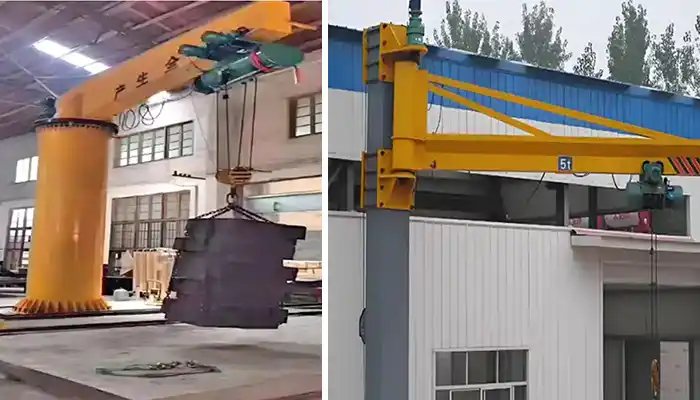
5 Ton Jib Cranes: Floor-Mounted vs. Wall-Mounted Differences
Content Quick Link
Introduction: Choosing the Right 5 Ton Jib Crane for Your Workshop
A 5-ton jib crane is one of the most practical tools for moving heavy loads safely in industrial settings. Whether it's a workshop, assembly line, or outdoor fabrication area, these cranes make lifting faster, easier, and more controlled. They are commonly used in manufacturing, construction, marine operations, and storage facilities.
But here's the thing: picking the right type isn't just about the weight it can lift. It's about space, installation, and operational efficiency. The wrong crane can slow down work, increase costs, or even create safety hazards.
This guide focuses on helping you understand the differences between floor-mounted and wall-mounted 5-ton jib cranes. By the end, you'll know which type fits your workshop needs, installation conditions, and workflow.
What You'll Learn in This Guide:
- Key features and applications of floor-mounted 5-ton jib cranes
- Advantages and use cases of wall-mounted 5-ton jib cranes
- A side-by-side comparison of both types: load capacity, rotation, space usage, and installation requirements
- Practical tips for choosing the right crane for your environment and workflow
Strong and Stable: Floor-Mounted 5 Ton Jib Cranes
Floor-mounted 5-ton jib cranes are designed for maximum stability and reliability. Anchored to a solid foundation or steel pillar, they are ideal for lifting heavy loads safely in workshops, outdoor fabrication areas, and industrial yards. Their robust construction allows frequent use while providing wide rotational coverage for various lifting tasks.
Key Advantages
Floor-mounted cranes offer several benefits that make them suitable for demanding industrial applications:
- Handles heavier loads with full stability: Perfect for lifting 5-ton loads repeatedly without risk
- Ideal for open floors or outdoor setups: Works well in spacious workshops or outdoor industrial areas
- Wide rotation coverage: Allows rotation up to 360°, providing flexibility in material handling
Typical Installation Requirements
Before installing a floor-mounted jib crane, certain site preparations are essential:
- Concrete foundation or steel pillar: Ensures the crane remains stable under full load
- Duty class and height specifications: Must align with lifting requirements and usage frequency
- Clear workspace: Required to allow safe rotation and unimpeded movement of loads
Common Industries
Floor-mounted 5-ton jib cranes are widely used in industries that demand heavy-duty lifting and reliable operation:
- Manufacturing plants
- Construction sites
- Marine operations and shipyards
- Heavy equipment workshops
Space-Saving and Flexible: Wall-Mounted 5 Ton Jib Cranes
Wall-mounted 5-ton jib cranes are an excellent solution when floor space is limited. These cranes are fixed to a strong wall or column, providing reliable lifting capability without occupying valuable floor area. They are particularly suitable for workshops, assembly lines, and storage facilities where maximizing space is crucial.
Key Advantages
Wall-mounted cranes offer practical benefits that make them ideal for tight or constrained environments:
- Saves floor space: Frees up room for other operations or equipment
- Easier installation in limited-space workshops: Can be mounted quickly to existing walls or columns without extensive floorwork
- Covers aisles, loading docks, or assembly lines: Provides flexible lifting coverage in linear or narrow work areas
Typical Installation Requirements
Proper installation is critical to ensure safety and reliable operation:
- Strong wall or column support: Must be capable of handling the full lifting load and stress
- Load distribution calculations: Ensures the crane and wall structure can safely bear the forces during operation
- Adequate clearance: Allows the hoist and jib to swing safely without obstruction
Common Industries
Wall-mounted 5-ton jib cranes are widely used in industries that prioritize space efficiency and targeted lifting:
- Assembly lines
- Repair workshops
- Storage facilities and warehouses
- Small fabrication or maintenance areas
Wall-mounted cranes combine space efficiency, flexibility, and practical lifting capability, making them a smart choice for environments where floor space is limited but reliable lifting is still needed.
Floor vs. Wall-Mounted 5 Ton Jib Cranes: Which One Fits Your Needs?
Choosing between a floor-mounted and wall-mounted 5-ton jib crane depends on your workshop layout, lifting requirements, and space availability. Both types have their advantages, so it's important to understand how they differ in key aspects.
| Feature | Floor-Mounted 5 Ton Jib Crane | Wall-Mounted 5 Ton Jib Crane |
|---|---|---|
| Load & Stability | Very stable; handles repeated 5-ton lifts safely. Great for heavy-duty work. | Stable but depends on wall/column strength. Suitable for standard 5-ton lifts. |
| Rotation / Swing | Rotates up to 360° around the base for full coverage. | Swings 180°–270°; best for aisles, docks, or linear areas. |
| Installation | Needs concrete foundation or steel pillar; requires enough space for rotation. | Mounts on a strong wall or column; load calculations needed. Quicker in tight spaces. |
| Space Usage | Takes up floor space but covers a wide area. | Saves floor space; ideal for small workshops or storage areas. |
| Cost & Maintenance | Higher installation cost (foundation work); maintenance is straightforward. | Lower installation cost if wall is strong; may need to check wall anchoring regularly. |
| Best For | Manufacturing, construction, shipyards, heavy workshops. | Assembly lines, repair shops, storage facilities, small fabrication areas. |
Load Capacity & Stability
When lifting heavy loads, stability is crucial.
- Floor-mounted jib crane: Provides full stability and can handle repeated 5-ton lifts safely. Ideal for heavy-duty operations.
- Wall-mounted jib crane: Offers reliable lifting for 5-ton loads but depends on the wall or column strength for stability.
Rotation / Swing Radius
The ability to cover a workspace efficiently matters for workflow.
- Floor-mounted jib crane: Can rotate up to 360°, allowing full coverage around the base pillar.
- Wall-mounted jib crane: Usually swings 180°–270°, suitable for aisles, docks, or linear assembly lines.
Installation Requirements
Installation complexity and site preparation differ.
- Floor-mounted jib crane: Requires a concrete foundation or steel pillar; space clearance is needed for rotation.
- Wall-mounted jib crane: Needs a strong wall or column; load distribution calculations are necessary. Installation is faster in limited-space workshops.
Space Utilization
Maximizing usable workspace is often a deciding factor.
- Floor-mounted jib crane: Occupies floor space but provides wide lifting coverage.
- Wall-mounted jib crane: Saves floor space, making it ideal for compact workshops or storage areas.
Cost & Maintenance
Budget and upkeep should align with your operational needs.
- Floor-mounted jib crane: Typically higher installation cost due to foundation work; maintenance is straightforward.
- Wall-mounted jib crane: Lower installation cost if a strong wall is available; maintenance may require checking wall anchoring and support.
Best Use Cases
Choosing the right type depends on your workflow and environment.
- Floor-mounted jib crane: Manufacturing plants, construction sites, shipyards, heavy-duty workshops.
- Wall-mounted jib crane: Assembly lines, repair workshops, storage facilities, small fabrication areas.
Key Considerations for Selecting Your 5 Ton Jib Crane
Choosing the right 5-ton jib crane requires more than just picking a type. Several practical factors influence efficiency, safety, and long-term performance. Evaluating these points ensures you select a crane that meets your current needs while accommodating future growth.
Workshop Layout and Available Space
Before ordering, assess how much room you have for crane installation and operation.
- Determine if the workshop can accommodate a floor-mounted crane or if a wall-mounted crane is better suited for tight spaces.
- Consider the rotation radius and path of the hoist to avoid obstruction and improve workflow.
Frequency of Use and Lifting Height Requirements
The crane's duty and design must match operational demands.
- Identify how often the crane will be used and for how long each day.
- Confirm the required lifting height and reach to ensure the hoist and jib span cover all work areas safely.
Environmental Factors
The operating environment can affect crane durability and maintenance needs.
- Indoor vs. outdoor usage: Outdoor cranes may need weatherproof coatings.
- Coastal or humid environments require corrosion-resistant materials to prevent rust and wear.
Future Expansion and Versatility
Planning ahead can save costs later.
- Choose a crane type that allows flexible mounting options, especially if you may upgrade or rearrange your workspace.
- Ensure compatibility with multiple hoist types, such as chain hoists or wire rope hoists, for varied lifting tasks.
Budget and Installation Logistics
Cost considerations include both purchase and installation.
- Floor-mounted cranes may require foundation work, increasing installation costs.
- Wall-mounted cranes are generally quicker and less expensive to install if a strong wall or column is available.
- Factor in maintenance and inspection costs over the crane's operational life.
Maximizing Safety and Efficiency with Your 5 Ton Jib Crane
Operating a 5-ton jib crane safely requires attention to both equipment and personnel. Regular maintenance, proper training, and environmental protection are key to ensuring reliable and long-lasting performance. Following practical tips can prevent downtime, reduce repair costs, and keep your workshop safe.
Regular Inspections and Maintenance
Routine checks help identify potential issues before they become serious problems.
- Inspect the hoist, jib, and mounting structures regularly for wear or damage.
- Lubricate moving parts and check bolts, pins, and fasteners for tightness.
- Schedule preventive maintenance to extend the crane's operational life and ensure consistent performance.
Proper Operator Training
A well-trained operator is essential for safe and efficient crane use.
- Ensure all operators understand load limits, control mechanisms, and emergency procedures.
- Provide hands-on training for rotating, lifting, and positioning loads safely.
- Reinforce safety guidelines specific to floor-mounted or wall-mounted 5-ton jib cranes.
Corrosion Protection and Painting for Coastal Environments
Tropical or coastal conditions can accelerate wear and corrosion.
- Use corrosion-resistant paint and coatings to protect steel components.
- Inspect protective coatings regularly and reapply if signs of rust appear.
- Consider stainless steel or treated materials for hoists and critical components exposed to salt air.
Ensuring Electrical and Structural Compatibility
Proper installation and compatibility are critical for safe crane operation.
- Confirm the crane's voltage, phase, and duty class match the local electrical supply.
- Verify wall, column, or foundation strength to support lifting loads safely.
- Ensure proper grounding, wiring, and control systems to reduce the risk of electrical hazards.
Choosing Between Floor-Mounted and Wall-Mounted 5 Ton Jib Cranes
Selecting the right 5-ton jib crane is more than just picking a model—it's about matching the crane to your workshop layout, lifting requirements, and operational environment. Understanding the differences between floor-mounted and wall-mounted jib cranes ensures you make a choice that is safe, efficient, and cost-effective.
Floor-mounted cranes provide maximum stability and full rotation, making them ideal for heavy-duty workshops and open floor spaces. Wall-mounted cranes, on the other hand, offer space-saving versatility and are perfect for tight workshops, assembly lines, or storage areas where floor space is limited.
Key Takeaways for Buyers:
- Assess workshop layout and available space to determine which crane type fits best
- Consider lifting frequency and height requirements for safe and efficient operation
- Account for environmental conditions, especially for coastal or tropical locations
- Plan for future versatility and expansion to maximize crane usability over time
- Verify installation and electrical compatibility to ensure long-term reliability

Article by Bella ,who has been in the hoist and crane field since 2016. Bella provides overhead crane & gantry crane consultation services for clients who need a customized overhead travelling crane solution.Contact her to get free consultation.
Yuantai Cranes
Overhead Crane Manufacturer with CE, ISO, SGS, CNEX Certificates.
- Main Specifications - Capacity: 0.5–550 tons | Span: up to 40m | Speed: 0.8–12 m/min | Duty: A3–A7 | Power: 380–690V, 50/60Hz | Control: pendant/remote/cabin
- Full engineering: FEA/PLC/VFD + in-house build + global delivery + on-site support, for workshops, factories, EPC contractors, industrial projects, etc.
- Support: design, manufacturing, testing, service – end-to-end, customized lifting solutions worldwide.
How to Get an Accurate Crane Price for Your Application?
Tips: Copy the spec list, fill in your details, and paste it into the form on the right/ down-below for a quick price.
- Crane type:_____ . (e.g., overhead crane, gantry crane, jib crane)
- Max weight to lift:_____ tons. (e.g., 2t, 5t, 10t, 20t, 50t)
- Lifting height:_____ m. (How high does the hook need to reach?
- Workshop width (span):_____ m . (Distance between the two crane rails)
- Travel distance:_____ m . (How long does the crane need to move along the runway?)
- Control type:_____. (Pendant / remote / cabin Control)
- Power supply:_____. (Local voltage & frequency – e.g., 380V, 50Hz, 3-phase)
- What will it be used for?_____ (e.g., steel fabrication, concrete products, mold handling, general manufacturing, etc.)
- Any special requirements?_____ (e.g., extreme temperature, dusty or explosive environment, special paint color, etc.)
Just leave a message via the contact form and our hoist and crane engineer will contact you with in 24working hours.
Get Your Custom Quote–Quick & Easy
Fill in what you know. Skip what you don't – we'll help.Any question will be reply with 24 working hours