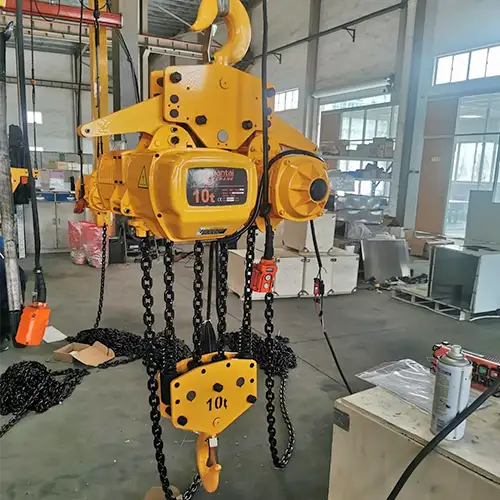
How to Choose a 10 Ton Electric Chain Hoist in Ghana – Complete Buyer Guide
Learn how to choose the right 10 ton electric chain hoist in Ghana. This practical guide covers specifications, safety features, buyer types, costs, and expert purchasing tips for workshops and industrial users.
| Application | Material handling, lifting, positioning, assembly, maintenance, loading/unloading, |
| Certifications | CE / ISO / SGS / Other third-party inspection |
| Customization | Customized material handling cranes solutions available for indoor, outdoor, hazardous, corrosive, cleanroom, and heavy-duty industrial applications. |
Crane Manufacturer: Yuantai Cranes – 30+ Years Professional Crane Manufacturer from China
Category: Featured
Tags: electricchainhoist,ghana
Introduction: Why a 10 Ton Electric Chain Hoist is Popular in Ghana
In Ghana, industrial activity is on the rise, and so is the demand for reliable lifting solutions. The 10 ton electric chain hoist has become a common choice for workshops, factories, and construction sites. It's not just about lifting heavy loads; it's about doing it safely, efficiently, and without breaking the budget.
Growing Industrial Workshops
Small and medium workshops across Ghana are handling more steel fabrication, machinery maintenance, and assembly work than ever before. Many of these workshops don't have the space or budget for full-sized overhead cranes. That's where a 10 ton hook-mounted hoist comes in handy. It fits into limited workshop spaces, can be moved as needed, and still handles substantial loads.
- Ideal for lifting steel components, machine parts, and tools.
- Can be installed on existing beams or temporary structures.
- Reduces the need for manual handling and heavy labor.
Construction and Maintenance Sectors
Construction companies, maintenance teams, and installation crews are also turning to these hoists for daily operations. They need something they can rely on, especially for lifting equipment to higher floors, moving construction materials, or handling heavy machinery during repairs.
- Supports lifting of generators, compressors, and HVAC units.
- Helps move construction materials safely on site.
- Reduces time and manpower compared to manual lifting.
Cost-Effective Alternative to Large Overhead Cranes
Full-scale overhead cranes are expensive to purchase and maintain. A 10 ton electric chain hoist offers a budget-friendly alternative for workshops and small plants. It delivers much of the lifting capacity of larger cranes without requiring complex installation or high upfront costs.
- Lower installation and setup costs.
- Portable and adaptable to multiple locations.
- Requires minimal structural modification to existing beams.
Common Use Cases
Across Ghana, this hoist is widely applied in areas where lifting heavy loads is frequent but space or budget is limited. Its versatility makes it a practical choice for multiple industries.
- Steel Fabrication Workshops: Moving steel plates, beams, and assembled parts with precision.
- Equipment Maintenance Facilities: Lifting heavy machinery for repair, inspection, or repositioning.
- Warehouses and Logistics Yards: Loading and unloading pallets, drums, or heavy packages safely.
- Construction and Installation Projects: Handling building materials, machinery, and equipment during assembly.
What Is a 10 Ton Electric Chain Hoist?
A 10 ton electric chain hoist is an electrically powered lifting device designed to raise and lower loads up to 10,000 kg using a high-strength steel load chain. It is commonly used in industrial workshops, factories, warehouses, and maintenance facilities where heavy materials need to be lifted safely and efficiently.
Unlike large crane systems, this type of hoist provides a compact and flexible lifting solution, making it suitable for facilities that require reliable lifting without installing a full overhead crane.
Main Components of a 10 Ton Electric Chain Hoist
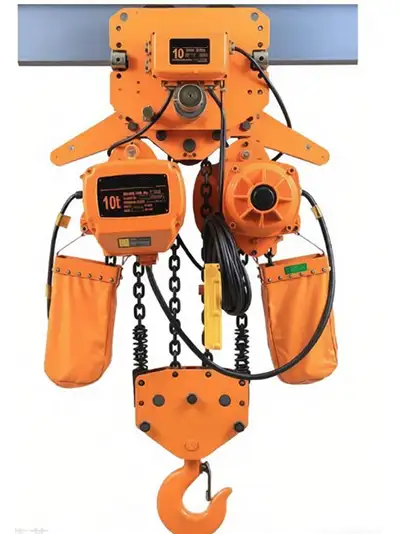
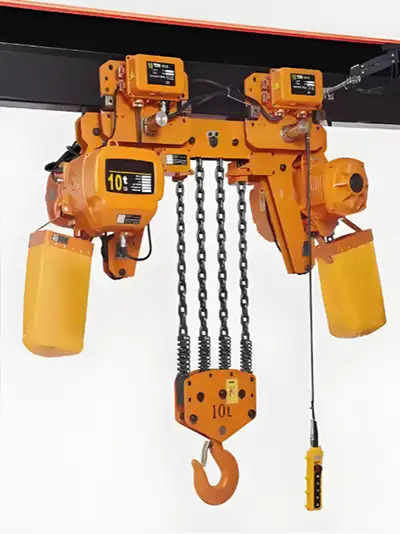
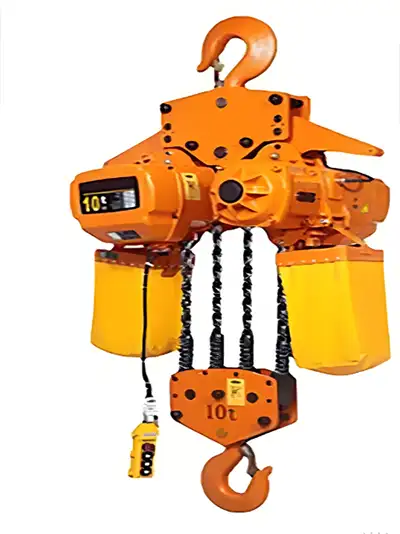
A standard 10 ton electric chain hoist typically includes the following key parts:
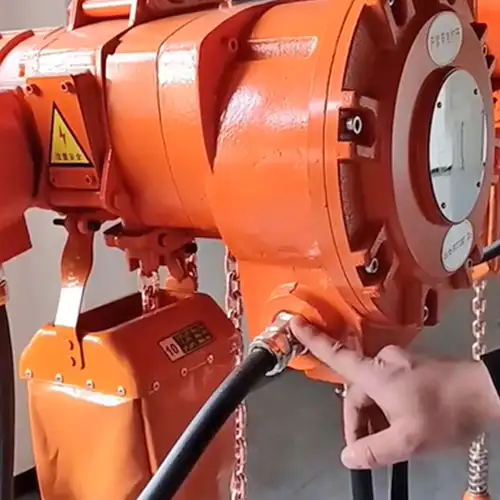
- Hook Suspension: The hoist is usually mounted with a top hook, allowing it to be easily attached to an overhead beam, lifting frame, or crane structure.
- Electric Motor and Lifting Mechanism: An electric motor drives the gear system and load chain, providing controlled lifting and lowering of heavy loads.
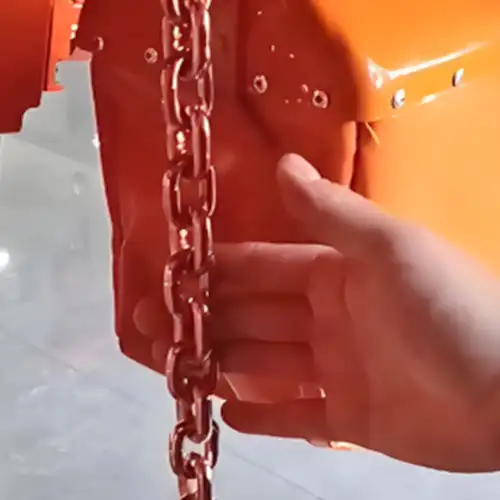
- Load Chain: A high-strength alloy steel chain supports the load during lifting operations and ensures durability under repeated use.
- Pendant Control: Operators control the hoist through a wired pendant controller, enabling safe operation from ground level.
- Optional Trolley System: For horizontal movement, the hoist can be mounted on a manual or motorized trolley that travels along an I-beam or monorail.
Key Advantages
- Compact Structure: Electric chain hoists are designed to occupy minimal space, making them ideal for workshops with limited headroom or installation space.
- Cost-Effective Lifting Solution: Compared with wire rope hoists, chain hoists generally offer lower purchase and maintenance costs for medium-duty lifting applications.
- Simple Installation: Most units can be installed quickly using hook suspension or beam-mounted trolley systems, reducing setup time.
- Flexible Applications: Because they are relatively portable and easy to mount, electric chain hoists can be used in multiple lifting points or temporary lifting setups within a facility.
General Buying Guide: Key Factors to Consider
Choosing the right 10 ton electric chain hoist involves more than simply selecting a lifting capacity. Buyers should carefully evaluate several technical and operational factors that influence safety, performance, installation compatibility, and long-term reliability.
Key considerations include:
- Rated lifting capacity
- Required lifting height
- Power supply compatibility
- Operating duty requirements
Rated Capacity
Rated capacity refers to the maximum load weight a hoist is designed to lift safely under normal operating conditions. A standard 10 ton electric chain hoist is engineered to lift loads up to 10,000 kg.
However, running lifting equipment continuously at its maximum load limit can place excessive strain on critical components such as:
- electric motor
- gearbox
- load chain
- braking system
For this reason, experienced lifting engineers recommend maintaining a working safety margin during daily operations.
Recommended Working Load Range
For frequent lifting tasks, the optimal load should generally stay within:
70% – 80% of the hoist's rated capacity
| Rated Capacity | Recommended Working Load |
|---|---|
| 10 tons | 7 – 8 tons |
Why a Safety Margin Is Important
Maintaining this margin offers several operational benefits:
- reduces mechanical stress on the hoist motor and transmission
- extends the service life of the load chain
- improves lifting stability and safety
- provides additional capacity for occasional heavier loads
Practical Buying Advice
If your facility regularly lifts loads between 9 and 10 tons, it may be safer and more efficient to select a higher-capacity hoist, such as:
- 12.5 ton electric chain hoist
- 16 ton electric chain hoist
This approach improves long-term reliability and equipment lifespan.
Lifting Height
Lifting height refers to the maximum vertical distance the hoist hook can travel when raising a load. It is determined by the length of the hoist's load chain.
Electric chain hoists are typically manufactured with customizable chain lengths, allowing the lifting height to be matched to the facility's ceiling height and operational requirements.
Why Correct Lifting Height Matters
Selecting the proper lifting height ensures that:
- loads can reach the required working position
- the chain does not touch the floor during operation
- lifting movements remain smooth and safe
Typical Lifting Heights
| Lifting Height | Typical Application |
|---|---|
| 6 m | Small workshops and maintenance areas |
| 9 m | Medium factories and warehouses |
| 12 m | Large industrial buildings |
For taller facilities, chain hoists can also be supplied with extended lifting heights such as:
- 15 m
- 18 m
- 20 m or more
Practical Selection Tips
When determining the correct lifting height, buyers should consider several factors:
- total building height
- overhead beam installation height
- hook clearance above the load
- required working clearance
In most installations, the actual lifting height required is slightly lower than the building height, because the hoist body and trolley occupy some vertical space.
Power Supply Compatibility
The power supply specification is a critical technical parameter when selecting an electric chain hoist. The hoist motor and electrical control system must be compatible with the local electrical infrastructure.
Different regions use different voltage and phase configurations, so verifying these details before purchasing is essential.
Standard Industrial Power Supply in Ghana
In many factories and industrial facilities in Ghana, the most common electrical configuration is:
380V / 3 Phase / 50Hz
This type of power supply is ideal for industrial equipment because it provides:
- stable motor performance
- higher efficiency for heavy lifting
- reliable operation during continuous use
Therefore, most 10 ton electric chain hoists used in industrial environments are configured for this power standard.
Alternative Power Option
Some smaller workshops or maintenance facilities may operate using single-phase electricity.
Typical configuration:
220V / Single Phase / 50Hz
While single-phase hoists can still perform lifting tasks, they are generally better suited for:
- light-duty lifting
- occasional use
- smaller workshops
They may not provide the same performance or efficiency as three-phase systems in heavy-duty applications.
Electrical Information Buyers Should Confirm
Before placing an order, buyers should verify the following electrical specifications:
- Voltage (V)
- Power phase (single-phase or three-phase)
- Frequency (Hz)
Providing this information allows manufacturers to properly configure the hoist motor, control panel, and protection systems.
Risks of Incorrect Voltage Selection
Choosing an incompatible power supply can lead to serious operational issues, including:
- motor overheating
- unstable lifting performance
- damage to electrical components
- reduced equipment lifespan
Ensuring correct power compatibility helps guarantee safe, efficient, and reliable hoist operation.
Duty Cycle & Working Class of a 10 Ton Electric Chain Hoist
The duty cycle or working class of a 10 ton electric chain hoist tells you how often and how hard the hoist can be used over a certain period. This specification is especially important for industrial workshops in Ghana, where hoists may be running multiple shifts or handling heavy loads daily. Choosing a hoist with too low a duty rating can cause the motor to overheat, wear out components faster, and shorten the hoist's service life.
Manufacturers classify hoists according to international standards, usually FEM (European Federation of Materials Handling) or ISO duty classes, which help buyers match the hoist to their expected workload.
Light-Duty Hoists
Light-duty hoists are designed for occasional lifting tasks with limited daily operation. They are suitable for small workshops, maintenance areas, or equipment repair facilities where lifting is not part of a continuous production process.
Characteristics:
- Infrequent lifting operations
- Low daily operating hours
- Moderate load weights
Typical Applications:
- Small workshops handling steel plates or machine parts
- Maintenance operations in factories
- Equipment repair facilities
Medium-Duty Hoists
Medium-duty hoists are built for regular lifting operations. They strike a balance between cost, performance, and durability, making them a popular choice for industrial facilities across Ghana.
Characteristics:
- Frequent daily lifting
- Moderate production workloads
- Reliable performance for ongoing operations
Typical Applications:
- Manufacturing plants with regular material handling
- Fabrication workshops lifting steel beams or components
- Warehouse operations for medium-weight loads
Heavy-Duty Hoists
Heavy-duty hoists are engineered for continuous, intensive lifting in demanding industrial environments. These models feature more robust motors, stronger gear systems, and high-grade components to handle repetitive heavy loads safely.
Characteristics:
- High lifting frequency
- Continuous production environments
- Large and repetitive loads
Typical Applications:
- Steel fabrication plants handling heavy plates and beams
- Heavy manufacturing facilities
- Mining maintenance workshops
- Large logistics centers and warehouses
Example: FEM / ISO Duty Classes
| Duty Class | Typical Usage |
|---|---|
| FEM 1Am | Light-duty workshop use |
| FEM 2m | Moderate industrial lifting |
| FEM 3m | Frequent lifting operations |
| FEM 4m | Heavy-duty industrial environments |
Safety Features of a 10 Ton Electric Chain Hoist
Safety is critical when operating a 10 ton electric chain hoist, especially in industrial or construction settings. Modern hook-mounted hoists integrate multiple safety systems to protect operators, the equipment, and the loads being lifted.
Overload Protection
Overload protection automatically stops lifting if the load exceeds the hoist's rated capacity. This prevents:
- Damage to the hoist and chains
- Mechanical failure of motors or gears
- Unsafe lifting conditions for personnel and materials
Upper and Lower Limit Switches
Limit switches stop the hoist when the hook reaches its maximum upper or lower travel points. They help:
- Prevent the chain from over-winding
- Protect internal components from damage
- Avoid accidental collisions with overhead structures
These switches are essential in workshops where hoists operate close to ceilings, beams, or other equipment.
Emergency Stop Button
An emergency stop (E-stop) allows operators to immediately shut down the hoist in unsafe situations. It is usually integrated into the pendant control and should be easily reachable during lifting operations.
Thermal Motor Protection
Thermal protection monitors the electric motor's temperature. If the motor overheats due to continuous operation or electrical issues, the system shuts the hoist down automatically. This feature:
- Prevents permanent motor damage
- Extends the service life of the hoist
- Ensures safe operation during heavy-duty lifting cycles
Chain Guide System
The chain guide keeps the load chain aligned and moving smoothly during lifts. A properly designed chain guide:
- Reduces chain twisting or kinking
- Prevents jamming inside the hoist body
- Ensures stable lifting, especially for long lifts or repeated cycles
Pro Tip: For workshops and construction sites in Ghana, regular inspection of all safety features—limit switches, overload protection, and chain guides—can prevent accidents and prolong the lifespan of a 10 ton electric chain hoist.
Installation Method for a 10 Ton Electric Chain Hoist
Installing a 10 ton electric chain hoist correctly is crucial for safe and efficient lifting in Ghanaian workshops, construction sites, and industrial facilities. The installation method depends on your workspace layout, lifting requirements, and whether the hoist will be used occasionally or continuously. Choosing the right setup ensures smooth load movement, reduces wear on the hoist, and integrates well with existing lifting systems.
Hook-Mounted Installation
In this method, the hoist is suspended directly from an overhead beam, lifting frame, or structural support using its top hook. This setup is simple, flexible, and cost-effective, making it ideal for workshops or temporary lifting areas.
Advantages:
- Quick and simple installation
- Easily moved between different lifting points
- Minimal infrastructure required
Common Applications:
- Equipment repair workshops lifting machinery or heavy components
- Maintenance areas handling occasional loads
- Temporary lifting setups on construction or installation sites
This installation style is particularly suitable when mobility and quick deployment are needed, allowing small and medium workshops in Ghana to adapt to changing tasks without installing a permanent crane.
Beam Trolley Mounted
A beam trolley-mounted hoist runs along an I-beam or monorail, either manually or with a motorized trolley. This configuration allows horizontal movement of loads, improving workflow efficiency and reducing the need for repeated repositioning of heavy items.
Advantages:
- Smooth horizontal travel along beams or tracks
- Improves material handling efficiency
- Supports production line operations and repeated lifts
Common Applications:
- Fabrication workshops moving steel beams, plates, or assemblies
- Warehouses handling pallets or heavy inventory
- Assembly lines requiring frequent material repositioning
Beam trolley installation is ideal for facilities in Ghana where heavier items need consistent, controlled movement along fixed paths. It combines mobility with stability, which is critical for industrial lifting.
Integration with Overhead Cranes
For larger operations, a 10 ton electric chain hoist can be integrated into a full overhead crane system. In this setup, the hoist handles vertical lifting while the trolley and bridge mechanisms allow horizontal and long-travel movement.
Capabilities:
- Vertical lifting via the hoist motor
- Cross-travel with the trolley along the bridge
- Long-travel across the crane span
Common Applications:
- Manufacturing plants handling heavy machinery or steel components
- Steel processing facilities with large load areas
- Large warehouses requiring full-area material handling
This method offers maximum coverage and efficiency, making it suitable for industrial plants and logistics hubs in Ghana that require frequent, heavy-duty lifting across large workspaces.
Pro Tip: Choosing the right installation method for a 10 ton electric chain hoist depends on your lifting frequency, workspace size, and mobility needs. Hook-mounted hoists are perfect for flexible and temporary setups, beam trolleys offer smooth horizontal movement for mid-sized workshops, and integration with overhead cranes provides full industrial lifting coverage.
Spare Parts & Maintenance for a 10 Ton Electric Chain Hoist
When investing in a 10 ton electric chain hoist in Ghana, thinking ahead about maintenance and spare parts can save a lot of headaches. In industrial workshops, construction yards, and equipment maintenance facilities, downtime is costly. Having quick access to replacement chains, motors, or control components ensures the hoist stays operational and keeps lifting schedules on track.
- Chain Availability -The chain is the backbone of any hook-mounted hoist, and for a 10 ton electric chain hoist, it must be high-grade and durable. Local availability of replacement chains in Ghana is crucial, especially for humid environments where corrosion can accelerate wear. Confirm with your supplier that spare chains can be delivered promptly and match the hoist's load rating.
- Motor Serviceability -Heavy-duty lifts rely on motors that can handle frequent operation. For a 10 ton electric chain hoist, modular motors that can be serviced locally are a big advantage. Ask whether the motor is easy to remove and if the supplier provides maintenance manuals. Routine inspection of brushes, windings, and connections keeps the hoist running safely and efficiently.
- Control Components -Control boxes, pendant switches, and wiring must be easily replaceable. A reliable industrial hoist system allows local technicians to swap or repair these parts without specialized tools. This ensures the hoist can continue operations in workshops or construction sites across Ghana without prolonged downtime.
- Brake Systems -The braking system on a 10 ton electric chain hoist is critical for safe lifting. Make sure replacement pads, springs, and emergency brake components are accessible. Regular inspection and maintenance of the hoist brake reduce the risk of load slippage, which is especially important when handling steel components or heavy machinery.
Pro Tip: Planning for spare parts and regular maintenance is just as important as selecting the hoist itself. In Ghana, where importing components can take weeks, a well-prepared maintenance plan keeps your workshop lifting operations smooth and uninterrupted.
Supplier Reliability for a 10 Ton Electric Chain Hoist
Buying a 10 ton electric chain hoist is not just about the product—it's about the supplier's ability to deliver consistent support and technical guidance. A trustworthy supplier ensures your hoist performs reliably in Ghana's industrial and construction environments.
- CE / ISO Certification-Choose a supplier whose hoists carry CE or ISO certification. This guarantees that the hoist has been manufactured under internationally recognized safety and quality standards, giving confidence that your hook-mounted hoist can handle heavy-duty lifting safely.
- Factory Testing-Every hoist should undergo load testing before shipment. Factory-tested 10 ton electric chain hoists confirm the system can manage rated loads and function smoothly upon arrival. This minimizes surprises during installation and early operation in workshops or maintenance yards.
- Warranty-A solid warranty covering motors, chains, control components, and brakes is essential. For hoists operating in Ghana, this protects against early failures and ensures you can get parts or service quickly, reducing downtime for industrial lifting tasks.
- Technical Support-Suppliers who offer manuals, troubleshooting guidance, and even remote support make a big difference. Proper guidance for hoist installation, maintenance, and operation ensures the lifting team in Ghana can use the equipment safely and efficiently.
- Export Experience to Africa-Suppliers familiar with exporting to Africa understand local logistics, shipping methods, and customs clearance processes. This experience ensures your 10 ton electric chain hoist arrives safely, and critical spare parts can be delivered on time, even in regions with longer import lead times.
Pro Tip: Reliable suppliers are more than sellers—they help keep your industrial lifting operations in Ghana running efficiently, from workshop lifting to construction and maintenance tasks.
Hook mounted electric chain hoist for sale Ghana
10 ton electric chain hoist with motorized trolley for 10 ton portable gantry crane
Buying Considerations for Different Types of Buyers
Different buyers often have different priorities when selecting a 10 ton electric chain hoist. For example, workshop operators may focus on ease of operation and safety, while procurement managers may prioritize cost control, supplier reliability, and spare parts availability. Understanding these varying requirements helps ensure that the selected hoist not only meets technical specifications but also supports the operational goals of each buyer type.
The following sections highlight the key concerns and practical considerations for several common buyer groups, including workshop operators, industrial users, procurement teams, multi-purpose facilities, and equipment dealers.
Workshop Operators (End Users)
Workshop operators in Ghana face daily challenges lifting heavy components in tight spaces. The focus is on safe, reliable, and efficient lifting, often without a full overhead crane. A 10 ton electric chain hoist offers a practical solution, but choosing the right features is key to avoiding accidents and improving workflow.
Typical Problems Faced
Operators need to manage occasional heavy lifts without overcomplicating the workspace. Space constraints and operator experience make hoist selection critical.
- Occasional lifting tasks: Many workshops only lift heavy machinery, steel plates, or equipment sporadically. A hoist that is easy to deploy and remove between jobs minimizes downtime.
- Limited space: Small workshops or maintenance bays often cannot accommodate large cranes. Compact hook-mounted hoists provide lifting capability without requiring extra infrastructure.
- Ease of operation: Operators may have limited training, so hoists must be intuitive to control, with safety features like emergency stop buttons and limit switches readily accessible.
Practical Buying Tips
To make the most of a 10 ton electric chain hoist in a workshop, focus on features that improve usability and safety.
- Choose a compact design: A smaller footprint allows the hoist to fit above machines, workbenches, or narrow aisles, giving more flexibility for lifting different loads.
- Select a standard lifting speed: Consistent speed ensures smooth handling of steel components and machinery, reducing jerking or swinging that can damage loads or create hazards.
- Ensure operator training: Even the safest hoist requires proper instruction on load attachment, emergency stops, and daily inspections to protect both operators and equipment.
Tip: The right hoist isn't just about lifting capacity. For Ghanaian workshops, it's about making daily operations safer, faster, and more manageable, while keeping maintenance simple and costs reasonable.
Procurement Managers / Industrial Buyers
For procurement managers and industrial buyers in Ghana, the focus is on cost control, operational efficiency, and fleet reliability. Purchasing a 10 ton electric chain hoist is not just about the unit price—it's about ensuring smooth logistics, standardization across multiple hoists, and minimizing downtime across workshops or production sites.
Key Considerations
Industrial buyers often face challenges when managing multiple hoists. Understanding costs, shipping, and spare parts availability upfront avoids unexpected delays and extra expenses.
- Bulk purchase pricing: Buying multiple hoists at once can lower the unit cost, but it's important to balance price savings with the supplier's ability to deliver reliably and provide spare parts in Ghana.
- Shipping logistics: Importing hoists involves transportation, customs clearance, and handling. Planning for shipping time and proper packaging ensures the hoists arrive in good condition and on schedule.
- Import documentation: Proper documentation, including invoices, certificates, and compliance papers, is essential to avoid delays or penalties at Ghanaian ports.
- Spare parts compatibility: Standardizing on a single hoist model ensures that chains, motors, control units, and brakes are interchangeable, simplifying maintenance and reducing inventory costs.
Practical Tips
To manage a fleet of hoists efficiently, industrial buyers should plan not just for the purchase but for ongoing operation and maintenance.
- Standardize hoist models: Using the same 10 ton electric chain hoist across multiple workshops or plants makes training, spare parts management, and maintenance simpler.
- Order spare chains and control units: Having critical spare parts on hand prevents downtime, especially in Ghana where importing replacements can take weeks.
- Plan preventive maintenance schedules: Regular inspection and maintenance of hoists, including motors, chains, brakes, and limit switches, ensures long-term reliability and avoids costly breakdowns.
Tip: For Ghanaian industrial operations, the smartest purchase strategy combines cost-effective bulk buying with a clear plan for logistics, spare parts, and maintenance. A well-planned approach keeps workshops productive and hoists performing reliably.
Heavy Industrial Users
For heavy industrial users in Ghana—such as steel factories, mining maintenance shops, and large fabrication plants—the main concern is reliability and productivity. These facilities lift heavy loads frequently, and any downtime can disrupt production lines or delay maintenance schedules. Choosing the right 10 ton electric chain hoist is critical to keeping operations running safely and efficiently.
Important Factors
Heavy-duty lifting environments place intense demands on hoists. Selecting a hoist that can handle continuous operation without overheating or wearing out prematurely is essential.
- High duty cycle: Hoists in steel plants or mining workshops must operate multiple times per shift. Look for models rated for continuous or frequent lifting to prevent motor burnout.
- Durable motor and gearbox: A strong motor and robust gear system are key to sustaining heavy loads. These components must withstand repetitive lifting without excessive maintenance.
- Frequent lifting capacity: Hoists should handle repeated 10 ton lifts smoothly, maintaining consistent speed and safety even under continuous operation.
Practical Tips
To maximize uptime and efficiency, industrial users should select hoists built for heavy-duty tasks and implement proper monitoring.
- Choose heavy-duty hoists: Opt for models specifically rated for industrial lifting, rather than standard workshop hoists. Heavy-duty 10 ton electric chain hoists are designed to endure continuous operation and frequent load handling.
- Consider dual-speed lifting: A dual-speed hoist allows slower lifts for precise placement and faster lifting for routine transfers, improving workflow and safety.
- Monitor brake systems regularly: Frequent inspection of brakes ensures that heavy loads are controlled safely. Well-maintained brakes prevent accidents and reduce wear on hoist components.
Tip: For Ghanaian industrial facilities, the right heavy-duty hoist balances lifting power, durability, and reliability, ensuring long-term productivity without constant maintenance interruptions.
Multi-Purpose Workshops
In multi-purpose workshops, repair shops, and project-based operations in Ghana, lifting needs can change daily. Teams may need to move machinery, assemble equipment, or lift materials at different locations. The main priority is flexibility—the hoist must adapt to different tasks without slowing down operations. A 10 ton electric chain hoist that can be moved, adjusted, or mounted on different beams provides a practical solution for these dynamic environments.
Typical Challenges
Operators often face unpredictable lifting requirements. Fixed installations may not cover all areas, and oversized cranes are rarely cost-effective for occasional or varying loads.
- Equipment repair shops: Hoists need to reach multiple machines or benches, often in cramped spaces.
- Installation teams: Lifting points may shift as projects progress, requiring hoists that can be easily relocated.
- Project-based lifting: Tasks vary from day to day, so the hoist must handle different heights, positions, and load types without major reinstallation.
Practical Tips
Choosing the right hoist setup helps workshops remain productive while keeping installation simple and costs manageable.
- Use beam trolleys: Installing the hoist on a manual or motorized beam trolley allows horizontal movement across different lifting points, improving workflow efficiency.
- Install portable lifting beams: For temporary or project-based work, portable beams provide flexible support for hook-mounted hoists, allowing quick relocation without permanent infrastructure.
- Choose moderate lifting height: Avoid oversizing hoists for rare high lifts; selecting a moderate height suited to most tasks ensures safer and more efficient operation.
Tip: In Ghanaian multi-purpose workshops, a 10 ton electric chain hoist that combines portability, adjustable height, and simple beam-mounted movement keeps operations flexible, safe, and cost-effective.
Dealers and Distributors
For dealers and distributors in Ghana, the main goal when offering a 10 ton electric chain hoist is resale potential and customer satisfaction. Success depends not just on selling the hoist but on understanding local buyer needs, providing after-sales support, and ensuring that workshops and industrial users can operate the hoist safely and efficiently.
Market Strategy
Selling hoists in Ghana requires addressing the specific challenges of end users, from small workshops to larger industrial buyers. A dealer who anticipates these needs gains a competitive advantage.
- Target small workshops: Focus on end users who need reliable lifting solutions but may not have large overhead crane infrastructure. A hook-mounted 10 ton hoist fits perfectly for occasional or mobile lifting tasks.
- Provide spare parts packages: Offering chains, control boxes, and brake components along with the hoist reduces downtime and makes your customers more confident in purchasing.
- Offer installation services: Many buyers prefer ready-to-use solutions. Providing installation guidance or on-site setup ensures proper operation and safety, increasing repeat business and referrals.
Sales Tips
Maximizing sales and customer satisfaction often comes down to convenience and completeness. Bundling the right components ensures buyers have everything they need to get started safely.
Bundle:
- Hoist: The main 10 ton electric chain hoist unit
- Trolley: Beam or motorized trolleys for horizontal movement
- Spare chain: Critical for maintenance and uninterrupted lifting
- Control box: Complete with pendant switch and safety features
Tip: Dealers in Ghana who combine quality hoists, practical spare parts, and installation support can capture more of the market. Offering ready-to-use bundles tailored for workshops, repair shops, and project-based lifting teams ensures both repeat sales and satisfied customers.
Cost Considerations for Importing a 10 Ton Electric Chain Hoist to Ghana
When planning to purchase a 10 ton electric chain hoist for workshops, fabrication shops, or industrial facilities in Ghana, understanding the total cost of ownership is essential. The price of the hoist itself is just part of the picture—importing involves shipping, customs, and local installation. Considering all cost elements upfront helps buyers plan budgets accurately and avoid unexpected expenses.
Key Cost Elements
- Hoist Price: The factory price of a 10 ton electric chain hoist varies depending on features, duty cycle, and safety systems. Heavy-duty models with dual-speed lifting, hook-mounted or trolley-mounted setups, and integrated overload protection are slightly higher but provide long-term value through durability and safety.
- Shipping: Most hoists are shipped by sea freight to Ghanaian ports. Shipping costs depend on container size, port charges, and logistics handling. Planning for shipping time is critical, as delays can affect project schedules.
- Import Duty: Ghana Customs applies duties and taxes on imported hoists. These fees vary depending on classification codes, origin, and declared value. Including import duties in the budget prevents last-minute financial surprises.
- Installation: Local installation by qualified technicians ensures the hoist is safely mounted and operational. Installation costs cover labor, mounting hardware, and sometimes minor infrastructure adjustments like beams or trolley tracks.
Example Cost Breakdown
| Cost Element | Description |
|---|---|
| Hoist Price | Factory price for 10 ton electric chain hoist with standard safety features |
| Shipping | Sea freight, port handling, and inland transportation in Ghana |
| Import Duty | Customs duty and taxes applied by Ghana Revenue Authority |
| Installation | Local technician service, mounting hardware, and setup |
Tip: When importing a 10 ton electric chain hoist to Ghana, always calculate the total landed cost—including the hoist price, shipping, import duties, and installation. Planning for all these costs ensures smoother procurement and avoids unexpected delays or additional expenses.
Common Mistakes Buyers Should Avoid When Purchasing a 10 Ton Electric Chain Hoist
Buying a 10 ton electric chain hoist is a significant investment for workshops, fabrication shops, and industrial facilities in Ghana. Many buyers make avoidable mistakes that lead to downtime, extra costs, or unsafe lifting conditions. Understanding these common pitfalls can save time, money, and frustration.
Buying Too Small Capacity
One of the most frequent errors is selecting a hoist with insufficient lifting capacity. A hoist rated below your heaviest load may seem cheaper upfront but can:
- Overload the motor and chain
- Cause premature wear on gears and brakes
- Create unsafe lifting conditions for operators
Tip: Always choose a hoist rated for your maximum expected load, ideally with a 10–20% safety margin for occasional heavy lifts.
Ignoring Duty Cycle
Many buyers focus only on load capacity and forget about the duty cycle. A hoist designed for light-duty workshop tasks will wear out quickly if used for frequent, continuous lifting in an industrial environment.
- Motor overheating
- Faster chain and gear deterioration
- Increased maintenance costs
Tip: Check FEM or ISO duty classifications and select a hoist that matches your lifting frequency and operational intensity.
No Spare Parts Planning
Even high-quality hook-mounted 10 ton electric chain hoists require regular maintenance. Failing to plan for spare chains, control units, brake components, or motors can lead to costly downtime, especially in Ghana where importing parts may take weeks.
Tip: Order spare parts along with your hoist, and keep them on hand to maintain uninterrupted lifting operations.
Choosing Suppliers Without Export Experience
Some buyers assume any supplier can handle international shipping. Choosing a supplier without experience exporting to Ghana can cause delays, incomplete documentation, or damage during transit.
Tip: Work with suppliers who have a proven track record of exporting hoists to Africa and can provide proper certifications, packaging, and shipping support.
Ignoring Electrical Compatibility
Ghana has specific power supply standards. Buying a hoist without checking voltage, phase, or frequency compatibility can result in additional electrical costs, rewiring, or even motor damage.
Tip: Confirm that the hoist's motor matches your local power supply, and consider any need for transformers or local wiring adjustments.
Pro Tip
A successful purchase of a 10 ton electric chain hoist combines proper capacity, correct duty rating, spare parts planning, experienced suppliers, and electrical compatibility. Avoiding these common mistakes ensures safe, reliable, and cost-effective lifting for workshops, industrial facilities, and project-based operations in Ghana.
Conclusion
Selecting the right 10 ton electric chain hoist is more than just picking a model off a catalog. For workshops, industrial facilities, and dealers in Ghana, it's about finding the right balance between lifting capacity, duty cycle, safety features, and supplier reliability—while also considering your specific operational needs.
- Capacity: Ensure the hoist can handle your heaviest loads, with a safety margin for occasional overloads.
- Duty Cycle: Match the hoist to your expected lifting frequency—light, medium, or heavy-duty—so motors and gears last longer.
- Safety: Features like overload protection, limit switches, thermal motor protection, and chain guides are critical for protecting operators and equipment.
- Supplier Reliability: Work with suppliers who provide proper certification, spare parts, technical support, and experience exporting to Ghana.
- Buyer-Specific Needs: Consider workshop space, project flexibility, bulk purchasing, or resale potential depending on whether you are an end user, procurement manager, industrial lifting team, or dealer.
Tip: Always combine practical considerations—capacity, duty, safety, and supplier reliability—with the specific workflow requirements of your facility to make the most cost-effective and reliable purchase in Ghana.

Yuantai Cranes
Yuantai Cranes - Global Material Handling Crane Solution Provider & Manufacturer with CE, ISO, SGS, CNEX and other Third Party Certifications.
- Main Specifications - Capacity: 0.5–550 tons | Span: up to 40m | Speed: 0.8–12 m/min | Duty: A3–A7 | Power: 380–690V, 50/60Hz | Control: pendant/remote/cabin
- Full engineering: FEA/PLC/VFD + in-house build + global delivery + on-site support, for workshops, factories, EPC contractors, industrial projects, etc.
- Support: design, manufacturing, testing, service – end-to-end, customized lifting solutions worldwide.
Get Your Custom Quote – Quick & Easy
Fill in what you know. Skip what you don't – we'll help.
- Crane type:_____ . (e.g., overhead crane, gantry crane, jib crane)
- Max weight to lift:_____ tons. (e.g., 2t, 5t, 10t, 20t, 50t)
- Lifting height:_____ m. (How high does the hook need to reach?
- Workshop width (span):_____ m . (Distance between the two crane rails)
- Travel distance:_____ m . (How long does the crane need to move along the runway?)
- Control type:_____. (Pendant / remote / cabin Control)
- Power supply:_____. (Local voltage & frequency – e.g., 380V, 50Hz, 3-phase)
- What will it be used for?_____ (e.g., steel fabrication, concrete products, mold handling, general manufacturing, etc.)
- Any special requirements?_____ (e.g., extreme temperature, dusty or explosive environment, special paint color, etc.)
Just leave a message via the contact form and our hoist and crane engineer will contact you with in 24working hours.
Inquire Yuantai Cranes