How Does a Manual Rotating Jib Crane with Electric Hoist Work?
See how a manual rotating jib crane with electric hoist combines simple hand-operated jib rotation with motorized hoist travel and electric lifting.
Short Video Description
This video shows a manual rotating pillar jib crane designed for 500kg, 1000kg and 2000kg lifting applications.The jib is rotated manually by the operator, while the electric hoist travels along the jib beam by motor and lifts the load vertically.
This gives the crane three basic working movements: manual jib rotation, motorized hoist travel and electric lifting.The design is simple and practical for workshops where the operator does not need motorized slewing but still wants powered lifting and load positioning.
In other words, the operator provides the rotation. The electric hoist does the heavy work.
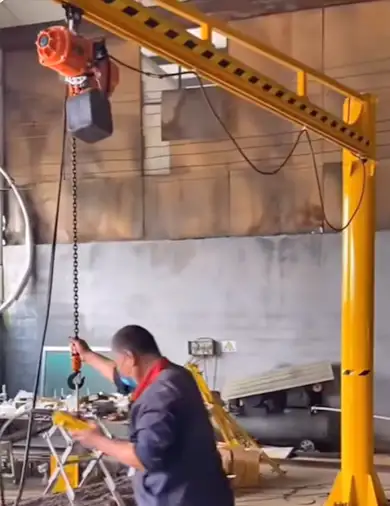 manual rotating jib crane for light duty material handling
Main Specifications
| Item | Specification |
|---|---|
| Crane type | Manual Rotating Pillar Jib Crane |
| Rated capacity | 500kg / 1000kg / 2000kg |
| Jib rotation | Manual operation |
| Rotation range | Up to 360°, according to design |
| Jib type | Steel jib beam |
| Hoist type | Electric Hoist |
| Hoist travel | Motorized travel along jib beam |
| Hoisting | Electric motorized lifting |
| Jib span | Customized according to working area |
| Lifting height | Customized |
| Lifting speed | According to selected electric hoist |
| Trolley speed | Motorized, according to hoist specification |
| Control | Pendant control or radio remote control |
| Power supply | 380V/50Hz/3Ph or customized |
| Typical applications | Machine loading, maintenance, assembly, repair and workshop material handling |
How Does a Manual Rotating Jib Crane Work?
The operating principle is simple.
The jib rotates manually around the vertical pillar. The operator pushes or pulls the jib to bring the lifting point toward the required working position.
Once the jib is in position, the electric hoist travels along the jib beam to move the hook closer to the load.
The electric hoist then lifts or lowers the load vertically.
So the three movements are:
- Manual slewing: operator rotates the jib by hand.
- Motorized travelling: electric hoist trolley moves along the jib beam.
- Electric lifting: electric hoist raises and lowers the load.
This combination keeps the jib structure relatively simple while still giving the operator powered load handling.
Why Use Manual Rotation Instead of Motorized Slewing?
For many workshop applications, the operator does not need a motor to rotate the jib.
If the load is between 500kg and 2 tons and the jib is reasonably sized, manual slewing can be a practical solution.
Manual rotation can offer:
- Simple mechanical structure
- Lower equipment cost
- Less electrical equipment
- Easy operation
- Lower maintenance requirements
- Good control for short-distance load positioning
The operator manually moves the jib, while the electric hoist handles the lifting and trolley travel.
If the jib is very long, the working frequency is high, or the operator needs frequent powered slewing, a motorized rotating jib crane may be a better choice.
How Does the Electric Hoist Move the Load?
The electric hoist performs two important functions.
1. Motorized Hoist Travel
The hoist trolley travels along the jib beam.
This allows the hook to move toward or away from the pillar without manually moving the entire crane.
2. Vertical Lifting
The electric hoist raises and lowers the load using its electric lifting motor.
The operator can therefore position the load in three directions:
- Rotate the jib manually.
- Move the electric hoist along the jib.
- Lift or lower the load electrically.
For workshop material handling, this can provide enough movement without the complexity of a full overhead crane.
What Loads Can a Manual Rotating Jib Crane Handle?
The crane shown in this product range can be configured for 500kg, 1000kg and 2000kg loads.
The correct capacity depends on the actual application.
A buyer should consider:
- Maximum load weight
- Jib span
- Lifting height
- Working radius
- Working frequency
- Load type
- Required hook position
- Existing floor or structural condition
A 2 ton crane with a short jib is not the same engineering problem as a 2 ton crane with a long jib.
Capacity and reach should always be considered together.
Where Is This Jib Crane Used?
Manual rotating jib cranes are commonly used for localized lifting around machines and workstations.
Typical applications include:
- Machine loading and unloading
- CNC machine maintenance
- Die and mould handling
- Equipment assembly
- Motor replacement
- Workshop maintenance
- Component handling
- Production workstation lifting
They are especially useful when the lifting area is fixed but the hook needs to reach different positions around the workstation.
When Should You Choose a Motorized Slewing Jib Instead?
Manual rotation is not always the best solution.
Consider a motorized slewing jib crane when:
- The jib is long.
- The load is handled very frequently.
- The operator needs powered rotation.
- The working area is large.
- Precise powered slewing is required.
- The operator cannot easily push the jib manually.
For a compact workstation and moderate lifting frequency, manual rotation can be simpler and more economical.
Related Videos
- How Does a Manual Rotating Jib Crane with Electric Hoist Work?
- Can a 500kg Jib Crane Be Installed Without a Foundation?
- 1 Ton Mobile Jib Crane – Portable Workshop Lifting Solution
- Installing a 4 Ton Pillar Jib Crane | Workshop Floor Mounted Project
- How Does a 500kg Portable Articulating Jib Crane Work?
- How to Choose a 2 Ton Floor Mounted Jib Crane for Mould & Die Handling?

Article by Bella ,who has been in the hoist and crane field since 2016. Bella provides overhead crane & gantry crane consultation services for clients who need a customized overhead travelling crane solution.Contact her to get free consultation.
Yuantai Cranes
Overhead Crane Manufacturer with CE, ISO, SGS, CNEX Certificates.
- Main Specifications - Capacity: 0.5–550 tons | Span: up to 40m | Speed: 0.8–12 m/min | Duty: A3–A7 | Power: 380–690V, 50/60Hz | Control: pendant/remote/cabin
- Full engineering: FEA/PLC/VFD + in-house build + global delivery + on-site support, for workshops, factories, EPC contractors, industrial projects, etc.
- Support: design, manufacturing, testing, service – end-to-end, customized lifting solutions worldwide.
How to Get an Accurate Crane Price for Your Application?
Tips: Copy the spec list, fill in your details, and paste it into the form on the right/ down-below for a quick price.
- Crane type:_____ . (e.g., overhead crane, gantry crane, jib crane)
- Max weight to lift:_____ tons. (e.g., 2t, 5t, 10t, 20t, 50t)
- Lifting height:_____ m. (How high does the hook need to reach?
- Workshop width (span):_____ m . (Distance between the two crane rails)
- Travel distance:_____ m . (How long does the crane need to move along the runway?)
- Control type:_____. (Pendant / remote / cabin Control)
- Power supply:_____. (Local voltage & frequency – e.g., 380V, 50Hz, 3-phase)
- What will it be used for?_____ (e.g., steel fabrication, concrete products, mold handling, general manufacturing, etc.)
- Any special requirements?_____ (e.g., extreme temperature, dusty or explosive environment, special paint color, etc.)
Just leave a message via the contact form and our hoist and crane engineer will contact you with in 24working hours.
Get Your Custom Quote–Quick & Easy
Fill in what you know. Skip what you don't – we'll help.Any question will be reply with 24 working hours