How to Choose a 2 Ton Floor Mounted Jib Crane for Mould & Die Handling?
How do you choose a 2 ton jib crane for mould and die handling when workshop space is limited? This video shows a compact floor mounted jib crane installed near a concrete wall and used for local lifting around a machine.
Short Video Description of 2 Ton Jib Crane for Die Handling
This video shows a 2 ton floor mounted jib crane designed for mould and die handling in a compact workshop.
The crane is installed on the workshop floor near a concrete wall. Its jib rotates around the fixed column to bring the electric hoist and hook to the required lifting position.
This type of crane is useful when moulds or dies need to be removed from, installed into or serviced around a machine, but a full overhead crane system is not necessary.
For buyers, the important question is not simply whether the crane can lift 2 tons. The hook must reach the mould, the lifting height must clear the machine, and the floor and foundation must safely support the crane.
That is where the real crane selection starts.
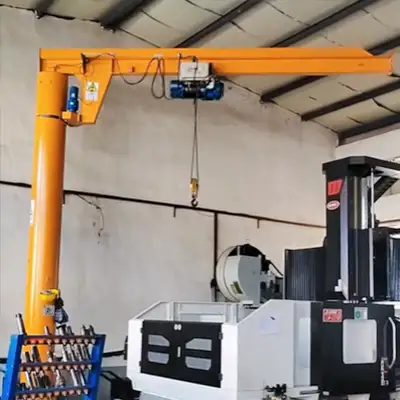
screen short of 2 ton jib crane for die and mould handling
Main Specifications
| Item | Specification |
|---|---|
| Crane type | Floor Mounted Jib Crane |
| Application | Mould & Die Handling |
| Rated capacity | 2 ton |
| Jib span | Customized according to machine and mould position |
| Rotation | 180° / 270° / 360°, according to layout |
| Hoist | Electric Chain Hoist or Electric Wire Rope Hoist |
| Lifting height | Customized according to machine height |
| Hoist travel | Along jib arm, according to design |
| Slewing | Manual or motorized |
| Control | Pendant control or radio remote control |
| Power supply | 380V/50Hz/3Ph or customized |
| Installation | Floor mounted with base plate and anchor bolts |
| Workshop condition | Limited space / machine area / concrete wall nearby |
| Typical use | Mould changing, die changing, machine maintenance and assembly |
Why Use a 2 Ton Jib Crane for Mould and Die Handling?
Moulds and dies are often heavy, compact and expensive. They also need to be positioned accurately around a machine.
A 2 ton floor mounted jib crane can provide a dedicated lifting point close to the machine without installing a complete overhead crane system across the workshop.
The crane column is fixed to the floor. The jib rotates around the column, and the hoist moves the hook into the required position.
This makes the crane suitable for jobs such as:
- Removing moulds from machines
- Installing moulds into machines
- Die changing
- Mould maintenance
- Machine repair
- Tooling assembly
The key is to position the crane so the hook can reach the mould without requiring an unnecessarily long jib.
How Do You Choose the Jib Span?
For mould and die handling, jib span should be based on the actual distance between the crane column and the lifting point.
Measure the distance from the proposed crane position to the centre of the mould or die.
Then check:
- Distance from column to machine
- Distance from machine to mould changing position
- Required hook approach
- Machine width and height
- Wall clearance
- Required rotation area
Do not choose a longer jib simply because it looks more flexible.
A longer jib increases the bending moment on the crane structure and foundation. If a 3 m jib can reach the mould, there is usually no engineering reason to make it 5 m.
For jib cranes, reach is useful. Unnecessary reach is load.
Is 2 Tons Enough for My Mould or Die?
Start with the actual mould or die weight, not the machine size.
If the heaviest mould weighs 1.5 tons, a 2 ton crane may be suitable, subject to the required lifting accessories, working conditions and safety requirements.
But buyers should also consider future moulds.
If the workshop plans to introduce heavier dies later, it may be more economical to design the crane for the future requirement rather than replace the crane after installation.
Yuantai Cranes can select the crane capacity according to the maximum load, working frequency, lifting height, jib span and application conditions.
What About the Concrete Floor?
This is one of the most important points for a floor mounted jib crane.
The crane column transfers the working loads into the floor and foundation through the base plate and anchor system.
Before installation, the following should be checked:
- Concrete thickness
- Concrete strength
- Existing foundation condition
- Base plate size
- Anchor bolt arrangement
- Floor load capacity
- Distance from floor edges and walls
A good crane design does not stop at the column. The connection between the crane and the building is part of the engineering.
How Should the Crane Be Positioned in a Small Workshop?
For a limited workshop, the crane should normally be placed as close as practical to the mould handling point while maintaining the required operating clearance.
The concrete wall can help define the available layout, but the crane should not simply be placed against the wall because there is an empty corner.
The buyer should first mark:
- Crane column position
- Machine position
- Mould storage position
- Mould changing position
- Maximum hook position
- Operator working area
A simple workshop layout drawing can often tell the crane designer more than several paragraphs of description.
FAQ
Key questions buyers ask when selecting a 2 ton jib crane for mould and die handling.
1. Why is a 2 ton jib crane suitable for mould and die handling?
A 2 ton jib crane provides a local lifting point close to the machine. It can lift, rotate and position moulds or dies without requiring a full overhead crane system for the whole workshop.
2. How much jib span do I need for mould handling?
Measure the distance from the proposed crane column to the mould changing or lifting position. The jib should be long enough to reach the load with the required clearance. A longer jib is not automatically better because it increases the load on the crane structure and foundation.
3. What lifting height do I need for a mould or die?
The required lifting height depends on the machine height, mould position and required clearance. Measure from the floor to the highest point the hook must reach, then allow enough space for the hoist and lifting accessories.
Key questions about buying and installing a 2 ton floor mounted jib crane.
4. Can I install a 2 ton jib crane near a concrete wall?
Yes, if the layout provides enough operating clearance and the floor or foundation can support the crane. The wall, floor, foundation, crane base and anchor arrangement should be checked before installation.
5. What information should I send for a 2 ton jib crane quotation?
Provide the maximum mould or die weight, lifting height, required jib span, machine dimensions, mould changing position, rotation requirement, working frequency and power supply. A workshop layout or simple drawing showing the machine and crane position is very useful.
6. What should I check before buying a 2 ton mould and die handling crane?
Check the mould weight, crane capacity, jib span, hook height, rotation area, hoist type, working frequency and floor foundation. Also check the lifting accessories and the actual hook position around the machine. Yuantai Cranes can customize the jib dimensions, hoist and installation arrangement according to the workshop layout.
Related Videos
- How Does a Manual Rotating Jib Crane with Electric Hoist Work?
- Can a 500kg Jib Crane Be Installed Without a Foundation?
- 1 Ton Mobile Jib Crane – Portable Workshop Lifting Solution
- Installing a 4 Ton Pillar Jib Crane | Workshop Floor Mounted Project
- How Does a 500kg Portable Articulating Jib Crane Work?
- How to Choose a 2 Ton Floor Mounted Jib Crane for Mould & Die Handling?

Article by Bella ,who has been in the hoist and crane field since 2016. Bella provides overhead crane & gantry crane consultation services for clients who need a customized overhead travelling crane solution.Contact her to get free consultation.
Yuantai Cranes
Overhead Crane Manufacturer with CE, ISO, SGS, CNEX Certificates.
- Main Specifications - Capacity: 0.5–550 tons | Span: up to 40m | Speed: 0.8–12 m/min | Duty: A3–A7 | Power: 380–690V, 50/60Hz | Control: pendant/remote/cabin
- Full engineering: FEA/PLC/VFD + in-house build + global delivery + on-site support, for workshops, factories, EPC contractors, industrial projects, etc.
- Support: design, manufacturing, testing, service – end-to-end, customized lifting solutions worldwide.
How to Get an Accurate Crane Price for Your Application?
Tips: Copy the spec list, fill in your details, and paste it into the form on the right/ down-below for a quick price.
- Crane type:_____ . (e.g., overhead crane, gantry crane, jib crane)
- Max weight to lift:_____ tons. (e.g., 2t, 5t, 10t, 20t, 50t)
- Lifting height:_____ m. (How high does the hook need to reach?
- Workshop width (span):_____ m . (Distance between the two crane rails)
- Travel distance:_____ m . (How long does the crane need to move along the runway?)
- Control type:_____. (Pendant / remote / cabin Control)
- Power supply:_____. (Local voltage & frequency – e.g., 380V, 50Hz, 3-phase)
- What will it be used for?_____ (e.g., steel fabrication, concrete products, mold handling, general manufacturing, etc.)
- Any special requirements?_____ (e.g., extreme temperature, dusty or explosive environment, special paint color, etc.)
Just leave a message via the contact form and our hoist and crane engineer will contact you with in 24working hours.
Get Your Custom Quote–Quick & Easy
Fill in what you know. Skip what you don't – we'll help.Any question will be reply with 24 working hours