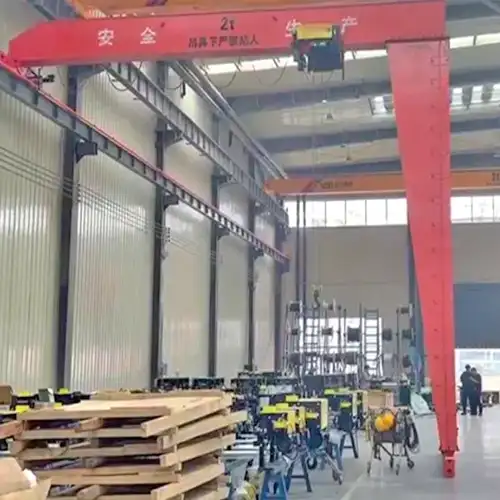
Rail-Free vs Rail-Mounted Semi Gantry Crane Guide
Compare rail-free and rail-mounted semi gantry cranes for workshops, including cost, installation, flexibility, and duty cycle for smarter selection.
| Crane Type | Semi gantry crane with ground rail travelling or with rubber tyred wheel travelling - Rail-mounted designs use a dedicated floor rail for guided travel; rail-free designs use wheels or rubber-tyred travel without embedded floor rails.ISO A3–A5 / FEM 1Am–3 |
| Crane Capacity | 3–20 ton; heavier applications can be engineered with double-girder configurations. |
| Span Length | 7.5–25 m span; customized according to the building structure, ground layout, and required lifting coverage. |
| Lifting Height | 4–12 m; customized according to building clearance, storage height, equipment dimensions, and lifting requirements. |
| Coverage Area Type | Rectangular working coverage along the crane travel path; workshops, production lines, machine areas, assembly stations, maintenance zones, warehouses, storage yards, and loading areas. |
| Application | Production lifting, workshop material handling, machine loading and unloading, fabrication, maintenance, assembly, warehouse handling, outdoor storage, and areas where only one side of the crane can use an existing runway. |
| Certifications | CE / ISO / SGS / Other third-party inspection |
| Customization | Customized single- or double-girder structure, rail-mounted or rail-free travel, electric wire rope/chain hoist, manual/electric trolley, wheel arrangement, pendant/radio/cabin control, VFD, and application-specific lifting attachments.380/400/415V, 50Hz, |
Crane Manufacturer: Yuantai Cranes – 30+ Years Professional Crane Manufacturer from China
Category: Featured
Tags: semigantry
Your Trusted Semi Gantry Crane Manufacturer & Supplier
Rail-Free vs Rail-Mounted Semi Gantry Crane: Workshop Selection Guide
Most Important Takeaway
The core decision is not about which crane is universally better, but whether your workshop prioritizes fixed high-efficiency production or flexible multi-zone material handling, because that single factor determines whether a rail-mounted semi gantry crane system or a rail-free workshop gantry solution delivers the best long-term value.
- Rail-mounted systems optimize long-term efficiency in fixed production layouts
- Rail-free systems prioritize low infrastructure cost and fast deployment
- Cost advantage depends on whether you evaluate initial investment or lifecycle cost
- Installation complexity is driven by civil works vs floor-based mobility requirements
- Duty cycle capability differs significantly between continuous industrial use and intermittent workshop operations
Semi Gantry Crane Systems in Workshop Applications
Semi gantry crane systems are commonly used in workshops where materials need to move between indoor work areas and nearby outdoor or semi-open zones such as loading areas, steel storage yards, or assembly points. In many small and medium factories, this type of crane is chosen when a full overhead crane system is not practical due to building structure or budget limits.
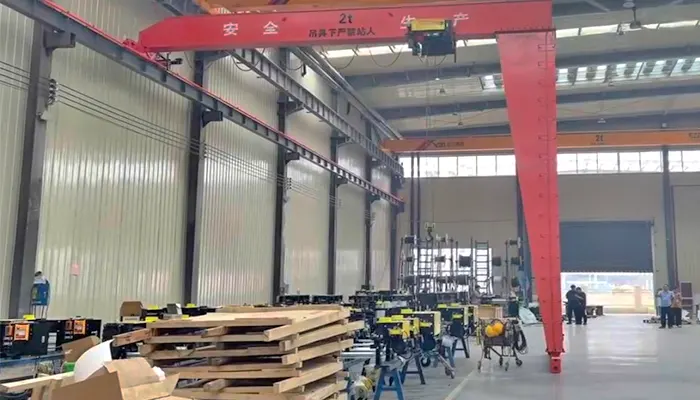
In simple terms, a semi gantry crane has one side running on a fixed runway beam (usually attached to the building structure), while the other side runs on the ground or another support method. This uneven support design allows it to cover a wider working area without requiring a fully enclosed crane runway system.
Typical workshop uses include steel fabrication, machinery repair, structural assembly, and general industrial material handling where loads are too heavy for forklifts but do not justify a full double girder overhead crane.
Basic Working Idea (Easy Understanding)
To understand it clearly, think of it like this:
- One side moves along a fixed elevated beam
- The other side moves along the floor or ground track system
- The crane bridges the working area between wall side and open space
This simple structure is what makes semi gantry cranes widely used in workshop crane systems and industrial material handling layouts.
Rail-Mounted Semi Gantry Crane -Fixed Path System
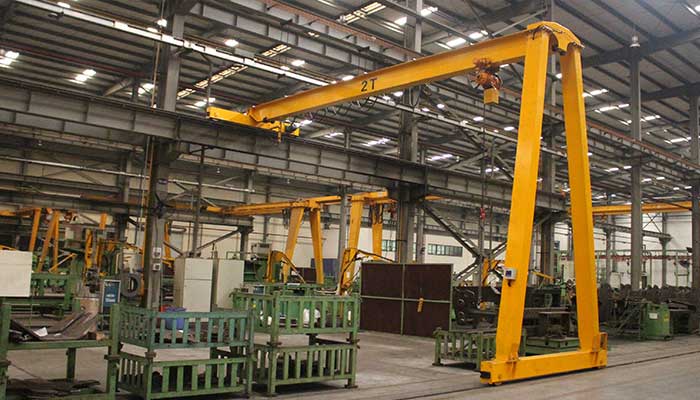
This version uses a fixed rail track installed on the ground. The crane always moves along this defined path, similar to a train running on rails. It is usually planned for workshops where the production flow does not change often.
How it works in industrial workshop use
- The crane travels on a fixed rail line
- Movement direction is stable and predictable
- Suitable for repeated lifting along the same production route
Installation requirements
- Ground rail installation and alignment
- Concrete foundation preparation
- Precise leveling of rail system
Typical applications
- Steel fabrication workshops
- Production lines with fixed workflow
- Heavy component assembly areas
- Continuous material handling operations
Practical behavior in operation
- Very stable movement during lifting
- Less deviation during long travel
- Works best when workshop layout is fixed for years
Rail-Free Semi Gantry Crane -Flexible Floor-Moving System
This version does not rely on a fixed rail track. Instead, it moves using heavy-duty wheels or mobile travel systems directly on the workshop floor. It is often chosen when workshop layout changes or when users want to avoid civil construction work.
How it works in industrial workshop use
- Crane moves freely across designated floor areas
- Position can be changed based on job requirement
- No permanent rail path limits movement
Installation requirements
- No rail construction needed
- Floor must be strong and level enough
- Basic commissioning and load testing
Typical applications
- Maintenance workshops
- Repair and service centers
- Multi-project fabrication shops
- Temporary or rental production sites
Practical behavior in operation
- High flexibility in movement
- Can serve multiple working zones
- Requires careful operator control during travel
Key Differences in Workshop Operation (Simple Comparison)
Movement pattern
- Rail-mounted: fixed direction, same path every time
- Rail-free: flexible movement across workshop floor
Workshop layout dependency
- Rail-mounted: needs stable, fixed production layout
- Rail-free: adapts to changing workshop arrangement
Installation approach
- Rail-mounted: requires rail + civil foundation work
- Rail-free: mostly depends on floor condition only
Usage style in industrial projects
- Rail-mounted: long-term production efficiency focus
- Rail-free: flexible job-based lifting tasks
Practical Workshop Insight
In industrial workshop planning, the choice usually comes down to how stable the production environment is. If materials always move through the same process line, a rail-mounted semi gantry crane keeps things organized and reduces unnecessary repositioning. If the workshop handles different jobs every day or frequently changes layout, a rail-free system makes operations more adaptable without modifying the building structure.
In short, the decision is less about crane type alone, and more about how your workshop actually runs on a daily basis.
Cost Comparison: Initial Investment vs Lifecycle Cost
| Item | Rail-Mounted Semi Gantry Crane | Rail-Free Semi Gantry Crane |
|---|---|---|
| Upfront Cost | Higher because rail system + civil work is needed | Lower because no rail or foundation work |
| Installation Work | Needs rail installation, concrete foundation, alignment | No rail work, only floor and basic setup |
| Installation Time | Longer project time | Faster setup and commissioning |
| What You Pay For | Crane + rails + construction + engineering | Mainly crane equipment only |
| Maintenance Cost | Lower in long run (stable guided movement) | Higher in long run (wheels and steering wear) |
| Wear and Tear | Low (fixed rail supports movement) | Higher (moves directly on floor) |
| Operation Stability | Very stable, same path every time | Depends on floor condition and operator control |
| Best for | Fixed production lines, heavy repetitive lifting | Flexible workshops, changing job sites |
| Overall Cost View | Higher start cost, lower long-term cost | Lower start cost, higher possible maintenance cost |
Simple Cost Understanding
- Rail-mounted crane → you pay more at the beginning, but save money later if your workshop layout does not change.
- Rail-free crane → you save money at the start, but may spend more over time if used heavily.
In industrial workshop planning, the choice depends on one question:
Do you want a fixed production line or a flexible working space?
FAQ Section: Cost Comparison of Rail-Mounted vs Rail-Free Semi Gantry Crane
Q: Why is a rail-mounted semi gantry crane more expensive at the beginning?
A: Because it requires rail installation, concrete foundation work, and precise alignment before operation starts.
In industrial workshop or yard projects, the crane itself is only part of the system cost, while civil work and engineering preparation often make up a large portion of the upfront investment.
Q: What makes a rail-free semi gantry crane cheaper to install?
A: It does not require rail tracks or foundation construction, so the installation is mainly limited to equipment setup and basic commissioning.
This is why many workshop owners searching for "low cost gantry crane for workshop use" or "quick installation overhead crane alternative" prefer rail-free systems for fast deployment.
Q: Which system has longer installation time?
A: Rail-mounted systems take longer because rail laying, leveling, and civil works must be completed before commissioning.
Rail-free systems can usually be installed much faster since they rely on existing floor conditions rather than structural modification.
Q: What is included in the total cost of a rail-mounted gantry crane system?
A: The total cost includes the crane itself, rail system, construction work, and engineering design.
In practical procurement, buyers often underestimate rail and foundation costs, which are necessary for safe long-term operation in fixed industrial layouts.
Q: What is included in the cost of a rail-free semi gantry crane?
A: The cost mainly covers the crane equipment and basic installation setup.
Since there is no rail system or civil foundation requirement, the overall initial investment remains lower, especially for workshops with existing flat floors.
Q: Why does a rail-free crane usually have higher maintenance cost?
A: Because it relies on wheel systems and floor movement, which experience more wear over time.
In industrial workshop usage, frequent turning, uneven floor conditions, and heavy loads can increase maintenance frequency compared to rail-guided systems.
Q: Which crane type has better operation stability?
A: Rail-mounted cranes provide more stable and predictable movement because they always follow a fixed rail path.
This makes them suitable for repetitive lifting tasks in steel processing lines, fabrication workshops, and assembly production zones.
Q: Which system is better for heavy repetitive lifting operations?
A: Rail-mounted semi gantry cranes are generally better for continuous and repetitive heavy lifting.
They maintain consistent travel paths and reduce mechanical stress, which supports long-term use in high-frequency industrial environments.
Q: Which crane is more suitable for changing workshop layouts?
A: Rail-free semi gantry cranes are more suitable because they can adapt to different working positions without fixed rail restrictions.
This is often preferred in maintenance workshops, multi-project fabrication shops, and temporary production sites.
Q: Is lower initial cost always better when choosing a crane?
A: Not necessarily, because lower upfront cost can lead to higher long-term maintenance if the crane is used heavily.
In practical workshop planning, the total lifecycle cost matters more than the purchase price alone.
Q: How should a buyer decide between rail-mounted and rail-free systems?
A: The decision depends on whether the workshop prioritizes fixed production efficiency or operational flexibility.
If the layout is stable and production is repetitive, rail-mounted systems are more economical over time. If the workshop changes frequently or needs fast deployment, rail-free systems reduce initial investment pressure.
Installation Requirements and Project Execution Speed
Understanding how installation complexity and execution time differ between rail-mounted and rail-free semi gantry crane systems.
| Item | Rail-Mounted Semi Gantry Crane | Rail-Free Semi Gantry Crane |
|---|---|---|
| Installation Setup | Requires rail system + concrete foundation work | No rail required, uses existing workshop floor |
| Ground Work | Heavy civil engineering required | Only floor load verification needed |
| Installation Steps | Rail alignment → fixing → assembly → testing | Assembly → positioning → setup → testing |
| Skill Requirement | High (civil + mechanical coordination) | Medium (mechanical + electrical work) |
| Installation Time | Longer | Much faster |
| Start of Operation | After full construction and commissioning | Quick startup after delivery |
| Best Application | Fixed production lines, long-term workshops | Flexible workshops, temporary sites, fast projects |
| Key Dependence | Rail alignment accuracy and foundation quality | Floor flatness and load-bearing capacity |
What is the simple difference in installation between the two systems?
- Rail-mounted: more civil work, longer installation time, high stability after completion
- Rail-free: minimal construction work, faster installation, depends on floor condition
Installation speed directly affects how quickly production can start in industrial workshops.
How is a rail-mounted semi gantry crane installed?
Rail-mounted installation is a structured engineering process involving civil and mechanical coordination.
Typical installation steps:
- Foundation and ground preparation for rail system
- Rail installation, alignment, and leveling
- Rail anchoring and fixing
- Main girder and end carriage assembly
- Electrical system installation
- Load testing and commissioning
This process requires precision because rail alignment directly affects long-term operational performance.
Typical use conditions:
- Planned construction projects
- Steel mills and fabrication plants
- Facilities with scheduled commissioning timelines
How is a rail-free semi gantry crane installed?
Rail-free systems are faster to install because they operate directly on the workshop floor without rail construction.
Typical installation steps:
- Floor load capacity inspection
- Crane assembly and positioning
- Basic leveling and adjustment
- Electrical connection setup
- Safety and load testing
This reduces dependency on civil works and shortens project execution time significantly.
Typical use conditions:
- Temporary or rental workshops
- Fast-track industrial projects
- Maintenance and flexible job-shop environments
Why does installation speed matter in crane selection?
Installation time directly impacts production startup and project delivery schedules.
- Rail-mounted systems require more construction time before operation begins
- Rail-free systems allow faster commissioning and earlier production start
In industrial planning, delays in installation can affect overall workshop productivity and contract timelines.
Flexibility and Workshop Adaptability
Understanding how rail-mounted and rail-free semi gantry cranes behave in real workshop operations.
How does a rail-mounted semi gantry crane operate in workshops?
Rail-mounted semi gantry crane systems move along a fixed rail track, creating a stable and predictable travel path.
This ensures consistent lifting routes in structured production environments where workflow does not change frequently.
Typical working characteristics:
- Fixed travel path along runway rails
- Repeated lifting in the same production zones
- Stable and predictable crane movement
- Minimal operator adjustment during operation
Common applications:
- Steel processing workshops with fixed flow lines
- Fabrication plants with repetitive production steps
- Assembly lines with directional material flow
How does a rail-free semi gantry crane operate?
Rail-free semi gantry cranes operate directly on the workshop floor, allowing flexible movement without fixed rails.
This makes them suitable for workshops where lifting points and tasks change frequently.
Typical working characteristics:
- Free movement across workshop floor areas
- Flexible positioning for different lifting tasks
- Serves multiple working zones
- High operator control during positioning
Common applications:
- Job-shop workshops with mixed production
- Maintenance and repair facilities
- Custom fabrication workshops
- Multi-project industrial environments
What is the key difference in flexibility between the two systems?
Flexibility depends on how stable or changing your production workflow is over time.
- Rail-mounted systems: focus on stable and repeatable production flow
- Rail-free systems: focus on adaptability and multi-zone operation
Simple decision guide:
- Stable workflow → rail-mounted crane is more efficient
- Changing workflow → rail-free crane offers better flexibility
Duty Cycle Performance and Operational Limits
Understanding how rail-mounted and rail-free semi gantry cranes perform under different duty cycle conditions.
How does a rail-mounted semi gantry crane perform in continuous operation?
Rail-mounted semi gantry cranes are designed for steady, repeated lifting over long operating hours with stable rail guidance.
This makes them suitable for continuous production environments where the crane operates as part of the workflow rhythm.
Typical operating characteristics:
- Medium to heavy-duty continuous operation
- Frequent lifting cycles during production
- Stable rail guidance reduces mechanical wear
- Consistent performance over long shifts
Common applications:
- Steel fabrication plants with continuous flow
- Precast concrete yards
- Industrial production lines
- Material storage and transfer yards
How does a rail-free semi gantry crane perform in duty cycle use?
Rail-free semi gantry cranes are better suited for intermittent lifting tasks rather than continuous heavy-duty operation.
They operate on floor wheels, making them flexible but more dependent on operating conditions and usage frequency.
Typical operating characteristics:
- Light to medium-duty applications
- Intermittent or variable lifting cycles
- Task-based workload changes
- Sensitive to floor surface conditions
Common applications:
- Maintenance and repair workshops
- Job-shop fabrication facilities
- Custom production environments
- Temporary or flexible industrial sites
What is the key difference in duty cycle suitability?
Duty cycle performance depends on how often lifting operations are repeated in the same workflow.
- Rail-mounted systems: optimized for continuous and repetitive lifting
- Rail-free systems: optimized for intermittent and project-based lifting
Simple decision logic:
- High-frequency production → rail-mounted crane is more stable long-term
- Variable workload → rail-free crane offers operational flexibility
Integrated Selection Framework for Workshop Buyers
A practical guide to choosing between rail-mounted and rail-free semi gantry crane systems based on real workshop operations.
When should I choose a rail-mounted semi gantry crane?
Rail-mounted systems are best suited for stable and predictable production workflows where material movement follows a fixed route.
Typical conditions:
- Fixed and stable workflow
- Repeated lifting along production lines
- Frequent daily lifting operations
- Focus on long-term production efficiency
Common applications:
- Steel fabrication workshops
- Precast concrete production yards
- Assembly line manufacturing plants
- Structured industrial facilities
In these environments, the crane becomes part of the production system and ensures consistent, repeatable material handling.
When should I choose a rail-free semi gantry crane?
Rail-free systems are ideal for workshops with changing layouts, mixed production, or flexible working conditions.
Typical conditions:
- Changing workshop layout
- Mixed material and product handling
- No fixed production line
- Need for fast relocation or setup
Common applications:
- Maintenance and repair workshops
- Job-shop fabrication facilities
- Small and medium mixed-production workshops
- Temporary or rental industrial sites
These systems prioritize flexibility, allowing operators to move across multiple working zones.
Why should I consider lifecycle cost instead of only purchase price?
Crane selection should consider total operating cost over its service life, not just initial investment.
- Rail-mounted systems: higher initial cost but lower long-term cost in stable production
- Rail-free systems: lower upfront cost but may require more maintenance in intensive use
Key insight: evaluate total lifecycle cost, including operation, maintenance, and downtime impact.
Why is workshop floor condition important for rail-free cranes?
Floor condition directly affects performance, safety, and long-term durability of rail-free systems.
Key factors:
- Load-bearing capacity of concrete floor
- Surface flatness and smoothness
- Resistance to long-term wear
- Stability under moving heavy loads
Poor floor conditions can reduce efficiency and increase maintenance requirements.
What is the simple decision logic for selecting a crane?
- Stable production + repeated lifting: rail-mounted system
- Changing layout + mixed operations: rail-free system
- Long-term efficiency: evaluate lifecycle cost first
- Floor or structural limits: assess before installation
The best crane is the one that matches real material flow, not just theoretical specifications.
Practical Application Scenarios
Real-world use cases of rail-mounted and rail-free semi gantry cranes in different industrial workshop environments.
How are semi gantry cranes used in steel fabrication workshops?
Steel fabrication workshops handle repetitive lifting of steel plates, beams, and structural components in a fixed production flow.
Rail-mounted semi gantry cranes are commonly used because they follow a stable travel path along production lines.
Typical working conditions:
- Frequent lifting of steel beams, plates, and structures
- Repetitive loading/unloading in fixed zones
- High daily lifting cycles with stable workflow
Why rail-mounted is preferred:
- Supports consistent production rhythm
- Reduces repositioning time
- Suitable for long-term fixed layouts
How are cranes used in maintenance workshops?
Maintenance workshops involve changing tasks and unpredictable lifting requirements, with no fixed material flow.
Rail-free semi gantry cranes are preferred due to their mobility and flexibility.
Typical working conditions:
- Irregular lifting tasks and varying load types
- Changing work zones based on repair needs
- Low predictability of lifting paths
Why rail-free is preferred:
- Flexible movement across workshop areas
- No fixed rail limitations
- Suitable for repair-driven operations
What crane system is suitable for small manufacturing facilities?
Small and medium workshops often combine fixed production with flexible job-shop operations.
Typical working conditions:
- Mixed fixed and variable production
- Moderate lifting frequency
- Space constraints and gradual expansion
Practical approach:
- Rail-mounted crane for core production lines
- Rail-free crane for flexible or auxiliary tasks
This hybrid configuration is common in growing industrial workshops.
Why are rail-mounted cranes widely used in large industrial plants?
Large industrial plants rely on structured production lines with high-volume and continuous material flow.
Typical working conditions:
- Defined production routes and high throughput
- Continuous operation across shifts
- Strict efficiency and scheduling requirements
Why rail-mounted is preferred:
- Stable heavy-duty performance
- Predictable material handling flow
- Reduces production interruptions
What is the key industrial decision factor for crane selection?
In real industrial planning, crane selection depends on how material flow behaves in daily operations.
- Fixed production flow: rail-mounted system is more suitable
- Variable maintenance work: rail-free system offers flexibility
- Mixed or growing workshops: hybrid systems are common
- Large structured plants: rail-mounted dominates core zones
Key question: Is your material flow fixed or changing depending on the job?
FAQ: Semi Gantry Crane Selection for Workshops
Practical guidance for choosing rail-mounted and rail-free semi gantry crane systems in real workshop conditions.
How do I know if my steel fabrication workshop needs a rail-mounted semi gantry crane?
If your workshop has a stable production flow such as cutting → welding → assembly → storage, a rail-mounted system is usually more suitable.
It is ideal for repetitive lifting paths like steel beams, plates, and H-sections, improving workflow consistency and reducing handling delays.
My workshop layout changes often. What crane should I choose?
A hybrid solution is often recommended for flexible workshops.
Use a rail-mounted crane for main production lines and a rail-free semi gantry crane for auxiliary or changing work zones.
Why is a rail-free semi gantry crane recommended for maintenance workshops?
Maintenance work has no fixed material flow and requires flexible lifting points.
Rail-free cranes allow movement between different repair zones, making them more suitable for motors, gearboxes, and irregular components.
Can rail-mounted gantry cranes work in flexible workshop environments?
Yes, but efficiency may be reduced when lifting points change frequently.
The fixed rail path limits flexibility and may require additional repositioning in dynamic workflows.
What is the main limitation of rail-mounted cranes in flexible workshops?
The main limitation is the fixed travel path.
It performs best in structured production lines but is less suitable for job-shop environments with changing lifting zones.
Are rail-free semi gantry cranes suitable for heavy steel fabrication?
Yes, but they are better suited for intermittent heavy-duty operations.
For continuous heavy lifting in fixed production lines, rail-mounted cranes offer better stability and durability.
How do I choose a crane for a small workshop with mixed production?
Selection depends on production stability and workflow variation.
Many workshops combine rail-mounted cranes for core processes and rail-free cranes for flexible or auxiliary tasks.
Why are rail-mounted cranes used in large industrial plants?
Large plants require continuous and predictable material flow.
Rail-mounted cranes support high-volume lifting and stable routing across production lines.
Is combining rail-mounted and rail-free systems common?
Yes, many industrial facilities use both systems together.
Fixed production areas use rail-mounted cranes, while flexible zones use rail-free gantry systems.
What is the key factor when selecting a workshop crane?
The most important factor is whether material flow is fixed or changing.
- Fixed repetitive flow → rail-mounted crane
- Flexible or changing flow → rail-free crane
This factor often matters more than price or capacity.
Selecting between rail-free and rail-mounted semi gantry crane systems is fundamentally a decision between operational flexibility and production efficiency. Rail-mounted systems deliver long-term performance advantages in fixed industrial workflows, while rail-free systems provide cost-effective mobility for dynamic workshop environments. The optimal choice depends on how stable your production layout is, how often lifting operations repeat, and how much flexibility your workshop requires over time.
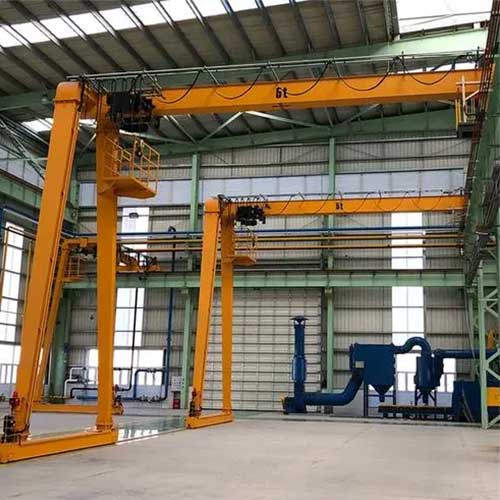

Yuantai Cranes
Overhead Crane Manufacturer with CE, ISO, SGS, CNEX Certificates.
- Main Specifications - Capacity: 0.5–550 tons | Span: up to 40m | Speed: 0.8–12 m/min | Duty: A3–A7 | Power: 380–690V, 50/60Hz | Control: pendant/remote/cabin
- Full engineering: FEA/PLC/VFD + in-house build + global delivery + on-site support, for workshops, factories, EPC contractors, industrial projects, etc.
- Support: design, manufacturing, testing, service – end-to-end, customized lifting solutions worldwide.
How to Get an Accurate Crane Price for Your Application?
Tips: Copy the spec list, fill in your details, and paste it into the form on the right/ down-below for a quick price.
- Crane type:_____ . (e.g., overhead crane, gantry crane, jib crane)
- Max weight to lift:_____ tons. (e.g., 2t, 5t, 10t, 20t, 50t)
- Lifting height:_____ m. (How high does the hook need to reach?
- Workshop width (span):_____ m . (Distance between the two crane rails)
- Travel distance:_____ m . (How long does the crane need to move along the runway?)
- Control type:_____. (Pendant / remote / cabin Control)
- Power supply:_____. (Local voltage & frequency – e.g., 380V, 50Hz, 3-phase)
- What will it be used for?_____ (e.g., steel fabrication, concrete products, mold handling, general manufacturing, etc.)
- Any special requirements?_____ (e.g., extreme temperature, dusty or explosive environment, special paint color, etc.)
Just leave a message via the contact form and our hoist and crane engineer will contact you with in 24working hours.
Get Your Custom Quote–Quick & Easy
Fill in what you know. Skip what you don't – we'll help.Any question will be reply with 24 working hours