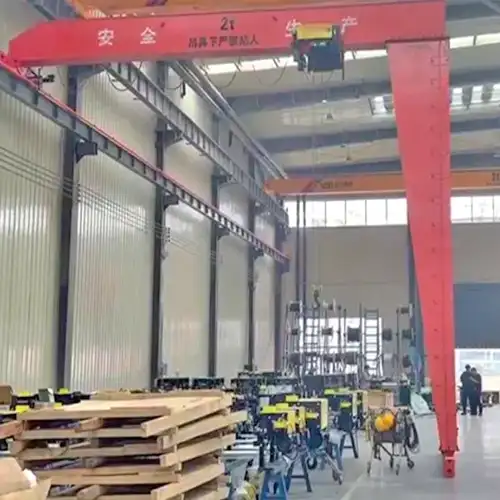
Rail-Free Semi Gantry Crane | No Rail Type Crane
Rail-free semi gantry crane offers flexible lifting without rails, ideal for workshops and warehouses needing easy installation and mobile material handling.
| Crane Type | Semi Gantry Crane with No Ground Rail Travelling but with Rubber Tyred Wheel Travelling - Rubber-Tyred Semi Gantry Crane with Single or Double Girder, rubber-wheel travelling instead of ground rails, electric hoist or open winch, ISO A3–A5 / FEM 1Am–3M , |
| Crane Capacity | Typically 3–30 Ton; customized for heavier loads when required. |
| Span Length | Typically 8–25 m; customized according to the working area and required coverage. |
| Lifting Height | Typically 6–15 m; customized according to building clearance and lifting requirements. |
| Coverage Area Type | Rectangular-Flexible travel paths across workshops, yards, loading zones, storage areas, and production spaces without fixed ground rails. |
| Application | A ground wheel travelling semi gantry crane without rails is used for handling machinery, steel structures, and heavy materials in workshops, warehouses, and yards, providing flexible floor-based movement without rail installation. |
| Certifications | CE / ISO / SGS / Other third-party inspection |
| Customization | 3–30 Ton; Single/Double Girder; Rubber-Tyred Travel; No Ground Rail; Electric Hoist/Open Winch; Customized Span & Lift; Pendant/Remote Control. |
Crane Manufacturer: Yuantai Cranes – 30+ Years Professional Crane Manufacturer from China
Category: Full& Half Gantry
Tags: semigantry
Your Trusted Semi Gantry Crane Manufacturer & Supplier
Rail-Free Semi Gantry Crane
No-Rail Wheel Travelling Semi Gantry Crane for Flexible Lifting
Rail-free semi gantry crane (no-rail wheel travelling type) provides flexible and cost-effective material handling without runway rails. Ideal for workshops, warehouses, and fabrication plants requiring mobile, easy-to-install gantry crane solutions for medium-duty lifting operations.
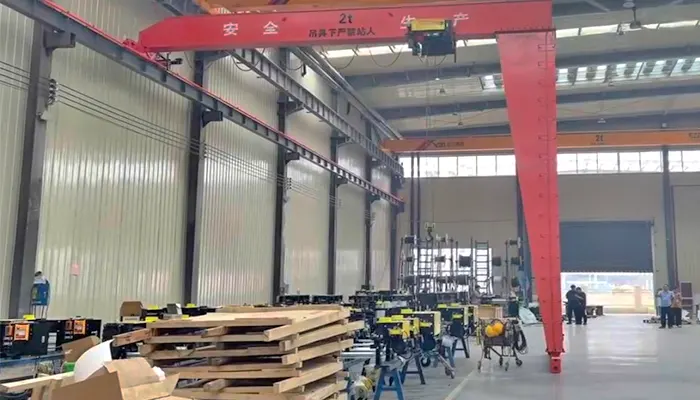
Introduction to Rail-Free Semi Gantry Crane
A rail-free semi gantry crane, also called a no-rail wheel travelling semi gantry crane, is a lifting system and a type of semi gantry crane systems that moves on wheels directly over a concrete floor instead of using fixed rails. One side runs on a runway beam or building support, and the other side travels on ground wheels. Simple idea, but very practical in workshop lifting. It is commonly searched as rail-free gantry crane for workshop, wheel travelling semi gantry crane, or mobile semi gantry crane without rail system. In many factories, it is used when rail installation is not needed or the layout changes often.
Definition of Rail-Free Semi Gantry Crane
A rail-free semi gantry crane is a ground wheel travelling crane system without embedded rails. It carries loads using a semi gantry structure while moving freely along a prepared floor surface.
- No rail track installation required
- Runs on heavy-duty industrial wheels
- One side supported, one side ground travelling
- Suitable for indoor workshops and open yards
In use, it is often chosen for steel fabrication, maintenance work, and general material handling where flexibility matters more than fixed paths.
Core Concept: Wheel Travel Without Fixed Rails
The main idea is straightforward: replace rail tracks with industrial wheel travel on concrete floor.
- Wheels carry and distribute the load directly on ground
- Movement follows a simple floor path, no rail constraint
- One side support balances the structure during lifting
- Works best on reinforced concrete workshop floors
In practice, this system is often used when production layout changes, or when buyers want a low infrastructure cost gantry crane solution without rail installation work.
Working Principle and Structural Concept
A rail-free semi gantry crane works on a ground wheel travelling system, where movement happens directly on a reinforced concrete floor instead of fixed rails. The structure is simple in layout, but the load path and balance design are carefully arranged to keep stable lifting during operation. In many workshops, operators just call it a "floor running gantry." That gives a clear idea already—no rail, just wheel movement.
Ground-Supported Wheel Traveling System
The crane moves using a set of heavy-duty wheels that run on the workshop floor. No rail track is needed.
- Wheels directly contact the concrete surface
- Movement guided by motor drive or steering wheel assembly
- Floor must be level and strong enough to handle load pressure
- Common in steel fabrication shops and assembly workshops
In practical use, this system works best when the travel path is short and controlled. Not for high-speed long-distance running, but steady lifting work.
One Side Runway Beam + Opposite Side Ground Travel
The structure is not fully supported on both sides. Instead, it uses a semi-portal arrangement.
- One side runs along a runway beam or building column system
- The opposite side is supported by ground travelling wheel legs
- Load is shared between fixed support and moving ground side
- Suitable for workshops with limited structural modification space
This layout is often chosen when a full gantry crane is too heavy or expensive for the project, but a simple mobile crane is not strong enough.
Wheel Set Design (Polyurethane or Steel Wheels)
The wheel system is one of the most important parts of the crane. It directly affects movement smoothness and floor condition.
Polyurethane wheels
- Lower noise during travel
- Less floor wear
- Common in indoor workshops
Steel wheels
- Higher load capacity
- Better for rough or heavy-duty conditions
- Often used in steel yards or outdoor areas
Wheel assemblies may also include:
- Steering wheel units for directional control
- Guided wheels to maintain straight travel path
- Anti-slip surface design for safety during load movement
Drive System and Control Method
The crane is usually powered by an electric motor-driven travel system. It can be controlled in different ways depending on working requirements.
- Electric motor with gearbox for wheel driving
- Push-button pendant control or wireless remote control
- Optional VFD (Variable Frequency Drive) for speed adjustment
- Smooth start and stop to reduce load swing
In operation, VFD control is often preferred because it helps reduce sudden movement, especially when handling steel plates, beams, or machinery parts.
Load Transfer Path and Stability Mechanism
The load path is designed to keep balance between the supported side and the ground wheel side.
- Load is lifted by hoist and transferred to main girder
- Force is distributed to one fixed support + one ground wheel side
- Ground wheels carry vertical load through floor pressure
- Runway beam side provides structural stability and guidance
To keep safe operation:
- Wheel spacing is designed based on load capacity
- Structural reinforcement reduces bending during lifting
- Floor strength must match rated crane load
- Anti-tilt balance is maintained through geometry design
In simple terms, the crane "leans on the building side and rolls on the floor side," but the load is always balanced within a controlled structural range.
Main Structural Components
A rail-free semi gantry crane is built from several key systems working together. Each part has a clear role: support, lifting, movement, and control. The design is simple in appearance, but every component is tied to load safety and floor travel performance.
Main Girder System
The main girder is the primary load-bearing beam. It carries the hoist and transfers the lifting force across the structure.
- Available in single girder or double girder configurations
- Structural form: box-type or I-beam design
- Designed with reinforcement for torsion resistance during travel
- Supports hoist movement along the span
In practical workshop use, single girder is often selected for light to medium duty, while double girder is used when lifting heavier steel parts or larger spans are required.
Semi Portal Frame
This is the supporting structure that defines the semi gantry layout.
- One side connects to a fixed building column or runway beam
- The opposite side forms a ground travelling leg structure
- Designed to balance load between fixed and moving support points
- Keeps crane stability during lifting and movement
It is commonly used in workshops where one side of the building can carry structural load, reducing the need for a full gantry frame.
Wheel Traveling System (Key Feature)
This is what makes the crane "rail-free." Movement happens directly on the floor through wheel assemblies.
- Rail-free wheel units replace traditional track systems
- Heavy-duty industrial wheels carry vertical load
- Wheel spacing designed for even load distribution on concrete floor
- Optional steering or guided wheel design for travel control
Floor condition is important here. A strong, level concrete surface is usually required for stable operation.
Hoisting Mechanism
The hoisting system handles the actual lifting work.
- Options include wire rope hoist or electric chain hoist
- Hoist can be fixed or mounted on a traveling trolley
- Designed for vertical lifting and precise load positioning
- Used for steel plates, beams, machinery parts, and assemblies
In many workshop applications, wire rope hoists are preferred for higher lifting capacity and longer service life.
Drive and Control System
This system controls movement and operation of the crane.
- Motor-driven wheel travel system for crane movement
- Remote control or operator cabin control options available
- Safety interlocks to prevent overload or unsafe operation
- Limit switches for travel end positions and lifting height control
Optional VFD control is often added to improve smooth start/stop performance, especially when handling long or heavy materials that require controlled movement.
Working Mechanism of Rail-Free Operation
A rail-free semi gantry crane runs directly on the workshop floor instead of following a fixed rail track. The movement is controlled by wheels and guided by the crane structure itself. In practice, it is a simple concept, but it depends heavily on floor quality and wheel design.
Direct Floor Travel System
The crane moves straight on a prepared surface, usually reinforced concrete.
- No rail embedding or steel track required
- Wheel sets run directly on factory floor
- Floor must be level and load-bearing
- Common in workshops with flexible layout needs
This is why it is often selected for steel workshops, fabrication areas, and general industrial yards where rail installation is not preferred.
No Embedded Rail Requirement
Unlike rail-mounted systems, this crane does not depend on fixed guide tracks.
- Eliminates rail installation and alignment work
- Reduces civil construction cost and time
- Allows quicker setup and relocation if needed
- Suitable for temporary or changing production lines
In many cases, users choose this system when they want "plug-and-operate" style installation.
Steering and Direction Control
Since there is no rail guiding the movement, direction control is handled by the wheel system and drive control.
- Motor-driven steering or guided wheel units
- Remote control or pendant control for operator handling
- Smooth directional changes based on design configuration
- Controlled turning for layout adjustments in workshop space
Some designs allow slight curved movement, but most systems are optimized for straight-line travel.
Load Balancing Mechanism
Stability is achieved through balanced load distribution between the supported side and the ground wheel side.
- One side supported by runway beam or building structure
- Opposite side carries load through ground wheel system
- Load is evenly distributed across wheel sets
- Structural frame prevents tilting during lifting
In simple terms, the crane keeps its balance by combining fixed support with rolling support. This balance is what allows safe lifting without rail guidance.
Movement Patterns in Operation
The crane can follow different movement patterns depending on workshop layout and design requirements.
- Linear travel along workshop production lines
- Short-distance positioning for assembly or loading tasks
- Limited curved adjustment in some steering wheel configurations
- Controlled stop-and-go movement for precise load placement
In industrial use, most operations are linear, especially in steel fabrication or material staging areas where workflow is arranged in straight production paths.
Video of Rubber Tyred Wheel Semi Gantry Crane
Technical Parameters (Typical Range)
The rail-free semi gantry crane is usually designed based on workshop conditions, load type, and daily working frequency. The parameters are flexible, but they stay within a practical industrial range used in fabrication shops, warehouses, and general manufacturing plants.
Load Capacity
- Typical range: 1 ton – 32 tons
- Custom designs available for higher capacities depending on structure and floor condition
- Common applications include steel plates, structural beams, machinery parts, and packaged materials
In practical use, most workshop setups stay in the 5 ton to 20 ton range. That's where this type of crane is most frequently used.
Span (Working Width)
- Standard range: 3 m – 30 m
- Determined by workshop layout and support structure spacing
- Larger spans require stronger girder reinforcement and stable wheel alignment
Shorter spans are common in maintenance areas, while wider spans are used in steel processing or storage zones.
Lifting Height
- Typical range: 3 m – 18 m
- Depends on building height and hoist configuration
- Can be adjusted based on material stacking or assembly requirements
In most indoor workshops, a moderate lifting height is preferred to keep structure compact and stable.
Travel Speed
- Controlled by motor system with optional VFD (Variable Frequency Drive)
- Allows adjustable speed for smooth operation
- Slow speed for precise positioning, higher speed for empty travel
Operators often reduce speed during heavy lifting to avoid load swing and improve control.
Duty Class
- Standard classification: A3 – A6 duty range
- A3–A4: light to medium workshop use
- A5–A6: more frequent lifting and industrial production lines
Duty class selection depends on how often the crane is used per day and the type of load cycle. For continuous steel handling, higher duty class is usually recommended to maintain service life and stable performance.
Key Design Features
The rail-free semi gantry crane is designed around one main idea: keep lifting flexible without building fixed rail infrastructure. Every structural choice supports that goal. In workshop use, it is often selected when layouts change, production flow shifts, or space is shared between different operations.
Rail-Free Mobility System for Flexible Workshop Layouts
The biggest feature is the wheel-based travel system without rails. It allows the crane to move directly on the floor and adjust to different working zones.
- No fixed runway rail or embedded track required
- Runs on reinforced concrete workshop floor
- Supports flexible movement across multiple workstations
- Suitable for changing production layouts and multi-purpose workshops
In practice, this is useful when material flow is not fixed in one direction. Operators can reposition the crane within the same shop without structural modification.
Modular Structure for Easy Relocation
The crane is usually built in modular sections, which makes installation and relocation more practical.
- Main girder, end carriage, and leg sections are prefabricated
- Bolt-connected structure for faster assembly and disassembly
- Can be relocated to another workshop with minimal downtime
- Suitable for temporary production lines or rented industrial spaces
This modular approach reduces dependency on permanent foundations. In many cases, it can be dismantled, transported, and reinstalled with basic mechanical work.
Compact Footprint Compared to Full Gantry Systems
Compared with full gantry cranes, the rail-free semi gantry has a more space-efficient structure.
- Requires only one-side runway support
- No dual rail system or wide gantry base needed
- Frees up more usable floor space under the crane
- Easier integration into existing workshop buildings
This makes it a common choice for indoor workshops where space is limited, but lifting coverage is still required.
Ground Load Dispersion Design to Prevent Floor Damage
Since the crane runs directly on the floor, load distribution becomes a critical design point.
- Wheel load is spread across multiple contact points
- Reinforced wheel assemblies reduce point pressure
- Designed for standard industrial concrete floors
- Helps avoid floor cracking or surface deformation
In practical terms, the crane is not just "rolling on the floor." The wheel system is engineered to keep ground pressure within safe limits, especially during full-load lifting.
Anti-Sway and Stability Reinforcement Features
Load stability is controlled through both structural design and operational control systems.
- Reinforced main girder reduces deflection during lifting
- Balanced semi-portal frame improves load stability
- Optional anti-sway control for hoist movement
- Controlled acceleration and deceleration using VFD systems
During operation, especially when lifting long steel plates or uneven loads, these features help reduce swing and keep positioning more controlled. It is not perfect rigidity, but it is stable enough for normal industrial handling tasks.
Overall Structural Coordination in Industrial Use
In industrial environments, these design features work together rather than separately. The result is a crane that stays simple in structure, but still performs reliably in workshops where flexibility and practical handling matter more than fixed infrastructure.
Advantages of Rail-Free Semi Gantry Crane
The rail-free semi gantry crane is mainly chosen for its simplicity in installation and flexibility in daily use. It removes a lot of fixed infrastructure work, which makes it easier to deploy in workshops where layout and production flow may change over time.
Below are the key advantages seen in practical industrial use:
- No need for rail foundation or runway beam installation
- Lower infrastructure cost
- Faster installation and commissioning
- Flexible relocation inside workshop or yard
- Suitable for temporary or changing production layouts
- Reduced civil engineering requirements
Each of these points directly affects project setup time and overall investment. For example, without rail construction, the crane can be installed as soon as the floor and power supply are ready.
In real workshop conditions, this means less waiting, fewer construction steps, and easier adaptation when production lines shift or expand.
Limitations and Design Considerations
The rail-free semi gantry crane is practical for flexible workshop use, but it is not a universal solution. Its performance depends heavily on floor conditions, load requirements, and how often the crane is used in daily operations.
Before selecting this type, it is important to understand its working limits and design constraints.
- Requires strong and level concrete flooring
- Lower precision travel compared to rail-guided systems
- Load capacity limited by wheel-ground pressure
- Not ideal for ultra-heavy or continuous high-duty operations
- Floor wear and maintenance considerations
Each point reflects real operating conditions. For example, if the floor is not properly reinforced, wheel pressure can lead to uneven movement or surface damage over time.
In practical use, this crane works best in medium-duty environments where flexibility matters more than high-speed precision or continuous heavy-cycle lifting. Regular floor inspection and wheel maintenance are also part of normal operation to keep performance stable.
Typical Industrial Applications
The rail-free semi gantry crane is mainly used in workplaces where lifting tasks are repetitive but the layout is not fixed. It fits well in medium-duty environments where flexibility is more important than strict rail-guided precision.
Below are the most common application areas seen in real industrial use.
Steel Fabrication Workshops
In steel processing environments, materials are heavy but handling routes often change with production stages.
- Plate handling for cutting and assembly lines
- Beam movement during welding and fitting work
- Lifting for structural assembly and positioning tasks
This is one of the most common uses, especially where steel plate handling crane system and beam lifting semi gantry crane solutions are required.
Warehouses and Logistics Centers
In storage and logistics operations, the crane supports loading and internal movement of goods.
- Equipment loading and unloading from transport vehicles
- Bulk material handling inside storage areas
- Short-distance lifting between storage zones
It is often used when a fixed overhead crane system is not available or not necessary.
Machinery Manufacturing Plants
Manufacturing plants use this crane for controlled assembly work and equipment handling.
- Component lifting during assembly processes
- Medium-weight machinery positioning
- Support for production line installation work
In practice, it helps reduce manual handling when positioning heavy parts.
Construction Sites and Temporary Yards
Because it does not rely on rail installation, it can be used in temporary working environments.
- Flexible lifting for on-site construction work
- Portable operation for short-term projects
- Easy relocation between working zones
This makes it suitable for projects where equipment setup changes frequently.
Maintenance Workshops
Maintenance and repair operations often require occasional but precise lifting.
- Equipment repair and repositioning
- Lifting of disassembled machine parts
- Support for maintenance and overhaul work
In these cases, the crane is used more as a support tool rather than a continuous production system.
Comparison with Other Crane Types
The rail-free semi gantry crane is often selected after comparing it with rail-mounted systems, full gantry cranes, and mobile gantry cranes. Each type solves a different handling need, so the choice depends on floor conditions, load level, and how fixed or flexible the workshop layout is.
No ground rail - rubber tyred wheel travelling semi gantry crane
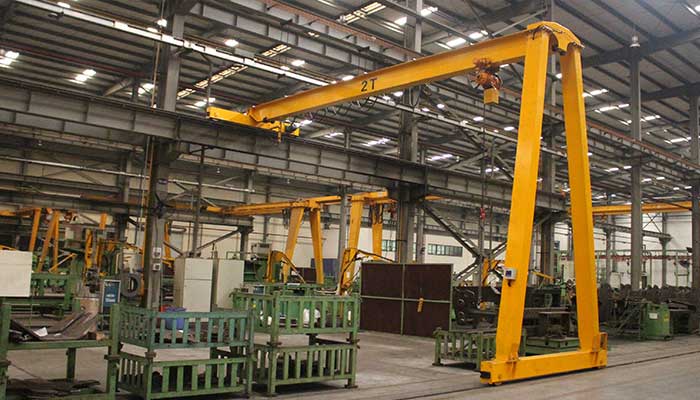
Rail-Free vs Rail-Mounted Semi Gantry Crane
These two look similar in structure, but the travel system is completely different.
Infrastructure requirement differences
- Rail-free type runs directly on concrete floor, no rail installation needed
- Rail-mounted type requires steel rails, foundation work, and alignment
- Rail-free is quicker to install, rail-mounted needs civil preparation
In practice, rail-free systems are often chosen when workshops want to avoid construction work or expect layout changes later.
Precision and stability comparison
- Rail-mounted crane offers more stable and accurate straight-line travel
- Rail-free crane depends on floor condition and wheel guidance
- Rail-mounted is better for repetitive production lines
- Rail-free is more flexible but slightly lower in positioning precision
Simply put, rail-mounted is "fixed and precise," while rail-free is "flexible and adjustable."
Rail-Free vs Full Gantry Crane
Full gantry cranes are heavier systems designed for large-scale lifting operations.
Coverage area and structural cost differences
- Full gantry crane covers wider working spans with dual-side support
- Rail-free semi gantry uses one-side support + ground wheels
- Full gantry requires more steel structure and stronger foundation
- Rail-free system reduces structural and installation cost
Full gantry cranes are common in steel yards, ports, and shipyards, while rail-free systems are more common inside workshops and medium-duty production areas.
Rail-Free vs Mobile Gantry Crane
Mobile gantry cranes are lightweight and portable, but their capacity and structure are limited.
Mobility method and load capacity differences
- Mobile gantry crane is manually moved or lightly pushed
- Rail-free semi gantry is motor-driven and follows a defined path
- Mobile gantry has lower lifting capacity and shorter span
- Rail-free system supports higher loads and more stable operation
In simple terms, mobile gantry is for light maintenance jobs, while rail-free semi gantry is for regular industrial lifting tasks.
Summary Insight
Across all comparisons, the rail-free semi gantry crane sits in a middle position:
- More stable and stronger than mobile gantry systems
- More flexible and easier to install than rail-mounted systems
- Lighter and more cost-efficient than full gantry cranes
It is typically chosen when a workshop needs industrial-level lifting without permanent rail infrastructure.
Comparison Table
| Item | Rail-Free Semi Gantry Crane | Rail-Mounted Semi Gantry Crane | Full Gantry Crane | Mobile Gantry Crane |
|---|---|---|---|---|
| Rail / Foundation Needed | No rail needed, runs on concrete floor | Needs rail installation | Needs full rail + strong foundation | No rail, simple floor use |
| Installation Work | Quick setup, less construction | Medium installation work | Heavy civil and steel work | Very fast setup |
| How It Moves | Motor wheels on floor | Runs on fixed rails | Runs on dual rails | Manual or light wheel movement |
| Precision & Stability | Medium, depends on floor | High precision | Very stable, high accuracy | Low precision |
| Load Capacity | Medium range (about 1–50 tons) | Medium to heavy | Heavy to very heavy | Light duty only |
| Working Area | Flexible workshop use | Fixed production line | Large yards, outdoor heavy work | Small or temporary area |
| Cost Level | Medium | Higher (rail system needed) | Highest | Lowest |
| Best Use | Workshops, fabrication plants | Fixed production lines | Ports, steel yards, shipyards | Repair and light lifting |
Simple Understanding
- Rail-free type = no rail, flexible, workshop-friendly
- Rail-mounted type = fixed path, more precise, less flexible
- Full gantry = heavy-duty outdoor lifting system
- Mobile gantry = light lifting, temporary use
Selection Considerations for Buyers
Choosing a rail-free semi gantry crane is not only about lifting capacity. It also depends on how the workshop is built, how often the crane will move, and how the operation is planned on a daily basis. In real projects, these points decide whether the crane will run smoothly or cause problems later.
Load Weight and Duty Cycle Requirements
- Check the maximum load weight per lift and add a safety margin
- Match the crane with actual working frequency, not just occasional lifting
- Light use vs continuous daily production makes a big difference in design level
In practice, a crane used all day in a fabrication shop needs a stronger duty class than one used only for occasional maintenance lifting.
Floor Strength and Reinforcement Level
- Floor must be reinforced concrete with sufficient thickness
- Wheel load is concentrated, so surface strength matters
- Weak floors may cause cracking or uneven travel over time
This is one of the most important checks, because rail-free systems rely completely on the ground surface for movement.
Required Mobility Frequency
- Frequent movement needs smoother wheel design and motor control
- Occasional movement allows simpler configuration
- High mobility may require better floor finishing and VFD control
If the crane is moving multiple times per hour, control smoothness becomes more important than speed.
Indoor vs Outdoor Usage Conditions
- Indoor use: focus on compact design and floor protection
- Outdoor use: consider weather protection and wheel durability
- Dust, rain, and temperature changes affect long-term performance
Many buyers underestimate this point. Outdoor use often requires stronger wheels and better sealing systems.
Span and Lifting Height Requirements
- Span must match workshop layout and support structure spacing
- Higher lifting height needs stronger girder and stable frame design
- Over-sizing increases cost, under-sizing limits operation efficiency
A balanced design is usually better than simply choosing the largest specification.
Budget vs Infrastructure Investment Trade-off
- Rail-free systems reduce rail construction cost
- Higher capacity designs increase equipment cost
- Rail vs no-rail decision affects total project budget significantly
In many cases, buyers choose rail-free semi gantry cranes to avoid civil construction work, especially when the workshop layout may change in the future.
Additional Practical Note
In real procurement decisions, selection is rarely based on a single parameter. Load, floor condition, mobility frequency, and budget all interact together. A properly balanced specification ensures stable operation and longer service life in actual workshop conditions.
Safety Systems and Operational Protection
Safety design is a key part of a rail-free semi gantry crane because the system runs directly on the workshop floor and depends on controlled movement, stable load handling, and reliable electrical operation. These protection functions are not optional in real industrial use; they are part of daily safe operation.
Below are the main safety systems commonly used:
- Overload protection system
- Emergency stop function
- Travel limit switches
- Anti-slip wheel design
- Electrical protection and grounding system
Each system plays a different role. Overload protection prevents lifting beyond rated capacity, while limit switches control travel range and avoid collision at the end positions.
In practical operation, these safety features work together to reduce risks during lifting, moving, and stopping. They help keep both the operator and equipment protected, especially in busy workshop environments where repeated lifting is common.
FAQ Section
Q: Can rail-free semi gantry cranes be used on normal factory floors?
A: Yes, but only when the floor is reinforced and suitable for wheel-based industrial crane movement.
- Works on reinforced concrete workshop floors used for material handling equipment
- Not suitable for weak or unprepared ground surfaces often found in light storage areas
- Commonly selected in steel fabrication workshops and machinery assembly plants with existing heavy-duty flooring
Q: What is the required concrete thickness for safe operation?
A: A properly reinforced concrete floor is required, typically designed for industrial load-bearing use.
- Many industrial buyers looking for floor-mounted gantry crane solutions use reinforced slabs around standard workshop thickness levels
- Final requirement depends on load capacity, wheel pressure, and duty cycle
- Heavier systems used for steel plate lifting or beam handling applications require stronger floor design
Q: How stable is a rail-free system under full load?
A: It remains stable when correctly designed and used within rated capacity and proper floor conditions.
- Stability relies on wheel load distribution and semi portal structure balance
- Frequently used in medium-duty workshop lifting and fabrication line material movement
- Less rigid than rail-guided cranes, but suitable for controlled industrial handling tasks
Q: Can the crane be moved frequently between workshops?
A: Yes, it can be relocated, but it requires proper setup at each new working site.
- Often used in multi-workshop production environments and temporary manufacturing setups
- No rail dismantling is needed, which makes relocation simpler than fixed gantry systems
- Power supply and floor conditions must still be checked before reuse
Q: What is the maximum load capacity without rails?
A: Most rail-free semi gantry cranes are designed within a medium to heavy industrial range depending on configuration.
- Commonly used in 1 ton to 50 ton workshop lifting applications
- Higher capacity versions exist for steel structure handling and heavy fabrication work
- Final capacity depends on wheel design, girder strength, and concrete floor load rating
Q: Does floor condition affect crane lifespan?
A: Yes, floor quality directly affects wheel wear and long-term structural performance.
- Uneven or weak floors increase stress on industrial wheel systems used in rail-free crane operation
- Proper surface condition improves stability in continuous workshop material handling cycles
- Maintenance intervals are shorter when used on poor or cracked concrete surfaces
Q: Can it replace a rail-mounted gantry crane in production lines?
A: It can replace rail-mounted systems only in flexible or medium-duty production environments.
- Suitable for workshops requiring adjustable layout material handling systems
- Not ideal for high-precision continuous rail-guided production lines such as automated steel processing systems
- Often chosen when buyers want to reduce rail installation cost and civil construction work in industrial projects
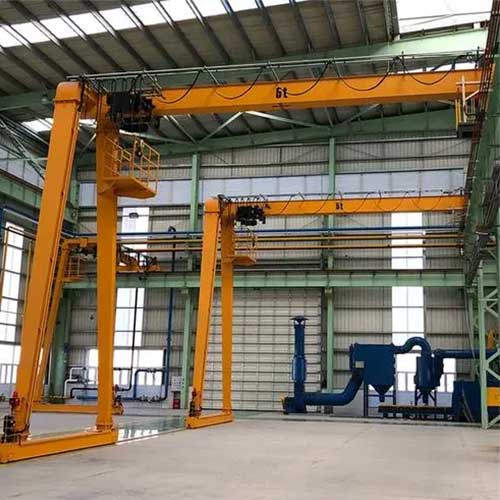

Yuantai Cranes
Overhead Crane Manufacturer with CE, ISO, SGS, CNEX Certificates.
- Main Specifications - Capacity: 0.5–550 tons | Span: up to 40m | Speed: 0.8–12 m/min | Duty: A3–A7 | Power: 380–690V, 50/60Hz | Control: pendant/remote/cabin
- Full engineering: FEA/PLC/VFD + in-house build + global delivery + on-site support, for workshops, factories, EPC contractors, industrial projects, etc.
- Support: design, manufacturing, testing, service – end-to-end, customized lifting solutions worldwide.
How to Get an Accurate Crane Price for Your Application?
Tips: Copy the spec list, fill in your details, and paste it into the form on the right/ down-below for a quick price.
- Crane type:_____ . (e.g., overhead crane, gantry crane, jib crane)
- Max weight to lift:_____ tons. (e.g., 2t, 5t, 10t, 20t, 50t)
- Lifting height:_____ m. (How high does the hook need to reach?
- Workshop width (span):_____ m . (Distance between the two crane rails)
- Travel distance:_____ m . (How long does the crane need to move along the runway?)
- Control type:_____. (Pendant / remote / cabin Control)
- Power supply:_____. (Local voltage & frequency – e.g., 380V, 50Hz, 3-phase)
- What will it be used for?_____ (e.g., steel fabrication, concrete products, mold handling, general manufacturing, etc.)
- Any special requirements?_____ (e.g., extreme temperature, dusty or explosive environment, special paint color, etc.)
Just leave a message via the contact form and our hoist and crane engineer will contact you with in 24working hours.
Get Your Custom Quote–Quick & Easy
Fill in what you know. Skip what you don't – we'll help.Any question will be reply with 24 working hours