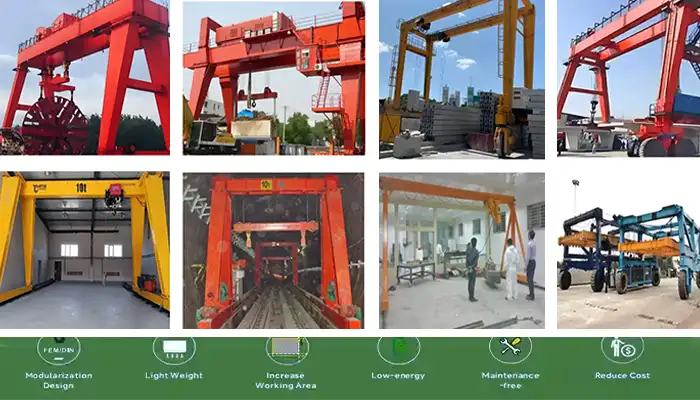
10–50 Ton Tunnel Gantry Crane: Capacity & Configuration Guide
Content Quick Link
Select 10–50 ton tunnel gantry cranes for TBM, metro, mining, and hydropower projects. Learn capacity and configuration choices to improve tunnel workflow and avoid delays.
How to Select the Right Tunnel Gantry Crane Capacity and Configuration
The correct tunnel gantry crane is not selected by tonnage alone—it is defined by the combined engineering logic of capacity + configuration + TBM workflow integration. Early-stage alignment prevents redesign, reduces downtime, and ensures continuous underground construction flow.
This guide helps you clearly determine:
- What tunnel gantry crane capacity selection is appropriate for your TBM or underground workflow
- Which configuration (double girder, rail-mounted, low headroom, semi gantry, enclosed trolley) fits your tunnel geometry
- How to match lifting duty classification, cycle time, and underground logistics requirements
- How EPC planners, engineers, procurement teams, and project managers influence final crane decisions
- How to avoid common mistakes in tunnel crane specification checklist preparation
Tunnel Gantry Crane FAQs: Quick Guide
Frequently asked questions about tunnel gantry crane capacity selection, configuration, project applications, and planning considerations.
How to choose crane capacity?
Pick a crane that safely handles your heaviest loads.
- Metro: 10–20 t segments
- TBM spoil: 20–32 t
- Hydropower/mining: 32–50 t
How to pick crane configuration?
Match the crane to tunnel space and workflow.
- Rail-mounted: long tunnels, frequent moves
- Double girder: high-load, stable lifting
- Low headroom: tight TBM backup zones
Best crane for metro, mining, hydropower?
Depends on load, space, and workflow:
- Metro: double girder / rail-mounted
- Mining: rugged, dust-resistant
- Hydropower: heavy-duty high-capacity
How do lifting cycles affect choice?
High-frequency lifts → double girder or rail-mounted
Low-frequency lifts → single girder or low headroom
How do project roles influence selection?
- Engineers: fit in tunnel
- EPC planners: match TBM workflow
- Procurement: clear specs
- Project managers: avoid bottlenecks
What if capacity and configuration mismatch?
TBM slows, installation stalls, costs increase.
When to finalize crane choice?
Early in planning alongside TBM and tunnel design to ensure smooth logistics and avoid delays.
Why Capacity and Configuration Must Be Considered Together
Selecting a tunnel gantry crane is not just about choosing a lifting tonnage—it requires evaluating both capacity and configuration as an integrated system.
- Capacity determines what loads the crane can safely lift.
- Configuration determines how the crane can operate within confined tunnel space and TBM logistics.
Failing to match capacity with configuration can cause:
- TBM excavation delays due to lifting constraints
- Bottlenecks in segment installation or equipment handling
- Inefficient underground material flow and workflow interruptions
- Higher lifecycle and maintenance costs
Key takeaway: Every TBM gantry crane must be selected as a complete system, balancing load requirements, structural design, and underground workflow integration to ensure smooth and continuous tunnel construction.
Typical Tunnel Gantry Crane Configurations and Capacity Ranges
Overview
The most widely used configuration for TBM-driven tunnels in metro, subway, and hydropower projects.
Provides high structural rigidity to handle repetitive lifting cycles of precast segments, spoil containers, and heavy equipment.
Supports stable and continuous underground crane workflow, even under high-duty operations.
Operational Focus
Ideal for main TBM drives where material handling frequency is high.
Handles both segment installation and spoil removal without stopping TBM advance.
Reduces stress on crane components during continuous lifting cycles, minimizing maintenance needs.
Capacity Mapping
- 10–20 ton → Metro/subway segment handling and installation
- 20–32 ton → TBM spoil removal plus combined segment logistics
- 32–50 ton → Heavy hydropower tunnels and large infrastructure segments
Practical Selection Guidance
Use double girder when tunnel diameter allows and heavy-duty lifting is required.
Recommended for high-frequency, high-reliability TBM logistics where downtime must be minimized.
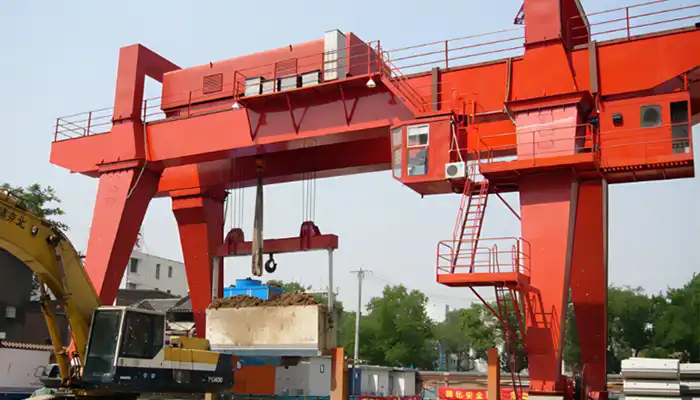
Rail-Mounted Gantry Crane (10–32 ton)
Designed for long-distance, repetitive movement along structured TBM tunnel lines.
Overview
Designed for long-distance, repetitive movement along structured TBM tunnel lines.
Supports synchronized operation with TBM advance cycles for continuous material flow.
Common in metro tunnels with pre-planned logistics layouts.
Operational Focus
Moves precast segments, muck containers, or equipment along the tunnel efficiently.
Reduces manual handling and downtime between lifts.
Ideal for projects requiring strict coordination between lifting operations and TBM cycles.
Capacity Mapping
- 10–20 ton → Segment transfer cycles between shaft, staging area, and tunnel face
- 20–32 ton → Continuous muck handling or spoil transport systems
Practical Selection Guidance
Use rail-mounted cranes when tunnels are long and lifting cycles are repetitive.
Ensures consistent underground crane workflow, reducing the risk of TBM stoppages.
Recommended for projects where coordination with multiple TBM and logistics points is critical.
Low Headroom Rubber Tyred Gantry Crane (5–20 ton)
Designed for confined or retrofit tunnel environments with strict vertical clearance.
Overview
Designed for confined or retrofit tunnel environments with strict vertical clearance.
Optimized to operate where TBM backup equipment or tunnel geometry limits overhead space.
Common in compact subway gantry crane layouts and auxiliary tunnels.
Operational Focus
Maximizes usable lifting height in tight or congested areas.
Often used for maintenance tasks, minor equipment handling, or segment installation in restricted tunnels.
Reduces interference with TBM backup systems and other tunnel utilities.
Capacity Mapping
- 5–10 ton → Maintenance lifts and auxiliary tunnels
- 10–20 ton → Compact metro tunnel sections or smaller segment handling
Practical Selection Guidance
Recommended when vertical clearance is constrained or retrofitting existing tunnels.
Select for low-to-medium frequency lifting where space optimization and TBM backup coordination are priorities.
Double Hoist Gantry Crane (20–50 ton equivalent lifting system)
Designed for tandem lifting or synchronized operations, handling oversized or heavy tunnel segments.
Overview
Designed for tandem lifting or synchronized operations, handling oversized or heavy tunnel segments.
Enhances load balance, cycle efficiency, and safety during complex underground installation tasks.
Often applied in large infrastructure tunnels, hydropower projects, or heavy mining operations.
Operational Focus
Enables simultaneous dual-hoist operations, reducing handling time for large or irregular components.
Maintains stability under high-duty cycles, crucial for continuous TBM or segment-handling workflows.
Minimizes the risk of misalignment during heavy or oversized component installation.
Capacity Mapping
- 20–32 ton → Coordinated TBM segment handling or combined segment + equipment logistics
- 32–50 ton → Heavy infrastructure lifting, oversized components, or hydropower tunnel applications
Practical Selection Guidance
Use double hoist cranes when single hoist systems cannot meet weight, balance, or cycle requirements.
Essential for projects where TBM workflow, underground logistics, and oversized component handling intersect.
Consider for high-duty, high-reliability applications to maintain continuous excavation and installation progress.
Enclosed / Protected Trolley TBM Gantry Crane (5–32 ton)
Built for harsh underground environments where dust, humidity, and corrosion are significant challenges.
Overview
Built for harsh underground environments where dust, humidity, and corrosion are significant challenges.
Equipped with enclosed or protected trolleys to safeguard electrical components and reduce downtime.
Ideal for long-term tunnel crane system operation in metro, hydropower, or mining tunnels.
Operational Focus
Ensures reliable continuous lifting under dusty or humid conditions.
Minimizes maintenance intervals and reduces unexpected equipment failures.
Supports underground crane workflow continuity, especially where repeated lifting cycles are required.
Capacity Mapping
- 5–20 ton → Maintenance, auxiliary tasks, and utility tunnels
- 20–32 ton → Continuous logistics, segment transfer, and TBM spoil handling systems
Practical Selection Guidance
Select when environmental protection and long-term reliability are critical.
Recommended for projects with high dust, water, or corrosive exposure.
Ensures consistent underground workflow without frequent service interruptions, particularly in continuous TBM-driven tunnel operations.
Common Tunnel Gantry Crane Configurations
| Configuration | Typical Capacity | Typical Use | Practical Focus | Role Consideration |
|---|---|---|---|---|
| Single girder | 5–20 ton | Compact utility tunnels | Cost-effective, simple segment handling, limited lifting demand | Engineers validate structural fit in tight tunnel geometry |
| Double girder | 10–50 ton | TBM segment installation and spoil handling | High rigidity, continuous lifting under TBM cycle conditions | EPC ensures integration with TBM logistics and tunnel workflow |
| Low headroom | 5–20 ton | Retrofit tunnels, vertical clearance-limited sections | Maximizes lifting height in restricted tunnel space | Project managers monitor production continuity under clearance constraints |
| Semi gantry | 10–32 ton | Asymmetrical shafts and constrained tunnel portals | Adaptable structure for partial runway or uneven layouts | Planners coordinate interface between shaft and tunnel logistics systems |
| Rail-mounted | 10–32 ton | Long-distance repetitive underground logistics | Stable, high-frequency transport along tunnel axis | Procurement verifies precision, duty class, and long-term reliability |
| Double hoist / enclosed trolley | 20–50 ton (system equivalent) | High-frequency, heavy or multi-load underground operations | Improved load balance, dust/humidity protection, cycle efficiency | Engineers evaluate operational reliability under harsh TBM conditions |
Early-Stage Selection Considerations: Capacity + Configuration Driven
When selecting a tunnel gantry crane, early-stage decisions are critical. Engineers, planners, and project managers must evaluate tunnel geometry, TBM integration, and segment weight together, because each factor directly affects the crane type, capacity, and operational efficiency.
Tunnel Geometry & Diameter
The physical dimensions of the tunnel determine which crane configurations can safely operate. Narrow or retrofit tunnels require compact designs, while large TBM-driven tunnels allow heavier, more robust cranes.
| Tunnel Type | Recommended Crane | Capacity | Practical Focus | Role Consideration |
|---|---|---|---|---|
| Narrow / retrofit tunnels | Low headroom / Single girder | 5–20 ton | Fits tight spaces while allowing safe segment handling | Engineers verify physical clearance and travel paths |
| Large TBM tunnels | Double girder / Rail-mounted | 10–50 ton | Supports higher lifting capacity and continuous underground workflow | EPC planners coordinate span and structure with TBM backup |
Takeaway: Tunnel diameter defines crane span, lifting height, and structural class, guiding the selection of both configuration and capacity to match project needs.
TBM Integration & Excavation Rate
Tunnel gantry cranes must match the speed and cycle of TBM operations. Faster excavation requires higher-duty cranes capable of continuous lifting, while slower TBM advance allows standard duty cranes without compromising workflow.
| TBM Advance Rate | Crane Duty & Type | Practical Focus | Role Consideration |
|---|---|---|---|
| High advance rate | Heavy-duty cranes, A6–A8 classification | Continuous lifting without blocking TBM workflow | Planners synchronize crane cycles with TBM logistics |
| Low advance rate | Standard duty cranes | Reduced cost while maintaining efficiency | Project managers monitor productivity impact |
Takeaway: Matching crane duty and configuration to TBM advance rate prevents bottlenecks and ensures smooth underground logistics.
Segment & Equipment Weight
The weight of tunnel segments or underground equipment drives capacity requirements. Standard precast segments can be handled with moderate cranes, but oversized or heavy equipment requires double hoist or double girder systems to maintain load balance and efficiency.
| Segment Type | Recommended Crane | Capacity | Practical Focus | Role Consideration |
|---|---|---|---|---|
| Standard precast segments | Single / Double girder | 10–20 ton | Efficient lifting for typical tunnel segments | Engineers ensure safe handling in confined spaces |
| Oversized / heavy components | Double hoist / Double girder | 20–50 ton | Balanced tandem lifts, supports complex installation | Project managers plan cycle efficiency and safety |
Takeaway: Segment weight directly impacts both capacity and configuration, which influences cycle efficiency, safety, and integration into the TBM-driven workflow.
Lifting Frequency & Cycle Time
In tunnel construction, lifting frequency is directly tied to TBM progress and segment installation rhythm. High-cycle operations require more robust and continuous-duty crane systems, while low-cycle operations allow simpler configurations. This factor also strongly influences hoist type and trolley traveling mechanism selection.
| Lifting Cycle Condition | Recommended Crane Type | Practical Focus | Role Consideration |
|---|---|---|---|
| High-frequency lifting | Rail-mounted / Double girder systems | Continuous operation aligned with TBM cycle | EPC planners synchronize crane cycle time with excavation rate |
| Low-frequency lifting | Single girder / Low headroom systems | Cost-efficient operation for intermittent lifting | Project managers balance cost vs productivity |
Takeaway: Lifting frequency determines crane duty level and directly impacts hoist selection, trolley mechanism design, and system continuity in TBM workflows.
Underground Environmental Conditions
Underground environments expose cranes to dust, humidity, and water ingress, which significantly affects equipment durability and maintenance requirements. Proper configuration ensures stable long-term performance in harsh tunnel conditions.
| Environmental Condition | Recommended Protection Strategy | Practical Focus | Role Consideration |
|---|---|---|---|
| Dust / high humidity | Enclosed trolley systems | Protect moving parts and electrical components | Engineers evaluate operational reliability in tunnel conditions |
| Water ingress / corrosion risk | Anti-corrosion coating + sealed electrical systems | Extend service life and reduce downtime | Maintenance planners focus on lifecycle stability |
Takeaway: Environmental conditions define the required protection level of the crane system, directly influencing long-term reliability and maintenance strategy.
Power Supply & Infrastructure Constraints
Power availability in underground construction varies depending on TBM capacity and tunnel infrastructure design. Crane systems must be matched with available power supply conditions to ensure stable operation without overloading the system.
| Power Condition | Suitable Crane Design | Practical Focus | Role Consideration |
|---|---|---|---|
| Limited power supply | Compact drive systems | Energy-efficient operation with controlled load demand | Engineers ensure electrical feasibility in tunnel layout |
| High-power TBM zones | Heavy-duty crane systems | Support continuous high-load lifting cycles | EPC planners integrate crane with TBM power distribution system |
Takeaway: Power availability directly influences motor sizing, drive selection, and control system design, affecting overall crane performance.
Maintenance & Lifecycle Planning
Maintenance accessibility is a critical factor in tunnel crane selection due to confined space conditions and long project durations. The crane system must be designed not only for operation but also for efficient inspection and servicing.
| Tunnel Condition | Recommended Design Approach | Practical Focus | Role Consideration |
|---|---|---|---|
| Confined tunnels | Modular crane structure | Easy assembly and replacement of components | Maintenance teams focus on accessibility and downtime reduction |
| Long-distance tunnels | Rail-mounted systems | Stable operation with reduced relocation needs | Project managers optimize lifecycle cost and service intervals |
Takeaway: Maintenance strategy and tunnel length determine crane modularity and system configuration, directly impacting downtime and lifecycle cost.
FAQs on Tunnel Gantry Crane Capacity and Configuration Matter
In underground construction projects, selecting a tunnel gantry crane is not just a matter of picking a tonnage or a type. In practical world projects, every decision about crane capacity, configuration, and duty cycle directly affects TBM excavation efficiency, segment installation, and logistics flow. Different project roles see these effects from different angles, and understanding this is critical for smooth tunnel operations.
Tunnel Engineers: Ensuring Physical Feasibility
Tunnel engineers are usually the first to evaluate crane proposals. Their concern is simple: will it actually work inside the tunnel? Tight spaces, TBM backup equipment, and limited vertical clearance are everyday constraints. Engineers need to visualize how the crane moves along rails, how the trolley travels, and how the hoist handles heavy precast segments in a confined tunnel.
Key question:
"Can this crane physically operate inside the tunnel without interfering with TBM systems?"
Yes, if the configuration matches tunnel geometry and low headroom or compact gantry systems are selected.
Practical focus points for engineers:
- Verifying crane operation in restricted tunnel geometry
- Determining maximum lifting height and span based on tunnel diameter
- Selecting low headroom or compact single girder systems
- Ensuring lifting sequence aligns with segment handling and TBM workflow
EPC Planners / Designers: Coordinating System Integration
EPC planners look at the crane as part of a full underground construction system. Their job is to make sure the crane integrates seamlessly with TBM advance cycles, conveyor lines, and spoil removal. A crane that doesn't align with excavation rhythm can cause production delays, wasted resources, and safety risks.
Key question:
"Does this crane fit the TBM layout and tunnel logistics without slowing down operations?"
Yes, if rail-mounted, double girder, or semi-gantry configurations are selected based on TBM workflow and tunnel layout.
Practical focus points for EPC planners:
- Matching crane configuration to TBM logistics and underground workflow
- Ensuring trolley speed and cycle time sync with segment installation
- Avoiding interference with material transport pathways
- Evaluating duty classification and repetitive lifting performance
Procurement Teams: Defining Specifications and Reducing Risk
Procurement teams turn technical requirements into actionable purchase specifications. Clarity in crane capacity, configuration, and lifting duty is essential. Without it, suppliers may over-spec or under-spec equipment, leading to costly delays or modifications.
Key question:
"Are capacity, configuration, and duty class clearly defined to avoid mismatch or confusion?"
Yes, if the RFQ and crane specification checklist include capacity ranges, duty cycle, hoist selection, and configuration type.
Practical focus points for procurement:
- Confirming crane capacity ranges (5–50 ton depending on tunnel type)
- Specifying double girder, low headroom, or rail-mounted systems
- Detailing hoist selection, trolley traveling mechanism, and duty cycle requirements
- Creating clear RFQ documents for supplier comparison
Project Managers: Maintaining Schedule and Workflow Continuity
Project managers care about one thing in industrial tunnels: keeping TBM and crane operations moving. Even a technically perfect crane can become a bottleneck if cycle times or lifting capacity don't match excavation progress. Managers focus on downtime and its impact on tunnel progress.
Key question:
"Will this crane keep up with TBM and avoid slowing down the tunnel project?"
Yes, if high-duty configurations and synchronized cycle time cranes are selected.
Practical focus points for project managers:
- Evaluating crane capacity against peak TBM output
- Choosing double hoist or rail-mounted systems for high-frequency lifting
- Monitoring lifting cycle synchronization to prevent bottlenecks
- Ensuring downtime and maintenance plans match tunnel construction schedule
Integrated Industrial Perspective
Across all roles, the goal is the same: efficient underground material handling. Every crane choice affects TBM workflow, segment installation, and spoil/equipment transport. By considering capacity, configuration, lifting frequency, and tunnel logistics together, teams can:
- Avoid bottlenecks in segment installation or spoil removal
- Match crane type to tunnel geometry and TBM requirements
- Reduce lifecycle costs through correct duty classification and configuration
- Ensure continuous, safe, and efficient underground construction
Correct capacity and configuration selection ensures smooth TBM-driven excavation, continuous segment installation, and reliable underground logistics.
Conclusion: Capacity + Configuration Defines Tunnel Performance
In practical tunnel engineering, a tunnel gantry crane is never just a piece of lifting equipment. It is part of the TBM-driven construction system, and its performance is directly tied to how well it is designed into the underground workflow from the beginning.
What really determines success in selection
When engineers talk about tunnel gantry crane selection, the real decision is always about three things working together: capacity, configuration, and how the system behaves inside the tunnel during continuous excavation.
A stable tunnel construction system depends on a few core technical alignments:
- Capacity must match TBM workload and segment weight
- Configuration must fit tunnel geometry and clearance conditions
- System layout must support continuous underground crane workflow
If any one of these is mismatched, the TBM cycle slows down, and the whole tunnel logistics chain becomes unstable.
What happens when selection is done correctly
When tunnel gantry crane capacity and configuration are properly matched during early design and specification stages, the project runs in a more controlled and predictable way.
Typical results in real underground projects include:
- Stable excavation cycles without lifting interruptions
- Smooth and continuous segment installation at the tunnel face
- Reliable spoil and material handling through the full tunnel length
- Lower maintenance pressure and reduced lifecycle operating cost
- Fewer redesigns during construction execution
Correct crane selection keeps TBM production steady and reduces operational friction across the entire tunnel system.
Why early-stage decision matters
In metro, subway, mining, hydropower, and railway tunnel projects, most crane-related problems do not come from equipment failure. They come from early mismatch—wrong capacity range, unsuitable configuration, or weak integration with TBM logistics.
That is why tunnel gantry crane capacity selection and configuration design must be defined at concept stage, not after construction starts.
Good early decisions prevent rework, delays, and productivity loss during excavation.
Final takeaway
In modern underground construction, project success is not only measured by how fast the TBM advances. It is also measured by how well the lifting system supports that movement continuously.
A properly selected tunnel gantry crane ensures:
- excavation stays continuous
- logistics stay synchronized
- installation stays efficient
- and the entire underground system stays under control
Tunnel performance depends as much on crane capacity and configuration as it does on TBM speed itself.

Article by Bella ,who has been in the hoist and crane field since 2016. Bella provides overhead crane & gantry crane consultation services for clients who need a customized overhead travelling crane solution.Contact her to get free consultation.
Yuantai Cranes
Overhead Crane Manufacturer with CE, ISO, SGS, CNEX Certificates.
- Main Specifications - Capacity: 0.5–550 tons | Span: up to 40m | Speed: 0.8–12 m/min | Duty: A3–A7 | Power: 380–690V, 50/60Hz | Control: pendant/remote/cabin
- Full engineering: FEA/PLC/VFD + in-house build + global delivery + on-site support, for workshops, factories, EPC contractors, industrial projects, etc.
- Support: design, manufacturing, testing, service – end-to-end, customized lifting solutions worldwide.
How to Get an Accurate Crane Price for Your Application?
Tips: Copy the spec list, fill in your details, and paste it into the form on the right/ down-below for a quick price.
- Crane type:_____ . (e.g., overhead crane, gantry crane, jib crane)
- Max weight to lift:_____ tons. (e.g., 2t, 5t, 10t, 20t, 50t)
- Lifting height:_____ m. (How high does the hook need to reach?
- Workshop width (span):_____ m . (Distance between the two crane rails)
- Travel distance:_____ m . (How long does the crane need to move along the runway?)
- Control type:_____. (Pendant / remote / cabin Control)
- Power supply:_____. (Local voltage & frequency – e.g., 380V, 50Hz, 3-phase)
- What will it be used for?_____ (e.g., steel fabrication, concrete products, mold handling, general manufacturing, etc.)
- Any special requirements?_____ (e.g., extreme temperature, dusty or explosive environment, special paint color, etc.)
Just leave a message via the contact form and our hoist and crane engineer will contact you with in 24working hours.
Get Your Custom Quote–Quick & Easy
Fill in what you know. Skip what you don't – we'll help.Any question will be reply with 24 working hours