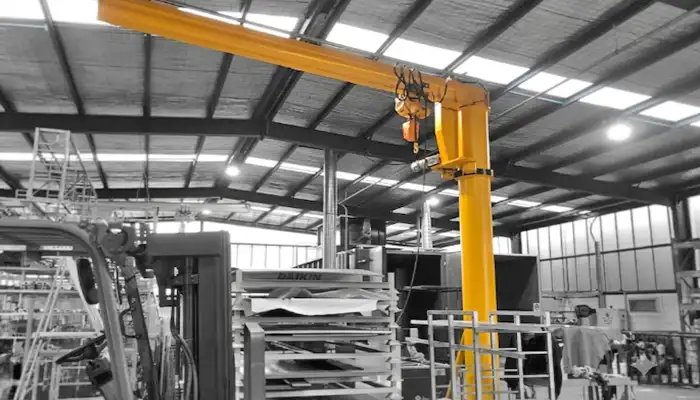
Jib Crane Cantilever Deflection and Load Drift Guide
Content Quick Link
Jib Crane Cantilever Deflection and Load Drift in 0.5–5 Ton Precision Industrial Applications
In 0.5–5 ton jib crane systems used for assembly, machining support, and precision material handling, cantilever deflection is the dominant cause of load drift and positioning inaccuracy. It does not indicate structural failure, but it directly determines whether the crane can consistently place loads at the correct position without manual correction.
- Cantilever deflection is a normal elastic response but becomes critical in precision lifting
- Load drift increases significantly at maximum outreach and during rotation movement
- Different jib crane structures show different stiffness and positioning stability behavior
- Precision applications depend more on deflection control than rated lifting capacity
- Camber design and structural reinforcement directly influence positioning accuracy
- Buyers must evaluate deflection data, not just tonnage rating, before purchasing
FAQs – Questions This Guide Solves -Cantilever Jib Crane 0.5–5 Ton
Why does my jib crane shift load position even under rated load?
Because of cantilever deflection.
When the jib crane lifts a load, the cantilever bends slightly. This small bend changes the hook position.
In simple terms:
- Lift load → beam bends a little
- Beam bends → hook moves slightly
- Hook moves → load shifts position
So even at rated load, small movement is normal.
Why is load drift worse at the far end of the jib crane cantilever?
Because bending increases with distance.
- Near column → very stable
- Middle reach → small movement
- Full outreach → most deflection and drift
Operators often say:
"Near is fine, far end moves more."
That is normal beam behavior.
How does cantilever deflection affect assembly and machining accuracy?
It affects where the load lands.
In real use:
- Parts may not align with fixtures
- CNC workpieces may need adjustment
- Extra time for positioning
- Less repeat accuracy in production
So lifting is fine, but placement becomes less precise.
Which jib crane type is most stable for precision work?
Simple comparison:
- Workstation jib crane → light duty, small deflection visible
- Rotating jib crane → flexible, but drift during rotation
- Free standing jib crane → most stable, best for precision (3–5 ton use)
For accuracy work, free standing is usually preferred.
What should I check before buying a 0.5–5 ton jib crane?
Don't only check tonnage. Check:
- Cantilever deflection at full load
- Maximum outreach performance
- Positioning accuracy requirement (mm level)
- Camber design (anti-deflection shape)
- Load stability across working range
How can I reduce load drift in daily use?
You cannot remove it fully, but you can reduce it:
- Use stronger cantilever structure
- Choose camber design jib crane
- Avoid working at full outreach for precision tasks
- Use free standing type for higher stability
- Ensure proper installation and foundation
Simple rule:
Better structure + shorter working radius = less drift.
Jib Crane Cantilever Deflection in industrial Industrial Operation
In jib crane systems ranging from 0.5 ton to 5 ton, the cantilever arm acts as a fixed-end structural beam that carries both static and dynamic loads. When a load is applied, the steel structure undergoes elastic deformation due to material properties and bending stress distribution along the cantilever length.
This deformation becomes most noticeable at the free end of the cantilever, where the hook and load are positioned. In industrial environments such as assembly lines, CNC machining support stations, and mold handling areas, even small vertical or angular displacement at the cantilever tip can result in visible positioning errors.
Unlike overload conditions, cantilever deflection occurs even under normal working load and is a design behavior rather than a failure condition.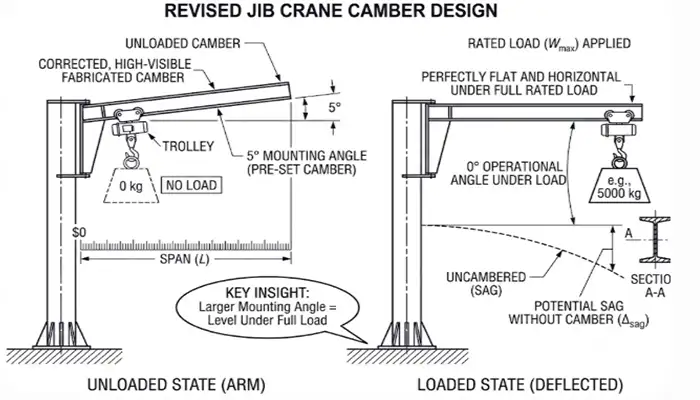
Why Load Drift Happens in Jib Crane Systems (Cantilever Jib Crane 0.5–5 Ton)
Load drift is something operators often notice in industrial workshop use of a cantilever jib crane system. The jib crane lifts the load normally, no issue there. But when you place it, the position is slightly off. A bit to one side, or a little lower than expected. People usually say, "ah, it doesn't land exactly the same spot," or "it moves a bit at the end." That's load drift.
In a cantilever jib crane (wall mounted jib crane, pillar mounted jib crane, free standing jib crane, rotating jib crane), this happens mainly because the cantilever arm bends under working load. This is called jib crane cantilever deflection under load.
Load drift is the visible result of cantilever deflection in jib crane operation
When a load is lifted, the steel cantilever beam does not stay perfectly straight. It bends slightly downward, you know, just a small drop. This small movement shifts the hook position away from the no-load position.
In other words:
- Lift a load → cantilever bends a bit
- Cantilever bends → hook position moves
- Hook position moves → load drift happens
This is normal in all 0.5 ton to 5 ton cantilever jib crane systems, especially in precision material handling jib crane applications. Nothing unusual, just how steel behaves.
Why load drift becomes more obvious in cantilever jib crane systems (jib crane load positioning accuracy issue)
In industrial workshops, load drift is not always visible when lifting close to the column. But once you go outward, it starts showing. And honestly, most operators notice it only at the far end.
This is very common in:
- Assembly line cantilever jib crane for material handling workstations
- CNC machine loading and unloading jib crane systems
- Mold and die handling cantilever jib crane setups
- Free standing jib crane for light fabrication workshops
Here is the simple reason:
- Longer jib crane outreach → higher bending moment
- Load moves away from column → more cantilever deflection
- End position → even small movement becomes visible
So operators often say, "near the column it's fine, but at the end it drops a little."
Yes, that's exactly how a cantilever jib crane behaves in industrial use.
Why load drift is worst at maximum jib crane outreach (0.5–5 ton jib crane deflection behavior)
This part is important for buyers, industrially.
At full outreach:
- Cantilever bending stress is at its highest, no doubt
- Hook position drops more compared to mid-range
- Small deflection becomes visible during placement
In practice:
- 0.5 ton jib crane → slight but noticeable movement, you can see it
- 3 ton cantilever jib crane → clear load drop at outer radius
- 5 ton jib crane system → operator often needs small correction before placement, "just a bit adjustment"
So yes, load drift is not random. It follows working radius. Simple engineering behavior.
Load drift behavior in rotating jib crane systems (slewing cantilever jib crane)
Now, when you add rotation, things become more noticeable. Let's be honest here.
In a rotating cantilever jib crane system, load is affected by both bending and movement.
During rotation:
- Cantilever is already slightly deflected under load
- Slewing motion adds inertia force
- Start and stop creates small swing effect, you can feel it
So operators may notice:
- Load "lags behind" a little during rotation
- Position shifts slightly when stopping
- Needs small correction before final placement, just a quick touch
This is very common in:
- Wall mounted rotating jib crane systems
- Free standing slewing jib cranes in assembly areas
- Workstation rotating jib crane setups
What operators actually see in daily cantilever jib crane use (industrial workshop behavior)
In industrial production, load drift is not always obvious when lifting straight up. It shows up during movement, you know, when things are not static.
Typical signs include:
- Load does not land exactly at fixture point
- Hook position slightly drops at full outreach
- Small correction needed before final placement
- Slight variation in repeated lifting cycles, especially in batch work
Nothing is broken. The crane is fine. But positioning is not perfectly repeatable.
Why load drift matters in precision cantilever jib crane applications (assembly and machining use)
In general lifting, nobody industrially cares much. But in precision work, it matters, sometimes a lot.
In applications like:
- Assembly line material positioning
- CNC machining loading and unloading
- Mold and die installation alignment
- Precision component transfer between stations
Even small movement leads to:
- Parts not aligning directly with fixtures
- Extra adjustment time per cycle
- Reduced repeat positioning accuracy
- Small errors building up in production flow over time
So the industrial point is simple:
lifting is easy, but placement is where accuracy matters.
Simple way to understand cantilever jib crane load drift (quick field explanation)
Let's make it practical, like workshop talk:
- Near column → very stable, almost no visible movement
- Mid reach → normal small deflection, acceptable
- Full outreach → most visible load drift, operators notice it
So in any cantilever jib crane system, working radius directly affects positioning accuracy. No surprise there.
Key buying note for cantilever jib crane buyers (0.5–5 ton industrial jib crane selection)
Here is the practical takeaway for buyers of 0.5–5 ton cantilever jib crane systems:
You cannot remove cantilever deflection completely. That's physics, simple as that. But you can control it, yes.
- Stronger cantilever beam → less load drift
- Better jib crane structural design → more stable positioning
- Camber design → compensates deflection under load
- Higher stiffness design → better repeat positioning accuracy
So before buying a cantilever jib crane, especially for assembly or machining work, don't just look at tonnage. Check how it behaves at full outreach. That's where industrial performance shows up in daily industrial operation.
Structural Behavior Differences Between Jib Crane Types -Cantilever Jib Crane 0.5–5 Ton
When people compare different cantilever jib crane systems, they often focus only on capacity. But in industrial workshop use, the structure matters more than tonnage. You know, the way the jib crane behaves under load is what decides positioning accuracy, not just lifting power.
In 0.5 ton to 5 ton applications, three common types are used: workstation jib crane, rotating jib crane, and free standing jib crane. Each one behaves differently when it comes to cantilever deflection and load drift.
Workstation jib crane – light structure, small space handling, but more visible micro-deflection
Workstation jib cranes are usually installed in compact production cells. They are used for repetitive lifting, assembly work, and light material handling close to the workstation.
The structure is relatively light. So, under working load, the cantilever reacts more visibly. Operators sometimes say, "it feels a bit soft at the end." That is the micro-deflection effect.
In industrial use:
- Designed for assembly line material handling jib crane workstation applications
- Good for frequent lifting, fast operation, easy movement
- More sensitive to jib crane cantilever deflection under repeated cycles
- Not ideal when you need very tight positioning over long outreach
So in simple words:
it works well for daily handling, but not for high-precision long reach positioning.
Rotating jib crane – flexible movement, but load drift increases during slewing
Rotating jib cranes are widely used because they give good working coverage. You can rotate the arm, cover more area, and reduce operator movement. Sounds good, right? Yes, but there is a trade-off.
During rotation, especially at full load, the cantilever is not only bending—it is also dealing with torsion and inertia. This combination makes load drift more noticeable.
In industrial operation:
- Common in rotating cantilever jib crane systems for workshop material handling
- Works well for flexible positioning and multi-station use
- During slewing, cantilever deflection + rotation force interact
- Sudden stop or fast rotation → small load shift becomes visible
Operators often say:
"it's fine when moving slow, but when you stop, it moves a bit."
So yes, it is flexible, but positioning stability depends on how you operate it.
Free standing jib crane – stronger structure, better stability for 3–5 ton precision lifting
Free standing jib cranes are built with an independent column and foundation system. This is the key difference. The structure does not rely on building walls, so rigidity is higher.
In industrial use:
- Used in free standing cantilever jib crane systems for industrial workshops
- Better suited for 3 ton to 5 ton precision material handling applications
- Higher structural stiffness reduces visible cantilever deflection
- More stable load positioning compared to wall mounted or workstation types
In practical terms:
when you need repeat positioning—same point, same accuracy—this type performs more consistently.
You will often hear:
"it feels steady, even at full reach."
That is because the structure absorbs bending better and reduces load drift impact.
Simple comparison in industrial workshop behavior (how they feel in operation)
To make it easy:
- Workstation jib crane → fast, light, but small movement is visible
- Rotating jib crane → flexible, but rotation can affect positioning
- Free standing jib crane → stable, better for accuracy and heavier duty use
So in 0.5–5 ton cantilever jib crane selection, structure choice directly affects load drift behavior and positioning accuracy.
Key takeaway for buyers (industrial decision point)
Here is the practical point, no theory:
If your work is:
- Simple lifting → workstation jib crane is fine
- Flexible multi-area handling → rotating jib crane works well
- Precision assembly or machining support → free standing jib crane is safer choice
Because at the end of the day:
cantilever jib crane performance is not only about lifting capacity, it is about how stable the load stays during industrial placement work.
How Cantilever Deflection Impacts Production Accuracy-Cantilever Jib Crane 0.5–5 Ton
In industrial factory work, jib crane cantilever deflection is not something operators always notice at first. The crane still lifts fine, no problem there. But when it comes to placing the load, small movement at the cantilever tip starts to matter. You know, just a few millimeters off, but it adds up in production.
In 0.5 ton to 5 ton cantilever jib crane systems, this becomes important in assembly, machining support, and mold handling work where positioning accuracy is part of daily operation, not just lifting.
Assembly line material handling – small hook movement, industrial positioning errors
In assembly line environments, the cantilever jib crane for assembly workstation material handling is often used for repeated placement of parts into fixtures or assembly stations.
Here, even a small cantilever deflection under load can affect alignment.
In industrial operation:
- Hook position shifts slightly during final placement
- Parts may not drop exactly into fixture points
- Operator needs small correction before tightening or assembly
- Cycle time increases because of repeated adjustment
People often say:
"it's just a little off, but I still need to adjust it."
That "little off" is exactly load drift caused by cantilever deflection.
CNC machining support – load drift affects fixture alignment and repeatability
In CNC machining loading and unloading jib crane applications, accuracy matters more than people think. Workpieces need to land in the same position every time. No guessing.
When cantilever deflection happens:
- Workpiece placement position changes slightly
- Fixture alignment becomes inconsistent
- Small errors affect machining precision
- Repeatability across batches becomes unstable
In simple terms:
even a small deviation at the jib crane hook turns into a machining alignment issue later.
This is why many CNC workshops prefer higher stiffness free standing cantilever jib crane systems for loading support.
Mold and die handling – off-center placement becomes a setup issue
In mold and die handling jib crane systems, loads are heavier and positioning is more sensitive. Even slight cantilever deflection can shift the mold position during installation.
What usually happens:
- Mold lands slightly off center
- Operators need crowbar or manual adjustment
- Alignment pins do not fit smoothly
- Setup time increases, sometimes quite a bit
And honestly, operators often say:
"it's close, but not perfect alignment yet."
That "not perfect" is where cantilever deflection shows up in industrial use.
Why small deflection becomes a production problem over time
The key point is not one single lift. It is repetition.
In daily cantilever jib crane operations, small deviations repeat again and again:
- Assembly point shift
- Fixture mismatch
- Re-adjustment before final tightening
- Slight inconsistency across production batches
So the industrial impact is not structural damage. It is workflow efficiency.
Industrial takeaway for production planners and buyers
To be clear and practical:
- Cantilever deflection does not break the jib crane
- But it affects positioning accuracy in daily work
- And small errors accumulate in production flow
In 0.5–5 ton jib crane selection for assembly or machining environments, this is why buyers should not only look at lifting capacity. They should also consider load positioning accuracy, cantilever stiffness, and load drift behavior at full outreach.
Because in industrial production, lifting is easy. Placement accuracy is what controls efficiency.
Key Technical Factors That Control Load Drift Behavior (Cantilever Jib Crane 0.5–5 Ton)
In industrial cantilever jib crane systems, load drift is not random. It follows clear working conditions. Operators may say "it moves a bit sometimes", but there is always a reason behind it. In 0.5 ton to 5 ton jib crane applications, a few key technical factors control how much deflection you will actually see in daily operation.
Cantilever length and outreach – the main driver of jib crane deflection
Cantilever length is one of the most important factors in jib crane cantilever deflection behavior. The longer the arm, the more obvious the movement at the tip.
In simple workshop terms:
- Short outreach → stable lifting, small deflection
- Medium outreach → normal and expected movement
- Long outreach → visible load drift at the hook
As the working radius increases in a cantilever jib crane system, the bending force does not increase slowly. It increases fast, especially near full extension.
In industrial use:
- Load near column → very stable positioning
- Load at mid span → slight movement, still acceptable
- Load at full reach → most visible drift and correction needed
So yes, outreach length directly decides positioning accuracy in 0.5–5 ton industrial jib crane systems.
Dynamic operation – why load drift appears during movement, not just lifting
Many users notice something interesting. The crane is stable when lifting still, but once it moves, the load shifts a bit. This is very common.
During jib crane operation (trolley travel or rotating jib crane slewing):
- The cantilever is already under bending load
- Movement introduces additional transient force
- Start and stop creates small inertia effect
This is why load drift is more obvious in industrial operation than in static load testing.
In workshop situations:
- During slow lifting → movement is minimal
- During trolley travel → small swing appears
- During rotation → load shift becomes more visible
Operators often say:
"it's fine when standing still, but when moving, it shifts a little."
That is dynamic deflection in industrial conditions.
Long-term usage – small structural settling over time
Over long-term operation, a cantilever jib crane system does not stay exactly the same forever. With repeated lifting cycles, small changes can occur in the structure.
This is usually called:
- structural settling
- minor cantilever sagging
- long-term elastic deformation
In practical terms:
- Frequent lifting cycles → gradual micro deformation
- High duty cycle workshop → more noticeable over time
- Heavy use at full outreach → faster visible change
It does not mean the crane is unsafe. Not at all. But it can affect positioning consistency in precision material handling jib crane applications if not properly designed.
Why these factors matter in industrial production environments
When you combine all these factors together, you understand why load drift happens:
- Long cantilever → higher bending moment
- Dynamic movement → temporary deflection increase
- Long-term use → slight structural change
In industrial factory work:
- Assembly accuracy becomes less consistent
- CNC loading needs small corrections
- Repetitive positioning may vary slightly
- Operators spend extra time adjusting load position
So the industrial issue is not lifting performance. It is repeat positioning accuracy in cantilever jib crane operation.
Practical takeaway for jib crane buyers
For buyers selecting a 0.5–5 ton cantilever jib crane, here is the simple field-level takeaway:
- Do not only check lifting capacity
- Always consider cantilever length and working radius
- Ask about deflection at full outreach
- Check how the crane behaves during movement, not just static load
Because in industrial use:
lifting is easy, but stable and repeatable positioning is what decides productivity.
How to Evaluate a Low-Deflection Jib Crane Before Purchase (Cantilever Jib Crane 0.5–5 Ton)
When you choose a cantilever jib crane system, especially in the 0.5 ton to 5 ton range, the industrial decision is not only about lifting capacity. In practical workshop use, what matters more is positioning accuracy and load drift control.
Many buyers focus on tonnage first. But in assembly, machining support, or precision material handling, that is only part of the story. The industrial question is simple: can the jib crane place the load exactly where it should be, every time?
Positioning accuracy requirement – define what "good enough" industrially means
Before selecting a low-deflection cantilever jib crane, the first step is to clearly define your positioning accuracy requirement.
In industrial applications:
- Precision assembly work → usually needs ±2 mm tolerance
- General manufacturing handling → around ±5–10 mm is acceptable
- Heavy fabrication work → slightly larger tolerance may be fine
You will often hear operators say:
"lifting is fine, but I need it to land in the same spot."
That "same spot" requirement is what defines whether you need a precision cantilever jib crane system or a standard one.
Ask for industrial cantilever deflection data – not just lifting capacity
This is where many buyers miss important details.
A proper jib crane manufacturer should provide:
- Cantilever tip deflection at full rated load
- Deflection value at maximum outreach position
- Measured data, not only design assumptions
Because in industrial operation:
- Full load + full outreach = worst-case deflection condition
- This is where load drift is most visible in workshop use
- This directly affects jib crane positioning accuracy in assembly and machining workstations
If a supplier only talks about "tons capacity", but not deflection data, then you are missing key performance information.
Camber design – small detail, big impact on load drift
Camber design is one of the most practical engineering methods used in cantilever jib crane systems.
In simple terms:
- The cantilever is built with a slight upward curve
- When load is applied, it bends down into a near-level position
So instead of fighting deflection, the design balances it.
In industrial workshop use:
- Helps reduce visible hook drop at full outreach
- Improves repeat positioning accuracy
- Reduces operator correction during placement
People often say:
"it looks slightly curved when empty, but straight when loaded."
That is exactly how camber compensation works in jib crane design.
Load-to-outreach performance curve – where accuracy industrially changes
Another important evaluation point is the load vs outreach behavior of the cantilever jib crane.
This is often ignored, but very important.
Why? Because:
- Near the column → very stable, minimal deflection
- Mid outreach → normal working condition
- Full outreach → highest deflection and load drift
A proper technical evaluation should show:
- How deflection changes across working radius
- Where positioning accuracy starts to drop
- What happens at maximum outreach under rated load
In industrial use, most positioning problems happen at the far end of the jib arm, not near the column.
So if your application involves long reach lifting, this curve becomes very important.
Practical buying takeaway – what you should actually check
To make it simple, here is what experienced buyers usually check before purchasing a 0.5–5 ton cantilever jib crane:
- Required positioning tolerance in industrial work (mm level accuracy)
- Cantilever deflection data at full load and full outreach
- Whether camber design is used or not
- Load behavior across full working radius, not only rated capacity
You will often hear this in workshops:
"it lifts fine, but I need it to place better."
That is exactly why deflection evaluation matters.
Final note for buyers
In industrial applications, especially assembly and machining support, the key performance of a cantilever jib crane system is not how much it lifts, but how consistently it places the load.
If positioning is stable:
- Less adjustment time
- Higher assembly efficiency
- Better repeat accuracy in production
So before purchase, always check deflection behavior. Not just tonnage on paper.
Conclusion
Cantilever deflection is a fundamental structural behavior in all jib crane systems, but in 0.5–5 ton precision applications it becomes a key performance factor that determines load drift and positioning accuracy. While it does not compromise lifting safety, it directly influences operational precision in assembly, machining, and industrial handling processes.
For crane buyers, the critical decision is not selecting based on capacity alone, but evaluating cantilever stiffness, deflection data, camber compensation design, and verified positioning accuracy at full outreach. These parameters determine whether the jib crane will deliver stable, repeatable, and precise material handling performance in industrial production conditions.

Article by Bella ,who has been in the hoist and crane field since 2016. Bella provides overhead crane & gantry crane consultation services for clients who need a customized overhead travelling crane solution.Contact her to get free consultation.
Yuantai Cranes
Yuantai Cranes - Global Material Handling Crane Solution Provider & Manufacturer with CE, ISO, SGS, CNEX and other Third Party Certifications.
- Main Specifications - Capacity: 0.5–550 tons | Span: up to 40m | Speed: 0.8–12 m/min | Duty: A3–A7 | Power: 380–690V, 50/60Hz | Control: pendant/remote/cabin
- Full engineering: FEA/PLC/VFD + in-house build + global delivery + on-site support, for workshops, factories, EPC contractors, industrial projects, etc.
- Support: design, manufacturing, testing, service – end-to-end, customized lifting solutions worldwide.
Get Your Custom Quote – Quick & Easy
Fill in what you know. Skip what you don't – we'll help.
- Crane type:_____ . (e.g., overhead crane, gantry crane, jib crane)
- Max weight to lift:_____ tons. (e.g., 2t, 5t, 10t, 20t, 50t)
- Lifting height:_____ m. (How high does the hook need to reach?
- Workshop width (span):_____ m . (Distance between the two crane rails)
- Travel distance:_____ m . (How long does the crane need to move along the runway?)
- Control type:_____. (Pendant / remote / cabin Control)
- Power supply:_____. (Local voltage & frequency – e.g., 380V, 50Hz, 3-phase)
- What will it be used for?_____ (e.g., steel fabrication, concrete products, mold handling, general manufacturing, etc.)
- Any special requirements?_____ (e.g., extreme temperature, dusty or explosive environment, special paint color, etc.)
Just leave a message via the contact form and our hoist and crane engineer will contact you with in 24working hours.
Inquire Yuantai Cranes